Ibanez
RG550
Nobody’s name on it. Just a thin neck, 24 frets, and a locking trem, and it keeps coming back.
Anaheim, Winter NAMM, 1987. Ibanez rolls out a new line of guitars with sharp horns, 24 frets, and necks so thin they feel like cheating. One of them, the Roadstar Deluxe RG550, has nobody’s name on it. It’s about to be the one in all the ads.
- Introduced
- 1987
- Type
- Solidbody electric
- Class
- Production
Have a photograph of this guitar? Send a picture
The short version
1987
Winter NAMM
The new lineup debuts in Anaheim, with the RG550 in it.
1992
Just “RG”
The Roadstar name falls away, and the Edge trem gives way to the Lo-Pro Edge.
1994
End of the original
New pickups and a new neck joint in its last year. Then the first run is over.
2003
A new number
The idea carries on in Ibanez’s top Japanese line under a different model number.
2007
Twentieth anniversary
A Japanese anniversary run brings the name back.
2013
Genesis, at home
A limited reissue for the Japanese market.
2017
Genesis, everywhere
The Japanese-built reissue goes worldwide, with the original-style Edge back on it.
Side A
A1
The one in the ads
Some guitars get famous because a famous person plays them. The RG550 did it the hard way.
It showed up in 1987, when Ibanez launched a whole new lineup at Winter NAMM in Anaheim. Its proper name on the tag was the Roadstar Deluxe RG550, a mouthful that got shortened to RG around 1992. It had no signature on the headstock and no story about a star designing it on a napkin. Looking back, it was the most successful model to come out of that whole new era. Steve Vai’s JEM was the personality in the family. The RG550 was the one in the ads.
A guitar without a name on it has to win on how it plays. So here’s how it plays.
A2
A neck like a ruler
Start with the neck, because that’s what everybody remembers. Ibanez called it the Wizard. It was about 17 millimeters deep at the first fret and 19 at the twelfth, and the fingerboard was nearly flat. If you’d grown up on a chunky vintage neck, picking one up was a shock. Your hand could go anywhere, fast, and bends up high didn’t choke out.
There were 24 jumbo frets, a full two octaves. There was the Edge, a double-locking whammy that locked at the nut and the bridge, so you could dive-bomb and come back in tune. The body was basswood, light and even-sounding. The pickups went humbucker, single coil, humbucker, with a five-way switch that got you from fat to glassy and back.
It came in colors that looked like 1987: Road Flare Red, Purple Neon, Desert Sun Yellow, with a headstock painted to match on most of them.
It had one flaw worth knowing. The locking nut on the originals was bolted right through the neck, and old ones are known for cracks. If you’re looking at one, check the neck carefully.
A3
Sisters, not hand-me-downs
People sometimes describe the RG550 as the JEM with the fancy parts taken off. I don’t buy it.
They were born the same year. They share a lot: the switching, the 24 frets, the rounded heel where the neck meets the body so your hand can get to the top, and the Edge in its rout. Ibanez’s own word for the RG is the JEM’s sister. But the JEM was built to be one man’s guitar, with his handle through the body and his favorite pickups. The RG550 had a different job. It had to sell on the neck, the frets, and the trem alone, with no famous name to lean on.
The lineup that had the RG550 in it debuted at Winter NAMM. The JEM launched that summer. Neither one is a leftover of the other.
Flip the record · By the numbers
17 mm
Neck depth at the first fret on the Wizard neck, 19 at the twelfth. Thin, and nearly flat across.
24
Jumbo frets, a full two octaves.
1987–94
The original Japanese run.
2017
The year the reissue went worldwide. It’s still in the catalog.
Side B
B1
Paul Gilbert’s blueprint
Paul Gilbert was one of the first major shredders to play an RG550. When Ibanez built him his own signature guitars, the PGMs, several of them were based on it. So the plain one ended up as the starting point for somebody else’s name.
Nili Brosh, Larry Mitchell, Blues Saraceno, and Dave Urich have all been named among its players. Not bad for a guitar with nobody’s name on it.
One warning, since it comes up. Paul Gilbert’s best-known hit with Mr. Big, “To Be With You,” is not an RG550 track.
B2
They put the old bridge back
The original ran from 1987 to 1994, and it changed as it went. In 1992 the Edge gave way to a lower-profile version. In its final year it got new pickups and a new, smoother neck joint. Then the first run ended. Later RG550s came and went, and around 2003 the number moved on to a different model in the top Japanese line.
That should have been the end. It wasn’t. In 2007 there was a twentieth-anniversary run in Japan. In 2013 there was a limited Japanese reissue. And in 2017 Ibanez brought it back worldwide, still built in Japan, and still in the catalog today.
Look at what they did with that reissue. They gave it a five-piece maple-and-walnut neck, and otherwise they went backward on purpose: the original-style Edge instead of the later low-profile one, the old neck joint instead of the smoother one from 1994. The guitar that came back is the one from 1987, more or less.
It still has nobody’s name on it. It never needed one to be missed.
The cast
The people, and the specific guitars, that made the legend.
Paul Gilbert
RG550, then signatures built from it
One of the first big-name shredders on an RG550. Several of his PGM signature models were based on it.
Nili Brosh
RG550
Named in a magazine roll call of RG550 players.
Blues Saraceno
RG550
Also on the list of players who picked the plain one.
Larry Mitchell
RG550
One more name from the RG550 roll call.
Liner notes
Specs, construction, rarity, value, and every source we used.
Mass sibling of the 1987 JEM — Wizard, Edge, HSH, no monkey grip or lion’s claw — two Japanese objects sharing a name (1987–94 FujiGen original and 2017+ Genesis), not Prestige, not RG570, not a numbered JEM.
- Body
- Solid basswood
- Neck
- Bolt-on Super Wizard, 5-piece maple/walnut
- Fingerboard
- Maple, black dots, 24 jumbo
- Scale
- 25.5" (648 mm)
- Pickups
- HSH: V7 neck (ceramic), S1 middle (alnico), V8 bridge (alnico)
- Hardware
- Edge double-locking trem, 10.8 mm spacing, black; Gotoh machines
- Electronics
- Volume, tone, 5-way
- Finish
- Road Flare Red, Purple Neon, Desert Sun Yellow, Black, Electric Blue; flats BKF / GRF / WHF
- Nut
- Locking, 43 mm
Open the full research fileConstruction details, the complete player record, production numbers, dated value estimates, and sources
Current production typical = Japanese Genesis Collection RG550 (ibanez.com NA, 25 August 2026). Joint not named on that table; Wiki and dealer copy: tilt, not AANJ. Retailer “AANJ” tags are errors. Original 1987–94 is a different guitar.
Construction
Ibanez RG550 is the 1987 mass sibling of the JEM777: new RG body, 24 jumbo, Wizard, Edge, HSH — without monkey grip, lion’s claw, pyramid / Tree of Life inlay, or DiMarzios. Superstrat is a genre label, not an Ibanez SKU. Period name is Roadstar Deluxe RG550 (Roadstar Guitar). “Super Edition” as an official 1987 catalog trim was not sourced. Wikipedia lead: series name shortens to RG around 1992. JEM was the personality; this was the one in the ads.
Gill (Guitar World, 9 Nov 2025): the lineup debuted at 1987 Winter NAMM, Anaheim; the 550 was “the most successful model to come from this new era.” MusicRadar: “mass-appeal version of Steve Vai’s famous JEM777.” Ibanez’s Vai page calls the RG the JEM’s sister; the Strat-sales ranking is promotional for the line, not a counted 550 total.
Not this SKU. JEM has the hole and the claw. RG570 is the 500-class idea without a pickguard — typically rosewood, rear-routed. guitar-list.com dates it 1989–2002; mijguitarguide lists 1987. First year contested; do not assert 1987 RG570 without a catalog page. Genesis is not Prestige. Do not flatten RG750/770, RG1550 Prestige, RG2550, or LA Custom Shop RG550FM “Ruby” (neck-through homage) into this card. RG550DX (2019+) is Genesis-family. RG550L is lefty.
Original, 1987–1994 (Japan). FujiGen on the wiki; not printed on the current NA table. Official body basswood both eras. Isolated stripped ash examples exist (Wiki); no official mahogany year. Wizard 1-piece maple 1987–91 (skunk stripe), 1-piece quartersawn maple 1992–94. Tilt / square-heel 1987–93; AANJ 1994. Edge 1987–91; Lo-Pro Edge 1992–94. Top-Lok III bolted through the neck — crack-prone at the pocket. Board 1987–89 maple or rosewood (outside Japan, black typically rosewood); 1990–94 maple. Pearloid dots, 3-ply guard. V1/S1/V2 through 1993; V7/S1/V8 from 1994 on this SKU (V7/V8 exist from 1992 elsewhere; wiki puts the 550 swap at 1994). Volume pot moved slightly off the bridge pickup in 1990. Most headstocks color-matched; some 1989–90 (including some DY) went black; color-match returned after 1990. Original Wizard widely cited 17/19 mm, 430 mm radius, 43 mm nut — same as the current Super Wizard table. Later Prestige-era charts listed 18/20; do not retrofit those onto 1987 without a catalog scan.
1995–96 RG550-R and 1997–2002 RG550 are later catalog, not the 1987 object. Around 2003 numbering moves to RG1550 Prestige (JEMsite) — different card.
2007 RG550MXX / RXX: 20th-anniversary FujiGen. Forum: V1/V2, 5-piece neck, KTS rods, colored cases. 2013 Japan Genesis: limited domestic reissue; forum V1/V2. Do not copy current V7/V8 onto those runs.
Genesis, worldwide 2017–present. Still Japan; FujiGen on the wiki. Live 2026 NA and JP factory pages. Wiki “2017–2025” is stale; do not write discontinued. Reissue, not a 1987 clone: 5-piece maple/walnut Super Wizard, V7/S1/V8, original-style Edge (not Lo-Pro), tilt kept (not AANJ), volute, top-mounted nut, no fingerboard extension into the pocket. Factory tuners: “Gotoh machine heads.” Dealers sometimes say MG-T locking; wiki: SG381. Don’t freeze locking vs non-locking. Case recommended, not included.
Players
Do not recruit JEM, Universe, or later RG users. Satriani is JS. Vai is JEM.
Paul Gilbert — Gill: one of the first major shredders to play an RG550; several PGM signatures “were based on the RG550.” Platform claim, not a serial plus a Racer X or Mr. Big take. Ibanez’s Gilbert page is PGM/Fireman. Do not file “To Be With You” as an RG550 track. PGM painted f-holes, and “Dino” widely an RG750, are relatives.
Gill also names Nili Brosh, Larry Mitchell, Blues Saraceno, Dave Urich. Magazine list; not named-studio documents here.
Rarity
Not scarce as a model. Mass sibling. Original 1987–94 is finite but was mass production. No numbered JEM-style cap. Factory yearly totals unpublished.
Condition filters: neck-pocket cracks at the through-bolted nut, tired Edges, refinishes. First-year 1987 matching-headstock is the top of original-run tape. 2007 MXX/RXX and 2013 Japan Genesis are limited (totals unpublished). Current worldwide Genesis is regular FujiGen production.
Value
Informal estimate, 25 August 2026. Not an appraisal.
Sold comps are thin. Reverb 1987–94 sold guide bot-walled; no histogram. Ask ≠ sold.
New street. Genesis street is in flux: Sweetwater $999.99; Music & Arts $1,199.99; wiki 2025 SMAP $1,049.99; Equipboard June 2026 new $859–$1,200. Do not pick one as “the” 2026 street. Working: ~$1,000 ± $200 after a 2025–26 tariff bump from a long $999 hold (jemsite: tariffs, not limited-run).
Used modern. Equipboard used available $749; jemsite / The Gear Page ~$700–$750. Forum plus merchant available, not Reverb solds. 1997-era later RG550: no clean 2024–26 sold sample.
Vintage / collectible. Original 1987–94 asks: Gumtree 1987 £1,200; Roadhouse 1992 PN $1,499; Reverb live asks ~$970–$1,300. Angel City 1987 RF sold out without a public price (listing pickups replaced — not stock). Working: clean original typically asks in the same neighborhood as or modestly above Genesis new (~$1,000–$1,500). First-year 1987 matching-headstock is the top of that tape. No named 2024–26 hammer. 2007 MXX/RXX: no 2024–26 labeled ask or sold. Do not invent a premium.
No Burst / Broadcaster tier. Mint 1987 matching-headstock still trades as a used superstrat, not LNG money.
See also
- ibanez-jem — the 1987 signature sibling with the grip and the claw
- fender-stratocaster — the superstrat’s parent layout
- gibson-sg — the other double-cut players treat as a lead guitar
- jackson-soloist — Jackson neck-through Soloist; not the 1987 RG550 and not a Rhoads V
Keep digging
Guitars this one gets compared to, confused with, or descended from.
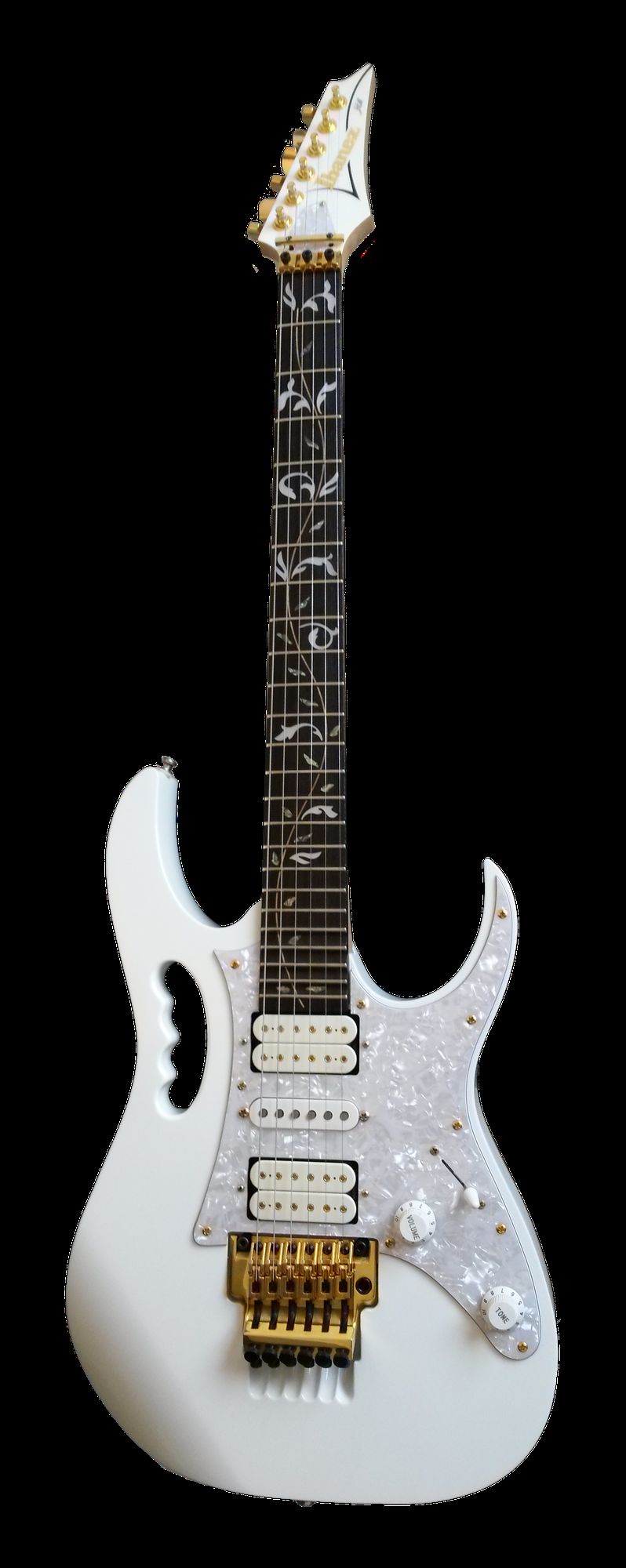
Ibanez Jem 7VWH vertical. Photo by Rachmaninoff; upright derivative by GreyCat. Licensed under CC BY-SA 4.0. Via Wikimedia Commons. Ibanez
JEM
1987
Steve Vai wanted a handle through the body and a finish that matched his curtains. Ibanez put it in the catalog.

Photo: Lightburst / Wikimedia Commons / CC BY-SA 4.0 Fender
Stratocaster
1954
The guitar most people mean when they say “electric guitar.” Designed by a man who didn’t play one.
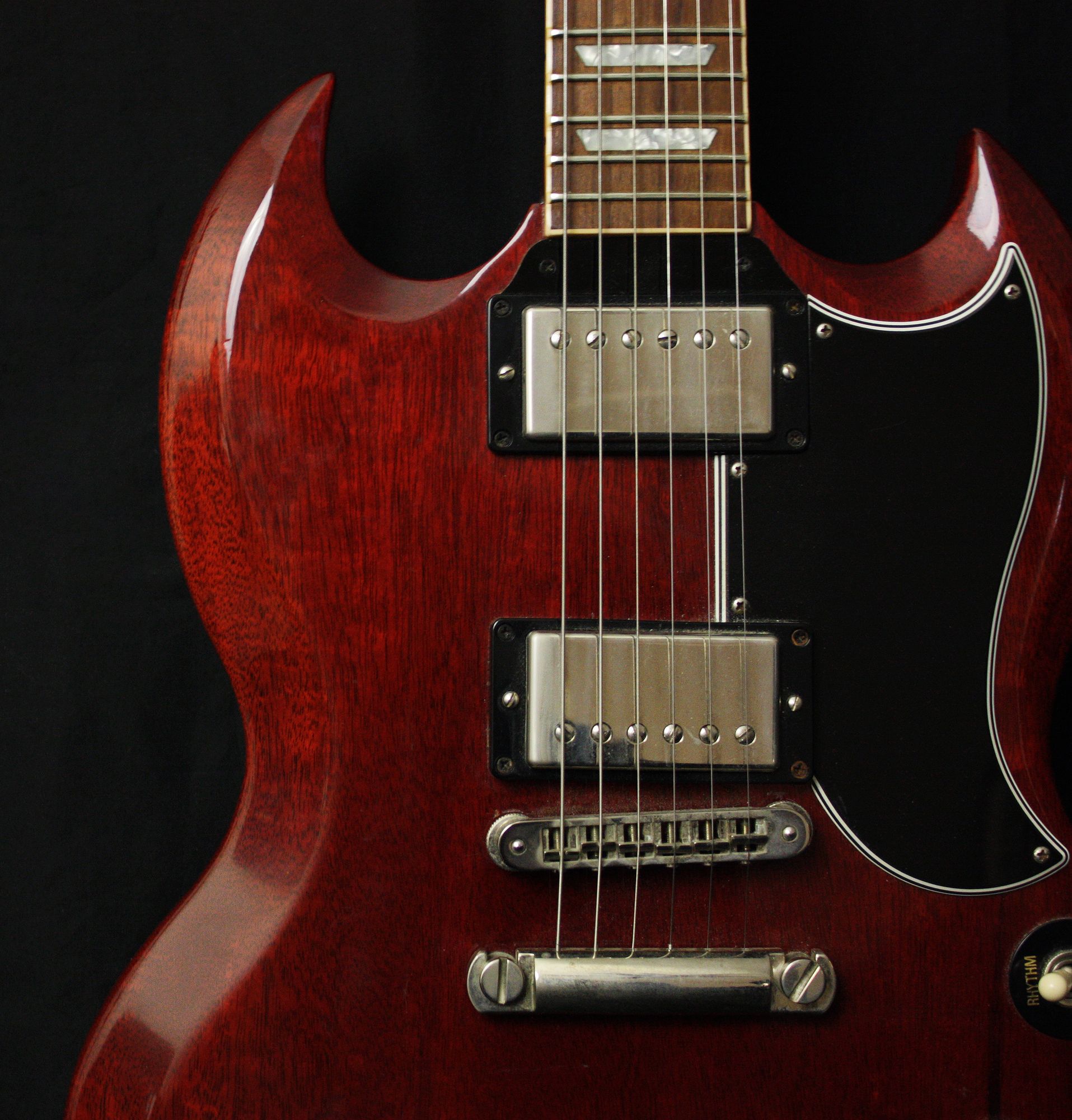
Gibson SG Standard ’61 Reissue, photographed 18 March 2010. Photo by John Tuggle. Licensed under CC BY 2.0. Via Wikimedia Commons. Gibson
SG
1961
Gibson has never stopped making SGs. Angus Young has lost count of his. He still only means one.