Gretsch
White Falcon
Gretsch built it to stop people in the aisle of a trade show. It never stopped doing that.
July 1954, the NAMM show. Jimmie Webster of Gretsch has brought a guitar nobody ordered: a big hollow archtop painted white, with gold hardware and gold sparkle running around its edges. He calls it the Guitar of the Future. It was a showpiece. A year later, it was in the catalog.
- Introduced
- 1955
- Type
- Hollowbody electric
- Class
- Production
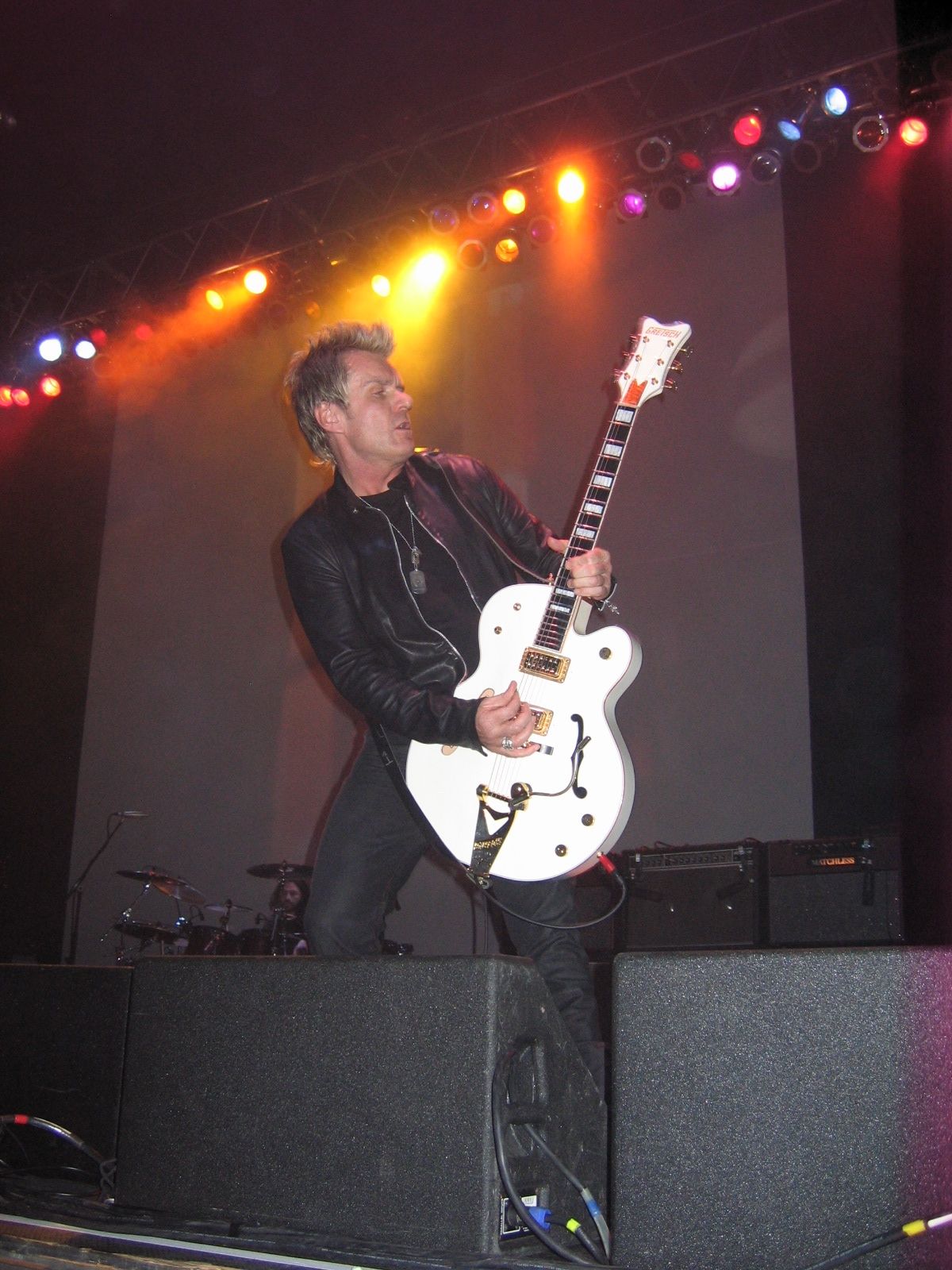
The short version
1954
The Guitar of the Future
Jimmie Webster unveils a white-and-gold showpiece at the July NAMM show.
1955
Into the catalog
Production begins as the White Falcon, at around $600.
1958
Filter’Trons and stereo
Gretsch’s humbuckers are standard by now, and a stereo version is on offer.
1960
Slimmer
The body drops from nearly three inches deep to two.
1962
Two horns
The Falcon goes double-cutaway.
1980
The original run ends
The Falcon is discontinued. Japan brings it back later.
1981
Billy Duffy finds one
The only one he can track down is a stereo double-cut. The single-cut comes next.
Side A
A1
Built for the aisle, not the stage
Most guitars are designed to be played, and then somebody makes them look nice. The White Falcon went the other way around. It was built to be looked at first, and it has been daring people to play it ever since.
Gretsch was a Brooklyn company, started by a German immigrant named Friedrich Gretsch in 1883. For a long time it was better known for drums and banjos than for guitars. By the 1950s its guitar man was Jimmie Webster, a player, a demonstrator, and an inventor, the kind of man who designed a guitar and then went out and showed it off himself.
In July 1954 he gave people a reason to look. At the NAMM trade show he unveiled what he called the Guitar of the Future: a big hollow archtop, white all over, with gold hardware and gold sparkle in the binding. It was a concept, the kind of thing a company builds to get people talking.
People talked. By 1955 it was in the catalog as the White Falcon. That same catalog had the orange Chet Atkins hollowbody in it, and the two are separate models with separate stories. Don’t let anybody tell you a Falcon is a fancy 6120.
A2
Seventeen inches of white and gold
The first Falcons were 17 inches wide and nearly three inches deep. Gretsch dressed every inch. Pearl block inlays with birds engraved in them. The Gretsch name running vertically down the headstock. A gold Cadillac “G” tailpiece. Two DeArmond single-coil pickups, which to my ear sound like a jazz box with its collar loosened.
It listed at about $600. By 1958 it was $675.
Nobody buys a White Falcon to blend in.
Nobody knows how many were made in those first years. Gretsch never published yearly totals, and serial numbers were shared across models, so they don’t help. One researcher puts it at fewer than 100 in the first two years. Whatever the real number, the early ones are scarce, and you won’t see many.
A3
A new outfit every couple of years
Webster’s showpiece never sat still. In 1957 the block inlays gave way to “humptop” blocks. The DeArmonds lasted through 1957, and by 1958 the Falcon wore Filter’Trons, Gretsch’s own humbuckers. I hear them as fatter and rounder, with the hum gone. Some guitars from the overlap could go either way, so don’t assume a ’57 has one or the other.
Around the same time, Gretsch offered a stereo Falcon, which split the guitar’s output to two amps. Whether that started in 1957 or 1958 depends on which guide you open.
Then the body kept changing. In 1959 the logo turned horizontal. In 1960 the body got thinner, down to two inches, as the whole industry chased thinline guitars. In 1962 the Falcon grew a second cutaway. The Bigsby vibrato became standard in 1962 or 1964, depending who you ask.
In the 1970s, during the Baldwin years, the single-cut came back under a new model number. The original run ended in 1980. Today’s professional Falcons are built in Japan, and there are several of them, including copies of particular years. Ask which one before you fall in love.
Flip the record · By the numbers
17
Inches across the body. A lot of guitar to get your arm around.
$600
Mid-1950s list price, give or take a dollar. By 1958 it was $675.
<100
Falcons built in the first two years, by one researcher’s estimate. Gretsch never published totals.
Side B
B1
The people brave enough
You don’t play a White Falcon quietly, and the people who have owned them know it.
Stephen Stills had a 1958. Gretsch later made a signature model that copies his original “right down to its aged finish,” which tells you how much the look of the thing matters, even the wear. Neil Young has owned a vintage stereo single-cut, usually dated 1961, for decades. It isn’t his main electric. It’s the one he keeps around. Brian Jones and Joe Strummer were both seen onstage with one.
A few names get pinned on the Falcon that belong elsewhere. Eddie Cochran, Duane Eddy, and Brian Setzer’s Stray Cats guitar are 6120s. Malcolm Young’s Gretsch is a Jet Firebird. George Harrison’s Gretsches were a Country Gentleman, a Tennessean, and a Duo Jet. There’s no Falcon in John Lennon’s story either.
B2
The one people have seen
In 1981, Billy Duffy, who would later make his name in the Cult, went looking for a White Falcon. The only one he could find was a stereo double-cut. He took it. Later he got the single-cut mono, and in his own telling, “that’s the one people have seen a lot.”
Webster built it in 1954 to stop people in an aisle, and twenty-seven years later a young guitarist went out and hunted one down. Seen a lot. It’s a big white target of a guitar, gold everywhere, and when you strap one on, you are agreeing to be looked at.
Plenty of players never take that dare. The ones who do end up in the photographs.
The cast
The people, and the specific guitars, that made the legend.
1954
Jimmie Webster
Designer
Designed it and debuted it. A demonstrator and inventor, not a hit-record player on it.
1958
Stephen Stills
1958 White Falcon
Gretsch’s signature model copies his original “right down to its aged finish.”
Neil Young
Vintage stereo single-cut
Usually dated 1961. He’s owned it for decades and still has it, but it isn’t his main electric.
1981
Billy Duffy
Stereo double-cut, then a mono single-cut
The single-cut is the one that became his picture.
Brian Jones & Joe Strummer
White Falcons, onstage
Both were seen playing one. Known to play, not tied to particular songs.
Liner notes
Specs, construction, rarity, value, and every source we used.
Seventeen inches of white and gold: the hollow archtop Gretsch built as a NAMM concept, not a 6120, not a Country Gentleman, and not a Falcon Jr.
- Body
- Laminated maple hollow single-cut, 17"-class, 2.5" deep, ML bracing; gold-sparkle binding
- Neck
- Set maple “U”
- Fingerboard
- 12" ebony, 22 medium-jumbo, neo-classic thumbnails, Luminlay side dots
- Scale
- 25.5"
- Pickups
- FT-67 Filter’Trons
- Hardware
- Adjusto-Matic on pinned ebony; string-thru Bigsby B6GP; Grover Imperial locking; gold
- Electronics
- Two volumes, master volume with treble bleed, no-load master tone
- Finish
- Gloss
- Nut
- TUSQ XL, 1.6875"
Open the full research fileConstruction details, the complete player record, production numbers, dated value estimates, and sources
Current typical player spec: G6136TG Players Edition Falcon. Parallel current SKUs — G6136T-59 Vintage Select ’59 and G6136-55 Vintage Select ’55 — are year-clones. They are not this table. Factory PE table omits width; 17" is vintage identity + 17" case + sibling PE copy + VS dealer sheets.
Construction
Gretsch White Falcon, vintage 6136: 17"-class hollow archtop, white finish, gold hardware, gold-sparkle binding, 25.5" scale. Not a 6120.
Keep the neighbors straight. 6120 is 16"-class hollow, orange/Western, 24.6"-class scale. 6122 Country Gentleman is 17" but ~2" thin, often painted f-holes, Chet trim, mahogany brown. Country Club is another 17" hollow. White Penguin 6134 is the solidbody white/gold sibling. G6636T PE Falcon Center Block DC is a 16" double-cut with a chambered spruce center block. Falcon Jr (16"/14"-class, often center-block) is not this page’s guitar.
Jimmie Webster’s July 1954 NAMM showpiece (“Guitar of the Future”). Catalog/production 1955 as 6136. guitarhq’s “1954 introduction specs” is intro-spec language, not a proven 1954 retail year. Current professional 17" Falcons are Japan (Terada) unless a SKU is USA Custom Shop.
guitarhq vintage: 17" × 2 7/8", maple body, two pickups. Vintage top wood is not settled: guitarhq says maple; the current ’55 Vintage Select uses a solid spruce top over laminated maple back and sides. Recreations are not proof of 1955 factory tops. Depths: intro 2 7/8"; 2" in 1960; current VS 2.75"; current PE 2.5".
Intro (guitarhq): two DeArmond single-coils, Cadillac “G” tailpiece, gold Melita bridge, pearl block inlays with engraved birds, vertical peghead logo. 1957: humptops replace blocks. Filter’Tron: guitarhq’s Falcon card is 1958, with neo-classic thumbprints. TV Jones (Butts papers, same split as the 6120): installs mid-1957, exclusive by early 1958. Safe line: DeArmond through 1957; Filter’Tron standard on Falcon by 1958, with 1957 overlap possible. Do not write Filter’Trons from day one. Project-O-Sonic stereo optional 1958 (guitarhq); identification guides also date catalog 6137 from 1957. Keep both; do not borrow Country Club’s 1963 stereo drop. 1959: horizontal logo. 1960: body thinned to 2". 1962: double-cut; zero fret. Bigsby-as-stock is contested: guitarhq 1962 vs Reverb News 1964. Flag, don’t pick. 1971: 7594, 7595 stereo, single-cut return as 7593. Discontinued 1980 (guitarhq).
Current Japan line is three full Falcons, not one spec. G6136TG Players Edition is the table above. G6136T-59 (’59 clone): 2.75", trestle, nitro, TV Jones Filter’Tron Classic, Space Control, Bigsby B6GVT, bone nut. Stars Music: 17" / 432 mm. G6136-55 (’55 clone): 17" (Dave’s), 2.75", solid spruce top, parallel tone bars, TV Jones T-Armonds, Cadillac “G” (no Bigsby), nitro. Do not back-copy that spruce top onto every 1955 original. USA Custom Shop G6136CST is a mid-’50s recreation (Duncan DynaSonics, Cadillac tailpiece), not the Japan PE.
Players
Jimmie Webster — 1954 NAMM showpiece. Official Gretsch (8 January 2020): designed and debuted it, then 1955 production. Endorser-inventor, not a hit-record player on it.
Stephen Stills — 1958 White Falcon; G6136-1958 signature. Factory page: the signature “mirrors Stephen Stills’ original Falcon right down to its aged finish.” Song-level studio credits are not sourced here. Do not invent Suite: Judy Blue Eyes or Buffalo Springfield titles.
Billy Duffy (The Cult) — White Falcons from 1981. First a stereo double-cut, then the single-cut mono that became the image. Duffy’s own site (January 2013): only Falcon he could find was a stereo double-cut; then a single-cut mono “and that’s the one people have seen a lot.”
Neil Young — vintage White Falcon (often a 1961 stereo single-cut). Owned long-term, used, not his primary electric. Guitar Player (Dave Hunter, 7 March 2023): still owns a vintage single-cutaway stereo model. Acoustic Music/Cragg: a 1961 used in early Buffalo Springfield / CSNY stages. File as documented owner of a vintage stereo Falcon, not as “Neil Young = White Falcon.” Year not independently serial-checked here.
Hunter (2023) also puts Brian Jones and Joe Strummer onstage with White Falcons. Known-to-play, not named-serial + song. John Frusciante appears with one in a 2006 Wikipedia photo. Photo-level only.
Do not dump 6120 players here. Eddie Cochran, Duane Eddy, Brian Setzer’s Stray Cats guitar, Pete Townshend Who’s Next — those are 6120s. Setzer’s later Black Phoenix is a Falcon-platform SKU, not that 6120. Malcolm Young’s official Gretsch identity is the 1963 Jet Firebird (“The Beast”); a tertiary 1959 6137 tour mention is not a Falcon identity. John Lennon is not sourced to a White Falcon; late-Beatles electric is the Epiphone Casino. Harrison’s Gretsches are Country Gentleman / Tennessean / Duo Jet.
Rarity
Modern Japan Professional Falcons are regular production. Not rare. Vintage: factory yearly totals unpublished. Serials are shared across Gretsch models. Do not treat serial ranges as Falcon counts.
Attributed non-factory estimates (label them): Ed Ball (Guitar Player, 24 Nov 2022) — fewer than 100 in the first two years. GuitarPoint (dealer) — less than 100 1955–56; “between 80 and 90” in three batches. Christie's Gilmour 6136 lot text — believed fewer than 300 between 1955 and 1959. Auction-house estimate, not a ledger.
1955–57 single-cut DeArmond Falcons are the scarce first-production object. 1958–61 single-cut Filter’Tron examples are still the blue-chip vintage Falcon. 1962+ double-cut Brooklyn is vintage versus Japan, but Edgewater (Feb 2026 dealer guide) puts DC ~30–40% below comparable single-cut years — rule of thumb, not a sold ratio. Baldwin/Booneville 1970s are a lower collector rung. Converted stereos lose the stereo premium (Edgewater: ~15–25% — dealer guide). Artist-owned pieces are a separate market.
Value
Informal estimate, 25 August 2026. Not an appraisal.
Factory yearly totals unpublished. Public 2024–26 solds for original White Falcons are thin. Prefer labeled asks over invented medians. Japan reissues are not 1950s 6136s. A Falcon Jr is not a White Falcon comparable.
New street. G6136TG Players Edition Falcon about $3,600 (manufacturer est. U.S. street $3,599.99). Japan Professional, not a Brooklyn original.
Used modern. Sold comps are thin; this is listings, not a sold average. No Reverb guide number captured. Austin Guitar House 2013 G6136T asking $2,999. Gretsch-Talk $2,300 ask for a 2011 Japan Dynasonic Falcon — forum, one guitar. Baldwin-era: Guitar.com near-mint 1979 asking £4,750 (ATB; not a 2024–26 article).
Vintage / collectible. Original list $599–$600 (Vintage Guitar; Guitar Player / Ed Ball $600). 1958 new price cited $675 (Premier Guitar / Dave’s). No 2024–26 Heritage/Carter/Dave’s/Bill’s hammer for a non-celebrity 1950s White Falcon was captured. GuitarPoint asks (Europe): played 1956 6136 €45,000; cleaner second 1956 €65,000. Music City Vintage Guitars 1964 6136 asking $27,500, listing sold out — ask that left the shop, not a hammer; year is DC-era. Premier Guitar / Dave’s on a 1958 6136: “current value is about $20,000” — undated estimate, not a 2026 sold.
Christie's June 2019 Gilmour sale included a circa-1958 6136. The $447,000 hammer in that sale is Gilmour’s White Penguin 6134, not a Falcon. Do not use the Penguin hammer — or any artist lot — to price ordinary Falcons.
See also
- gretsch-6120 — the 16" Chet hollowbody this guitar is not
- gibson-es-335 — the thinline Gretsch was chasing when the Falcon got thinner
Sources
- guitarhq, Gretsch 6136 year map
- Reverb News, White Falcon — 1954 NAMM; 1955 lineup; 1962 DC; 1964 Bigsby-as-stock in that article
- G6136TG Players Edition Falcon
- PE Falcon sibling copy (17"-wide, 2.5"-deep)
- G6136T-59 Vintage Select
- Stars Music, G6136T-59 — 17" / 432 mm; Japan
- G6136-55 Vintage Select
- Dave’s Guitar Shop, G6136-55 — 17" wide
- Vintage Guitar, G6136-55 review
- G6136-1958 Stephen Stills Signature
- G6136CST USA Custom Shop
- G6636T PE Falcon Center Block DC — 16" DC center-block, not the full hollow
- Gretsch Falcon family
- Gretsch, Webster White Falcon turns 65 — July 1954 NAMM; 1955 lineup
- Gretsch, 70 years of the Atkins deal — 1955 catalog: Falcon and 6120 as distinct models
- Vintage Guitar, 1955–’61 White Falcon
- Guitar Player, Dave Hunter, White Falcon — Young vintage stereo single-cut; Duffy; Jones and Strummer known-to-play
- Billy Duffy, The Legendary White Falcon — 1981; stereo DC then single-cut mono
- Acoustic Music, White Falcon — Stills 1958; Young 1961 + Cragg
- Gretsch, Malcolm Young — 1963 Jet Firebird, not Falcon
- Wikipedia, Gretsch White Falcon — lead only; 1954 NAMM / 1955 6136; Young 2009 photo; Frusciante 2006 photo
- Guitar Player / Ed Ball, 1950s White Falcons — fewer than 100 first two years
- Premier Guitar / Dave’s, 1958 6136 — ~$20,000 undated estimate
- Edgewater, White Falcon identification/value guide — Feb 2026 dealer hierarchy, no dollar solds
- GuitarPoint, 1956 6136 €45,000 ask
- GuitarPoint, 1956 6136 €65,000 ask
- Music City Vintage Guitars, 1964 6136 $27,500 ask
- Austin Guitar House, 2013 Japan G6136T $2,999 ask
- Guitar.com, 1979 Baldwin White Falcon £4,750 ask
- Christie's, Gilmour 6136 lot — <300 1955–59 estimate; not ordinary price
- Christie's, Gilmour sale results — White Penguin $447,000, not a Falcon
Keep digging
Guitars this one gets compared to, confused with, or descended from.
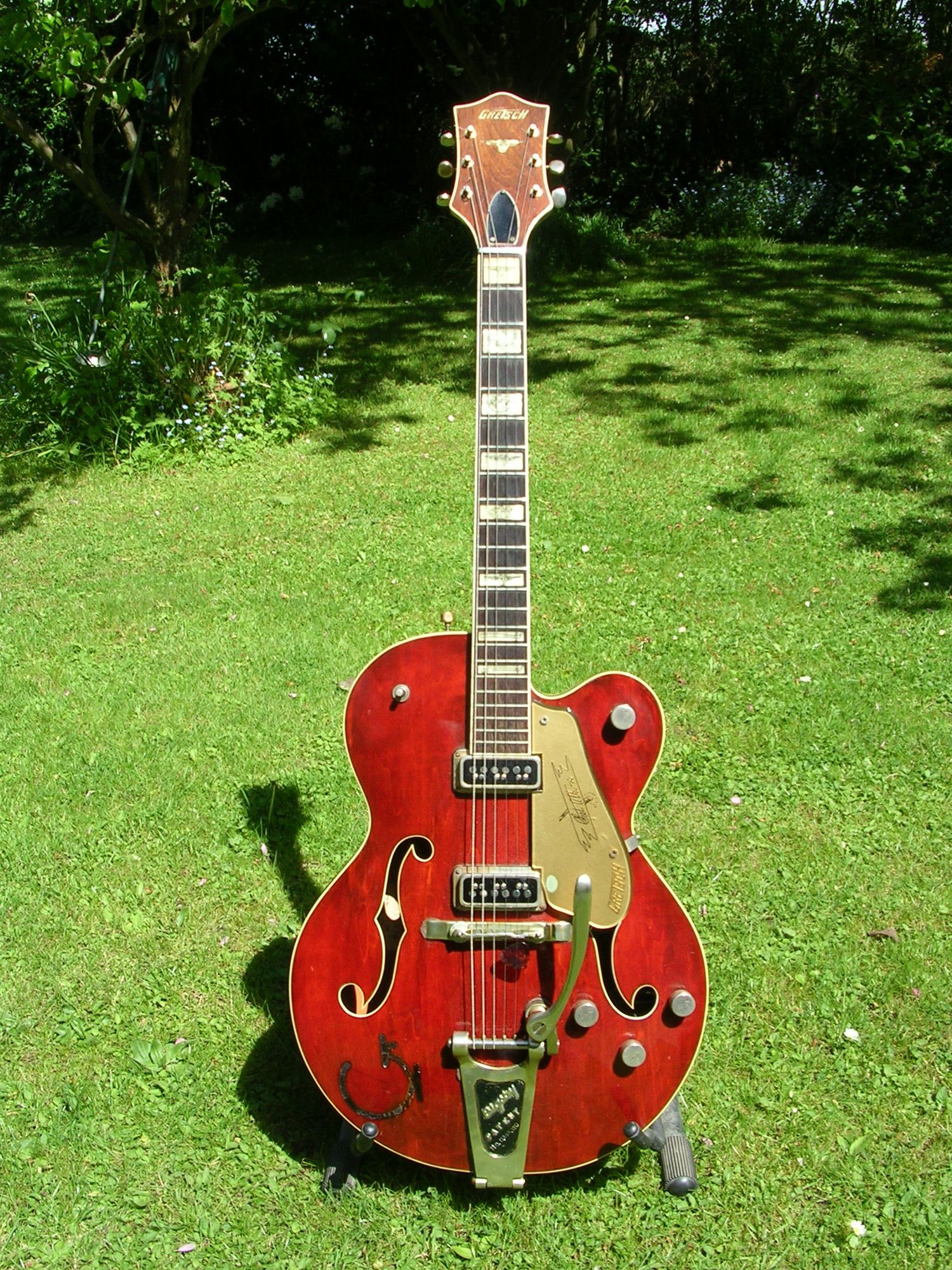
Gretsch 6120 G-Brand 1955. Photo by Francis pullen. Public domain (PD-self). Via Wikimedia Commons. Gretsch
6120
1955
Joe Walsh gave Pete Townshend one. Steve Miller gave Brian Setzer one. Chet Atkins just lent it his name.

Photograph of a vintage 1960 Gibson ES-335TD. Photo by Lightburst. Licensed under CC BY-SA 4.0. Via Wikimedia Commons. Gibson
ES-335
1958
Larry Carlton played three 335s off a shop wall, unplugged, paid $850 for one, and became Mr. 335.