Gibson
L-5 CES
In the ’50s Gibson shipped a few dozen a year. Wes Montgomery and Scotty Moore made them count.
Memphis, 7 July 1955. Scotty Moore walks into O.K. Houck’s music store carrying a gold ES-295 that has already played on four Elvis singles, and he trades it in. He walks out with a natural-finish L-5 CES, 17 inches wide, with a top carved from solid spruce.
- Introduced
- 1951
- Type
- Hollowbody electric
- Class
- Production
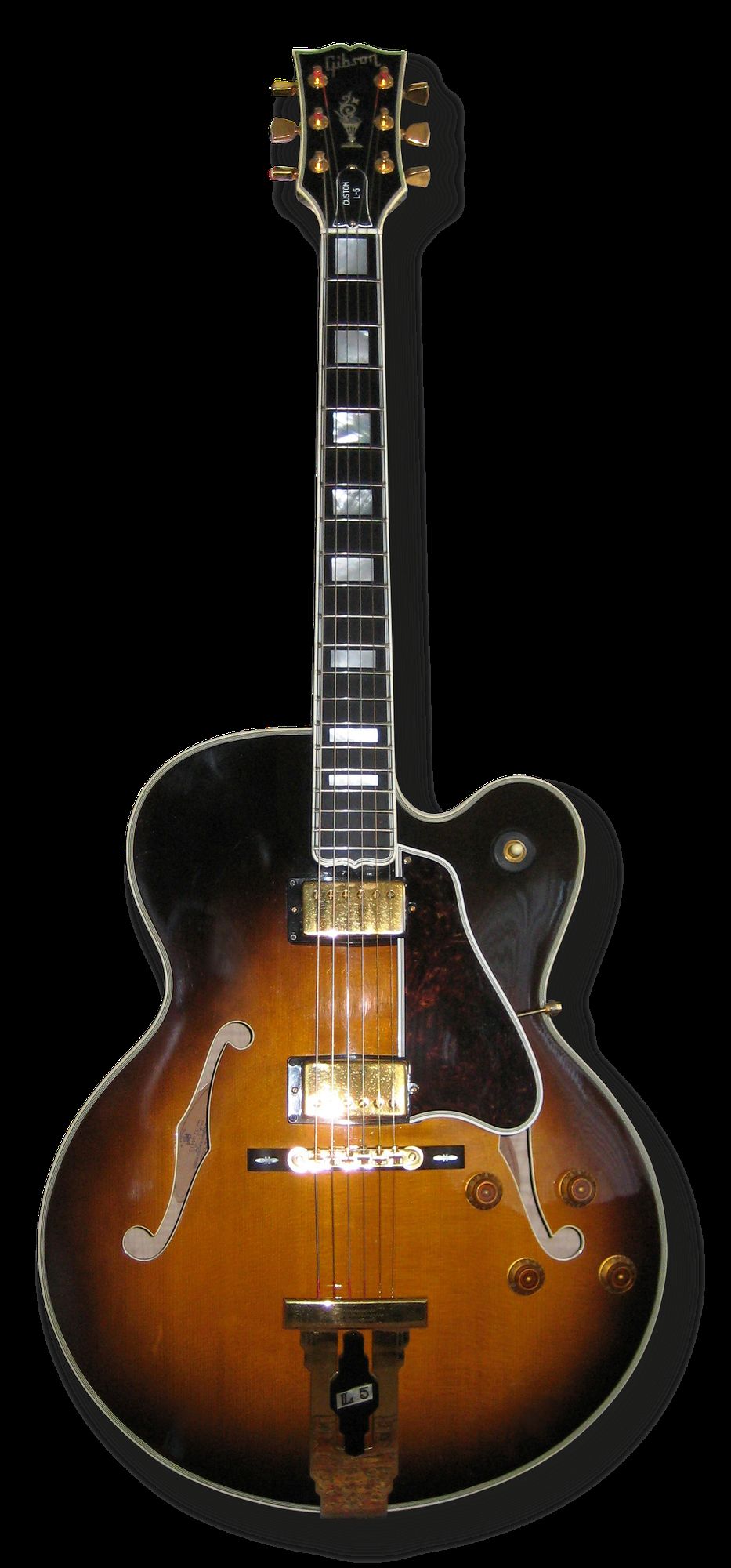
The short version
1923
The acoustic L-5
Lloyd Loar’s carved archtop appears on Gibson’s April price list. No pickups yet.
1951
The CES
“Cutaway Electric Spanish.” The carved L-5 gets two P-90s routed into its spruce top.
1955
Scotty trades up
Moore swaps his ES-295 for a natural L-5 CES at O.K. Houck’s in Memphis. “Mystery Train” follows.
1957
Humbuckers
Humbuckers replace the Alnico V pickups. Or 1958, depending who you ask.
1960
The pointed horn
The rounded Venetian cutaway becomes the sharp Florentine. Sources say mid-1960 or 1961.
1962
Full House
Wes Montgomery records live at Tsubo on 25 June. A sunburst L-5 is on the back cover.
1969
Rounded again
The Venetian cutaway comes back, along with a solid two-piece back.
Side A
A1
The one you keep for the next guy
Most guitars get played until they’re worn out. The L-5 CES was never that kind of guitar. It had a carved top, it sat at the top of the line, and in some years of the 1950s Gibson shipped fewer than fifty of them. It was made to outlast whoever bought it.
Scotty Moore knew what it was. In 1955 he was the guitar player on Elvis Presley’s records for Sun, and he was doing fine with a gold ES-295. On 7 July he traded it in at O.K. Houck’s in Memphis for a natural-finish L-5 CES.
Elvis’s last single for Sun, “Mystery Train,” is that L-5. So is most of what Scotty played in the early RCA years, until a Super 400 replaced it in January 1957. The L-5 moved on. It was the kind of guitar that did.
A2
An acoustic that learned to plug in
The L-5 was already famous before it had a pickup. Lloyd Loar designed it as Gibson’s Master Model, and it showed up on the April 1923 price list, a carved acoustic archtop. By 1939 it was 17 inches wide, on a 25½-inch scale, with a rounded cutaway.
In 1951 Gibson routed two P-90 pickups straight into that carved spruce top and called it the L-5 CES. The letters stand for Cutaway Electric Spanish, which is about as romantic as Gibson’s naming ever got.
What makes it different is the top. After the war, most of Gibson’s electric archtops went to laminated maple, pressed plywood, basically, because it fights feedback. Only a handful of flagships kept the solid carved spruce. That spruce gives you more of the acoustic guitar underneath: more air, more bloom, and more trouble when you turn up. You don’t play an L-5 CES loud. You play it well.
Most electric archtops went to plywood after the war. The L-5 CES kept its carved spruce top and made you earn it.
A3
Three sets of pickups and a pointier horn
The pickups kept changing. Two P-90s in 1951. In 1954 the Alnico V, with its rectangular magnets, the ones everybody calls “staples.” Then humbuckers in 1957, or 1958, depending on who you read. Collectors split the whole run into eras by pickup, and they argue about the edges.
Around 1960 or 1961 the soft, rounded Venetian cutaway turned into a sharp Florentine point. The rounded one came back in 1969. Take your pick. Both are gorgeous.
And the numbers are tiny. Gibson shipped 39 in 1951. It shipped 37 in 1957. In 1966 it shipped exactly one natural-finish L-5 CES. From 1951 to 1969, the whole run comes to 1,268. After 1962 it was essentially a custom order.
Flip the record · By the numbers
39
L-5 CES guitars Gibson shipped in 1951, the first year.
37
Shipped in 1957, the year it got humbuckers.
1
Natural-finish L-5 CES shipped in 1966. One.
1,268
Total shipped from 1951 to 1969, sunburst and natural together.
Side B
B1
A man and his thumb
If one person owns the sound of this guitar, it’s Wes Montgomery. He played it with his thumb instead of a pick, in octaves, and the tone that came out was warm and fat.
It wasn’t one guitar. Wes went through at least five L-5 CES bodies: a sunburst with P-90s, a natural with humbuckers, a sunburst Florentine, and two custom guitars with a single humbucker, one with a pearl heart inlaid in it, and the last one with his name on a sticker. Gibson never made those one-pickup versions for the public.
On 25 June 1962 he recorded Full House live at a club called Tsubo, and a sunburst L-5 is on the back of the record. Gibson never put out a Wes Montgomery model while he was alive. The production one came decades after his death in 1968.
B2
Handed along
The L-5 CES never sold in big numbers, and it didn’t need to. It found its people. Kenny Burrell had a custom blond Florentine in 1958, before the pointed cutaway was even standard. Pat Martino played one after El Hombre. Robert White, the Motown session man best remembered for the “My Girl” hook, played a Florentine too.
Then there’s the sunburst Florentine on the cover of Wes’s Movin’ Wes. After Wes, it went to George Benson. After Benson, it went to Pat Metheny, who put it on the cover of his album Orchestrion.
Scotty moved on to a Super 400. Wes’s went from one great jazz player to the next, and then to the one after that. In the ’50s Gibson built only a few dozen a year. It turns out that’s plenty, when the guitars keep finding their next player.
Put this on
You’ve read about it. Now hear it. Here’s what this guitar sounds like, and what to listen for.
Mystery Train
Elvis’s last Sun single, with Scotty Moore on the L-5 CES he’d traded his ES-295 for that July. Put it next to the earlier Sun sides and listen to the bigger guitar.
Find it on YouTube (opens in a new tab)
The cast
The people, and the specific guitars, that made the legend.
1960s
Wes Montgomery
Several L-5 CES bodies
At least five, from P-90s to custom one-pickup models. Gibson never made a Wes model in his lifetime.
1955
Scotty Moore
Natural-finish L-5 CES
Traded his ES-295 for it on 7 July 1955. On “Mystery Train” and most of the early RCA years, until a Super 400 took over in January 1957.
1958
Kenny Burrell
1958 custom blond Florentine
A special-order L-5 CES with the pointed cutaway, before it was standard.
1967
Pat Martino
Florentine L-5 CES
Played one after his 1967 album El Hombre.
1960s
Robert White
Florentine L-5 CES
Motown session player, best remembered for the “My Girl” hook, and one of the Florentine L-5 CES players.
later
George Benson & Pat Metheny
Wes’s sunburst Florentine
The guitar from the Movin’ Wes cover went to Benson, then to Metheny, who put it on the cover of Orchestrion.
Liner notes
Specs, construction, rarity, value, and every source we used.
Carved-spruce flagship electric — Cutaway Electric Spanish, not a laminated ES-175, and not Maybelle’s acoustic L-5.
- Body
- 17 in, fully hollow. Carved spruce top; figured maple back and sides. Venetian cutaway on typical later Custom Shop. Bound f-holes.
- Neck
- Set. Later Custom Shop often five-piece maple/walnut (Wes SKU copy). Bound headstock; flowerpot inlay.
- Fingerboard
- Ebony (L-5C family from 1948); pointed end; pearl blocks; 20 frets (1955 catalog).
- Scale
- 25 1/2 in. Not 24 3/4 in.
- Pickups
- Two humbuckers set into the carved top on typical later CES. Not a floating McCarty unit.
- Hardware
- Gold-plated. ABR-1 on an ebony base; L-5-style tailpiece.
- Electronics
- Volume and tone per pickup; 3-way toggle.
- Finish
- Nitrocellulose. Sunburst or natural.
- Nut
- No factory CES width sourced.
Open the full research fileConstruction details, the complete player record, production numbers, dated value estimates, and sources
Typical later Custom Shop / 1969–present Venetian CES (Joe’s Vintage). Not a live 2026 gibson.com SKU. A Custom Shop reissue is not a 1950s CES.
Construction
CES = Cutaway Electric Spanish. The 1951 factory-electric of the carved 17" L-5C: pickups routed into a solid spruce top. Fully hollow. Not a laminated ES-175. Not an ES-335 with a center block. Not the 18" Super 400 CES.
Keep the acoustic distinct. The L-5 is Lloyd Loar’s Master Model — designed 1922, April 1923 price list, 16". Advanced 17" in 1934 (guitarhq) / 1935 (prewargibsonl-5.com). Scale to 25 1/2" in 1938. Venetian cutaway as L-5 Premier in 1939; renamed L-5C around 1948, ebony from that year.
1951 CES: 17" Venetian, carved spruce/maple, gold, two P-90s. Postwar, guitarhq: only L-5 CES, Super 400 CES, Byrdland, and floating-pickup models keep solid carved spruce; everyone else goes laminated maple to fight feedback.
Pickup eras do not flatten. guitarhq: 1951 two P-90s; 1954 Alnico V replace P-90s; 1957 humbuckers replace Alnico V. Wikipedia’s L-5 lead dates humbuckers 1958 — keep 1957/1958; prefer guitarhq. Alnico V, 1954–57: guitarhq says staples in both positions; Joe’s Vintage says staple neck + P-90 bridge; Premier Guitar’s 1955 write-up calls them P-90s while quoting “Alnico No. 5” catalog copy. Catalog name is Alnico. Tune-o-matic from the end of 1953 (Premier Guitar).
Florentine vs Venetian: Joe’s table starts Florentine in 1960. guitarhq: 1961 pointed cutaway, laminated 2-piece back, 5-piece neck (was 3-piece). Vintage Guitar and Bass: mid-1960. Wikipedia lead: 1961–1969. Keep 1960/1961. guitarhq: laminated backs 1961–69; solid 2-piece back again in 1969 when Venetian returns. Typical later Custom Shop, when offered: 17" Venetian, carved spruce, figured maple, ebony/blocks/flowerpot. Not on gibson.com as a live SKU this pass (25 August 2026). Not this guitar: L-5S (1972–83) solidbody, 24 3/4" scale. Gibson did not ship a Wes Montgomery signature in his lifetime.
Players
Wes Montgomery’s public electric is this guitar. Not an ES-175. Do not caption Maybelle’s guitar as CES, or Elvis’s 1968 Comeback Special as an L-5.
Wes Montgomery — several CES bodies, not one serial. Jazz Guitar Today (Marc Silver, May 2020): (1) sunburst Venetian, two black P-90s; (2) natural L-5 CESN, two humbuckers; (3) sunburst Florentine, two humbuckers — Movin’ Wes cover; later Benson, then Metheny (Orchestrion cover); (4) sunburst Venetian, one humbucker, pearl heart inlay; Tequila; (5) last guitar: sunburst Venetian, one pickup, name sticker. Last two were custom — no stock single-pickup CES. Vintage Guitar: 25 June 1962, Tsubo — sunburst L-5 on the back of Full House. The production Wes model came decades after 1968.
Scotty Moore — L-5 CESN serial A-18195. Vintage Guitar: traded a gold ES-295 for this natural CES on 7 July 1955 at O.K. Houck, Memphis. Sun 223, “Mystery Train” / “I Forgot to Remember to Forget,” and through most RCA Elvis years. Super 400 CESN serial A-24672 replaces it in January 1957. The 1968 NBC Comeback Special guitar is Moore’s Super 400 CES, not this guitar.
Named CES-class (Vintage Guitar Florentines): Jerry Miller, “Beulah” (1962 sunburst; Moby Grape); Pat Martino (Florentine after 1967’s El Hombre); Kenny Burrell (1958 custom blond Florentine); Grant Geissman (1968; “Feels So Good”); Robert White (Motown; “My Girl” hook).
Mother Maybelle Carter is acoustic L-5, not CES. Hall of Fame captions say 1928; Joe Spann dates serial 85558 to January 1930. Keep both; still 16" acoustic, still not CES. Hank Garland: acoustic vs CES not pinned. Benson/Metheny owned Wes’s Florentine; not CES poster children. Chuck Berry is not listed — early hits were ES-350T, later 335-family.
Rarity
Not a current gibson.com catalog model (25 August 2026). Possible Custom Shop special order.
Factory shipping is tiny. GuitarHQ / Meiners, 1951–69: 1,268 shipped (934 sunburst, 334 natural). Factory shipping totals, not a survival census. 1951–59 combined: 406. Several 1950s years under 50. First year 1951: 39. 1957: 37. 1966 natural: 1. Late-60s jump — 1968 200, 1969 225 — is still small next to an ES-175. After 1962, Vintage Guitar and Bass: custom-order on the price list. 1970–present shipping: unknown. Collector split: 1951–53/54 P-90; 1954–56 Alnico V; 1957–60 PAF Venetian (GuitarHQ 1950s = A); c. 1961–69 Florentine (1960s = B). Late Custom Shop carved examples are not vintage CES.
Value
Informal estimate, 25 August 2026. Not an appraisal.
Public 2024–26 solds for vintage 1950s–60s CES were not found in a usable series. Label ask vs sold. Reissues are not vintage CES. Artist-owned lots (Wes, and other named instruments) are a separate market, not a comp.
New street. No current Gibson catalog SKU and no public 2026 list price. Mid-2010s Crimson Division MSRP sat around $14,500–$15,000 (Guitars ’n Jazz) — historical dealer MSRP, not 2026 street.
Used modern (Custom Shop / later CES). Reverb Custom Shop L-5 CES 1993–2015 is the only public sold strip retrieved: 2024–25 solds $5,625–$10,000; Reverb estimate $4,730–$10,236 (67 orders). That is later CES, not 1950s originals. Guitars ’n Jazz sold 2014–15 Crimson examples ~$11,000–$12,000. Wes Montgomery Custom used: dealer asks $10k–$16k; thin solds.
Vintage / collectible. Distinguish ask vs sold. 1960s Florentine asks (not sold): 1968 sunburst $18,500–$19,995; 1962 sunburst £23,400 (~$30k; GuitarHQ 1962 sunburst = 30). 1950s Venetian asks (not sold): Carter Vintage 1958 sunburst, PAFs, missing pickguard, refret/overspray, replaced parts — $25,000 (modified). Music Emporium 1955 natural, original Alnico V, Bigsby conversion, Jimmy Rip provenance — $29,995. Clean all-original 1957–60 PAF Venetian, especially blonde, sits at or above these asks. No 2024–26 auction sold ladder was retrieved.
See also
- gibson-es-335 — laminated thinline with a center block; not this carved hollowbody, and not Wes’s guitar
- gibson-es-295 — Moore’s first Elvis guitar; gold laminated 175-platform, not this carved 17" CES
- gibson-les-paul-standard — the solidbody flagship from the same years
Sources
- GuitarHQ L-5 CES — 1951 L-5CES 17" Venetian, carved spruce/maple, two P-90s; 1954 Alnico V; 1957 humbuckers; 1961 Florentine + laminated 2-piece back + 5-piece neck; 1969 Venetian + solid 2-piece back; Super 400 CES 18" contrast; L-5C 1948 ebony; Advanced 17" 1934.
- GuitarHQ general Gibson spec — postwar electrics that stay carved spruce; 1960–69 laminated backs on L-5 CES; Alnico V staple 1954–57; nitro.
- GuitarHQ PAF — PAF on L-5CES; narrow-spaced neck jazz PAF.
- GuitarHQ hollowbody shipping — L-5ces / L-5cen factory shipping 1951–69.
- Premier Guitar: 1955 L-5 CES — 1951 CES origin vs laminate ES-5; 1955 catalog 17" × 21", 20-fret, Kluson Sealfast, TOM, Alnico No. 5, 3-way, gold.
- Pre-war Gibson L-5: 17-inch timeline — 17" Advanced 1935; 25 1/2" in 1938; Premier Venetian 1939.
- Joe’s Vintage: L-5 CES value guide — CES vs acoustic L-5/L-5C; pickup-era table; Florentine 1960–69; Custom Shop special-order.
- Vintage Guitar and Bass: L-5CES — Florentine change mid-1960 / 1969; custom-order after 1962.
- Vintage Guitar: Gibson’s Fabulous Florentines — CES as Cutaway Electric Spanish; Wes Full House; Benson/Metheny chain; Martino; Burrell 1958 custom; Miller Beulah; Robert White “My Girl”; Geissman “Feels So Good”; Super 400 on the 1968 special.
- Vintage Guitar: Scotty Moore’s Gibson ES-295 — L-5 CESN A-18195, 7 July 1955, “Mystery Train”; Super 400 CESN A-24672 January 1957.
- Vintage Guitar: Remembering Scotty Moore — L-5 through most RCA years; Super 400 from January 1957.
- Jazz Guitar Today: The Many L5’s of Wes Montgomery — early 175 pictures vs career CES; five CES bodies; custom single-pickups; no Wes model until decades after 1968.
- Wikipedia: Gibson L-5 — lead only: 1923 Loar acoustic; 1951 CES; humbuckers 1958 (prefer guitarhq 1957); Florentine 1961–69.
- Country Music Hall of Fame press, 14 Oct 2020 — Maybelle’s 1928 Gibson L-5, acoustic.
- Pre-war Gibson L-5: serial 85558, Maybelle Carter — Hall of Fame; Gruhn; Joe Spann January 1930 vs popular 1928.
- Pre-war Gibson L-5: Maybelle Carter — acoustic identity.
- Birthplace of Country Music: Guitars of the Carter Family — 1928 caption; Spann 1930; later family acoustics.
- Guitar Center Riffs: ES-335 history — Chuck Berry ES-350T vs later 335 family (negative evidence for Berry-as-L-5).
- mylespaul.com: L-5S 1972–1983 — L-5S solidbody, 24 3/4" scale (contrast).
- The Gear Page: Gibson L-5 vs L-5 Wes Montgomery — Gibson Custom Wes copy 25 1/2", ABR-1 on ebony, L-5 tailpiece, five-piece maple/walnut neck.
- Carter Vintage: 1958 L-5 CES SB ask $25,000
- The Music Emporium: 1955 L-5 CES natural ask $29,995
- Reverb: Gibson Custom Shop L-5 CES 1993–2015 — sold strip 2024–25.
- Jazzguitar.be: L5CES current prices
- Guitars ’n Jazz: CS L-5 CES sold examples
- The Music Zoo: CS Crimson L-5 CES natural
- Gibson Custom collection — no L-5 CES listed as of fetch.
- Jazzguitar.be: archtops returning 2026?
- Gibson forum: no more L-5s?
Keep digging
Guitars this one gets compared to, confused with, or descended from.

Photograph of a vintage 1960 Gibson ES-335TD. Photo by Lightburst. Licensed under CC BY-SA 4.0. Via Wikimedia Commons. Gibson
ES-335
1958
Larry Carlton played three 335s off a shop wall, unplugged, paid $850 for one, and became Mr. 335.
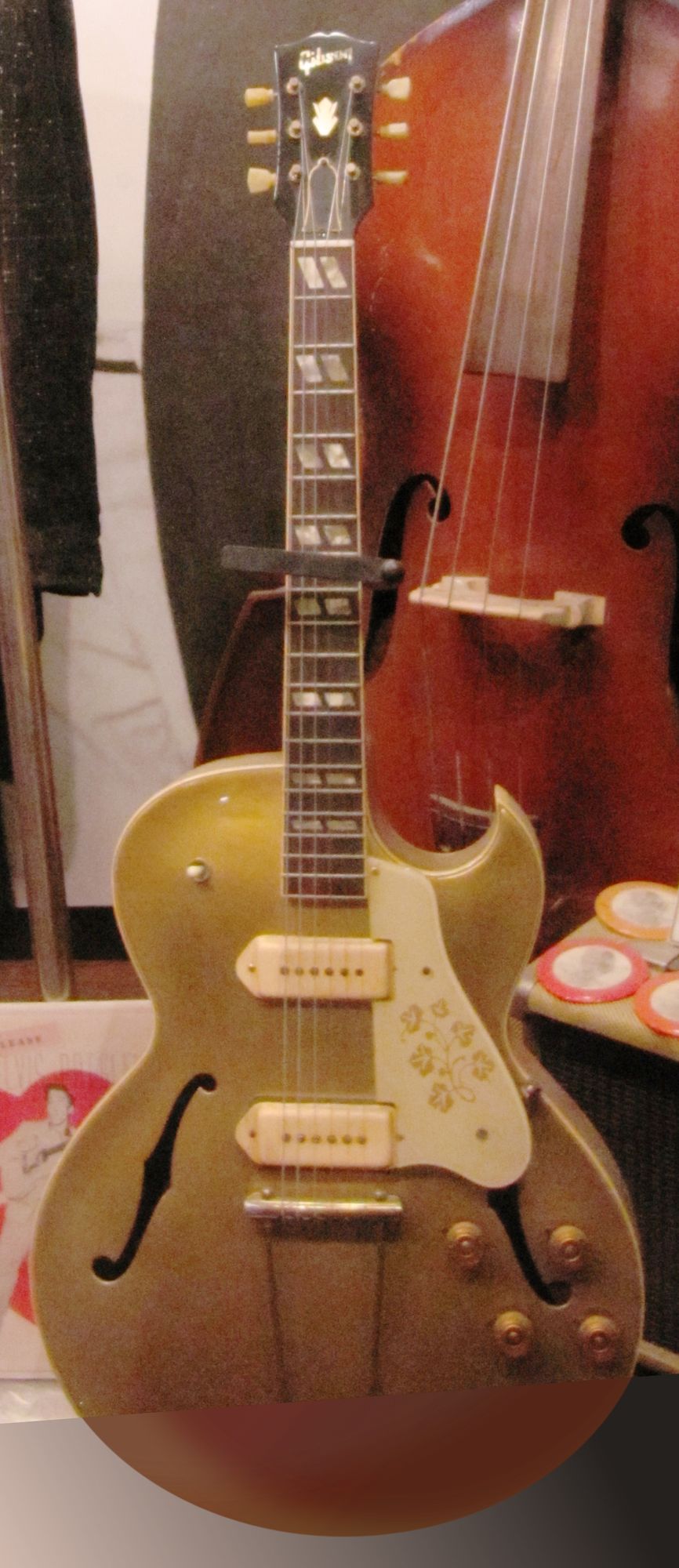
Gibson ES-295, Sun Studio. Clipped from Memphis Sun Studios Elvis instruments.jpg. Photo by Mr. Littlehand; derivative by Clusternote. Licensed under CC BY 2.0. Via Wikimedia Commons. Gibson
ES-295
1952
Scotty Moore traded a Fender for the gold guitar in the window. Four Elvis singles later, he traded it away.

2006 Gibson Les Paul Standard (SN 000660573). Photo by wetwebwork. Licensed under CC BY-SA 2.0. Via Wikimedia Commons. Gibson
Les Paul Standard
1952
Gibson made about 1,500 sunburst Les Pauls, decided nobody wanted them, and stopped. Then the British blues boom happened.