Gretsch
Synchromatic
Gretsch’s answer to Gibson had cat’s eyes, a harp, and a neck with no rod in it. The files burned.
Look through the cat’s-eye soundhole of a pre-war Gretsch Synchromatic and you may find a number written in pencil. It tells you roughly when the guitar was made. It can’t tell you how many others there were. The records that could went up in fires in the 1970s.
- Introduced
- 1939
- Type
- Archtop acoustic
- Class
- Closed run
Have a photograph of this guitar? Send a picture
The short version
1933
Gretsch on the headstock
The first guitars under Gretsch’s own name, the American Orchestra series.
1939
The Synchromatic line
Cat’s eyes, harp tailpieces, the Miracle Neck. Some sources start the 400 in 1940. Keep both.
1942
The war
Production is on hold for the war. Fred Gretsch Sr. leaves the company.
1948
A number that isn’t a price
The 400 becomes the 6040 in sunburst and the 6041 in natural.
1951
The cat’s eyes close
The 400 gets f-holes, a “G” tailpiece, and a rounded headstock.
1955
The Eldorado
The Eldorado replaces the 400.
2025
The name, on another guitar
Gretsch launches a Synchromatic Nashville, a laminated hollowbody in the 6120’s shape.
Side A
A1
A pencil number under the cat’s eye
Find a pre-war Synchromatic and tip it toward the light. Through one of those cat’s-eye soundholes, on the wood inside, there may be a number written in pencil. Gretsch did that until it switched to labels in 1949.
A three-digit pencil number puts a guitar somewhere between 1939 and 1945. It doesn’t say what model it is, and it doesn’t count anything. The numbers ran across the whole company. The records that could have told you more were lost in fires in the 1970s.
So nobody knows how many there were. The best guitar Gretsch made before the war has no census. Only the guitars themselves are left to tell it.
A2
Gibson already had the job
In the 1930s the job was the dance-band archtop: a big carved guitar loud enough to chop rhythm behind a horn section. Gibson and Epiphone owned it. Gretsch started putting its own name on guitars in 1933, with the American Orchestra series, and those were mostly midrange takes on Gibson’s L-5.
The Synchromatic line was Gretsch trying to stop following. Most accounts put it in 1939. Some put the flagship 400 a year later, in 1940, built to go up against Gibson’s Super 400. Keep both. Some people see the Art Deco of that year’s World’s Fair in the styling, and once you’ve heard that, it’s hard to unsee.
Gretsch sold it with a list called the Seven Points of Supremacy. The points that get quoted are a “non-pressure neck,” “streamlined tone holes,” a “chromatic tailpiece,” and a “synchronized bridge,” plus the finish and a three-year guarantee. That isn’t seven. The rest haven’t been quoted, so don’t fill them in.
A3
Cat’s eyes and a harp
You know a Synchromatic before you know anything else about it. The soundholes are cat’s eyes, not f-holes. The tailpiece is a harp. The bridge is a little stairstep of rosewood. On the 400 the binding is the loud part: no fewer than thirteen black-and-white layers by one count, with gold sparkle inside.
The 400 was 18 inches across in the catalog, the size of the Gibson it was chasing. The 300, 200, and 160 were the same idea at 17. Underneath them, the 100 and the 75 were 16-inch guitars with plain f-holes.
The model number was the price. From 1933 to 1948, that’s how Gretsch numbered things, so a 300 was a $300 guitar. By the same rule the 400 was the $400 one.
Flip the record · By the numbers
18"
The catalog width of the flagship 400, a match for Gibson’s Super 400.
$300
The Synchromatic 300, priced by its own model number.
13
Black-and-white layers in the 400’s binding, by one count, with gold sparkle inside.
0
Truss rods in the early Miracle Neck.
Side B
B1
The Miracle Neck
The other half of the pitch was the neck, and the early one had no truss rod at all. Gretsch called it the Miracle Neck. It was asymmetrical, thicker on the bass side, built up from laminates that aren’t the same from one guitar to the next.
Harry Volpe, one of the players who endorsed it, put it the way an endorser would:
“My fingers seem to travel twice as fast on my new Synchromatic.”
There’s no record or date attached to that line. It’s an ad, and it reads like one. But it tells you what Gretsch thought the neck was for.
B2
A war, a picture, and a different guitar
Then the war. Production went on hold once the United States entered, and Fred Gretsch Sr. left the company in 1942. A Synchromatic 200 from that year turns up 16 inches wide, never catalogued, gone by 1949. Wartime guitars are their own thing.
The most famous photograph of a Synchromatic is of Django Reinhardt holding a blonde one, most likely with a Leutone pickup added. It’s a great picture, and it’s only a picture. His records were made on a Selmer. Don’t hang a Hot Club side on this guitar.
B3
The name kept going
In 1948 the 400 became the 6040 in sunburst and the 6041 in natural. Those numbers weren’t prices anymore. In 1951 the cat’s eyes closed into f-holes, the harp gave way to a “G” tailpiece, and the headstock went round. In 1955 the Eldorado replaced it.
The name didn’t go with it. The script logo on the first Duo Jets came off these headstocks. A flat-top with a triangle soundhole carried the word, and a jumbo that later became the Rancher. From 1991 a Japanese G400 used it for two decades. In 2025 Gretsch put it on a laminated hollowbody in the shape of a 6120, with f-holes and Filter’Trons.
None of those are this guitar. The one with cat’s eyes and a harp and no rod in its neck closed its eyes in 1951, and the paperwork that could have counted it is gone. What’s left is the guitars. Inside each of the early ones, if you tip it to the light, there’s a number in pencil. It still doesn’t add up to a count.
The cast
The people, and the specific guitars, that made the legend.
Harry Volpe
Synchromatic
An endorser. He said his fingers seemed to travel twice as fast on it. No record or year is tied to that line.
Django Reinhardt
Blonde Synchromatic archtop, in a photograph
The well-known Gretsch picture, most likely with a Leutone pickup added. His records were made on a Selmer, not this.
Liner notes
Specs, construction, rarity, value, and every source we used.
Cat's-eye holes, a harp tailpiece, and a neck with no truss rod — Gretsch's 1939 archtop, not a 6120, and not the hollowbody using the name now.
- Body
- Non-cutaway archtop, carved spruce. Flagship 400: 18" in the catalog, cat's-eye holes, maple back and sides, gold sparkle in the binding. 160 / 200 / 300: Blue Book 17", cat's-eye. 100 and 75: 16", f-holes. One 1940 300 measures 17 3/8" (RetroFret). One late-1940s 400 card says 18" and prints a lower bout of 45.5 cm. Mix flagged. Do not convert 18".
- Neck
- Set maple, asymmetrical, no truss rod on the early neck. Thicker on the bass side (Sweetwater). Gretsch called it the Miracle Neck. Laminates are not one recipe. Blue Book: five-piece maple/rosewood on the 400. One 1939 300: two-piece flame maple, one veneer strip (Campellone). One wartime 200: two-piece maple, mahogany center (Fretted Americana).
- Fingerboard
- 20 frets, 14 clear of the body (Blue Book "14/20"; Georgia Southern's 400 joins at the 14th). Board wood on the 400 is not settled. Blue Book: rosewood. Fretted Americana and the Georgia Southern card: ebony. Don't pick.
- Scale
- 26" on the 160, 200, 300, and 400 (Blue Book). 24.5" on the 100 and the 75. One wartime 200: 25" (Fretted Americana). One late-1940s 400 card: 66.7 cm (26.2 in). One mid-1940s 115: 62.4 cm (24.6 in). Mix flagged. Do not average, and do not turn 26" into 66.7 cm.
- Pickups
- None. A DeArmond or a Leutone is a floating add-on, not this table.
- Hardware
- Stairstep rosewood bridge. Harp tailpiece. Blue Book: chrome Grover tuners on the 160, 200, 300, and 400; gold-plated hardware on the 200, 300, and 400, the 400's harp gold and chrome; chrome-plated hardware on the 160. Fretted Americana's 400 writeup just says gold-plated parts. Don't merge the plating. Sweetwater calls the bridge synchrosonic. A later Melita is a different part.
- Electronics
- None
- Finish
- Sunburst or natural. RetroFret's 1940 300 is blonde.
- Nut
- No catalog nut. One wartime 200: 1 3/4" (Fretted Americana). One late-1940s 400: 4.3 cm at the nut (Georgia Southern). One mid-1940s 115: 4.2 cm. Mix flagged. Do not convert.
Open the full research fileConstruction details, the complete player record, production numbers, dated value estimates, and sources
Classic living example = a pre-war Brooklyn Synchromatic 400. Eighteen inches in the catalog, non-cutaway, cat's-eye holes, harp tailpiece, Miracle Neck, no pickup. The 160, 200, and 300 are that idea at 17". The 100, the 75, and a measured 115 are the 16" f-hole guitars underneath. Not a 6120, a Country Gentleman, a White Falcon, a White Penguin, a Duo Jet, or a Rancher. Not the flat-top 400F or the jumbo 125F / 6021. Not a Japan G400, and not the 2025 Synchromatic Nashville or Falcon. Mixed inch/mm flagged. Do not average 26" with 25", 24.6", 24.5", or 26.2".
Construction
The job was the dance-band archtop, and Gibson and Epiphone already had it. Gretsch's own name went on guitars in 1933, the American Orchestra series. Edward Ball (Vintage Guitar): midrange variations on an L-5. In 1939 that job changed. Ball, Sweetwater, and RetroFret put the Synchromatic line, 400 included, in 1939. Blue Book's span for the 400 starts in 1940, and Fretted Americana says it was introduced that year, against the Super 400. Keep both. This plate starts in 1939.
Sweetwater ties the look, in part, to the Art Deco of that year's World's Fair. The pitch was the Seven Points of Supremacy. RetroFret names a "non-pressure neck," "streamlined tone holes," a "chromatic tailpiece," and a "synchronized bridge," plus the finish and a three-year guarantee. It never prints seven lines. Don't invent the rest.
What you hold, on the guitars people mean, is carved spruce, maple back and sides, and cat's-eye holes — the 160, 200, 300, and 400. The 100 and the 75 keep f-holes. The bridge is a stairstep of rosewood. The tailpiece is a harp. Sweetwater calls that bridge synchrosonic. On Gretsch-Talk the Melita Synchrosonic is a later electric part, the one that intonates a string at a time. Same word. Two objects. The 400's binding is the loud one: Sweetwater counts no fewer than thirteen black-and-white layers, gold sparkle inside.
The neck is the other half, and the early one has no truss rod. Thicker on the bass side. Sweetwater's name is the Miracle Neck. The laminates are not one drawing. RetroFret's 1940 300 is slim, the layers under the board what Gretsch called pregwood, top carved thin on parallel braces. Campellone's 1939 300 is two-piece flame maple and one veneer strip, thickest off-center toward the bass. Blue Book's 400 is five-piece maple and rosewood. A circa-1950 400 at Gardiner Houlgate is described as missing its truss-rod cover. The early neck didn't have one. Don't date the change off that lot.
Widths and scales are the table, and they don't agree. RetroFret measured one 1940 300 at 17 3/8", scale 26", list $300 — wider than the L-5 it was priced against, in the class of an Epiphone Deluxe. One guitar. Not a correction of Blue Book's 17". Georgia Southern prints a late-1940s 400 as 18" and in centimetres on the same card, and a mid-1940s 115 at a scale that is not the 100's 24.5". Mix flagged above. Don't convert, and don't average.
Reverb News (Peter Schu, 11 March 2015): from 1933 to 1948 the model number is the retail price, and the original Synchromatics are that system. The $300 is RetroFret stating it. A 400 in that window is the $400 guitar by the same rule, not a list in hand. In 1948 Blue Book numbers it 6040 sunburst and 6041 natural. Those are not prices.
The war is the split. Huw Price (Guitar World, 30 December 2023): production went on hold when the United States entered, and a player who wanted volume hung on a floating pickup. The 1939 Electromatic, Gretsch's first electric, was a different guitar, and Kay built it. Fred Gretsch Sr. left in 1942 (Guitar World, 2009). Fretted Americana's 1942 Synchromatic 200 is still a real instrument: 16" wide, 3 3/8" deep, 25" scale, 1 3/4" nut, 5.10 lb, cat's eyes, never catalogued, gone by 1949. Blue Book keeps a 17" / 26" 200 through that year. A wartime 16" does not revise it.
Then the holes change and the name stays. Blue Book on the 400: 1951 brings f-holes, a "G" tailpiece for the harp, and a rounded headstock. 1955: the Eldorado replaces it. From 1951 to 1955, 6038 / 6039 is its own Synchromatic — single cutaway, carved spruce, laminated maple back, f-holes — and Blue Book carries the number on as Fleetwood/Eldorado, at 17". Not a pre-war cat's-eye. The script logo on the first Duo Jets came off these headstocks (Vintage Guitar, on the 1953 Jet). A Jet is still not this guitar.
Two flat-tops use the word and leave the page. The 400F, model 6042, is an 18" flat top with a triangle hole, from 1947 (Fretted Americana, citing Jay Scott). The 125F, model 6021, is the 17" jumbo the Rancher plate follows out of this name. Japan is next, and it is not Brooklyn. Blue Book: G400, 1991–2012; cutaway G400C, 1991–2009. A Reverb note on a circa-1992 400CV calls it a Japan take on the 1951 6039 — 17", 25 1/2", a Filter'Tron, a Bigsby. Dealer copy. A hybrid.
September 2025, the name came back on the wrong outline. Gretsch's Synchromatic Nashville is a laminated hollowbody in the 6120's shape, estimated U.S. street $1,259.99. Guitar World (Phil Weller, 12 September 2025) prices the Falcon beside it at $1,469.99. F-holes and Filter'Trons. Not a cat's eye, and not a reason to park a 6120 or a White Falcon here.
Players
Harry Volpe. Fretted Americana, on the Miracle Neck, quotes him: "my fingers seem to travel twice as fast on my new Synchromatic." An endorser's line. No serial, no year, no record on that page.
Django Reinhardt — a photograph, not the records. Huw Price (Guitar World, 30 December 2023): the well-known Gretsch picture is a blonde Synchromatic archtop, most likely with a Leutone added. A picture, and a "most likely." Vintage Guitar (Michael Dregni) writes his recorded guitar as the Selmer. Do not hang a Hot Club side on this archtop, and do not turn a probable add-on pickup into a factory guitar.
Johnny Smith is the flat-top trap. Fretted Americana believes the natural 6042 is the 400F he played before Guild. Triangle hole. Not this table.
Also known stays empty on purpose. Chet Atkins, Eddie Cochran, Brian Setzer, and George Harrison belong to other Gretsches — the 6120, the Country Gentleman, the Tennessean, the Duo Jet. Not a Synchromatic.
Rarity
You cannot order a new cat's-eye Synchromatic. Blue Book ends the Japan G400 in 2012. The 2025 hollowbodies are a catalog item under the old name. Regular production. Not rare, and not this guitar.
What is thin is the professional cat's-eye line. RetroFret: the 400, 300, 200, and 160 were extremely limited, and the war left Gretsch late. No factory total was published. None invented. Reverb News: from 1939 the serials run across the company, in pencil inside the body until labels in 1949, and a three-digit number only places a guitar somewhere in 1939–1945. It does not count Synchromatics. Ball: the records went in fires in the 1970s. That is why a first-year census is unknown, not a puzzle to solve from the pencils.
His one counted neighbor is not a census either. A natural 17" cat's-eye tenor from 1953, DeArmond floating pickup, single cutaway, was a special order sitting inside a 50-guitar batch of six-string Constellations, model 6030-1, batch 112xx, and those had ordinary f-holes. The 50 belongs to the Constellation. The tenor is one guitar.
Pre-war non-cutaway cat's eyes are the scarce object. A 1951 f-hole 400 is later Brooklyn. An Eldorado is the successor. A Japan G400 is another factory. A 2025 Nashville is a third thing.
Value
Informal estimate, 1 October 2026. Not an appraisal.
Ask is not sold. A 2025 hollowbody is not a comp, and Japan is not Brooklyn. No invented medians, and no factory counts. Period money, while the model number was still the price (Reverb News, 1933–1948): RetroFret states the 300 at $300. The 400 is the $400 guitar by that rule, not a list in hand. From 1948 the same guitar is a 6040 or a 6041. Don't carry $400 past the rename.
New street. None for this archtop. Nothing cat's-eyed on the current Gretsch page this pass. The namesake Nashville is $1,259.99 estimated U.S. street (Gretsch). The namesake Falcon is $1,469.99 (Guitar World, 12 September 2025). Other guitars.
Used modern. Japan G400s. Clean 2024–26 hammers were thin this pass. Named asks on Blue Book's for-sale strip, fetched this pass, not hammers: a 2004 G400C at $1,699 (eBay), a 1999 400c at $2,496 (Reverb). Don't average them. A 400CV with a Bigsby is a different Japan guitar.
Vintage / collectible. Public 2024–26 hammers for Brooklyn cat's-eye Synchromatics were thin this pass. Named ask, not a hammer: that same strip shows a 1939 400 at $13,500 (Reverb). The listing's condition was not opened here. Gardiner Houlgate, sale 8 December 2026, still in preview: a circa-1950 400, fair and restored — cracks repaired, a refinish, a neck reset, replacement tuners — estimate £1,000–£2,000. An estimate on a tired guitar. Not a hammer. Don't convert it, and don't set it next to the $13,500 ask and split the difference.
What moves a result: cat's eyes or the 1951 f-holes, an 18" 400 or a 17" 300 or a 16" 100, a wartime 16" 200 or the catalog 17", the original harp and stairstep or replacements, and whether the guitar is Brooklyn, Japan, or the 2025 hollowbody.
See also
- gibson-super-400 — the 18" carved archtop this line was answering; f-holes, not cat's eyes
- gretsch-rancher — the flat-top that began as a Synchromatic 125F and then lost the name
- gretsch-6120 — the hollow electric people now mean by Gretsch; not this archtop
Sources
- Sweetwater InSync, "Synchromatic," 10 September 2008 — line in 1939; Seven Points of Supremacy; 400 with stairstep "synchrosonic" bridge, harp tailpiece, asymmetrical non-truss-rod Miracle Neck, cat's-eye holes, thirteen-layer binding with gold sparkle
- RetroFret, Synchromatic 300 (1940), item 9558 — 1939; professional line 400/300/200/160, extremely limited; points named in part; one guitar 17 3/8", 26" scale, $300 list, pregwood, parallel bracing
- Vintage Guitar, Edward Ball, "Gretsch's Golden Tenors" (July 2010) — debut 1939; 1933 line as L-5 variations; 1953 cat's-eye cutaway tenor inside a 50-guitar Constellation batch 112xx; records lost to 1970s fires
- Vintage Guitar, "The Birth of the Gretsch Duo Jet" — script headstock logo carried from Synchromatic archtops, 1939 through the late 1940s
- Blue Book, Gretsch acoustic archtops, 1930s–1970s — 75, 100, 160, 200, 300, 400: widths, scales, years, woods, hardware; 6038/6039; Eldorado
- Blue Book, Synchromatic 400 (6040/6041) — 18", 26", 1940–1955; 6040/6041 from 1948; 1951 f-holes and G tailpiece; 1955 Eldorado. For-sale strip this pass, asks: 1939 400 at $13,500 (Reverb); 2004 G400C at $1,699 (eBay); 1999 400c at $2,496 (Reverb)
- Blue Book, recent Gretsch acoustic archtops — G400, 1991–2012; G400C, 1991–2009
- Fretted Americana, 1951 Gretsch 6040 Synchromatic 400F — 400 in 1940, against the Super 400; 18", 26", cat's-eye, ebony, five-piece neck; Volpe quote; 400F from 1947; Johnny Smith on the 400F before Guild
- Fretted Americana, 1942 Synchromatic 200 — wartime 16" line; 3 3/8" deep; 25" scale; 1 3/4" nut; 5.10 lb; uncatalogued; gone by 1949
- Georgia Southern, "Synchromatic guitar, model 400" — late 1940s; described 18"; lower bout 45.5 cm; scale 66.7 cm (26.2 in); nut 4.3 cm; 20 frets, join at the 14th; ebony; added pickup; 8 lb 6.5 oz. Mix flagged
- Georgia Southern, Synchromatic 115 — mid-1940s; described 16"; f-holes; scale 62.4 cm (24.6 in); nut 4.2 cm; no pickup; 5 lb 7.5 oz. Mix flagged
- Reverb News, Peter Schu, "How To Date A Gretsch Guitar," 11 March 2015 — 1933–1948 model numbers are the retail price; sequential serials; three pencil digits span 1939–1945 across the company, not a model count; labels from 1949
- Guitar World, Huw Price, 30 December 2023 — wartime production on hold; Django photo is a blonde Synchromatic, most likely a Leutone; 1939 Electromatic was made by Kay
- Guitar World, "Gretsch Guitars: The Big Twang," 31 August 2009 — Gretsch-name guitars 1933; Synchromatic series 1939; Fred Gretsch Sr. left in 1942
- Vintage Guitar, Michael Dregni, "Django Reinhardt" — the guitar in that piece is the Selmer
- Gretsch, Synchromatic Nashville — 2025 namesake; estimated U.S. street $1,259.99; not this archtop
- Guitar World, Phil Weller, 12 September 2025 — Synchromatic Collection; Falcon $1,469.99 and Nashville $1,259.99
- Gardiner Houlgate, sale 8 December 2026, lot 55 — circa-1950 400, fair/restored, missing truss-rod cover, estimate £1,000–£2,000, sale in preview
- Gretsch-Talk, Synchromatic bridge and Synchrosonic bridge — the acoustic stairstep is not the Melita
- Reverb listing, Gretsch 400CV, circa 1992 — dealer copy: Japan, claimed 17" and 25 1/2", Filter'Tron, Bigsby; called a recreation of the 1951 6039, not a 1939 400
Keep digging
Guitars this one gets compared to, confused with, or descended from.
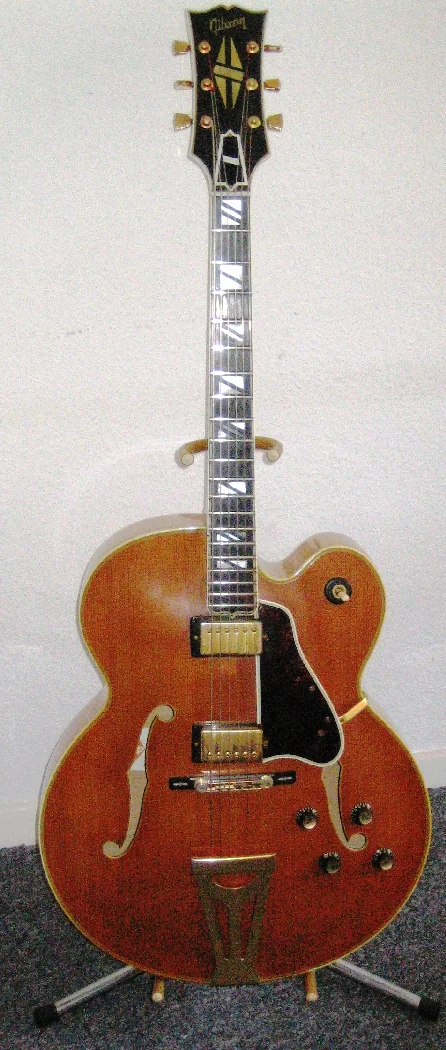
Photo: Cuetty / Clusternote / Wikimedia Commons / CC BY-SA 3.0 Gibson
Super 400
1934
Gibson priced it at $400 in the middle of the Depression and put the price right in the name.
- Send a picture
Gretsch
Rancher
1954
The experts call it a stage prop. That’s exactly why the movies kept casting it.
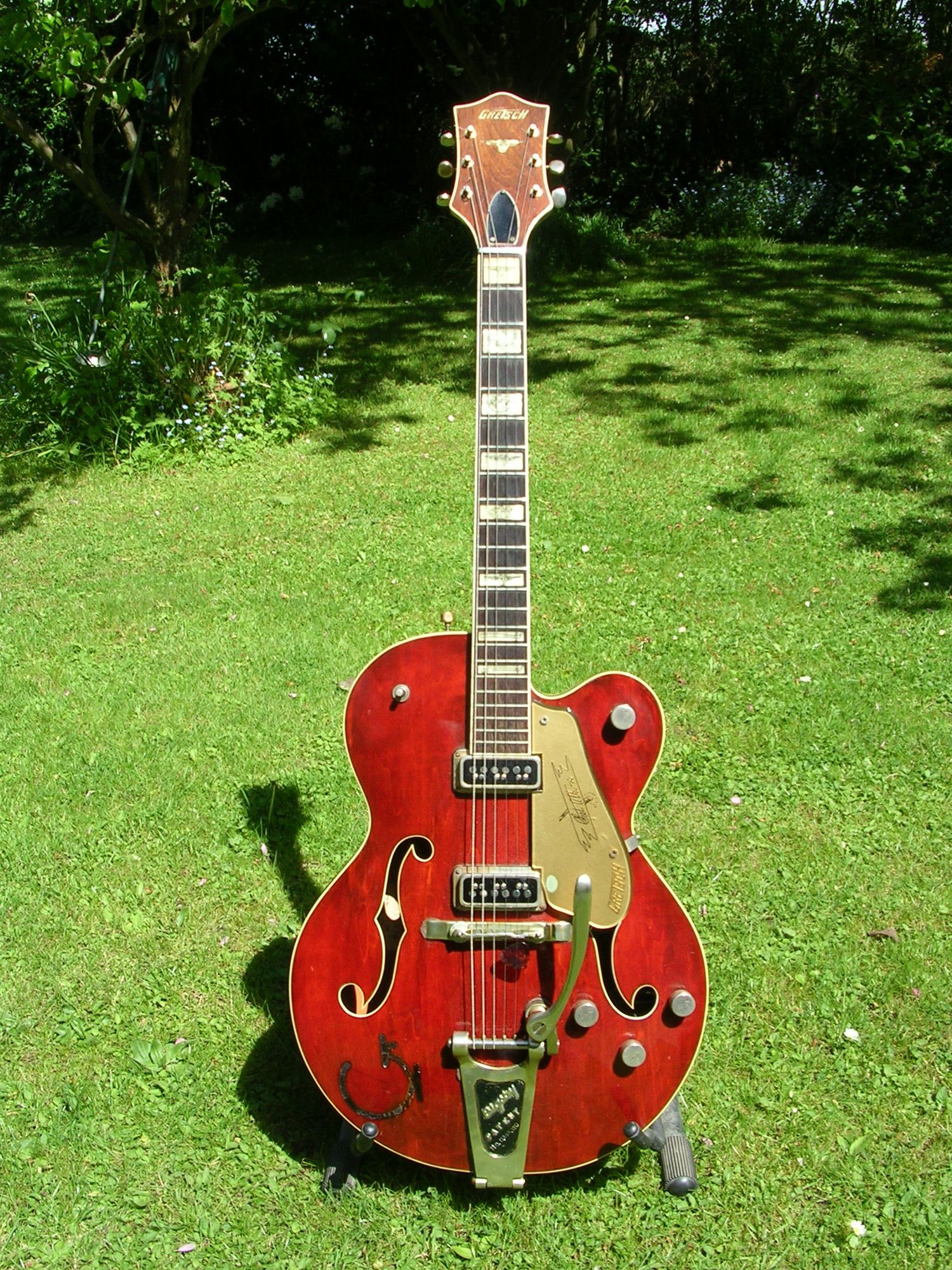
Gretsch 6120 G-Brand 1955. Photo by Francis pullen. Public domain (PD-self). Via Wikimedia Commons. Gretsch
6120
1955
Joe Walsh gave Pete Townshend one. Steve Miller gave Brian Setzer one. Chet Atkins just lent it his name.