Gibson
J-35
Named after its $35 price. The J-45 that replaced it looked just like it, give or take a pickguard.
Kalamazoo, late 1936. Gibson’s big round-shoulder Jumbo has flopped at $60, and Martin’s dreadnoughts are the ones to beat. So the shop builds a plain mahogany one for $35. For a few weeks, it goes out the door with a different name: the Trojan.
- Introduced
- 1936
- Type
- Flat-top steel-string acoustic
- Class
- Production
Have a photograph of this guitar? Send a picture
The short version
1934
The Jumbo flops
Gibson’s first 16-inch round-shoulder lists at $60. It doesn’t sell.
1936
Trojan, then J-35
The first Trojan is logged on 27 October. The J-35 name appears on 10 December.
1937
Bound back, $37.50
Binding on the back, a bigger sunburst, and a small price bump.
1939
Natural, maybe
Some sources say natural tops were offered this year. Another says 1940, maybe not shipping until 1941.
1941
The big year
One table has 797 sunburst plus 28 blond. Other counts say 846 or 855.
1942
The J-45 arrives
First J-45 in the ledger on 17 August. One source has J-35s going through ’43.
1945
The Flatt photo
A Blue Grass Boys photo shows new guitarist Lester Flatt with a natural-top J-35.
Side A
A1
The one before the famous one
Every guitar shop has a J-45 on the wall. Fewer have ever had the guitar it replaced.
Before the J-45 there was the J-35. Same round shoulders, same mahogany, same sixteen inches of Gibson flat-top. It came first, it sold better than any Gibson flat-top of its time, and it was in the pictures when bluegrass was getting started. Then in 1942 a new model took over, and the J-35 turned into a footnote in somebody else’s story.
It deserves better than that.
A2
The price is the name
Gibson’s first big round-shoulder guitar, the Jumbo of 1934, listed at $60 and didn’t sell. In 1936 Gibson tried again with two guitars aimed straight at Martin: a rosewood Advanced Jumbo at $80 to go up against the D-28, and a mahogany guitar at $35 to go up against the D-18, which cost $65. The cheap one got named for its price. J-35.
For its first few weeks it had another name. Gibson’s ledgers log the first “Trojan” on 27 October 1936 and the last on 17 December. The J-35 name appears on 10 December. One later count finds “Trojan” 39 times in the surviving 1936 ledgers. One history says there’s very little difference between the two.
What you got for $35: a 16-inch mahogany body, a sunburst top, three plain tone bars under it, a V-shaped neck, and “Gibson” silkscreened on the headstock. It was light, with a thin top and light bracing. Light guitars like that tend to speak up the moment you hit them. It’s also a guitar that doesn’t forgive rough treatment, and plenty of them got rough treatment.
A3
A guitar that wouldn’t sit still
The J-35 changed almost every year. In 1937 it got a bound back and went up to $37.50. By 1939 the neck was getting rounder and the bracing had moved. Somewhere around then the tone bars went from three to two, and scalloped braces turned up on some guitars and not others. One dealer’s history says Gibson scalloped them “seemingly at will.”
Natural tops are a real fight. Some sources say they were offered in 1939. Another says 1940, “although none may have shipped until 1941.” We’ll leave it there.
What isn’t in dispute is that people bought them. Gibson shipped somewhere around 380 to 400 a year through the late ’30s, and then in 1941 a lot more: 846 or 855 by two counts, 797 sunburst plus 28 blond by another. By one account it outshipped every Gibson model that year except a violin. The rough total is about 3,000, more than any other pre-war Gibson flat-top.
It outsold every Gibson flat-top of its day, and history filed it under “the one before the J-45.”
Flip the record · By the numbers
$35
List price in December 1936, and the name. A Martin D-18 was $65.
39
Times the name “Trojan” shows up in the surviving 1936 ledgers.
855
J-35s shipped in 1941 by one count. Others say 846, or 797 sunburst plus 28 blond.
~3,000
Rough total built, more than any other pre-war Gibson flat-top.
Side B
B1
In the band photos
Here’s where the J-35 turns up. Charlie Monroe holds a sunburst one in the Monroe Brothers photos. When Bill Monroe played his Grand Ole Opry debut in 1939, his guitarist Cleo Davis is pictured with a natural-top J-35. The historian Walter Carter says that if you had been there, you would probably have seen it.
In a 1945 Blue Grass Boys photo, a newly arrived Lester Flatt is holding a natural-top J-35 too. Carter asks whether it was really Monroe’s guitar, and whether it was the same one Cleo Davis had. Nobody knows.
Two things to keep straight. The famous guitar kickoff on Monroe’s 1940 “Muleskinner Blues” is a Martin D-28 story, not this guitar. And Flatt’s famous guitars later on were Martins. The J-35 is in the photographs. That’s what we can say.
B2
Looked just like it
In 1942 Gibson brought out the J-45. The first one shows up in the ledger on 17 August. One history describes it as a guitar that “looked just like the J-35 except for its pickguard and wartime peghead logo,” with bracing a little heavier. One source has the J-35 gone by late 1942. Another says it kept going through ’43.
Gibson makes J-35s again now, in Bozeman, in a few versions, including a careful copy of a 1936. Some modern ones wear the wartime banner logo on the headstock. The original never did.
The J-45 went on to be the one on every shop wall. The J-35 got a footnote. But before there was a J-45 at all, the J-35 was already the guitar in the pictures with Bill Monroe’s band.
The cast
The people, and the specific guitars, that made the legend.
1930s
Charlie Monroe
Sunburst J-35
Holding one in the Monroe Brothers photos.
1939
Cleo Davis
Natural-top J-35
Bill Monroe’s original guitarist. Pictured with a natural J-35 around Monroe’s Grand Ole Opry debut.
1945
Lester Flatt
Natural-top J-35, maybe Monroe’s
Holding one in a 1945 Blue Grass Boys photo. Whose it was is an open question. His famous guitars later were Martins.
1940
Clyde Moody
A Martin D-28, not this
The “Muleskinner Blues” kickoff is a D-28 story, by legend a 1936. Different guitar from the J-35 in the photos.
Liner notes
Specs, construction, rarity, value, and every source we used.
Round-shoulder mahogany jumbo, 1936: Gibson’s J-35 — the guitar the J-45 replaced, not a cousin of it, and not a Super Jumbo.
- Body
- Round-shoulder J-35; thermally aged red spruce top, mahogany back and sides; multi-ply top, single-ply back
- Neck
- Mahogany, Historic profile; compound dovetail neck-to-body
- Fingerboard
- Rosewood, 12" (304.8 mm) radius, mother-of-pearl dots, 19 frets
- Scale
- 628.65 mm / 24.75"
- Pickups
- None (this Custom Historic). Vintage J-35s have none. 30s Faded and Exclusive carry L.R. Baggs VTC.
- Hardware
- Rectangle open-slot, historic spacing; bone saddle; bone pins; nickel strap cream button tuners; AJ pickguard
- Electronics
- None
- Finish
- Thin-finish nitrocellulose, VOS; Vintage Sunburst
- Nut
- Bone, 44.95 mm / 1.77"
Open the full research fileConstruction details, the complete player record, production numbers, dated value estimates, and sources
Current living reissue on Gibson.com, fetched 16 September 2026: Custom 1936 J-35 Reissue (CSRS3536VS), $4,999. Mixed inch/mm flagged on that factory sheet. 30s Faded (OCRS3FAN) is the recent player SKU — Gibson.com marks it no longer available; leftover dealer street $2,199. Exclusive Vintage Sunburst (DTCRS35VS) $2,849, sold out. 2013–2018 Bozeman catalog J-35 is a different SKU. Vintage Kalamazoo 1936–1942 is the original — do not copy thermally aged red spruce, a 1.77" nut, or VOS onto it. Gibson’s 30s Faded sheet calls the body shape “J-45”; that is their shape library, not this model.
Construction
The job was a mahogany jumbo cheap enough to sell. Gibson’s first 16" round-shoulder, the Jumbo of 1934, listed at $60 and did not. Vintage Guitar (Gruhn): in 1936 Gibson replaced it with two dreads aimed at Martin — rosewood Advanced Jumbo at $80 against the D-28, mahogany J-35 at $35 against the D-18 at $65. The name is the price. Not a J-45. That guitar is 1942. Not a J-50. Not a Super Jumbo.
It did not start as J-35. guitarhq: first ledger as Trojan, 27 October 1936, FON 912b; last Trojan 17 December. The J-35 appears 10 December 1936. True Vintage Guitar: the designation shows up late 1936; a later correction puts Trojan in the surviving 1936 ledgers 39 times, only one with an attached FON (960-12, Ridders Music, Atlanta). guitarhq: very little difference between a Trojan and a J-35. Early Trojans can still wear the Jumbo’s deeper, less-tapered body and a 3¾" soundhole; most already taper. No back binding. Square neck block. The name lasted months. This plate starts in 1936.
December 1936 J-35, guitarhq: $35 list, 16" round-shoulder, dark-red mahogany back and sides, 4" soundhole, tapered body, three-on-a-plate plastic-button tuners (often Kluson), single-bound top, no back binding, rectangle bridge with two pearl dots, three non-scalloped tone bars, “V” mahogany neck, small pointy French heel, 24.75" scale, silkscreened “Gibson,” sunburst top. Vintage Guitar: lightweight, thin top, light bracing. Kalamazoo. Current production is Bozeman.
Then the instrument changed in the shop. 1937: back binding, $37.50, “large” sunburst; some scalloped braces seen. 1938: usually a rounded neck heel. 1939: neck from “V” toward round; French heel rounded; X moved closer to the soundhole; two non-scalloped tone bars. guitarhq and True Vintage treat 1939 as the last three-bar year. guitarhq maps three bracing eras. True Vintage (2013): four patterns — three-bar scalloped or not, two-bar scalloped or not — and scalloping “seemingly at will.” Keep both. Natural is a fight. VG’s J-35 plate and guitarhq: offered 1939. VG’s blond plate: option extended 1940, “although none may have shipped until 1941.” True Vintage: 1939 first year natural was offered. Keep all three. Don’t pick.
1940: VG says two scalloped tone bars by this year. guitarhq keeps two non-scalloped through 1940, two scalloped 1941–42, and a French heel returning. Don’t flatten 1940. 1941: sunburst or natural; some drop-in saddles; narrower bridge spacing. guitarhq list $40 sunburst / $45 natural, then late 1941 $42 / $47.25. Two scalloped bars — guitarhq: the same style the new J-45 would use. 1942: a few opaque “blond” tops that are not natural (VG blond plate; guitarhq). FON letter H.
End year is split. guitarhq: discontinued late 1942, replaced by the J-45. True Vintage: produced up until 1942, when Gibson introduced the J-45. VG’s J-45 plate (Gruhn/Carter, March 2008): by August, a new dreadnought that “looked just like the J-35 except for its pickguard and wartime peghead logo,” bracing a little heavier. First J-45 ledger 17 August 1942. VG’s own J-35 plate: production continued through ’43. Keep 1942 replacement and through-’43. The J-45 is the next guitar. It is not this one with a new sticker.
Do not hang J-45 banner shortages, square-shoulder 1969–82, or Dylan’s debut cover here. Those live on gibson-j-45 and gibson-j-50. Advanced Jumbo is the rosewood sibling, 1936–40, not this table.
Bozeman is not 1936. Reverb files a reissue window 1994–2018, a late-1980s return, a 1995 limited run of 250, and a later RS35 catalog guitar; its overview also prints “2012–present.” Gibson’s own 2013 page is the modern equivalent with Sitka, hide-glue dovetail, firestripe, and a Baggs Element. True Vintage (2013): Fuller’s had a 2000s sunburst first; the 2013 production guitar added natural, Kluson-style tuners, a banner logo, and an L.R. Baggs Element. True Vintage: the original J-35 never wore a wartime banner — that logo is a Bozeman tell, not a 1936 one. The table above is Custom Historic 1936: thermally aged red spruce, hide glue, 1.77" bone, no pickup. 30s Faded is satin Sitka, 1.73" bone, VTC, 19 frets — Gibson.com no longer selling it. Neither is a FON-B Trojan.
Players
Named instruments and sourced photographs. Do not dump J-45 / J-50 / J-200 / Southern Jumbo players onto this plate.
Charlie Monroe — sunburst J-35. Walter Carter (Carter Vintage, D-28 history): earlier Monroe Brothers photos show Charlie with a sunburst J-35. Band guitar in the photograph. Not a session log for a named side.
Cleo Davis — natural-top J-35 at Monroe’s Grand Ole Opry debut, 1939. Carter: if you had been there, you would probably have seen the instrument Monroe’s original guitarist is pictured with — a natural-top Gibson J-35. The 1940 “Muleskinner Blues” kickoff is a D-28 story (Clyde Moody’s 1936, by legend). Two guitars. Don’t collapse them.
Lester Flatt — 1945 Blue Grass Boys photograph, natural-top J-35. Carter: a 1945 band photo shows newly arrived Flatt holding a natural-top J-35. Carter asks whether it was actually Monroe’s, and whether it was the same guitar Davis is pictured with. Leave the question. Do not upgrade the photograph to the 1946–47 Columbia sessions. Flatt’s later famous instruments are Martins: a 1942 D-18 (Tut Taylor / Bluegrass Heritage Foundation; the D-28 plate already flags this) and the 1950 “L-5” D-28 Marty Stuart donated to the Country Music Hall of Fame. Those are not this guitar.
Woody Guthrie’s “This Machine Kills Fascists” stencil is a Southern Jumbo, not a J-35. Dylan’s debut cover is a J-50. Buddy Holly’s leather jumbo is a J-45. Page’s Led Zeppelin I acoustic is a borrowed J-200. Elvis is J-200. Do not migrate them.
Also known to play stays short. Unsourced celebrity lists are not used.
Rarity
You can order a new Custom 1936 J-35 from Gibson.com. That is a Historic recreation. It is not vintage rare. 30s Faded leftover and 2013–2018 Bozeman catalog guitars are used-modern supply. Bozeman unit counts are unpublished.
The scarce object is Kalamazoo, 1936–1942 (VG: through ’43). guitarhq: about 3,000 Jumbo 35s, more than any other pre-WW2 Gibson flat-top — guitarhq’s own order-of-magnitude, not a closed census. guitarhq’s shipping table (pre-WW2 numbers “probably not very accurate”): no pre-1937 cell; 1937: 385; 1938: 335; 1939: 497; 1940: 435; 1941: 797 sunburst plus 28 blond; war years ?; printed total 2,449 + 28. VG: average 380 a year 1937–40; 1941 surged to 855, topping every Gibson model except the V-25 violin. VG blond plate: averaging over 400 a year 1937–40; 1941 shipments 846 including 49 natural tops. Keep 380 / over-400, and keep 797 / 846 / 855. Do not average them into a factory total.
Trojan 1936 is the thin first object — months, a handful of FON batches. Natural / blond is the scarce finish: guitarhq 28 blond in 1941; VG 49 naturals that year. Opaque 1942 blond is a handful (VG). Three-bar 1936–39 vs two-bar later is a dating fact, not a production count. FONs date a guitar. They don’t count a year.
Value
Informal estimate, 16 September 2026. Not an appraisal.
Historical lists, not 2026 street: $35 (guitarhq, December 1936); $37.50 (1937; VG blond plate uses that figure for the late-1930s guitar); $40 / $45 then $42 / $47.25 (guitarhq, 1941 sunburst / natural). VG: about half a new Martin D-18.
New street. Custom 1936 Reissue $4,999 (Gibson.com, 16 September 2026). 30s Faded leftover $2,199 (Guitar Center sold out; Music & Arts still printing that figure). Exclusive Vintage Sunburst $2,849, sold out on Gibson.com. 2013 catalog starting $1,699 / MSRP $2,190 is 2013 money. Reissues are not 1936.
Used modern. Reverb Price Guide on J-35 Reissue 1994–2018: estimated used $1,039–$1,642 (376 orders, Good to Mint). Named 2026 solds on that page: 8 August Very Good $1,400; 18 July Good $1,299; 11 July Very Good $1,349; 10 July Very Good $1,350; 8 July Very Good $1,499; 12 May Very Good $1,300; 6 May Very Good $1,750. 30s Faded used is leftover-player money: Guitar Center Excellent $1,649.99. Custom Historic used listings sit under new street (Reverb “from $2,842” on that family) — listing floor, not a sold median. Ask ≠ sold unless labeled.
Vintage / collectible. Public 2024–26 sold histograms are thin. Prefer labeled asks. Reverb’s vintage J-35 1936–1942 marketplace prints a listing neighborhood from $16,487.29 (three comps) — not a hammer. Named asks, not a series: Mass Street Music 1941 natural Excellent $22,000; Musician’s Friend 1940s natural Good, restored (neck reset, cleated cracks) $9,999.99. Do not average those into a median. Original finish vs refinish, neck reset, and replaced bridge move a pre-war J-35 a full tier. VG: lightly built examples not treated with care frequently fall into poor condition. Artist-owned J-35s, if any surface, are a separate market. Not a comp.
See also
- gibson-j-45 — the 1942 round-shoulder that replaced this one; wartime banner lives there
- gibson-j-50 — natural-top sibling of the J-45, not this guitar; Dylan’s debut cover lives there
- martin-d-18 — the square-shoulder mahogany dreadnought this was priced against
Sources
- guitarhq, Gibson J-35 / Trojan — 1936–1942; Trojan 27 Oct–17 Dec 1936; J-35 ledger 10 Dec 1936; $35 / $37.50 / 1941 $40–$47.25; 16"; 24.75"; three bracing maps; ~3,000; FON batches
- guitarhq, Gibson flattop shipping — J-35 1937–41 cells; 28 blond 1941; war ?; pre-WW2 accuracy footnote
- Vintage Guitar, Gruhn, Gibson J-35 — 1936; $35 vs D-18 $65; 16"; three then two bars; French heel; natural by ’39; through ’43; ~380/year 1937–40; 855 in 1941
- Vintage Guitar, Gruhn, Gibson’s “blond” J-35 — Jumbo 1934 then AJ + J-35 1936; $37.50; over 400/year 1937–40; natural option 1940 / maybe no ships until 1941; 846 in 1941 incl. 49 natural; J-45 by August 1942; opaque blond 1942
- Vintage Guitar, Gibson J-45 — Trojan late 1936; J-35 tapered depth; J-45 looked like J-35 except pickguard and wartime logo, slightly heavier bracing; first J-45 ledger 17 August 1942
- Gibson Custom 1936 J-35 Reissue — CSRS3536VS; $4,999; thermally aged red spruce; 44.95 mm / 1.77 in; 628.65 mm / 24.75 in; no pickup
- Gibson J-35 30s Faded, Natural — OCRS3FAN; no longer available on Gibson.com; Sitka; satin nitro; VTC; body shape listed “J-45”
- Gibson J-35 Exclusive Vintage Sunburst — DTCRS35VS; $2,849 sold out
- legacy.gibson.com, 2013 J-35 — introduced 1936; 2013 modern equivalent; $1,699 starting / Antique Natural MSRP $2,190
- True Vintage Guitar, 1939 J-35 — J-35 late 1936; Trojan 39 ledger entries / FON 960-12; until 1942; 1939 natural and last three-bar year
- True Vintage Guitar, 2013 J-35 — precursor to J-45 1936–1942; Fuller’s 2000s; 2013 Bozeman with Element and banner
- Carter Vintage, Walter Carter, D-28 history — Charlie Monroe sunburst J-35; Cleo Davis natural J-35, 1939 Opry; Lester Flatt 1945 photo, natural-top J-35
- Reverb Price Guide, J-35 Reissue 1994–2018 — used $1,039–$1,642; named 2026 solds; overview 1995 run of 250 / RS35 / 2012–present
- Reverb, J-35 1936–1942 — vintage listing neighborhood from $16,487.29; Mass Street 1941 natural ask $22,000
- Guitar Center, J-35 30s Faded — $2,199 sold out
- Music & Arts, J-35 30s Faded — $2,199
- Guitar Center, used J-35 30s Faded — Excellent $1,649.99
- Musician’s Friend, 1940s J-35 Natural — restored Good ask $9,999.99
- Reverb, Custom Shop Historic 1936 J-35 — used listings from $2,842
Keep digging
Guitars this one gets compared to, confused with, or descended from.
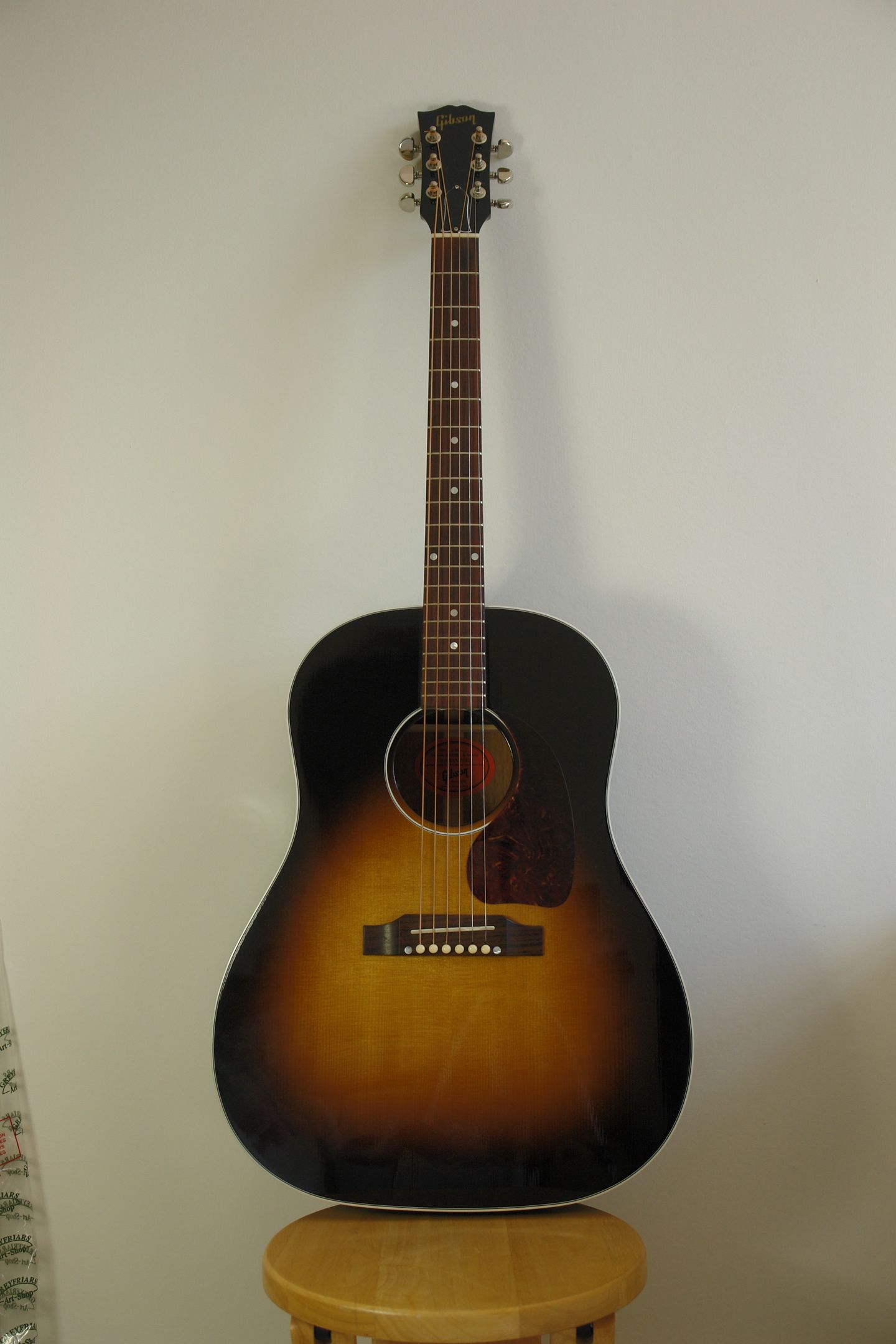
Gibson J-45. Photo by Jim Hutcheson. Licensed under CC BY 2.0. Via Wikimedia Commons. Gibson
J-45
1942
Born in 1942 out of whatever wood a wartime factory could find. Gibson calls it its best-selling acoustic ever.
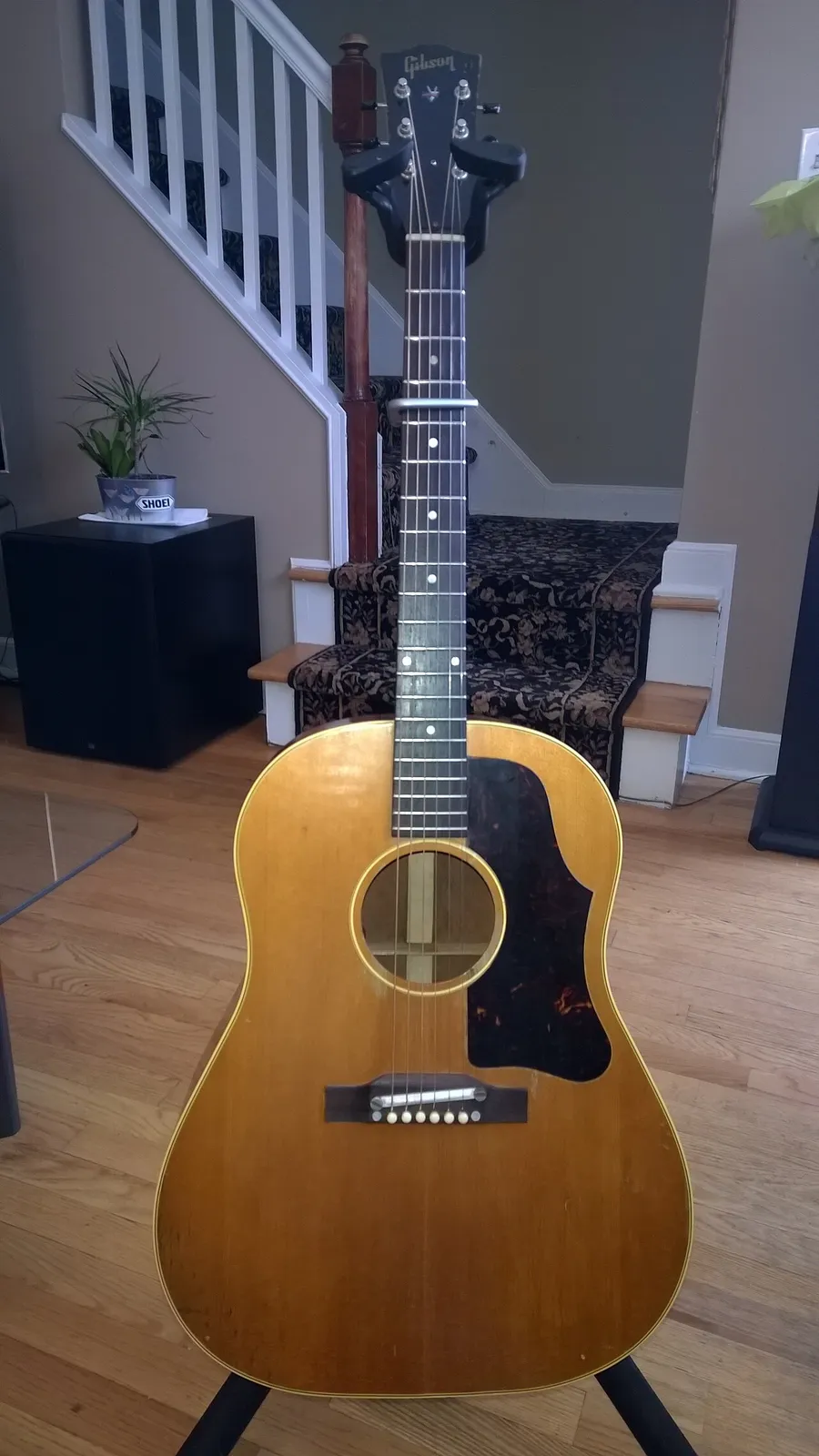
Photo: sbaimo from United States / Wikimedia Commons / CC BY 2.0 Gibson
J-50
1942
The J-45 with nothing to hide: a bare natural top, five dollars more, and Bob Dylan’s first album cover.
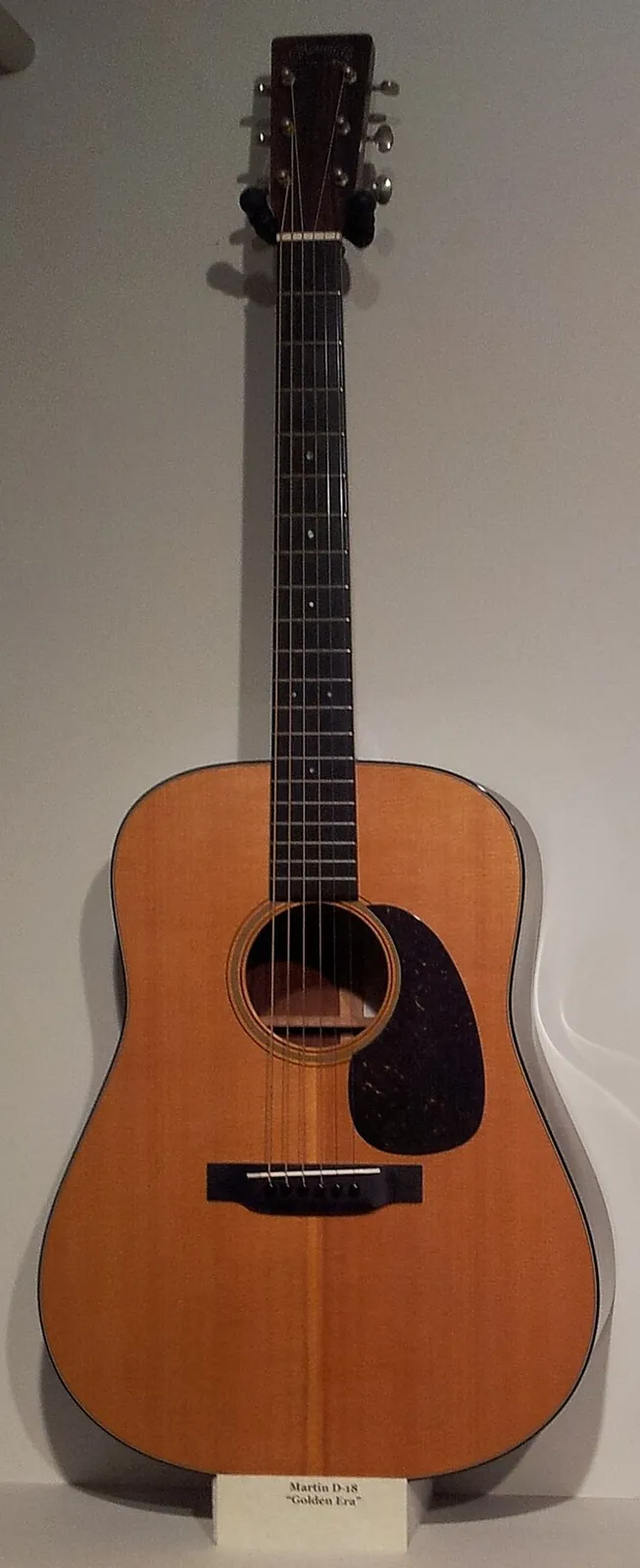
Photo: doryfour / Wikimedia Commons / CC BY-SA 2.0 Martin
D-18
1931
Elvis traded his D-18 up for a leather-covered D-28. The plain one had already been there for the Sun records.