Eko
Ranger 6
Not the dreadnought anybody dreamed about. The one Europe could actually get.
Recanati, on Italy’s Adriatic side, the mid-1960s. The folk boom wants big square-shouldered guitars like the American ones, and Oliviero Pigini’s company can build one that doesn’t have to come all the way from Pennsylvania.
- Introduced
- 1967
- Type
- Acoustic flat-top
- Class
- Production
Have a photograph of this guitar? Send a picture
The short version
1960
Eko is founded
Oliviero Pigini’s company is constituted in July. English-language sources say 1959.
1962–66
The guitar before the name
A jumbo called the J-52, then the bolt-on J-54. The sources don’t agree on which year is which.
1967
Ranger
The J-54 and the 12-string J-56 become the Ranger VI and Ranger XII. Pigini dies in February.
1970
Rose-Morris
In the UK catalog as model 1780, £30 10s. Eko calls the 12-string that year’s best-selling 12-string in the world.
~1973
The plainer rosette
A simpler stencil replaces the ornate rosette. The finish gets thinner and the bracing improves.
1984
Out of the catalog
The Ranger is replaced by the AW. Eko closes in 1985.
1987
Bought back
Lamberto Pigini buys the brand. The Rangers that follow are made elsewhere.
Side A
A1
The guitar you could get
Picture somebody in Europe in the late 1960s who wants a big folk guitar. The one in the photographs is a Martin, and a Martin is made in Nazareth, Pennsylvania, a long way off and a lot of money away.
What’s in the shop window is an Eko. It has square shoulders, a spruce face, a rosewood board, and the big body of the American ones. It’s heavy for its size. Tip it over and there’s a metal plate and four screws where the neck meets the body.
That’s the Ranger 6. It was never the dreadnought anybody dreamed about. It was the one you could actually get.
A2
A company in Recanati
Eko was Oliviero Pigini’s company, in the town of Recanati. Italian records say it was constituted on July 28, 1960; English-language sources say 1959. In the 1960s the electrics were the main business, and the acoustics were a side job.
The guitar under the Ranger name is older than the name, and nobody agrees on exactly how much older. Eko’s own pages say both 1962 and 1964 for the first jumbo. One history has a glued-neck J-52 in late 1964, then the bolt-on J-54 soon after. Another puts the bolt-on and the J-54 name in 1966. The 12-string was the J-56.
Most sources settle on 1967. That year the J-54 became the Ranger VI and the J-56 became the Ranger XII. Oliviero Pigini died in Recanati that February.
A3
Four screws and a tilt
The Ranger was a laminate guitar all the way through, top included. It never pretended to be a Martin.
The neck is the clever bit. Instead of a glued dovetail, it’s held by four screws and a metal plate, so the neck angle can be tilted to set the action. There’s no heel in the way of the high frets. The bridge adjusts too, and the saddle is aluminum. There’s a zero fret at the nut. The body came out bigger and squarer than the dreadnoughts from Kalamazoo.
The plate and screws add weight, which is why a Ranger feels heavier than it looks.
The finish is polyester, thicker on the early ones. You’ll see old Rangers covered in cracks, and they look worse than they are. Often only the finish has cracked, and the wood underneath is fine.
Flip the record · By the numbers
100,000+
Italian Rangers, six- and 12-string together, by one historian’s estimate. Possibly closer to 200,000.
4
Screws, plus a metal plate, holding the neck on.
£30 10s
The six-string acoustic in Rose-Morris’s April 1970 UK catalog.
Side B
B1
When Eko became an acoustic company
Two things changed the Ranger’s place in the company. First, the electrics dried up. Vox shipments ended in 1968, LoDuca’s in 1971, and cheaper Japanese electrics were squeezing the middle of the market. The acoustics became the center of Eko.
Second, Britain. Rose-Morris carried the line, and in the April 1970 book the plain six-string Ranger is model 1780 at £30 10s. A six-string with a pickup was £41 19s. Eko says the Ranger 12, sold with Rose-Morris, was the best-selling 12-string in the world in 1970.
Around 1973 the guitar changed. The ornate rosette gave way to a plainer stencil. One of the people who has studied them most closely actually prefers the later ones as instruments, with thinner polyester and better bracing. The early ones are the ones that look old.
B2
Page didn’t play it
This is where the Ranger gets its most famous wrong story. Dealer listings love to say Jimmy Page played one on a Led Zeppelin record.
He didn’t, as far as anyone can prove. “Thank You” was recorded on a Vox 12-string. The acoustic credited with most of Led Zeppelin III and the acoustic parts of “Stairway to Heaven” is a Harmony Sovereign. Page, Gerry Rafferty, and Mike Rutherford were all seen with Eko guitars at some point. No Ranger 6 session credit has turned up for any of them.
No famous record is pinned on this guitar, and that fits. It was never a star’s guitar.
B3
Still everywhere
The Ranger left the catalog in 1984, replaced by a model called the AW. Eko closed in 1985, and Lamberto Pigini bought the brand back in 1987. In 2000 came reproductions from the Czech Republic, and later reissues from the East.
You can buy a new Ranger 6 today. It’s a student guitar with the old name on it, from a revived brand whose guitars have mostly come from Asia since the 1990s. It isn’t the Recanati laminate. The Ranger VI VR comes closer, with the bolt-on neck, the zero fret, and the aluminum saddle.
The originals are easy to find, though. Somewhere between a hundred and two hundred thousand Rangers left Recanati, six- and 12-strings together. That’s why they still turn up everywhere. They were never anybody’s dream guitar. They were the one people could actually get, and there were enough of them to go around.
The cast
The people, and the specific guitars, that made the legend.
1967
Oliviero Pigini
Founder of Eko
Built Eko in Recanati and died there in February 1967, the year the guitar took the Ranger name.
1987
Lamberto Pigini
Bought the brand back
Revived the Eko name after the 1985 closure.
1969
Jimmy Page
Not a Ranger 6
Dealer copy likes to hang “Thank You” or “Stairway” on one. The first is a Vox 12-string, and the main Led Zeppelin III acoustic is a Harmony Sovereign.
Liner notes
Specs, construction, rarity, value, and every source we used.
Laminate spruce, a four-screw neck, and an aluminum saddle — the Italian dreadnought Europe's folk boom could buy.
- Body
- Dreadnought / jumbo. Laminate spruce top, mahogany back and sides. vintageguitarandbass.com: standard Ranger about 16½" wide and 4¾" deep; Ranger Folk 15¼" and 3¾". Mix flagged.
- Neck
- Bolt-on. Eko's company history: the J54 jumbo that became this guitar used four screws and a metal plate.
- Fingerboard
- Rosewood, dot markers, zero fret on the Italian run. Fret count is not one factory figure (dealer sheets print 20, or 21 plus the zero).
- Scale
- No single Italian factory figure. Current Eko sheet: 650 mm. Dealer tapes on 1970s examples: 628 mm and 642 mm; one seller prints 65 cm. Do not average. Mix flagged.
- Pickups
- None on the plain acoustic. Rose-Morris 1894 is the six-string with a pickup.
- Hardware
- Adjustable bridge. Jack Marchal: aluminum saddle. Individual all-metal machines on the period guitars.
- Electronics
- None on this table
- Finish
- Polyester. Marchal: thicker early; thinner and more even after about 1973. Checking is common, and finish-deep.
- Nut
- Unpublished for the Italian run. Current Eko sheet: 43 mm, beside a 14" radius. Mix flagged.
Open the full research fileConstruction details, the complete player record, production numbers, dated value estimates, and sources
Classic living example = Italian Ranger VI / Ranger 6 (Recanati), the plain acoustic — Rose-Morris 1780 in the April 1970 book. Ranger Folk is the smaller body. Ranger XII is the 12-string. Vox Country-Western (1965–68) is another badge. The current Ranger 6 is a different guitar: Eko's sheet says spruce, linden, okoumé, South American roupanà, plastic nut and saddle, 20 frets, 650 mm, 43 mm, 14" radius, gloss, die-cast, no electronics. Ranger VI VR keeps the bolt-on, the zero fret, and the aluminum saddle. Inch widths and millimetre scales sit together — mix flagged. Do not average 628 mm / 642 mm / 65 cm / 650 mm, or Eko's 650 mm against Promenade's 655 mm and Musician's Friend's 25.5".
Construction
Recanati, folk boom. The job was a dreadnought Europe could put on a wall without waiting on Nazareth. Laminate, top included. A neck you could tilt. A saddle you could raise. Heavy, because the joint is a plate and four screws, not a dovetail.
Oliviero Pigini's company was constituted 28 July 1960 (Italian Wikipedia). The English Wikipedia dates the founding to 1959. He died in Recanati on 10 February 1967, the year this guitar took the Ranger name.
The first year is a fight, and so is the first number. Eko's Vintage Reissue page: 1962, folk guitars on the American dreadnought shape, first 6-string named J54. Eko's company timeline, under 1964: the jumbo, neck fixed by four screws and a metal plate, J54 and 12-string J56, later Ranger 6 and Ranger 12. Jack Marchal: glued neck in late 1964 as J-52, soon the bolt-on J-54 and the J-56. Accordo, 14 February 2017: J-52 in 1964, glued; bolt-on and the J-54 name in 1966; officially Ranger in 1967. Eko's Ranger-series page and Marchal agree on 1967 for the rename — Marchal says early 1967. This plate starts at 1967. Keep 1962, 1964, and 1966 for the guitar underneath the name.
Once it is a Ranger it is a square-shouldered laminate box. Marchal: laminated woods, not a solid top and a set neck. Accordo: laminate through the top, bigger and squarer than the Kalamazoo dreadnoughts, no heel blocking the high frets, action set by tilting the neck and by the bridge. The 1970 Rose-Morris sentence we have in words is for the smaller Ranger Folk: spruce-faced ply, mahogany back and sides, polyester, detachable neck, adjustable double T-bar, rosewood board, adjustable rosewood bridge. That is model 1781, not this body. vintageguitarandbass.com puts the standard Ranger about 16½" wide and 4¾" deep, the Folk an inch and a quarter narrower and an inch shallower.
Marchal's split is about 1973. Ornate rosette before, plainer stencil after. He prefers the later ones as instruments: thinner polyester, improved bracing. The early ones are the ones that look old. Cracks in the finish are often only in the polyester.
Acoustics were a side job in the 1960s. Marchal: they became the center of the company after Vox shipments ended in 1968 and LoDuca's in 1971, with Japanese electrics squeezing the middle. Little-changed guitars left as Vox Country-Western and Folk Twelve, 1965–68. Other badges. Eko's history says the Ranger 12, with Rose, Morris & Co., was the world's best-selling 12-string in 1970. That is the XII. Rose-Morris 1780 is this six-string acoustic, £30 10s in the April 1970 book. 1894, £41 19s, is the six-string with a pickup. Knobs and a soundhole unit mean the Electra, not the 1780.
Classic2Vintage: the Ranger left the catalog in 1984, replaced by the AW; Eko closed in 1985; the bankruptcy petition is 21 May 1986. Accordo's "another ten years" after the late 1960s is a shorter clock. Keep both. Lamberto Pigini bought the brand back in 1987. Eko's Back (2000) was Czech reproductions. Accordo dates an Eastern reissue to 2008. Amazon's 50th Anniversary listing (first listed 1 November 2009; page unavailable this pass) said 1,000 worldwide, solid Sitka, rosewood, a 1967-style bridge. Listing copy, not a ledger.
What Eko sells now as Ranger 6 is the student guitar on the sheet above. The official page does not say the factory, or bolt-on versus set. Piazza Strumenti prints birch and a set neck. Do not average that with okoumé. Ranger VI VR is the closer shape: bolt-on, zero fret, rectangular dots, aluminum saddle. Promenade measures one at 655 mm, 43.39 mm, 15" radius, laminated Sitka and sapele. Eko prints 650 mm, 43 mm, 14". Musician's Friend prints 25.5", 22 frets, rosewood, China, and the word parlor. The last of those is the wrong body. French Wikipedia: since the 1990s the revived brand has sold guitars essentially made in Asia. A new Ranger 6 is that company. It is not a 1967 Recanati laminate.
Players
The people who made this guitar matter did not leave a single agreed serial. It was the dreadnought you could get.
Zachary Fjestad, Premier Guitar, 4 November 2018: the Ranger line "came out in the 1970s," and Gerry Rafferty, Jimmy Page, and Mike Rutherford "were all seen playing Eko guitars." He dates the line later than 1967. He does not say Ranger 6, and he does not name a song.
Jimmy Page is where the mash happens. "Thank You," Morgan Studios, 1969: Wikipedia says a Vox 12-string. The acoustic the Met showed with his rig, credited with most of Led Zeppelin III and the acoustic parts of "Stairway to Heaven," is a Harmony Sovereign H1260, serial 9631111260. Dealer copy that hangs either track on a Ranger 6 is the wrong guitar. A 12-string Eko, if a photograph holds, is a Ranger XII.
No Ranger 6 session credit for Rafferty or Rutherford turned up either. Also known to play stays empty on purpose.
Rarity
A new Ranger 6 is a catalog student guitar. The VR is a reissue with the old joint and the zero fret. Neither is the Recanati laminate.
The Italian run was ordinary production, which is why they are still everywhere. Marchal: at least 100,000, six- and 12-string together, possibly closer to 200,000. His estimate, not a factory book, and not a Ranger 6-only count. Eko published no Ranger 6 total. None invented. A neck plate dates a guitar. It does not count a year.
Thinner inside that pile: Marchal's pre-1973 rosette; a plain 1780 with the bridge and the polyester left alone; a guitar still badged J-54. Folk, XII, Vox Country-Western, and Electra are other objects. The anniversary listing's 1,000, if it was real, is a 2009 cap, not 1967.
Value
Informal estimate, 24 September 2026. Not an appraisal.
Ask vs sold labeled. No celebrity Ranger 6 lot, so no not-a-comp to park. No invented medians. £30 10s (Rose-Morris 1780, April 1970) and £41 19s (1894) are 1970 money. The 1973 Folk, model 1781, £29.13, is the smaller body.
New street. The living Ranger 6 is ordinary European money, and it is not the Italian guitar. idealo.it €88.90–€99 (black updated 30 August 2026, €88.90–€98.90). Banana Music, Red Sunburst, 20 September 2026, €99 (was €110). Groove DJ Point, black, €89. Piazza Strumenti, blue sunburst, €70.87. Euroguitar, natural, €109. Ranger VI VR: Bax Music, natural, £207 including VAT (recommended £277). A current Reverb ask, MCpro, new VR EQ natural, $274.99. Do not blend those into one midpoint.
Used modern. A Reverb "similar products" line showed Ranger 6 VR used from $350, new from $186.77 — a snapshot, not a sold median. Subito asks on 23 September 2026 included €55 and €65 for recent Ranger 6s and €130 for one VR. Asks. Higher asks sat on the same page. Don't average them.
Vintage / collectible. No Reverb Price Guide widget for the Italian Ranger 6 isolated this pass. Flag: thin sold-comp access. Named hammers, not a series: Omega Auctions, 4 July 2023, a pair of circa-1970 Ranger 6s with cases, £70 for the pair. Gardiner Houlgate, 9 December 2020, one, sold £60 (estimate £40–60). Barnebys, 4 February 2026, one 6-string, hammer $81 (estimate $28); condition unpublished. One Reverb sale of a 1967, about three years before this pass, $652. Do not average a pair-lot with a single restored guitar. Named asks, not hammers: a 1967 at $389.58; a 1970s excellent at $837.15, seller away. Page's Sovereign is a different guitar.
See also
- yamaha-fg180 — Hamamatsu's 1966 folk jumbo; not this Recanati laminate
- martin-d-28 — the American dreadnought this shape was built against; not an Eko
- seagull-s6 — La Patrie's later folk dreadnought; not the Ranger
Sources
- Eko, Ranger series — J-54 / J-56 named Ranger VI and Ranger XII in 1967; current series woods
- Eko, Ranger 6 Black — spruce, linden, okoumé, roupanà, 43 mm, 14", 650 mm, 20 frets, plastic nut and saddle
- Eko, Ranger VI VR Natural Top Stained — 1962 / J54 telling; bolt-on, aluminum saddle, zero fret; 650 mm, 43 mm, 20 frets
- Eko, company history (Italian) — 1964 jumbo, four screws, J54 / J56 later Ranger 6 / 12; 1970 Ranger 12 and Rose, Morris; 1985 close; 1987; Eko's Back, 2000, Czech Republic
- Jack Marchal, The Eko Ranger Series — late 1964 J-52; J-54 bolt-on; early 1967 rename; Vox 1965–68; ≥100,000 / closer to 200,000; laminate; ~1973 split
- Accordo, Eko Ranger: nascita e rinascita di un mito, 14 February 2017 — 1964 J-52 glued; 1966 bolt-on J-54; Ranger in 1967; laminate including the top; 2008 Eastern reissue
- vintageguitarandbass.com, 1973 Eko Ranger Folk — 16½" × 4¾" standard vs Folk 15¼" × 3¾"; 1970 Folk catalog text; 1973 model 1781 at £29.13
- vintageguitarandbass.com, 1970 Rose-Morris catalog p. 7 — model 1780 £30 10s; electric-acoustic 1894 £41 19s
- Classic2Vintage, Eko — the 1980s — Ranger gone in 1984; closed 1985; bankruptcy petition 21 May 1986
- Wikipedia, Oliviero Pigini (Italian) — constituted 28 July 1960; died 10 February 1967, Recanati
- Wikipedia, Eko Guitars — founded 1959; Recanati
- Wikipedia, Eko (French) — Ranger 6 and 12; Asia-made logo guitars since the 1990s
- Premier Guitar, Zachary Fjestad, 4 November 2018 — Rangers "came out in the 1970s"; Rafferty, Page, Rutherford seen with Eko guitars
- Wikipedia, Thank You (Led Zeppelin song) — Morgan Studios, 1969; Page on a Vox 12-string
- Wikimedia Commons, Jimmy Page's rig, Met — Harmony Sovereign H1260, serial 9631111260
- Musician's Friend, Ranger VI Vintage Reissue — China; 1.69" (43 mm); 25.5"; 22 frets; rosewood; "parlor"
- Promenade Music, Ranger VI VR — laminated Sitka and sapele; 655 mm; 43.39 mm; 15" radius
- Bax Music, Vintage Reissue Ranger VI Natural — £207 incl. VAT; laminated; 650 mm
- Woodbrass, Ranger VI EQ — 25.6" / 650 mm; 43 mm / 1.69"
- Banana Music, Ranger 6 Red Sunburst — €99 on 20 September 2026
- idealo.it, Eko Ranger 6 — €88.90–€99; black updated 30 August 2026
- Groove DJ Point, Ranger 6 Black — €89
- Piazza Strumenti, Ranger 6 Blue Sunburst — €70.87; birch and set-in on the dealer sheet
- Euroguitar, Ranger 6 Natural — €109
- Omega Auctions, 4 July 2023, lot 286 — pair, £70 hammer
- Gardiner Houlgate, 9 December 2020 — one 1970s Ranger 6, sold £60; estimate £40–60
- Barnebys, 4 February 2026 — hammer $81; estimate $28
- Amazon, Ranger 6 50th Anniversary — listing copy: 1,000, solid Sitka, rosewood; page unavailable this pass
- Reverb, Eko Ranger VI (1967) — sold about three years before this pass at $652
,_2%C3%97_Marshall_1959_Super_Lead,_Super_Bass,_3%C3%97_4%C3%9712in._cab.,_etc._-_Play_It_Loud._MET_(2019-05-13_19.09.34_by_Eden,_Janine_and_Jim).jpg)
Keep digging
Guitars this one gets compared to, confused with, or descended from.
- Send a picture
Yamaha
FG180
1966
Built to survive a ship’s hold. Decades later, the photos put one in Elliott Smith’s hands at the Oscars.
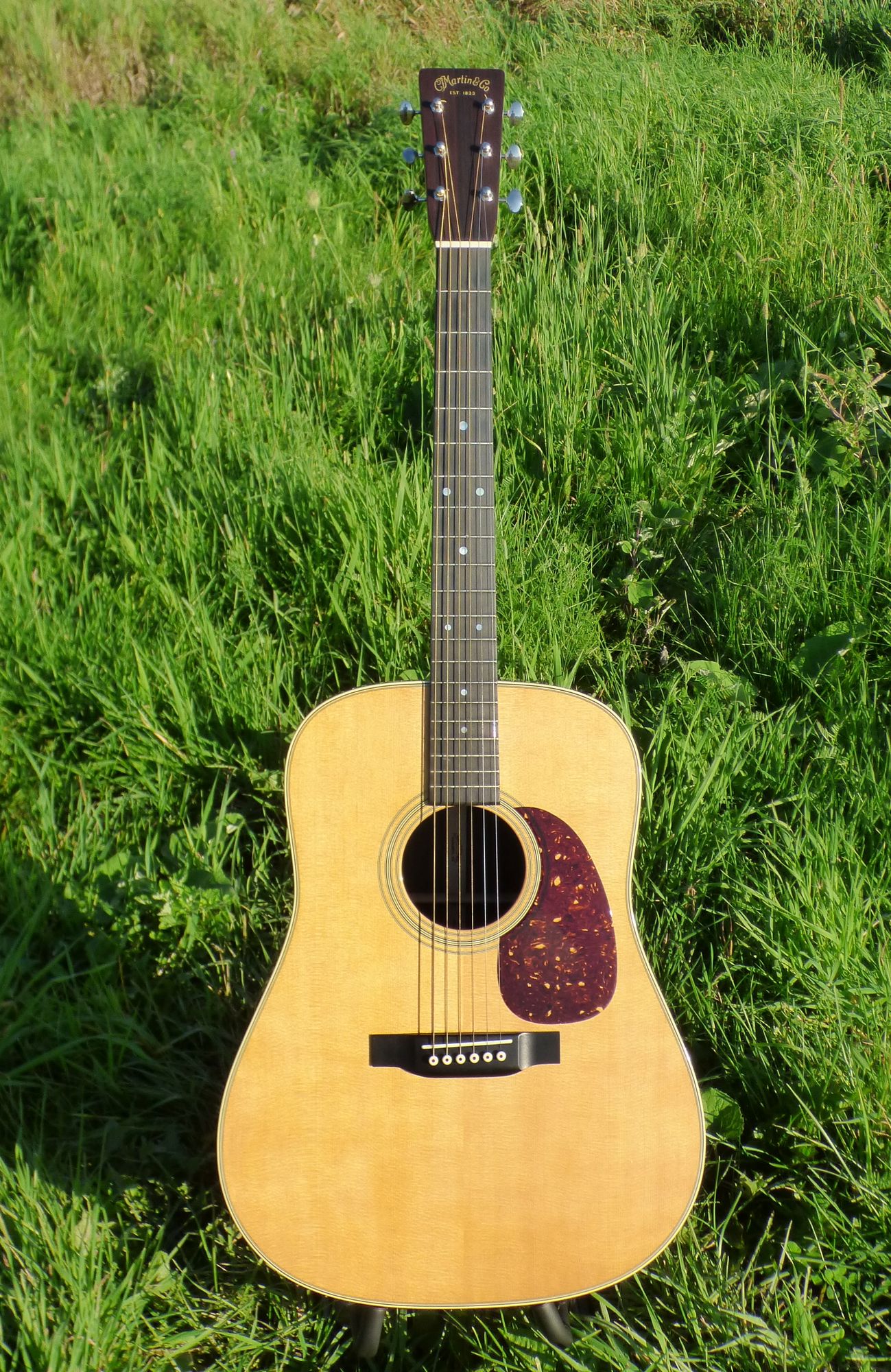
Martin D-28 Acoustic Guitar. Photo by Niranjan Arminius. Licensed under CC BY-SA 4.0. Via Wikimedia Commons. Martin
D-28
1931
You’ve heard a D-28 your whole life. It just never asked for the credit.
- Send a picture
Seagull
S6
1982
Kim Deal liked it because it sounded flat and dull. James Blunt took his to Kosovo.