Gretsch
Rancher
The experts call it a stage prop. That’s exactly why the movies kept casting it.
Brooklyn, 1954. Gretsch takes a 17-inch jumbo it already makes, paints it orange, cuts a triangle for a soundhole, and engraves a steer’s head on the pickguard. The 1955 catalog pitches it at “Hill-billy and Cowboy bands.” It was never going to beat a Martin. It was built to be seen.
- Introduced
- 1954
- Type
- Acoustic flat-top
- Class
- Production
Have a photograph of this guitar? Send a picture
The short version
1947
The body
Gretsch designs a 17-inch jumbo flat-top, the Synchromatic 125F.
1954
The Rancher
The same body gets the cowboy kit and a new number, 6022. Jay Scott allows late 1953.
1956
The Girl Can’t Help It
Paul Peek of Gene Vincent’s Blue Caps plays one on screen. The shot later sends Jeff Beck out to buy one.
1957
The steer goes
A guitar bought that April already has a horseshoe instead. Other sources say the kit lasted longer.
1980
The original line stops
After a run to 1973, a two-year gap, and a brief return.
1982
Tender Mercies
Robert Duvall borrows a 1955 Rancher because his Martin looks too ordinary.
1993
Crazy Legs
Jeff Beck buys a Japanese 6022 so Adrian Utley can play rhythm on it.
2012
The name comes back
Gretsch launches five new Ranchers. None is a steer-head 6022.
Side A
A1
An orange guitar for the back row
Gretsch didn’t design a new guitar for the Rancher. It had a 17-inch jumbo already, drawn up in 1947 as the Synchromatic 125F. In 1954, one version became the Town and Country, with a natural top. The other got the costume.
And what a costume. A Golden Red finish, a color Vintage Guitar says people often called Western Orange. A triangular soundhole. A tortoiseshell pickguard engraved with a steer’s head. Pearloid fret markers engraved with cows and cactus. A G brand, like a cattle mark. The 1955 catalog pitched it as having “powerful appeal for Hill-billy and Cowboy bands.”
This was a guitar designed to be looked at, and there’s no shame in that. Some guitars are for sounding like the song. This one was for looking like it.
A2
“Musical stage props”
The experts are blunt about it. George Gruhn looked at the laminated top, the heavy bracing, and the bridge, and called Ranchers “musical stage props.” Walter Carter says you need the heaviest strings you can find, and you have to hit it.
RetroFret, selling a 1957, admits it won’t convert anybody who loves a ’50s Martin, but says it has a midrange kick that records. Randy Armentrout, who owns the most famous one, calls it thin, bright, and balanced, close to a Gibson J-series but not as deep.
So no, it isn’t the jumbo you buy to fill a room with bass. It’s the one you buy to be seen from the back of it.
A3
The shot that sold a guitar
In 1956, The Girl Can’t Help It put Gene Vincent and His Blue Caps on screen, and Paul Peek, one of the Blue Caps, is holding a Rancher. Jeff Beck saw that shot and went out and bought a Rancher because of it.
Beck also had a story about the one in the film: that the hole in the top was from a cherry bomb a Blue Cap put inside. Other writers have Vincent himself waving a Rancher with a large hole in it, “presumably accidental.” That’s the legend. What’s documented is that the guitar in the film is Peek’s, not Vincent’s.
Flip the record · By the numbers
17"
Across the body. The same jumbo Gretsch had drawn up in 1947.
$185
List price at the start. By the late ’50s, $250.
~3
Years the full western kit lasted, by one count. Steer, cactus, engraved guard.
≤450
Ed Ball’s estimate for 1950s production. An estimate, not a factory count.
Side B
B1
Cowboy kit off
The full western outfit didn’t last. One writer gives it about three years. A Rancher bought new on 20 April 1957, for $275 with case and strap, already had a horseshoe where the steer used to be, and humped markers instead of the engraved ones. Jay Scott says the G brand came off in 1958. The Blue Book moves those changes later, to 1959 and 1961. They don’t agree, and I’m not going to split the difference.
The original line kept going, plainer, until 1973. It stopped for two years, came back, and stopped again in 1980. Later came a Japanese 6022 in 1990, a 1954-style reissue from 1997 to 2002, and in 2012 a family of new Ranchers. The jumbo you can buy today is a cutaway with a pickup and no steer.
B2
Too ordinary for Mac Sledge
In 1982 Robert Duvall was about to play Mac Sledge, a washed-up country singer, in Tender Mercies. He had a Martin D-28. It looked too ordinary.
So he asked Edward Guy for his 1955 Rancher, a guitar Guy had bought used at Manny’s in New York in the mid-1960s. It wasn’t stock anymore. Guy had had the pickguard replaced and fitted Grover tuners. The props department stuck a Lone Star armadillo over the G brand and relic’d a Guild case Guy had bought for the job.
Vintage Guitar says Willie Nelson reportedly played it at a screening party, one of three guitars passed around the room. The Armentrouts bought it in 2010.
Think about that. A Martin D-28 is about as good a flat-top as you can put in anyone’s hands, and it lost the part because it didn’t look like enough of a story.
B3
Crazy Legs
Beck never lost his taste for it. For Crazy Legs in 1993, his album of Gene Vincent and the Blue Caps songs, he bought a 1990 Japanese 6022 so Adrian Utley could cut rhythm on it. Beck’s verdict: “a bit of a dog to play.”
It was never the best-sounding jumbo in the room. It was the one you remembered after the movie ended, and that was enough to send Jeff Beck out to buy one and Robert Duvall to borrow one.
Put this on
You’ve read about it. Now hear it. Here’s what this guitar sounds like, and what to listen for.
The Girl Can’t Help It
The orange jumbo is in Paul Peek’s hands, not Vincent’s. It’s the shot that sent Jeff Beck out to buy a Rancher.
Watch it on YouTube (opens in a new tab)Tender Mercies
Duvall as Mac Sledge with a borrowed 1955 6022. That armadillo on the body is a props-department sticker covering the G brand.
Watch it on YouTube (opens in a new tab)Crazy Legs
Adrian Utley’s rhythm guitar is Beck’s 1990 Japanese 6022, bought for the sessions. A reissue, not a Brooklyn guitar.
Find it on YouTube (opens in a new tab)
The cast
The people, and the specific guitars, that made the legend.
1956
Paul Peek
6022 Rancher
Blue Caps rhythm player, on screen with one in The Girl Can’t Help It.
1982
Robert Duvall
Edward Guy’s 1955 6022
Asked to use it in Tender Mercies because his Martin D-28 looked too ordinary for Mac Sledge.
Mid-1960s
Edward Guy
The Tender Mercies 1955 6022
Bought it used at Manny’s in New York and lent it to the film.
1993
Jeff Beck
1990 Japan 6022
Bought a Rancher because of The Girl Can’t Help It. Later bought the Japan one for Crazy Legs, and called it “a bit of a dog to play.”
1993
Adrian Utley
Beck’s 1990 Japan 6022
Played rhythm on it for Crazy Legs.
Liner notes
Specs, construction, rarity, value, and every source we used.
A triangular soundhole on a 17-inch Golden Red jumbo — Gretsch’s western flat-top, not a 6120, not a Duo Jet, and not the cutaway in the current catalog.
- Body
- 17" jumbo. Flat spruce top, arched maple back and sides, triangular soundhole. Blue Book and a Georgia Southern X6022 card: laminated spruce. Gruhn: laminated top, heavy bracing. Two museum cards measure the lower bout at 42.6 cm and 43.5 cm. Not a second catalog width. Mix flagged. Do not convert 17".
- Neck
- Set maple. Jay Scott: three-piece maple with an ebony center. One measured 1955: maple with a mahogany center strip. Don’t merge the strip.
- Fingerboard
- Bound rosewood, 21 frets, 14 clear of the body. 1954–56: pearloid blocks engraved cows-and-cactus.
- Scale
- 25 1/2". Premier Guitar, Jay Scott, Blue Book. Do not convert. One Georgia Southern card measures 64.2 cm and prints 25.35 in on a guitar it also calls 25 1/2. Another prints 65 cm and “(22 inches).” Those pairs do not match. Mix flagged.
- Pickups
- None. Factory acoustic. A piezo or an extra jack is a later hole.
- Hardware
- Triangular rosewood bridge, adjustable saddle, strings to a metal bar. Jay Scott: not bridge pins. Vintage Guitar (Sutherland): pins, like most flat-tops. Don’t pick. 1954–56 guard: tortoiseshell, engraved steer. 1955 catalog, via Jay Scott: machines plated in 24-K gold.
- Electronics
- None
- Finish
- Golden Red. Vintage Guitar also says Amber Red, “often referred to as Western Orange.” Maple usually takes the lacquer darker than the spruce.
- Nut
- No catalog nut. Measured, not averaged: 1 3/4" (one 1955), just over 1 11/16" (one 1956), 1 5/8" (Guitar Hangar), 45 mm on an otherwise inch-spec 1954. Mix flagged.
Open the full research fileConstruction details, the complete player record, production numbers, dated value estimates, and sources
Classic living example = 1954–56 6022. Steer head, cows-and-cactus, G brand, engraved tortoiseshell guard. That is the guitar. RetroFret’s 1957 is Brooklyn. Japan, below, is not. Not the 6021 Town and Country. Not a 6120. Not a Duo Jet, a 6121, or a 6130 Round-Up. Not a White Falcon. Current G5022CE is a Venetian-cutaway namesake: solid spruce, scalloped X, 25" (635 mm), Fishman, no steer. Not this table. Mixed inch/mm flagged. Do not average 25 1/2" with 25".
Construction
The 1955 catalog wanted a jumbo “with powerful appeal for Hill-billy and Cowboy bands.” The body was already there. Vintage Guitar (Ward Meeker): in 1947 Gretsch designed three flat-tops, among them the 17" Jumbo Synchromatic 125F, model 6021. In 1954 “Synchromatic” came off and the 6021 became the Town and Country. The 6022, introduced beside it, is that guitar in the cowboy kit.
Premier Guitar: the Rancher dates to 1954. Jay Scott, via Fretted Americana: late-1953 or early-1954, for model year 1954. Russ Sutherland dates one example to 1954 and treats the 1955 catalog as the printed introduction. This plate uses 1954. Scott’s late-1953 edge stays his.
Sutherland also calls the hole “French.” The 18" 6042 had shared it, and the bridge, and was leaving the line. Town and Country kept a natural top over shaded maple and, Meeker says, was gone by ’59. The table is the orange 6022. The neighbors are not.
It is not a Martin, and the sources who say so are blunt. George Gruhn, to Vintage Guitar: laminated top, heavy bracing, that bridge, “musical stage props.” Walter Carter: the heaviest strings you can find, and you have to hit it. RetroFret, on a Brooklyn 1957: it will not convert anyone attached to a ’50s Martin; a midrange kick that records. Randy Armentrout, on the 1955 from Tender Mercies: thin, bright, balanced, near a Gibson J-series and not as deep. Same guitar. Two uses.
The cowboy kit came off, and the year depends on who is holding the pen. Sutherland: steer, engraved blocks, and engraved tortoise for about three years, while catalogs kept the old drawing until ’63. Premier’s guitar, bought new 20 April 1957: humped blocks, a horseshoe instead of the steer, a plain gold guard, the G brand still on, scale still 25 1/2". Jay Scott: 1957 is the more orange Golden Red, horseshoe, humped blocks; 1958 brings neo-classic thumbnails, the G brand off, plain gold Lucite. Blue Book moves the same parts later — tan guard and thumbnails in 1959, G brand off and the horseshoe in 1961, a zero fret in 1969, model number 7525 in 1971. Premier’s 1957 already wears the horseshoe. Don’t average 1957 with 1961.
Meeker gives the Town and Country ladder bracing and calls the Rancher that body in costume. Jay Scott: bulky, slightly curved braces, the top tapering front to back. Gruhn just says heavy. None of that is the scalloped X on a new G5022CE. The inch-against-centimetre fights, including a museum card’s “22 inches” that does not match its own 65 cm, stay in the table. Don’t convert them.
Meeker: the original run goes to 1973, stops two years, returns, and stops again in 1980. A 1970s 6022 is not a steer-head. Japan is the next guitar with the number, and it is still not Brooklyn. Christie's: Fred Gretsch Enterprises, 1990, model 6022, serial 903022-247. Blue Book: a 1954-spec reissue, G6022-1954, 1997–2002.
Then the name returned without the model. Gretsch’s blog, 19 January 2012: five new Ranchers, the old one dated only “the early 1950s.” The jumbo in that launch is the G5022CE, and the 2012 copy gives it a rosewood board.
The page up now, model 2714022522, is not that sentence and not a 6022. Laurel. Delrin nut 1.6875" (42.86 mm). Scale 25" (635 mm). Radius 12" (305 mm). Twenty-one vintage-style frets, neo-classic thumbnails, solid spruce, laminated flame maple, scalloped X, gloss polyester, gold die-cast tuners, a compensated bridge. Estimated U.S. street $599.99. On that same page, “other features” still says Fishman Isys+ and the electronics row says Presys III. The URL still says rosewood. Musician’s Friend’s table still prints rosewood, Isys+, nut 1.6875" (43 mm), scale 25" (63.5 cm). Twenty-five inches is both 635 mm and 63.5 cm. Forty-three millimetres rounds 42.86. Mix flagged. Don’t average, and don’t turn 25 1/2" into 25". Official copy omits the width.
The G5034TFT is a dreadnought with a Bigsby and a Fideli'Tron, estimated street $1,049.99. Not this jumbo. The parlor G5021E is a Penguin. Not this plate.
Players
Paul Peek, The Girl Can’t Help It (1956). Premier Guitar, and Gretsch’s blog after it: Peek, of Gene Vincent’s Blue Caps, on a Rancher in that film. Jeff Beck, in BECK01 as Christie's quotes him, bought a Rancher because of the shot. He says the hole in the top was a cherry bomb a Blue Cap put inside. RetroFret has Gene Vincent brandishing one with a large hole, “presumably accidental.” Sutherland has Vincent playing one with a silver-dollar-size hole. The film guitar is Peek’s. Don’t give it to Vincent, and don’t give Vincent’s name to Peek.
Eddie Cochran is in the same picture on another Gretsch. Sutherland says he laid “classic rhythm parts” on a Rancher. This catalog’s Cochran instrument is the 1955 6120, “Twenty Flight Rock” included. A rhythm-part line is not that hollowbody.
Robert Duvall — a 1955 6022, Tender Mercies. Meeker. Edward Guy bought it used at Manny’s in the mid-1960s. In 1982 Duvall asked for it: his Martin D-28 looked too ordinary for Mac Sledge. He used it in the film. Meeker also has him singing the soundtrack; that is the vocal, not a claim the 6022 is the studio guitar. It was not stock on camera. Guy had Matt Umanov replace the guard in the mid-1970s and fitted Grovers in 1981. Props stuck a Lone Star armadillo over the G brand and relic’d a Guild case Guy had bought for the job. Vintage Guitar says Willie Nelson reportedly played it at a screening party, one of three guitars passed around. Not Nelson’s guitar. The Armentrouts bought it in 2010. In 2009, on Pawn Stars, Rick Harrison declined $10,000. Not a sale.
Adrian Utley — Beck’s 1990 Japan 6022, serial 903022-247. Christie's. Beck bought it so Utley could cut rhythm on Crazy Legs (1993) and called it “a bit of a dog to play.” Darrel Higham plays it in Still on the Run (2018). The electric on that album is a Duo Jet. This one is the flat-top, and it is Japan. Not a price for a 1954.
Also known, short. Sutherland: Brian Setzer used a Rancher in the studio in the ’80s — not his 1959 6120. Billy Walker at the Opry. Nikki Sixx, photographed with one. RetroFret: Alis Lesley. Sutherland also puts a ’60s Rancher on the cover of Layla. Christie's puts Brownie, the 1956 Strat, on the back of that sleeve. Don’t move Layla onto a 6022.
Rarity
A new Rancher is a catalog item: G5022CE, or a dreadnought with a vibrato, or a parlor Penguin. None of them is a 1954 steer-head, and none is rare.
What is thin is the full western 6022, those three years of steer, cactus, and engraved guard. After the horseshoe it is a later 6022 that kept the triangle. After 1973 it is a gap, a short return, and a stop in 1980. The 1990 Japan guitar and the 1997–2002 G6022-1954 wear the outline. They are not a 1950s 6022.
Gretsch published no 6022 totals. Ed Ball’s “no more than 450” in the 1950s is an estimate on RetroFret’s page, not a factory count. Duvall’s 1955 and Beck’s Japan 6022 are one guitar each. They are not the model.
Value
Informal estimate, 23 September 2026. Not an appraisal.
Ask is not sold. Celebrity lots are not comps. No invented medians. Period list, via Jay Scott: $185 at the start, $250 by the late 1950s, $275 by the early 1960s through the early 1970s. Premier Guitar’s receipt: $275 on 20 April 1957, case and strap in. 1950s money.
New street. G5022CE, the cutaway, estimated U.S. street $599.99 (Gretsch and Sweetwater). Not a 6022. The G5034TFT dreadnought with Bigsby is another Rancher, $1,049.99. Don’t price them as one guitar.
Used modern. Reverb’s guide widget on a G5022CE listing: $352–$429. Named ask, not a hammer: an Excellent Savannah Sunset at $449. Don’t average the widget into the ask.
Vintage / collectible. Clean sold hammers for original 6022s were thin this pass. Named ask, not a hammer: a 1954 Western Orange, Very Good, piezo fitted and an old double-guard patched, $12,246.55 (Randy’s Guitar Collection, Ringkøbing, on Reverb). Kurosawa’s tag on a 1962: ¥997,999. Don’t convert it, and don’t average it with the 1954 ask. Premier Guitar’s $3,500 is a 2012 guess on one 1957. Pawn Stars passing on $10,000 in 2009 is not a sale.
Christie's, 22 January 2025, lot 45: Beck’s 1990 Japan 6022, price realised £10,080 (estimate £3,000–£5,000). One celebrity reissue. Not a comp for a 1950s 6022, and not a comp for a plain Japan 6022.
What moves the number: steer-head or horseshoe, G brand or none, a 1950s 6022 or a 1970s one or Japan, a stock top or a piezo hole, and a Golden Red that is not just anything orange with the name on the headstock.
See also
- gretsch-6120 — the hollow western guitar in the same film; Cochran’s, not this flat-top
- gretsch-duo-jet — 6121 and Round-Up are Jets in cowboy dress, not a 6022
- gibson-j-200 — the other jumbo; a J-series resemblance is not this bass
Sources
- Premier Guitar, Dave Rogers, “1957 Gretsch 6022 Rancher,” 10 February 2012 — 1954; 17" jumbo; triangular hole; based on the 125F; western kit shared with 6120, 6121, 6130; Golden Red; Paul Peek in The Girl Can’t Help It (1956); 1957 features including 25 1/2" scale, humped blocks, horseshoe, plain gold guard, G brand; 20 April 1957 receipt $275 with case and strap; 2012 market estimate $3,500 on that guitar
- Gretsch blog, Premier Guitar spotlights the 1957 Rancher, 12 March 2012 — repeats Peek in the 1956 film
- Vintage Guitar, Russ Sutherland, “Gretsch Rancher” — 1955 catalog line; 1954 example; “French” hole; bridge and pins; 6021 and 18" 6042; Golden Red / Amber Red / Western Orange; full western about three years, catalogs to ’63; 1957 horseshoe and Lucite; 1958 thumbnails and G brand gone; arched back; Cochran rhythm parts; Vincent’s holed guitar; Setzer in the studio in the ’80s; Duvall; Layla cover claim; Sixx; Billy Walker
- Vintage Guitar, Ward Meeker, “Movie Star, Rancher” (January 2011; web 5 January 2015) — 1947 flat-tops; 1954 Town and Country and 6022; 6021 ladder bracing, laminated spruce, arched back; cowboy kit; Gruhn and Carter; Town and Country gone by ’59; 6121 and 6130 as Jets in Rancher dress; run to 1973, gap, gone 1980; Duvall’s 1955, Guy, Manny’s, the D-28, Umanov, Grovers, props decal, 2010 sale, Pawn Stars $10,000 declined
- Fretted Americana, quoting Jay Scott, *The Guitars of the Fred Gretsch Company*, pp. 167–169 — late-1953 or early-1954 for model year 1954; 17" width; 25 1/2" scale; maple-ebony-maple neck; cows-and-cactus; bar bridge, not pins; list $185, then $250, then $275; 1957 and 1958 changes; measured nut 1 3/4" on that page’s 1955. 1956 measured example — nut just over 1 11/16"; that guitar’s scale 25 1/4", bridge not the stock rosewood piece; 1955 catalog text, p. 168
- Blue Book of Guitar Values, Rancher 6022/7525 — laminated spruce; 17 in. width; 25.5 in. scale; 14/21; 1954–1973; 7525 in 1971; later dates for guard, thumbnails, horseshoe, G brand, zero fret. G6022-1954 reissue — 1997–2002
- Georgia Southern, Gretsch artifact X6022, c. 1956 (card 148) — laminated spruce; description “25 1/2 scale”; measured scale 64.2 cm (25.35 in); lower bout 42.6 cm; 21 frets, join at 14. Second X6022 card — scale printed 65 cm “(22 inches)”; lower bout 43.5 cm
- RetroFret, 1957 PX-6022, Brooklyn — Ed Ball’s “no more than 450” for the 1950s; Vincent and Alis Lesley; midrange rhythm, not a Martin
- Christie's, Fred Gretsch Enterprises Japan 1990 Rancher 6022, serial 903022-247 — Beck, BECK01, Peek, the cherry-bomb story, Utley on Crazy Legs (1993), Higham in Still on the Run. Sale results, 22 January 2025, lot 45 — price realised £10,080; estimate £3,000–£5,000
- Christie's, Clapton “Brownie” — 1956 Strat pictured on the back of Layla; not a Rancher
- Gretsch, G5022CE, model 2714022522 — current spec; laurel; 25" (635 mm); nut 1.6875" (42.86 mm); radius 12" (305 mm); Isys+ in other features vs Presys III in the electronics row; $599.99 est. U.S. street. 2012 Rancher launch — five models; “early 1950s”; G5022CE then spec’d with rosewood and Isys+
- Gretsch, G5034TFT — dreadnought, Bigsby, Fideli'Tron; $1,049.99 est. U.S. street; not the jumbo
- Sweetwater, G5022CE Savannah Sunset — $599.99; laurel board
- Musician’s Friend, G5022CE spec table — rosewood, Isys+, nut 1.6875" (43 mm), scale 25" (63.5 cm); stale against the current Gretsch header
- Reverb, 1954 6022 ask, Randy’s Guitar Collection — asking $12,246.55; piezo; filled guard work; not a hammer
- Reverb, used G5022CE Savannah Sunset — Excellent ask $449; guide widget $352–$429
- Kurosawa Gakki, 1962 Rancher — posted ¥997,999; not converted
- Vintage & Modern Guitars, 1954 6022 — one guitar: 25.5", 17" wide, 4 1/4" deep, nut printed 45 mm. Mix flagged
- Guitar Hangar, 6022 — one measured nut 1 5/8"; scale 25.5"
Keep digging
Guitars this one gets compared to, confused with, or descended from.
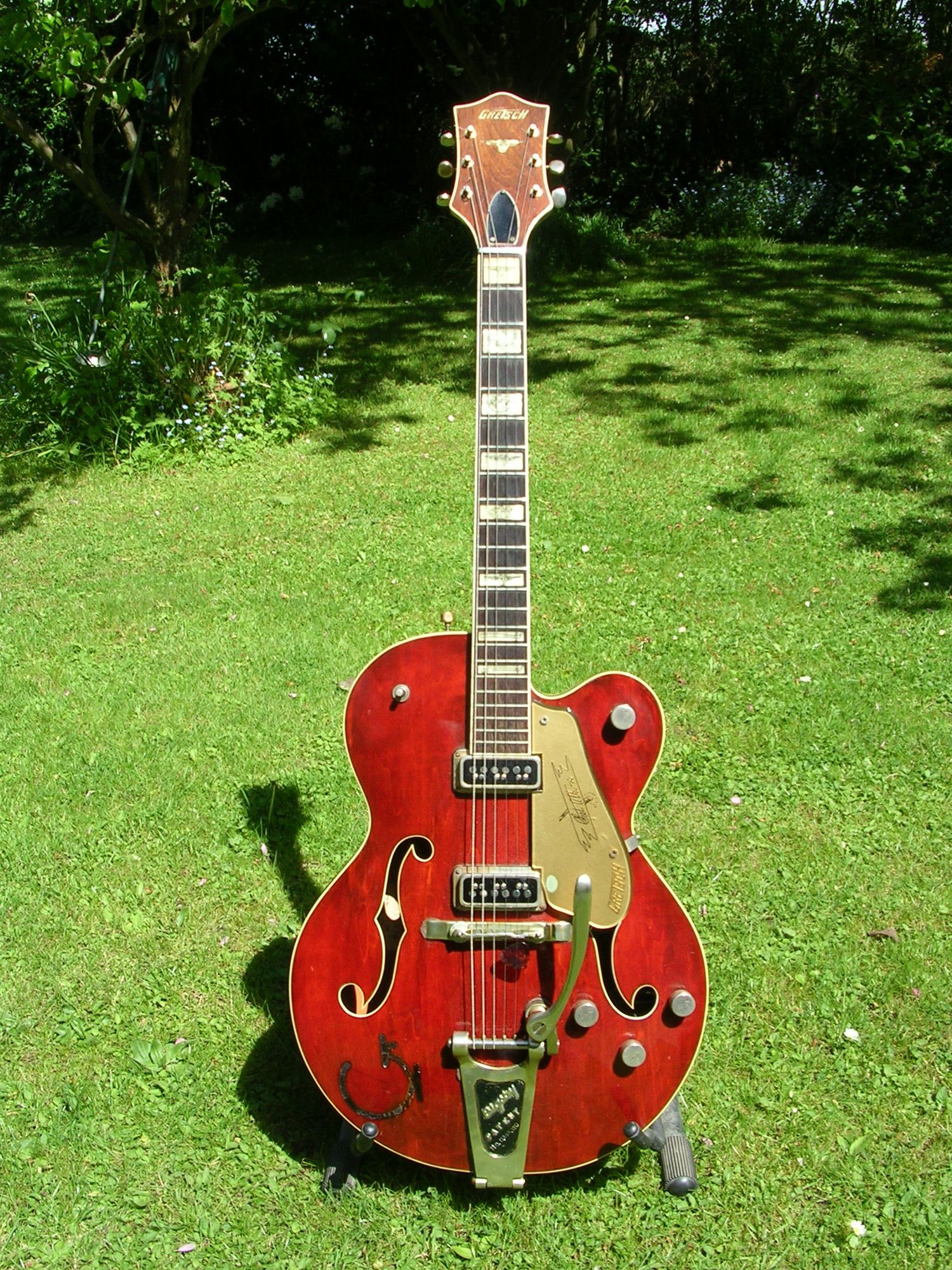
Gretsch 6120 G-Brand 1955. Photo by Francis pullen. Public domain (PD-self). Via Wikimedia Commons. Gretsch
6120
1955
Joe Walsh gave Pete Townshend one. Steve Miller gave Brian Setzer one. Chet Atkins just lent it his name.
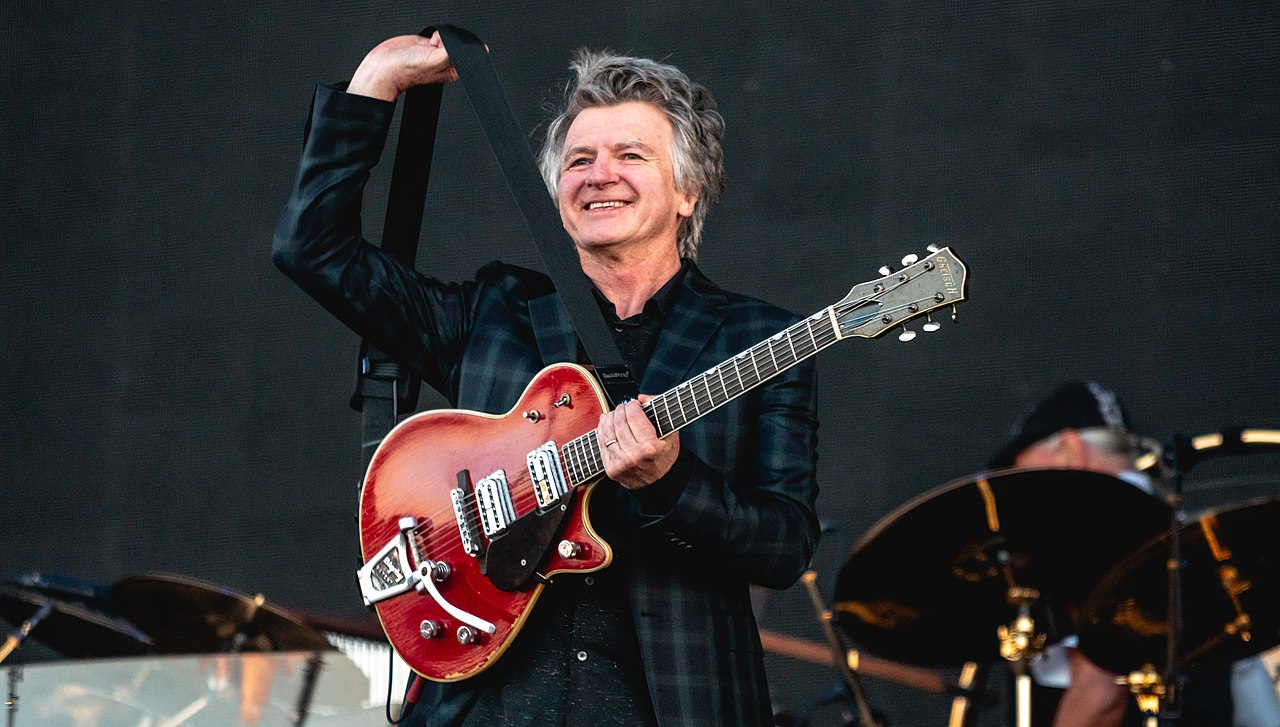
Photo: Raph_PH / Wikimedia Commons / CC BY 2.0 Gretsch
Duo Jet
1953
George Harrison bought his used in Liverpool as a teenager. In 1987 he put it on an album cover.
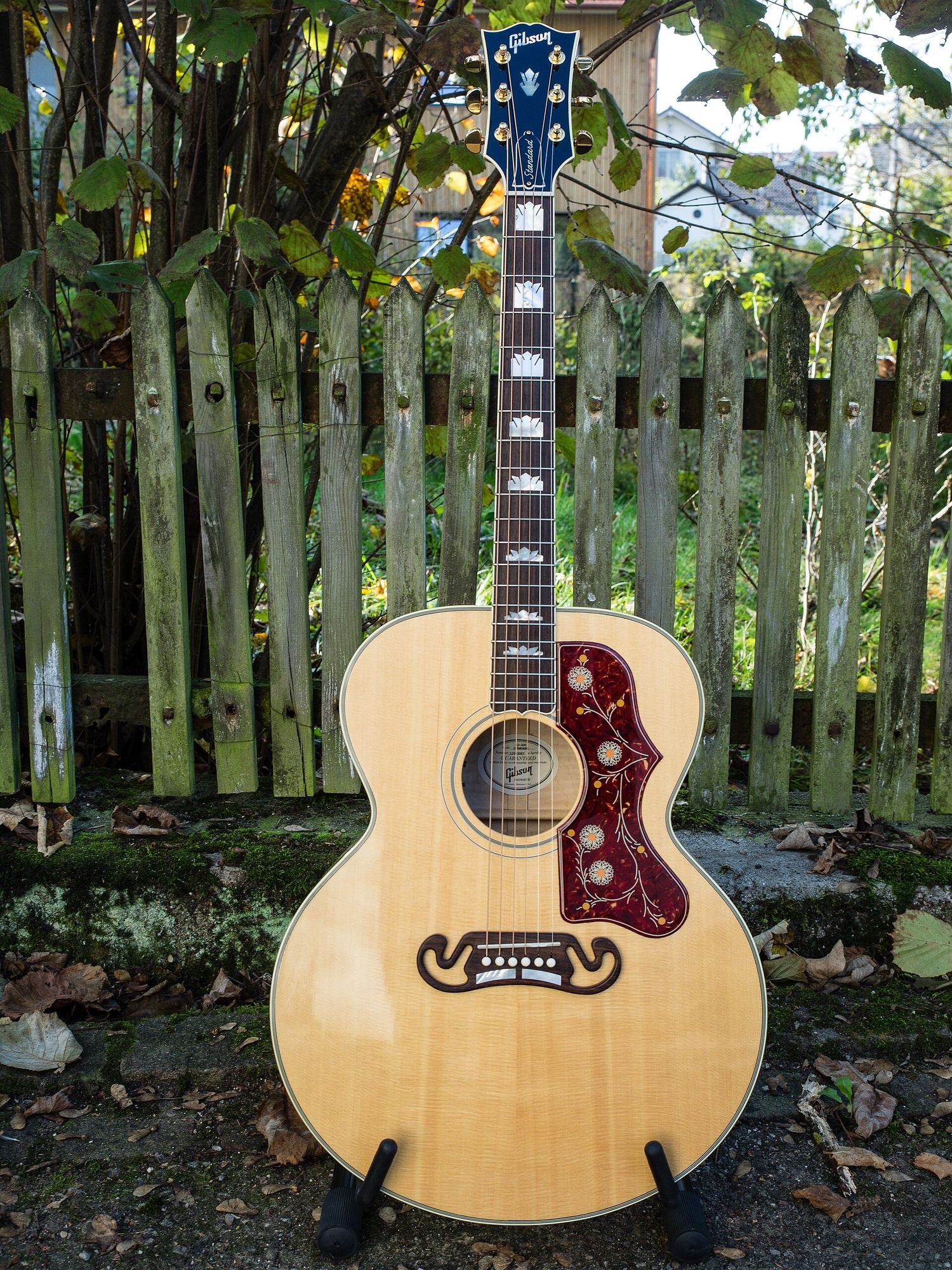
Gibson SJ-200 Standard Acoustic Guitar, Super Jumbo, Antique Natural Finish. Photo by Gibb Stutz. Licensed under CC BY 3.0. Via Wikimedia Commons. Gibson
J-200
1937
Gibson built the first one for a singing cowboy. It has been making people look like stars ever since.