Epiphone
Wilshire
Jimi Hendrix played one upside down in a Nashville club, painted its pickguard white, then pawned it.
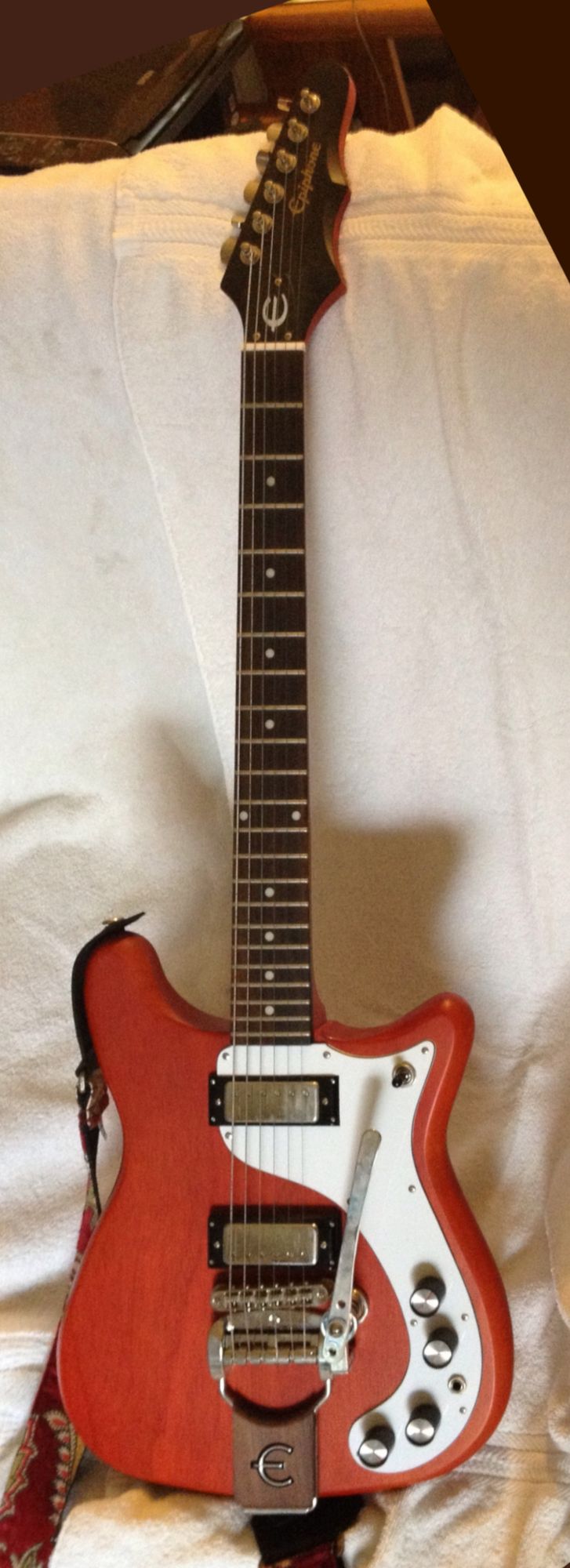
1962. Jimi Hendrix is out of the Army, playing in a club band in Nashville, and nobody outside that room knows his name. The guitar in his hands is a cherry Epiphone Wilshire, a right-handed solidbody flipped over for a lefty, with its pickguard painted white.
- Introduced
- 1959
- Type
- Solidbody electric
- Class
- Production
The short version
1959
The Wilshire
Two soapbar P-90s on a slab of mahogany, between the one-pickup Coronet and the Crestwood. The first shipments may be 1960.
1960
Thinner, rounder
The body slims down and the square edges get rounded off.
1962
Hendrix
He plays a cherry Wilshire with the King Kasuals in Nashville, and pawns it late in the year.
1963
A new shape
Longer bass horn, six tuners on one side. Same name, different-looking guitar. The catalogs don’t show it until 1964.
1964
The peak
1,045 Wilshires ship, the best year it ever had.
1972
Beat-Club
Wayne Kramer of the MC5 plays one on German TV.
2011
Phant-o-Matic
Frank Iero gets his own modified Wilshire, built until 2019.
Side A
A1
A cherry guitar, upside down
In 1962 Jimi Hendrix was out of the Army and playing in a band called the King Kasuals, with his Army friend Billy Cox, at a club called the Del Morocco in Nashville. Nobody had heard of him. His guitar was a cherry Epiphone Wilshire, a right-handed guitar he flipped over and played left-handed, because left-handed solidbodies weren’t something you could order out of the catalog.
He made it his. He painted the pickguard white. He taped over the fret markers. Accounts differ on how he got it in the first place. One version has him trading a Danelectro for it, in a $65 deal.
Late in 1962, he pawned it.
That’s the whole arc, and you’ll notice it doesn’t make the posters. The guitars people put on walls are the ones from the famous stages. The Wilshire was a working guitar in the lean years, and then it was gone.
A2
Two P-90s and a stopbar
The Wilshire came out of Kalamazoo, where Gibson was making Epiphones after buying the company. The job was a solidbody for music stores that couldn’t get the Gibson franchise. Same plant, different badge, its own shape.
Epiphone laid out the line the way Gibson did. The Coronet was the simple one, one pickup and a wraparound tailpiece, like a Les Paul Junior. The Wilshire was the step up, like a Special: two P-90 “soapbar” pickups, a proper adjustable bridge, and a stopbar tailpiece. Epiphone put it out in 1959, though the first shipments may not have gone out until 1960.
What you get is a slab of mahogany with two fat single-coils. It’s loud, it growls when you dig in, and it doesn’t have much to hide behind. The very first ones had squared-off edges and a body an inch and three-quarters thick. By 1960 it was thinner, with rounded edges, and kinder to your ribs.
In 1962 it listed at $235.
A3
The same name on a different guitar
In 1963 the Wilshire changed shape, though the catalogs didn’t show it until 1964. The bass-side horn got longer, the body went asymmetrical, and the headstock switched to six tuners in a row. Somewhere between 1962 and 1964, depending on who you ask, the P-90s gave way to mini-humbuckers.
If you see a Wilshire for sale, look at the horns before you look at anything else. They’ll tell you which guitar you’re looking at.
The new shape sold. In 1964, 1,045 of them shipped, the best year the model had. Epiphone offered custom colors with names like Red Fox, Sunset Yellow, California Coral, and Pacific Blue. From 1966 the six-strings all left the factory with a Maestro vibrato, and there was a 12-string too, 183 of them in all. By 1969 it was down to 18 guitars. In all, Kalamazoo shipped 2,640.
Flip the record · By the numbers
$235
The 1962 list price, the year Hendrix had his.
1,045
Wilshires shipped in 1964, its best year.
2,640
Kalamazoo Wilshires shipped in the 1960s, twelve-strings included.
18
Wilshires shipped in 1969, as the Kalamazoo line ran down.
Side B
B1
Who else had one
Wayne Kramer of the MC5 played a Wilshire on the German TV show Beat-Club in 1972. That’s the clip to look for if you want to see one of these earn its keep at volume.
Bruce Springsteen had one in the mid-sixties, a gift from his mother. That’s a story about a kid and a guitar, not about Born to Run. Pete Townshend and Johnny Winter played them. And Frank Iero of My Chemical Romance got a signature version called the Phant-o-Matic, made from 2011 to 2019.
One correction you’ll need at some point: Steve Marriott’s famous Humble Pie slab isn’t a Wilshire. It’s a Coronet, wearing a Dwight badge.
B2
The pawnshop ticket
Hendrix didn’t keep his. After Nashville came the road, the Strats, the famous stages, the Woodstock guitar. None of that is this guitar, and it’s worth saying out loud, because people try to connect them all the time.
But somebody had to get him through the Del Morocco. Somebody had to put up with the white paint and the tape on the markers. For most players there’s a guitar like that, the one that carried them through the years nobody filmed, and it almost never ends up in the story. For Hendrix, it was a cherry Epiphone that ended up with a pawnshop ticket on it.
Put this on
You’ve read about it. Now hear it. Here’s what this guitar sounds like, and what to listen for.
MC5 on Beat-Club
Wayne Kramer with a Wilshire on German TV, a slab solidbody earning its keep at full volume. (The Kick Out the Jams album was made on other guitars.)
Watch it on YouTube (opens in a new tab)
The cast
The people, and the specific guitars, that made the legend.
1962
Jimi Hendrix
Cherry Wilshire, 1961 or 1962, flipped for a lefty
Played it with the King Kasuals in Nashville, painted the guard white, taped over the markers, then pawned it. Not the Woodstock guitar.
1972
Wayne Kramer
Wilshire
The MC5 guitarist, on Beat-Club.
mid-1960s
Bruce Springsteen
Wilshire
A gift from his mother. It has nothing to do with the Born to Run cover, which is a Fender.
2011
Frank Iero
Wilshire Phant-o-Matic
A modified signature Wilshire, in production from 2011 to 2019.
Steve Marriott
A Dwight-badged Coronet, not a Wilshire
His Humble Pie slab gets called a Wilshire. It’s a Coronet with a different badge.
Liner notes
Specs, construction, rarity, value, and every source we used.
Two soapbar P-90s, a slim mahogany double-cut, and a stopbar — Epiphone’s solidbody between Coronet and Crestwood, not a Casino.
- Body
- Symmetrical double-cut mahogany. Gloss. Solid — not a Casino, not a 335. Official sheet omits width, depth, country.
- Neck
- Set mahogany; medium C. Reduced-size Kalamazoo headstock; Bikini badge; 3+3.
- Fingerboard
- Laurel; 22 medium jumbo; dots; 305.0 mm / 12.01 in radius. Mix flagged.
- Scale
- 628.0 mm / 24.72 in. Vintage sheets print 24 3/4". Mix flagged; do not average.
- Pickups
- Epiphone PRO P-90 Soapbar neck and bridge; black covers
- Hardware
- LockTone Tune-O-Matic; LockTone stop bar; Epiphone Deluxe ivory-button tuners; nickel. Butterfly tortoise guard with foil E.
- Electronics
- 2 volume, 2 tone; 3-way toggle; 1/4 in jack. Mono.
- Finish
- Gloss (Ebony, Cherry)
- Nut
- Graph Tech NuBone, 43.0 mm / 1.69 in. Mix flagged.
Open the full research fileConstruction details, the complete player record, production numbers, dated value estimates, and sources
Current Wilshire P-90, Ebony, model EOWLEBNH1, $549 (gibson.com; Guitar Center). Sweetwater and Sam Ash street $499. Not a Kalamazoo 1959–62. 150th Anniversary Wilshire (Pacific Blue, Gibson USA minis, batwing) is off the current gibson.com cart. Guitar Center copy that calls this guitar a semi-hollow is retailer taxonomy, not a spec.
Construction
Gibson bought Epiphone in 1957. New Epiphones started in Kalamazoo in 1958. The job was a solidbody for dealers who could not carry Gibson — same plant, different badge, own outline. Not a Casino (epiphone-casino): fully hollow, dog-ear P-90s, no center block, 1961. Not a Sheraton. This plate is mahogany slab.
Guitar World (Neville Marten, 16 February 2021): Crestwood 1958, Wilshire and Coronet 1959 — Junior / Special logic. Coronet is the one-pickup wraptail. Wilshire is the two-soapbar mid. Vintage Guitar and Bass: Coronet and Crestwood 1959, Wilshire added 1960. guitarhq, MusicRadar, gibson.com, Wikipedia, GITARRE & BASS: 1959. Keep 1960 as first VG&B shipping year. This plate starts in 1959. Pre-1957 New York Epiphone never cataloged a Wilshire.
Kalamazoo 1959–70 is the identity. guitarhq 1959: symmetrical slab, square edges, 1 3/4" deep, two white soapbar P-90s, Tune-o-matic, optional vibrato, unbound rosewood, dots, pearl logo, sunburst or cherry. 1960: 1 3/8", rounded edges, cherry. Guitar World 2021: 44.45 mm (1.75 in) down to 35 mm (1.375 in). Mix flagged. VG&B vintage sheet: 12 3/4" × 15 5/8" × 1 3/8", 24 3/4" scale. Current cart is 628.0 mm / 24.72 in. Do not average. Reverb’s 1959–62 card: Coronet outline with the wraptail swapped for stopbar / Tune-o-matic and a second P-90. That is why it is not a Coronet.
Pickups date the guitar. guitarhq / MusicRadar: white soapbars 1959, black 1961, minis 1962 (guitarhq: mid-year). True Vintage Guitar: leftover New York coils, Gibson P-90s in 1961, minis from 1962. Wikipedia and the Epiphone wiki put minis on the 1963 reshape. VG&B: P-90s, “or (after 1964) 2 mini humbuckers.” Keep the split. Early ones are soapbars. Later ones are minis. Neither is a full-size Gibson PAF.
1963 is the other guitar under the same name. Asymmetrical body, longer upper bass horn, six-on-a-side batwing, gold silkscreen logo (guitarhq / Wikipedia / wiki). VG&B: two-sided headstock into late 1963; first catalog to show the new silhouette is 1964. guitarhq 1963–69: Wilshire and Crestwood Custom nearly identical except dots, gold logo, no board bind, and a stopbar the Crestwood almost never wore. Do not file a Crestwood as this guitar. VG&B finishes: cherry, Red Fox, Sunset Yellow, California Coral, Pacific Blue. guitarhq 1965: Red Silver Fox optional.
Vibrato is not a second model. VG&B: Maestro optional; early Tremotone; 1966–69 all shipped with Maestro even when the ledger still reads SB432. guitarhq drops it in 1961, optional again mid-1962, then “no longer optional” in 1966. Keep both. Wilshire-12 (SB432-12): VG&B 1966–68, no vibrato, two-sided headstock; 183 shipped.
Later factories are other guitars. Japan 1975–79 (wiki; guitar-list also 1977–79): maple neck, full-size humbuckers. 1970s ET-275 / 276 / 278 / 290 get called Wilshires; they were not marketed as this name. Korean Wilshire II / III (1982–85): two minis or three. 2009: Chinese ’66 Worn and Gibson Custom Nashville 1962 Historic (P-90s, 100 cherry then 100 white). 2011–19: Frank Iero Phant-o-Matic. 2020: current P-90 with Coronet and Crestwood Custom. 2023 150th: batwing, Pacific Blue, Gibson USA minis; gibson.com NLA. Current cart is the Chinese soapbar above. Classic vs current: 1959 Kalamazoo — 1 3/4" slab, white soapbars, rosewood — against a 24.72 in Chinese P-90 with laurel.
Players
Do not hang a Casino on this plate. Do not file Steve Marriott’s Humble Pie Dwight Coronet as a Wilshire. Townshend’s SG Special and Springsteen’s Born to Run Esquire stay off.
Jimi Hendrix — 1961 cherry Wilshire, two P-90s, right-handed guitar flipped. After the Army, 1962. Guitar.com / TMZ, via Moments in Time: traded a Danelectro, $65. Ground Guitar (Larry Lee letter): King Kasuals at the Del Morocco, Nashville; painted the guard white and taped the markers; pawned it late 1962. VG&B: also with Don Covay and Little Richard — lefty solidbodies were not a catalog item. Sale cards print 1961; some tellings print 1961 or 1962. Keep both. The $1.25 million Moments in Time ask (July 2023) is one object, not a production comp. This is not a Strat, and it is not Woodstock.
Wayne Kramer — Epiphone Wilshire, Beat-Club, 1972. Wikipedia names the clip. Kick Out the Jams is other instruments. Do not move those onto this plate.
Frank Iero — Phant-o-Matic, 2011–19. Signature Wilshire: early headstock, later guard and switch, blocks. Reverb years 2011–2019. Modified artist SKU, not a 1961 SB432 and not the current P-90.
Also known to play stays short. MusicRadar names Pete Townshend, Johnny Winter, Bruce Springsteen. Performer Mag: Springsteen’s was a gift from his mother, mid-sixties. That is not Born to Run. Manufacturer copy (Guitar Hive) repeats Winter, Paul Gilbert, Steve Marriott. Marriott’s documented Humble Pie slab is a Dwight-badged Coronet. GITARRE lists Hendrix / Townshend / Marriott on early P-90 examples. None invented.
Rarity
You can buy a new Wilshire P-90 tomorrow. Cherry and Ebony are regular production. The 150th Anniversary (2023) was a limited current object; it is off the cart. It is not vintage rare.
1960s Kalamazoo is the collector object. Later Japanese ET-series, Korean II/III, Chinese Worn / P-90 / 150th, and the 2009 Nashville Historic are not 1959–70 originals.
Kalamazoo shipping (Vintage Guitar and Bass; statistics, not a serial census): nine years, 2,640 including 183 twelves. Peak 1964: 1,045. First VG&B year 1960: 59. 1969: 18. Cells: SB432 1,475; SB432 V 472; SB432 MV 494; SB432-12 183; Red Fox SB432 RF 16 (listed separately only in 1967 — VG&B warns not to read that as the only Red Fox year). GITARRE & BASS: early 3+3 soapbar Wilshires 243 — among the thinnest Kalamazoo electrics. That 243 is not the VG&B 1960–62 sum; keep both. zZounds / TMRZoo Historic copy: 180 in 1962 — that is the SB432 cell, not the year’s 180+42 vibrato total. Serials were shared with Gibson and overlap years, so they date a guitar, they don’t count a year.
What is actually thinner: first-year 1 3/4" slabs; white-cover soapbars; custom-color California Coral / Pacific Blue / Sunset Yellow / Inverness Green. Hendrix’s photographed Wilshire and Iero’s Phant-o-Matic are unique objects. They are not a vintage Wilshire.
Value
Informal estimate, 11 September 2026. Not an appraisal.
Ask vs sold labeled. Celebrity lots are not-comps. No invented medians. Period list $195 (Fretted Americana, added 1959), $210 (TMRZoo / zZounds intro copy), $235 (1962), $285 (1967) is 1960s money, not 2026 street.
New street. Current Chinese Wilshire P-90: $549 (gibson.com; Guitar Center; Sweetwater Cherry). Ebony street $499 this pass (Sweetwater from $549; Sam Ash; Alto). Vintage Guitar (Pete Prown, June 2021): launch $449. 150th Anniversary Wilshire (2023, limited, NLA on gibson.com): $899 (Guitar Center; Sweetwater; Guitar Interactive). Historical 2009 Nashville Historic list, not a live cart: TMRZoo suggested $4,832.
Used modern. Reverb Price Guide, Epiphone ’66 Wilshire Reissue (2009–15): estimated used $383–$639 (110 orders, Good to Mint); named 2026 solds on that page include Excellent $400 (30 May 2026) and Very Good $520 (22 May 2026). Phant-o-Matic used $673–$994 (165 orders). Reverb’s current P-90 dollar widget was empty this pass. Expect used Chinese P-90s well under $549. Flag: public solds for the 2020 cart are thinner than the Worn ’66 band.
Vintage / collectible. Distinguish ask vs sold. GITARRE & BASS (1961 soapbar, 2020): market sometimes from about $4,500, mint toward double. GITARRE (1965 batwing, 2021): from about €3,500; custom-color asks to $20,000. Named asks this pass, not a sold series: VG&B affiliate 1966 original $3,600; 1962 cherry £8,499; Reverb 1963 Red Fox $4,595; 1961 cherry $3,800; 1963–70 vibrato examples $4,000–$5,900. No 2024–26 named public sold series was captured. Original finish vs refinish, swapped pickups, and a converted tailpiece move the number.
Artist-owned Hendrix Wilshires are a separate market. The $1.25 million 2023 ask is one object. Do not price ordinary 1960s SB432s off that lot.
See also
- epiphone-casino — fully hollow, dog-ear P-90s, no center block; the Beatles guitar, not this solidbody
- gibson-sg-special — the Kalamazoo cousin VG&B maps the Wilshire against; two pickups, different outline, Gibson badge
- gibson-les-paul-special — two soapbars on a different body; GITARRE’s mapped cousin, not a Wilshire SKU
Sources
- Epiphone Wilshire P-90s, Ebony — current EOWLEBNH1 spec; PRO P-90s; Bikini badge; $549; first appearance 1959
- Epiphone 150th Anniversary Wilshire, Pacific Blue — NLA; Gibson USA minis; batwing; 24.75 in / 628.65 mm
- Vintage Guitar and Bass: Wilshire SB432 — available 1960–69; 12 3/4" × 15 5/8" × 1 3/8"; 24 3/4"; SG Special map; shipping 2,640 / peak 1964 1,045 / 1960 59 / 1969 18; 12-string 183; Hendrix flipped; catalog quotes
- guitarhq: Epiphone Wilshire — available 1959–1970; 1 3/4" then 1 3/8"; white then black P-90s; minis mid-1962; batwing 1963; cousin to Crestwood / Coronet
- Vintage Guitar: Epiphone’s Wilshire and Coronet (Pete Prown, June 2021) — current P-90 reissue $449; Coronet one dog-ear wraptail; butterfly guard; Bikini badge
- Guitar World: Coronet, Wilshire and Crestwood Custom (Neville Marten, 16 February 2021) — Crestwood 1958, Wilshire/Coronet 1959; 1.75 in → 1.375 in; Wilshire as Special to Coronet’s Junior; $449
- MusicRadar: Old gold, 1961 Epiphone Wilshire — launched 1959 between Crestwood and Coronet; 1 3/4" then 1 3/8"; Townshend / Winter / Springsteen; white then black P-90s then minis 1962
- GITARRE & BASS: 1961 Epiphone Wilshire (Franz Holtmann) — nominally 1959; Les Paul Special counterpart; early 3+3 soapbar 243; Hendrix / Townshend / Marriott; from ~$4,500
- GITARRE & BASS: 1965 Epiphone Wilshire — Crestwood 1958, Coronet and Wilshire 1959; batwing 1963; from ~€3,500; custom-color asks to $20,000
- True Vintage Guitar: Vintage Epiphone Wilshire — 1959 intro; NY then P-90s 1961 then minis 1962–69; not just an Epiphone Special
- Wikipedia: Epiphone Wilshire — 1959–70; between Crestwood and Coronet; 1963 reshape; Kramer Beat-Club 1972; 2020 P-90 reissue
- Epiphone wiki: Wilshire — introduced 1960, ended 1969; shipping table; Japan 1975–79; II/III Korea; ET-series not this name
- Sweetwater: Wilshire P-90s Ebony — $499 from $549; earliest-incarnation copy
- Guitar Center: Wilshire P-90 Ebony — $549; since 1959
- Guitar Center: 150th Anniversary Wilshire Pacific Blue — $899; sold out
- Reverb: Wilshire P90 — years 2020–2026; China; typical new listings $499; dollar widget empty this pass
- Reverb: ’66 Wilshire Reissue — used $383–$639 (110 orders); 2009–15
- Reverb: Wilshire Phantomatic 2011–2019 — used $673–$994 (165 orders)
- Reverb: Wilshire 1959–1962 — Coronet frame, stopbar/TOM, dual P-90s; 1963 moves toward Crestwood
- Guitar.com: Hendrix 1961 Wilshire $1.25 million — $65 trade 1962; King Kasuals; 186 in 1961 (VG&B 186 SB432 cell)
- TMZ: Hendrix 1961 Wilshire — Moments in Time ask $1.25M; last on market 2008
- Ground Guitar: Hendrix’s 1961 Epiphone Wilshire — Larry Lee letter; Del Morocco 1962; pawned late 1962
- Fretted Americana: 1967 Wilshire SB 432 — added 1959 ~$195; 1962 $235; 1967 $285; SG Special equivalent
- TMRZoo: 1962 Wilshire Reissue — 180 in 1962; intro $210; vintage $5,000–$12,000 (2009 copy); Historic list $4,832
- zZounds: Gibson Custom 1962 Wilshire — 180 in 1962; 100 cherry then 100 white
- Guitar Interactive: 150th Anniversary Wilshire — MSRP $899 / £799
- Performer Mag: 1966 Epiphone Wilshire — Hendrix / Springsteen / Kramer; Springsteen gift from his mother
- MusicRadar: Hendrix Wilshire $1.25 million — King Kasuals with Billy Cox; mixed acquisition accounts
- Premier Guitar: Worn 1966 Wilshire (Doug Robertson, March 2010) — “perfect for old-school garage rock”
- MusicRadar: 1966 Worn Wilshire review — 1959 intro; batwing 1963; minis from 1962
- Guitar Hive: The Epiphone Wilshire — manufacturer copy: Winter / Gilbert / Marriott; Springsteen gift from his mother
- guitar-list: Epiphone Wilshire — Japan 1975–79 / 1977–79; II/III 1982–85
- humble-pie.net: Steve’s Guitars — Marriott’s Humble Pie slab is a Dwight Coronet, not a Crestwood and not a Wilshire
- Sweetwater: 150th Anniversary Wilshire Pacific Blue — $899
Keep digging
Guitars this one gets compared to, confused with, or descended from.
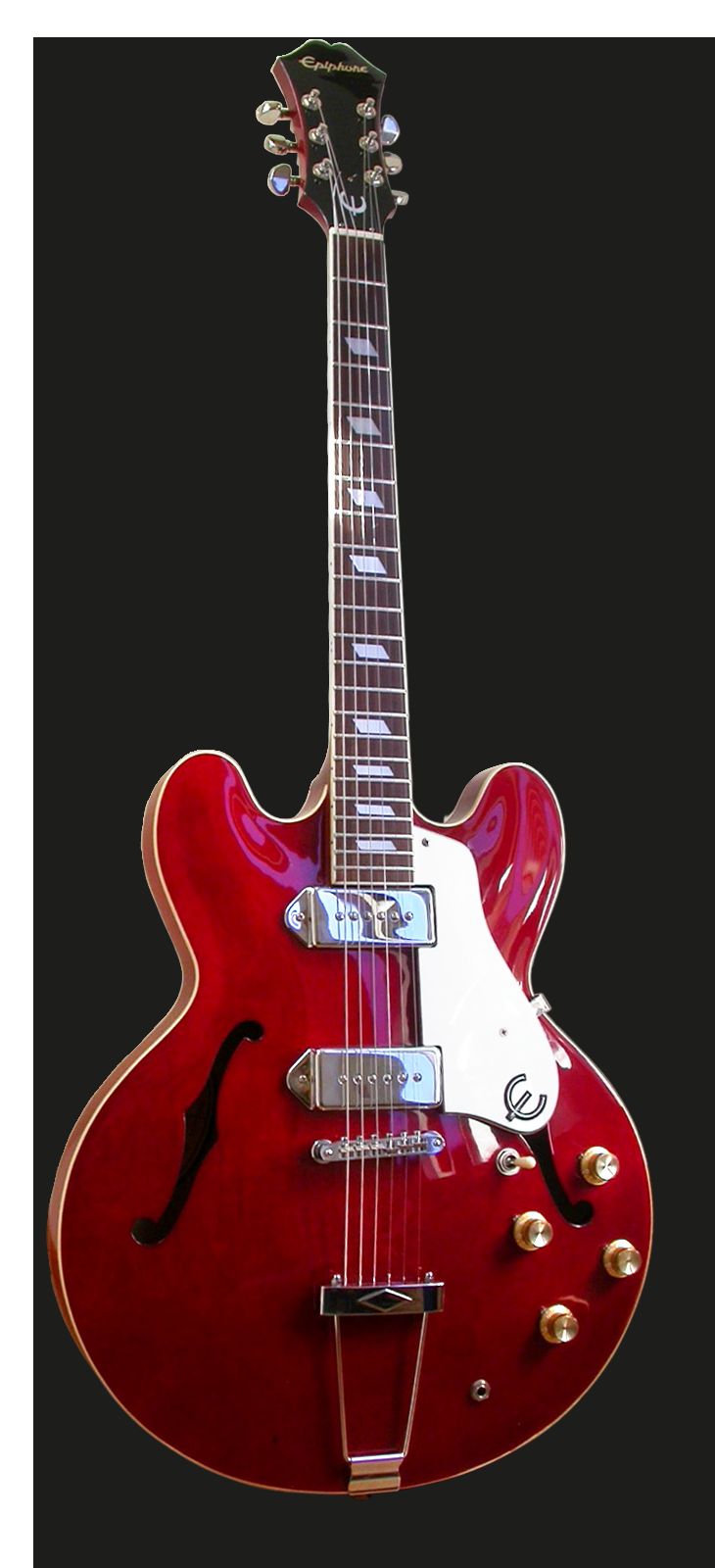
Epiphone Casino Cherry. Photo by Maxo; background removed by Auge=mit. Licensed under CC BY-SA 4.0. Via Wikimedia Commons. Epiphone
Casino
1961
Of all the Beatles’ famous guitars, the only one John, Paul, and George all had. Two sanded theirs bare.
- Send a picture
Gibson
SG Special
1961
Townshend smashed them. Iommi stuck a monkey on one. Nobody was ever gentle with an SG Special.
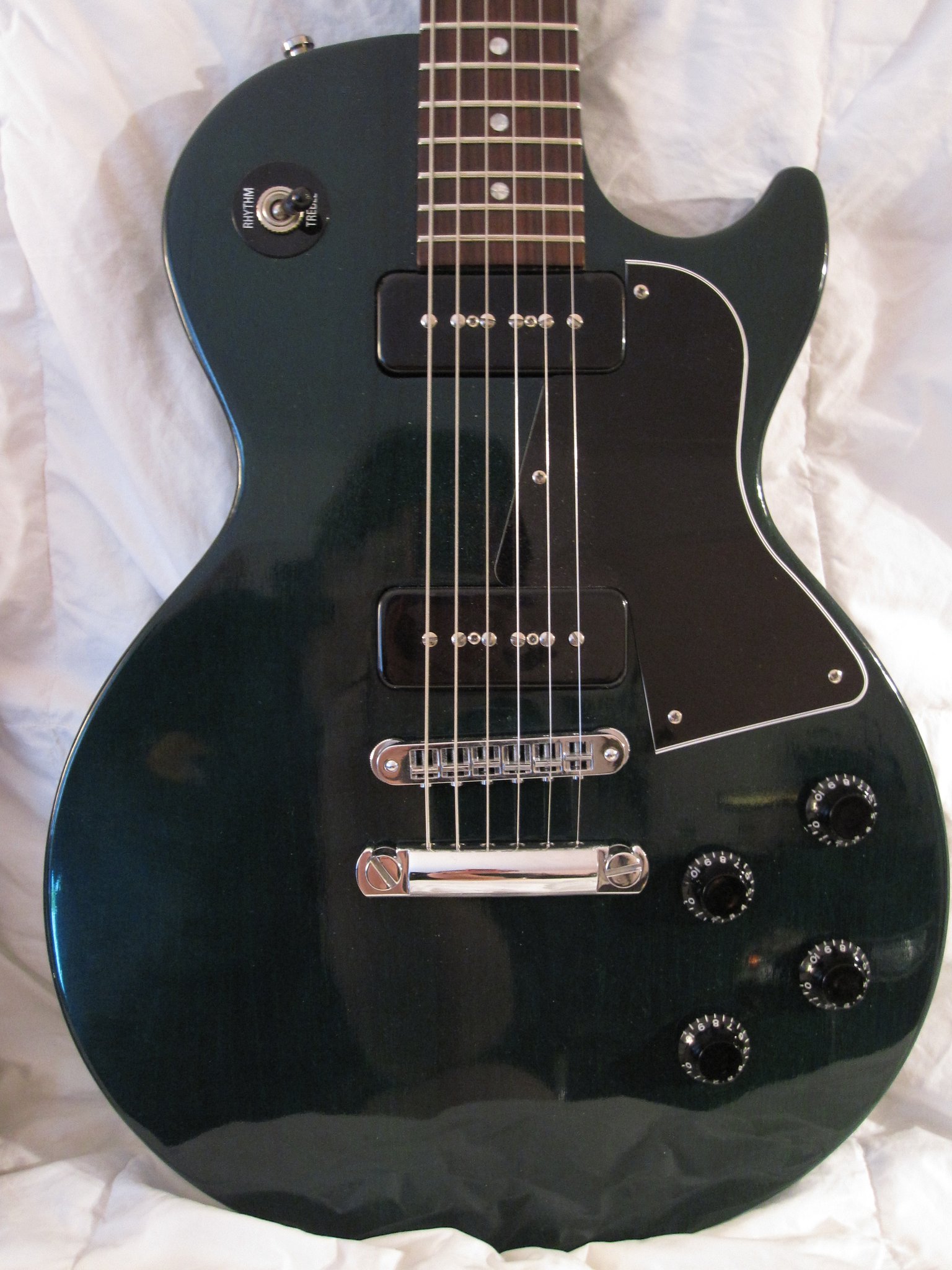
Gibson Les Paul Special 1998 Spearmint. Photo by A Gibson Man. Licensed under CC BY-SA 3.0. Via Wikimedia Commons. Gibson
Les Paul Special
1955
Dan Armstrong modified it. Marc Bolan traded it in. Bob Marley bought it and made it his.