Epiphone
Sheraton
Epiphone’s own catalog called it second best. John Lee Hooker and Noel Gallagher didn’t read the catalog.
Kalamazoo, 1958. Gibson has just bought Epiphone, the old New York archtop company, and Ted McCarty is showing off the first Epiphones built in Gibson’s own plant. Most of them are thin, something Epiphone had never made. One of them is a gold-trimmed double-cutaway called the Sheraton, and it’s the fancy one.
- Introduced
- 1958
- Type
- Semi-hollow electric
- Class
- Production
Have a photograph of this guitar? Send a picture
The short version
1957
Gibson buys Epiphone
The New York company becomes Gibson’s second brand, and production moves to Kalamazoo.
1958
The new line
Ted McCarty debuts the Kalamazoo Epiphones. Four of the five new electrics have thin bodies.
1959
First ones ship
Forty-six Sheratons go out, most with leftover New York pickups that look like something they aren’t.
1961
“Second only to the Emperor”
The catalog says so. Mini-humbuckers are arriving around now, maybe a year earlier.
1969
Kalamazoo winds down
The last American shipments. Some date the move to Japan to 1970.
1996
Knebworth
Noel Gallagher plays Oasis’s biggest shows on a 1990s American Sheraton.
2000
Hooker’s own model
Epiphone gives John Lee Hooker a signature Sheraton, the year before he dies.
Side A
A1
Second place, in writing
In 1957 Gibson bought Epiphone. For decades Epiphone had been a New York company, run by the Stathopoulo family and famous for big archtops, and for a while it had been Gibson’s real rival. Now it was a second badge, and by 1958 the new Epiphones were coming out of Gibson’s own plant in Kalamazoo, Michigan.
Ted McCarty, who ran Gibson, launched the line that year. Four of the five new electrics had thin bodies, a style Epiphone had never built. One of them was a double-cutaway with a maple block down the middle, the same idea Gibson was launching at the same time as the ES-335. That was the Sheraton, and it was the fancy one.
Epiphone’s 1961 catalog was proud of it, up to a point.
A superb professional guitar, second only to the Emperor.
Second only to the Emperor. Written by the people selling it. Hold onto that.
A2
Dressed for the good room
The Sheraton wasn’t Epiphone’s version of the plain 335. It was Epiphone’s version of the ES-355, Gibson’s dressed-up one, and it looked the part. A tree-of-life inlay up the headstock. Big pearl block markers with abalone triangles set in them. Seven layers of binding around the top. Gold hardware on everything.
It even undercut the Gibson a little. In 1963 a Sheraton with a vibrato listed at $595. A similarly equipped ES-355 was $635.
From across a shop, a Sheraton can pass for a 335. It has the center block. It doesn’t have the big Gibson humbuckers. That’s where the sound goes its own way.
A3
Pickups that look like something they aren’t
The first Sheratons, the ones that shipped in 1959, came with leftover pickups from the old New York Epiphone days. They sit under rectangular covers and people often mistake them for mini-humbuckers. They’re single-coils, lower in output than a P-90 and closer to the gentle sound of a gold-foil pickup.
Then Kalamazoo did something clever. Gibson’s new humbucker looked like a scaled-up version of those New York pickups, so they built a scaled-down humbucker that kept the Epiphone look and dropped straight into the same hole. The mini-humbucker showed up on the Sheraton in 1961, or a year earlier depending on who you ask. It has less low-mid thickness than a full-size humbucker, so it sounds tighter and clearer. That’s the Sheraton voice.
The tailpiece is the other tell. It’s a Frequensator, a two-tier trapeze from Epiphone’s old archtops, with a long run for the bass strings and a short one for the trebles. It looks like a piece of jewelry. You either love it or you put a Bigsby on.
Flip the record · By the numbers
46
Sheratons shipped in 1959, the first year.
689
Sheratons shipped from Kalamazoo in the whole of the 1960s.
$595
1963 list price, against $635 for Gibson’s similarly equipped ES-355.
7
Layers of binding around the top. Part of the dress.
Side B
B1
Six hundred and eighty-nine
Forty-six Sheratons shipped in 1959. Across the whole Kalamazoo run, 689. Natural finishes are thinner still. When you see a real 1960s one on a wall, you’re looking at something that was never common.
The Kalamazoo years ended at the end of the ’60s. The last shipments were in 1969, and some put the move to Japan in 1970. After that the name went on to other factories and other ideas. The Sheraton II arrived in 1986 without the Frequensator, and most of those wear full-size humbuckers and a stopbar. Same name, different guitar.
B2
Somebody’s first choice
John Lee Hooker got his first electric from T-Bone Walker in Detroit. It was “an Epiphone,” and that’s all anybody can say for sure about it. What is sure is that the Sheraton became one of his favorites. In 2000, the year before he died, Epiphone gave him his own signature Sheraton, and put mini-humbuckers back on it.
A generation later, an English songwriter came to it by another road.
I wanted to start playing Epiphones because of the Beatles.
That’s Noel Gallagher. In August 1996, Oasis played Knebworth, and he was holding a 1990s American Sheraton with minis and a Frequensator. Earlier that year there were Union Jack Sheratons, one on Top of the Pops for “Don’t Look Back in Anger” and one at Maine Road. Noel says they were two different guitars, and the Maine Road one later went missing. The Supernova signature that came after is a different design, full-size humbuckers and a stopbar, so don’t let anyone tell you that’s the flag guitar.
Epiphone’s catalog put the Sheraton second, behind the Emperor. The bluesman who made “Boom Boom” and the guitarist who stood in front of a field at Knebworth never treated it as second best. For both of them, it was one of the first guitars they reached for.
Put this on
You’ve read about it. Now hear it. Here’s what this guitar sounds like, and what to listen for.
Live at Knebworth
August 1996. Noel is on a 1990s American Sheraton with mini-humbuckers and the two-tier tailpiece, the classic Sheraton recipe.
Watch it on YouTube (opens in a new tab)Don’t Look Back in Anger (Top of the Pops)
February 1996, and that’s a Union Jack Sheraton. Not the same flag guitar he played at Maine Road two months later, by Noel’s own account.
Watch it on YouTube (opens in a new tab)
The cast
The people, and the specific guitars, that made the legend.
2000
John Lee Hooker
Sheraton
A favorite model. Epiphone gave him a signature Sheraton in 2000, the year before he died.
1996
Noel Gallagher
1990s American Sheraton, and a Union Jack one
Knebworth on a tobacco-burst Sheraton. The Union Jack Sheratons were two different guitars, and the later Supernova signature is a different design.
1958
Ted McCarty
The Kalamazoo Epiphone line
Gibson’s president, who debuted the new Epiphones, the Sheraton among them.
T-Bone Walker
“An Epiphone”
Gave Hooker his first electric guitar. It was an Epiphone. Nothing pins it down as a Sheraton, so we won’t say it was.
Liner notes
Specs, construction, rarity, value, and every source we used.
Mini-humbuckers, a maple center block, and a Frequensator — Epiphone’s dressy semi-hollow, not the hollow Casino and not a 335.
- Body
- Double-cut thinline. Layered maple; maple centerblock; f-holes. 7-ply top, 3-ply back bind. Semi-hollow. Gloss. Official sheet omits width, depth, country.
- Neck
- Set mahogany; SlimTaper 60s C. Kalamazoo-shape headstock; Tree of Life inlay.
- Fingerboard
- Bound laurel; 22 medium jumbo; MOP block with abalone triangle; 12.0 in / 304.8 mm radius. Mix flagged.
- Scale
- 24.75 in / 628.65 mm
- Pickups
- Epiphone ProBucker Mini-Humbucker neck and bridge; gold covers
- Hardware
- LockTone Tune-O-Matic; Frequensator Split Trapeze; Wilkinson tuners; gold. 1962 Sheraton Historic tortoise guard with foil E, 5-ply bind.
- Electronics
- 2 volume, 2 tone; 3-way toggle; 1/4 in jack. Mono. No Varitone.
- Finish
- Gloss (Vintage Sunburst, Natural)
- Nut
- Graph Tech, 43.0 mm / 1.69 in. Mix flagged.
Open the full research fileConstruction details, the complete player record, production numbers, dated value estimates, and sources
Current Epiphone Sheraton, Vintage Sunburst, model EOSHVSGH1, $899 (gibson.com / Sweetwater). Not a Kalamazoo 1958–59. Sheraton-II PRO (full-size ProBuckers, stopbar, coil-split) is off the current gibson.com cart.
Construction
Gibson bought Epiphone in 1957. New Epiphones started in Kalamazoo in 1958. Vintage Guitar (George Gruhn and Walter Carter): Ted McCarty debuted the new line that year. Four of five new electrics were thin-bodied — a style Epi had never done. One of them, the Sheraton, was a semi-hollow double-cut, “a style Gibson was introducing concurrently under the Gibson brand as the ES-335.” First instruments shipped 1959. Vintage Guitar and Bass: 46 that year. Not a New York Stathopoulo guitar. Pre-1957 NY Epiphone never cataloged a Sheraton.
The job was the fancy one. Gruhn/Carter: the Sheraton was the equivalent of the ES-355, so the later expansion went the other way — Riviera in 1962 as the 335-class sibling. Casino (1961) is the hollow P-90 cousin, ES-330 family. From across a shop the Sheraton can look like a 335. It is not one. Center block, yes. Full-size Gibson humbuckers, no. Tree-of-life headstock, block-and-triangle markers, seven-ply top bind, gold, Frequensator. That’s the dress.
Kalamazoo 1959–69 is the identity. Laminated maple, 16" × 1¾" (VG&B). Set mahogany, 22 frets, neck joining at the 19th. VG&B: bound rosewood. Guitar Player’s 1959: bound ebony and a laminated five-piece neck — none of Gibson’s semis of the era. Keep both boards. VG&B prints scale 24½"; the current sheet is 24.75 in / 628.65 mm. Mix flagged; do not average. Gold throughout. 1961 catalog: “A superb professional guitar, second only to the Emperor.” 1963 list (VG&B): E212TV $595 against $635 for a similarly equipped ES-355TD. Historical list, not 2026 street.
The pickups are the other half of why it is not a 335. Earliest Kalamazoo examples wear leftover New York single-coils — rectangular covers, offset poles — often mistaken for mini-humbuckers. They are not. Guitar Player (Dave Hunter, on a 1959): low-output relative to a P-90, closer to gold-foil. Guitar World: Gibson’s PAF looked like a scaled-up New York coil, so Kalamazoo built a scaled-down humbucker that kept the Epiphone look and dropped into the same cutout. Minis begin appearing on the Sheraton in 1961. Guitar Player: 1960 or early ’61. Keep both. Narrower aperture, less low-mid than a PAF. That is the voice the rest of the decade wore.
Tailpiece is the other tell. Frequensator — two-tier trapeze from the old archtops (Premier Guitar: late 1930s; GITARRE & BASS names Herb Sunshine), long on the bass side, short on the treble. VG&B: 1959–60 Sheratons were offered only with the Tremotone vibrola, even though the codes read E212T / E212TN; Frequensator as the non-vibrato option from 1961. Joe’s Vintage Guitars treats Frequensator as the earliest standard and a Bigsby as usually aftermarket. Premier Guitar (1967 E212T): Frequensator stayed an option after Tremotone arrived in ’61. Keep the split. Factory vibrato is Tremotone, not a 335 stopbar.
Short headstock 1958–64; elongated after (Guitar Player; Mat Koehler to Guitar World). Cherry in catalogs from 1962; shipping stats split it only from 1967 (VG&B). GITARRE & BASS: official cherry not before 1965, except a small 1962 run. Keep both. VG&B’s last shipping year is 1969 (44). Joe’s: American-made Sheraton closed when production moved to Japan in 1970. Do not pick a single last-US year.
Later Sheratons are other factories. Matsumoku early-1980s reissue (VG&B 1982 catalog): maple neck, maple/mahogany center block “for additional sustain and high frequency response.” Not Kalamazoo mahogany-and-minis. Sheraton II from 1986: Frequensator gone, stopbar in. Most IIs wear full-size humbuckers. Elitist (Terada) and the John Lee Hooker signatures (2000–05) put Gibson minis back on; they are not this table. 150th Anniversary Sheraton (2023) is a limited cherry with USA Gibson minis and Tremotone. Current cart is the Chinese Frequensator Sheraton above: ProBucker minis, laurel, Wilkinson, gig bag. Sheraton-II PRO (coil-split full-size ProBuckers, 5-piece maple/walnut neck, stopbar) is the other modern silhouette; gibson.com has it as no longer available.
Players
Do not hang a Casino or an ES-335 on this plate. Do not file Noel Gallagher’s Union Jack as a 1960s Kalamazoo, and do not treat the Epiphone Supernova as this guitar.
John Lee Hooker. The bluesman who kept the name on a catalog card. Gibson: a favorite model being the Epiphone Sheraton; Epiphone introduced a signature Sheraton and Sheraton II in 2000, the year before his death. Guitar Center / Sheraton-II PRO copy quotes him calling it “an outdid 335” — manufacturer copy, not a named interview in-hand. T-Bone Walker gave him his first electric, “an Epiphone,” in Detroit (Gibson, citing Hooker). That gift is not pinned here as a Sheraton. Boom Boom is the electric stretch-out; which guitar on the session is unpublished here. The association is the fact.
Noel Gallagher — 1990s USA Sheraton, mini-humbuckers, Frequensator. Not a stopbar II. Not a 1960s E212T. British Music Experience (Epiphone 150th): Oasis at Knebworth, August 1996, Noel on a 1990s USA-made Sheraton. Ground Guitar / Equipboard: tobacco-burst, Frequensator, minis, through the rest of the Morning Glory tour and into Be Here Now. Union Jack Sheraton: Maine Road, April 1996; Top of the Pops, February 1996, “Don’t Look Back in Anger.” Noel told the Matt Morgan Podcast (2023) those were two different guitars; the Maine Road Union Jack later went missing. The Supernova signature (1997–2005) is the trap: full-size humbuckers and a stopbar, built to look like the flag guitar. Guitar.com: scant evidence he used the signature. Keep them apart.
Also known to play stays short. Guitar Player names Ezra Koenig. Manufacturer Sheraton-II PRO copy names The Edge and Emily Wolfe — II, not the Frequensator current SKU. Premier Guitar (1967 vault) names Mick Cripps of L.A. Guns. None invented.
Rarity
You can buy a new Sheraton tomorrow. The Frequensator Chinese run is regular production. The 150th Anniversary (2023) is a limited current object. It is not vintage rare.
1960s Kalamazoo is the collector object. Later Japanese, Korean, Chinese, Elitist, and Nashville-assembled Hooker signatures are not 1959–69 originals.
Kalamazoo shipping (Vintage Guitar and Bass / Gruhn, statistics, not a serial census): 1959: 46; 1960: 26; peak 1967: 123; 1969: 44; period total 689. Guitar Player repeats 46 / 26 for the New York-pickup years. Natural is thin: VG&B 71 non-vibrato E212TN plus 48 E212TNV across the run. Joe’s: sunburst outnumbering Natural by roughly four to one. 1959–60 NY-pickup guitars are the thin window. Serials were shared with Gibson and overlap years, so they date a guitar, they don’t count a year.
Hooker’s photographed Sheratons and Gallagher’s Union Jack / Knebworth bursts are unique objects. They are not a vintage Sheraton.
Value
Informal estimate, 4 September 2026. Not an appraisal.
Ask vs sold labeled. Celebrity lots are not-comps. No invented medians. Period $595 (1963 E212TV list, VG&B) is 1960s money, not 2026 street.
New street. Current Chinese Frequensator Sheraton: $899 (gibson.com; Sweetwater). 150th Anniversary Sheraton (2023, limited): dealer examples around $899–$1,859 (MusicRadar launch £/$899; Nantel Musique $1,859). Historical II PRO list, not a live cart: Guitar Center $749; Sweetwater used-guide prints new $699.
Used modern. Reverb Price Guide, Epiphone Sheraton (2023–present): estimated used $422–$719 (26 orders, Good to Mint); typical new $899. Named 2026 solds on that page include Mint $699 (24 July 2026) and Excellent $500 (11 July 2026). Sheraton-II PRO used (Sweetwater Gear Exchange, Wine Red): $363–$538. Matsumoku / early-’80s Japan sits above the Chinese used band; no clean 2024–26 sold series isolated this pass. Flag: public solds for Japan/Korea are thinner than the 2023 cart.
Vintage / collectible. Distinguish ask vs sold. Joe’s Vintage Guitars, 10 July 2026, dealer excellent-original / player-grade bands (asks and price-guide figures, not a sold series): 1958–60 New York pickups about $10,000–$16,000 excellent, $5,000–$8,000 player/modified; 1961–65 minis about $8,000–$12,000 / $4,000–$6,500; late-1960s Kalamazoo about $6,000–$9,000 / $3,500–$5,500. Natural carries a premium. VG&B live affiliate asks this pass include a 1964 sunburst $13,999 and a 1966 Royal Tan $7,199.99 — asks, not hammers. No 2024–26 named public sold series was captured. Original finish vs refinish, swapped pickups, and a converted tailpiece move the number.
Artist-owned Hooker and Gallagher Sheratons are a separate market, not a production comp. Do not price ordinary 1960s E212Ts off those objects.
See also
- epiphone-casino — fully hollow, dog-ear P-90s, no center block; the Beatles guitar, not this one
- gibson-es-335 — same-year Kalamazoo semi-hollow; full-size humbuckers, plainer
- gibson-es-355 — the fancy Gibson cousin Gruhn/Carter put the Sheraton against
Sources
- Epiphone Sheraton, Vintage Sunburst — current EOSHVSGH1 spec; ProBucker minis; Frequensator; $899
- Epiphone Sheraton, Natural
- Vintage Guitar and Bass: Sheraton E212T — 1959–69; 16" × 1¾"; 24½" scale; 19th-fret join; shipping 46 / 26 / 123 / 44 / 689; 1963 E212TV $595 vs ES-355TD $635; Tremotone 1959–60; 1982 Japan maple/mahogany block “high frequency response”
- Vintage Guitar: Epiphone Riviera (Gruhn and Carter, December 2005) — 1958 McCarty debut; Sheraton concurrent with ES-335; Sheraton as ES-355 equivalent; Riviera 1962
- Vintage Guitar: ’66 Epiphone Casino (Gruhn) — Sheraton almost concurrent with 335; Casino 1961 as ES-330 analog
- Guitar Player: 1959 Sheraton (Dave Hunter) — first production year 1959; NY single-coils not minis; 46 / 26 shipped; short headstock to 1964; five-piece neck; Frequensator; Hooker / Gallagher / Koenig
- Premier Guitar: 1967 Epiphone Sheraton E212T — introduction 1958; NY pickups until ~end of 1961; Seth Lover minis; Frequensator option after Tremotone ’61; Hooker / Gallagher / Cripps
- Joe’s Vintage Guitars: The Epiphone Sheraton (10 July 2026) — 1958 launch / 1959 first ship; NY vs mini; Frequensator vs Bigsby; 689 shipped; dealer bands
- Guitar World: the mini-humbucker’s history (Huw Price, 15 March 2024) — minis on Sheraton from 1961; scaled-down PAF; narrower aperture
- Guitar World: 150 years of Epiphone — 1958 NAMM; shipping early 1959; Sheraton between 335 and 355
- Guitar World: Epiphone and Gibson (Mat Koehler) — Sheraton more complex than a 355; priced above the 355; elongated headstock
- Gibson: King of the Boogie — John Lee Hooker — Sheraton as a favorite; 2000 signature; T-Bone’s Epiphone gift; Boom Boom as the electric stretch-out
- Sweetwater: Sheraton Frequensator Natural — $899; 1959–69 run; well under 1,000 (use VG&B 689)
- Reverb: Epiphone Sheraton (2023–Present) — typical new $899; used $422–$719
- Sweetwater Gear Exchange: Sheraton-II PRO Wine Red — used $363–$538; new $699
- gibson.com: Sheraton-II PRO Ebony — no longer available; Hooker / Gallagher / Edge / Wolfe copy
- Guitar Center: Sheraton-II PRO — $749; “outdid 335” Hooker copy; originally released 1959
- MusicRadar: Epiphone 150th Anniversary — 2023 Sheraton; Gibson minis; Tremotone; £/$899
- British Music Experience / Epiphone 150th (Noel Gallagher) — Knebworth 1996 on a 1990s USA Sheraton; “I wanted to start playing Epiphones because of the Beatles”
- Guitar.com: Noel Gallagher Oasis reunion guitars — Union Jack Sheraton, Frequensator, minis; Supernova is the stopbar/full-size trap
- Ground Guitar: Noel Gallagher Union Jack Sheraton — Maine Road / TOTP; two guitars (Matt Morgan Podcast 2023)
- Ground Guitar: Noel Gallagher burst Sheraton — Knebworth 1996
- GITARRE & BASS: 1967 Epiphone Sheraton — cherry official from 1965 except small 1962 run; Tremotone optional 1961
- epiphonewiki: Sheraton — Sheraton II 1986 stopbar; Hooker 2000–05
- Wikipedia: Epiphone Sheraton — period 1959–70; NY then minis; Japan 1970
- Premier Guitar: 1962 Sheraton E212T 50th — conceived 1958 as alternative to ES-335; Frequensator extra bass-string length
- Verge: new Casino, Broadway, and Sheraton (31 May 2023) — current Frequensator Sheraton launch
- Nantel Musique: 150th Anniversary Sheraton Cherry — $1,859 dealer
Keep digging
Guitars this one gets compared to, confused with, or descended from.
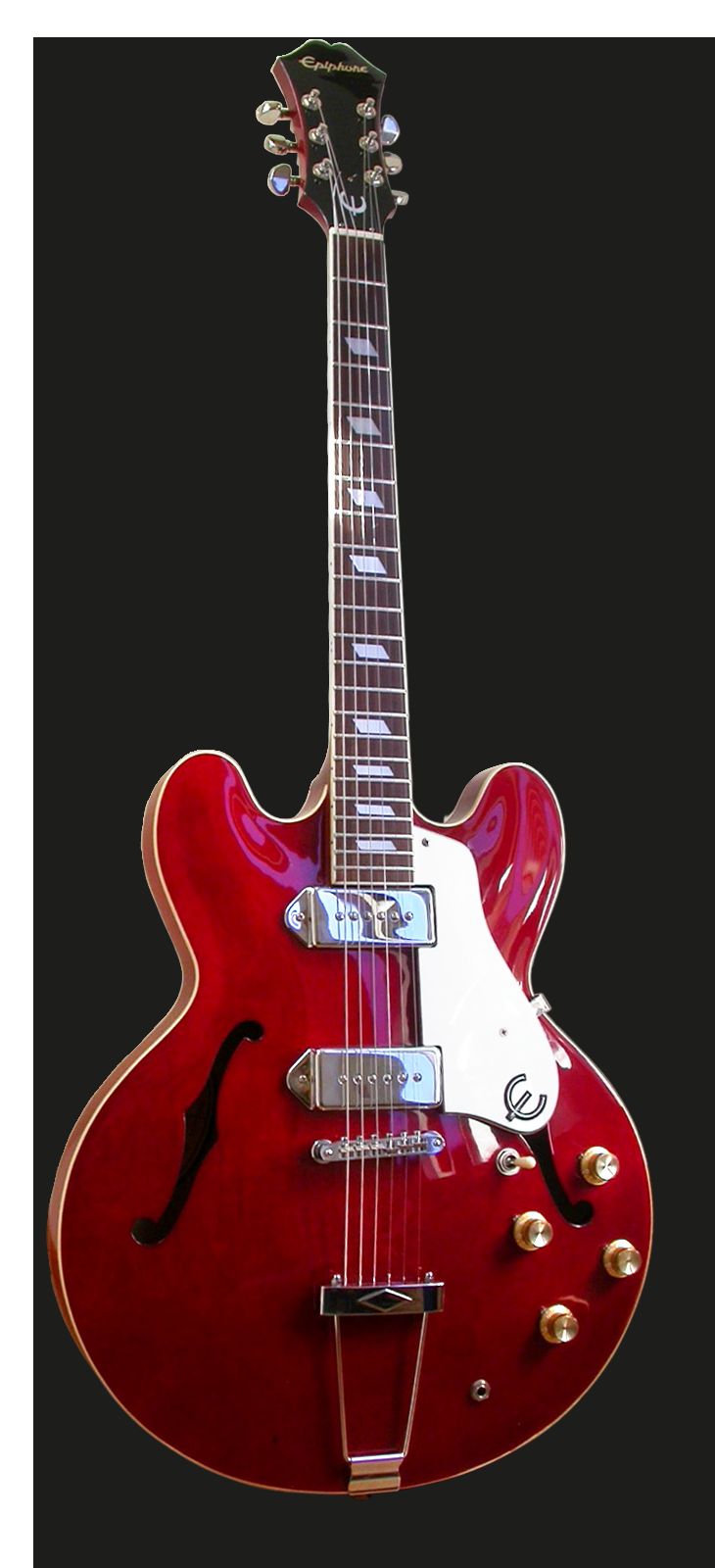
Epiphone Casino Cherry. Photo by Maxo; background removed by Auge=mit. Licensed under CC BY-SA 4.0. Via Wikimedia Commons. Epiphone
Casino
1961
Of all the Beatles’ famous guitars, the only one John, Paul, and George all had. Two sanded theirs bare.

Photograph of a vintage 1960 Gibson ES-335TD. Photo by Lightburst. Licensed under CC BY-SA 4.0. Via Wikimedia Commons. Gibson
ES-335
1958
Larry Carlton played three 335s off a shop wall, unplugged, paid $850 for one, and became Mr. 335.
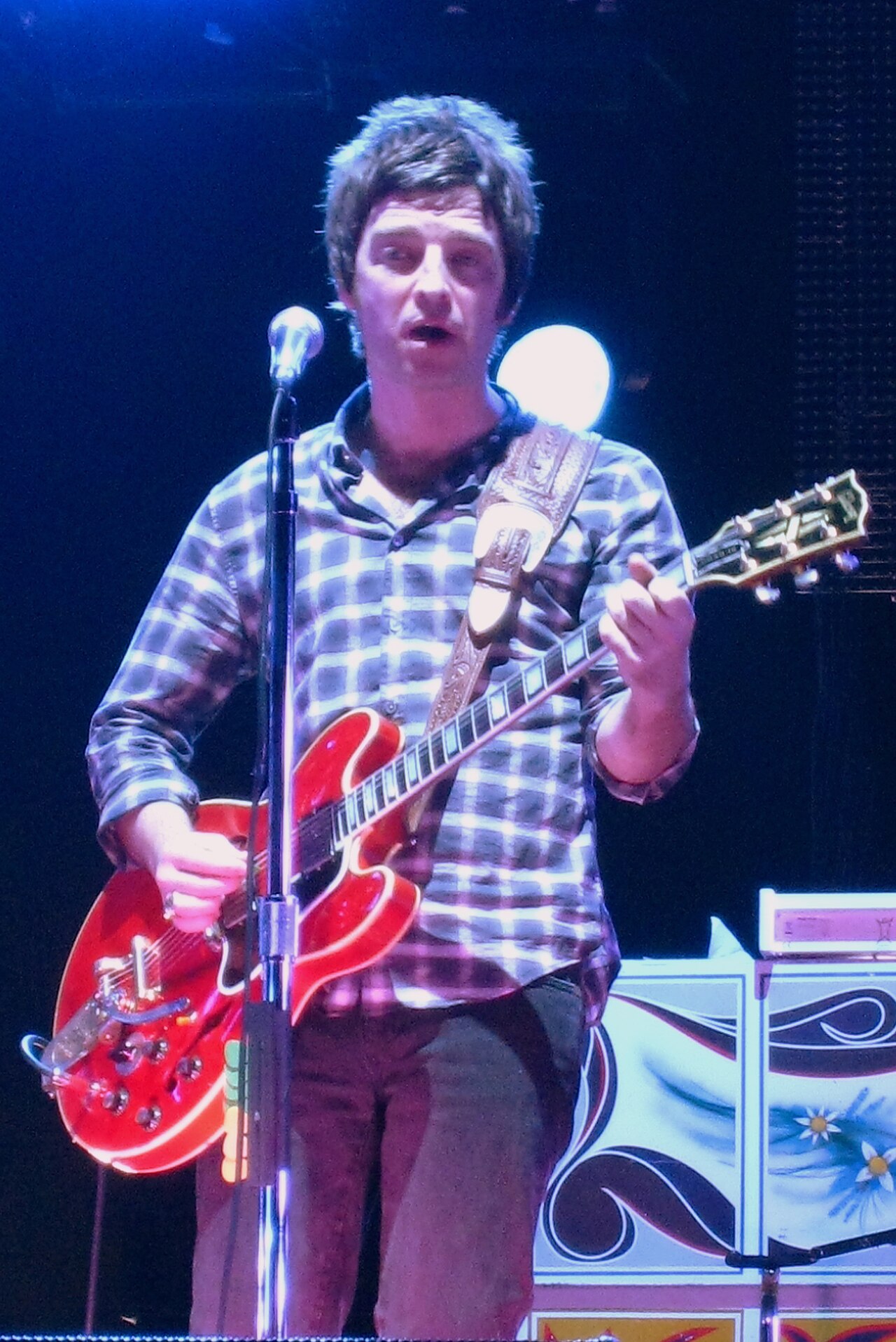
Photo: Anirudh Koul / Wikimedia Commons / CC BY 2.0 Gibson
ES-355
1958
B.B. King ran into a burning dance hall to save a guitar. Every Gibson after it was Lucille too.