Epiphone
Riviera
Stevie Ray Vaughan traded his big brother’s Esquire for one. Robben Ford made a whole album on its neck pickup.
Around 1991, Robben Ford buys a 1966 Epiphone Riviera. It’s a nice guitar. He puts it under the piano, and there it sits. It will be a long time before anyone finds out what it can do.
- Introduced
- 1962
- Type
- Hollowbody electric (semi-hollow)
- Class
- Production
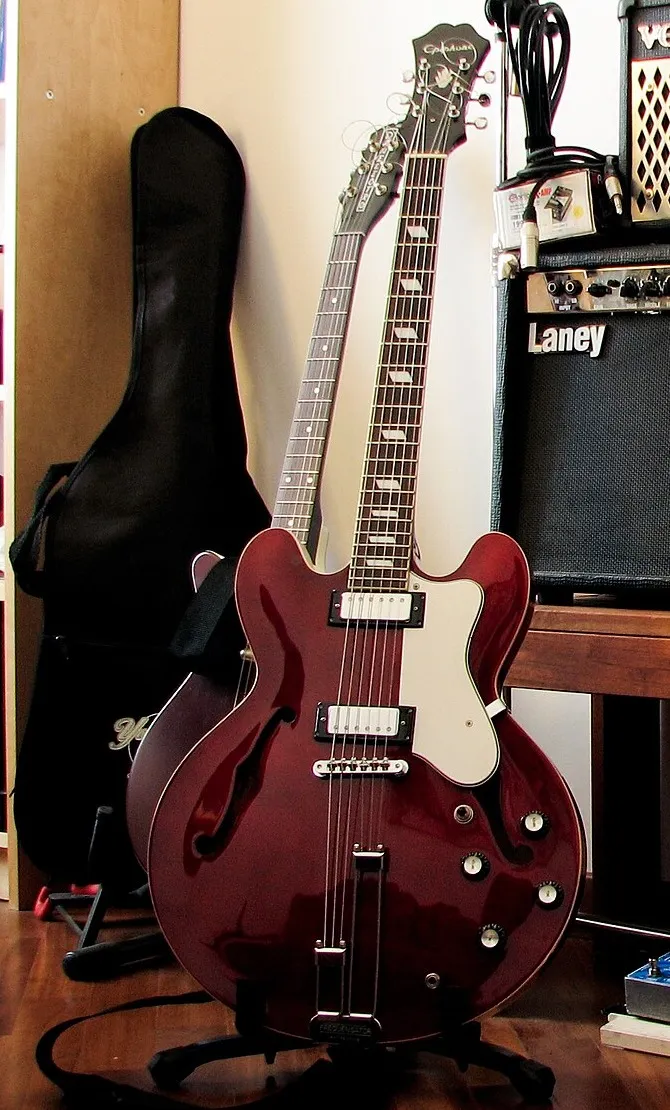
The short version
1962
The Riviera arrives
Epiphone’s everyday semi-hollow, in two-tone Royal Tan only. Forty ship the first year.
1965
Twelve strings
A 12-string Riviera joins the line. Carl Wilson of the Beach Boys later plays one.
1967
The peak
Over 1,400 ship in one year. A factory vibrato becomes an option.
1969
Kalamazoo winds down
The last American shipments. Depending on who you ask, the line moved to Japan in 1970.
1970
The trade
Late in the year, Stevie Ray Vaughan swaps his brother Jimmie’s 1951 Esquire for a 1963 Riviera.
1995
Morning Glory
Noel Gallagher plays rhythm on a 1983 Japanese Riviera.
2002
Out from under the piano
Robben Ford’s 1966 Riviera shows up for overdubs on Blue Moon. A whole album on it comes later.
Side A
A1
Under the piano
Around 1991, Robben Ford bought a 1966 Epiphone Riviera. Then he did what a lot of us do with a guitar we like but don’t need yet. He put it under the piano.
It stayed there for years. He had other guitars. He was Robben Ford.
That’s a pretty good summary of the Riviera’s whole life, actually. It has spent most of its sixty-odd years being the one people walk past on the way to something else.
A2
The one in the middle
Epiphone had a fancy semi-hollow already, the gold-trimmed Sheraton. In 1962 they filled in below it with the Riviera, the everyday version of the same idea. It has a maple block down the middle like a Gibson ES-335, the same size body, f-holes, a double cutaway.
It looks like an Epiphone, not a Gibson, from the headstock to the parallelogram markers. But the differences you can hear are the ones that count. Instead of full-size humbuckers it has mini-humbuckers, which have a narrower pickup field and sound brighter and more focused. Instead of a stopbar tailpiece it has a Frequensator, a two-tier trapeze with a long side for the bass strings and a short one for the trebles. The claim was that it helped the lows and highs. Plenty of players would tell you they can’t hear it.
The first year it came only in Royal Tan, a two-tone red and yellow burst. It listed at $325, which was $25 more than an ES-335. Forty of them shipped in 1962.
And then there’s the Casino, Epiphone’s hollow P-90 guitar from a year earlier. The Beatles took that one, and the Riviera has lived in its shadow ever since.
A3
Chicago wanted it bright
Blues players noticed.
In the early ’60s, the sound on a lot of Chicago bandstands was coming out of Fender single-coils, bright and cutting. A full-size humbucker was darker than that. A mini-humbucker split the difference. Of Chicago’s big three blues guitarists, Otis Rush and Magic Sam both played Rivieras.
The model did well for a while. Over 1,400 shipped in 1967, its best year. There was a 12-string from 1965, too, 446 of them in all, and Carl Wilson of the Beach Boys played one. That jangle on a Riviera 12 is a very different animal from a blues player’s six-string, which tells you how wide a net this plain little guitar threw.
Then the Kalamazoo years ran out. The last American shipments went out in 1969, and the line moved to Japan in 1970 or so.
Flip the record · By the numbers
$325
The 1962 list price. A Gibson ES-335 was $300. The Epiphone cost more.
40
Rivieras shipped in 1962, the first year.
1,424
Rivieras shipped in 1967, its best Kalamazoo year.
446
Twelve-string Rivieras shipped from Kalamazoo.
Side B
B1
Stevie traded his brother’s guitar
Late in 1970, a teenage Stevie Ray Vaughan made a private deal. He traded away his big brother Jimmie’s 1951 Fender Esquire, the one known as “Jimbo,” for a red and white 1963 Riviera.
The first photo of him with it is from Pecos, Texas, on 14 January 1971. It was his main guitar through the bands Blackbird, the Nightcrawlers, and Krackerjack, before the Strats. He was still playing “Hideaway” on it live in 1984, two pickguards and all. It is not Number One. Number One is a Strat.
Other people found it too. Robbie Robertson played one. So has Lenny Kravitz. Lou Reed played a Riviera with a Bigsby after he left the Velvet Underground. Noel Gallagher and Bonehead bought Japanese Rivieras in a Manchester shop, and Noel’s wine-red 1983 one is his rhythm guitar on (What’s the Story) Morning Glory?. That’s a later Riviera with full-size humbuckers, not a Kalamazoo one, but it wears the name.
B2
One guitar, one pickup
Eventually Robben Ford pulled the Riviera out from under the piano. It turned up for overdubs on his 2002 album Blue Moon. Somewhere along the way it got a refret and a new bridge, and the Bigsby came off.
And then he made a whole record on it. Bringing It Back Home is that one guitar, played through the neck pickup, start to finish. No switching, no second guitar for the solos. If anybody ever tells you that you need a wall of guitars to make a record, hand them this one.
Of all the guitars Robben Ford could have picked for that record, he picked the one that had spent years under the piano.
Put this on
You’ve read about it. Now hear it. Here’s what this guitar sounds like, and what to listen for.
Hideaway (live)
Stevie’s 1963 Riviera, the red-and-white one with two pickguards. The guitar he played before the Strats took over.
Find it on YouTube (opens in a new tab)Bringing It Back Home
The whole album is one guitar, his 1966 Riviera, and one pickup, the neck. Listen to how much range there is in something that simple.
Find it on YouTube (opens in a new tab)(What’s the Story) Morning Glory?
Noel Gallagher’s rhythm guitar is a 1983 Japanese Riviera with full-size humbuckers. A later cousin of the Kalamazoo guitar, but a Riviera.
Find it on YouTube (opens in a new tab)
The cast
The people, and the specific guitars, that made the legend.
Otis Rush
Riviera
One of Chicago’s big three blues guitarists. Two of the three played Rivieras.
Magic Sam
Riviera
The other half of the Chicago Riviera pair. Narrow mini-humbuckers, not a 335’s big ones.
1971
Stevie Ray Vaughan
1963 Riviera, red and white
Traded his brother’s Esquire for it. His main guitar before the Strats. This is not Number One.
1991
Robben Ford
1966 Riviera
Bought it, left it under the piano, then made a whole record on its neck pickup.
Lou Reed
Riviera with a Bigsby
After the Velvet Underground. The Velvets records themselves were made on other guitars.
1995
Noel Gallagher
1983 Japanese Riviera, wine red
Bought in Manchester with Bonehead. Full-size humbuckers and a stopbar, so not a 1960s Riviera.
Liner notes
Specs, construction, rarity, value, and every source we used.
Two mini-humbuckers on a maple-block thinline — Epiphone’s 335-class sibling, not the hollow Casino and not a Sheraton.
- Body
- Double-cut thinline. Layered maple; maple centerblock; f-holes. Single-ply cream bind, top, back, and board. Semi-hollow. Gloss. Official sheet omits width, depth, country.
- Neck
- Set mahogany; Rounded C. Sloped dove-wing headstock; Historic logo and pearl dot.
- Fingerboard
- Laurel; 22 medium jumbo; trapezoid; 305.0 mm / 12.01 in radius. Mix flagged.
- Scale
- 628.0 mm / 24.72 in. Vintage sheets print 24 3/4". Mix flagged; do not average.
- Pickups
- Epiphone PRO Mini Humbucker R (neck) and T (bridge); nickel covers
- Hardware
- LockTone Tune-O-Matic; Frequensator; Vintage Deluxe metal-button tuners; nickel. 3-ply Riviera guard with foil E.
- Electronics
- 2 volume, 2 tone; CTS pots; 3-way toggle; 1/4 in jack. Mono. No Varitone.
- Finish
- Gloss (Royal Tan, Sparkling Burgundy)
- Nut
- Graph Tech NuBone, 43.0 mm / 1.69 in. Mix flagged.
Open the full research fileConstruction details, the complete player record, production numbers, dated value estimates, and sources
Current Riviera Frequensator, Sparkling Burgundy, model EORSBUNH1, $699 (gibson.com; Guitar Center). Royal Tan EORRTNH1 same list; sold out on gibson.com this pass. Not a Kalamazoo 1962. Noel Gallagher Riviera (full-size Alnico Classic PROs, stopbar) and Bonehead Riviera are other SKUs.
Construction
Gibson bought Epiphone in 1957. New Epiphones started in Kalamazoo in 1958. Vintage Guitar (George Gruhn and Walter Carter): Ted McCarty drew a second brand for dealers who could not carry Gibson. Four of five new electrics were thin-bodied — a style Epi had never done. The Sheraton (epiphone-sheraton) was the fancy one, concurrent with the ES-335, “the equivalent of the ES-355.” Expansion went the other way. The new model arrived in 1962 and they called it the Riviera. Factory E360TD. Not a New York Stathopoulo guitar. Pre-1957 NY Epiphone never cataloged a Riviera.
The job was the 335-class Epiphone. Laminated maple, maple center block, double-cut, f-holes. Mini-humbuckers instead of full-size PAFs. Frequensator instead of a stopbar. Parallelograms, not dots. An Epiphone headstock. From across a shop it can look like a 335. It is not one. Not a Casino (epiphone-casino): fully hollow, dog-ear P-90s, no center block, 1961, ES-330 family. Not a Sheraton: Tree of Life, block-and-triangle, seven-ply top bind, gold. Not a Wilshire. This plate is the midline semi-hollow.
Kalamazoo 1962–69 is the identity. Vintage Guitar and Bass: maple, 16" × 19" × 1 3/4", one-piece set mahogany, bound rosewood, 22 frets, 24 3/4" scale, neck meeting the body at the 19th. The 1962 catalog, quoted on the same page, says the neck “joins the body at the 20th fret.” Keep both. Guitar World (Rod Brakes): same dimensions as the 335; unbound f-holes; single top and back bind. Current cart is 628.0 mm / 24.72 in. Mix flagged; do not average.
The pickups are why it is not a 335. Seth Lover’s minis, already designed to replace leftover New York single-coils. Guitar World (Bob Wootton, 5 May 2025): narrower field, brighter than a PAF — the voice Chicago bluesmen wanted when Fender single-coils were in. Early minis wear Patent Applied For labels through 1963, then patent-number. They later showed up on Firebirds and the Les Paul Deluxe. Not full-size Gibson humbuckers. Not P-90s.
Tailpiece is the other tell. Frequensator — two-tier trapeze, long on the bass, short on the treble. Wootton: a claim that it boosted lows and highs “many players would not substantiate.” Factory vibrato is Tremotone, optional from 1967 (Gruhn/Carter; Guitar World). A converted stopbar is a later guitar.
Headstock: short open-book 1962–63, elongated with bevelled edges from 1964 (Guitar World). Nut: 1 11/16" into a 1 9/16" transition beginning 1964, both widths into 1965. Chrome begins replacing nickel 1965. Witch-hat knobs from 1966, concurrent with reflector caps. Finishes: Royal Tan only at intro — two-tone red/yellow. Shaded (three-tone) from 1965; Royal Tan off the list by 1966. Cherry (E360TDC) and Sparkling Burgundy (also coded TDC) from 1966. Wootton: one known blonde from ’66. E360TD-12 from 1965.
Guitar World: intro list $325 against the ES-335TD at $300. Vintage Guitar: 1966 Riviera (shaded or cherry, no vibrola) $369.50; two-pickup Casino $325 cherry / $310 shaded; ES-335 $365–$385. VG&B, 1 October 1966: $395, $435 with Tremotone. Historical list, not 2026 street. Gruhn/Carter: the Beatles made vintage Casinos cost more than Rivieras. Fate, not construction.
VG&B’s last shipping year is 1969. Gruhn/Carter: the line went to Japan in 1970. Guitar-list also prints 1970. Do not pick a single last-US year.
Later Rivieras are other factories. Matsumoku: JDM 1975–79, export into the early 1980s (epiphonewiki; Reverb). Full-size Maxon humbuckers; Frequensator, then stopbar from 1982. That is the Oasis guitar, not a 1962 E360TD. 1993–94 Nashville run exists (guitar-list); no factory total in-hand. Elitist (Terada), the Nick Valensi P-94, Jorma Kaukonen Riviera Deluxe, P93, and the Noel Gallagher / Bonehead signatures are other SKUs. Current cart is the Chinese Frequensator above: PRO minis, laurel, dove-wing. Classic vs current: 1962 Kalamazoo — rosewood, parallelograms, 24 3/4" — against a 24.72 in Chinese mini-humbucker with laurel.
Players
Do not hang a Casino or a Sheraton on this plate. Do not file Noel Gallagher’s Union Jack as this guitar. Do not treat the Nick Valensi P-94 as a mini-humbucker Riviera. Number One is a Strat.
Otis Rush and Magic Sam. Guitar World (Wootton): of Chicago’s “big three,” two played Rivieras. Narrower minis, not a 335’s full-size PAFs. Album-to-guitar credits for named Cobra / West Side Soul sides are unpublished here. The association is the fact.
Stevie Ray Vaughan — 1963 Riviera, red and white. Reverb News (Casey Hopkins, 2 October 2017): traded Jimmie Vaughan’s 1951 Esquire “Jimbo” in a private deal, late 1970. First photographed 14 January 1971, Pecos. Main guitar through Blackbird, Nightcrawlers, Krackerjack — before the Strats. Live Hideaway, 1984, two pickguards. This is not Number One.
Robben Ford — 1966 Riviera. Premier Guitar (Jason Shadrick, 15 April 2013): bought around 1991, sat under the piano; Blue Moon (2002) overdubs; then the whole of Bringing It Back Home through the neck pickup, one guitar. Joe Glaser: refret, new bridge, Bigsby off. GITARRE & BASS: same neck-pickup rule on that record.
Lou Reed — Riviera, post-Velvet Underground. Manufacturer copy names him with the model. Gibson archive (Ted Drozdowski, 24 June 2010): “an Epiphone Riviera with a Bigsby.” Velvet Underground studio credits stay on other instruments.
Noel Gallagher — 1983 Matsumoku Riviera, wine red, full-size Maxon humbuckers, stopbar. Not a 1960s E360TD. Not the Union Jack Sheraton. Guitar World: Johnny Roadhouse, Manchester, with Bonehead; rhythm guitar on (What’s the Story) Morning Glory?; Don’t Look Back in Anger video. Signature SKU (2022, launch $899) copies that Japan guitar. Bonehead’s dark sunburst is the sibling object. Keep both off the Kalamazoo table.
Also known to play stays short. Guitar World names Robbie Robertson and Carl Wilson (12-string, after 1965). Premier Guitar vault names Lenny Kravitz. Manufacturer copy names Nick Valensi (P-94 signature) and Jorma Kaukonen (Riviera Deluxe). None invented.
Rarity
You can buy a new Frequensator Riviera tomorrow. Royal Tan and Sparkling Burgundy are regular production. Signature SKUs are current objects. They are not vintage rare.
1960s Kalamazoo is the collector object. Later Japanese, Korean, Chinese, Elitist, Nashville-assembled, and artist SKUs are not 1962–69 originals.
Kalamazoo shipping (Vintage Guitar and Bass; statistics, not a serial census): six-string E360TD family 2,556; twelve-string 446; period total 3,002. First year 1962: 40. Peak 1967: 1,424 (Guitar World: “over 1,400”). 1968 six-string 288; 1969 six-string 196. Cherry split out only from 1966 (E360TDC 485). Tremotone cells E360TDV 133 + E360TDVC 145. Serials were shared with Gibson and overlap years, so they date a guitar, they don’t count a year.
What is actually thinner: first-year short-headstock 1962–63; PAF-sticker minis; Royal Tan; Sparkling Burgundy; factory Tremotone; the 446 twelves. Rush’s, Sam’s, Vaughan’s, Ford’s, and Reed’s photographed guitars are unique objects. They are not a vintage Riviera.
Value
Informal estimate, 17 September 2026. Not an appraisal.
Ask vs sold labeled. Celebrity lots are not-comps. No invented medians. Period $325 (1962 list, Guitar World), $369.50 (1966, Vintage Guitar), $395 / $435 Tremotone (1 October 1966, VG&B) is 1960s money, not 2026 street.
New street. Current Chinese Frequensator: $699 (gibson.com; Guitar Center; Reverb new listings). Royal Tan EORRTNH1 sold out on gibson.com this pass at the same list. Sweetwater Sparkling Burgundy page is NLA this pass. Historical signature lists, not this table: Noel Gallagher Riviera launch $899 (Guitar World, 26 October 2022; Premier Guitar street $899).
Used modern. Reverb listing widget, Riviera Frequensator: estimated used $533–$603. Named solds on that run include Excellent Sparkling Burgundy $467, Royal Tan $400, and Good $399. Expect used Chinese well under $699. Matsumoku 1975–84 (Reverb Price Guide, 7 orders): named 2025 solds include Very Good $1,255.50 (13 September 2025) and Excellent $2,250 (8 September 2025). Flag: public solds for Japan/Korea are thinner than the 2020 cart.
Vintage / collectible. Distinguish ask vs sold. VG&B live affiliate asks this pass include a 1963 Royal Tan $13,995, a 1963 $19,995, a 1968 $5,500, and 12-string examples $4,295–$4,500. Reverb asks include a 1966 cherry $5,499 and a 1967 sunburst $9,495. Named solds, not a series: 1967 cherry Excellent $4,000 (from $6,000 ask); 1966–67 Royal Tan with added stopbar $3,700. Reverb’s 1962–69 dollar widget printed “used estimate unavailable” this pass. Flag: thin sold-comp access. Original finish vs refinish, swapped minis, and a converted tailpiece move the number.
Artist-owned Vaughan, Ford, Reed, and Gallagher Rivieras are a separate market, not a production comp. Do not price ordinary 1960s E360TDs off those objects.
See also
- epiphone-casino — fully hollow, dog-ear P-90s, no center block; the Beatles guitar, not this semi-hollow
- epiphone-sheraton — the dressy sibling Gruhn/Carter put against the ES-355; Tree of Life, not this midline
- gibson-es-335 — same Kalamazoo semi-hollow job; full-size humbuckers, typically a stopbar
Sources
- Epiphone Riviera, Sparkling Burgundy — current EORSBUNH1 spec; PRO minis; Frequensator; $699; Ford / Rush / Reed / Valensi copy
- Epiphone Riviera, Royal Tan — current EORRTNH1; $699; sold out this pass
- Vintage Guitar: Epiphone Riviera (Gruhn and Carter, December 2005) — 1962 intro; Sheraton as ES-355 equivalent; Riviera as the other-direction expansion; minis; Frequensator; Tremotone 1967; 1966 lists $369.50 vs Casino $325/$310 vs ES-335 $365–$385; Japan 1970; Beatles/Casino shadow
- Vintage Guitar and Bass: Riviera E360TD — available 1962–1969; 16" × 19" × 1 3/4"; 24 3/4"; 19th-fret join; 1962 catalog 20th-fret quote; shipping 2,556 / 446 twelves / 3,002; 1962 40; 1967 peak; 1 Oct 1966 $395 / $435 Tremotone; Royal Tan / Shaded / Cherry
- Guitar World: Classic gear, Epiphone Riviera (Rod Brakes) — 1962 E360TD $325 vs ES-335TD $300; 16" × 1 3/4"; 24 3/4"; 19th-fret join; open-book to elongated 1963–64; nut 1 11/16 to 1 9/16 from 1964; chrome 1965; Cherry and Sparkling Burgundy 1966; Tremotone 1967; peak “over 1,400”; discontinued 1969; SRV / Carl Wilson 12-string / Kaukonen / Valensi
- Guitar World: In praise of the Riviera (Bob Wootton, 5 May 2025) — 1962 counterpart to ES-335T; Lover minis; Magic Sam and Otis Rush; SRV / Robertson / Ford; PAF minis to 1963 then patent-number; Frequensator claim; Sheraton leftover long-scale necks vs Riviera 24 3/4"; Japan 1970
- Premier Guitar: 1968 Epiphone Riviera (Vintage Vault) — 1962–69 run; Kravitz / SRV / Reed / Valensi / Gallagher list
- Premier Guitar: Robben Ford, one guitar (Jason Shadrick, 15 April 2013) — 1966 Riviera; bought ~1991; Blue Moon 2002; Bringing It Back Home neck pickup; Glaser refret / bridge / tailpiece
- Reverb News: Lesser-known guitars of Stevie Ray Vaughan (Casey Hopkins, 2 October 2017) — 1963 Riviera; Jimbo trade late 1970; Pecos 14 January 1971; Hideaway 1984 two pickguards
- Guitar World: Oasis signature guitars — Johnny Roadhouse Matsumoku Rivieras; Maxon 61s; stopbar; Bonehead
- Guitar World: Noel Gallagher Riviera review (26 October 2022) — 1980s Japan original; launch $899 / £789; full-size humbuckers vs current minis; stopbar vs Frequensator
- Premier Guitar: Noel Gallagher Riviera — street $899; 1980s Japan, not a Beatles Casino
- Gibson archive: Lou Reed (Ted Drozdowski, 24 June 2010) — post-VU Riviera with Bigsby
- Guitar Center: Riviera Sparkling Burgundy — $699
- Sweetwater: Riviera Sparkling Burgundy — NLA this pass; Kaukonen / Valensi / Ford / Gallagher copy
- Reverb: Riviera Frequensator — years 2020–2026; China; typical new $699; listing widgets print used $533–$603
- Reverb: Riviera E360TD 1962–1969 — used-estimate widget unavailable this pass
- Reverb: Riviera 1975–1984 — Matsumoku; Frequensator then stopbar 1982; JDM 1975–79 / export 1980–84; named 2025 solds
- epiphonewiki: Riviera — 1962–69 E-360TD; open-book 1962–63; Matsumoku early 1980s; Elitist Terada 2001–06; JDM 1975–79
- guitar-list: Riviera — 1962–70; Nashville 1993–94
- GITARRE & BASS: Robben Ford — 1966 Riviera on Bringing It Back Home neck pickup
- Vintage Guitar: Robben Ford, Pure — Riviera on “Balafon”
Keep digging
Guitars this one gets compared to, confused with, or descended from.
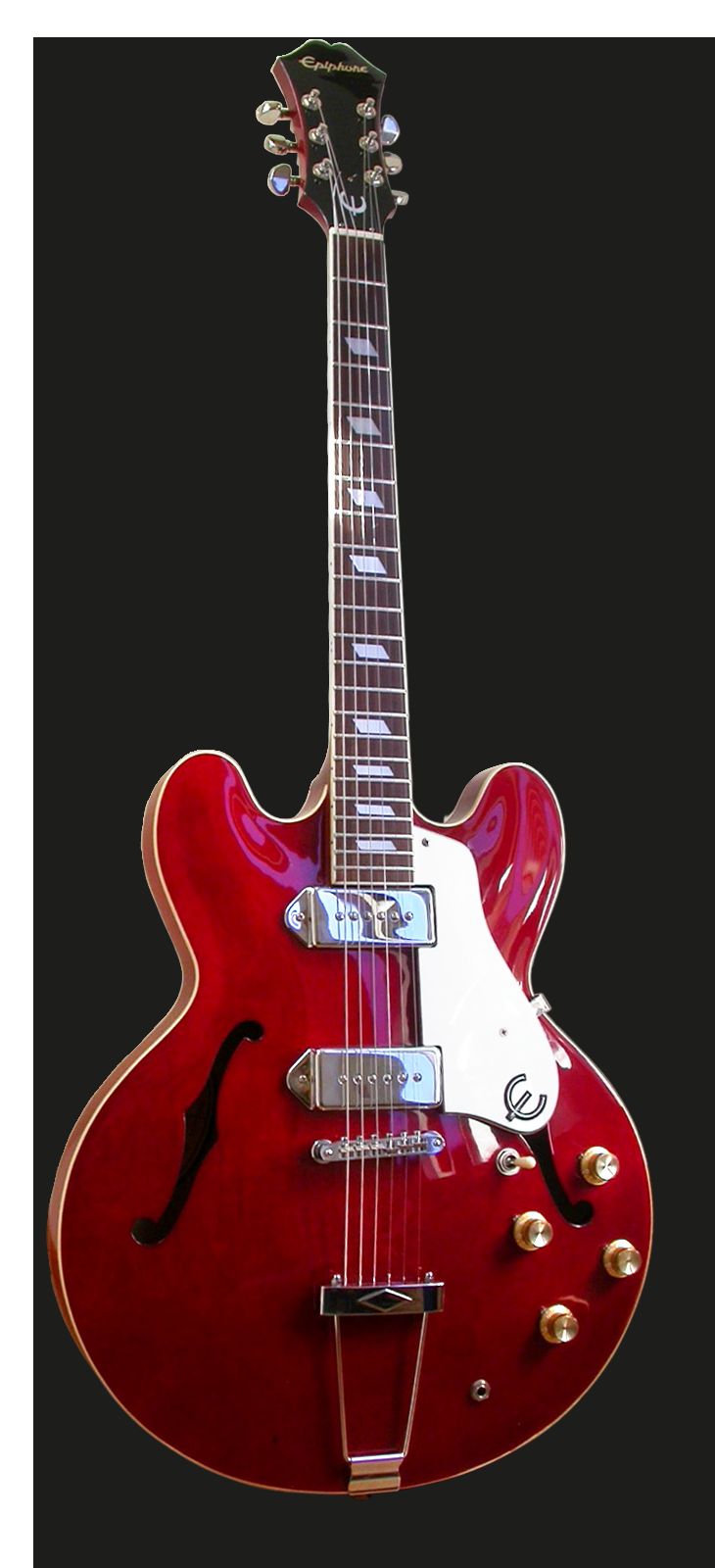
Epiphone Casino Cherry. Photo by Maxo; background removed by Auge=mit. Licensed under CC BY-SA 4.0. Via Wikimedia Commons. Epiphone
Casino
1961
Of all the Beatles’ famous guitars, the only one John, Paul, and George all had. Two sanded theirs bare.
- Send a picture
Epiphone
Sheraton
1958
Epiphone’s own catalog called it second best. John Lee Hooker and Noel Gallagher didn’t read the catalog.

Photograph of a vintage 1960 Gibson ES-335TD. Photo by Lightburst. Licensed under CC BY-SA 4.0. Via Wikimedia Commons. Gibson
ES-335
1958
Larry Carlton played three 335s off a shop wall, unplugged, paid $850 for one, and became Mr. 335.