Epiphone
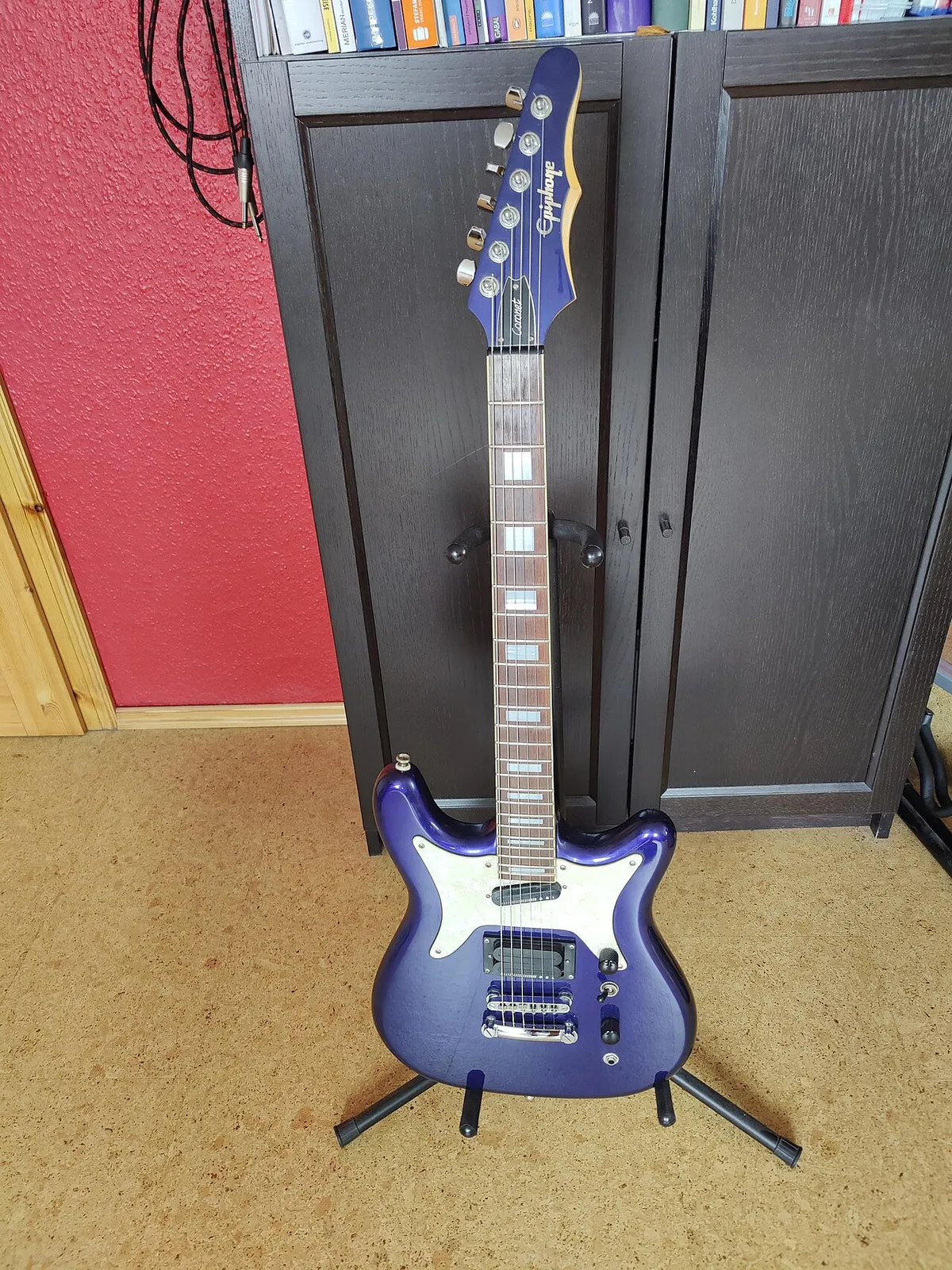
Coronet
Epiphone built the Coronet for shops Gibson wouldn’t sell to. Steve Marriott’s wore a third name.
February 6, 1958. Kalamazoo. Gibson’s bosses spec out two poplar solidbodies for the Epiphone name they’ve just bought, and call them Moderne. By the time the cheaper one ships, it’s mahogany, it has one pickup, and it’s called the Coronet.
- Introduced
- 1959
- Type
- Solidbody electric
- Class
- Production
The short version
1957
CMI buys Epiphone
Gibson’s parent company now owns a second badge for a second set of dealers.
1958
The Moderne memo
February 6. Two poplar solids are specced. The one-pickup guitar becomes the Coronet, in time for the July NAMM show.
1959
First shipments
237 ship. None did in 1958. A 1¾-inch slab with a leftover New York pickup, then a P-90 by year’s end.
1962
Vibrato optional
A Maestro for $27.50 more. 54 got one. 499 didn’t.
1963
Batwing
A longer bass horn, a covered P-90, and six tuners on one side.
1966
Pricier than the Gibson
The Coronet lists at $179.50. The SG Junior is $169.50.
1969
The end
Four ship. Another count has the last 20 going out in 1970.
2020
Back again
A Chinese reissue with a dog-ear P-90 and a wraparound bridge, beside a new Wilshire and Crestwood Custom.
Side A
A1
A badge for the other shops
February 6, 1958. Gibson’s parent company, CMI, had bought Epiphone the year before, and now Kalamazoo had a problem it wanted to have. Gibson dealers had territories. A shop that couldn’t get Gibsons could get Epiphones, if Epiphone had something to sell.
So four men from the company, Maurice Berlin and Ted McCarty among them, specced two solidbodies in poplar and called them Moderne Black and Moderne Deluxe. Moderne was already a Gibson name. The one-pickup guitar became the Coronet, and it became mahogany. Black stayed on as a color.
Even the name was a hand-me-down. Epiphone had sold a cheap archtop called the Coronet in the late 1930s and ’40s.
The Coronet was the guitar Kalamazoo built for the other store, so it could sell a Gibson without selling a Gibson.
A2
None shipped in 1958
It was meant for the July 1958 NAMM show, and Epiphone still says it was “first introduced in 1958.” The shipping ledger disagrees. None went out that year. In 1959, 237 did. Both dates stay.
The first ones are slabs: 1¾ inches deep, square edges, the Les Paul Junior’s wraparound tailpiece, and a metal plate on the headstock. The pickup was left over from Epiphone’s New York days. Its coil sits on its side, and the poles run across the top instead of through it. It can pass for a mini-humbucker. It isn’t one.
By the end of 1959 the New York parts had run out and a P-90 went in. In 1960 the Coronet listed at $132.
A3
Same plant, more Juniors
A year in, it got thinner, 1⅜ inches, with the edges rounded off. The metal plate came off the headstock the year after that. A Maestro vibrato turns up on a handful in 1961, and by 1962 it was a $27.50 option. That year 54 went out with one, and 499 without.
The same factory made 2,395 SG Juniors that year. The Gibson outsold it by miles.
In 1963 the Coronet was redrawn: a longer bass horn, a covered P-90, and a batwing headstock with all six tuners on one side. Cherry ran all the way through. Silver Fox came for a few years, and Sunset Yellow, California Coral, and Pacific Blue in numbers nobody has published. By January 1966 it listed at $179.50. The SG Junior was $169.50.
The stand-in cost more than the thing it was standing in for.
Flip the record · By the numbers
0
Coronets shipped in 1958, the year Epiphone says it was introduced.
$132
List price in 1960.
499 vs. 2,395
Coronets without vibrato against SG Juniors, 1962. Same plant.
4,414
Shipped through 1969, with and without vibrato. Another count, stop-tail only, is 3,373.
Side B
B1
Nashville tuning, double-tracked
Johnny Marr had a 1962 Coronet. He strung it with the high strings from a 12-string set, the thin octave strings, so everything came out bright and up high. It doubled his Rickenbacker arpeggios, most notably on “William, It Was Really Nothing.” That trebly layer on top of the Rickenbacker is the Coronet. The song was written on a Gibson J-160E. The Coronet is on the record.
On “Half a Person” it’s called the main guitar. A 1963 Strat, strung the same way, is on that song too. Both stay.
This month Marr’s Coronet was lot 14 in Christie’s sale of his guitars.
B2
The stand-in’s stand-in
The Kalamazoo Coronet ran out slowly. By one count, 4,414 shipped through 1969, and only four in the last year. Another count, stop-tail guitars only, is 3,373, with the last 20 going out in 1970. The name went on without it, on a two-pickup bolt-on from Japan in the ’70s and a short run in the ’90s. In 2020 Epiphone brought it back, with a dog-ear P-90 and a wraparound bridge.
Some Coronets don’t say Coronet at all. In the ’60s, Sonny Shields Music in East St. Louis sold them with another peghead and the name Dwight, after Charles “Dwight” Shields, with a “D” on the guard. One ledger row counts 111. A second badge for a second badge.
Steve Marriott played a cherry Dwight in the Small Faces and Humble Pie. People file it as a Crestwood. It isn’t. His Les Paul Junior later wore the Dwight’s white pickguard. Humble Pie’s fan history hangs the opening of “I Don’t Need No Doctor” on its sound.
It was stolen in the UK, and it hasn’t turned up. But his son Toby says it was still Steve’s until about six months before he died.
Put this on
You’ve read about it. Now hear it. Here’s what this guitar sounds like, and what to listen for.
William, It Was Really Nothing
Johnny Marr’s 1962 Coronet, strung with the high strings from a 12-string set, double-tracks the Rickenbacker arpeggios. Listen for the trebly layer on top.
Find it on YouTube (opens in a new tab)Half a Person
The Coronet is said to be the main guitar here. The same account puts a Nashville-strung 1963 Strat on the song too, so it may be both.
Find it on YouTube (opens in a new tab)I Don’t Need No Doctor
Humble Pie’s fan history hangs the opening on Steve Marriott’s Dwight Coronet. That’s their account, not a session log.
Find it on YouTube (opens in a new tab)
The cast
The people, and the specific guitars, that made the legend.
Steve Marriott
Cherry Dwight Coronet
Small Faces and Humble Pie. Often filed as a Crestwood. It isn’t. Still his until about six months before he died. Reported stolen in the UK.
1984
Johnny Marr
1962 Coronet, Nashville tuning
The Smiths. Doubled his Rickenbacker arpeggios on “William, It Was Really Nothing.” Lot 14 at Christie’s sale of his guitars, September 2026.
1963
Charles “Dwight” Shields
The Dwight badge
Sonny Shields Music, East St. Louis. Coronets with his name on the peghead and a “D” on the guard.
Jimi Hendrix
1961 Wilshire, not a Coronet
A current Coronet product page names him. The Epiphone solidbody on the record for him is a Wilshire.
Liner notes
Specs, construction, rarity, value, and every source we used.
One bridge pickup and a wraparound tail on a mahogany double-cut — Epiphone’s one-pickup solidbody, not a Wilshire and not a Casino.
- Body
- Symmetrical double-cut mahogany. Gloss. Solid. Official sheet omits width, depth, and country. Guitar World (2021), on this reissue: rounded edges, the slimmed body, not the 1¾" slab.
- Neck
- Set mahogany; medium C. Reduced-size Kalamazoo headstock; Bikini badge; 3-on-a-plate.
- Fingerboard
- Indian laurel; 22 medium jumbo; dots; 305.0 mm / 12.01 in radius. Mix flagged.
- Scale
- 628.0 mm / 24.72 in. Vintage sheets and the USA cart print 24 3/4" or 24.75 in. Mix flagged; do not average.
- Pickups
- One Epiphone P-90 PRO Dogear, bridge, black cover
- Hardware
- Lightning Bar compensated wraparound; 3-on-a-plate tuners, ivory buttons, press-in bushings; nickel. White butterfly guard with foil E.
- Electronics
- One volume, one tone; CTS pots. No selector. Mono.
- Finish
- Gloss (Ebony, Cherry)
- Nut
- Graph Tech NuBone, 43.0 mm / 1.69 in. Mix flagged.
Open the full research fileConstruction details, the complete player record, production numbers, dated value estimates, and sources
Current Coronet, EOCOEBNH1, list $499 (gibson.com, 25 September 2026). Ebony was sold out on that fetch; Cherry is the other finish. China (Guitar World, 2021; Reverb). Not a Kalamazoo 1959–70. USA Collection (EUCO23EBNH1, $1,699) and the Coronet ’66 batwing exclusives ($529) are other current guitars. gibson.com files the body style as “SG.” That is site taxonomy. This is not an SG.
Construction
The job was a one-pickup solid for shops Gibson would not sell to. CMI bought Epiphone in 1957. Kalamazoo needed a second badge that did not break a Gibson dealer’s territory (George Gruhn, Vintage Guitar, January 2011; Mat Koehler, Guitar World, 9 March 2021). Not a Wilshire (epiphone-wilshire): two soapbars, a stopbar. Not a Crestwood: the two-pickup deluxe. Not a Casino (epiphone-casino): hollow, dog-ears, no center block, 1961. Not a Les Paul Junior (gibson-les-paul-junior): same job, Gibson outline. Not a Riviera. Not a Sheraton. Gruhn: the Coronet name had already been a low-end Epiphone archtop in the late 1930s and ’40s. That archtop is not this slab.
6 February 1958. Berlin, McCarty, Rounds, and Havenga specced two poplar solids called Moderne Black and Moderne Deluxe (Gruhn). Moderne was a Gibson name. The one-pickup guitar became Coronet, in mahogany. Black stayed a color. Koehler: the line was for the July 1958 NAMM show. Epiphone’s page still says “First introduced in 1958.”
The ledger starts later. Gruhn: the line debuted in ’59, Coronet still the single, Crestwood the double. Vintage Guitar and Bass: debuting 1959. RetroFret, on a 1959 black slab: shown at that NAMM, “none of these shipped in 1958,” 237 in 1959, 221 in 1960. Marten (16 February 2021): Crestwood 1958, Coronet 1959. Keep 1958. This plate starts in 1959.
What shipped was a slab. Gruhn: 1 3/4" deep, square edges, the Junior’s wraptail, a metal plate on the headstock. The pickup was a leftover New York single-coil — offset poles, the coil on its side, poles across the top, not through it. It can pass for a mini-humbucker. It is not one. By the end of 1959 the New York parts were gone and a P-90 went in. 1960 list $132 (RetroFret).
A year on, Gruhn has it at 1 3/8", edges rounded, a new symmetrical guard, and the peghead plate gone the year after that. Marten prints the same cut as 44.45 mm (1.75 in) to 35 mm (1.375 in). Mix flagged. Do not put 1 3/8" on a 1959. VG&B’s later sheet is 12 3/4" × 15 5/8" × 1 3/8", scale 24 3/4". Current cart 628.0 mm / 24.72 in. USA cart 628.65 mm / 24.75 in. Do not average.
The vibrato is not a model. VG&B: Maestro, SB533MV, 1961–65, 7 in 1961. Gruhn: optional in ’62. RetroFret’s 1962: $27.50 extra, 54 with it, 499 without. From mid-1965 it was standard and the MV code dropped, so a post-1966 SB533 should have one, exceptions exist (VG&B). guitar-list: nickel until 1966, chrome from then.
1963 redraws it. Longer bass horn, covered P-90, batwing six-on-a-side (Gruhn). VG&B: restyle late 1963, first catalog picture 1964. Cherry all the way; Silver Fox 1963–65; Sunset Yellow, California Coral, Pacific Blue, that last count unpublished. RetroFret’s 1963: $162.50 plus case, symmetrical bodies done by year’s end. 1/10/66 list $179.50, SG Junior $169.50 (VG&B). The stand-in cost more.
Dwight is this guitar with another peghead. “D” on the guard, “Dwight” above it, cherry. VG&B’s row: 75 in 1963, 36 in 1967, 111 there, not every badge. The Epiphone wiki: Sonny Shields Music, East St. Louis, Charles “Dwight” Shields, some 1964s. humble-pie.net: a New York shop, “under licence.” Keep the town. Not a Wilshire. Not a Crestwood.
Two endings. VG&B through 1969: SB533 3,373 plus SB533MV 1,041 is 4,414, peak 1964 at 1,061, and 4 left in 1969. Gruhn’s 3,373 is that stop-tail cell, and he puts the last 20 in 1970. Keep both. Dwight’s 111 is outside the 4,414.
The name kept going without the guitar. VG&B: 1970s Japan, model ET-275, two pickups, bolt-on. guitar-list and the wiki: a short 1990s USA-then-Korea run, Explorer headstock, then a neck single and a bridge humbucker. Not an SB533.
2020 is the one on the $499 cart, back beside Wilshire and Crestwood Custom (American Songwriter, 17 December 2020). Marten, on that Coronet: China, polyester, dog-ear, Lightning Bar, 628 mm (24.72"), nut 43 mm (1.69"), radius 305 mm, £349 / $399, one sample 6.6 lb. Prown (June 2021): $399 and 24 3/4". The 2026 sheet still omits depth. USA Collection, $1,699: nitro, rosewood, SlimTaper, soapbar not dog-ear. Prose 1.375" and nut 1.695"; sheet 43.05 mm / 1.7 in, 304.8 mm / 12.0 in, 628.65 mm / 24.75 in. Mix flagged. That page names Hendrix. The Epiphone solid on the record for him is a 1961 Wilshire. Coronet ’66, batwing, $529. Mod Collection High Five: two pickups and a Bigsby, $4,199. Not this table.
Classic vs current: 1959 slab, New York coil, metal plate — against a Chinese dog-ear at 24.72 in, and a USA soapbar at 1.375".
Players
Do not hang a Casino, a Wilshire, or a Crestwood here. Do not move Hendrix’s 1961 Wilshire over because a product page lists him.
Steve Marriott — Dwight Coronet, Humble Pie. VG&B: one of the Dwight cherry Coronets, Small Faces / Humble Pie. humble-pie.net: thinner mahogany, jack on the front, a black guard run out to the controls. Toby Marriott told that site it was still Steve’s until about six months before he died. The page also says it was stolen in the UK. It hangs the opening of “I Don’t Need No Doctor” on the sound. The site’s claim, not a studio log. Same page: his Les Paul Junior later wore the Dwight’s white guard, and people file the Dwight as a Crestwood. It is neither. Vintage Guitar (Bret Adams, on Smokin’): a photo of Marriott “with a Dwight guitar.” Not a track credit.
Johnny Marr — 1962 Coronet, Nashville tuning. smithsonguitar.com carries him: a 1962, strung with the high strings from a 12-string set, doubling Rickenbacker arpeggios, “most notably on ‘William, It Was Really Nothing,’” and “the main guitar on ‘Half a Person.’” Christie’s, on his 1982 Rickenbacker 330: those “William” arpeggios were double-tracked by a trebly Coronet, lot 14 at Marr’s Guitars, London, 17 September 2026. The writing guitar for “William” on that sale is a J-160E, not this slab. The same smithsonguitar page also puts a 1963 Strat, Nashville-strung, on “Half a Person.” Keep both. Where he bought the Coronet is unpublished here.
Also known to play stays short. The USA page adds Marshall Crenshaw. No year, guitar, or track on this pass.
Rarity
You can buy a new Coronet tomorrow. The USA Collection was in stock on 25 September 2026. Chinese Ebony was sold out that fetch; Cherry is the other finish on the page. The ’66 exclusives are a limited current object, not vintage rare.
Kalamazoo is the collector guitar. Chinese dog-ears, USA nitro, ’66 batwings, ET-275s, and 1990s OBL Coronets are other factories on the name.
Which total you get depends on the column. VG&B’s 4,414 is stop-tail plus vibrato through 1969. Gruhn’s 3,373 is stop-tail only, with the last 20 in 1970. Dwight’s 111 is a separate row, not every “D” on a guard. No single factory total settles it. Shared Gibson serials date a guitar. They don’t count a year.
What is actually thinner: 1959 slabs that still have the New York pickup (RetroFret: none shipped in 1958); metal-plate headstocks; Silver Fox and the custom colors. Gruhn: in the peak year Gibson sold more than 3,800 SG Juniors. RetroFret: 2,395 SG Juniors in 1962 against 499 Coronets without vibrato, and over 2,300 Juniors in 1963 against 368 Coronets. Same plant. The Gibson outsold it. Marriott’s Dwight and Marr’s 1962 are unique objects. They are not a vintage Coronet.
Value
Informal estimate, 25 September 2026. Not an appraisal.
Ask vs sold labeled. Celebrity lots are not-comps. No invented medians. Period $132 (1960, RetroFret), $162.50 plus case (late 1963, RetroFret), vibrato extra $27.50 (1962), and $179.50 against an SG Junior at $169.50 (1/10/66, VG&B) is 1960s money.
New street. Chinese EOCOEBNH1: $499 (gibson.com). Launch on this reissue was $399 (Marten, February 2021; Prown, June 2021). USA Collection: $1,699, case included. Coronet ’66: $529. The High Five at $4,199 is a two-pickup Bigsby. Not a comp.
Used modern. Reverb, Coronet 2020–present: $241–$361 (125 orders, Good to Mint). Named solds on that page: Mint $381.65 (5 December 2025), Mint $348 (1 December 2025), Excellent $300 (17 October 2025), Excellent $249.99 (3 October 2025). A USA Coronet listing (2024–present) showed estimated used $898–$1,160. Order count not on that page. Don’t average China into USA.
Vintage / collectible. Reverb, 1963–1969: $2,151–$4,514 (96 orders, Good to Mint). Named solds: Good $2,250 (8 July 2026), Good $2,500 (24 March 2026), Excellent $4,650 (16 March 2026), Very Good $3,325 (2 January 2026), Very Good $3,950 (9 December 2025). The 1960–1963 dollar widget did not render. Flag: no 1960–63 sold band. Named asks, not hammers: 1961 $3,495, 1965 $3,500 and $4,000, 1962 $4,999, 1964 Silver Fox $4,999, 1963 $7,019 (VG&B affiliates); Sweetwater Gear Exchange 1962 $7,989; Reverb 1965 cherry $6,989, 1965 Pacific Blue $9,989. David Davidson (Guitar World, 19 July 2025): thick-body New York examples around three times a thin-body P-90. His ratio, not a price.
Marr’s 1962 was lot 14 at Christie’s on 17 September 2026. That hammer was not captured. The sale total is not a Coronet comp. Marriott’s stolen Dwight is one missing guitar. Not a comp.
See also
- epiphone-wilshire — two soapbars and a stopbar on the sibling solid; not this one-pickup wraptail
- gibson-les-paul-junior — the one-pickup Gibson the Coronet stood in for; different outline
- epiphone-casino — fully hollow, a pair of dog-ears, no center block; not this solidbody
Sources
- Epiphone Coronet, Ebony — EOCOEBNH1; P-90 PRO Dogear; Lightning Bar; 628.0 mm / 24.72 in; 305.0 mm / 12.01 in; 43.0 mm / 1.69 in; “first introduced in 1958”; $499; Ebony sold out 25 September 2026; Body Styles “SG”
- Epiphone USA Coronet, Ebony — EUCO23EBNH1; USA; nitro; soapbar; 1.375" / 1.695" prose; sheet 43.05 mm / 1.7 in, 628.65 mm / 24.75 in, 304.8 mm / 12.0 in; $1,699; Hendrix in the marketing copy
- Epiphone Coronet ’66, Heather Poly — batwing; $529
- Epiphone Coronet ’66, Inverness Green — $529
- Gibson Mod Collection Epiphone USA Coronet, High Five — two pickups, Bigsby; $4,199; not this spec
- Vintage Guitar: Epiphone Coronet (George Gruhn, January 2011) — 6 February 1958 meeting; Moderne renamed; archtop name; debut ’59; New York pickup; 1 3/4" then 1 3/8"; P-90 by end of 1959; batwing 1963; 237 / 499 / peak 685; last 20 in 1970; total 3,373; SG Juniors 3,800+
- Vintage Guitar and Bass: Coronet SB533 — debut 1959; 12 3/4" × 15 5/8" × 1 3/8"; 24 3/4"; 1/10/66 $179.50 vs SG Junior $169.50; 4,414 / 1964 peak 1,061 / Dwight 111; Maestro caveat; Marriott; ET-275
- Guitar World: Coronet, Wilshire and Crestwood Custom (Neville Marten, 16 February 2021) — Coronet 1959; China; $399; 628 mm / 24.72"; 43 mm; 305 mm; 6.6 lb; 44.45 mm to 35 mm
- Vintage Guitar: Wilshire and Coronet (Pete Prown, June 2021) — Coronet $399; one dog-ear; 24 3/4" printed for the reissue
- Guitar World: How Gibson rescued Epiphone (Mat Koehler, 9 March 2021) — July 1958 NAMM; Moderne memo becomes Coronet
- American Songwriter, 17 December 2020 — “first introduced in 1958”; 2020 dog-ear / Lightning Bar spec
- RetroFret: 1959 Coronet — none shipped 1958; 237 in 1959; 221 in 1960; 1960 list $132
- RetroFret: 1962 Coronet MV — vibrato $27.50; 54 and 499 in 1962; 2,395 SG Juniors
- RetroFret: 1963 Coronet — 368; $162.50 plus case; over 2,300 SG Juniors
- Guitar World: 1960 Coronet (David Davidson, 19 July 2025) — thick-body New York examples around three times a thin-body P-90
- Reverb: Coronet (2020–present) — China; used $241–$361 (125 orders); named 2025 solds
- Reverb: Coronet 1963–1969 — used $2,151–$4,514 (96 orders); named 2025–26 solds
- Reverb: Coronet 1960–1963 — dollar widget did not render
- Epiphone wiki: Coronet — Dwight, East St. Louis; some 1964s; 1990s note. Unofficial
- guitar-list: Coronet (1958–1970) — nickel until 1966, then chrome; 1990s name reuse
- humble-pie.net: Steve’s Guitars (archive) — Dwight, not a Crestwood; “I Don’t Need No Doctor”; stolen; Toby
- Vintage Guitar: Humble Pie’s Smokin’ (Bret Adams) — Marriott with a Dwight
- smithsonguitar.com: William, It Was Really Nothing — Marr, 1962 Coronet, Nashville tuning
- smithsonguitar.com: Half a Person — Coronet, and a 1963 Strat in the same tuning
- Christie’s: Johnny Marr Rickenbacker 330 — “William” doubled by a trebly Coronet, lot 14, 17 September 2026
- Sweetwater Gear Exchange: 1962 Coronet — ask $7,989
Keep digging
Guitars this one gets compared to, confused with, or descended from.
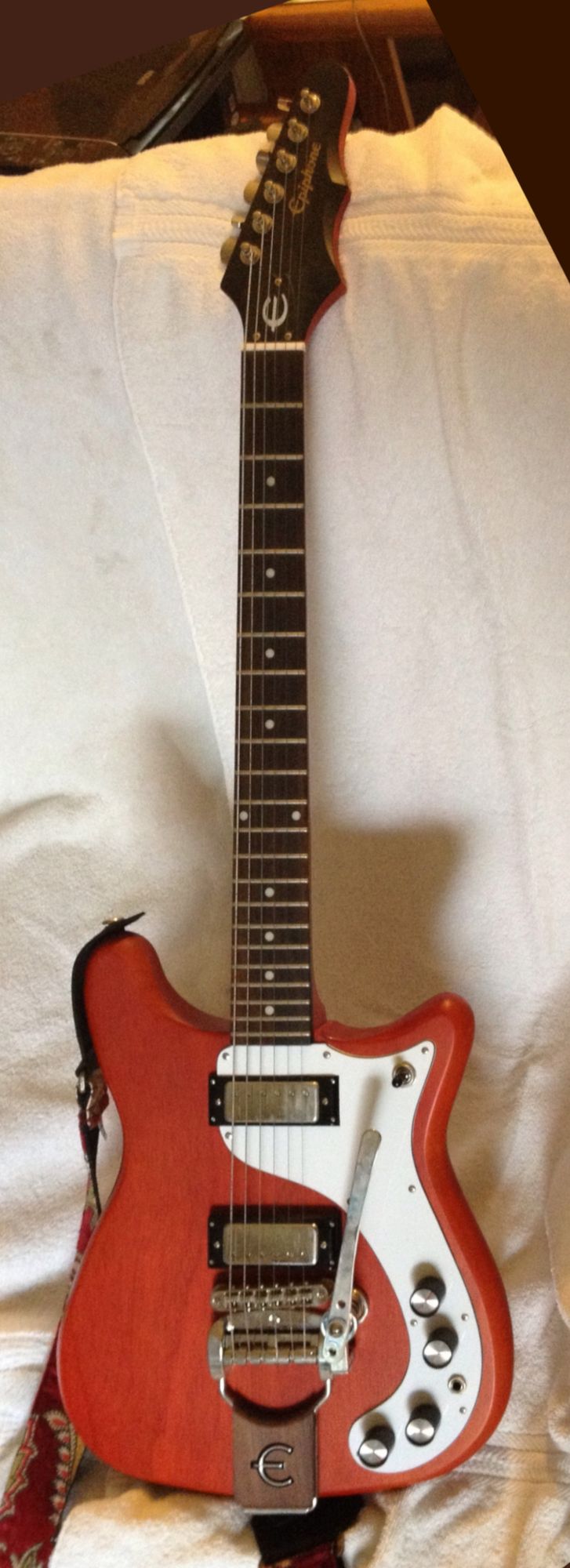
Photo: Marshall Stax / Clusternote / Wikimedia Commons / CC BY-SA 3.0 Epiphone
Wilshire
1959
Jimi Hendrix played one upside down in a Nashville club, painted its pickguard white, then pawned it.
Gibson Les Paul Junior. Photo by Detroit Gorilla. Licensed under CC BY 2.0. Via Wikimedia Commons. Gibson
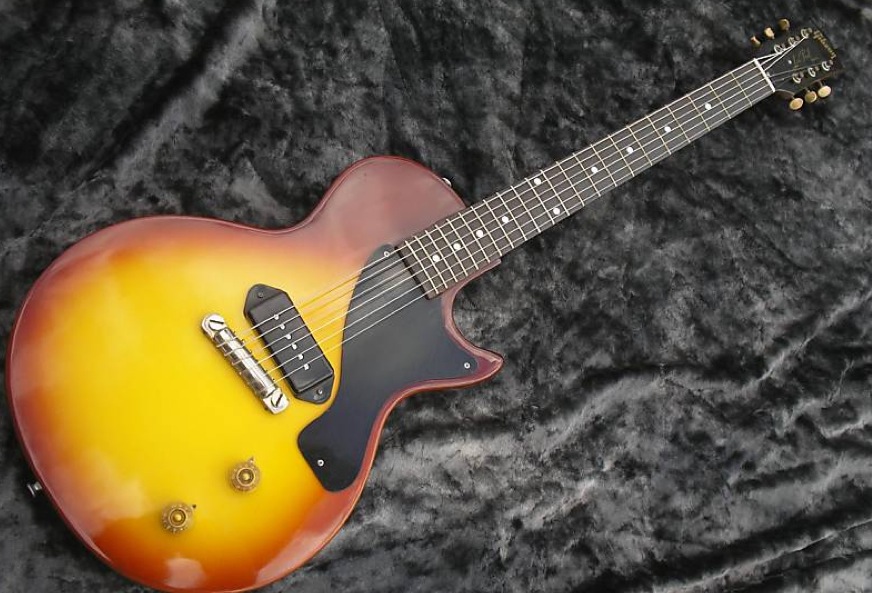
Les Paul Junior
1954
One pickup, two knobs, no switch. Built for beginners. Mountain and the New York Dolls never needed more.
Epiphone Casino Cherry. Photo by Maxo; background removed by Auge=mit. Licensed under CC BY-SA 4.0. Via Wikimedia Commons. Epiphone
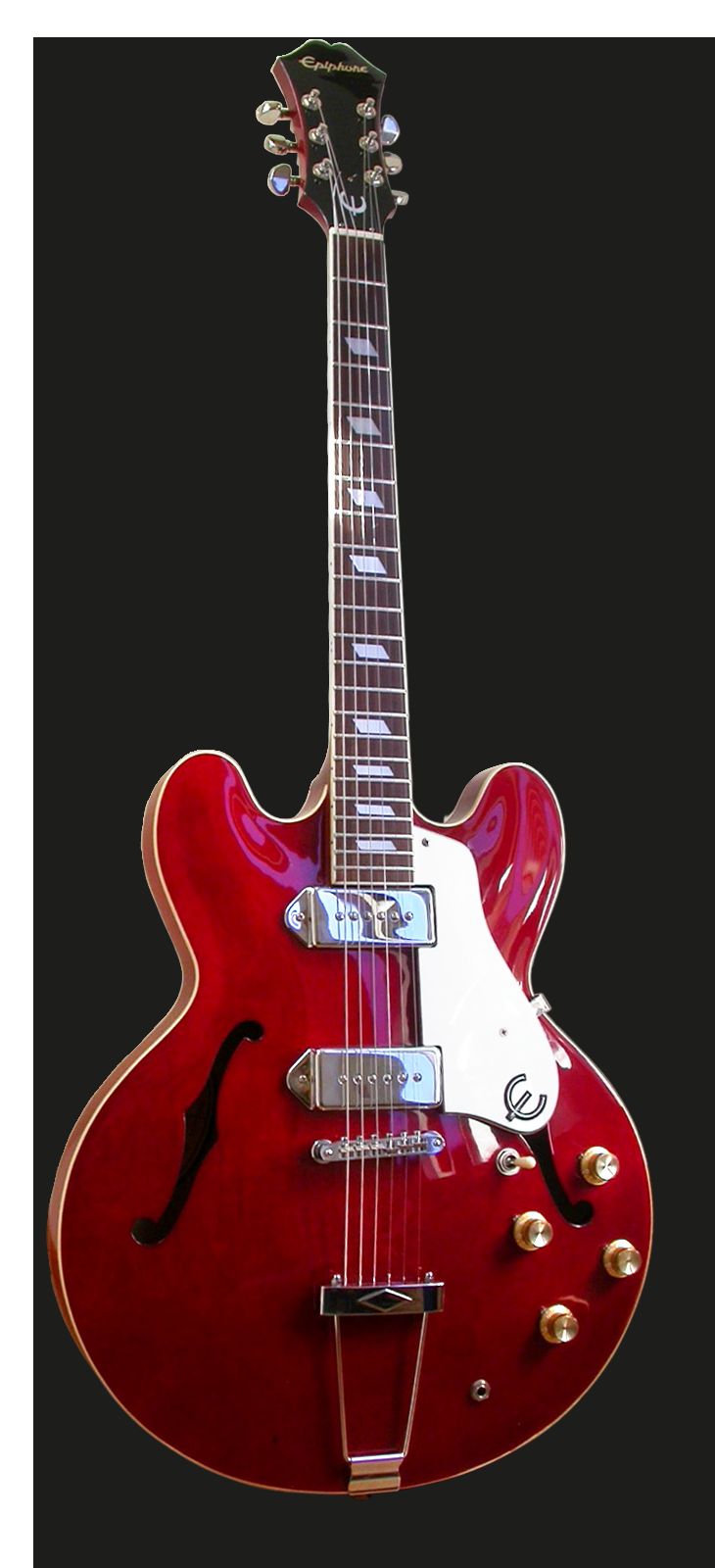
Casino
1961
Of all the Beatles’ famous guitars, the only one John, Paul, and George all had. Two sanded theirs bare.