Epiphone
Broadway
No famous player, no hit record. Just a name that kept getting handed to the next guitar.
New York, 1931. Epiphone launches a line of carved-top archtops to take on Gibson, and one of them is made of walnut. It isn’t the fanciest in the line. It’s the one just under it, and the name is still on a guitar you can order.
- Introduced
- 1931
- Type
- Archtop
- Class
- Production
Have a photograph of this guitar? Send a picture
The short version
1931
Masterbilt
Epiphone’s carved-top line arrives, De Luxe to Zenith. The Broadway sits one step under the top.
1935
Third-best
The Emperor arrives above everything, and the Broadway moves down a rung.
1936
Wider
From about 16⅜ inches to 17⅜. Some sources say 1937.
1937
The Frequensator
The split tailpiece arrives, long on the bass side, short on the treble. Some say 1939.
1939
Maple
The walnut back gives way to maple, though some guitars kept walnut a little longer.
1954
The last New York ones
Last made in 1954, 1957, or 1958, depending on whose count you trust.
1958
Kalamazoo
Gibson shows a new electric Broadway at summer NAMM, built in earnest for 1959.
2023
Refreshed
A new Broadway with a gold Frequensator, in Vintage Sunburst or Wine Red.
Side A
A1
Not quite as deluxe
New York, 1931. Epiphone puts out the Masterbilt line, carved tops aimed straight at Gibson: De Luxe, Broadway, Triumph, Royal, Zenith. The De Luxe is the showpiece. The Broadway is the next one down.
It’s the same size as the De Luxe, and it’s walnut. That was the tell. Orville Gibson had built with walnut, but the historian Walter Carter says no high-quality guitar had used it in a quarter century. Four-point stars on the board, a banner peghead, a spruce top. His verdict on where it sat:
“Not quite as deluxe as the DeLuxe.”
In 1932 a sunburst Broadway was $175. In 1940 it was still $175. By the late 1930s it was a full $100 under the De Luxe. That gap is the whole idea. A carved Epiphone a working player could actually get to.
A2
Bigger, and nobody agrees when
It didn’t stay the same guitar for long. The 1931 body is about 16⅜ inches wide, though one surviving 1932 measures 16¾. Then it grew to 17⅜. Some sources say 1936, some say 1937, and one dealer measured 17¼ on a 1935 and a 1936. Keep all of it.
The back went from laminated walnut to carved walnut, in 1932 or 1934 depending on who you read, and then to maple around 1939. Stars became blocks. Gold hardware came in 1934.
The ladder moved around it, too. For a while in the mid-1930s a model called the Tudor sat between the Broadway and the De Luxe. Then the Emperor arrived in 1935 above everything, and the Broadway became third-best. Still not the fancy one. Still the one people bought.
A3
The tailpiece that stayed
In 1937, or 1939 in another count, the Broadway got the Frequensator. It’s a split trapeze tailpiece: two arms, a long one for the bass strings and a short one for the treble.
That’s the detail to remember, because almost nothing else on this guitar made it to today. The walnut didn’t. The stars didn’t. The tailpiece did.
Flip the record · By the numbers
$175
A sunburst Broadway in 1932. In 1940 it was still $175.
$100
How far under the De Luxe it sat in the late 1930s.
608
Electric Broadways shipped from Kalamazoo, 1959 to 1969, by the shipping figures.
$385
A shaded electric Broadway in September 1963. Gibson’s ES-175D was $365.
Side B
B1
Fewer every year
The Broadway was fairly popular through the 1930s and ’40s. Then it dropped off. After 1949 there were very few batches. The registry that tracks New York Epiphones by serial has confirmed only about three dozen post-1949 Broadways, and the non-cutaway was down to a few in 1953.
A cutaway version turns up on a 1948 price list. In one count it became the Broadway Cutaway, then the Regent. When the plain Broadway ended is an argument: 1954, 1957, or 1958. The counts don’t agree, so we don’t pick.
B2
Kalamazoo gets the name
In 1957 Gibson’s parent company bought Epiphone. At the summer 1958 NAMM show it put the Broadway name on a new guitar, built in Kalamazoo in earnest from 1959. It had never been an electric in New York.
This one was a full-depth electric archtop: laminated maple, a Venetian cutaway, 17⅜ inches wide, and a Frequensator on the back end. The early ones used up leftover New York pickups, which are single-coils, before the mini-humbuckers came in. Don’t confuse it with the Casino or the Sheraton. Those are thinlines. This is the big one.
In 1959 it was $335 plus the case. In September 1963 a shaded one was $385 and a natural $405, while Gibson’s own ES-175D, the Kalamazoo cousin, listed at $365 and $380. The Epiphone cost more.
By the shipping figures, 608 went out between 1959 and 1969. The best years were 1966 and 1967, over a hundred each. In 1968 and 1969, nine apiece.
B3
Still on the order sheet
The Casino got the Beatles. The Sheraton got John Lee Hooker. The Broadway got nobody you can put on a record. Epiphone’s own copy places Les Paul and George Van Eps in the old West 14th Street showroom, and that’s a nice sentence about a showroom. It isn’t a Broadway on a session.
What it got instead was a run of guitars. A reissue in 1997. A fancier Elitist. Then, in 2023, a refresh at $999: laurel board, Alnico Classic PRO pickups, a Tree of Life headstock, Vintage Sunburst or Wine Red.
And a gold Frequensator, long on the bass side, short on the treble. Nearly ninety years on, it’s the one part of the prewar Broadway still bolted to the guitar.
The cast
The people, and the specific guitars, that made the legend.
Walter Carter
The 1931 walnut Broadway, in his Epiphone history
Called it “not quite as deluxe as the DeLuxe,” and noted that no high-quality guitar had used walnut in a quarter century.
Felix Wiedler
The New York Epiphone registry
Counts the surviving guitars by serial. About three dozen post-1949 Broadways confirmed, and very few batches after that year.
Liner notes
Specs, construction, rarity, value, and every source we used.
A walnut New York archtop that came back from Kalamazoo as a full-depth electric — Epiphone’s Broadway, not the hollow Casino and not a Sheraton.
- Body
- Single-cut archtop. Select spruce top; layered maple back and sides; f-holes. Gloss. Official sheet omits width, depth, and country.
- Neck
- Set maple; SlimTaper 60s C. Large clipped dovewing headstock; Tree of Life.
- Fingerboard
- Laurel; 20 medium jumbo; block mother-of-pearl with an abalone triangle; 304.8 mm / 12.0 in radius. Mix flagged.
- Scale
- 647.7 mm / 25.5 in. Reverb’s category field prints 24.75". Mix flagged; do not average.
- Pickups
- Alnico Classic PRO, neck and bridge; gold covers
- Hardware
- Adjustable floating pau ferro bridge; Frequensator split trapeze; Wilkinson; gold. Multi-bound imitation-tortoise guard with a foil E.
- Electronics
- 2 volume, 2 tone; 3-way toggle; 1/4 in jack. Mono. No Varitone.
- Finish
- Gloss (Vintage Sunburst, Wine Red)
- Nut
- Graph Tech, 43.0 mm / 1.69 in. Gibson Japan prints 1.692 in. Mix flagged.
Open the full research fileConstruction details, the complete player record, production numbers, dated value estimates, and sources
Current Broadway, Vintage Sunburst, model EOBDWVSGH1, $999 (gibson.com; sold out this pass). Not a 1931 carved-walnut acoustic. Not a Kalamazoo E252. Factory strings .012–.052. Premium gig bag. Pre-2023 reissue copy still prints pau ferro, a vine inlay, Grover Rotomatics, and a 1.68" nut. Do not average that with 43.0 mm / 1.69 in.
Construction
The job was a professional archtop under the fancy one. Guitar World: the 1931 Masterbilt line — De Luxe, Broadway, Triumph, Royal, Zenith — put carved tops against Gibson. Felix Wiedler: introduced that year in that line. Vintage Guitar and Bass: first shipped 1931, New York, latterly Philadelphia. No earlier prototype is sourced. This plate starts in 1931.
Walter Carter, on the Epiphone wiki: same size as the De Luxe, walnut, four-point stars, the Masterbilt peghead, “not quite as deluxe as the DeLuxe.” Walnut was the tell. Orville Gibson had used it; Carter says no high-quality guitar had, for a quarter century. prewargibsonl-5.com: one step below the Deluxe, except while the Tudor sat above it. Wiedler: Tudor 1934–1935, priced between them, gone after a year. Premier Guitar: 1933–1936. The Emperor, 1935, takes the top, and Premier then calls the Broadway “third-best.” Not the Emperor. Not Gibson’s 18" Super 400.
Wiedler’s 1931 is an auditorium: 16⅜" × 20¼", spruce, pressed-laminate walnut, segmented f-holes, stars, nickel trapeze, an asymmetrical banner peghead. Blue Book and Premier agree on 16⅜". The wiki prints 16½" for 1931–1936. Serial 5785, a 1932 at Twelfth Fret, measures 16¾". Do not average.
It grew, and the year is the argument. Wiedler: 17⅜" × 20¾" in 1936. Premier: to 17⅜" by 1936, no length given. Blue Book and the wiki: 17⅜" from 1937. archtop.com measured 17¼" on a 1935 and a 1936. The Kalamazoo electric inherits 17⅜" × 20¾" (VG&B). The wiki’s electric width is 17.5". Do not average.
The back is three stories. Wiedler: laminate walnut in 1931, carved walnut by 1932, maple from 1939. Blue Book and prewargibsonl-5 put the carved walnut back in 1934. Premier and the wiki put maple at 1939; the wiki keeps walnut through 1938. archtop.com still has walnut into 1939 and early 1940. Serial 5785 is described with a carved curly maple back and walnut sides. One guitar. F-holes: Wiedler, cello-shaped in 1935, modern in 1949. The wiki holds segmented holes through 1936.
Wiedler’s board is rosewood, stars in 1931, wide blocks in 1933. Blue Book, prewargibsonl-5, and the wiki put blocks at 1934, and the 1932 plus that early prewargibsonl-5 guitar are ebony. Keep the board. Gold from 1934. Tailpiece: trapeze, a compensator in 1936, Frequensator in 1937 (Wiedler; Blue Book). The wiki says 1939. Long on the bass, short on the treble. That trapeze is what the name keeps.
Peghead, Wiedler: banners, vine from 1934, center-dip in 1939, dogwood on some by 1950. Premier: 1951 is the first single flower. Wiki: flower 1950–53, column 1954–58. VG&B’s 1954 catalog picture is still a flower. Neck, Wiedler only: maple, mahogany from 1933, cherry from 1940, three centerstripes. Sunburst throughout; a semi-opaque top only in 1933–34, an opaque top only in 1942–44, blonde from 1940.
Non-cutaway to the end, and the end is contested. Wiedler: last made 1954. Zachary Fjestad, 2012: until 1957. Blue Book and the wiki: through 1958. The 1954 catalog still shows one. Do not pick.
The cutaway acoustic is not the electric. Wiedler prices a cutaway in 1948, and his 15 March 1948 list names one. His table then says 1949 Broadway Cutaway, 1950 Regent. Blue Book and the wiki: Regent 1948–1958. Keep 1948 and 1949. Bretton is the 1931 four-string. Wiedler’s Broadway Tenor runs 1936–44; Blue Book’s runs 1937–1949. Not this guitar. Not a Zephyr. The wiki: never an electric in the old line.
Gibson’s parent bought Epiphone in 1957 and put the name on a new guitar. RetroFret: at summer 1958 NAMM, built in earnest for 1959. VG&B’s table starts in 1959. The wiki says the electric ran 1958–1969, and the name through 1970, with no 1970 cell. Keep the show and the shipments. Do not invent a last year.
Laminated maple, Venetian cut, full depth. Not a thinline. VG&B: 17⅜" × 20¾", mahogany, rosewood blocks, 20 frets, neck at the 14th, 25½", Tune-o-matic, Frequensator. With the Howard Roberts, one of two full-depth Kalamazoo Epiphones. That other model is not this one. The cousin VG&B names is the ES-175D (gibson-es-175): same job, 16¼", Florentine. September 1963: Broadway $385 shaded / $405 natural, the 175D $365 / $380. RetroFret: $335 plus case in 1959. Old money.
Pickups are the Sheraton trap. Wiki: New York coils 1958–60, minis from 1961. RetroFret’s 1959 still had the leftovers — 68 shipped that year, 34 in 1960 — then a Gibson neck. VG&B’s spec line mentions only nickel minis and skips those years. New York coils are single-coils. Not minis. Minis are not full-size PAFs.
Depth: 3 7/16" through the mid-1966 catalog, 2⅞" on the October 1966 list (VG&B). The same page’s box says 3 7/16" for 1959–65 and 2⅞" for 1966–68. One 1959 at RetroFret is 3⅜". Do not average. 1969 shipped. No 1969 depth is printed. Headstock: open-book through 1964, elongated after (wiki); VG&B keeps the Epiphone “i.” Cherry is on lists from September 1964 and in its own shipping cell only in 1967, because shaded and cherry shared E252.
Not a Casino, a Sheraton, or a Riviera. Those are thinlines, two of them with a center block. Not a Coronet or a Wilshire. The old Coronet was the cheap New York archtop.
Reissued 1997 (VG&B): tree-of-life peghead, abalone-triangle blocks, Emperor dress, not a walnut top. The 2003 ETBW: rosewood, nut 1.68", ’57 Classics. Elitist: solid spruce, flame maple, ebony, USA humbuckers, bone 1-11/16". The living guitar is the 2023 refresh, $999 (Guitar.com, 24 May 2023): laurel, Wilkinson, Tree of Life, Alnico Classic PROs, gold Frequensator, Vintage Sunburst or Wine Red. A 1931 walnut non-cut, or a 1959 laminate with New York coils, against that. The sheet still omits width, depth, and country.
Players
This guitar did not get the career the Casino and the Sheraton got. No Beatles side, no Hooker signature, no pinned session in the sources here.
Do not hang a Casino on it. The shared Beatle electric is the hollow P-90 (epiphone-casino). Do not hang a Sheraton on it. Hooker’s catalog guitar, and Noel Gallagher’s Union Jack, are that thinline. Joe Pass’s Epiphone is an Emperor. Wes Montgomery’s public electric is an L-5 CES. The Epiphone Howard Roberts is the other full-depth Kalamazoo electric, not an E252.
Epiphone’s “On Broadway” paragraph, repeated by Chicago Music Exchange and zZounds, puts Les Paul and George Van Eps in the West 14th Street showroom, “inspiring and shaping the modern Broadway.” A showroom sentence. Not a Broadway on a record. Les Paul’s catalog guitar in the Gibson story is a Super 400, billed as Rhubarb Red. It stays there.
The same paragraph says Nick Colionne “performs with his Epiphone Broadway.” Official Epiphone videos put him on an Ultra-339 (2012) and an ES-175 Premium (2015). No Broadway serial and no album credit in hand. Brochure, not a session.
Also known to play stays short. Nothing verified, so nothing added.
Rarity
You can buy the 2023 Broadway when it is in stock. Regular production. Not vintage rare. gibson.com’s Vintage Sunburst was sold out this pass. Sweetwater still listed it as orderable.
The carved New York guitar is the scarce acoustic, and Epiphone never published a Broadway total. None invented. Wiedler’s registry counts known instruments. He calls it fairly popular in the 1930s–40s, then a drop: very few batches after 1949, about three dozen post-1949 examples confirmed by serial, 1950s non-cutaways down to a few in 1953. His model page says last made 1954, against Fjestad’s 1957 and Blue Book’s 1958. Cutaway / Regent: at least 59 confirmed, his guesstimate “not much more than a hundred.” Label the guesstimate. Walnut, pre-widen, star-inlay guitars are the thin acoustic end. A Regent is not a non-cut.
Kalamazoo is a small electric. VG&B shipping, 1959–1969, statistics, not a serial census: 608. First year 87, including E251N at 19. VG&B calls that code an anomaly, a clerical error or a real model name. Unresolved. Do not invent a one-pickup Broadway from it. Peak 1966: 110, 1967: 119. 1968 and 1969: 9 each. Natural E252N across the run: 96. Cherry’s own cell is 24, 1967 only. New York-pickup 1959–60 guitars are the thin electric window. A 1997 reissue, an Elitist, and a 2023 laurel Broadway are not an E252.
Value
Informal estimate, 6 October 2026. Not an appraisal.
Ask versus sold, labeled. No artist-owned Broadway lot turned up, so there is no celebrity comp. Period lists are old money. Wiedler: sunburst $175 in 1932, still $175 in 1940 with blonde at $200; 1948 cutaway $290 / $315; 1953 non-cut $290 / $315, cutaway $335 / $355. RetroFret: late 1930s $175, a full $100 under the De Luxe. Electric: $335 plus case in 1959 (RetroFret); September 1963, $385 shaded / $405 natural (VG&B).
New street. Current laurel Broadway: $999 (gibson.com; Sweetwater; Guitar Center; zZounds). Guitar.com’s 24 May 2023 launch price is the same $999. EOBDWVSGH1 was sold out at that list this pass. Sweetwater: not normally stocked, “we can get it,” estimated December 2026, still $999. Named lower new asks, not a street average: Dave’s Guitar Shop $699; one Reverb listing cut from $999 to $899.10. Guitar Center’s older Antique Sunburst restock at $499.99 is a different, sold-out listing. Do not fold it into $999.
Used modern. One Reverb Vintage Sunburst widget printed estimated used $739–$861. The same model on Reverb Malta printed “used estimate unavailable.” Keep both. Named asks, not hammers: Excellent Wine Red, laurel, $745; left-handed Vintage Sunburst, Excellent, $849. A pre-2023 unplayed Excellent (pau ferro, Reverb’s 1997–2022 run) ask $849. Sweetwater Gear Exchange on ETBWNAGH Natural, the older natural, suggests used $415–$615 and prints new $799. Not the $999 cart. Elitist solds: Very Good $2,500 (24 September 2025), Excellent $2,500 (30 July 2024), Very Good $1,765 (19 July 2023). Asks beside them: $2,800 and $3,200. Flag: 2023 solds are thinner than the asking list.
Vintage / collectible. No 2024–26 sold series for a New York acoustic or a Kalamazoo E252. Flag: thin sold-comp access. Named asks this pass, not hammers. VG&B affiliates: a 1963 at $7,795, a 1949 at $6,800, a 1964–66 at $4,395, a 1949 with a DeArmond at $3,500, a 1951 natural at $3,459. Reverb asks: a 1965 at $4,495.50 (from $4,995), a c. 1966 at $3,145.50 (from $3,495), a 1965 Excellent at $6,651.49, a 1966 Good at $2,997. One 1965 with a Bigsby sold at $3,995, listed about six years ago. An old hammer. Premier Guitar, July 2012, put one mostly original 1951 at $2,000–$2,500. One appraisal, that year. Not 2026.
Finish, cracks, a replaced neck, New York coils versus minis, and Regent versus non-cut versus E252 move the number. A 2023 Broadway stands in for none of them.
See also
- epiphone-casino — fully hollow, dog-ear P-90s, no center block; the Beatles electric, not this archtop
- epiphone-sheraton — the dressy thinline with a center block; Frequensator, but not this full depth
- gibson-es-175 — the Kalamazoo cousin VG&B sets the electric Broadway against; 16¼", Florentine, not 17⅜" Venetian
Sources
- Felix Wiedler, NY Epiphone Registry: models — introduced 1931, last made 1954; 16⅜" × 20¼" then 17⅜" × 20¾" in 1936; laminate walnut, carved walnut by 1932, maple 1939; stars then blocks 1933; cello f-holes 1935; Frequensator 1937; dogwood by 1950; neck maple / mahogany 1933 / cherry 1940; blonde from 1940; cutaway priced 1948, named Cutaway 1949 and Regent 1950; tenor 1936–44; price ladder $175 (1932) through 1953; Tudor 1934–1935
- Felix Wiedler, close-up 41 — 15 March 1948 price list; post-1949 drop; about three dozen post-1949 confirmed; Regent at least 59, guesstimate not much more than 100; a few non-cut 1953s. Registry, not a factory total
- Vintage Guitar and Bass: Broadway — first shipped 1931, New York then Philadelphia; 1954 catalog flower and 20¾" × 17⅜"; electric E252 1959–1969; depth 3 7/16" through mid-1966, 2⅞" on the October 1966 list; 14th-fret join; September 1963 $385/$405 vs ES-175D $365/$380; shipping 608; E251N 19; 1997 reissue
- Guitar World: 150 years of Epiphone — 1931 Masterbilt: De Luxe, Broadway, Triumph, Royal, Zenith
- Premier Guitar: Epiphone Broadway (Zachary Fjestad, 9 July 2012) — “third-best” behind Emperor (1935) and De Luxe; Tudor 1933–1936; 16⅜" to 17⅜" by 1936; maple in 1939; flower first year 1951; until 1957; one 1951 at $2,000–$2,500 in 2012
- prewargibsonl-5.com: Epiphone Broadway — 1931, under the Deluxe except during the Tudor; laminated walnut, carved back in 1934; ebony stars, then 1934 rosewood blocks; serial 7262 mixes features
- Epiphone wiki: Broadway acoustic — Carter, pp. 23–25; 1931–1958; 16½" then 17⅜" from 1937; walnut through 1938; segmented holes through 1936; flower 1950–53, column 1954–58; Frequensator 1939–1958; Regent 1948–1958
- Epiphone wiki: Broadway electric — never an electric in the New York line; name on a full-depth electric 1958–1970; laminated maple; 17.5"; NY pickups 1958–1960, minis 1961–1969; open-book through 1964, elongated 1965–1969; nut 1.68"; Howard Roberts as the other full-depth electric
- Blue Book of Guitar Values: Epiphone Broadway — 16.375", 1931–1958; carved back and gold in 1934; 17.375" and Frequensator in 1937; Regent 1948–1958; Bretton 1931–36; Broadway Tenor 1937–1949
- RetroFret: 1939 Broadway — late-1930s list $175, $100 under the De Luxe
- RetroFret: 1959 E-252 — NAMM summer 1958; 68 in 1959, 34 in 1960; leftover New York parts; 3⅜" rim on this guitar; $335 plus case
- archtop.com: 1936 Broadway — measured 17¼"; walnut wide-body dated 1936–1939 on that page
- Twelfth Fret: 1932 Broadway, serial 5785 — measured 16¾"; ebony stars; described with a carved curly maple back and walnut sides. One guitar
- Gibson: Broadway, Vintage Sunburst — EOBDWVSGH1; 647.7 mm / 25.5 in; 304.8 mm / 12.0 in; 43.0 mm / 1.69 in; Alnico Classic PRO; Frequensator; Wilkinson; Tree of Life; .012–.052; $999; sold out this pass
- Gibson Japan: Broadway — nut 43.0 mm / 1.692 in
- Guitar.com: refreshed Broadway (Crystal Koe, 24 May 2023) — Vintage Sunburst and Wine Red; $999
- Sweetwater: Broadway Vintage Sunburst — $999; orderable, estimated December 2026
- Guitar Center: Broadway Vintage Sunburst — $999
- guitar-list: Broadway ETBW — 1997; 2003 catalog; ’57 Classic / ’57 Classic Plus; nut 1.68"
- Epiphone Elitist catalog (archived) — solid spruce, AAA flame maple, ebony, bone 1-11/16", USA humbuckers. Not the current sheet
- Chicago Music Exchange, quoting Epiphone — Les Paul, George Van Eps, Nick Colionne copy; pre-2023 pau ferro / vine / Grover / 1.68"
- Epiphone: Nick Colionne, Ultra-339 — 2012, not a Broadway
- Epiphone: Nick Colionne, ES-175 Premium — 2015, not a Broadway
- Reverb: Broadway (2023–present) — category field prints 24.75" against the factory 25.5"; Malta widget “used estimate unavailable”; Dave’s new ask $699
- Reverb listing: Vintage Sunburst — new ask $899.10 from $999; estimated used $739–$861
- Reverb: Elitist Broadway — solds $2,500 (24 September 2025), $2,500 (30 July 2024), $1,765 (19 July 2023)
- Sweetwater Gear Exchange: ETBWNAGH Natural — older natural; used $415–$615; page prints new $799
- Reverb: 1965 E-252, sold — sold at $3,995, listed about six years ago
Keep digging
Guitars this one gets compared to, confused with, or descended from.
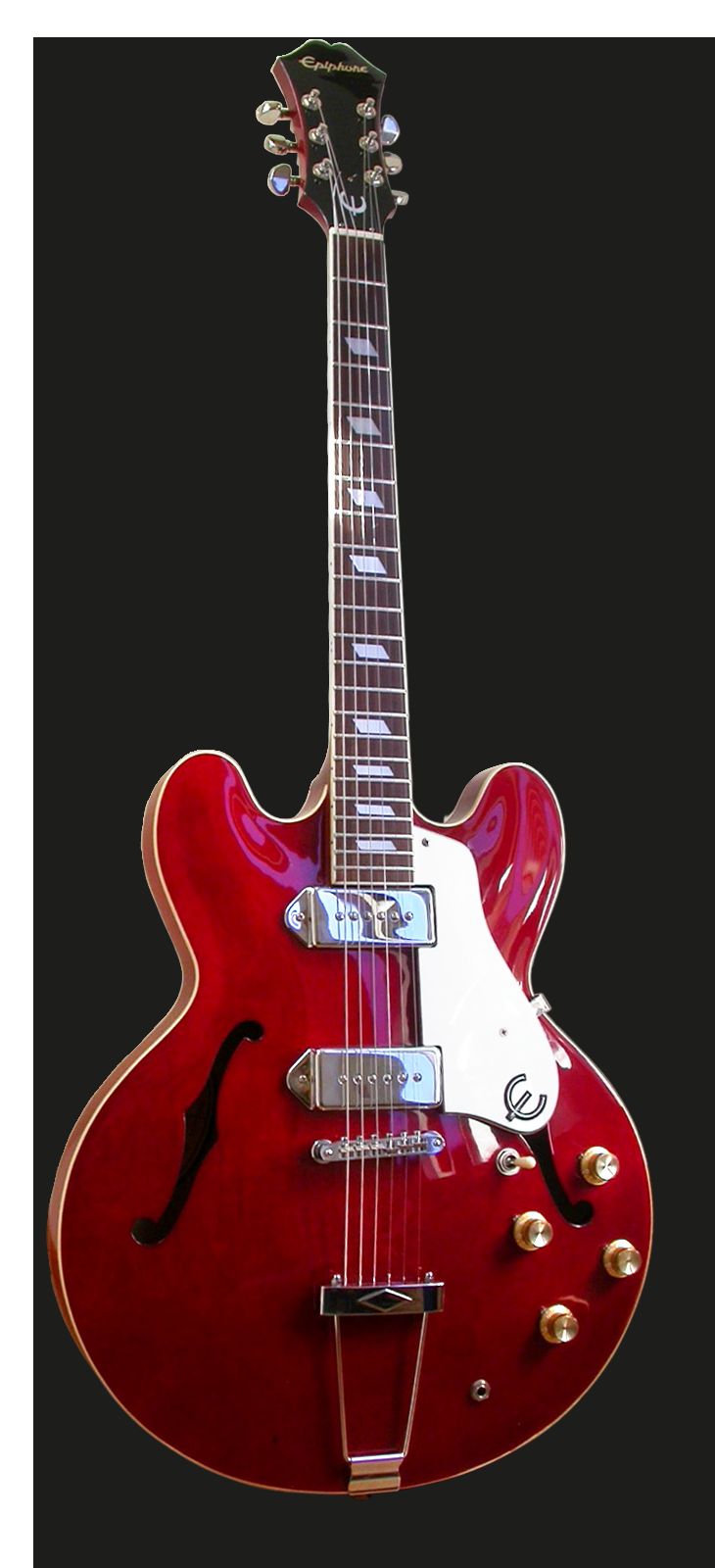
Epiphone Casino Cherry. Photo by Maxo; background removed by Auge=mit. Licensed under CC BY-SA 4.0. Via Wikimedia Commons. Epiphone
Casino
1961
Of all the Beatles’ famous guitars, the only one John, Paul, and George all had. Two sanded theirs bare.
- Send a picture
Epiphone
Sheraton
1958
Epiphone’s own catalog called it second best. John Lee Hooker and Noel Gallagher didn’t read the catalog.
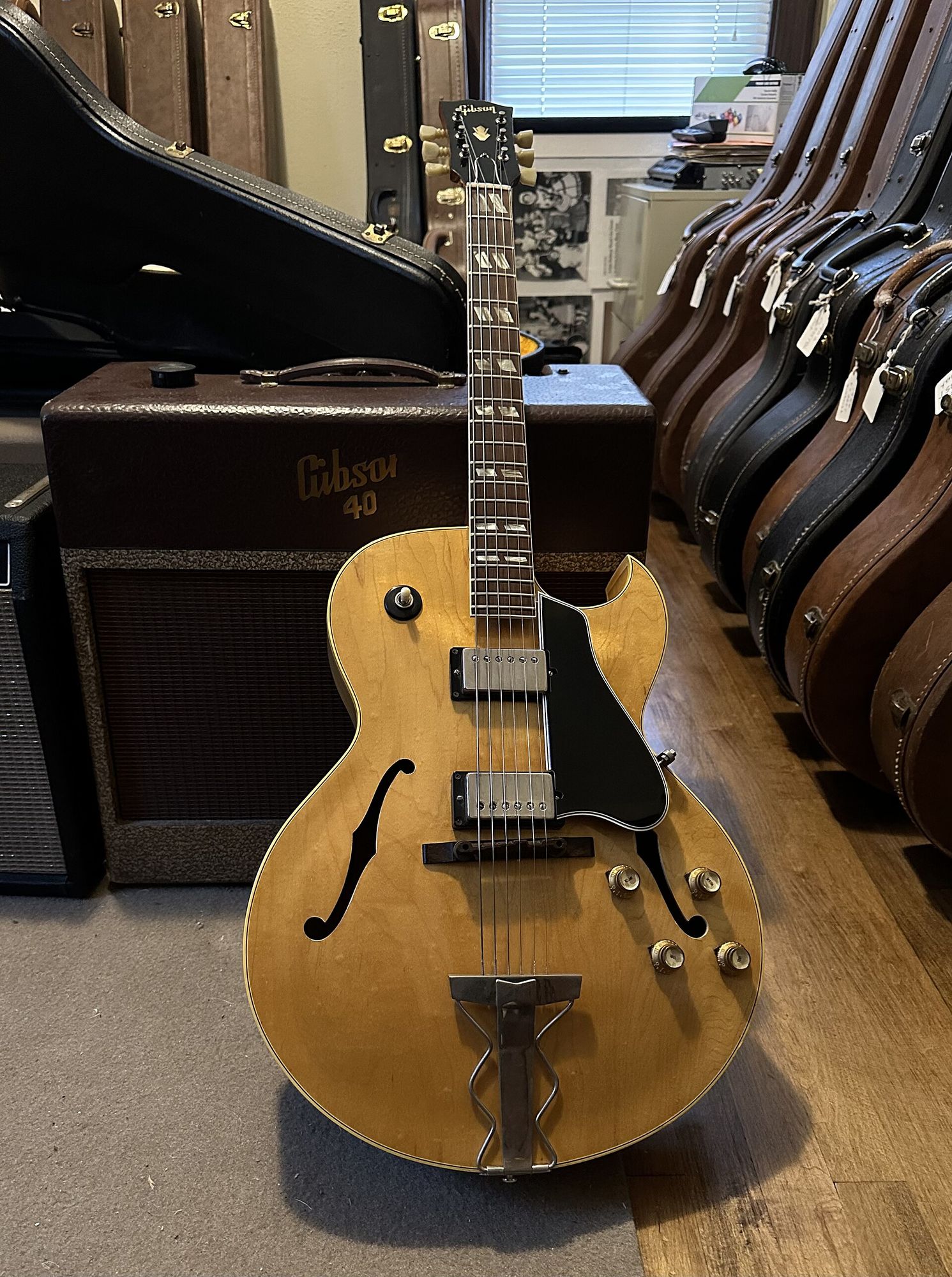
1963 Gibson ES-175DN. Photo by Lightburst. Licensed under CC BY-SA 4.0. Via Wikimedia Commons. Gibson
ES-175
1949
A laminated jazz box that kept changing hands: bought used, given as a gift, borrowed for a hit.