Gibson
Les Paul
Special
Dan Armstrong modified it. Marc Bolan traded it in. Bob Marley bought it and made it his.
Denmark Street, London, May 1973. At Top Gear, a guitar shop on the street everybody in British music knows, there’s a secondhand Les Paul Special. Marc Bolan has just traded it in. Bob Marley, in England for a run of dates, buys it.
- Introduced
- 1955
- Type
- Solidbody electric
- Class
- Production
The short version
1955
The Special
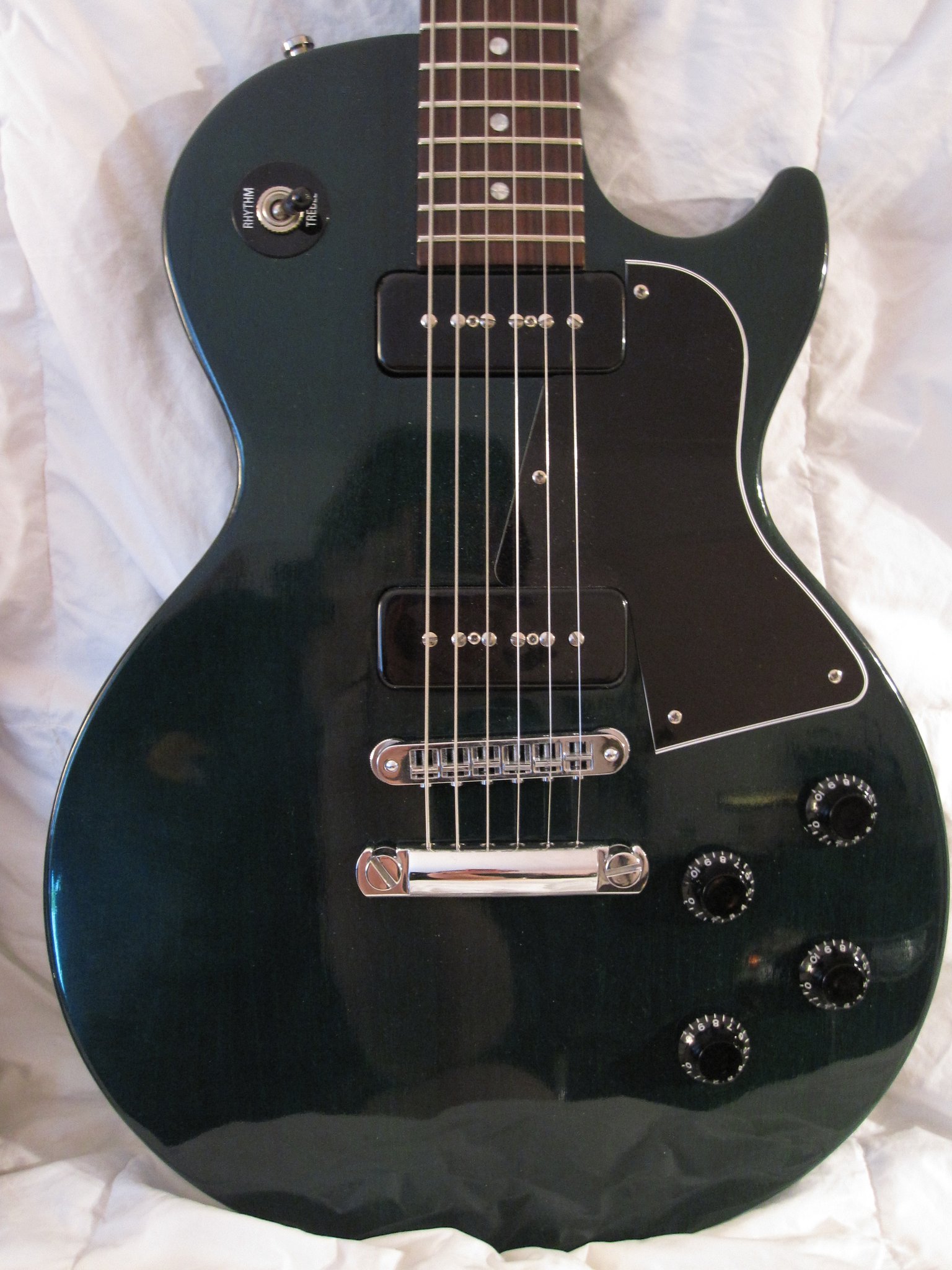
Two P-90s on a flat mahogany slab, in a pale “TV” finish. List price $169.
1958
Two cutaways
A rounded double-cut body shows up as a prototype at the July trade show.
1959
The name comes off
Cherry arrives in the spring. By late in the year the headstock no longer says Les Paul.
1961
Pointed
The thin, pointed body arrives, and it’s the SG Special now.
1972
Back
The single-cut Special returns, years before the Junior does.
1973
Marley’s
Bob Marley buys a used, modified single-cut Special at Top Gear on Denmark Street.
1974
Cover star
Johnny Thunders holds a 1955 single-cut Special on the cover of Too Much Too Soon.
1978
Made his
Roger Mayer fits an aluminum pickguard and switch plate to Marley’s guitar.
Side A
A1
Somebody else’s guitar
Buy a used guitar and you buy everything that’s happened to it. The ding on the edge, the swapped tuners, the hole somebody drilled and then thought better of. For a while it still feels like theirs. Then you start changing it, and one day it’s yours.
The Les Paul Special that Bob Marley bought in May 1973 had been through a lot already. Dan Armstrong, a guitar builder, had owned it, and it came away from him with block inlays where the dots should be, work on the finish, and binding on the headstock. Then Marc Bolan of T. Rex had it, briefly, before trading it in at Top Gear on Denmark Street for a Les Paul with humbuckers.
Marley took it straight out onto his UK dates that month. It was somebody else’s guitar. It wouldn’t stay that way.
A2
The one in the middle
Gibson introduced the Special in 1955 to fill a gap. Below it sat the one-pickup Junior at $120. Above it sat the carved goldtop at $235. The Special was $169 and sat right in between.
It’s a Junior body, a flat mahogany slab with no carving, but with two pickups: flat, black “soapbar” P-90s at the neck and bridge. Four knobs and a three-way switch. A bound rosewood fingerboard with dots. Gibson’s catalog put it like this:
Solid Honduras mahogany body and neck finished in limed mahogany shading.
That “limed mahogany shading” is the pale finish people now call TV yellow, somewhere between wheat and banana. On the Special it was simply the standard color.
Two P-90s change everything. The neck pickup is warm and round, the bridge pickup bites, and with both on you get a hollow, funky middle sound. It’s the Junior plus a second voice, for $49 more.
A3
The name leaves before the shape does
In 1958 the Special grew a second cutaway, like the Junior did. A prototype showed at the July trade show, and the first double-cuts shipped early in 1959. Cherry red arrived that spring. Gibson shipped 1,821 Specials that year, its best year of the decade. One magazine called that a 190 percent jump over 1958. It was closer to 90. Still a good year.
The early double-cuts had a weak spot where the neck met the body, right where the neck pickup sat. Around 1960 Gibson moved that pickup about half an inch toward the bridge. Not every one of them broke, whatever you’ve heard, but it’s the first thing to check on an old one.
Then something odd happened. Late in 1959, the words “Les Paul Special” came off the headstock, and Gibson started calling it the SG Special. The body was still the thick, rounded slab. The thin, pointed SG shape didn’t show up until the middle of 1961.
For a year and a half or so, the guitar had a new name and its old body.
Flip the record · By the numbers
$169
The 1955 list price. The one-pickup Junior was $120. The goldtop was $235.
373
Specials Gibson shipped in 1955, the first year.
1,821
Shipped in 1959, the best year, as the double-cut arrived.
7,336
Total shipped from 1955 to 1960.
Side B
B1
A Dolls cover
The Special came back in the 1970s, as a single-cut as early as 1972, years before Gibson brought the Junior back. That same era gave it its best photo op. On the cover of the New York Dolls’ second album, Too Much Too Soon, in 1974, Johnny Thunders is holding a 1955 single-cut Special.
Look closely. Thunders’s real workhorse was a double-cut Junior, one pickup. The cover guitar has two.
B2
Bob’s
Marley played his Special hard. At some point the pickup toggle got smashed through the body, and it was repaired back at Top Gear with a bigger plate around the switch. Over time it became his main guitar on stage and in the studio.
In 1978 Roger Mayer went to work on it. He added a hard-anodized aluminum pickguard and an elliptical metal plate for the switch, and the electronics and tuners got more work later on. The P-90s stayed. Nobody looking at that guitar would mistake it for a stock Special, or for anybody else’s.
Nobody even agrees when it was made. Some call it a 1972 reissue; the fullest account of it doesn’t name a year. It doesn’t really matter. By then it had been Armstrong’s and Bolan’s, and then, one repair and one aluminum pickguard at a time, it was Bob’s. Ziggy Marley says the family still has it.
The cast
The people, and the specific guitars, that made the legend.
1973
Bob Marley
Modified single-cut Special
Bought used at Top Gear in May 1973. It became his main stage and studio guitar. His family still has it.
before 1973
Dan Armstrong
An earlier owner
The guitar had block inlays instead of dots, finish work, and a bound headstock by the time it left him.
1973
Marc Bolan
The owner before Marley
Had it briefly, then traded it in at Top Gear for a Les Paul with humbuckers.
1978
Roger Mayer
The 1978 changes
Added the aluminum pickguard and elliptical switch plate. The P-90s stayed.
1974
Johnny Thunders
1955 single-cut Special
On the cover of the New York Dolls’ Too Much Too Soon. His famous stage guitar is a Junior.
Liner notes
Specs, construction, rarity, value, and every source we used.
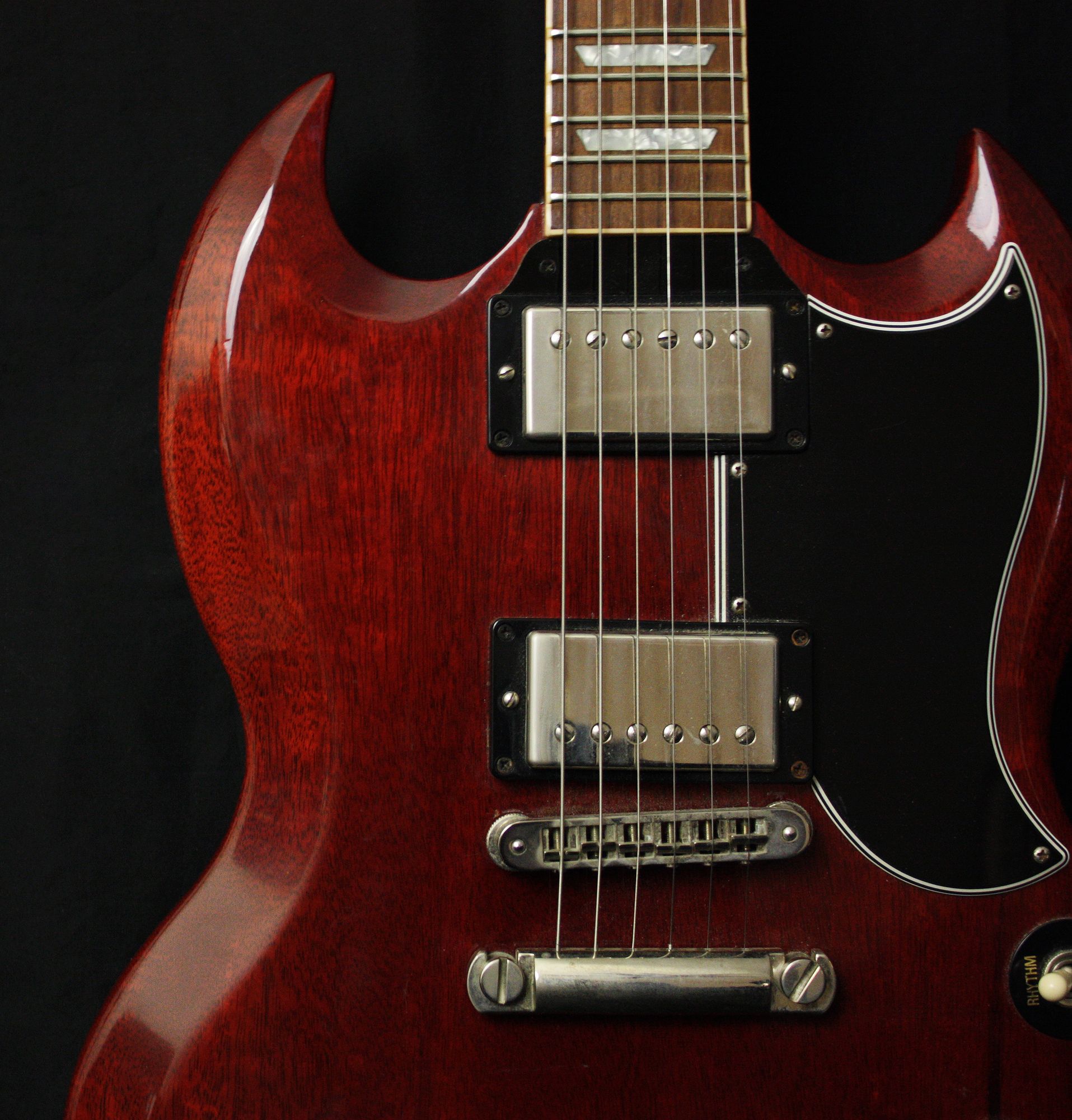
Two soapbar P-90s on a slab mahogany body — not a Junior, not a Standard, not a Burst, and not the pointed SG Special.
- Body
- Single-cut slab mahogany. Flat top, no carve, no maple cap. Unbound.
- Neck
- Set mahogany. 50s Vintage profile. Unbound headstock.
- Fingerboard
- Bound rosewood; 22 medium jumbo; acrylic dots; 12.0 in / 304.8 mm radius.
- Scale
- 24.75 in / 628.65 mm
- Pickups
- Two soapbar P-90s, neck and bridge.
- Hardware
- Wraparound. Nickel. Vintage Deluxe tuners, white buttons. Black 5-ply pickguard.
- Electronics
- 2 volume, 2 tone; 3-way toggle. Hand-wired Orange Drop capacitors.
- Finish
- Gloss nitrocellulose. TV Yellow (this SKU).
- Nut
- Graph Tech, 43.05 mm / 1.69 in
Open the full research fileConstruction details, the complete player record, production numbers, dated value estimates, and sources
USA Original Collection single-cut, TV Yellow, LPSP00TVNH1, list $1,799. Vintage Cherry (LPSP00VENH1) is the same SKU family. Custom Shop Historic 1957 SC / 1960 DC VOS are reissues (list $4,199), not the table. Tribute (maple neck, satin) is discontinued. Vintage Kalamazoo differs — Construction.
Construction
Kalamazoo, 1955. Two black soapbar P-90s, slab mahogany, no maple cap, bound rosewood dots, wraparound, four knobs, 3-way. One dog-ear P-90 = Junior. Carved maple + two humbuckers = Standard. Black Beauty = Custom. Pointed thin SG body = SG Special, not this guitar.
1955 catalog. Intermediate between the dual-P-90 Goldtop (MusicRadar: list $235) and the one-pickup TV/Junior (list $120). Special list $169. Limed mahogany / beige “TV” finish as stock. Pearl Gibson logo; gold “Les Paul Special” silkscreen. guitarhq: 3-layer black guard, nickel, no-line Kluson 3-on-a-plate with brass posts. MusicRadar quotes Gibson: “Solid Honduras mahogany body and neck finished in limed mahogany shading.” Binding is the board, not the body.
Three bodies, one name — then the name leaves first. 1955–mid-1958: single-cut slab. guitarhq mid-1958 / MusicRadar NAMM July 1958 prototype: rounded double-cut slab; MusicRadar: first DCs ship early 1959. Cherry becomes available spring 1959 (Gazette via MusicRadar); TV yellow stays as the Les Paul TV Special option once cherry is “normal.” Don’t date every DC “1959.” Late 1959: “Les Paul Special” comes off the peghead (guitarhq; Duchossoir; MusicRadar November 1959 “SG Special”) while the body is still the thick rounded slab. That blank-headstock slab is still this family, not Iommi’s pointed SG. Mid-1961: pointed thin SG body — gibson-sg. Do not file Iommi “Monkey,” Townshend Woodstock / Live at Leeds, or Santana Woodstock here.
TV finish ≠ TV Model. On the Junior, TV Model is that guitar in limed mahogany. On the Special, 1955–57 stock is the beige/yellow finish; cherry is later. Don’t pick a single “why TV” story (B&W glare vs Les Paul & Mary Ford Show vs unverifiable). Color ranges wheat to banana; guitarhq: yellower after 1958.
Contested / dated bits. 1956: longer wraptail inserts (lean/crack on earlier studs is condition, not a different model). guitarhq: mid-1956 single-line Klusons. 1958: some Specials use a large rubber switch washer and a larger hole (guitarhq). Early DC neck joint is weak; guitarhq late 1959/1960: neck pickup moved ~1/2" toward the bridge; toggle moves from between the treble knobs to in front of the treble volume. MusicRadar: early-1960 routing shift. Don’t call every DC a “broken-neck guitar.” 3/4-scale DC Specials exist (Blue Book: 1959); guitarhq’s shipping table excludes 3/4s. Guard ply: guitarhq vintage 3-layer vs MusicRadar 1959 example four-layer (b/w/b/w) — attribute. Current USA prints 5-ply.
Reissues, not vintage. VG (June 2007): Special returns in the 1970s (single-cut as early as 1972; DC as a separate model 1976) while the Junior stays gone until 1987. Wikipedia timeline is a lead for later USA name soup (Junior II, Junior Special, Faded, Tribute). Current 2026: USA Original Collection SC — the table. Historic 1957 SC VOS (LPSPSC57VOTVNH1) and 1960 DC VOS (LPSPDC60VOTVNH1) are Custom Shop, hide-glue/Historic recipe, not Nashville USA. 1960 Historic uses 60s SlimTaper and the later pickup placement — not a 1955. Epiphone Specials and a “Junior Special” with a Bigsby are not this guitar.
Players
Special vs Junior vs SG Special is the whole player story. Two soapbars and a bound board = this page. One dog-ear = Junior. Pointed SG with P-90s = gibson-sg. Clapton’s Beano guitar is a Les Paul, not this SKU. Do not steal Iommi, Townshend, or Santana’s Woodstock SG Specials onto this plate.
Bob Marley — modified single-cut Special; bought Top Gear, Denmark Street, May 1973. Reverb / Tony Bacon: unusual SC Special previously with Dan Armstrong (block markers instead of dots, finish work, bound headstock); Marc Bolan had just chopped it in for a humbucker Les Paul. First used on UK dates that May; later the main stage and studio guitar. Toggle smashed through the body; repair at Top Gear (Ground Guitar: Roger Giffin; larger poker chip). 1978: Roger Mayer adds hard-anodized aluminum pickguard and elliptical switch plate so it reads as Bob’s, plus later electronics/tuner work; P-90s left. Ziggy Marley (Guitar World): still held, not a public museum default. VG June 2007 treats a 1972 single-cut reissue as Marley’s axe. Bacon/Reverb do not publish a factory year. Keep both. Heavily modified; not a stock catalog Special and not a sold-comp.
Johnny Thunders (New York Dolls) — 1955 single-cut Special on the Too Much Too Soon cover (1974). Cover guitar = Special. His workhorse is the double-cut TV Junior — that story stays on gibson-les-paul-junior. Do not illustrate Thunders’s famous TV Jr as this plate.
Also known to play. Marc Bolan — briefly the later Marley Special, then a humbucker Les Paul (Bacon). Not a T. Rex catalog identity.
Rarity
Volume student/step-up model; scarcity is configuration/finish/body, not the name. Factory shipping, not production counts. guitarhq: 1958 mixes SC and DC in one year cell; TV Specials from 1958–65 are included in Special totals.
GuitarHQ LpSp 1955–60: 373 / 1,345 / 1,452 / 958 / 1,821 / 1,387 = 7,336. 1961 LpSp is ?; pointed-body SgSpR 1961 = 1,186 (red) — that column is the SG Special, not a Les Paul Special census. First-year 373 is small, not Flying-V small. Peak year in the table is 1959 (1,821). MusicRadar’s “190 per cent increase” at end-1959 is 1,821 / 958 ≈ 1.90 — a 90% rise, not 190%. Blue Book “~1,200 shipped, 1959 only” for the DC is a different bucket from GH’s 1,821 year total; don’t collapse them. 3/4s are outside the GH table.
Value
Informal estimate, 25 August 2026. Not an appraisal.
Asks ≠ solds. Reverb sold medians were not returned. Don’t invent them. Marley / artist lots are a separate provenance market, labeled not-a-comp. Humbucker conversion and headstock breaks destroy identity (Joe’s: a repaired headstock often 40–50% off an unbroken example — dealer narrative, not a sold strip). Don’t use SG Special comps.
New / reissue. USA Original Collection SC $1,799 (gibson.com). Historic 1957 SC VOS and 1960 DC VOS $4,199 (gibson.com). Tribute is discontinued. Used USA / recent should discount; thin labeled 2024–26 solds.
Vintage guides, not hammers. Joe’s July 2026 (excellent original case): Special 1955–59 TV Yellow $13,000–$21,000; 1959 Cherry Red $8,000–$15,000. Guide, not solds. No separate 1960 cell. Edgewater 2026 dealer-comp, all-original excellent: SC 1955–58 $12,000–$25,000; DC 1959–60 $15,000–$30,000. TV Yellow +20–30% vs cherry is Edgewater’s premium narrative, not a sold histogram. Guitar Value Guide excellent bands jump around by year (1958 $8,400–$12,000; 1959 $15,000–$30,000; 1960 $8,400–$12,000) — guide, not a 2024–26 sold median. Working ask-direction for a clean original 1950s SC TV sits in the low-to-mid teens into the low $20ks; DC and cherry need the source attached. Edgewater cites paying $17,000 for one clean 1957 — one dealer buy, not a market.
See also
- gibson-les-paul-junior — one dog-ear P-90; Thunders’s TV Jr lives there
- gibson-les-paul-standard — carved maple, two pickups; Burst sidebar and Beano live there
- gibson-sg — SG Special / Iommi-Townshend-Santana Woodstock live there; 1961 pointed Special stays there
Sources
- guitarhq: Les Paul Special and TV Special
- guitarhq: solidbody shipping 1952–69
- MusicRadar: Classic guitars — Gibson Les Paul Special
- Vintage Guitar: The Gibson Les Paul Special (June 2007)
- Gibson Les Paul Special, TV Yellow (USA)
- Gibson Les Paul Special, Vintage Cherry (USA)
- Gibson Custom 1957 Les Paul Special Reissue VOS TV Yellow
- Gibson Custom 1960 Les Paul Special Double Cut Reissue VOS TV Yellow
- Reverb News: The Definitive Story of Bob Marley’s Les Paul Special
- Ground Guitar: Bob Marley’s 1970s Gibson Les Paul Special
- Guitar World: Ziggy Marley on Bob’s Les Paul Special
- Joe’s Vintage Guitars: Vintage Gibson Les Paul market value guide
- Joe’s Vintage Guitars: 1955–1958 TV Yellow Les Paul Special
- Edgewater: 2026 vintage Gibson value guide
- Edgewater: 1957 Les Paul Special
- Guitar Value Guide: Les Paul Special
- Wikipedia: Gibson Les Paul Special (lead only)
- Gibson Tribute DC Worn Brown (discontinued, reference)
Keep digging
Guitars this one gets compared to, confused with, or descended from.