ESP
Mirage
ESP’s Mirage keeps vanishing from the catalog. The guitar underneath it never really left.
Early 1988. Wiley Arnett has just joined Sacred Reich, and his first ESP is a pearl white Mirage Custom: a neck-through, a Floyd, a humbucker and two single coils. He’d never held a neck-through before. He calls it the beginning of real life.
- Introduced
- 1984
- Type
- Solidbody electric
- Class
- Production
Have a photograph of this guitar? Send a picture
The short version
1984
THE MIRAGE
The name appears in ESP’s overseas catalog, on a Strat-shaped guitar in four versions.
1986
The dinky
At NAMM the body shrinks and sharpens. Deluxe bolt-on, Custom neck-through, a locking Sinclair trem.
1987
New York Series
Mirage Deluxe, Mirage Custom, and M-I Custom in the Japanese catalog.
1988
Wiley’s first ESP
A pearl white Mirage Custom. He also dates that first Floyd to 1987. Keep both.
1993
Mirage M-II
Around now the Custom, down to a single coil and a humbucker, becomes the Mirage M-II.
1997
The word drops off
Around 1997 “Mirage” leaves the model name. The guitar carries on as the M-II.
2020
The ’87 reissue
For ESP’s 45th year, the LTD Mirage Deluxe ’87 brings the name back. It’s gone again now.
Side A
A1
The beginning of real life
Early 1988. Wiley Arnett has just joined Sacred Reich. The band’s first record, Ignorance, is already done. And he gets his first ESP: a pearl white Mirage Custom. Neck-through. A Floyd Rose. A humbucker and two single coils.
He’d never held a neck-through. Years later he put it simply:
“That was the beginning of real life for me.”
In another telling he dates that first Floyd, on that first ESP, to 1987. Keep both years. Either way, it was a small, sharp guitar, and a new guitarist in a thrash band had found his.
What’s strange is that you can’t buy anything called a Mirage today. The name is gone. The guitar isn’t.
A2
A name before a shape
The word showed up first. THE MIRAGE was in ESP’s 1984 overseas catalog, the same book that first printed the Horizon. But that Mirage was still a Strat shape, in four versions split by fingerboard and pickups: Standard, Deluxe, Special, Custom. It had a Flicker-II bridge and what ESP calls the New York head.
Not this guitar, really. The name was waiting for a body.
A3
Smaller, harder, locked
It got one at NAMM in 1986. ESP took the Strat outline and refined it down to a dinky: a smaller double-cut, for players who wanted something harder than a parts Strat. The Deluxe had 22 frets, a bolt-on neck, and a single coil and a humbucker. The Custom had 24 frets and a neck straight through the body, with two single coils and a humbucker. Both got a locking ESP Sinclair trem, so you could dive and come back in tune.
The one-humbucker Standard got a new name. M for Mirage, one pickup: the M-I. A lot of players in those days wanted a single humbucker and nothing else.
In 1987 the Japanese catalog had a Mirage Deluxe, a Mirage Custom, and an M-I Custom. Here the accounts start to drift. One catalog reading has the 1987 Deluxe as a neck-through with a pointier head. A 1987 Deluxe that turned up for sale is a bolt-on. Keep both.
The name was waiting for a body.
Flip the record · By the numbers
4
Versions of the first Mirage in 1984, split by fingerboard and pickups.
22 / 24
Frets on the 1986 Deluxe and Custom. Bolt-on for one, neck-through for the other.
M-I
The one-humbucker model. M for Mirage, one pickup.
1984–97
The name’s first run, before it left the model name.
Side B
B1
Here, gone, here again
Around 1989, a Deluxe II and an M-III showed up and disappeared after a short consolidation. Around 1993 the Custom, now down to a single coil and a humbucker, became the Mirage M-II, with a knife-shaped head. Around 1997 the Deluxe went to 24 frets and became the M-II Deluxe, and the Mirage M-II became the M-II Custom. ESP’s own history says that’s where the word left the model name.
Other books kept it alive a little longer. One has a Mirage for 1991 only, and a second edition from 1994 to 1998. Another reads the name back into the 1995 catalog with a reversed head and an Original Floyd, then a Wilkinson trem, gone after 1997. The dates don’t line up. They don’t have to.
Meanwhile the shape spread. ESP says Kirk Hammett’s KH-2 and Jeff Hanneman’s model were both developed from the Mirage. That’s ancestry. Those records belong to those guitars, not this one.
B2
Ask for it by its other name
Bruce Kulick, remembering his ESP days in Kiss, put it the way a player would: ESP “would come out with an M1, or then the Horizon or the Mirage.” He doesn’t give the Mirage a Kiss track. Leave it at that.
From 2000 the M-II wore two humbuckers. In 2014 ESP’s Standard line became E-II, built at the same Tokyo factory. If you order on this outline today, the guitar that shows up is an E-II M-II. ESP’s own copy for its LTD guitars still says “M/Mirage.” The word is in the description, not on the headstock.
B3
The ’87, and then gone again
In 2020, for its 45th year, ESP brought the name back as a reissue: the LTD Mirage Deluxe ’87, “based on the original ESP Mirage body shape.” Bolt-on alder, an extra-thin maple neck, a Floyd Rose 1000, a Seymour Duncan Hot Rail at the neck and a Distortion at the bridge that splits when you pull the tone knob. Pearl Pink and Turquoise. Rainbow Crackle for the left-handers in 2021.
Now that page is gone too. The two big dealers still show the listing and won’t sell it.
So there’s no Mirage on ESP’s order page. There’s an M-II with a neck straight through it, a Floyd, and the same small, sharp outline Wiley Arnett picked up in 1988, or 1987. The name went somewhere. The guitar is still on the wall.
The cast
The people, and the specific guitars, that made the legend.
1988
Wiley Arnett
Pearl white Mirage Custom
Sacred Reich. His first ESP, neck-through, Floyd, humbucker and two single coils. Joined the band in early 1988, after Ignorance was recorded; another telling dates that first Floyd to 1987.
1980s
Bruce Kulick
Mirage, among his ESPs
Names the Mirage alongside the M1 and the Horizon as guitars ESP would bring him. No Kiss track is pinned to a Mirage.
Liner notes
Specs, construction, rarity, value, and every source we used.
ESP’s dinky superstrat — the Mirage, not an arched Horizon, not an Eclipse, and not Kirk Hammett’s KH-2.
- Body
- Alder, double-cut dinky
- Neck
- Bolt-on 3-piece maple, extra thin U
- Fingerboard
- Macassar ebony, 350 mm radius, 22 extra-jumbo. Mix flagged.
- Scale
- 25.5". Mix flagged.
- Pickups
- Seymour Duncan Hot Rail (neck), Distortion TB-6 (bridge). ESP’s sentence calls the Hot Rail a single coil; the same dealer copy calls it a humbucker in a single-coil housing
- Hardware
- Floyd Rose 1000; LTD tuners. Color follows the finish
- Electronics
- Volume, tone (push/pull splits the bridge TB-6), 3-way; passive
- Finish
- Metallic Gold on the pages still up. Pearl Pink, Turquoise, Snow White, and Rainbow Crackle were also catalogued
- Nut
- Locking, 43 mm on Guitar Center and Musician’s Friend (printed 1.69"). Other dealer tables print 42 mm. Mix flagged.
Open the full research fileConstruction details, the complete player record, production numbers, dated value estimates, and sources
Last guitar sold under the name = LTD Mirage Deluxe ’87, reissue of the 1987-catalog Deluxe, not a Japan Sinclair original. Guitar Center and Musician’s Friend still print $1,199.00 and will not sell it (unavailable / discontinued, fetched 1 October 2026). Spec list, not the feature bullets on those pages — those say single-cut mahogany, roasted jatoba, and 24 frets. Scale in inches; radius and nut in millimetres. No millimetres invented for 25.5". Do not average 42 mm and 43 mm. No case on the dealer tables. E-II M-II, M-I, MH, Horizon, Eclipse, and KH-2 are not this table.
Construction
The job was a smaller double-cut than the Strat outline ESP had been building, with a locking trem, for players who wanted something harder than a parts Strat. ESP’s model history (10 March 2010) puts that in the mid-1980s. Superstrat is a genre word, not a model.
Not a Horizon (esp-horizon). That one is the arched double-cut. Not an Eclipse (esp-eclipse). That one is the set-thru 24.75" single-cut. Not a KH-2 (esp-kh-2). Kirk Hammett’s is a reverse six-in-line with skull-and-bones. The same ESP blog says the KH-2, and Slayer’s Jeff Hanneman model, were developed from the Mirage. Ancestry, not a track list. …And Justice for All, “Enter Sandman,” and Slayer stay on their own plates. Not an M-I, the one-pickup fork. Not an MH. Current LTD copy takes the extra-thin neck and inline head from what ESP calls the M/Mirage, and the carved arch from the Horizon. That mix is an MH. No Gibson number lives here.
The name and the shape are not one year. THE MIRAGE, the blog says, was in the 1984 overseas catalog, the same book that first printed Horizon. Still an ST. Four guitars, split by fingerboard and pickups: Standard, Deluxe, Special, Custom. Flicker-II bridge. The head they adopted is the New York head. Not the dinky, and not this table.
1986 NAMM is the guitar the name came to mean. Body refined to a dinky. Deluxe: 22 frets, bolt-on, SH. Custom: 24 frets, neck-through, SSH. Locking ESP Sinclair as the bridge. The one-humbucker Standard was then renamed M-I — “M” for Mirage, one pickup, so M-I. Three of those: ST-shaped Standard, ST-shaped Deluxe (ESP notes the pickups are SSH and does not say why), and a dinky Custom. One-humbucker guitars were the fashion because of a player the blog does not name. This plate does not name him either.
1987, Japan, New York Series, the year Horizon joins that catalog too. On the page: Mirage Deluxe, Mirage Custom, M-I Custom. Axebition (9 January 2020), from catalogs, reads the 1987 Deluxe and Custom as neck-through, pointier head, square edge. A 1987 Pearl Gold Deluxe on Reverb (seller, serial 1180) is a bolt-on: alder, 3-piece maple, 42 mm locking nut, bound ebony, ESP SH-100 and LH-500, Sinclair. Keep the blog’s 1986 bolt-on Deluxe, Axebition’s neck-through 1987, and that seller. No average.
Around 1989, a maple-board Deluxe II and an M-III. ESP says both were gone after a short consolidation. Around 1993 the Custom, now SH, became Mirage M-II. The M-II name was already in the USA around 1990, on something ESP compares to the later 22-fret M-II Deluxe. Knife head. Around 1997 the Deluxe went to 24 frets and became M-II Deluxe; Mirage M-II became M-II Custom. The blog: here the word left the model name.
Other books kept it, or brought it back. Blue Book: a Mirage for 1991 only (bolt-on, 22, two singles and a humbucker, double-locking vibrato, offset blocks) and a second edition 1994–98 (alder or ash, Wilkinson VS-100, Sperzel lockers, reverse peghead). Axebition: the name returns in the 1995 catalog — rounded dinky, reversed New York head, HSS, Original Floyd — then a 1996–97 Wilkinson VS100, gone after 1997. ESP, for “this period,” describes an overseas body with a larger edge radius and a New York head, and the exit around 1997. Keep 1991, 1994–98, and 1995–97. No Jackson-lawsuit story. The factory blog does not print one.
From 2000 the M-II wore two humbuckers, and the 2010 blog said the line was still in production. It is, under the later badge. Standard became E-II in 2014, same Tokyo factory. The guitar you order on this outline now is an E-II M-II Snow White, fetched 1 October 2026: neck-thru, alder, 3-piece maple, ebony at 305 mm, 24 extra-jumbo stainless, 42 mm locking nut, Thin U, Floyd Rose Original SE, Fishman Fluence Modern, case, $2,899.00. E-II M-I NT, one pickup, $2,099.00. The site still writes “M/Mirage” on LTD copy. Same family. Not this table. M-I, the blog adds, showed in 1987 and then left the Japan list, later an export model.
The name came back as a reissue. 2020, ESP’s 45th year from the 1975 shop. LTD ’87 Series: recreations of the 1987 catalog. Mirage Deluxe ’87, “based on the original ESP Mirage body shape.” Bolt-on alder, 3-piece extra thin U maple, Floyd Rose 1000, Duncan TB-6 at the bridge with a push-pull split, Hot Rail at the neck. Pearl Pink and Turquoise in that preview. Rainbow Crackle on the 2021 left-handed list. Snow White in ESP’s demos. Metallic Gold is the color still printed at $1,199.00, and neither Guitar Center nor Musician’s Friend will sell it new.
That LTD is the table. Sinclair and ESP pickups are 1986. Duncan and a Floyd 1000 are 2020. The page is gone again. What you buy new is an M-II.
Players
Do not move Horizon, Eclipse, KH-2, or Hanneman sessions here. Ignorance was already recorded when Wiley got his first ESP.
Wiley Arnett, Sacred Reich. ESP’s interview, 15 September 2022: he joined in early 1988, just after that first record. Pearl white Mirage Custom. Floyd. Humbucker and two single coils. Neck-through. “That was the beginning of real life for me.” He had not held a neck-through before. A Floyd Rose reel, 24 November 2025, dates that same first Floyd — “my first ESP guitar, Mirage Custom” — to 1987. Keep both years. It is the blog’s Custom, not the bolt-on Deluxe in the table. The next guitar, same interview, was an M-1 Custom, black chrome, one pickup. That is the M-I.
Bruce Kulick names the model and does not give it a Kiss track. Ultimate Guitar, 5 December 2024: ESP “would come out with an M1, or then the Horizon or the Mirage.” The Banana on Crazy Nights is an M-1. The sunburst he puts around 1987 is a Horizon. Those plates already have them.
Also known to play stays empty. None invented.
Rarity
Nothing named Mirage is on the order page. E-II M-II and M-I are regular production under the later name. LTD M and LTD MH are import bodies. They are not a Mirage total.
ESP has published no Mirage count. None invented. A serial dates a guitar. It does not count a year. That is why a first-year number does not exist.
What is actually thin: the 1984 ST with a Flicker-II, because it is not this shape. The Deluxe II and the M-III, because ESP says they vanished after about 1989. Japan dinkies with a Sinclair and the pointed head, 1986 into the early 1990s, are the scarce end of the name. The LTD ’87 was a catalog reissue. Off the site is not the same as scarce when new.
Wiley’s pearl white Custom is one guitar. So is an 1988 USA Custom Shop Deluxe a Reverb seller finished in real sequential five-dollar bills, and says Kulick signed. That signature is the listing’s claim. Not a Kiss record, and not a Deluxe price.
Value
Informal estimate, 1 October 2026. Not an appraisal.
Asks are not sold prices. A celebrity guitar is not a comp. No medians, no factory counts. Flag: thin sold-comp access.
New street. None under this name. Last list still printed for an LTD Mirage Deluxe ’87 Metallic Gold: $1,199.00 at Guitar Center (unavailable) and Musician’s Friend (discontinued). A leftover price, not a cart. Orderable, and not this table: E-II M-II Snow White $2,899.00, E-II M-I NT $2,099.00. Don’t fold an LTD M or an MH into the Mirage.
Used modern. Reverb’s estimated-used widget on two LTD ’87 pages: $734–$860 (turquoise B-stock) and $742–$860 (Metallic Gold). Don’t average them. Named asks, not hammers: that B-stock $965; the Metallic Gold $949.61, from $1,055.12, on a sale line that ran through 15 December 2025. Not an October 2026 checkout.
Vintage / collectible. A 1980s Japan Deluxe or Custom is the scarce end of this slug, not another model. Named ask: 1987 Pearl Gold, serial 1180, $2,928 before shipping. Ended asks, not a clean row: 1987 Deluxe, seller says a non-original bridge pickup and a dead neck position, $1,625.93; 1988 candy-apple $2,165.97; foam-green Deluxe $2,499 (ended about four years ago); 1988 hundred-dollar-bill graphic $2,999.99 (about six years ago); 1990 graffiti Deluxe $3,211.84 (about six years ago). Do not average them. The five-dollar-bill custom is one object. No hammer printed. Not a comp.
See also
- esp-horizon — ESP’s arched double-cut; not this dinky
- esp-eclipse — the set-thru 24.75" single-cut; not this guitar
- esp-kh-2 — Hammett’s reverse-headstock signature; ESP says it was developed from the Mirage, and it is still not this slug
Sources
- ESP Official Blog, モデルヒストリー ~M-II~, 10 March 2010 — read via Wayback 21 May 2022. THE MIRAGE in the 1984 overseas catalog, ST-based, Standard / Deluxe / Special / Custom, Flicker-II, New York head; 1986 NAMM dinky, Deluxe 22-fret bolt-on SH, Custom 24-fret neck-through SSH, Sinclair; M-I is Mirage’s initial, one pickup; 1987 Japan New York Series (Deluxe, Custom, M-I Custom); Deluxe II and M-III around 1989, short-lived; around 1993 SH Custom becomes Mirage M-II, knife head, M-II name already used in the USA around 1990; around 1997 the name leaves; KH-2 and Hanneman’s model developed from the Mirage; M-I dropped after the 1987 catalog, later an export model
- ESP, 2020 Product Preview — the ’87 Series — 45th year from 1975; LTD ’87 as recreations of the 1987 catalog; Mirage Deluxe ’87 bolt-on alder, 3-piece extra thin U maple, Floyd Rose 1000, TB-6 with push-pull split, Hot Rail neck; Pearl Pink and Turquoise
- ESP, ’87 series category — fetched 1 October 2026; page title “87 Series Discontinued”; only Surveyor ’87 LH listed
- ESP site search, “mirage” — fetched 1 October 2026; no Mirage product; current LTD copy still says “M/Mirage” (extra-thin neck, inline head) and calls MH a mix with the Horizon arch; M-400HT and M-201 described on the “M/Mirage” or “M (Mirage)” shape
- ESP, E-II M-II Snow White — $2,899.00; neck-thru; alder; 3-piece maple; ebony 305 mm; 24 XJ stainless; 42 mm locking; Thin U; Floyd Rose Original SE; Fishman Fluence Modern; case
- ESP, E-II M-I NT Snow White — $2,099.00; one Fishman Fluence Modern; Gotoh TOM and string-through; bone nut
- ESP, New for 2021: The Lefties Are Coming — Mirage Deluxe ’87 Rainbow Crackle among the left-handed ’87s
- Guitar Center, LTD Mirage Deluxe ’87 Metallic Gold — fetched 1 October 2026; $1,199.00; unavailable PDP. Spec list: double-cut alder, 3-piece maple, 25.5", Macassar ebony, 13.78" (350 mm), 22 frets, locking nut 1.69" (43 mm), Hot Rail and Distortion, volume/tone push-pull, 3-way, Floyd Rose 1000, LTD tuners. Feature bullets on the same page: single-cut mahogany, roasted jatoba, 24 frets — rejected. Body copy: Hot Rail “single coil” and “humbucker in a single coil-sized package”
- Musician’s Friend, LTD Mirage Deluxe ’87 Metallic Gold — fetched 1 October 2026; $1,199.00; discontinued flag; same spec-list vs feature-bullet clash
- Axebition, The History of the ESP Mirage, M-I, M-II, M-III, 9 January 2020 — catalog reading; 1987 Deluxe/Custom as neck-through with a pointier head; 1995–97 name revival (Floyd, then Wilkinson VS100); name gone after 1997. Jackson-lawsuit sentence not used; the factory blog does not print it
- Blue Book of Guitar Values, ESP Mirage series — 1991 edition; 1994–98 second edition, Wilkinson VS-100, Sperzel; separate 1986 Standard and 1986–90 Custom / 1987–90 Deluxe rows that do not match the ESP blog’s wood and bridge. Years kept; wood not averaged
- ESP Guitars, Wiley Arnett interview, 15 September 2022 — early 1988, after Ignorance; pearl white Mirage Custom; Floyd; humbucker and two singles; neck-through; next guitar an M-1 Custom
- Floyd Rose, Wiley Arnett reel, 24 November 2025 — first Floyd in 1987, on his first ESP, a Mirage Custom
- Ultimate Guitar, Bruce Kulick, 5 December 2024 — “an M1, or then the Horizon or the Mirage”
- Reverb, 1987 ESP The Mirage Deluxe Pearl Gold, serial 1180 — seller’s description: bolt-on, alder, 3-piece maple, 42 mm locking nut, bound ebony, SH-100 and LH-500, Sinclair; ask $2,928 plus shipping
- Reverb, LTD Mirage Deluxe ’87 Turquoise B-stock — ask $965; estimated-used widget $734–$860
- Reverb, LTD Mirage Deluxe ’87 Metallic Gold — ask $949.61 from $1,055.12; sale line through 15 December 2025; estimated-used widget $742–$860
- Reverb, Original ESP Mirage Deluxe 1987 — ended ask $1,625.93; seller: non-original bridge pickup, neck position dead
- Reverb, 1988 ESP The Mirage Deluxe candy apple red — ended ask $2,165.97
- Reverb, 1980s The Mirage Deluxe, foam green — ended ask $2,499
- Reverb, 1988 Mirage Deluxe $100-bill graphic — ended ask $2,999.99
- Reverb, 1990 The Mirage Deluxe graffiti — ended ask $3,211.84
- Reverb, 1988 USA Custom Shop Mirage Deluxe, $5 bills — sold; no hammer printed; seller says real sequential bills and a Kulick signature on the headstock
Keep digging
Guitars this one gets compared to, confused with, or descended from.
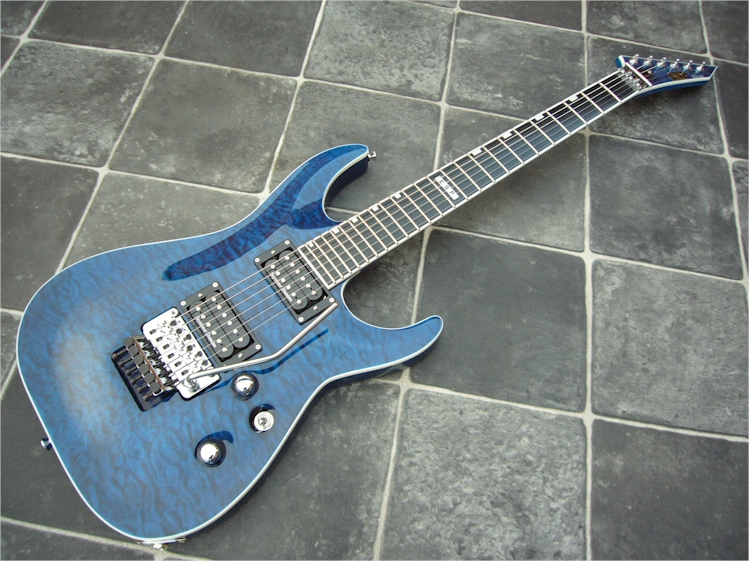
Photo: Cisco93 / Wikimedia Commons / Public domain ESP
Horizon
1987
Page Hamilton’s got smashed at First Avenue. Wooden dowels hold the horn on, and he says he’ll be buried with it.
- Send a picture
ESP
Eclipse
1993
ESP’s single-cut has no famous record to lean on. It has to win you over the honest way, in your hands.
- Send a picture
ESP
KH-2
1995
Kirk Hammett walked into ESP in 1987 knowing exactly what he wanted. He’s been playing it ever since.