ESP
M-II
Kirk Hammett’s famous ESP grew out of this one. Josh Middleton just wanted the plain version.
A flat double-cut with a pointed headstock, a locking trem, and nobody’s name on it. The M-II came off the Mirage, lent its bones to two signature guitars, and stayed what it was: the one you play hard.
- Introduced
- 1990
- Type
- Solidbody electric
- Class
- Production
Have a photograph of this guitar? Send a picture
The short version
1986
The Mirage goes dinky
At NAMM, ESP’s Mirage takes the slim double-cut outline the M-II will later carry.
1990
The name
ESP says M-II was already in use in the USA around 1990. Another guide starts a bolt-on M-II in 1989.
1993
The knife head
Around now the neck-through Custom becomes the Mirage M-II and takes the pointed six-in-line headstock.
1997
Mirage drops off
Around 1997 the Deluxe goes to 24 frets as the M-II Deluxe, and the Mirage M-II becomes the M-II Custom.
1998
Rail and humbucker
The catalog neck-through pairs a Duncan Hot Rails with a TB-6, at ¥250,000 before tax.
2008
Conclusion of an Age
Josh Middleton tracks Sylosis’s first album, and his Japanese bolt-on M-II is one of the two guitars that sound best.
2014
E-II
ESP’s Tokyo Standard line is renamed E-II, and the M-II goes with it.
Side A
A1
Five guitars in, two that worked
Josh Middleton walked into the sessions for Sylosis’s first album with about five guitars. The record came out on 24 October 2008 as Conclusion of an Age, and he remembers which two sounded best: an LTD Michael Wilton MW-600 and his ESP M-II. Both alder. Both bolt-on.
The M-II was a Japanese one he’d had for years. Nothing fancy. Alder, a flat top, a bolted neck, and no one else’s name on it.
That last part matters more than it should, because the M-II spent its whole life next to more famous relatives.
A2
Not the one from “Enter Sandman”
Kirk Hammett’s KH-2 is the ESP everybody knows. Reverse headstock, skull and bones, Mummy and Ouija graphics. ESP’s own history says the KH-2, and Jeff Hanneman’s model, were developed from the M-II line.
You’ll read that Hammett’s Mummy and Ouija guitars were M-IIs. That’s the legend. The careful history calls them KH-2 graphics. So “Enter Sandman” stays with the KH-2, and the M-II gets to be the plain one.
It also isn’t a Horizon. The Horizon has an arched top. The M-II is flat, and Middleton says the flat body is thicker than the carved one.
A3
Off the Mirage
The outline started under another name. In 1986 ESP showed its Mirage at NAMM in the slim double-cut shape, as a 22-fret bolt-on Deluxe and a 24-fret neck-through Custom.
Then the names shuffled. ESP says “M-II” was already in use in the USA around 1990. Another guide starts a bolt-on M-II in 1989, and one history only finds it in the 1992 catalog. They aren’t describing the same pickups or the same bridge, so nobody gets to pick a winner.
Around 1993 the Custom became the Mirage M-II and took the knife head, the pointed six-in-line that’s still on the guitar. Around 1997 the bolt-on Deluxe went to 24 frets as the M-II Deluxe, and the Mirage M-II became the M-II Custom. That’s where the Mirage left the name. In 2000 both went to two humbuckers.
The two halves were easy to tell apart. The Custom was the neck-through, the maple running the full length of the body. The Deluxe was the bolt-on. Middleton’s album guitar is the bolt-on kind, and he says that’s on purpose: he wants the attack.
The KH-2 got famous. The M-II gets to be the plain one.
Flip the record · By the numbers
24
Frets on a 25.5-inch scale, on today’s neck-through.
¥250,000
The 1998 catalog M-II, before tax.
~5
Guitars Josh Middleton took in to track Sylosis’s first album. His M-II was one of the two that made it.
15
Burl-top Experimental Series M-IIs, a labeled 2022 limited. Plus fifteen seven-strings.
Side B
B1
Rail and humbucker
The 1998 catalog M-II is the one to picture. Alder wings on a three-piece maple neck-through, ebony, 24 frets, pearl offset blocks with ESP at the twelfth, a Floyd Rose, a master volume and a mini toggle. ¥250,000 before tax.
The pickups were a Seymour Duncan Hot Rails and a TB-6. The Hot Rails is a humbucker squeezed into a single-coil’s size, so that guitar is still a rail and a full humbucker, not two matching ones. One history says that by 1998 it was two straight humbuckers. The catalog page disagrees. Keep both.
In 2014 the Tokyo Standard line was renamed E-II, and the M-II went with it. Today’s Snow White is the neck-through: alder, ebony, a thin U neck, a Floyd Rose Original SE, and Fishman Fluence pickups. There’s one volume, a toggle, and no tone knob. Pull the volume for a second voice. It’s a guitar that assumes you know what you want.
The hand-built cousin is still around, too: the M-II CTM, alder on a three-piece maple neck-through, with EMGs and a Floyd Rose Original. Different pickups. Same flat body.
B2
“It’s also an M2”
Daniel Gailey of Phinehas plays a See Thru Black E-II M-II with a pair of EMG 81s and a Floyd. “I use this for both studio and live purposes,” he says. He tracks at home.
Middleton got a signature eventually, an LTD bolt-on with a quilt top and a fixed bridge, not a Floyd. He first played it on a stage at the Royal Albert Hall stream, and only for Architects’ “Animals.” People get confused by the name, so he explained it. The first one was the JM-2, “because it’s based on an M2 guitar,” with a J in front for his initials.
“It’s also an M2.”
Hammett’s guitar grew out of this one and got famous. Middleton’s grew out of it and kept the name.
Put this on
You’ve read about it. Now hear it. Here’s what this guitar sounds like, and what to listen for.
Conclusion of an Age
Middleton says the two guitars that sounded best tracking this one were an LTD MW-600 and his Japanese ESP M-II, both alder and bolt-on. He doesn’t split them by song. Listen for the attack, which is why he wanted the bolt-on.
Find it on YouTube (opens in a new tab)ESP E-II M-II demo
The Phinehas guitarist plays his own E-II M-II See Thru Black, a flame top with a pair of EMG 81s and a Floyd. He uses it live and in the studio.
Watch it on YouTube (opens in a new tab)
The cast
The people, and the specific guitars, that made the legend.
2008
Josh Middleton
Japanese ESP M-II, bolt-on, alder
Of Sylosis and Architects. Had it for years and wants the bolt-on’s attack. His later LTD signature is based on the M-II. “It’s also an M2.”
2019
Daniel Gailey
E-II M-II See Thru Black
Of Phinehas. “I use this for both studio and live purposes.” EMG 81s and a Floyd. Which Phinehas songs, he doesn’t say.
Liner notes
Specs, construction, rarity, value, and every source we used.
ESP’s flat dinky with the knife head — the M-II, not an arched Horizon, not the Mirage, and not Kirk Hammett’s KH-2.
- Body
- Alder; flat-top double-cut. No figured top on this finish
- Neck
- Neck-thru 3-piece maple, thin U; satin on the back
- Fingerboard
- Ebony, 305 mm radius, 24 extra-jumbo stainless, offset mother-of-pearl dots. Mix flagged.
- Scale
- 25.5". Mix flagged.
- Pickups
- Fishman Fluence Modern humbuckers, direct-mount, black covers: ceramic bridge, Alnico neck. Pull the volume for voice 2
- Hardware
- Floyd Rose Original SE; Gotoh locking tuners; black; ESP strap locks
- Electronics
- Volume (push/pull), 3-way toggle; active. No tone control on the factory layout
- Finish
- Snow White
- Nut
- Locking, 42 mm. Mix flagged.
Open the full research fileConstruction details, the complete player record, production numbers, dated value estimates, and sources
Current typical = E-II M-II Snow White (neck-thru; Japan factory; espguitars.com, retrieved 13 October 2026). Factory $2,899.00, deluxe hardshell case included. Musician’s Friend and Music Store Live print the same $2,899.00. Factory mixed inch/mm flagged; no millimetres invented for the 25.5" scale. Andertons prints 25.5" (647.7 mm), radius 12" (305 mm), nut 1.65" (42 mm). A Japan-market Snow White card prints scale 648 mm and a Floyd Rose Original, not this page’s Original SE. Do not average 647.7 and 648. Musician’s Friend’s spec table prints a bone nut, pearloid offset blocks, and Bare Knuckle Aftermaths. Music Store Live prints a bone nut under a locking-Floyd description. Both rejected. See Thru Black, Black Natural Burst, CTM, DX, USA, and LTD are other specs of this outline. Horizon, Mirage, Eclipse, and KH-2 are other slugs.
Construction
The job was a flat double-cut you could play hard without wearing someone else’s name on the head. Dinky outline. 25.5". A locking trem. No arch.
Not a Horizon (esp-horizon). That top is arched, and it is the quilted workhorse. This one is flat. Josh Middleton (ESP interview, 6 September 2022) says the flat body is also thicker than the carved one. Not a Mirage (esp-mirage). The Mirage is the name this outline wore first: 1984 overseas catalog, still an ST; 1986 NAMM, the dinky, Deluxe a 22-fret bolt-on, Custom a 24-fret neck-through, Sinclair; 1987 Japan, the year Horizon joins that book; around 1989, a maple-board Deluxe II and an M-III, both gone after a short run. That chapter stays on the Mirage plate. Not an Eclipse (esp-eclipse). Set-thru, 24.75", single-cut. Not a KH-2 (esp-kh-2). Reverse six-in-line, skull-and-bones. ESP’s model history (10 March 2010) says the KH-2, and Jeff Hanneman’s model, were developed from this line. Ancestry. “Enter Sandman,” the Mummy, and the Ouija stay there. Wikipedia’s M-II article calls those two guitars M-IIs. Tony Bacon does not. Not a Rhoads (jackson-rhoads). An offset V. The one-pickup fork is the M-I. No Gibson number lives here.
ESP says the M-II name was already in use in the USA around 1990, on a guitar the factory compares to a later 22-fret M-II Deluxe. Around 1993 the Custom, then a humbucker and a single, was renamed Mirage M-II and took the knife head, the pointed six-in-line still on the guitar. Around 1997 the Deluxe went to 24 frets as M-II Deluxe, and Mirage M-II became M-II Custom. That is where ESP says Mirage left the name. In 2000 both went to two humbuckers.
Blue Book starts earlier, and on a different instrument. Bolt-on M-II: alder or ash, 24-fret maple or rosewood, dots, Original Floyd, reverse pointed peghead, two ESP LH-200s, volume and a 3-way, mfg. 1989–1994 and 1996–2000. M-II Custom: neck-through, bound rosewood, offset blocks, mfg. 1990–1994 and 2001. M-II Deluxe: bolt-on, dots, mfg. 1992–96 and 2000, koa and an oil finish replacing the original in 1995–96. Axebition (9 January 2020) finds an M-II only in the 1992 catalog — square edge, a slanted single-sized neck pickup, reversed pointed head, Sinclair — and dates a Custom 1991–1994. Its Jackson-lawsuit sentence is not used. The factory blog does not print one. ESP’s 25 March 2021 note says one basic spec had not moved in more than 30 years: 3-piece hard-maple neck-through, alder wings, 24 frets, two humbuckers. From March 2021 that is before March 1991. The same note adds a maple board at no charge, and a hardtail. That “unchanged” two-humbucker spec does not match the blog’s 22-fret USA comparison, or the blog’s 2000 date for two full humbuckers. Keep all three. This plate starts in 1990, on the factory’s “around,” and leaves Blue Book’s 1989 beside it. Not averaged into the woods or the bridge.
Custom was the neck-through. Deluxe was the bolt-on. One shop’s 1992 Deluxe, serial 61853, is bolt-on alder, 24 frets, a 350 mm radius, ESP SH-100 in the neck and LH-200 in the bridge, a licensed Floyd. A single and a humbucker, not Blue Book’s pair of LH-200s. Do not average 350 mm with the living 305 mm.
The archived Original Series page labels one spec the 1998 catalog model: alder, 3-piece hard maple, neck-through, ebony, 24 frets, scale 648 mm, locking nut 42 mm, pearl offset blocks with ESP at the 12th, Floyd Rose, master volume and a mini toggle, ¥250,000 without tax. Pickups: Seymour Duncan SHR-1n and TB-6. Duncan’s SHR-1n is the Hot Rails, a single-coil-sized humbucker, so the page is still a rail and a full humbucker. That fits 2000. It fights Axebition’s “as of 1998, two straight humbuckers.” Keep both. The yen is 1998 money.
2014. The Tokyo Standard line becomes E-II. Until the end of 2013 the levels were Custom Shop and Standard; E-II is that Standard factory under a new name. MusicRadar (11 April 2013) reported the rebrand and about a 20 percent list cut. Original Series and the Custom Shop keep the ESP logo.
The hand-built cousin is still the M-II CTM FR: alder 45 mm thick, 3-piece hard maple, thin U, ebony with black binding, 305R, 648 mm, lock nut 42 mm, Floyd Rose Original, EMG 66TW / 57TW, push-pull splits, Gotoh MG-T. Not the Fishman Snow White. The October 2025 M-II CTM FR/FM is flamed maple on mahogany. Its spec table says set-thru. The announcement’s prose says set-neck. Keep both. M-II DX (12 September 2025) brought the bolt-on back: roasted alder, 3-piece hard maple, ebony or an optional maple board, double-stripe inlays, the heel changed from ESP’s ERGO to a T-5 plate and five screws. Order-made.
USA is another factory. M-II DX USA: bolt-on mahogany, 45 mm, extra-thin U, 43 mm locking nut, Floyd Rose Original. M-II FR USA, 2025 line: bolt-on mahogany, thin U, the same 43 mm nut, a body ESP calls a flat-topped M. Do not average 42 mm and 43 mm.
So the classic catalog guitar, once the name had settled, is that 1998 neck-through: Hot Rails, TB-6, offset blocks, ¥250,000 without tax. The living table is the E-II Snow White at $2,899.00. Same joint. Different pickups, different badge.
Players
Josh Middleton (Sylosis, Architects). Tracking Sylosis’s first album, Conclusion of an Age (released 24 October 2008), he took about five guitars in. The two that sounded best, he says, were an LTD Michael Wilton MW-600 and his ESP M-II, both alder and bolt-on. ESP’s interview (6 September 2022): that Japanese M-II is one he has had for years, and he wants the bolt-on’s attack. The signature is later. Ultimate Guitar (6 July 2026): the first one was the JM-2 “because it’s based on an M2 guitar,” with a J in front of it. “It’s also an M2.” Factory LTD JM-II is bolt-on alder with a quilt top, roasted maple, a Gotoh TOM and string-through, Fishman Fluence Modern. Not a Floyd, and not the neck-through in the table. He first used that signature on a stage at the Royal Albert Hall stream, and only for Architects’ “Animals.” The Japanese bolt-on is the album guitar. The JM-II is the later one.
Daniel Gailey (Phinehas). ESP’s demo, 31 March 2019, of the E-II M-II See Thru Black. He calls it his M-II. “I use this for both studio and live purposes.” A pair of EMG 81s, a Floyd, tracking at home. The page he is standing over is the flame-top 81 / 81, not the Fishman Snow White. Which Phinehas songs were cut on it, he does not say.
Also known to play stays empty. Wikipedia’s list — Hanneman, Romeo, Tolkki, Buckethead, Oliva — is unsourced on that page, and it is not used.
Rarity
E-II, Original Series CTM, USA, and LTD on this outline are regular production. ESP does not publish an M-II unit total. None invented.
A serial dates a guitar. It does not count a year, and Blue Book’s 1989, the factory’s “around 1990,” and Axebition’s 1992 do not describe the same pickup and bridge. A first-year count would be a guess.
What is thin: a USA guitar from the years ESP only calls “around 1990,” and a Japan piece that still says Mirage M-II, 1993 into 1997. The 2022 Experimental Series is a labeled limited, not a vintage M-II: 15 M-II NT Buckeye Burl and 15 of the 7-string, list ¥720,000 without tax, and the elbow cut is not the traditional one. Middleton’s bolt-on and Gailey’s See Thru Black are two guitars, not a street E-II.
Value
Informal estimate, 12 October 2026. Not an appraisal.
Ask vs sold labeled. Celebrity lots are not-comps. No invented medians or factory counts. Yen stays yen. No conversion. The 1998 list, ¥250,000 without tax, is 1998 money, not 2026 street.
New street. Factory E-II M-II Snow White $2,899.00 with case. See Thru Black the same $2,899.00 on the factory page: flame top, EMG 81 / 81, Floyd Rose Original, volume and a toggle, no pull. Sweetwater and Crutchfield print that sibling at $2,889.00. Do not average the ten dollars. Black Natural Burst $3,999.00: set-thru, quilt, gold hardware, Bare Knuckle Aftermath. The E-II M-series category also lists an M-II HT Mercury Blue Burst at $3,799.00 and a 7-string M-II 7B EverTune Pearl White at $3,399.00. Not this six-string Floyd table. Japan list, not US street: M-II CTM FR ¥748,000 with tax (¥680,000 without); CTM FR/FM ¥790,000 without; M-II DX ¥530,000 without in black or snow-white satin, granite sparkle ¥550,000. USA M-II DX from $5,199. M-II FR USA Wild Plum $3,999. LTD JM-II $1,599.00 with case. LTD M-1000 this pass: Sweetwater candy-apple satin $1,399.00, Musician’s Friend black $1,499.00. Joints differ by listing. Labeled LTD, not this E-II.
Used modern. Reverb’s price guide on “ESP E-II M-II” prints an estimated used $1,357–$2,073 (100 orders, all models, good to mint) and a “typical new” $3,999, which matches the Black Natural Burst list, not the Snow White. Named final prices on that guide, not a median computed here: 18 December 2025, Excellent, $1,800; 27 October 2025, Excellent, $1,600; 20 October 2025, Excellent, $1,994.05; 9 October 2025, Excellent, $1,950; 30 September 2025, Excellent, $1,700; 21 August 2025, Excellent, $1,800; 15 December 2024, Very Good, $2,000. The guide blends finishes. Don’t fold an LTD or a 7-string into it.
Vintage / collectible. A 1990s Japan M-II is the scarce end of this slug, not another model. Flag: thin sold-comp access. Named asks, not hammers: a 1999 M-II Deluxe maple, cut to $2,790.87 from $3,397.59; Diablo’s 1992 snakeskin Deluxe, regular price $3,499.99, page sold out, no hammer printed. Roadhouse’s 1993 pearl-white Deluxe was listed $1,999.00 and marked sold. The hammer is not on the page. Do not average those asks. No celebrity lot with a captured price this pass.
See also
- esp-mirage — the dinky this name came off; 1984 and 1986 stay there
- esp-horizon — ESP’s arched double-cut; not this flat top
- esp-kh-2 — Hammett’s reverse-headstock signature; ESP says it was developed from this line, and it is still not this slug
Sources
- ESP Official Blog, モデルヒストリー ~M-II~, 10 March 2010 — M-II beside Horizon; dinky from the Mirage; KH-2 and Hanneman’s model developed from this line; 1984 ST Mirage; 1986 NAMM dinky; M-I; 1987 Japan; Deluxe II and M-III around 1989; M-II name already used in the USA around 1990 (likened to a later 22-fret M-II Deluxe); around 1993 Mirage M-II and the knife head; around 1997 M-II Deluxe and M-II Custom, Mirage leaves the name; 2000 both go to two humbuckers
- ESP, E-II M-II Snow White — $2,899.00 with case; neck-thru; alder; 3-piece maple; thin U; ebony 305 mm; 24 XJ stainless; offset MOP dots; 42 mm locking; 25.5"; Floyd Rose Original SE; Gotoh locking; Fishman Fluence Modern ceramic bridge / Alnico neck; volume push/pull and toggle; active
- ESP, E-II M-II See Thru Black — $2,899.00; flamed maple top; EMG 81 / 81; Floyd Rose Original; volume and toggle
- ESP, E-II M-II Black Natural Burst — $3,999.00; set-thru; quilt; Bare Knuckle Aftermath; gold hardware; Floyd Rose Original SE
- ESP, M Series category — Snow White $2,899.00; Black Natural Burst $3,999.00; See Thru Black $2,899.00; M-II HT Mercury Blue Burst $3,799.00; M-II 7B EverTune Pearl White $3,399.00
- ESP, M-II CTM FR — alder 45 mm; neck-thru; thin U; ebony, black binding; 305R; 648 mm; lock nut 42 mm; EMG 66TW / 57TW; Floyd Rose Original; ¥748,000 with tax (¥680,000 without)
- ESP, M-II CTM model change, 25 March 2021 — beside Horizon; basic spec unchanged more than 30 years (3-piece hard maple neck-through, alder wings, 24 frets, two humbuckers); EMG 57TW / 66TW; maple board; hardtail added
- ESP, M-II CTM FR/FM, 1 October 2025 — flamed maple over mahogany; EMG 66TW / 57TW; ¥790,000 without tax. Prose says set-neck; dealer spec table says set-thru
- ESP, M-II DX update, 12 September 2025 — bolt-on; roasted alder; T-5 joint replaces ERGO; ¥530,000 without tax (black, snow white satin); granite sparkle ¥550,000
- ESP, Experimental Series M-II NT, 15 April 2022 — 15 six-strings and 15 seven-strings; Buckeye burl; ¥720,000 without tax; elbow cut is not the traditional one
- ESP, Original Series M-II (archived product page) — labeled 1998 catalog model; alder; neck-thru; ebony 24; 648 mm; lock nut 42 mm; pearl offset block, ESP at the 12th; Floyd Rose; SHR-1n and TB-6; volume and mini toggle; ¥250,000 without tax
- ESP, A Closer Look at the ESP E-II Series — Standard until the end of 2013; E-II is that Tokyo factory line; Custom Shop and Original are hand-built; M is an E-II series
- ESP, USA M-II DX — from $5,199; bolt-on mahogany; 45 mm; 43 mm; extra thin U; flat-topped; Floyd Rose Original
- ESP, USA M-II FR Wild Plum — $3,999; 2025 USA line; bolt-on mahogany; thin U; 43 mm; “flat-topped M Shape”
- ESP, LTD JM-II — $1,599.00 with case; bolt-on; alder and quilt; Gotoh TOM string-through; Fishman Fluence Modern
- MusicRadar, Musikmesse 2013, 11 April 2013 — Standard becomes E-II in 2014; about a 20 percent list cut
- Blue Book of Guitar Values, ESP M-II / M-II Custom / M-II Deluxe — M-II bolt-on mfg. 1989–1994, 1996–2000, two LH-200s, Original Floyd; Custom neck-through mfg. 1990–1994, 2001; Deluxe bolt-on mfg. 1992–96, 2000, koa in 1995–96. Wood and bridge not averaged with the factory blog
- Axebition, The History of the ESP Mirage, M-I, M-II, M-III, 9 January 2020 — 1992-catalog M-II (slanted single, Sinclair, reversed pointed head); Custom 1991–1994; 1998 as two straight humbuckers. Jackson-lawsuit sentence not used
- Seymour Duncan SHR-1n Hot Rails, via StewMac — SHR-1n is the Hot Rails, a single-coil-sized humbucker
- Ultimate Guitar, Josh Middleton on the JM-1 and JM-2, 6 July 2026 — JM-2 “based on an M2 guitar”; the J is his initials; the shape is an M
- Josh Middleton, ESP LTD JM-II — Conclusion of an Age tracking: LTD MW-600 and his ESP M-II, both alder and bolt-on; JM-II first used at the Royal Albert Hall stream, for “Animals”
- ESP Guitars, Josh Middleton interview, 6 September 2022 — Japanese ESP M-II, bolt-on, owned for years; flat top; prefers the bolt-on attack
- Wikipedia, Conclusion of an Age — Sylosis, released 24 October 2008; Josh Middleton, lead guitar
- ESP Guitars, E-II M-II demo, Daniel Gailey, 31 March 2019 — “my ESP M-II”; studio and live; EMG 81s; Floyd; tracking at home; linked product is the See Thru Black
- Musician’s Friend, E-II M-II Snow White — $2,899.00. Spec table (bone nut, offset blocks, Bare Knuckle) rejected against the factory page
- Sweetwater, E-II M-II See Thru Black — $2,889.00
- Andertons, E-II M-II Snow White — 25.5" (647.7 mm); 12" (305 mm); 1.65" (42 mm)
- Reverb price guide, ESP E-II M-II — estimated used $1,357–$2,073 (100 orders, all models); typical new $3,999; named finals 15 Dec 2024 through 18 Dec 2025
- Reverb News, Tony Bacon, Kirk Hammett, George Lynch, and ESP’s Emergence, 27 February 2020 — Mummy and Ouija are KH-2 graphics, not a catalog M-II. Cited so they are not moved here
- Diablo Guitars, 1992 M-II Deluxe Blue Snakeskin — seller’s guitar: serial 61853; bolt-on; 24 frets; 350 mm; SH-100 and LH-200; regular price $3,499.99; sold out; no hammer
- Reverb marketplace, 1999 M-II Deluxe maple — named ask $2,790.87, cut from $3,397.59
- Roadhouse Vintage, 1993 M-II Deluxe pearl white — listed $1,999.00; marked sold; hammer not printed
- Wikipedia, ESP M-II — period “unknown”; player list and the Mummy / Ouija-as-M-II claim not used. The article flags itself as short on citations
Keep digging
Guitars this one gets compared to, confused with, or descended from.
- Send a picture
ESP
Mirage
1984
ESP’s Mirage keeps vanishing from the catalog. The guitar underneath it never really left.
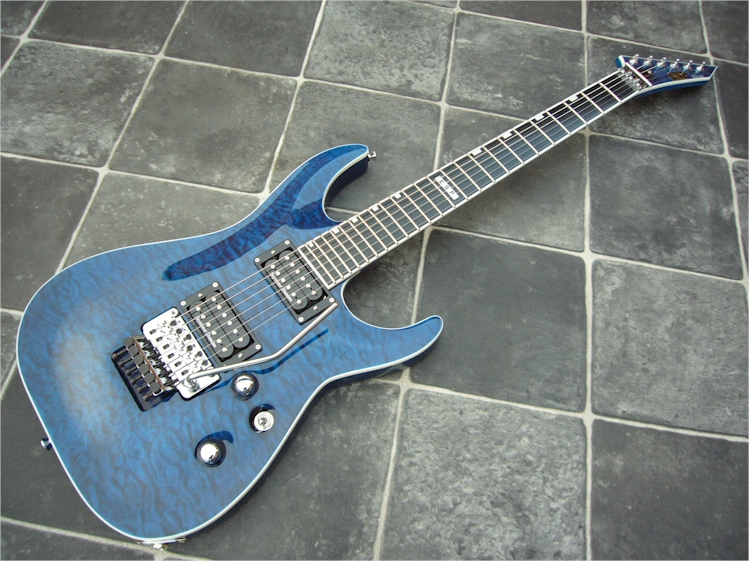
Photo: Cisco93 / Wikimedia Commons / Public domain ESP
Horizon
1987
Page Hamilton’s got smashed at First Avenue. Wooden dowels hold the horn on, and he says he’ll be buried with it.
- Send a picture
ESP
KH-2
1995
Kirk Hammett walked into ESP in 1987 knowing exactly what he wanted. He’s been playing it ever since.