ESP
Eclipse
ESP’s single-cut has no famous record to lean on. It has to win you over the honest way, in your hands.
A shop wall full of guitars with stories attached: this one belonged to a famous player, that one is on a famous record. In the middle hangs a black satin single-cut with nobody’s name on it. That’s the ESP Eclipse, and it’s going to have to do its own talking.
- Introduced
- 1993
- Type
- Solidbody electric
- Class
- Production
Have a photograph of this guitar? Send a picture
The short version
1993
The Eclipse begins
ESP dates the Japanese production start here. Some put it at 1995.
1995
Or maybe here
At least one magazine dates the Eclipse to 1995. The fight stays open.
2026
Black Satin
The current Japanese Eclipse, with active EMGs you can split into single-coils.
Side A
A1
Nobody’s name on it
Most guitars that get written about come with a person attached. Somebody famous played it, somebody famous recorded with it, and that story does half the selling before you’ve touched a string.
The ESP Eclipse doesn’t have that. Players do turn up in magazine lists of Eclipse users. But nobody has pinned a particular record to it, and I’m not going to make one up to give it a better résumé.
So it has to do this the hard way.
A2
A single-cut that lets you up the neck
From across the room, the Eclipse is the shape everybody knows: one cutaway, a maple cap on a mahogany body, a 24.75-inch scale that feels slinky under your fingers. It gets called a Les Paul copy. It isn’t one. The neck joint is different, the pickups are different, and it comes out of a different factory with different ideas.
The joint is the big one. ESP calls it set-thru. The neck is glued in, not bolted, and it runs deep into the body with the heel shaped away. What that means for you is simple: when you go for the top frets, your hand doesn’t run into a big block of wood. There are 22 of them, and you can actually use them all.
They’re big frets, too, extra-jumbo and made of stainless steel, set in ebony. Tall frets make bends and vibrato feel easy, because your fingertip barely touches the wood. Stainless steel wears slowly, so they stay that way for a long time.
A3
Two pickups, more than two sounds
The current Japanese Eclipse has a pair of active EMG humbuckers. The neat part is the volume knobs. Pull one up and that pickup splits into a single-coil. So one guitar gives you the thick, heavy humbucker sound for riffs, and then a thinner, brighter sound for clean parts, without reaching for a second instrument.
The bridge and tailpiece lock down, so they don’t shift or fall off when you change strings. The nut is bone. None of that makes headlines, and all of it is the kind of thing you appreciate on the fortieth gig more than the first.
There’s also an EverTune version, for players who never want to think about tuning again, and a BB version with silver binding and a different pair of EMGs.
Flip the record · By the numbers
24.75"
Scale length. The shorter, slinkier scale you’d expect on a single-cut.
22
Frets, and the set-thru joint means you can actually reach the top ones.
1993
The year ESP gives for the Eclipse’s start in Japan. Not everyone agrees.
Side B
B1
Three factories, one shape
The Eclipse is made at three levels. At the top is ESP’s custom shop in the USA. In the middle is E-II, built in Japan, the line that used to be called ESP Standard. At the bottom is the LTD EC, the import most people see first. They’re all Eclipses.
When did it start? Depends who you ask. ESP says 1993, in Japan. At least one magazine says 1995. I’d take the factory’s date and keep the other in your back pocket.
And a note for the trivia crowd. Kirk Hammett’s ESPs are his own KH models. James Hetfield’s are Snakebytes, Iron Crosses, and Trucksters. Neither of them is the reason anybody should buy an Eclipse.
B2
Take it down off the wall
That’s the funny freedom of a guitar without a legend. No one is going to tell you that you’re playing it wrong, or that it sounded better on somebody’s album. There isn’t an album.
What it has is a comfortable neck, a way up to the top frets, and a pair of pickups that give you more than one sound. Whether that’s enough is something no story can settle for you. You take it off the wall, plug it in, and find out.
The cast
The people, and the specific guitars, that made the legend.
Kirk Hammett
His KH signature models, not an Eclipse
His ESPs are his own KH signature guitars. Don’t file him here.
James Hetfield
Snakebyte, Iron Cross, Truckster
His ESPs are his own shapes. None of them is an Eclipse.
Liner notes
Specs, construction, rarity, value, and every source we used.
ESP’s set-thru single-cut — Eclipse, not a Les Paul Standard, not a Horizon, and not a Kirk Hammett signature as this slug.
- Body
- Mahogany, maple cap
- Neck
- Set-thru mahogany, thin U
- Fingerboard
- Ebony, 22 extra-jumbo stainless, 305 mm radius
- Scale
- 24.75"
- Pickups
- EMG 57TW (bridge) and 66TW (neck), brushed black chrome; push-pull coil split on each volume
- Hardware
- Gotoh locking TOM-style bridge and tailpiece; Grover tuners on the 2026 spec table (body copy also says Gotoh locking — clash, keep the table)
- Electronics
- Two volume (push/pull), tone, 3-way toggle; active
- Finish
- Black Satin
- Nut
- Bone, 42 mm
Open the full research fileConstruction details, the complete player record, production numbers, dated value estimates, and sources
Current production typical = E-II Eclipse Black Satin (Japan; espguitars.com, 26 August 2026). Factory $2,729.00, form-fit case included. Sibling E-II Eclipse EverTune $2,799.00. E-II Eclipse BB (silver-painted binding, EMG 60/81) $2,499.00. ESP USA Eclipse and LTD EC are the same silhouette on other lines — same plate, not a second slug. LTD EC-1000 is not this table.
Construction
Eclipse is ESP’s single-cut with set-thru access, 24.75" scale, typically 22 frets. Not a Gibson Les Paul Standard (gibson-les-paul-standard): different joint, different factory, different pickup recipes. Not a Horizon (ESP double-cut superstrat). Not KH-2 / KH-3 as this page — those are Kirk Hammett signatures; keep them labeled so nobody invents esp-kh as a second Eclipse. Not a Snakebyte or Truckster (Hetfield). Not an Iron Cross.
Year fight: ESP company history and dealer copy often put Eclipse in the early 1990s. MusicRadar has dated the Eclipse 1995; ESP-facing copy this pass still treats 1993 as the Japanese factory start. Keep 1993 as introduced; do not promote 1995 without flattening the fight. Wikipedia is a lead, not a rest.
E-II is the former ESP Standard line, built in Japan. USA Custom Shop Eclipse exists above it. LTD EC is the volume import. All three are Eclipses on this plate. Specs table is the living E-II Black Satin, not an LTD.
Players
Do not steal Les Paul, Horizon, or KH-series studio credits. Hammett’s living platform is ESP KH, not this E-II SKU. Hetfield’s living ESP platforms are Snakebyte / Iron Cross / Truckster, not Eclipse.
Named Eclipse users in magazine lists exist; this pass does not pin a studio album to the E-II Black Satin SKU. Do not invent one.
Rarity
E-II, USA, and LTD Eclipse SKUs are regular production. ESP does not publish Eclipse unit totals. None invented.
Value
Informal estimate, 26 August 2026. Not an appraisal.
Ask is not sold. Reverb Price Guide bot-walled this pass. No invented median.
New street. E-II Eclipse Black Satin factory $2,729.00. EverTune $2,799.00. BB $2,499.00. LTD EC streets sit well under E-II; don’t invent a midpoint.
Used. No clean 2024–26 E-II Black Satin hammer isolated this pass.
See also
- esp-kh-2 — Kirk Hammett’s 25.5" superstrat signature; not this single-cut
- gibson-les-paul-standard — the other famous set-neck single-cut; not this factory
- jackson-soloist — ESP’s Horizon is the closer superstrat cousin; Soloist is Jackson’s
- ibanez-jem — other 1980s–90s shred hero; not a single-cut
Sources
- ESP, E-II Eclipse Black Satin — $2,729; set-thru; EMG 57TW/66TW
- ESP, E-II Eclipse EverTune — $2,799
- ESP, E-II Eclipse BB — $2,499
- Wikipedia, ESP Guitars — lead only
Keep digging
Guitars this one gets compared to, confused with, or descended from.
- Send a picture
ESP
KH-2
1995
Kirk Hammett walked into ESP in 1987 knowing exactly what he wanted. He’s been playing it ever since.

2006 Gibson Les Paul Standard (SN 000660573). Photo by wetwebwork. Licensed under CC BY-SA 2.0. Via Wikimedia Commons. Gibson
Les Paul Standard
1952
Gibson made about 1,500 sunburst Les Pauls, decided nobody wanted them, and stopped. Then the British blues boom happened.
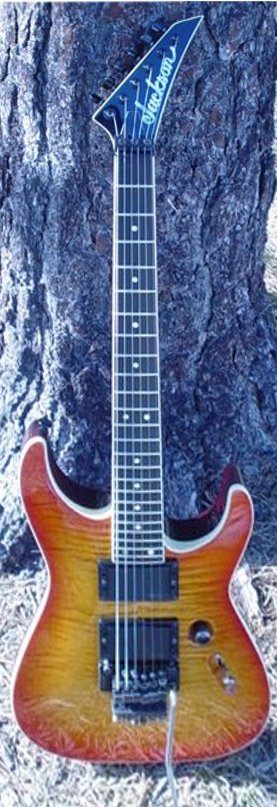
A 1987 Soloist archtop. Photo by Jimshine; perspective correction by GreyCat. Licensed under CC BY-SA 4.0. Via Wikimedia Commons. Jackson
Soloist
1984
Grover Jackson took the Strat shape and ran the maple neck straight through it. Jeff Beck’s was pink.