Fender
Jaguar
It was the top of Fender’s catalog in 1962. By the late ’70s it was a pawn-shop guitar, and somebody’s only one.
Melbourne, 1979. Rowland S. Howard gets hold of a 1969 Fender Jaguar, a guitar Fender had stopped making a few years earlier. It will be the only guitar he plays.
- Introduced
- 1962
- Type
- Solidbody electric
- Class
- Production
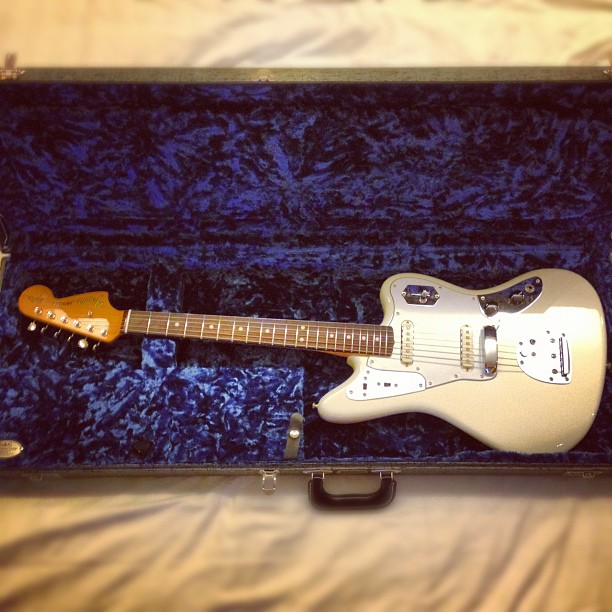
The short version
1962
The last of Leo’s four
A short-scale offset loaded with switches, at the top of the catalog.
1965
The Monkey’s Uncle
Carl Wilson plays one in the opening credits.
1975
Dropped
CBS stops making it. It had never caught up with the Strat or the Tele.
1979
Melbourne
Rowland S. Howard and his 1969 Jaguar.
1991
A left-handed ’65
Kurt Cobain buys a modified Jaguar in Los Angeles.
1992
Reading
Cobain’s Jaguar is a fixture of the Nevermind tour, Reading included.
1999
Back in America
The first U.S. reissue, after Japanese versions from the mid-1980s.
2012
Johnny Marr Jaguar
A signature model, based on the 1965 he’d been playing since Modest Mouse.
Side A
A1
Top of the catalog
The Jaguar was the last of Leo Fender’s original four: Telecaster, Stratocaster, Jazzmaster, Jaguar. It came out in 1962 (summer, or late spring, depending who you ask), and it went straight to the top of the catalog at $379.50.
The pitch was a Gibson-style short scale and a pile of features. This was Fender’s top of the line, the one you were supposed to save up for.
It wasn’t. Jazz players skipped it. Surf bands took to it only mildly. It sold less than the Strat and the Tele, and it never caught up. Remember that, because the Jaguar’s real story isn’t about the crowd it was built for. It’s about the few people who never put one down.
A2
Every switch in the building
Pick one up and the first thing you notice is the neck. The scale is 24 inches, not the Jazzmaster’s 25.5, with 22 frets instead of 21. Everything feels a little closer together, and the strings bend easier.
The pickups are tall, narrow single-coils sitting in notched metal brackets people call claws. They’re not the big flat Jazzmaster pickups, and they’re not Strat pickups either.
Then the switches. The lead circuit has three little sliders: neck on or off, bridge on or off, and a third one that cuts the bass out on purpose. Players call it the strangle, and it makes the guitar thin and cutting. Flip another switch and you’re on the rhythm circuit, neck pickup only, with two tiny thumbwheels.
And the mute. There’s a spring-loaded foam pad behind the bridge you can flip up against the strings for a muffled plunk. The Jazzmaster never had one. The foam crumbles with age, and a lot of original owners just took it off.
Fender’s top guitar had a switch whose only job was to take the bass away.
A3
Pawn-shop years
CBS dropped the Jaguar in 1975. By the late 1970s it was a pawn-shop guitar, the fancy Fender nobody wanted. Even its famous early owners are footnotes. Brian Jones gave Jimi Hendrix a 1963 as a gift. Nobody pictures Hendrix with it.
It also gets credit for records it didn’t make. The Ventures’ “Walk Don’t Run” is Don Wilson’s Jazzmaster. Tom Verlaine gets listed as a Jaguar player, but the guitar on Marquee Moon is a 1959 Jazzmaster. The two offsets get mixed up, and the Jaguar sometimes ends up with the Jazzmaster’s records.
In Melbourne in 1979, Rowland S. Howard got hold of a 1969 Jaguar. Fender Japan started reissuing the model in the mid-1980s, and the first U.S. reissue came in 1999. Some modern Jaguars drop the two circuits for a plain three-way switch, which makes them a different guitar electrically. The vintage-style ones put the strangle, the rhythm circuit, and the mute back.
Flip the record · By the numbers
$379.50
List price at introduction, sunburst. The top of Fender’s catalog.
24"
Scale length. The Jazzmaster is 25.5". Shorter scale, easier bends, looser feel.
3
Sliders on the lead circuit. Neck on/off, bridge on/off, and the “strangle,” which cuts the bass.
15
Years, nearly, the Jaguar had been central to Johnny Marr, by his count in November 2025.
Side B
B1
A left-handed ’65
In 1991, in Los Angeles, Kurt Cobain bought a left-handed 1965 Jaguar that somebody had already rewired, with DiMarzio humbuckers and a toggle switch. So Cobain’s famous Jaguar was already somebody else’s idea of a Jaguar before it was his.
It was his live constant on the Nevermind tours: on Saturday Night Live, at Reading in 1992. Was the album tracked on it? The paperwork doesn’t say so. Fender says he prized it “shortly after the recording of” Nevermind, which is careful wording.
And the Jag-Stang, which came later, is half Jaguar and half Mustang. It isn’t a Jaguar.
B2
The only guitar
Johnny Marr didn’t play a Jaguar in the Smiths. That was Rickenbackers, Gibson semis, and Strats. He picked up a 1965 Jaguar much later, with Modest Mouse and the Cribs, and Fender gave him a signature model in 2012. By November 2025 the Jaguar had been, in his words, “central … for nearly 15 years.” That’s a long time for a guitar player to stay loyal to anything.
Rowland S. Howard went further. The 1969 Jaguar he got in Melbourne in 1979 was the only guitar he played. Fender built the Jaguar to be the one everybody saved up for, and it never was. It turned out to be the one guitar Howard needed.
Put this on
You’ve read about it. Now hear it. Here’s what this guitar sounds like, and what to listen for.
The Monkey’s Uncle (opening credits)
Carl Wilson and his Jaguar, on film. It’s a cameo, not every Beach Boys solo, but it’s the Jaguar in its surf-era suit.
Watch it on YouTube (opens in a new tab)Live at Reading
Cobain’s left-handed 1965 Jaguar, humbuckers and all, at the height of the Nevermind tours. Whether the album itself was tracked on it is another question.
Watch it on YouTube (opens in a new tab)
The cast
The people, and the specific guitars, that made the legend.
1965
Carl Wilson
Jaguar
The Beach Boys, on film in The Monkey’s Uncle. Occasional, not his only guitar.
1991
Kurt Cobain
Left-handed 1965 Jaguar
Bought already modified with DiMarzio humbuckers. His live number one on the Nevermind tours.
1979
Rowland S. Howard
1969 Jaguar
Came to him in Melbourne in 1979. The only guitar he played.
2012
Johnny Marr
1965 Jaguar
Not a Smiths guitar. It came in with Modest Mouse and the Cribs, then a signature model.
1960s
Jimi Hendrix
A 1963, a gift from Brian Jones
A footnote, not a Hendrix guitar anybody pictures. But it’s a good footnote.
Liner notes
Specs, construction, rarity, value, and every source we used.
Fender’s 1962 short-scale offset — claw pickups, a strangle switch, and a mute the Jazzmaster never had — not a Mustang, and not the later Jag-Stang hybrid.
- Body
- Alder; offset waist
- Neck
- Bolt-on maple, Modern “C”
- Fingerboard
- Slab rosewood, 9.5" radius, 22 medium jumbo frets
- Scale
- 24" (610 mm)
- Pickups
- Two Player Series Jaguar single-coils
- Hardware
- Jaguar bridge with Mustang saddles; vintage-style floating tremolo; ClassicGear tuners
- Electronics
- Master volume, master tone, 3-way blade (no vintage dual circuit)
- Finish
- Gloss urethane
- Nut
- Synthetic bone, 1.650" (42 mm)
Open the full research fileConstruction details, the complete player record, production numbers, dated value estimates, and sources
Current Player II (Mexico). Classic 1962–75: 24"/22 frets, claw pickups, dual lead/rhythm plus strangle, spring/foam mute, floating bridge and separate vibrato. Vintera III Mid ’60s (April 2026) restores vintage circuit, mute, and 7.25". No American Vintage II Jaguar.
Construction
Fender introduced the Jaguar in 1962 — mid-1962 / summer 1962 in GuitarHQ; late spring in Joe’s. One writer claimed December 1960; Fender and vintage specialists date the model to 1962. Treat 1960 as unverified. Original U.S. run 1962–1975. Japanese reissues from the mid-1980s (Fender Japan 1982; resurrected after the 1985 sale). First U.S. reissue 1999 (AVRI ’62).
Offset-waist, contoured; upper horn sharper than Jazzmaster. Scale is 24" — not Jazzmaster 25.5". Twenty-two frets vs Jazzmaster’s typical 21. Bolt-on 4-bolt throughout; Joe’s: never the early-1970s 3-bolt/micro-tilt (unverified against a factory memo). Vintage bodies: alder on sunburst and most custom colors; blond is ash.
Neck: maple, rosewood board; maple-cap optional from ~1967. Slab vs veneer on 1962 contested: GuitarHQ veneer from introduction; Joe’s slab until ~July 1962 — not universal 1962 spec. A–D widths from day one; standard B = 1 5/8" (1.650"). Clay dots 1962–late 1964; pearloid late 1964 (Joe’s) or 1965 (GuitarHQ); binding late 1965; blocks mid/late 1966. Heel-adjust truss the whole original run. F-tuners contested: GuitarHQ 1966 (Jaguar first); Joe’s late 1967–1975.
Pickups: tall, narrow single-coils in notched metal claws. Not Jazzmaster wides (large, unshielded) and not Strat pickups. GuitarHQ (Duncan averages): 42 AWG Formvar, ~8,550 turns. Magnet grade: Joe’s Alnico V; GuitarHQ Alnico family, no grade.
Hardware: floating bridge and separate Jazzmaster-type vibrato with lock. Mute: spring/foam behind the bridge — unique to Jaguar among offset six-strings. Jazzmaster never had one. Foam crumbles; many originals removed.
Electronics: dual circuit. Lead: three sliders — neck on/off, bridge on/off, bass-cut strangle (typically 0.003 µF in Premier Guitar and Joe’s). Master volume/tone 1 MΩ. Rhythm: neck only; 1 MΩ volume and 50 kΩ tone thumbwheels. Pickguard ply contested: GuitarHQ three-layer celluloid; Joe’s 4-ply nitrate. Nitro to ~1968 polyester.
Player II drops the dual circuit for volume, tone, and a 3-way — electrically not a 1962 Jaguar. Pickup magnets conflict: Fender Alnico V bridge / Alnico II neck; Thomann both Alnico 5. Vintera III Mid ’60s (April 2026) restores lead/rhythm, strangle, mute, and 7.25". Jag-Stang (1995) is a Jaguar–Mustang hybrid, not a Jaguar.
Players
The 1962 pitch was last of Leo’s original four: Gibson-chasing short scale, “feature laden.” Jazz skipped it. Surf took it only mildly. CBS dropped it in 1975. Kelly: late-1970s pawn-shop guitar.
The Ventures’ 1960 “Walk Don’t Run” is Don Wilson’s Jazzmaster, not a Jaguar.
Carl Wilson (the Beach Boys). Fender points to The Monkey’s Uncle (1965) opening credits. Occasional, filmed — not every Beach Boys solo.
Kurt Cobain (Nirvana) — left-handed 1965 Jaguar, L.A. 1991. Already modified (DiMarzio humbuckers, toggle, Gotoh). Live constant of the Nevermind touring era (SNL, Reading 1992) — not a claim the album was tracked on it. Fender: prized “shortly after the recording of” Nevermind. The Jag-Stang is a Jaguar–Mustang hybrid; it is not this guitar and is not a Jaguar.
Johnny Marr — 1965 Jaguar; Fender Johnny Marr Jaguar (2012– ). Smiths-era Marr is Rickenbackers, Gibson semis, and Strats. The Jaguar is Modest Mouse / the Cribs, then the 2012 signature. November 2025: “central … for nearly 15 years” — post-2010, not The Queen Is Dead.
Rowland S. Howard — 1969 Jaguar, Melbourne 1979; the only guitar he played. Australian Music Vault.
Hendrix received a 1963 as a gift from Brian Jones — not a core Hendrix identity guitar. Tom Verlaine is on Fender’s Jaguar list; Television’s named Marquee Moon guitar is a 1959 Jazzmaster. Sonic Youth used both; named Jazzblasters belong on the Jazzmaster page.
Rarity
Current production is not rare. Collector core: original 1962–early 1965 Fullerton. Official shipping totals are unpublished. Serials were shared across models; they date era, not Jaguar counts. Catalog top-liner at introduction — $379.50 sunburst (Joe’s) — but it underperformed Strat/Tele. Less common than those, not Broadcaster-rare. Joe’s: 1965 “several thousand … more than 1962 and 1963 combined” — dealer estimate, not a factory ledger. 1962 first-year supply is the thinnest. A “1965 pre-CBS spec” guitar can be worth nearly double a “1965 transitional” of the same calendar year (Joe’s). AxeDB: after 1967, 20–40 listings/year; early 1970s 6–15. Mute foam almost never survives. Refinish typically ~40–60% (Joe’s); Edgewater 50–70% on pre-CBS.
Value
Informal estimate, 25 August 2026. Not an appraisal.
Asking prices are not sold prices. Original finish vs refinish, and provenance, can double or halve a result. Artist-owned examples (Cobain, Marr) are a separate market. Factory totals unpublished; serials are not shipping counts. Public 2024–26 sold comps are usable for mixed 1964 and 1966–69 Reverb buckets, thin for clean original-finish custom colors (mostly dealer asks) and thinner still for 1970–75. Do not use the undated Reverb News 1962 buyer’s guide ($3,000–$4,500 sunburst) as current.
New street. Mexico Player II $880 (Fender $879.99). Vintera III Mid ’60s $1,350. Mexico Kurt Cobain Jaguar $2,000. US Johnny Marr Jaguar $2,950. Custom Shop Journeyman/relic commonly $4,900–$6,500 dealer ask — not vintage.
Used modern. Used Players typically a few hundred below new. Kurt Cobain used $1,150–$1,325 (AxeDB). MIJ Traditional II ’60s Reverb $1,080–$1,840. Discontinued AVRI ’62 Reverb $1,320–$2,336. Player-grade original-run: Reverb 1966–69 $3,165–$5,474.
Vintage / collectible. Reverb 1964 Good–Mint $3,715–$7,113; named 2025 solds $4,800–$8,600. Reverb 1966–69 named solds cluster $3,600–$6,300. AxeDB sunburst medians ($3,800–$4,000 for 1963–65; ~$2,500 for 1968) are mixed-condition samples, not 2026 retail. Dealer asks sit above (CME 1964 Candy Apple Red $11,995 ask). Joe’s: a 1965 can be $4,000 or $10,000 depending on the CBS spec line. Clean all-original 1962–64 sunburst roughly $8,000–$18,000 dealer; public 2025 solds often $5,000–$9,000 mixed Excellent/VG. Custom-color matching-headstock asks commonly $12,000–$25,000+; True Vintage 1962 Foam Green $64,995 is a pinnacle ask, not a median.
See also
Sources
- From surf to shoegaze: a history of the Jaguar — 1962 intro; 24"/22 vs Jazzmaster 25.5"/21; claws; mute; Carl Wilson; Hendrix gift; 1975 drop; Japan then 1999; Cobain 1965; Jag-Stang 1995 (not a Jaguar); signatures; player list.
- GuitarHQ: Jaguar — 1962–68 chronology; veneer-from-start claim; F-tuners 1966; discontinued 1975.
- GuitarHQ: pickups — ~8,550 turns; Alnico family.
- GuitarHQ: custom colors — matching headstocks ~1962; blond = ash; poly 1968.
- Premier Guitar: Mod Garage — Jaguar — stock 1M / 50k / 0.003 µF strangle / 0.01 µF.
- Joe’s Vintage Guitars: Jaguar guide — slab/veneer; 4-bolt; 1965 estimate; pre-CBS-spec vs transitional; 2026 hierarchy.
- Muted by design — factory mute; Vintera III return.
- Player II Jaguar and Thomann — current spec; pickup magnet-grade conflict.
- Fender Jaguar collection — August 2026 street.
- Vintera III launch — April 2026 Mid ’60s Jaguar.
- Guitar World: rise, fall and rediscovery — Kelly; Marr; pawn-shop punk (28 August 2020).
- MusicRadar: Cobain’s Jaguar — 1991 purchase; stage Nevermind era; Jag-Stang distinguished (3 April 2020).
- Fender Kurt Cobain Jaguar — prized “shortly after the recording of” Nevermind.
- Vintage Guitar: Johnny Marr Jaguar — Smiths vs Modest Mouse/Cribs (March 2017).
- Premier Guitar: Marr Jaguar review — Modest Mouse is the turn (6 April 2012).
- Guitar World: Marr Signature Special — “nearly 15 years” (11 November 2025).
- From the Archives: Rowland S. Howard — 1969 Jaguar; only guitar he played.
- Australian Music Vault
- Edgewater: date a vintage Jaguar — refinish 50–70%.
- True Vintage: Jaguar through the 1960s
- True Vintage: 1962 Foam Green — $64,995 ask.
- Reverb Price Guide: 1964 and 1966–1969 — sold buckets.
- Reverb News: 1962 buyer’s guide — do not use as 2026 prices.
- AxeDB: CBS transition — post-1967 listing counts; sunburst medians not 2026 retail.
- AxeDB: custom colors
- Chicago Music Exchange Jaguar — 1964 CAR $11,995 ask.
- El Diablo Amps: 1963 sunburst — $7,519 ask.
Keep digging
Guitars this one gets compared to, confused with, or descended from.
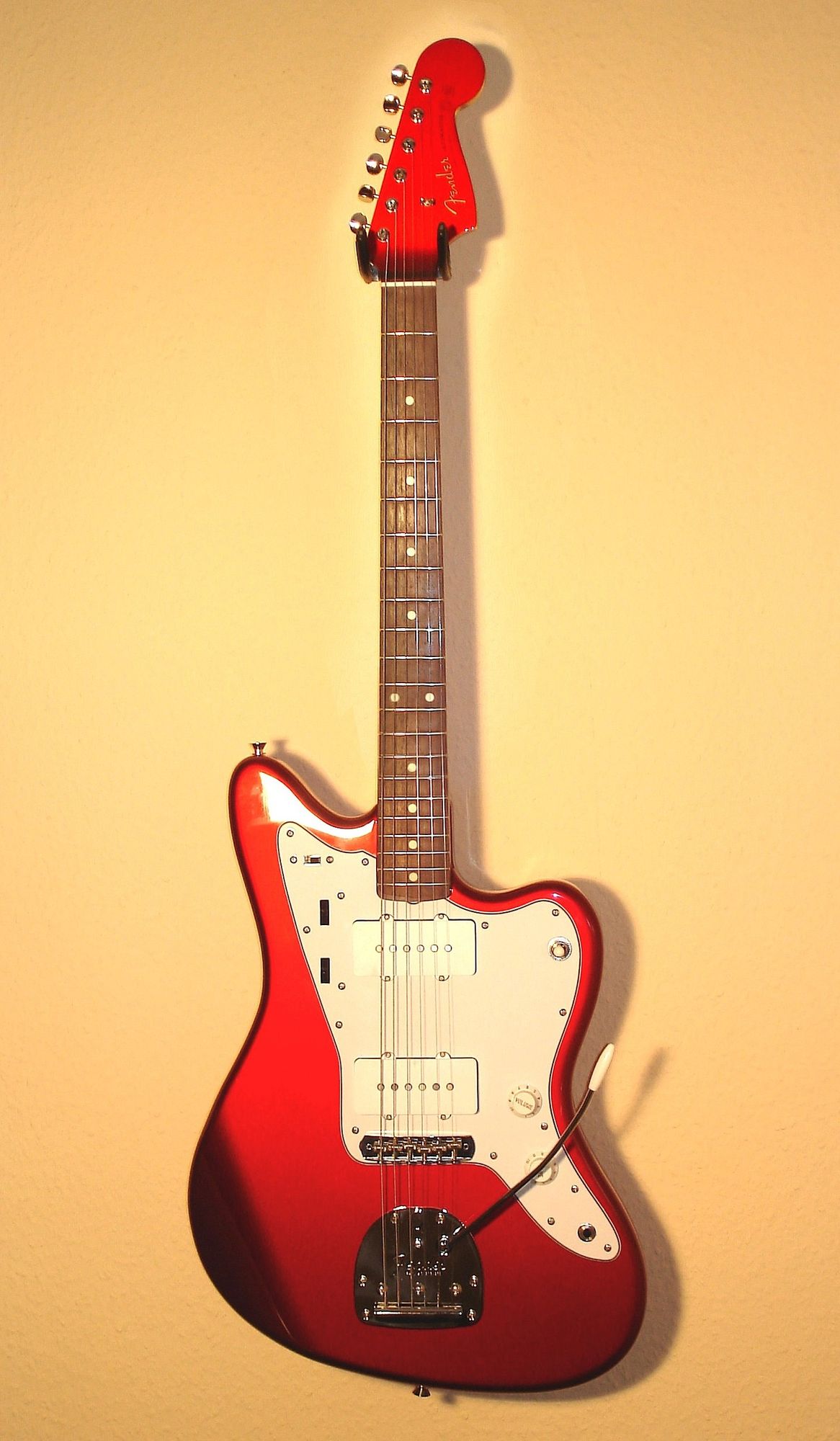
Photo: Dirk-X / Wikimedia Commons / CC BY-SA 4.0 Fender
Jazzmaster
1958
Fender built it for jazz players. Jazz players said no thanks. Surfers, punks, and noise bands said yes.

Photo: Lightburst / Wikimedia Commons / CC BY-SA 4.0 Fender
Stratocaster
1954
The guitar most people mean when they say “electric guitar.” Designed by a man who didn’t play one.