Fender
Mustang
Fender’s 1964 student guitar. It was built to be outgrown, and a lot of people never bothered.
August 1964. Fender puts a new guitar at the top of its student line, above the Musicmaster and the Duo-Sonic: a small offset body, a short neck, and a vibrato arm. It’s a student model. You’re supposed to learn on it and move on.
- Introduced
- 1964
- Type
- Solidbody electric
- Class
- Production
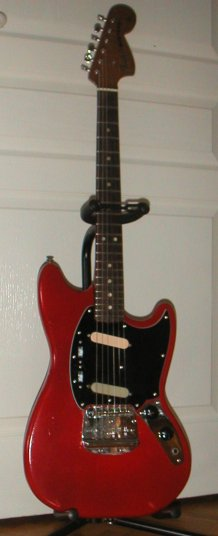
The short version
1964
Top of the student line
Introduced in August, the first of Fender’s student guitars with a vibrato.
1965
CBS
The sale closes on 5 January, so pre-CBS Mustangs cover only four or five months.
1966
The big year
17,788 ship in a single year.
1969
Contours and Competition
The slab body gets contours, and the Competition finish package arrives.
1982
Original run ends
Or 1981, depending who you ask.
1990
Japan
Japanese reissues begin.
1991
The video
Kurt Cobain plays a left-handed 1969 Competition Mustang in “Smells Like Teen Spirit.”
1993
In Utero
The same Mustang gets used on the record.
Side A
A1
Top of the student line
In August 1964, Fender introduced the Mustang as the top of its student line. The Musicmaster and the Duo-Sonic sat underneath it. The Mustang was the first of them with a vibrato arm.
It’s smaller than a Jazzmaster or a Jaguar. The common version uses a 24-inch scale, same as the Jaguar, and that’s where the resemblance ends. There was also a shorter version, 21 frets instead of 22, that Fender made only a very few of. Is that one 22.5 inches or 22 1/4? The measurements don’t agree.
Fender designed it for students. And students are supposed to outgrow things.
A few months after the Mustang came out, CBS bought Fender. The sale closed on 5 January 1965, so the whole pre-CBS Mustang era is about four or five months long.
A2
Sliders and a wiggle stick
The Mustang’s best trick is the Dynamic Vibrato. It works with a bridge that floats on its own, and among vintage Fender six-strings nobody else got that setup. Light, wobbly, and all its own.
The switching is odd too. There’s no ordinary pickup selector. Each of the two slanted, covered pickups gets its own little three-position slider, and with both on, they’re in parallel. How many different sounds does that give you? Depends who’s counting: some say eight, some say six. Count them yourself and you’ll probably get seven.
Until early 1969 the body was a plain slab. Then it got contours. What wood? Alder, or poplar on most of them, depending who you ask. Nobody’s settled it.
Plenty of people bought one. In 1966 alone, Fender shipped 17,788 of them.
A3
Competition
Around 1969 Fender rolled out the Competition finishes. It’s a paint package, not a different guitar. The Musicmaster II and Duo-Sonic II shared the same body, but only the Mustang got the Dynamic Vibrato.
The original U.S. run ended in 1981 or 1982, depending who you ask. Japan started reissuing it in 1990. Some of today’s Mustangs have no vibrato and a plain three-way toggle, so electrically they aren’t a 1964 at all. If you want the sliders and the wobble, the vintage-style reissues put them back.
Flip the record · By the numbers
17,788
Mustangs shipped in 1966 alone. One year, not a run total.
2
Factory scale lengths. 24" was common. A shorter one, 22.5" or 22 1/4" depending who measured, was rare.
4–5
Months between the Mustang’s launch and the CBS sale. That’s the whole pre-CBS window.
1982
End of the original U.S. run. Or 1981, depending who you ask.
Side B
B1
Whoever invented that guitar
Then came the video. In 1991, Kurt Cobain played a left-handed 1969 Competition Mustang in “Smells Like Teen Spirit,” and that’s the picture most people have of the model to this day.
Cobain most likely got it in August 1991, just before the video shoot, and the evidence strongly suggests it wasn’t used to record Nevermind. It was used on In Utero and at some live shows. It broke at the neck joint at Trees in Dallas in 1991 and was still on the road in Rio in 1993.
In February 1992 he said that “the Fender Mustang is my favorite.” Then he complained that they don’t stay in tune. Then: “Whoever invented that guitar was a dork.” Both things can be true.
The Fender Mustang is my favorite.
The Jag-Stang, which came later, is a Jaguar and Mustang hybrid. It isn’t a Mustang.
B2
Never outgrown
Todd Rundgren played a black Mustang in the late 1970s, and its tremolo is a big part of how he sounded then. Adrian Belew had a modified one known as the “Twang Bar King,” with multicolored pickup covers. Ben Gibbard toured on modified 1970s Mustangs for years, and Fender gave him a signature model in 2021.
None of them needed a student guitar. The Mustang was built to be the guitar you learn on and then trade in. For a lot of grown-up players it never made it to the trade-in counter.
Put this on
You’ve read about it. Now hear it. Here’s what this guitar sounds like, and what to listen for.
Smells Like Teen Spirit (video)
The left-handed 1969 Competition Mustang, and the reason people know the model. It’s the video guitar. The best evidence says it wasn’t used to record Nevermind.
Watch it on YouTube (opens in a new tab)
The cast
The people, and the specific guitars, that made the legend.
1991
Kurt Cobain
Left-handed 1969 Competition Mustang
The Teen Spirit video, In Utero, and some live shows. Called it his favorite and its inventor a dork, in the same interview.
late 1970s
Todd Rundgren
Black Mustang
The tremolo is a core part of his sound from that stretch.
1980s
Adrian Belew
Modified “Twang Bar King” Mustang
Multicolored pickup covers. One chapter of his career, not the whole thing.
2021
Ben Gibbard
Modified 1970s Mustangs
Later-career tour workhorses, and a Fender signature model in 2021. Not a Cobain tribute.
Liner notes
Specs, construction, rarity, value, and every source we used.
Fender’s 1964 student offset — compact body, Dynamic Vibrato, two factory scales — not a Jaguar, not a Jazzmaster, not a Jag-Stang, and not the Mustang Bass.
- Body
- Alder; Mustang offset
- Neck
- Bolt-on maple, Modern “C”
- Fingerboard
- Slab rosewood or maple, 9.5" radius, 22 medium jumbo frets
- Scale
- 24" (610 mm)
- Pickups
- Two Player Series Alnico 5 Mustang single-coils
- Hardware
- 6-saddle strings-through-body hardtail; ClassicGear tuners
- Electronics
- Master volume, master tone, 3-way toggle (no vintage sliders)
- Finish
- Gloss polyester
- Nut
- Synthetic bone, 1.650" (42 mm)
Open the full research fileConstruction details, the complete player record, production numbers, dated value estimates, and sources
Current Player II (Mexico). Classic 1964–82: 24"/22 or 22.5"/21, slab to 1969 then contours, covered slanted single-coils, dual 3-way sliders, Dynamic Vibrato. Vintera III Mid ’60s and MIJ Traditional ’60s restore vintage switching and tremolo.
Construction
Fender introduced the Mustang in August 1964 as the top of the student line — above Musicmaster and Duo-Sonic, first of those with a vibrato. Original U.S. run ended 1982 (Fender); Guitar World’s timeline says 1981. Keep both. Japanese reissues from 1990.
Compact offset, smaller than Jazzmaster or Jaguar. The common version shares Jaguar’s 24" scale — not the same guitar. Jazzmaster is 25.5". Two factory scales: 24"/22 frets (common) and 22.5"/21 frets (Fender: “a very few”). guitarhq code 9 = 22 1/4". 22.5" vs 22 1/4" is a source conflict. 1964–early 1969: slab body. 1969: contours. Body wood mixed: guitarhq alder; Joe’s poplar on most examples. Do not flatten.
Bolt-on maple, 4-bolt. Veneer rosewood expected from 1964; guitarhq slab exception Sept 1965–Oct 1966. Two slanted, fully covered single-coils. Dynamic Vibrato plus floating barrel-saddle bridge — unique to Mustang among vintage Fender six-strings. Electronics: no conventional 3-way; each pickup a 3-position slider. Both on = parallel. Fender “eight” settings; Vintage Guitar “six” — count contested.
Competition (c. 1969–c. 1973) is a finish package, not a different model. Musicmaster II / Duo-Sonic II share the body; only the Mustang has the Dynamic Vibrato. Current Player II is hardtail + 3-way — electrically not 1964. Jag-Stang is a Jaguar–Mustang hybrid, not a Mustang.
Players
Kurt Cobain (Nirvana) — left-handed 1969 Competition Mustang, “Smells Like Teen Spirit” video (1991). Canonical image, not the Nevermind tracking guitar. Christie’s (2026, Jim Irsay lot): 1969 Competition, Fullerton; “strongly indicates that this guitar was not used during the recording of Nevermind”; “likely that Cobain acquired the guitar in August 1991 before the video shoot”; used on In Utero and selected live shows. Trees, Dallas, 1991 neck-joint break; Hollywood Rock, Rio, 1993. Guitar World (February 1992): “the Fender Mustang is my favorite” — then: they don’t stay in tune; “Whoever invented that guitar was a dork.” The left-handed 1965 Jaguar is the Nevermind-era live number one — off this page. The Jag-Stang is a Jaguar–Mustang hybrid (Custom Shop prototypes 1993; production after his death); it is not a Mustang. Fender’s 2012 Kurt Cobain Mustang copies modified In Utero-tour Mustangs, a different fleet.
Ben Gibbard — modified 1970s tour Mustangs; Fender Ben Gibbard Mustang (2021). Later-career workhorse, not a Cobain replica.
Adrian Belew — modified “Twang Bar King” Mustang (Vintage Guitar: multicolored covers). 1980s chapter, not “the Belew guitar.”
Todd Rundgren — black Mustang, late 1970s (Guitar World 2026). Tremolo a core of that-era sound.
Fender’s later player list is acknowledgement, not serials. Sonic Youth Jazzblasters belong on the Jazzmaster page. Early Talking Heads photos are a Duo-Sonic/Mustang tangle — do not promote a “Talking Heads Mustang.” The Mustang Bass (1966) is a different instrument.
Rarity
Official factory totals are unpublished. Serials were shared across models; they date era, not Mustang counts. Only sourced year-count: Wheeler, The Fender Archives (2014), 1966 sales sheet 17,788 shipped (RetroFret: nearly 18,000; Edgewater: over 16,000) — a single-year peak, not a run total.
Pre-CBS is only ~4–5 months (August 1964 intro; CBS 5 January 1965). Those L-series / small-headstock 1964 examples are the scarcest standard Mustangs, not because the model was rare overall. Common scale is 24". 22.5"/21-fret (guitarhq 22 1/4") is scarce — no published count. Competition (c. 1968/69–c. 1973) is a finish package. Joe’s: Orange rarest, Red most common, Blue extra demand from the Cobain association — that association does not transfer. Matching painted headstocks on the earliest Competition sit above later natural-headstock cars. Visible original-run Mustangs are common as vintage Fenders go; clean original-finish with a complete Dynamic Vibrato is not.
Value
Informal estimate, 25 August 2026. Not an appraisal.
Ask ≠ sold. Dealer excellent-original (Joe’s / Edgewater) sits roughly 1.5–2.5× the lower half of mixed Reverb solds. Condition, originality, and a complete Dynamic Vibrato can double or halve a result.
New street. Mexico Player II $849.99. Vintera II ’70s Competition $1,149.99 (some dealer street ~$1,000). Vintera III Mid ’60s $1,249.99. Custom Shop Competition Heavy Relic 2025 ask $5,999 — not vintage. Japan MG-69 used Reverb solds $892–$1,399 (June–July 2026) — not vintage.
Vintage mixed solds. Reverb 1964–69 Good–Mint estimate ~$1,680–$3,310 (900+ orders); named 2025–26 solds cluster $1,800–$3,700. Competition 1969–73 Reverb estimate $2,080–$4,870 (253 orders). AxeDB mixed: standard ~$1,800–$2,000 through 1968; Competition medians $2,500–$3,000+, roughly 60–70% above same-year standard.
Dealer excellent-original. Joe’s 10 July 2026: CBS standard 1966–early 1970s player $1,200–$2,200 / excellent $2,200–$3,800; Competition player $2,500–$4,500 / excellent $4,500–$9,000. Edgewater Feb 2026: standard-finish 1964–69 $4,000–$8,000; Competition $6,000–$12,000; pre-CBS 30–50% premium. True Vintage 1965 Red 22.5" ask $3,995. Guitar Value Guide year-rows disagree with Joe’s on 1964 vs 1965 — guide, not sold.
Top. Clean 1964–65 pre-CBS: Joe’s excellent ~$2,800–$5,000. Authenticated original-finish Competition, especially Orange or 1969 matching-headstock Blue: Joe’s $4,500–$9,000 and up. Competition Orange solds and 22.5" solds are thin.
Cobain’s left-handed 1969 Competition (Teen Spirit video) is a multi-million-dollar artist-instrument market (Joe’s: ~$4.5M then ~$7M). Do not transfer that number to other Mustangs of the same color. Reissues and signatures are not 1964–82 originals.
See also
- Jaguar
- Jazzmaster
- fender-mustang-bass — 1966 30" companion bass; not this six-string
Keep digging
Guitars this one gets compared to, confused with, or descended from.
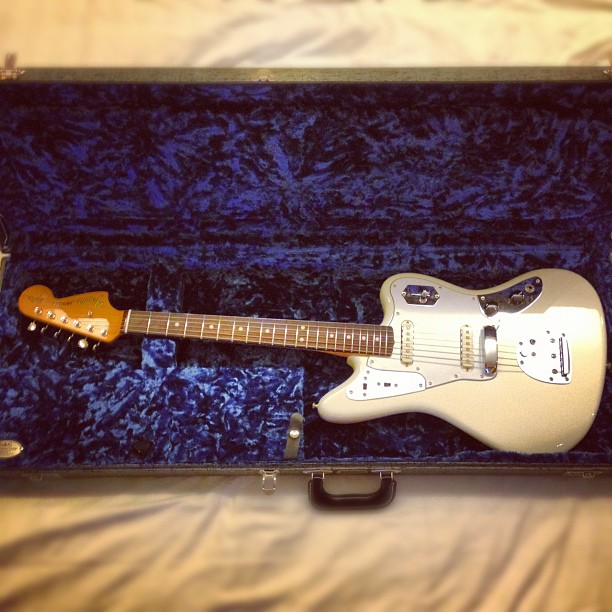
Fender Jaguar Johnny Marr signature. Photo by ToGa Wanderings. Licensed under CC BY 2.0. Via Wikimedia Commons. Fender
Jaguar
1962
It was the top of Fender’s catalog in 1962. By the late ’70s it was a pawn-shop guitar, and somebody’s only one.
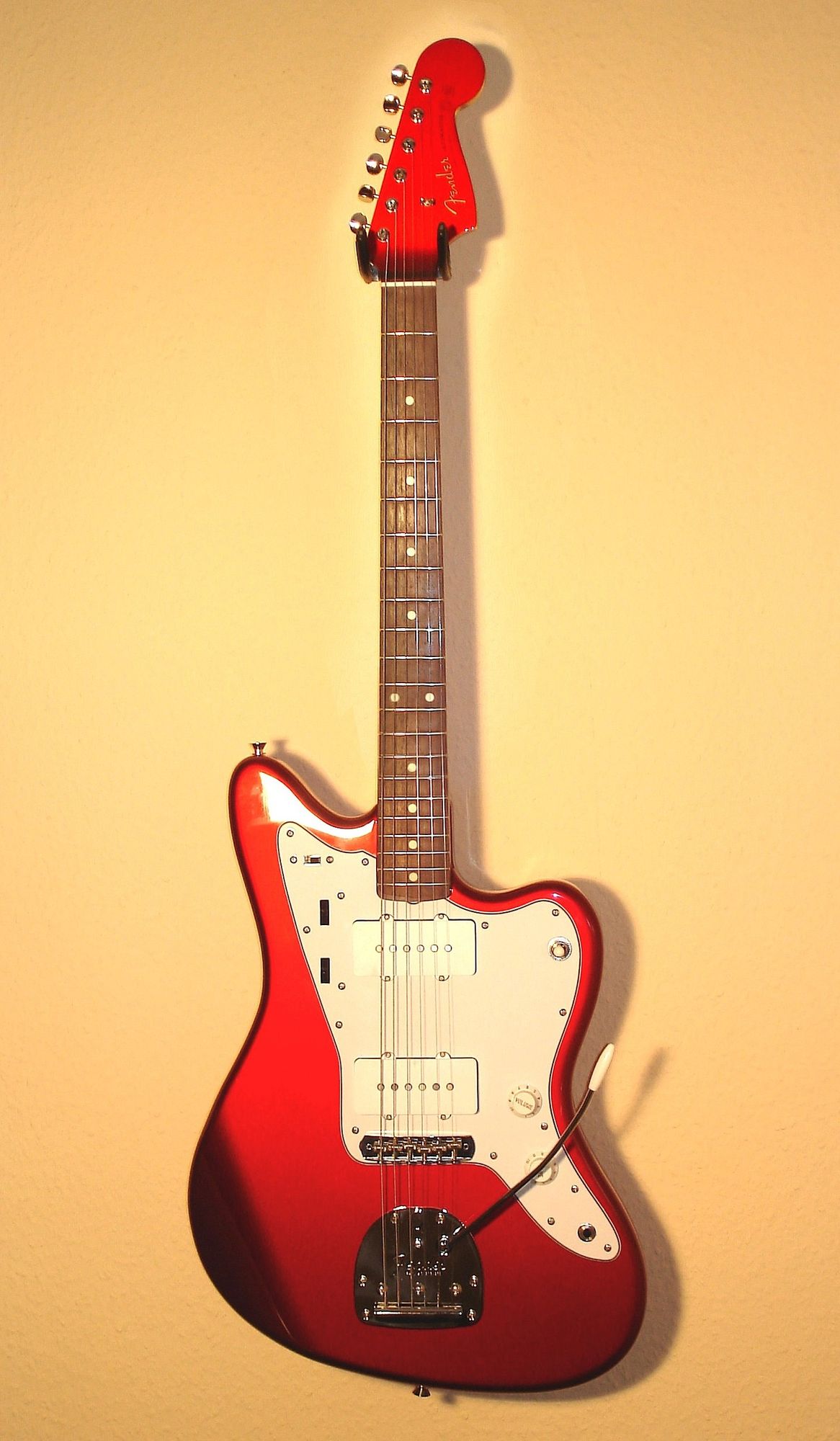
Photo: Dirk-X / Wikimedia Commons / CC BY-SA 4.0 Fender
Jazzmaster
1958
Fender built it for jazz players. Jazz players said no thanks. Surfers, punks, and noise bands said yes.
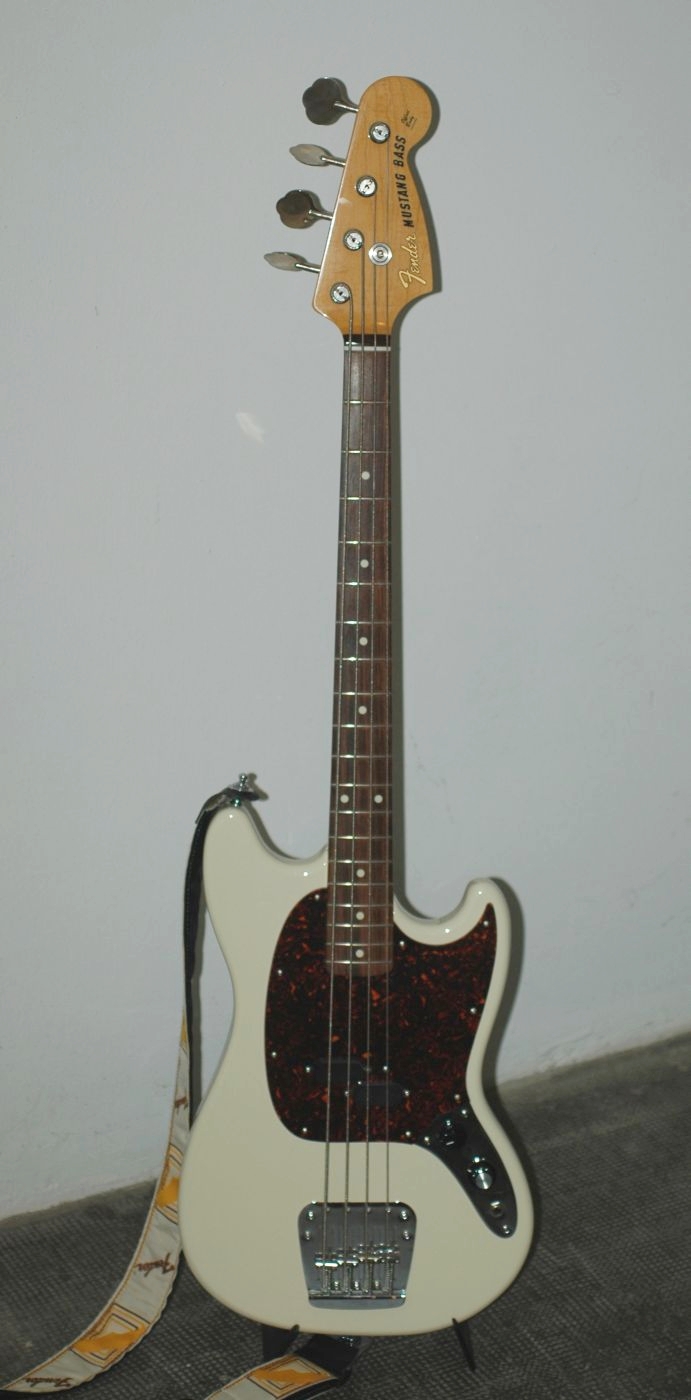
E-Bass Fender Mustang, shortscale 30". Photo by Joachim Hensel-Losch. Licensed under CC BY 2.5 (also offered as CC BY-SA 3.0). Via Wikimedia Commons. Fender
Mustang Bass
1966
Leo Fender’s last bass for Fender was a short, cheap student model. That was the whole idea.