Fender
Esquire
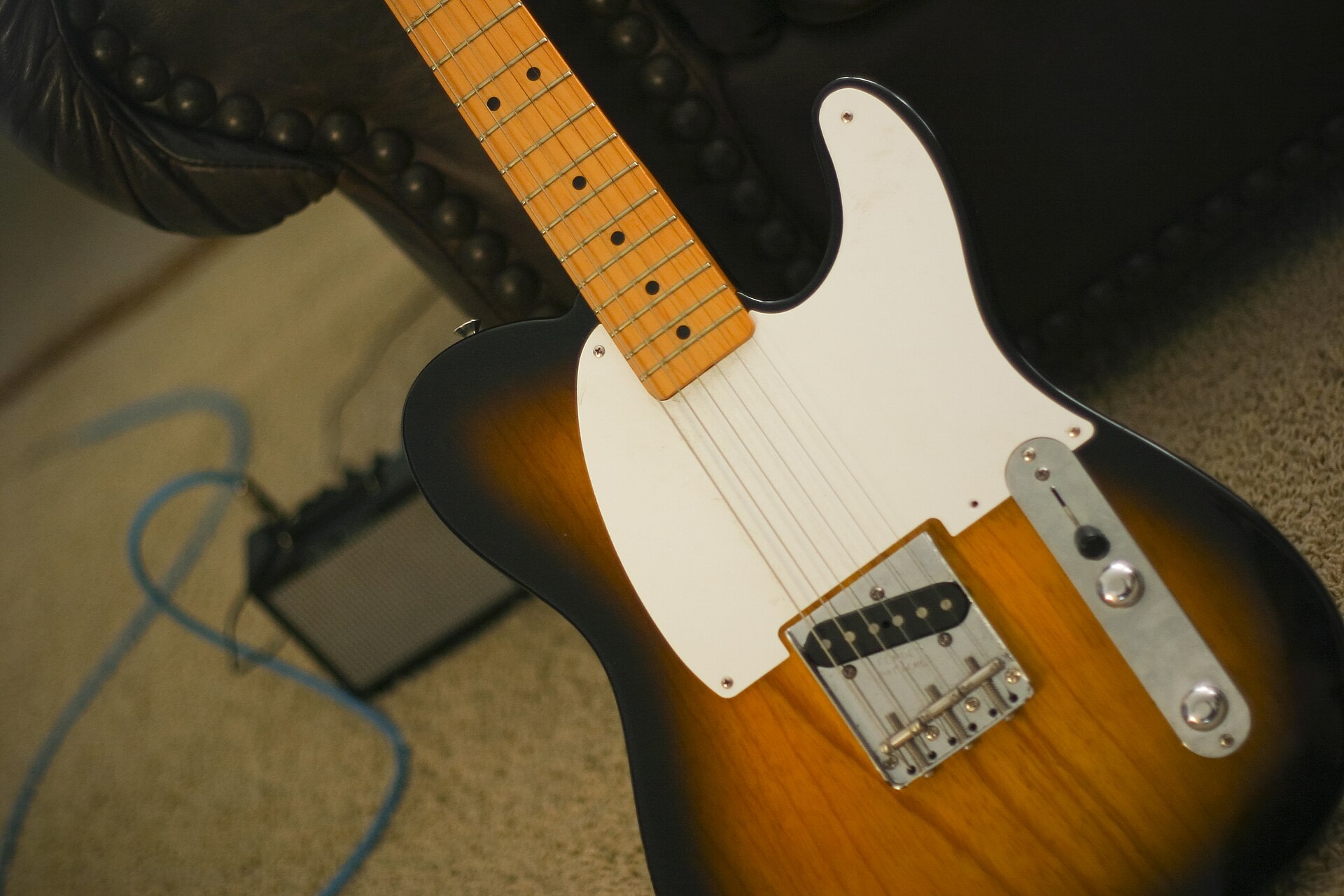
Fender’s first electric Spanish guitar settled on one pickup, and it’s been mistaken for its little brother ever since.
June 1950. Fender announces its first electric Spanish guitar and calls it the Esquire. About fifty go out the door, with hundreds more on backorder. A lot of them come back, because nobody put a truss rod in the neck.
- Introduced
- 1950
- Type
- Solidbody electric
- Class
- Production
The short version
1950
The Esquire
Announced in June, with one pickup or two. By September the name is pulled from the marketing.
1950
Little brother arrives
In October the two-pickup guitar becomes the Broadcaster, now with a truss rod.
1951
Back, with one pickup
The Esquire returns in January as the one-pickup sister. By February, one pickup is the norm.
1954
White guard
The black pickguard turns white in mid-1954, same as the Tele.
1959
Custom Esquire
A rosewood board, and a bound sunburst version. Still one pickup.
1965
Two famous ones
Jeff Beck buys John Walker’s ’54. Syd Barrett gets a white ’62 late that year.
1969
Quietly gone
The original run ends around here, or early 1970, depending who you ask. Student models had taken the cheap slot.
Side A
A1
First out the door
In June 1950, Fender announced its first electric Spanish guitar. It was called the Esquire. Depending on which one you got, it had one pickup or two. The best guess is that only about fifty of those first Esquires ever shipped, against a backorder of hundreds.
And a lot of the ones that did ship came back, because the early necks had no truss rod, and a maple neck with nothing inside it to keep it straight doesn’t stay straight. Many got new necks. Some got new bodies.
By September the marketing had dropped the name. In October the two-pickup guitar came back with a truss rod as the Broadcaster, and within a year or so it was the Telecaster. So the Esquire is the older sibling. It was first. And it has spent every year since being called by its little brother’s name.
A2
Back, with one pickup
In January 1951 the Esquire returned as the one-pickup version of the Broadcaster and Tele. A two-pickup Esquire from that January has turned up looking stock, but by February one pickup was the norm. If you meet a 1950 Esquire with two pickups, don’t call it a Telecaster. It isn’t one.
From then on it’s a Tele slab with nothing where the neck pickup would go: same maple neck, same 25.5-inch scale, three saddles, strings through the body. Black pickguard until mid-1954, white after. In 1959 a rosewood board showed up, and so did the Custom Esquire, bound and sunburst, still one pickup.
A3
One pickup, three sounds
Here’s the clever bit. The Esquire still has a three-way switch, and it doesn’t pick a pickup, because there’s only one. It changes what that one pickup sounds like.
On a 1953 blackguard, one position gives you the full pickup with no tone control in the way, one brings the tone knob in, and one is a preset, darker tone. Other years are wired differently, and even the paperwork on Fender’s own 1950 recreation can’t agree on the order. So I won’t hand you one map for every Esquire. Flip it and listen.
What you get is a guitar with nowhere to hide. One pickup at the bridge, bright and loud, and whatever your hands do with it.
Flip the record · By the numbers
~50
Original 1950 Esquires shipped. A best guess, not a factory count.
1
Pickup, at the bridge. No neck pickup, no pickup selector.
3
Positions on the switch anyway. What each one does depends on the year you ask about.
1954
The year of Jeff Beck’s Yardbirds guitar. An Esquire, not a Telecaster.
Side B
B1
Jeff Beck’s “Telecaster”
When Jeff Beck joined the Yardbirds, the band loaned him Eric Clapton’s red Telecaster. He wanted a maple neck. In 1965, on tour with the Walker Brothers, he bought John Walker’s maple-neck Esquire: a battered blonde 1954, fitted with a ’55 Telecaster neck. It powered “Heart Full of Soul,” and it gets the credit on “I’m A Man,” “Over Under Sideways Down,” and “Shapes of Things.”
In every photo it looks like a Tele. It’s an Esquire. Fender admitted as much when it made a Yardbirds Tribute Esquire years later. Beck eventually traded it to Seymour Duncan for a guitar called the “Tele-Gib.”
Luther Perkins, backing Johnny Cash from 1954, played an Esquire as well as a Telecaster. People mostly remember the Tele.
B2
The disc that wasn’t a mirror
Syd Barrett got a white 1962 Esquire late in 1965. In 1966 he wrapped it in silver plastic and stuck polished metal discs on it, and it became known as the “Mirror Disc Telecaster.” The name is wrong twice: the discs weren’t mirrored glass, and it wasn’t a Telecaster. He kept it through the A Saucerful of Secrets sessions, then traded it in mid-1968 for a black Telecaster Custom. Nobody knows where it is now.
Joe Strummer played a ’50s Esquire with a racing-stripe finish live around London Calling. Photos point to a 1960, but people still argue the year, and nobody can say for sure it’s on the record. His famous guitar is still the Tele.
B3
Borrowed necks
The original run ended quietly around 1969. The last decals are from 1968, and a few 1969s trickled out before the model went away, maybe as late as early 1970. By then Fender was building thousands of Teles a year and only a handful of Esquires. The cheap slot had gone to the student models.
Then look at the cover of Born to Run. That’s a Telecaster body with an Esquire neck on it. Beck’s Yardbirds “Tele” is an Esquire with a Tele neck. Barrett’s “Mirror Disc Telecaster” is an Esquire in silver plastic. The older sibling has been on some of the most famous records and album covers there are, under somebody else’s name, and it never once asked for a correction.
Put this on
You’ve read about it. Now hear it. Here’s what this guitar sounds like, and what to listen for.
Heart Full of Soul
Beck’s battered blonde ’54 Esquire, wearing a ’55 Telecaster neck, powered this one. One pickup. Listen to how much it does anyway.
Find it on YouTube (opens in a new tab)Shapes of Things
The same Esquire. Photos of Beck from this era look like a Tele. Count the pickups.
Find it on YouTube (opens in a new tab)Over Under Sideways Down
Another one credited to Beck’s Esquire. Same guitar, same single pickup.
Find it on YouTube (opens in a new tab)
The cast
The people, and the specific guitars, that made the legend.
1965
Jeff Beck
1954 Esquire
Bought from John Walker on a Walker Brothers tour. Later traded it to Seymour Duncan for the “Tele-Gib.”
1966
Syd Barrett
1962 Esquire
The “Mirror Disc Telecaster,” which wasn’t mirrored glass and wasn’t a Telecaster. Whereabouts unknown.
1954
Luther Perkins
An Esquire and a Telecaster
Behind Johnny Cash from 1954. The boom-chicka lives on both.
1975
Bruce Springsteen
Tele body, Esquire neck
The Born to Run cover guitar is half Esquire. Techs say 1953 or 1954.
c. 1979
Joe Strummer
A ’50s Esquire
Seen live around London Calling, with a racing-stripe finish. The year is argued; photos suggest 1960.
Liner notes
Specs, construction, rarity, value, and every source we used.
One pickup, no rhythm pickup — Fender’s first production solidbody electric; Beck’s Yardbirds guitar, not a two-pickup Tele, and not Micawber.
- Body
- 2-piece sandwich pine, 1.5" laminated; Esquire slab
- Neck
- Bolt-on 1-piece rift-sawn maple, 1950 Esquire “U”; no truss rod
- Fingerboard
- Maple (neck face), 7.25"–9.5" vintage compound radius, 21 medium-vintage frets
- Scale
- 25.5" (648 mm)
- Pickups
- One Custom Shop hand-wound ’50/’51 Blackguard single-coil (bridge)
- Hardware
- 3-saddle ’50 Esquire, original-style steel saddles, strings through; vintage-style tuners; disk string tree
- Electronics
- Volume, tone, 3-way Esquire circuit
- Finish
- NOS flash-coat nitrocellulose; Closet Classic hardware
- Nut
- Bone, 1.650" (42 mm)
Open the full research fileConstruction details, the complete player record, production numbers, dated value estimates, and sources
Fender does not currently ship an Esquire in American Vintage II, American Professional II, Player, or Vintera (AVII 2026 refresh is Tele/Strat/Thinline/Deluxe — no Esquire). This table is Custom Shop Vintage Custom 1950 Pine Esquire, model 9235001175 — a 1950 pine recreation, not a 1951–69 ash Esquire with a truss rod. Custom Shop also lists a Vintage Custom ’59 Esquire (ash). Last high-volume Fender catalog reissue: Mexico Classic Series ’50s Esquire (Blue Book 2005–2016). Squier Classic Vibe Custom Esquire is Squier.
Construction
The Esquire is the one-pickup Fender plank. It is not a Telecaster with the neck pickup omitted as a nickname. It is not Broadcaster. It is not Nocaster. It is not Micawber.
guitarhq: Fender’s first electric Spanish guitar, announced June 1950, one or two pickups. Marketing discontinued the name September 1950. “Only about 50 of these original Esquires were shipped,” with a backorder of hundreds; many returned for neck (and body) replacement because early necks lacked a truss rod. October 1950: the two-pickup guitar becomes Broadcaster, with a truss rod. January 1951: Esquire returns as the one-pickup Broadcaster/Tele sister. guitarhq has seen a January 1951 two-pickup Esquire that appeared stock; “by February 1951, one pickup was the norm.” Do not flatten 1950 into “always one pickup.” Do not call a 1950 two-pickup Esquire a Telecaster.
Fender’s later line: “introduced in 1950 and renamed the Telecaster in 1951” is the two-pickup story. The Esquire kept the name. True Vintage Guitar dates the Gretsch cease-and-desist 20 February 1951; nameless-headstock two-pickup guitars are the collector nickname Nocaster. That window is Telecaster history, not this model.
From 1951 the catalog Esquire is a Tele slab with no neck pickup: ash (blonde) or alder (opaque, after the mid-1950s wood split on non-blonde Teles), bolt-on maple, 25.5", typically 21 frets, 7.25" radius, three saddles, strings through, control plate with volume, tone, and a 3-way that is not a pickup selector. Black phenolic guard 1950–mid-1954; white from mid-1954 — the same blackguard/white-guard split as Tele. Serial on the bridge plate until mid-1954, then the neck plate. 1959: rosewood board; Custom Esquire — bound sunburst, still one pickup. That Custom is the one-pickup sibling of the 1959–72 bound Custom Telecaster, not the 1972 Wide Range Telecaster Custom.
The 3-way is era-sensitive. Dave’s Guitar Shop on a 1953 blackguard: position 1 full pickup with no tone control; middle tone engaged; position 3 a preset rolled-off tone. Squier’s current Classic Vibe Custom Esquire copy lists tone-off / tone-on / preset treble roll-off. Custom Shop’s 1950 Pine body copy (“full-throttle”): position 1 volume and tone, 2 volume, 3 pickup straight to the jack. The same dealer spec sheet lists those three jobs in reverse order. Attribute; do not pick a universal Esquire map.
Original catalog run ends around 1969. guitarhq lists Esquire / Custom Esquire peghead decals 1950–1968. RetroFret: a 1969 example “shortly before the model’s discontinuation in early 1970”; CBS pulled it as Mustang-class student models ate the cheap slot. Keep both cutoffs.
Reissues are not Fullerton 1950–69. Mexico Classic Series ’50s Esquire 2005–2016 (Blue Book): ash, one alnico Tele bridge coil, maple, 7.25", 21 vintage frets, 1.625" synthetic-bone nut, 3-saddle strings-through. Dealer copy on surviving examples notes a factory neck-pickup route — a conversion trap, not 1950. Custom Shop still builds Esquires (1950 pine; ’59; event relics; a limited Joe Strummer Relic). There is no current AVII Esquire.
Players
Jeff Beck — 1954 Esquire (Yardbirds). Not a Telecaster. Vintage Guitar: the Yardbirds loaned him Clapton’s red Telecaster when he joined; he wanted maple-neck and in 1965, on tour with the Walker Brothers, bought John Walker’s maple-neck Esquire. VG lists it on “I’m A Man,” “Over Under Sideways Down,” “Shapes of Things.” Guitar Player (updated 9 March 2026): the same battered blonde 1954 Esquire, fitted with a ’55 Telecaster neck, powered “Heart Full of Soul.” Photographs look like a Tele; it is a one-pickup Esquire. Fender’s later Yardbirds Tribute Esquire admits the distinction. Beck later traded it to Seymour Duncan for the “Tele-Gib.”
Bruce Springsteen, Born to Run cover guitar (1975). Not a stock Esquire. Not a stock Tele. Fender’s “Iconic Mods” page: Telecaster body, Esquire neck — a mutt. Techs indicate 1953 or 1954; bought shortly after the 1972 Columbia signing at Phil Petillo’s New Jersey shop. On the covers of Born to Run, Wrecking Ball, and Human Touch. The Telecaster plate already warns Esquire vs Tele on this guitar. Do not file it here as a two-pickup Tele or as a catalog Esquire.
Do not file Keith Richards’s Micawber here. Fender: 1953 Telecaster; Met Play It Loud 2019: 1954. Open-G stage Tele with a PAF in the neck. It lives on the Telecaster plate.
Luther Perkins (Johnny Cash). Fender: Perkins accompanied Cash from 1954 on a Telecaster and an Esquire. The Cash “boom-chicka” association is with Tele/Esquire. He later used a Jazzmaster; that does not overwrite this one.
Syd Barrett — 1962 Esquire (“Mirror Disc Telecaster”). Fender: the name is a misnomer — not mirrored glass, not a Telecaster. White 1962 Esquire, acquired late 1965; in 1966 shrink-wrapped in silver plastic with polished metal discs. Toward the end of 1967 he acquired a white Telecaster for live use; kept the Esquire through A Saucerful of Secrets sessions; mid-1968 traded it for a black Telecaster Custom. Whereabouts unknown. Fender’s year of acquisition (late 1965) is the citation here.
Joe Strummer. Identity guitar is the sunburst-then-stencil 1966 Telecaster (Tele plate). Mixdown’s London Calling rundown: live footage around that LP also shows a ’50s Esquire, racing-stripe finish, c. 1979–81. Guitar.com: photographic evidence of a 1960 Esquire; studio use on the LP is not confirmed. Fender Custom Shop’s later Strummer Relic treats an Esquire as the London Calling / Combat Rock weapon — tribute copy, not a census. Keep the Tele as canonical Clash; keep the Esquire as a documented live/period guitar with a contested year.
Rarity
Official 1950–69 Esquire shipping totals are unpublished. Serials were shared across Tele-family models; they date, they do not count.
June–September 1950 first Esquires: guitarhq specialist estimate ~50 shipped. That is not a factory ledger. Early no-truss-rod pine/black examples are the thin original window; many necks were replaced.
1951–69 one-pickup production is scarcer than same-year Telecasters in the dealer sense (RetroFret: by 1969 Fender built thousands of Teles a year and “only a handful” of Esquires) — still not a published total. Custom Esquire (1959–68 decals) is a bound one-pickup subset, not a 1972 Wide Range Custom.
Reissues (Classic Series 2005–2016, Japan, Custom Shop, Squier) are high-volume relative to 1950 pine. A Classic Series with a later neck pickup installed is a converted reissue, not an original Esquire and not a Telecaster.
Value
Informal estimate, 25 August 2026. Not an appraisal.
Ask ≠ sold. Original finish vs refinish, and a later neck pickup, move a guitar a full tier. Reissues are not Fullerton. Artist-owned examples sit outside these bands. Joe’s rule of thumb is not AxeDB’s sold table — keep both.
New street. No AVII / Player / Vintera Esquire. Custom Shop Vintage Custom 1950 Pine Esquire about $4,575 (N Stuff, SKU 9235001175, August 2026). Time Capsule dealer asks about $4,575–$4,800. 2026 Custom Shop event relics about $4,850 ask. Squier Classic Vibe Custom Esquire $529.99 list — not a Fender Esquire.
Used modern. Mexico Classic Series ’50s Esquire (2005–2016): named 2024–26 asks roughly $700–$1,100 (Parkway 2007 Black sold-out $999.95; guitar-list Reverb captures $710–$1,099; UK Listers White Blonde £799). Thin named ladder, not a sold median.
Vintage / collectible. Joe’s Vintage Guitars (July 2026, excellent-original dealer Tele bands): an Esquire is “usually around 75% of a same-year, same-color Telecaster.” AxeDB mixed-condition solds say that conventional 25–30% discount is mostly wrong except blackguard: Esquire vs Tele medians blackguard $25,000 vs $26,635 (−6%); condition-controlled blackguard −7% (n=10 Esquires, thin). Whiteguard / pre-CBS / early-CBS Esquire medians sit at or above Tele in that sample — AxeDB flags the later premiums as suggestive and likely condition mix. Edgewater (February 2026, excellent-original): 1950–54 Esquire $35,000–$65,000; 1955–64 $18,000–$35,000. Artist-owned (Beck, Barrett if found) is a separate market.
See also
- Telecaster — two pickups; Micawber and the Born to Run mutt live there
- Telecaster Custom — 1972 Wide Range HS; not the 1959 bound Custom Esquire
- Telecaster Deluxe — 1973 dual Wide Range, Strat headstock; not a one-pickup plank
Sources
- The one that started it all: a Telecaster history — 1950/1951 rename; Perkins Tele and Esquire.
- Iconic Mods: Springsteen’s ‘Boss’ Esquire — Tele body / Esquire neck mutt; not a stock Esquire or Tele.
- Psych Out: Syd Barrett’s ’62 Esquire — 1962 Esquire, not a mirrored Telecaster; late-1965 acquisition; 1968 trade.
- Vintage Custom 1950 Pine Esquire — current Custom Shop SKU 9235001175; pine, no truss rod, full-throttle wiring copy.
- N Stuff: Vintage Custom 1950 Pine Esquire — $4,575; spec table (switching order conflicts with Fender body copy).
- Vintage Custom ’59 Esquire — additional current Custom Shop Esquire (ash).
- American Vintage II electric guitars — no Esquire in the current AVII guitar collection.
- MusicRadar: Fender refreshes American Vintage II — 12 August 2026 finish refresh; listed Teles are Tele / Thinline / Deluxe, not Esquire.
- Classic Vibe Custom Esquire — Squier; $529.99; bound Custom-Esquire tribute, not Fender production.
- guitarhq.com Fender — June 1950 Esquire 1 or 2 pickups; ~50 shipped; Sept 1950 pause; Broadcaster Oct 1950; Esquire reintroduced Jan 1951; decals to 1968; no-truss-rod early necks.
- guitarhq.com 50tele — Esquire June–October 1950 name; Broadcaster has truss rod.
- True Vintage Guitar: Broadcaster 1950–1951 — 20 February 1951 Gretsch letter.
- Vintage Guitar: Jeff Beck — Yardbirds guitar is a 1954 Esquire, not a Tele.
- Guitar Player: Jeff Beck on Esquires — updated 9 March 2026; 1954 Esquire / ’55 Tele neck; “Heart Full of Soul.”
- Christie's: Jeff Beck — 10 guitars that shaped a legend — Esquire traded to Seymour Duncan.
- Joe’s Vintage Guitars Telecaster value guide — July 2026; Esquire typically ~75% of a same-year Tele.
- AxeDB: The Vintage Telecaster Market — Esquire vs Tele sold medians; blackguard discount ~6–7%; later eras not a 25–30% haircut.
- Edgewater Guitars 2026 value guide — February 2026 Esquire excellent-original bands.
- Blue Book: Fender Esquire series — Classic Series ’50s Esquire Mexico 2005–2016.
- Long & McQuade: Classic Series ’50s Esquire — last catalog-reissue spec snapshot (ash, 7.25", 1.625" nut).
- Dave’s Guitar Shop: 1953 Esquire — blackguard Esquire 3-way map.
- RetroFret: 1969 Esquire — discontinuation early 1970; late Esquires scarce vs Tele.
- Mixdown: London Calling gear — Strummer ’50s Esquire live c. 1979–81; ’66 Tele on the LP.
- Guitar.com: Clash London Calling gear — possible 1960 Esquire; studio use not confirmed.
- Parkway Music: Classic Series ’50s Esquire — used ask $999.95 (2007 Black).
Keep digging
Guitars this one gets compared to, confused with, or descended from.
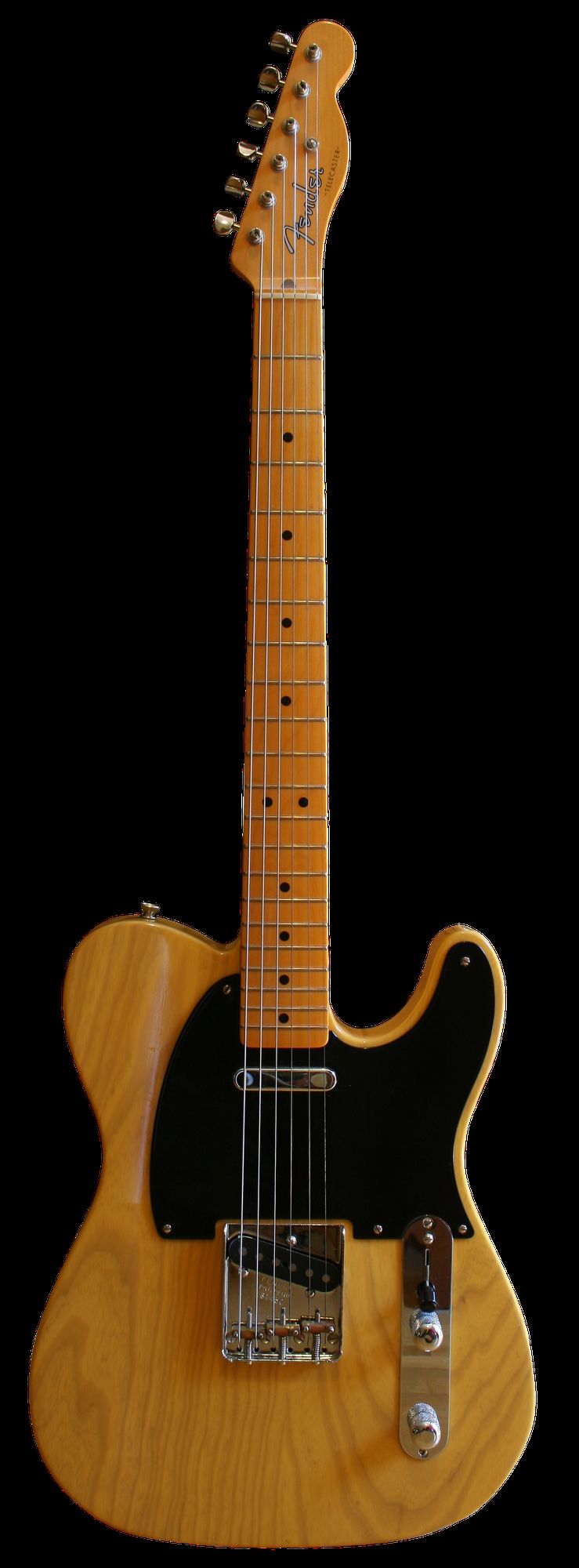
Fender Telecaster American Vintage 1952 with transparent background. Photo by Massimo Barbieri. Licensed under CC BY-SA 3.0. Via Wikimedia Commons. Fender
Telecaster
1950
Leo built it like a tool. The famous ones look like they just clocked off a double shift.
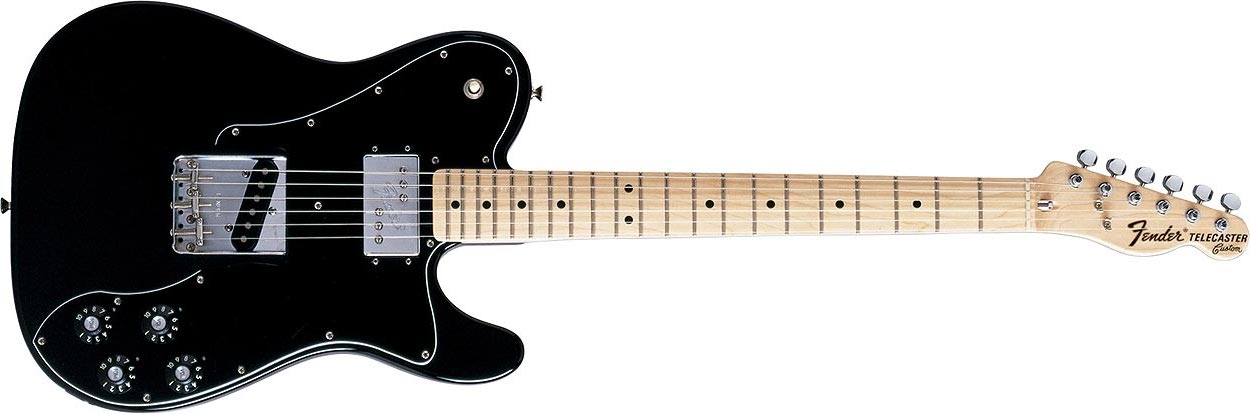
1976 Fender Telecaster Custom. Photo by GEisenhut. Public domain. Via Wikimedia Commons. Fender
Telecaster Custom
1972
A borrowed name, a copied hot-rod, modest sales. Keith Richards still sent it onstage in Micawber’s place.
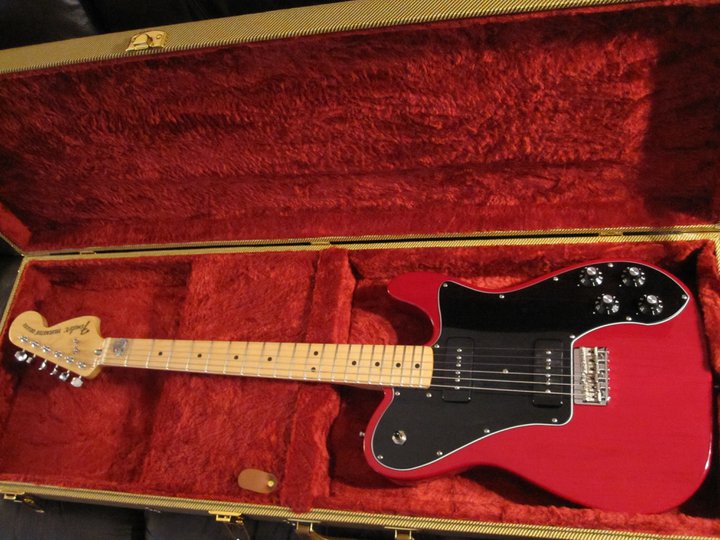
Telecaster Deluxe Black Dove. Photo by Mastermetal666. Licensed under CC BY-SA 3.0. Via Wikimedia Commons. Fender
Telecaster Deluxe
1973
A Tele body, a Strat headstock, and two big humbuckers. The odd cousin in the family, and somebody’s favorite.