Fender
Telecaster
Custom
A borrowed name, a copied hot-rod, modest sales. Keith Richards still sent it onstage in Micawber’s place.
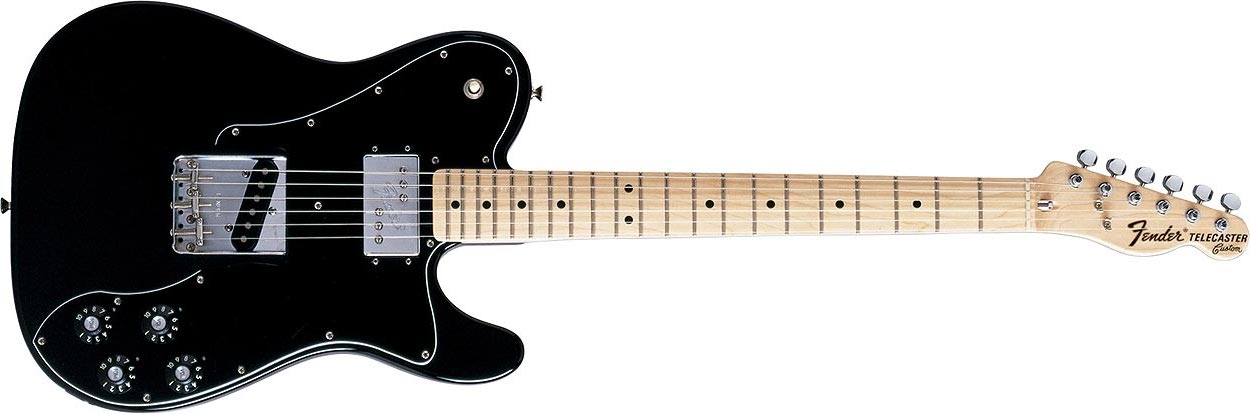
1972. For thirteen years “Telecaster Custom” has meant a Tele with binding around the edges. Now Fender retires that guitar and hands the name to something else: a plain slab Tele with a big chrome humbucker in the neck, four knobs, and a switch up on the horn, like a Gibson.
- Introduced
- 1972
- Type
- Solidbody electric
- Class
- Production
The short version
1959
The first Custom
A standard Telecaster with a bound body. It holds the name until 1972.
1971
The pickup debuts
Seth Lover’s Wide Range humbucker appears, as a pair, on the Telecaster Thinline.
1972
The new Custom
Mid-year, one Wide Range in the neck and a Tele pickup at the bridge. The bound Custom is dropped.
1975
Six saddles
The three-saddle bridge gives way to six.
1981
Off the price list
One Fender page says 1979. Most say 1981.
1986
Japan reissues it
The first of many reissues, followed by Mexico in 1999.
Side A
A1
A secondhand name
Almost nothing about this guitar was new, and that includes its name.
From 1959, a “Telecaster Custom” was a regular Tele with binding around the edges of the body. Fender’s own verdict on that one is short: “merely a standard Telecaster with a bound body.” In 1972 Fender dropped it, and gave the name to something else.
The something else wasn’t new either. Through the late ’60s, players had been hot-rodding their Teles by stuffing a humbucker into the neck position, for a fatter sound than the stock pickup could give them. Fender watched, and in mid-1972 it built that mod at the factory.
So you’ve got a guitar with a borrowed name, built to copy what players were already doing with a screwdriver. It was always going to be somebody’s stand-in.
A2
Fat on one end, bright on the other
The neck pickup is Seth Lover’s Wide Range humbucker: chrome cover, threaded magnet rods, bigger than a Gibson PAF. It had made its debut the year before on the Telecaster Thinline, in a pair. The Custom got one.
At the bridge there’s a regular Tele single-coil, bright and biting. So you’ve got a thick, warm neck sound at one end, the old Telecaster snap at the other, and the middle of the switch for both at once. Each pickup gets its own volume and tone, four knobs in all, and the selector sits up on the upper bout, the way a Gibson player would expect. It still has the Telecaster headstock and a plain slab body. No binding, which is funny, given the name.
The neck sounds like it wants to be a Les Paul. The bridge never got the memo.
A3
Modest sales
Nobody lined up for it. Fender itself describes “modest sales,” and one magazine history of the ’70s Teles says of these models that “none were ultimately considered a great success.”
It changed a little along the way. The bridge had three saddles until 1975 and six after. What the body is made of depends on the year and who you ask, alder or ash. And the end is disputed: most accounts drop it from the 1981 price list, but one Fender page says the Wide Range pickups “disappeared when the Telecaster Custom was discontinued in 1979.” Maybe the pickups stopped before the guitars did. Nobody has squared it.
Flip the record · By the numbers
1
Wide Range humbucker, in the neck. The bridge stays a Telecaster.
4
Knobs, a volume and tone for each pickup. A regular Tele has two.
13
Years the name belonged to a different guitar, the bound Custom of 1959 to 1972.
1975
The year the bridge went from three saddles to six.
Side B
B1
Subbing for Micawber
Here’s where the stand-in gets its big night.
Keith Richards’s famous Tele is Micawber, an early-’50s Telecaster with a Gibson PAF humbucker in the neck. That’s its own story, on another page. The point is, Richards’s own Tele already had roughly what Fender was now building at the factory.
Once factory Customs were in the shops, Richards “started subbing one in for Micawber,” as one history of the model puts it. He played a factory Custom, usually a black one in the stage pictures. Keep them straight: Micawber is one guitar, the Custom is another. Fender lists Richards first among the model’s players, and he usually gets the credit for whatever public success the Custom had.
B2
The tone you thought was a Rickenbacker
Peter Buck is a Rickenbacker man. Everybody knows that. But he “often played one with R.E.M. in the band’s early years, generating tones you likely thought were coming from his Rickenbacker,” as that same history of the model says.
Dave Pirner of Soul Asylum is “a long-time devotee of the Telecaster Custom and plays a somewhat modified model.” Mick Green, who went on to play for Bryan Ferry, Paul McCartney, and Van Morrison, sits right after Richards on Fender’s list.
Fender started reissuing it in Japan in 1986, then in Mexico in 1999. A lot of those reissue “Wide Range” pickups were ceramic or alnico copies, not the real thing. Today there’s an American 1977 version with the original-style pickup back in it.
Fender’s list of Custom players runs on from there: the Edge, Win Butler, Brody Dalle, and more. That’s acknowledgement, not history. A Custom sighting doesn’t make “Sunday Bloody Sunday” a Custom record.
It was never the headliner. It came in on a borrowed name, copying somebody else’s idea, and it didn’t sell. But when Keith Richards needed a Micawber that wasn’t Micawber, it went on. And in early R.E.M., some of what you took for Peter Buck’s Rickenbacker was the understudy, doing the part so well nobody noticed the swap.
The cast
The people, and the specific guitars, that made the legend.
1970s
Keith Richards
1970s Telecaster Custom
Subbed a factory Custom in for Micawber, his modified early-’50s Tele. Usually black in the stage pictures. Two different guitars.
1980s
Peter Buck
Telecaster Custom
Played one often in R.E.M.’s early years. His signature guitar is still a Rickenbacker.
Dave Pirner
Modified Telecaster Custom
Soul Asylum’s singer, a long-time devotee of the model.
Mick Green
Telecaster Custom
On Fender’s list right after Richards. Later-career, playing for Bryan Ferry, Paul McCartney, and Van Morrison. Not the early Pirates singles.
1971
Seth Lover
Designer, Wide Range humbucker
The big chrome pickup in the neck is his, with threaded magnet rods and a bigger footprint than a PAF.
Liner notes
Specs, construction, rarity, value, and every source we used.
The 1972 Wide Range neck plus Tele bridge — Fender’s factory HS Custom, not the 1959–72 bound Custom, not the Deluxe, not the Thinline, and not Micawber.
- Body
- Alder; Tele slab, no binding
- Neck
- Bolt-on maple, 3-bolt Micro-Tilt, 1977 “C,” bullet truss
- Fingerboard
- Maple or round-laminated rosewood, 7.25" radius, 21 vintage-tall frets
- Scale
- 25.5" (648 mm)
- Pickups
- Authentic CuNiFe Wide-Range humbucker (neck); Pure Vintage ’77 Tele single-coil (bridge)
- Hardware
- Pure Vintage 6-saddle Tele, slotted steel barrels, chrome cover; Pure Vintage “F” tuners
- Electronics
- Four knobs (vol/tone per pickup); 3-way toggle on the upper bout
- Finish
- Gloss polyurethane
- Nut
- Bone, 1.650" (42 mm)
Open the full research fileConstruction details, the complete player record, production numbers, dated value estimates, and sources
Current American Vintage II 1977 Telecaster Custom (USA). A 1977-spec recreation — not a 1972 three-saddle original, not 1972–81 Fullerton. Mexican Classic Series ’72 and many MIJ “Wide Range” pickups are ceramic or alnico copies; CuNiFe returned on AVII. Classic Series is widely treated as ended (~late 2010s).
Construction
Mid-1972 Fender reused a name. Guitar World: humbucker Custom 11-0700; bound Custom 11-1400 dropped the same year. Original run through 1981 (Fender; Guitar World: dropped from the 1981 price list). A Fender CuNiFe page says those pickups “disappeared when the Telecaster Custom was discontinued in 1979.” That conflicts with the Custom-story article and Guitar World (1981) — possibly pickup production versus guitar list. Keep both.
Layout: Seth Lover Wide Range (threaded CuNiFe rods, chrome cover, 3+3 poles, larger than a PAF) in the neck plus a Tele single-coil at the bridge. Four knobs — vol/tone per pickup. 3-way toggle on the upper bout. Elongated 3-ply pickguard. 3-bolt Micro-Tilt. Bullet truss. Traditional Telecaster headstock, not the Deluxe’s Strat headstock. No binding. Slab Tele body — not Strat-contoured, not the Deluxe’s belly cut.
The Wide Range debuted as a pair on the Thinline in 1971 — chambered, f-hole, a different instrument — not on this Custom. Mid-1972 Fender made the late-1960s Tele-neck-humbucker hot-rod a factory solid-body.
Body wood is contested. AVII 1977 uses alder. guitarhq’s post-1956 rule: alder unless blond (blond = ash). Surviving 1970s blond/natural Customs are frequently ash in dealer copy. Do not flatten the 1972–81 run. Maple neck; maple or rosewood board. 25.5" scale, 21 frets, 7.25" radius (1972 CME example; AVII). Guitar World: 3-saddle until 1975; 6 saddles from 1975.
Deluxe is not this guitar. Two Wide Ranges, Strat headstock, often a belly cut. Wikipedia’s lead files Custom and Deluxe as launched “alongside” in 1972; Fender, Guitar World, and Vintage Guitar put Deluxe in 1973. Attribute both.
The 1959–72 bound Custom is a different guitar: double-bound, two Tele single-coils, 4-bolt, volume/tone/blade on the control plate. Fender: “merely a standard Telecaster with a bound body.” Dropped in 1972 so the name could be reused. Albert Collins’s 1966 lives there, not here.
Players
Keith Richards — 1970s Telecaster Custom, stand-in for Micawber. Guitar Player (Hunter, 2023): Richards “started subbing one in for Micawber” once factory Customs were available. Fender lists him first. Guitar World credits the Custom’s public success to that association. Micawber is not this guitar — an early-1950s Tele (Fender: 1953; Met Play It Loud 2019: 1954) with a Gibson PAF in the neck, Clapton birthday gift. Richards also played a factory Custom, black in the usual stage pictures. Keep the mod, the 1950s Teles, and the 1970s Custom as three facts, not one guitar.
Dave Pirner (Soul Asylum) — modified Telecaster Custom. Hunter: “a long-time devotee of the Telecaster Custom and plays a somewhat modified model.”
Peter Buck (R.E.M.). Hunter: “often played one with R.E.M. in the band’s early years, generating tones you likely thought were coming from his Rickenbacker.” Early R.E.M. Custom use is real. Do not make it “the R.E.M. guitar.” Buck’s identity guitar is a Rickenbacker 360.
Mick Green (later Bryan Ferry, Paul McCartney, Van Morrison): first after Richards on Fender’s list. Later-career acknowledgement — do not back-date a 1972 Custom onto 1963 Pirates singles.
Also on Fender’s list (acknowledgement, not serials): the Edge, Win Butler, Anthony Gonzalez, Russell Lissack, Tom Smith and Justin Lockey (Editors), Brody Dalle. The Edge’s U2 identity guitars are Explorer / Strat / a yellow 1960s Tele — a Custom sighting is not “Sunday Bloody Sunday.”
Do not file here: Cropper’s Stax Tele, Page’s Dragon, Micawber / Malcolm, Albert Collins’s 1966 bound Custom, Burton, Strummer, Springsteen’s mutt — those sit on the Telecaster page — or Thinline/Deluxe players as Custom players.
Rarity
Official 1972–81 shipping totals are unpublished. Fender: “modest sales.” Guitar World: “none were ultimately considered a great success.” Serials date era, not Custom counts. Not scarce the way a 1959 bound Custom or a Broadcaster is scarce. The 1959–72 bound Custom is a different market — a dressed two-single-coil Tele. Keep it apart.
Early 1972–74 (three-saddle until 1975) is the thinner original window. 1975–81 six-saddle is the common CBS Custom. Original CuNiFe Wide Range pickups are the scarcity that actually moves money. Reissues (Japan 1986–, Mexico Classic Series 1999–, Vintera, AV/AO/AVII, Custom Shop) are high-volume relative to Fullerton.
Value
Informal estimate, 25 August 2026. Not an appraisal.
Ask ≠ sold. A swapped Wide Range moves a 1972–81 Custom a full tier (Edgewater: replaced WRHB −20–30%). Reissues are not Fullerton originals. Artist-owned examples sit outside these ranges.
New street. American Vintage II 1977 Telecaster Custom about $2,600 (Fender / Carter, $2,599.99, August 2026). Mexico Vintera ’70s Custom: Fender $899.99; dealer spread $900–$1,130. Custom Shop ’72 / ’70s relics commonly $4,000–$6,000 ask — not vintage.
Used modern. Mexico Classic Series ’72 Custom (1999/2000–2018): named 2024–26 solds roughly $650–$950 (Reverb NL €644–€784, ~$700–$850; CME 2003 Black $695). AVII used estimate $1,056–$1,587 (Reverb) — mixed AVII Teles, not Custom-only. Player-grade original-run with replaced WRHB or refin: CME 1978 Black $2,495; CA House 1974 Black Fair $2,250.
Vintage / collectible. AxeDB late-CBS Tele median (1970–79, mixed models) ~$2,900 (n=2,198) — not Custom-only. Named 1973–78 Custom asks: Fretparts 1973 $4,999; Guitar Colonel 1974 Blonde $5,950 (sold-out ask). Working informal zone for original-finish, original-WRHB 1970s Customs: roughly $3,000–$5,500 ask. Clean all-original 1972–75 CuNiFe with case: dealer neighborhood ~$4,500–$6,500 ask. Public solds at that top were not named — thin-data. Edgewater excellent-original CBS Tele (Feb 2026, model-mixed): 1966–75 $4,000–$9,000; 1976–81 $2,000–$4,500 — directional, not Custom-split.
See also
- Telecaster — two single-coils; the 1959–72 bound Custom lives there, not here
- Telecaster Thinline — WRHB debuted as a pair here, 1971; chambered, not this solid-body