Fernandes
ZO-3
A guitar shaped like an elephant, with the amp in its ear. Dave Navarro put one on a Chili Peppers record.
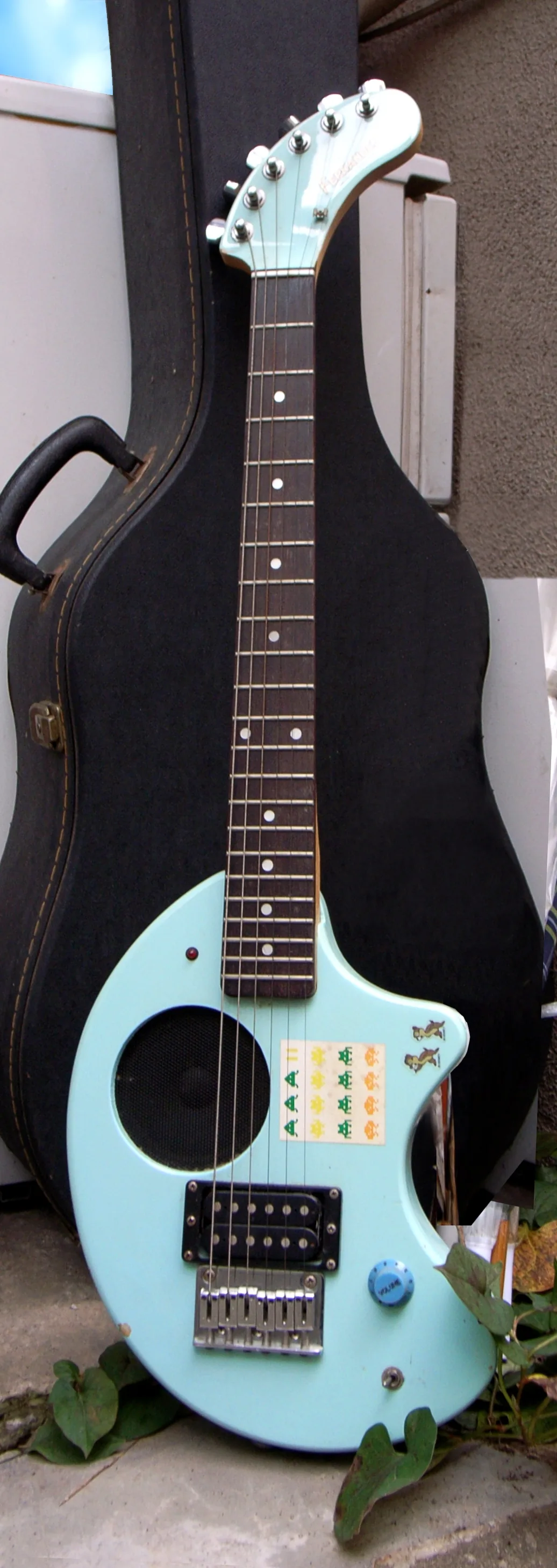
Japan, March 1990. Fernandes puts a small electric guitar on sale that doesn’t need an amp, a cable, or a spare room. Flip the switch and a light comes on where the eye would be. The sound comes out of the ear. The neck is the trunk. It’s an elephant, and it’s plugged into itself.
- Introduced
- 1990
- Type
- Solidbody electric (mini/travel)
- Class
- Production
The short version
1989
Developed
Jun Matsuzaki works up the design at Fernandes.
1990
On sale
The ZO-3 goes on sale in Japan in March, speaker built in.
1992
The designer leaves
Matsuzaki leaves Fernandes and founds his own shop. Fernandes USA opens and sells the ZO-3 as the Nomad.
1995
“Walkabout”
Dave Navarro mics up the tiny speaker for a guitar solo on the Red Hot Chili Peppers’ One Hot Minute.
2001
The ZO-LELE
The elephant becomes a ukulele, briefly.
2022
Matsuzaki dies
The ZO-3’s designer dies on 6 February.
2024
The factory stops
Fernandes halts operations by 11 July. A bankruptcy follows a year later.
Side A
A1
The amp is in the other room
Every guitar player knows this. You’re on the couch, a riff shows up in your head, and the amp is in the other room, and the cable is somewhere, and by the time you’ve found it the riff is gone.
The ZO-3 was built for that couch. In Japan it’s called an ozashiki guitar, a sofa instrument: small enough to take on the train, loud enough through its own speaker that you can write on the living-room floor without plugging into anything. Flip the switch and play.
It isn’t a three-quarter student guitar, and it isn’t one of those travel sticks that still needs an amp. It has the amp. It’s an elephant with the amp in its ear.
A2
Trunk, ear, eye
The name is the shape. Zō is Japanese for elephant. The headstock and neck are the trunk, the round speaker grille is the ear, and the power light is the eye. Once you see it you can’t not see it.
Jun Matsuzaki developed it at Fernandes in 1989, and it went on sale in March 1990. He also designed guitars for Tomoyasu Hotei and hide, two of the biggest names in Japanese rock, but the elephant is the one people remember. When he died in 2022, a Tokyo paper said the ZO-3 was “known as the world’s best-selling guitar.” That’s a reputation, not a sales figure. Fernandes never published one.
Matsuzaki left in 1992 to start his own shop. That same year Fernandes opened an office in Los Angeles, and in export markets the elephant got a new name, the Nomad. Same animal, different badge.
No amp, no cable, no spare room. Flip the switch and play. That was the whole idea.
A3
Not a toy
Pick one up and it’s a real guitar, just a short one. Alder body, bolt-on maple neck, 22 frets, one humbucker at the bridge. The scale is short, in the same neighborhood as a Fender Mustang, though the numbers vary a little depending on whose spec sheet you trust. One American catalog called it “full-scale” in the blurb and gave it a 24-inch scale in the specs, which is a very catalog thing to do.
Inside, a 9-volt battery runs a 5-watt amp and the speaker. There’s a volume knob, a little switch, a headphone jack for late nights, and a regular output jack for when you want a real amp after all. The sound through the ear is small and boxy. Nobody bought one for hi-fi.
Fernandes itself dates back to 1969, and in the West it was better known for copies and for the Sustainer, a pickup that keeps a note ringing forever. The elephant was something else. There’s a sibling with a tremolo and a distortion switch, an acoustic-electric that didn’t last, and a version with built-in effects.
It came in costumes, too: Hello Kitty, Ultraman, Kamen Rider, Star Wars, PaRappa the Rapper, and a run of rock-art graphics. There was a bass version and, in 2001, a ukulele. Early ones were made in Japan. Later ones came from China and the Philippines.
Flip the record · By the numbers
5 W
Output of the amplifier built into the body. Enough to fill a living room.
9 V
One battery runs the amp and the speaker in the elephant’s ear.
1
Humbucker at the bridge on the standard model. One volume knob and a little switch.
22
Frets, on a short neck. A grown-up fret count on a small guitar.
Side B
B1
Ugly on purpose
In 1995 the Red Hot Chili Peppers were making One Hot Minute, with Dave Navarro on guitar. For the solo on “Walkabout,” Navarro wanted something ugly. He grabbed a ZO-3, turned it up, leaned it against a wall, and put a microphone on the tiny speaker.
That’s the sound on the record: a major-label rock album, and a battery-powered elephant playing into a microphone.
David Bowie owned one, a sunburst ZO-3GF Nomad that’s now in the Victoria and Albert Museum’s collection of his things. The date he got it is unknown, and no recording has been pinned on it. And ahead of Tool’s Fear Inoculum, Adam Jones teased riffs from “Descending” on an American-flag ZO-3.
B2
Still switched on
Fernandes stopped operating in July 2024. In July 2025 a Tokyo court opened bankruptcy proceedings. Nobody is making the elephant anymore.
But nobody has to. A ZO-3 doesn’t live in a case in the closet, waiting for a gig. It lives next to the couch. The ones already out there are still leaning against sofas and bookshelves, one battery away from the next riff, which is where they were always supposed to be.
Put this on
You’ve read about it. Now hear it. Here’s what this guitar sounds like, and what to listen for.
Walkabout
Wait for the guitar solo. That’s Dave Navarro on a ZO-3, with a microphone on its own little speaker. He wanted something ugly, and he got it.
Find it on YouTube (opens in a new tab)Dave Navarro plays on the Fernandes ZO-3
Navarro explaining how the “Walkabout” solo was done, speaker and all.
Watch it on YouTube (opens in a new tab)
The cast
The people, and the specific guitars, that made the legend.
1989
Jun Matsuzaki
Designer
Developed the ZO-3 at Fernandes, along with artist guitars for Tomoyasu Hotei and hide. Left in 1992 and started Zodiac Works.
1995
Dave Navarro
ZO-3 / Nomad
Miked up the onboard speaker for the guitar solo on “Walkabout.” His signature guitars are a different story.
David Bowie
Fernandes ZO-3GF Nomad
Owned a sunburst one, now in the Victoria and Albert Museum’s Bowie collection. Date unknown, and a two-pickup variant.
Adam Jones
American-flag ZO-3
Teased riffs from Tool’s “Descending” on one ahead of Fear Inoculum.
Liner notes
Specs, construction, rarity, value, and every source we used.
A speaker in the ear of an elephant-shaped mini — Fernandes’s ZO-3, not a toy and not the bass they called PIE-ZO.
- Body
- Alder mini solidbody, elephant silhouette. Last-run factory cards: 55 mm. Musician’s Friend Nomad: 2.5" (6.35 cm) deep. Mix flagged.
- Neck
- Bolt-on maple; six-in-line headstock (the trunk)
- Fingerboard
- Last-run factory: laurel, 22 frets. Blue Book / Musician’s Friend Nomad: rosewood, dots. Some maple. Mix flagged.
- Scale
- Factory / Ikebe / ARMA BIANCA: 609 mm, labeled short scale. Blue Book, Reverb, Musician’s Friend: 24". Mix flagged.
- Pickups
- One humbucker at the bridge (typical Standard)
- Hardware
- Fixed string-through or adjustable hardtail; six-on-a-side die-cast tuners (Gotoh on named examples). 芸達者 (Geidatsha): FER-ST-PT two-point tremolo — not this table.
- Electronics
- Master volume; mini-switch (power, or distortion-select on Geidatsha); ¼" amp jack; headphone mini-jack; onboard 5 W amp, 9 V battery; speaker in the “ear”; power LED as the eye
- Finish
- Solid colors typical. Character, flag, and Art Rock graphics exist.
- Nut
- Unpublished on Japanese factory cards. Musician’s Friend Nomad: composite 1-5/8". Dealer measures run 40–42.2 mm / 1.64–1.67". Mix flagged.
Open the full research fileConstruction details, the complete player record, production numbers, dated value estimates, and sources
Classic living example = Japanese ZO-3 Standard (alder, 609 mm, one humbucker, 5 W speaker in the ear). No current typical ZO-3 SKU this pass: Fernandes stopped work 11 July 2024 and the Tokyo District Court opened bankruptcy 9 July 2025 (Guitar World / Tokyo Shoko Research). Nomad is the export name, not a second encyclopedia object. ZO-3 BASS / PIE-ZO is a bass. ZO-LELE is a ukulele. ZO-3A is a short-lived acoustic-electric. DIGI-ZO / Nomad Deluxe carry onboard effects. 芸達者 is the tremolo/distortion sibling. Mixed inch/mm flagged on factory 609 mm / 55 mm against Blue Book 24" and Musician’s Friend 24" / 2.5" / 1-5/8" / 4" speaker. Blue Book speaker 3.5 in. Mix flagged. Do not convert. Do not average 24" / 24¼" / 608 mm / 610 mm / 615 mm.
Construction
The job was an electric you could play without an amp in the room. Small enough to take on the train. Loud enough, through its own speaker, to write a riff on the floor. Wikipedia’s ZO-3 page calls it an お座敷 guitar — a sofa instrument, not a student ¾-scale and not a travel stick that still needs a plug.
The name is the silhouette. Zō-san: elephant. Wikipedia: headstock and neck are the trunk, the speaker grille is the ear, the power lamp is the eye. Export markets got Nomad. Same animal, other badge.
Jun Matsuzaki developed it while he was still at Fernandes. Tokyo Sports (8 February 2022, on his death): he developed Tomoyasu Hotei’s G-pattern Tele, hide’s Mockingbird-type signatures, and the ZO-3 — “known as the world’s best-selling guitar.” That is a claim, not a factory census. He left in 1992 and founded Zodiac Works. Those later Hotei and GLAY instruments are another shop. This plate is the elephant he left behind.
Fernandes itself is older than the elephant. Saito Musical Instruments, February 1969. Fernandes Co. Ltd., October 1972 (Japanese Wikipedia company page). Fender-style copies under Fernandes; Gibson-style under Burny. The Sustainer is the other thing the West remembers. It is not this guitar. Do not hang Steve Vai, The Edge, or a hide Mockingbird on this slug.
1989: developed in Japan (Wikipedia ZO-3, citing Tokyo Sports). March 1990: on sale — Japanese Wikipedia’s company page: elephant-shaped, speaker built in. Blue Book dates the ZO-3 Travel Guitar / Nomad Standard 1993–2004. Reverb’s product card prints 1993–2024. Just Guitars Australia: “producing various Zo-3 models since 1993.” Keep 1989, 1990, and 1993. This plate starts in 1990. Fernandes USA opened in Los Angeles in 1992 (English Wikipedia); Nomad is that office’s name for the same mini.
What you get is a short-scale solidbody with the amp already in it. Factory cards (Ikebe, ARMA BIANCA, late Fernandes copy): alder body 55 mm, bolt-on maple, 609 mm, 22 frets, one humbucker, one volume, a two-way mini-switch, ¼" out, headphone mini-jack, 5 W from a 9 V. Wikipedia’s ZO-3 page puts that 609 mm next to a Fender Mustang or Jaguar. Musician’s Friend’s Nomad Standard called it “full-scale” in the brochure and 24" in the spec — short scale with a grown-up fret count, not a 25½" neck stuffed into a toy. Wikipedia: 9 V in the body to play through the speaker; a ¼" jack to a real amp; a headphone mini-jack. Crank the speaker and you are the room.
Not the bass. ZO-3 BASS, earlier PIE-ZO, is four strings on this outline. Hainawa’s is that bass. Off this table. Not ZO-LELE (ukulele, 2001; Ikebe revived it 2021–22). Not ZO-3A (acoustic-electric, 2007, short run). Not DIGI-ZO, and not Blue Book’s Nomad Deluxe (1999–present on that card, onboard effects). Those are the same silhouette with a different board. 芸達者 keeps the elephant and adds a FER-ST-PT tremolo, a distortion mini-switch, and send/return. Shop originals (Ikebe panda, Strat-shaped ZO-3ST, bullseye ZW) are the same family in costume. Character runs — Hello Kitty, Ultraman, Kamen Rider, Star Wars, PaRappa — and the Art Rock graphics stay on this plate, not as second slugs.
Where they were built moved. Early ones are Japan. Dealer copy and a 1993 Reverb listing put later volume in China; David Bowie’s V&A packet is stickered MADE IN PHILIPPINES. Keep the factories. They are not a second model.
The living object ended with the company. Livedoor / TSR: operations posted stopped by 11 July 2024. Guitar World (Janelle Borg, 22 July 2025): Tokyo District Court commenced bankruptcy 9 July 2025; TSR debt about 730 million yen. A trademark sliver reportedly moved; no new ZO-3 cart this pass. Classic vs current: 1990 Japanese Standard — alder, 609 mm, one humbucker, speaker in the ear — against no Fernandes elephant you can order in 2026.
Players
Do not recruit hide’s Mockingbird or Hotei’s TEJ as this guitar. Do not file Hainawa’s ZO-3 bass here. Do not treat a Nomad Deluxe effects quote as a Standard.
Dave Navarro (Red Hot Chili Peppers). Named interview: the ZO-3 / Nomad, onboard speaker mic’d, for the guitar solo on “Walkabout,” One Hot Minute (1995). He wanted something ugly. He turned it up, leaned it on a wall, and let the little speaker do the work. Just Guitars points at that tone. The PRS signatures stay on those plates.
David Bowie. Victoria and Albert Museum: Fernandes ZO-3GF Nomad, sunburst, rosewood dots, inbuilt amp, battery compartment, archive DBG.310. Owned. Date unknown. V&A reads two pickups on that object — a variant, not the one-humbucker table. No session credit pinned here. Unique object. Not a vintage ZO-3.
Also known to play stays short. Equipboard: Adam Jones with an American-flag ZO-3, teasing riffs from “Descending” ahead of Tool’s Fear Inoculum. Manufacturer Nomad copy quoting Jones on writing, practice, and warmup names built-in FX — that line is Deluxe copy, not this table. Wikipedia lists hide and Hotei among ZO-3 artist-model names; those are catalog graphics, not named stage instruments in-hand.
Rarity
You cannot buy a new ZO-3 from Fernandes. The factory stopped. Living Fernandes-branded pages are archives. They are not a 1990 cart.
Fernandes did not publish ZO-3 unit totals. None invented. Tokyo Sports’ “world’s best-selling guitar” is a reputation, not a shipping book. Wikipedia’s 35万頭 as of 2018 is Wikipedia, cited to that Tokyo Sports obituary, which does not print the number. Do not rest a census on it. Serials date a guitar. They don’t count a year.
What is actually thinner: first-run Japanese Standards; Nomad Custom flags (Blue Book 1994–99); Blue Book’s Nomad Tremolo (2005 only) and Star Wars (2003 only); Art Rock and character graphics dealers treat as small runs. A Reverb PaRappa listing repeats “only around 2000” — attributed dealer copy, not a factory total. Navarro’s mic’d Standard and Bowie’s V&A ZO-3GF are unique objects. They are not a vintage ZO-3.
Value
Informal estimate, 21 September 2026. Not an appraisal.
Ask vs sold labeled. Celebrity lots are not-comps. No invented medians or factory counts. Reverb Price Guide exists on ZO-3 / Nomad Standard (years 1993–2024); the dollar widget did not print a clean band in the static fetch this pass. Flag: thin sold-comp access.
New street. None under ZO-3 this pass. Fernandes cart is dead. Historical last-run lists, not a 2026 street: MUSIC PLANT ZO-3芸達者 '24 ¥62,700 (tax-in; order stopped as of 8 August 2026). Ikebe shop originals 2022: ¥54,780 / ¥58,080 tax-in. ARMA BIANCA K-On! collab ¥66,000 tax-in (2023 order / 2024 ship). Musician’s Friend Nomad Standard page: discontinued; snapshot list $299.00. Those are old tickets. They are not this table’s guitar at a current register.
Used modern. Plain-color Standards trade used. Named asks this pass, not hammers: Reverb 1990s black Very Good $199; Nomad with gig bag Very Good $285. Don’t invent a midpoint. Don’t average those asks.
Vintage / collectible. A 1990 Japanese Standard is not pre-CBS money. Graphics are the other band. Named asks, not a series: Art Rock Kashmir Jimmy Page $1,026; Just Guitars three-guitar consignment (Yoda / Hello Kitty / Jamaican Beat) AUD $6,200. Bowie’s V&A ZO-3GF is one object. Not a comp.
See also
- fender-mustang — the 24-inch / 609 mm short-scale this mini is built around, not an elephant
- silvertone-1448 — amp-in-the-case travel; Danelectro masonite, not a speaker in the ear
- vox-phantom — Vox’s Mark V Mini is a ¾-scale pentagon on this job, not a ZO-3
Sources
- Wikipedia, フェルナンデス・ZO-3 — 1989 development; 1990 sale; Nomad export name; 609 mm; 22 frets; alder; laurel (some maple); humbucker; 9 V / headphone / ¼" jack; ZO-LELE 2001 / 2022; ZO-3A 2007; PIE-ZO bass; Geidatsha / DIGI-ZO; 2018 Wikipedia “35万頭” (cited to Tokyo Sports, which does not print the figure); production through 2024
- Wikipedia, フェルナンデス (楽器メーカー) — Saito Feb 1969; Fernandes Oct 1972; ZO-3 March 1990; stop by 11 July 2024; Tokyo District Court 9 July 2025; ~¥730 million
- Wikipedia, Fernandes Guitars — company 1969–2024; USA office 1992; Custom Shop 1996–2014; cease 11 July 2024; ZO-3 photograph; Sustainer is the other product
- Tokyo Sports, 松崎淳, 8 February 2022 — Matsuzaki developed ZO-3, Hotei G-pattern, hide models at Fernandes; Zodiac Works 1992; “world’s best-selling guitar” claim; died 6 February 2022
- Guitar World, Janelle Borg, 22 July 2025 — operations ceased July 2024; bankruptcy commencement 9 July 2025; TSR ~¥730 million / ~60 creditors; FY Jan 2022 sales ¥166.08 million
- Blue Book, Fernandes ZO Travel/Nomad Series — standing elephant; battery amp; Nomad Standard 24" / 22-fret rosewood / 3.5 in. speaker / mfg. 1993–2004; Custom 1994–99; Deluxe 1999–present; Tremolo 2005 only; Star Wars 2003 only
- Musician’s Friend, Nomad Standard — discontinued; 24" / 22 / rosewood / 16" radius / 1-5/8" composite nut / 5 W / 4" speaker / alder / maple bolt-on; 34.5" × 10.5" × 2.5"; 6.5 lb; list snapshot $299
- Reverb, Fernandes ZO-3 / Nomad Standard — years 1993–2024; 24"; H; string-through; 22 frets; Price Guide widget present, dollar band not printed this pass
- ARMA BIANCA, けいおん! ZO-3 — factory card: 609 mm short scale, 22F, laurel, alder 55 mm, 1 volume / 2-way mini-SW, amp jack + headphone; ¥66,000 tax-in
- Ikebe, ZO-3 Ikebe originals, 21 October 2022 — 609 mm, 22F, FER-ST-PT, 5 W, distortion mini-SW, send/return; ¥54,780 / ¥58,080 tax-in
- Ikebe, ZO-LELE revival — ZO-LELE short 2001 run; upgraded revival announced 30 December 2021
- MUSIC PLANT, ZO-3芸達者 '24 — alder 55 mm, maple neck/board, 609 mm, humbucker, FER-ST-PT, ¥62,700 tax-in; order stopped 8 August 2026
- V&A, Fernandes ZO-3GF (Bowie) — owned; sunburst; 86.5 × 24.5 × 6.3 cm; rosewood dots; inbuilt amp; DBG.310; ZO-3GF; packet stickered MADE IN PHILIPPINES
- YouTube, Dave Navarro plays on the Fernandes ZO-3 — Walkabout solo; mic on the onboard speaker; Nomad = export name
- Equipboard, Fernandes ZO-3 — Navarro Walkabout; Jones American-flag ZO-3 teasing “Descending”
- Just Guitars Australia, ZO-3 mini-collection — “since 1993”; 5 W practice concept; Nomad vs Japanese ZO-3; Navarro speaker-mic; AUD $6,200 three-guitar ask
- Reverb, 1993 MIJ ZO-3 — early Japan, later China in dealer copy
- Reverb, PaRappa Nomad — dealer “around 2000” made; 609 mm / 22 / 42 mm nut; China
- Reverb, ZO-3 90s Black — ask $199 this pass
- Reverb, ZO-3 Nomad with gigbag — ask $285 this pass
- Reverb, Art Rock Kashmir — ask $1,026 this pass
Keep digging
Guitars this one gets compared to, confused with, or descended from.
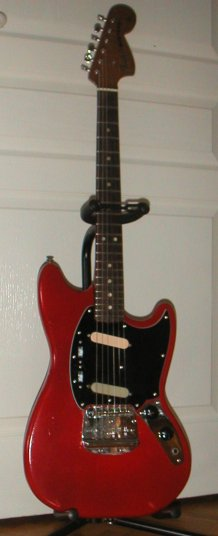
Photograph of a Fender Mustang of 1968. Photo by Alban Dericbourg. Licensed under CC BY-SA 3.0. Via Wikimedia Commons. Fender
Mustang
1964
Fender’s 1964 student guitar. It was built to be outgrown, and a lot of people never bothered.
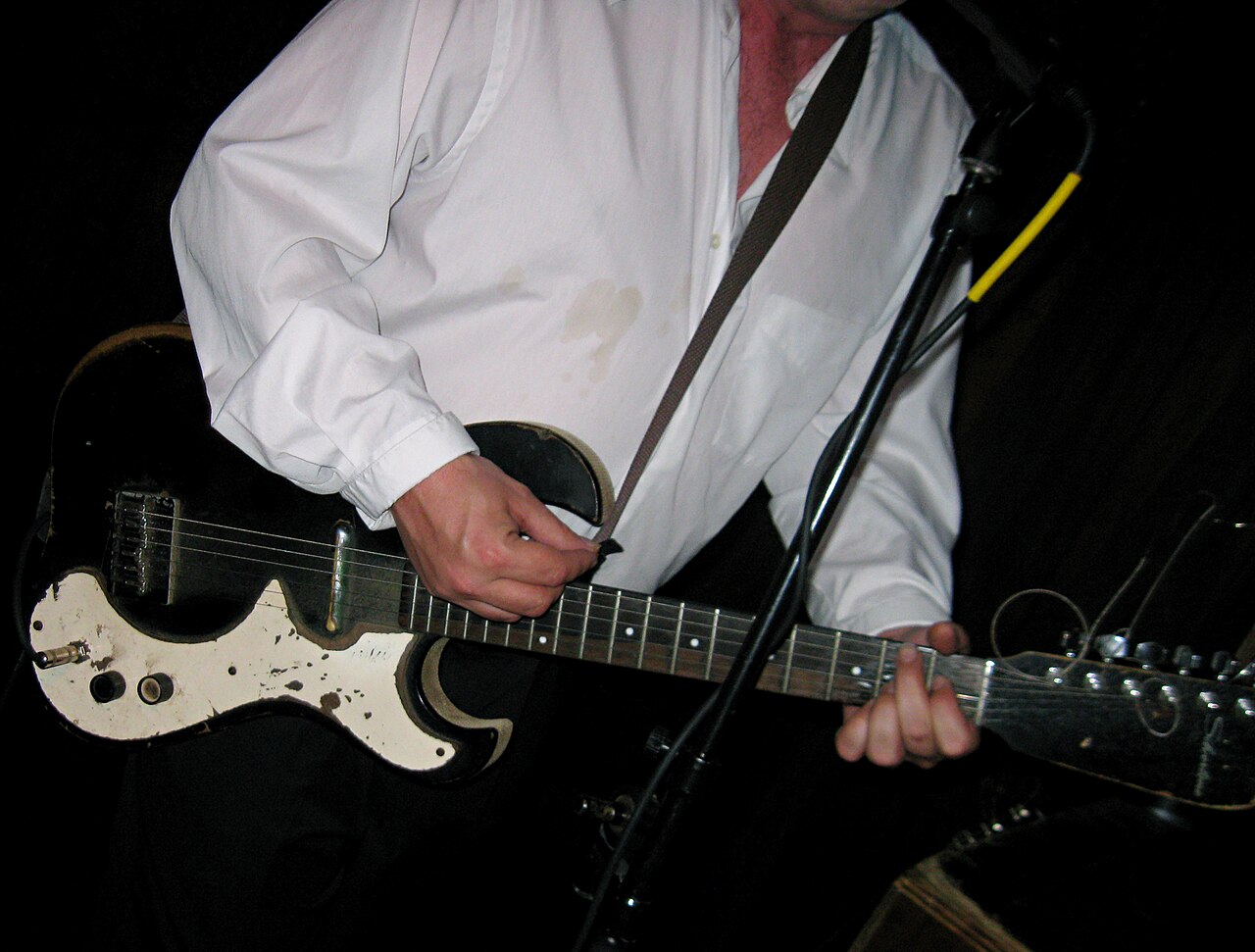
Photo: Rick Hall / Wikimedia Commons / CC BY 2.0 Silvertone
1448
1962
A beginner’s electric from the Sears catalog, with the amp in the case. Beck has played one his whole career.
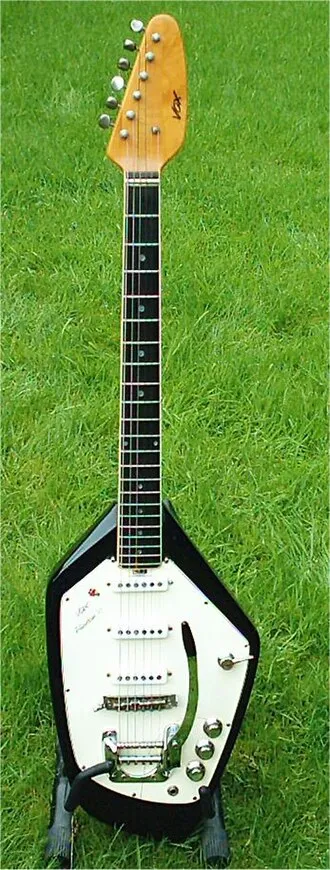
Photo: LittleRoughRhinestone / Wikimedia Commons / Public domain Vox
Phantom
1962
No Fenders in Britain, so Vox built a Strat in a five-sided coat you could spot from the back of the hall.