Silvertone
1448
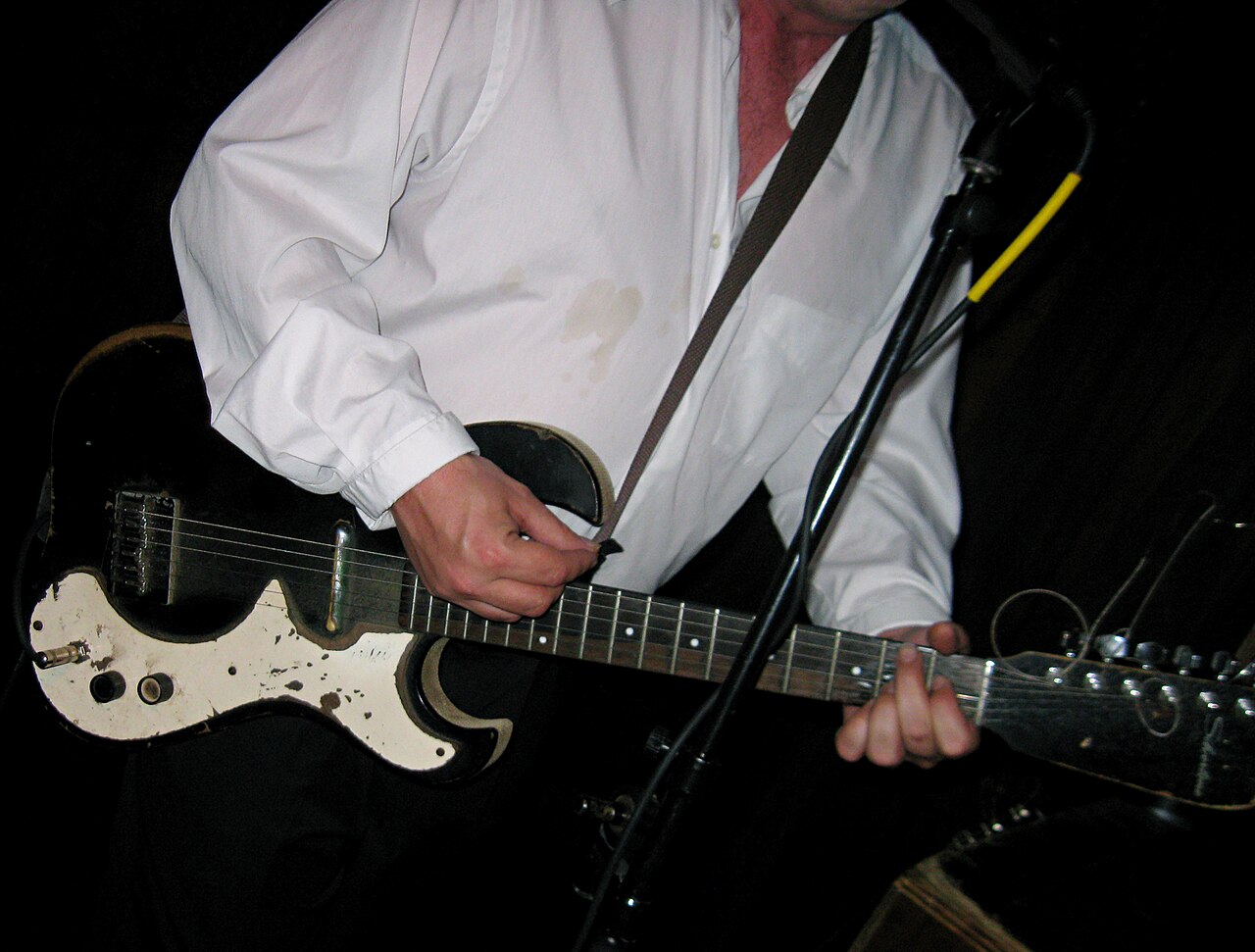
A beginner’s electric from the Sears catalog, with the amp in the case. Beck has played one his whole career.
Open the Sears catalog in the early 1960s and there it is: a black sparkle electric guitar, a case with a little tube amplifier built into the lid, and a record to teach you how to play. $67.95 for the lot. Unfold the case, plug in, and you’re in a band.
- Introduced
- 1962
- Type
- Solidbody electric
- Class
- Production
The short version
1956
The Danelectro method
Nathan Daniel’s factory starts building guitars from masonite over a stapled wooden frame.
1962
In the catalog
The 1448 outfit appears in the Fall/Winter Sears book at $67.95, amp in the case.
1963
A two-pickup sibling
The 1449 joins it. This one stays at one pickup.
1966
Out of the book
Gone somewhere between late 1965 and early ’67, depending on which catalog pages you trust. The 1451 takes over.
1990
Letterman
Dex Romweber plays one on national television with Flat Duo Jets.
2019
“Particle board”
Beck tells the New York Times he’s made so many of his albums on one.
Side A
A1
Everything in one box
Most guitars are sold as the thing you want. The Silvertone 1448 was sold as the thing you start with. It was built to be outgrown.
Joe Fisher was Sears’ instrument buyer. The catalog already had a cheap Harmony acoustic for beginners, and Fisher wanted an electric that could sit right next to it. He took the idea to Nathan Daniel at Danelectro, in New Jersey. Daniel built the guitar. The amplifier went into the case.
That’s the whole trick, and it’s a great one. Guitar in one half of the case, amp in the other. Open it up, stand the lid on end, plug in, and play. Fisher called it an “exclusive innovation” in his memoir, and remembered selling it for $49.95. The Fall/Winter 1962 catalog lists the outfit at $67.95. Memories and catalogs don’t always agree.
A2
Masonite, staples, and lipstick
This is not a Les Paul. Danelectro had a cheap, clever method, and the 1448 is that method on a short little double-cut. A wooden frame, stapled together, with masonite on the top and back. Masonite is hardboard, the stuff you’d find on the back of a cabinet. Vinyl covered the unpainted sides. The finish was black sparkle you can feel with your fingertips.
The single pickup sits in a metal tube. Nat Daniel bought surplus tubes from a cosmetics maker, so the pickup cover on a 1448 is, more or less, a lipstick case. It sounds bright, clear, and a little glassy. One volume and one tone knob, both on a white pickguard. The scale is short, somewhere around 22½ to 23½ inches depending on whose guitar got measured, so it’s easy on small hands.
The amp in the case made about three watts, from two tubes and a rectifier into a speaker of five or six inches, depending on the year and who you ask. Crank a little amp like that and it breaks up fast, which is either a flaw or the whole point, depending on who’s playing. The 1964 copy says the outfit came with a record for beginners, and shipped at 23 pounds.
The pickup cover on a 1448 is, more or less, a lipstick case. That’s the kind of guitar this is.
A3
Four years in the book
It wasn’t around long. The 1448 shows up in the catalog in late 1962 and runs to somewhere between late 1965 and early 1967, depending on who’s counting. By 1967 Sears had an all-new amp-in-case outfit.
Along the way Danelectro kept making small running changes: tuners, the neck joint, the speaker size. A two-pickup version, the 1449, came along in 1963. The one-pickup black sparkle guitar is the 1448, and that’s the one people mean.
Flip the record · By the numbers
$67.95
Catalog price for the whole outfit in 1962. Sears’ buyer remembered a $49.95 sale price.
3
Watts from the amp in the case. Two tubes and a rectifier, one small speaker.
23
Pounds, shipping weight, for the 1964 outfit. Guitar, amp, case, and a record.
~13
Silvertone 1448s Dex Romweber went through, worn out or stolen, by his own count.
Side B
B1
Not Page’s, not Hendrix’s
Because it was cheap and everywhere, the 1448 gets pinned on a lot of famous people. Most of it is wrong.
Jimmy Page’s Danelectro is a 1961 3021, with two pickups, sold under Danelectro’s own name. It isn’t a Sears guitar. Jimi Hendrix’s early Silvertone, the one called Betty Jean, is a 1956 U-1, years before the 1448 existed. And the plastic guitar Jack White played in the White Stripes is an Airline, from a different catalog altogether.
The legend puts every rock star in the country on a Sears guitar. The paperwork list is shorter, and more interesting.
B2
The man with thirteen of them
Dex Romweber played almost nothing but 1448s on stage from the last years of his band Flat Duo Jets onward. By his own count he went through about thirteen. Some wore out. Some got stolen, in New Orleans and in Austin. His first came from Pete Gamble.
Flat Duo Jets were a two-piece, and Dex made a Sears beginner’s guitar and a Conn amp sound like a much bigger band on In Stereo. In 1990 he played one on Late Night with David Letterman. And the guitar on “Lonesome Train”? “A 1448 Silvertone.”
Dex died in 2024. The guitar he loved is still the one from the catalog.
B3
Particle board and a whole career
In 2019 Beck talked to the New York Times about his favorite things, and one of them was a Silvertone 1448. He thinks he paid about $60 for it.
“It’s a cheap guitar from the Sears catalog, basically made out of particle board,” he said. Then: “I’ve recorded so many of my albums with it. I’ve been playing it my entire career.”
Mac DeMarco and Cat Power have been seen with them on stage too. None of these people needed a beginner’s guitar. Sears sold the 1448 as a place to start. For a few people, it turned out to be where they were headed all along.
Put this on
You’ve read about it. Now hear it. Here’s what this guitar sounds like, and what to listen for.
Flat Duo Jets on Late Night with David Letterman
Dex Romweber on national television with a 1448, the Sears guitar he played more than anything else.
Watch it on YouTube (opens in a new tab)In Stereo
Dex’s 1448 plugged into a Conn amp. Two people making a racket that sounds like a lot more than two people.
Find it on YouTube (opens in a new tab)Lonesome Train
The guitar on this one is “a 1448 Silvertone,” in so many words. Listen for how big one little lipstick pickup can sound.
Find it on YouTube (opens in a new tab)
The cast
The people, and the specific guitars, that made the legend.
2019
Beck
Silvertone 1448
Paid about $60 for it, he thinks, and says he’s recorded so many of his albums with it.
1990
Dexter Romweber
A long line of 1448s
Played about thirteen of them over the years, including on Letterman with Flat Duo Jets. He died in 2024.
1962
Joe Fisher
Sears’ instrument buyer
Asked Danelectro for a beginner electric that could sit in the catalog next to a cheap acoustic.
1962
Nathan Daniel
Builder
Danelectro’s founder. He built the guitar, and bought surplus lipstick tubes for the pickups.
1961
Jimmy Page
Not this one
Page’s Danelectro is a 1961 two-pickup 3021. Different guitar, different badge.
1956
Jimi Hendrix
Not this one either
Hendrix’s early Silvertone, Betty Jean, is a 1956 U-1, not a 1448.
Liner notes
Specs, construction, rarity, value, and every source we used.
One lipstick, masonite, and a tube amp in the case — Sears’ Silvertone 1448, not Danelectro’s two-lipstick ’59.
- Body
- Double-cut masonite over a poplar or pine frame; vinyl sides; black sparkle typical. Semi-hollow with a solid center (Sears: “solid-center-body”).
- Neck
- Bolt-on. guitarhq: poplar, 1956–69 Dano method. RetroFret / Chicago Music Exchange: maple on measured 1448s. Mix flagged.
- Fingerboard
- Brazilian rosewood, 18 frets, dots (1964 Sears catalog, VintageSilvertones)
- Scale
- 23½" (597 mm) on RetroFret’s 1965. Mix flagged.
- Pickups
- One lipstick-tube single-coil
- Hardware
- Chrome plate bridge with rosewood saddle; aluminum nut; six-in-line paddle head. Early strip tuners; later “skate key” metal buttons.
- Electronics
- Volume and tone on a white masonite pickguard; jack on the guard
- Finish
- Black sparkle / black metalflake. Silver-color accents in the Sears copy.
- Nut
- 1⅝" (41 mm) RetroFret. Mix flagged.
Open the full research fileConstruction details, the complete player record, production numbers, dated value estimates, and sources
Classic living example = 1962–66 Sears 1448 (Danelectro, Neptune, N.J.), sold as catalog stock 57H1448L / 57A1448L with the amp-in-case. No current typical 1448 SKU this pass. Evets’ 2008 Dano ’63 is a Danelectro reissue without the amp-in-case — not this table. 1449 / 1457 are two-lipstick siblings. 1451 is the later amp-in-case. danelectro-59 is the two-lipstick shorthorn. No Gibson SKU. Mixed inch/mm flagged on RetroFret’s measured guitar (overall 35¼" (89.5 cm), lower bout 13" (33 cm), depth 1⅝" (4.1 cm), scale 23½" (597 mm), nut 1⅝" (41 mm)). Sears 1964: guitar about 34×13×2 inches; case about 37×15×3. Luthiery Laboratories prints 22.5" scale on another example. Do not average them.
Construction
The job was a complete electric a kid could order from Sears. Guitar in one half of the case. Amp in the other. Plug in, stand the lid up, play. Joe Fisher, Sears’ instrument buyer, asked Nathan Daniel at Danelectro for a beginner electric that could sit next to Harmony’s cheap acoustic 605. Daniel built the guitar. The amp lived in the case. Fisher’s memoir, excerpted on Silvertone World, calls it an “exclusive innovation” and remembers a sale price of $49.95. The Fall/Winter 1962 Sears book lists the outfit at $67.95 as 57H1448L. Keep both. This plate starts in 1962.
Tony Bacon, quoted on the danguitars Silvertone archive: the single-pickup amp-in-case guitars “debuted in 1962.” Same passage: by 1962 the only Danelectro guitar Sears still offered was “a single-pickup short-horn in black metalflake.” Silvertone World dates the guitar late 1962, retired 1966 / early ’67, replaced by the 1451. The amp page on the same site retires the 1448 outfit Fall/Winter 1965 as 57A1448L, still $67.95. Catalog scans on the guitar page run through Fall/Winter 1966; Spring/Summer 1967 is already the “all-new” solidbody amp-in-case. Keep the range.
What you get is Danelectro’s cheap method, not a Les Paul and not a Strat. guitarhq: from fall 1956, a poplar (or pine) frame, stapled, ⅜" masonite top and back, vinyl on the unpainted sides, lipstick tubes in the masonite. The 1448 is that construction on a short double-cut with curling horns and a paddle head. One lipstick. Volume and tone. A white masonite guard. Black sparkle you can feel on the finish (Luthiery Laboratories). Sears 1964 copy, via VintageSilvertones: “glistening black” with silver-color accents, 18-fret Brazilian rosewood, separate tone and volume, a 5-in. speaker in the case, two tubes plus rectifier, a beginner’s record, shipping weight 23 pounds as 57 X 1448L.
Not Danelectro’s ’59 (danelectro-59). That plate is the two-lipstick shorthorn 3021 family. This is Sears’ one-lipstick amp-in-case. Same lipstick idea — Fisher: Nat bought surplus tubes from a cosmetics maker — different guitar, different badge, different job. Not the 1449. Silvertone World: two-pickup sibling, Fall/Winter 1963. guitarhq dates a two-pickup amp-in-case 1457 to fall 1963; Silvertone World puts the redburst 1457 in Fall/Winter 1964, after the 1449 drops. Keep both. This table is one pickup, black sparkle. guitarhq’s “famous red sunburst” line on the 1448 is the mash; Bacon and the Sears copy are black metalflake. Not the 1451 or 1452. Not Page’s 1961 3021 — that lives on the ’59 plate. No Gibson SKU.
The amp is the other half of the object. Wikipedia’s Amp-in-case page: 3 watts, two tubes plus rectifier, 5-inch speaker, gain. guitarhq prints a 6" speaker on the 1448 from the start. guitar-list: 5" in 1962–63, 6" from 1964, plastic tuner buttons to metal in the same pass. Silvertone World’s photo captions: early two-screw neck, no tilt; later three-screw with neck tilt; triangular neck plate at the very end. Do not flatten those running changes into one SKU year.
Classic vs current: 1962–66 Sears 1448 — masonite, one lipstick, amp in the lid — against no new 1448 you can order from Silvertone in 2026. The Dano ’63 is a later Danelectro, longer scale, no case amp.
Players
Do not recruit Jimmy Page. The Met guitar is a 1961 3021, two lipsticks, on danelectro-59. Do not recruit Hendrix’s Betty Jean — Wikipedia’s Amp-in-case page names that a 1956 Silvertone U-1, not a 1448. Do not recruit Jack White’s Airline Res-O-Glas; White talking about Dex’s cheap Silvertone is a Dex story.
Beck. Guitar World (Richard Bienstock, 3 December 2019), quoting the New York Times (22 November 2019): a Silvertone 1448. “It’s a cheap guitar from the Sears catalog, basically made out of particle board.” He thinks he paid about $60. “I’ve recorded so many of my albums with it. I’ve been playing it my entire career.” Named guitar. Not a year-stamped studio log for each record.
Dexter Romweber. Premier Guitar (Jack Silverman, 14 October 2016): onstage, pretty much nothing but Silvertone 1448s since the last years of Flat Duo Jets; gear list, a 1964 1448; “Lonesome Train” is “a 1448 Silvertone.” Silvertone World interview: “about thirteen” of them — worn out, stolen in New Orleans and Austin. First one from Pete Gamble. Flat Duo Jets’ In Stereo with the 1448 into a Conn amp. The Post and Courier (7 May 2014): Letterman, 1990, on a 1448. He died in 2024. The guitar is still this one.
Also known to play stays short. Wikipedia’s Amp-in-case page names Mac DeMarco, Cat Power, and others on the model live; album-to-guitar credits are unpublished here. None invented.
Rarity
You cannot buy a new 1448 from Sears. The catalog run is closed. Living Silvertone-branded guitars and the Dano ’63 are other factories on related silhouettes. They are not a 1962 amp-in-case.
Danelectro and Sears do not publish 1448 unit totals. None invented. Serials in the neck pocket date a guitar (guitarhq: week / unknown digit / year). They don’t count a year. That is why a first-year census is unknown, not the chapter.
What is actually thinner: early two-screw, strip-tuner, mid-placed-pickup examples Silvertone World calls the first off the line; complete outfits with a working original amp; the short-lived two-pickup 1449. A 1448 without its case is common enough that VintageSilvertones sells the guitar that way. Beck’s and Dex’s guitars are unique objects. They are not a vintage 1448.
Value
Informal estimate, 3 September 2026. Not an appraisal.
Ask vs sold labeled. Celebrity lots are not-comps. No invented medians or factory counts. Period catalog $67.95 (Fall/Winter 1962, Silvertone World) and Fisher’s $49.95 sale memory are 1960s money, not 2026 street. Beck’s “about $60” is what he paid for one guitar.
New street. None. Not a current Silvertone SKU. Dano ’63 is a different cart.
Used modern. There is no modern 1448 production to make a used-modern band. Later Silvertone-branded copies and the Dano ’63 are other guitars.
Vintage / collectible. Reverb Price Guide on 1448 with Case Amp, 1962–1967 black, Good to Mint, 345 orders: $440–$807. Named hammers on that rail: 24 August 2026 Good $600; 24 June 2026 Good $500; 17 June 2026 Good $450; 15 April 2026 Very Good $799.99; 7 March 2026 Very Good $900. Same guide on 1448 guitar (1962–1967 black sparkle), 198 orders: $279–$511. Labeled widget, not a sold median computed here. Named asks, not hammers: Music City Vintage Guitars 1960s with amp case $1,000; The Guitar Colonel 1962 with case amp $1,850. Do not average those asks with the Reverb bands. Dex’s Letterman guitar, if it surfaces, is not a comp.
See also
- danelectro-59 — the two-lipstick shorthorn 3021; same lipstick idea, not the Sears amp-in-case
- fender-mustang — another 1960s short-scale student solidbody; not masonite, not a case amp
- supro-dual-tone — another department-store electric; Valco, not Danelectro-for-Sears
Sources
- Silvertone World, Model 1448 guitar — late 1962 intro; 1966/early ’67 retire; 1451 successor; catalog scan captions FW62 through FW66 / SS67 solidbody; Beck, Dexter Romweber; Fisher/Daniel
- Silvertone World, Model 1448 amp — FW 1962 $67.95 as 57H1448L; FW 1965 retire as 57A1448L still $67.95; 1449 / 1457 siblings
- Silvertone World, Joe Fisher excerpt — Fisher and Daniel; amp-in-case concept
- Silvertone World, Dexter Romweber interview — ~thirteen 1448s; Pete Gamble; In Stereo / Conn amp; organ-like tone
- guitarhq, Danelectro / Silvertone — Daniel 1947; masonite/poplar from fall 1956; lipstick surplus tubes 4.75k; 1448 Fall 1962; 1457 Fall 1963; serial week/year in neck pocket; MCA 1966; plant closed 1969
- Tony Bacon via danguitars Silvertone archive (Wayback) — amp-in-case debut 1962; black metalflake short-horn; 1963 two-pickup; 1967 Jaguar-style shape
- VintageSilvertones, 1448 — 1964 Sears copy: 5-in. speaker, 18-fret Brazilian rosewood, 34×13×2 in., 37×15×3 in. case, 57 X 1448L, 23 lb; measured scale ~23.5"
- Wikipedia, Danelectro Amp-in-case — 1962–68 line; $67.95; 3-watt / 5-inch; 18 frets; 1449 by fall 1963; Dano ’63 2008; Beck, Romweber, DeMarco, Cat Power. Infobox scale 21.0" vs body 18-fret — mix flagged
- RetroFret, 1965 1448 — Neptune; black sparkle; 35¼" (89.5 cm) / 13" (33 cm) / 1⅝" (4.1 cm); scale 23½" (597 mm); nut 1⅝" (41 mm)
- Luthiery Laboratories, 1448 — 22.5" scale on that example; neck tilt; skunk stripe; 1964 catalog $67.95; copper-foil shielding
- Guitar World, Richard Bienstock, 3 December 2019 — Beck, New York Times; Silvertone 1448; ~$60; “I’ve recorded so many of my albums with it”
- New York Times, Beck’s Favorites, 22 November 2019 — named interview behind the Guitar World quote
- Premier Guitar, Jack Silverman, Dex Romweber’s Silvertone Soul, 14 October 2016 — 1448s since Flat Duo Jets; 1964 1448; “Lonesome Train”
- The Post and Courier, 7 May 2014 — 1448 1962–1966; ~$67 at Sears; Letterman 1990
- Reverb Price Guide, 1448 with Case Amp — $440–$807, 345 orders; hammers Aug–Mar 2026 $600 / $500 / $450 / $799.99 / $900
- Reverb Price Guide, 1448 1962–1967 — $279–$511, 198 orders
- Music City Vintage Guitars, 1960s 1448 w/amp case — ask $1,000
- The Guitar Colonel, 1962 1448 with case amp — ask $1,850
Keep digging
Guitars this one gets compared to, confused with, or descended from.
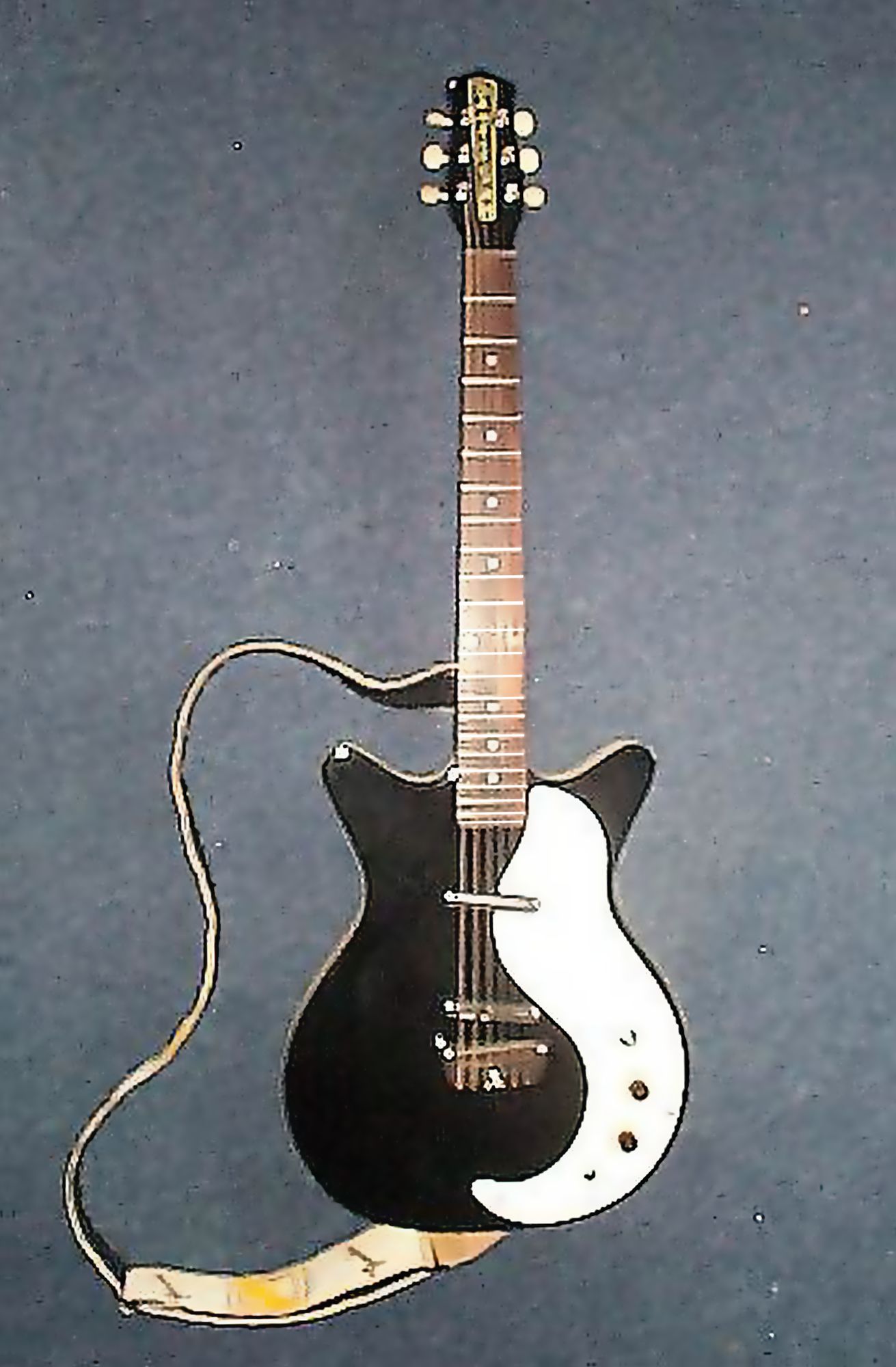
Danelectro 59-DC. Photo by Sander van Malssen. Licensed under CC BY-SA 2.0. Via Wikimedia Commons. Danelectro
59
1958
Jimmy Page’s has been shown at the Met. The same two lipsticks and coke-bottle head are hanging on a shop wall near you.
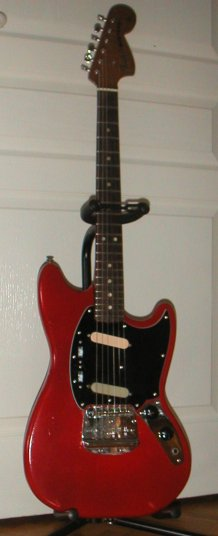
Photograph of a Fender Mustang of 1968. Photo by Alban Dericbourg. Licensed under CC BY-SA 3.0. Via Wikimedia Commons. Fender
Mustang
1964
Fender’s 1964 student guitar. It was built to be outgrown, and a lot of people never bothered.
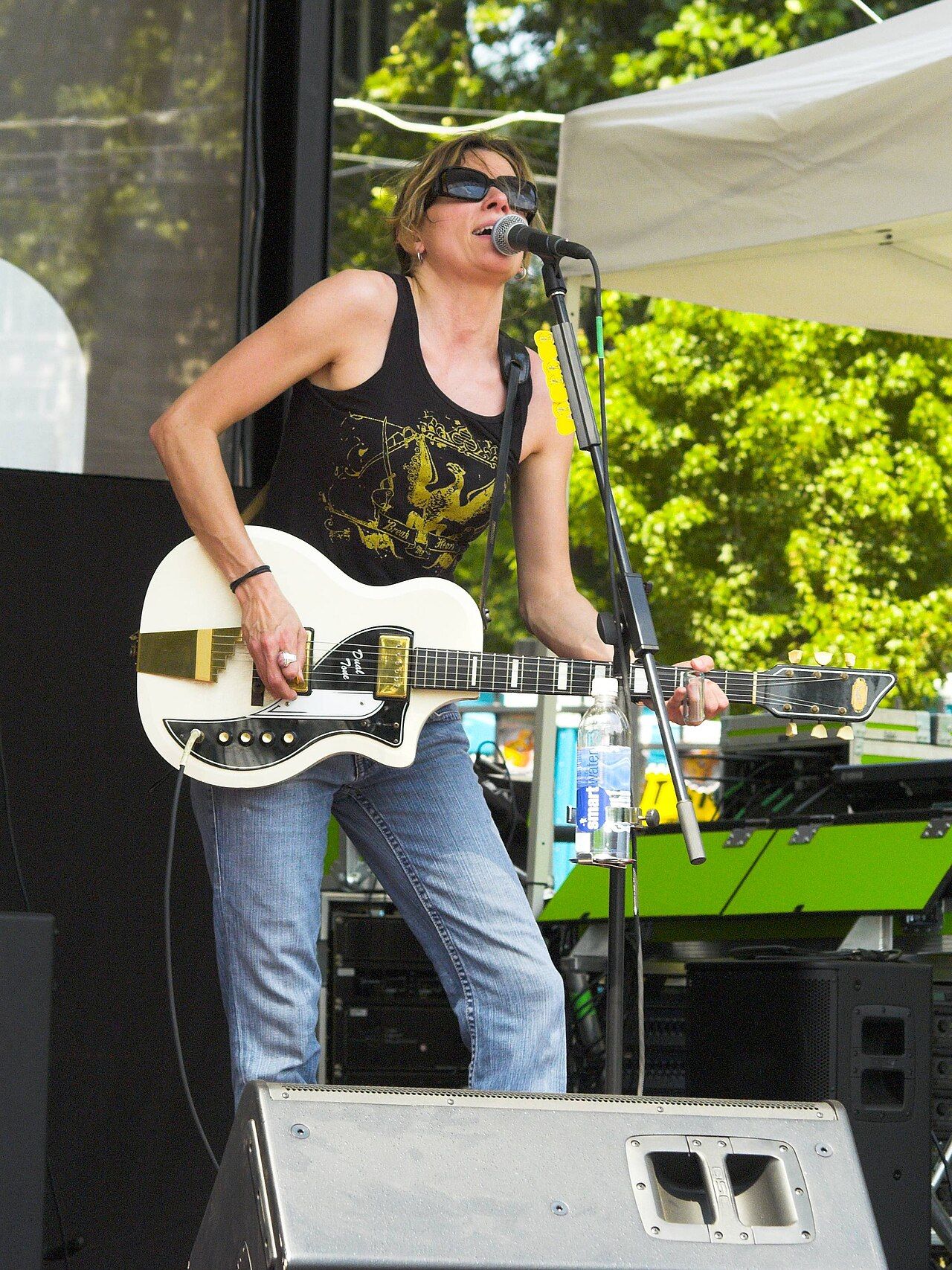
Photo: Tim from Atlanta, USA / Wikimedia Commons / CC BY 2.0 Supro
Dual Tone
1954
Link Wray posed with one for Rumble. Bowie found two on eBay. James Murphy bought his because Bowie said so.