Music Man
Axis
They copied the neck off Eddie Van Halen’s worn-out Kramer. Then Eddie left, and the guitar stayed.
1990. Sterling Ball is looking at a photo of Eddie Van Halen in his studio, 5150, with packs of strings on the floor. First, strings. Then a guitar, with a neck copied from the one Eddie had played until the wood wore down.
- Introduced
- 1991
- Type
- Solidbody electric
- Class
- Production
The short version
1990
The photo
Sterling Ball sees Eddie at 5150. Music Man later dates the guitar’s debut to this year.
1991
The Edward Van Halen
Production begins. Eddie takes his new Music Man into For Unlawful Carnal Knowledge.
1995
Eddie leaves
He goes to Peavey. Music Man keeps the shape and files off the name.
1996
The Axis
The guitar debuts under its new name, in translucent finishes.
1997
Old Gray
Stephen Egerton of the Descendents gets his first Music Man.
2016
Still on record
Old Gray is on the Descendents’ Hypercaffium Spazzinate.
2021
Roasted
Roasted maple and stainless frets come to the Axis line.
Side A
A1
The neck that wore down
By 1990, Eddie Van Halen’s Kramer years were ending, and he wanted off the Strat outline. He also had a neck he loved: the one on his Kramer, worn down from years of playing.
Around then, Sterling Ball of Music Man saw a photo of Eddie in his studio, 5150, with packs of strings on the floor. The strings came first. The guitar came after.
They copied that neck. Eddie, to Guitarist in 1993:
We exactly copied the neck on my Kramer, which is worn down because I played it for years.
Think about that. The feel under your hand on this guitar started as the feel of one man’s guitar after years of him playing it.
A2
Eighty percent Eddie
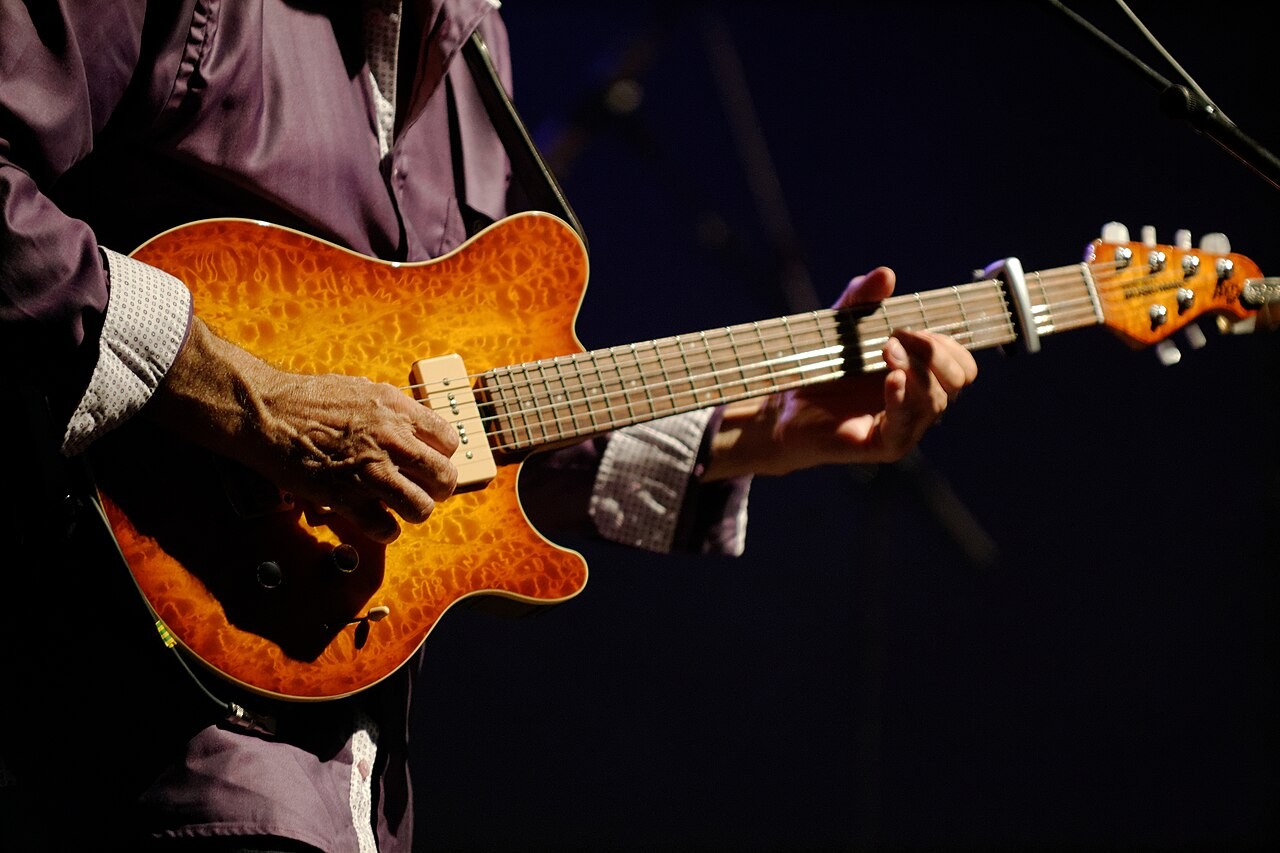
Eddie put the body at “probably 80 per cent my idea and 20 per cent theirs,” meaning Ball and Dudley Gimpel. What they built is a compact single-cutaway: basswood with a figured maple cap, two DiMarzio humbuckers screwed straight into the wood, one knob, and a locking tremolo that only goes down. You can dive-bomb it. You can’t pull it up.
The pickups are wound differently, neck and bridge, and they’re not interchangeable. “You can’t swap pickups; the back pickup only works in the back,” he said. DiMarzio still keeps those windings for the American-made Axis.
And the one knob? It was the volume. On Eddie’s version, it said Tone. That’s about the most Eddie Van Halen detail imaginable.
A3
“My music man guitar”
It went into production in 1991 as the Edward Van Halen model, though Music Man dates its debut to 1990. That May, in his studio, Eddie told an interviewer, “I used my new guitar, my music man guitar.” He took it into For Unlawful Carnal Knowledge that year and Balance after that. He had other instruments on those sessions too, so not every track is this guitar.
In the live video he’s playing a honey-colored one. He called that one “my special one.”
Flip the record · By the numbers
80%
Eddie’s share of the body design, by his own count. The other 20 went to Sterling Ball and Dudley Gimpel.
1
Knob. It was the volume, but on Eddie’s version it said Tone.
1/32"
How much wider the neck got after Eddie left, so the high E would stop slipping off.
4
Years it wore Eddie’s name before becoming the Axis.
Side B
B1
Filing the name off
In 1995 Eddie left for Peavey. That could have been the end. Plenty of signature guitars die when the signature walks out.
Music Man kept the guitar instead and made a handful of changes. The signature came off the headstock. The pickup switch moved from the top horn to below the knob, and the knob finally said Volume. The body got a belly cut. The neck got 1/32 of an inch wider around the 12th fret, so the high E would stop slipping off the edge. It came out under its new name, the Axis, in translucent finishes, and Music Man counts its debut from 1996.
Sisters followed, like the Super Sport, with a five-way switch and a tone knob. The Axis itself kept its one knob and its dive-only bridge.
The name causes some confusion, so one note. Albert Lee remembers Sterling Ball opening a case on an all-maple guitar “called the Axis at the time.” That one became Lee’s number one, and later his own signature model. Same word, different guitar. And the Wolfgang Eddie played next was a Peavey, and later an EVH. Not this one either.
B2
Old Gray
In 1997 Stephen Egerton of the Descendents got his first Music Man. He talked about it in 2016:
“I’ve been playing Music Man guitars now for coming up on 20 years. I think I got my first one in 1997. I call her Old Gray — she’s a gray Axis and that’s what I used on this last record.”
The record was Hypercaffium Spazzinate. That’s a punk band’s record, nearly twenty years into his Music Man years, and a long way from 5150. Steve Stevens has played an Axis too. So has Adam Levine.
The Axis now comes with a roasted maple neck and stainless frets, and the neck is carved thicker on the bass side and thinner under the treble. But the idea is where it started: a neck shaped by one guitarist’s years of wear.
Eddie wore his Kramer neck down playing it, and Music Man handed that neck to everybody else. Egerton gave his a name and took it into the studio. Old Gray has plenty of wear on it now that Eddie never put there.
Put this on
You’ve read about it. Now hear it. Here’s what this guitar sounds like, and what to listen for.
For Unlawful Carnal Knowledge
The album Eddie made with his new Music Man. He had other guitars in the room too, so hear it as the Music Man’s record, not every note on it.
Find it on YouTube (opens in a new tab)Balance
The last Van Halen album of the Music Man years. Same caution applies.
Find it on YouTube (opens in a new tab)Hypercaffium Spazzinate
Stephen Egerton on Old Gray, his gray Axis. By his own account, it’s the guitar he used on this record.
Find it on YouTube (opens in a new tab)
The cast
The people, and the specific guitars, that made the legend.
1991
Eddie Van Halen
The Music Man EVH
Designed most of the body and had the neck copied from his Kramer. Called his honey-colored one “my special one.”
1990
Sterling Ball
Music Man
Saw the photo, made the deal, and kept the guitar when Eddie left.
1990
Dudley Gimpel
Designer
Part of the 20 percent of the body that wasn’t Eddie’s idea.
1997
Stephen Egerton
“Old Gray,” a gray Axis
Got his first Music Man in 1997. Played Old Gray on the Descendents’ 2016 record.
Steve Stevens
Axis
Music Man lists him among Axis players.
Liner notes
Specs, construction, rarity, value, and every source we used.
Basswood, a figured maple cap, two DiMarzios, and a dive-only Floyd — Music Man’s Axis, Eddie’s guitar after Kramer, not a Silhouette and not a Wolfgang.
- Body
- Basswood, bookmatched figured maple top (flame or quilt), cream bind; 12-5/8" wide, 1-3/4" thick, 36-1/4" long (32.1 cm, 4.5 cm, 92.0 cm). Mix flagged.
- Neck
- Bolt-on roasted maple, asymmetric carve, 5-bolt sculpted joint; gunstock oil and hand-rubbed wax
- Fingerboard
- Figured roasted maple, 10" (25.4 cm) radius, 22 high-profile medium-width stainless. Mix flagged.
- Scale
- 25-1/2" (64.8 cm). Mix flagged.
- Pickups
- HH — two DiMarzio custom humbuckers, body-mounted
- Hardware
- Music Man double-locking tremolo, fine tuners, lowers pitch only; Schaller M6LA pearl buttons; 4+2 headstock 5-7/8" (14.9 cm)
- Electronics
- 500k volume only; 3-way toggle; graphite-acrylic cavity, aluminum-lined control cover
- Finish
- High-gloss polyester (Matcha, Olallieberry) or matte (Honey Pot, Charcoal Cloud)
- Nut
- Locking; 1-5/8" (41.3 mm) at nut, 2-3/16" (55.6 mm) at last fret. Mix flagged.
Open the full research fileConstruction details, the complete player record, production numbers, dated value estimates, and sources
Current typical = hosted Axis (San Luis Obispo; music-man.com, fetched 10 September 2026). Factory mixed inch/mm flagged; no millimetres invented. Factory configurator printed $0.00 this pass. Axis Super Sport (5-way, volume and tone, vintage trem or strings-thru) is a sister, not this table. Axis Sport (ash; buying guide: no longer offered) is discontinued. Axis Super Sport Semi-Hollow is a chambered sister. Axis EX is Japan, not this USA table. Sterling by Music Man Axis is another brand. No Gibson SKU. Silhouette is the 24-fret alder guitar. Wolfgang is Peavey, then EVH.
Construction
After Silhouette, San Luis Obispo still needed a guitar a hard-rock player would put a name on. Kramer was ending. Eddie Van Halen wanted off the Strat outline. What they built is a compact single-cut: basswood, a bookmatched maple cap, two DiMarzios screwed to the wood, one volume, a Floyd that only dives. That is this guitar. It is not the 24-fret alder Silhouette. It is not Peavey’s Wolfgang, and it is not the EVH-brand Wolfgang Corona ships now.
MusicRadar: 1990, Sterling Ball saw a photo of Eddie at 5150 with packs of strings on the floor. Strings first. Then a guitar. Official buying guide (Casey Ball, 16 June 2017): “The Axis made its debut in 1990.” Ernie Ball archive (Wayback, 2007): known as the Edward Van Halen from January 1990 through September 1995. MusicRadar’s timeline and Wikipedia: production 1991–95. Keep 1990 and 1991. This plate starts in 1991.
Eddie, to David Mead (Guitarist, 1993; Guitar World reprint): the body was “probably 80 per cent my idea and 20 per cent theirs” — Sterling and Dudley Gimpel. The neck is a copy of his worn Kramer. “We exactly copied the neck on my Kramer, which is worn down because I played it for years.” Pickups are DiMarzio, two different windings, bolted to the wood. “You can’t swap pickups; the back pickup only works in the back.” One volume. On the EVH it said Tone. DiMarzio still limits those windings to the USA Axis; overseas versions do not get them.
Albert Lee told Guitar World (2 September 2026) that Sterling once opened a case of an all-maple guitar “called the Axis at the time,” and that object became Lee’s number one, later the Albert Lee model. In-house name. Different guitar. Do not hang Lee on this table.
1991. Production of the Edward Van Halen. Basswood, figured maple cap, dual DiMarzios, Floyd, 4+2, five-bolt heel. For Unlawful Carnal Knowledge that June.
1995. Eddie left for Peavey. Gill (Guitar World, 21 October 2024): for the first four years it was the Edward Van Halen signature; the name changed in 1995. MusicRadar: Peavey could meet demand more easily. The Peavey-patented headstock stayed with Peavey. That millimetre card is not this one.
When he left, Music Man kept the shape. Gill’s list, matching the old factory FAQ: signature off the headstock; 3-way moved from the treble horn to below the volume; the knob marked Volume instead of Tone; a belly contour; neck widened 1/32" around the 12th so the high E would stop slipping; locking-trem saddles from offset to non-offset. Factory FAQ still says the Axis trem sits flat and only dives. First- and second-generation Axis/EVH used Gotoh trems; current generation uses Music Man’s own. Do not millimetre-convert that 1/32".
1996. Factory shop, 30th Anniversary Axis: “the translucent finishes that defined its 1996 debut.” Keep 1996 as Axis production under the new letters. The 30th is counting from 1996, not from 1991. A Japanese Axis EX exists. Other factory. Not this table.
1997. Axis Super Sport at NAMM (MusicRadar). Five-way, volume and tone, vintage trem or strings-thru. Buying guide: Axis Sport unveiled in the same window, ash, no maple cap, “no longer offered.” Semi-hollow Super Sport 1999 (MusicRadar). Sisters. Not this table.
2021. Guitar.com, Summer NAMM: roasted figured maple, 22 stainless, Yucatan Blue and Roasted Amber. Quilt list $3,199, flame $2,999 — 2021 money.
The living table is still the dual-humbucker Floyd guitar. Roasted figured maple, stainless 22, Matcha / Honey Pot / Charcoal Cloud / Olallieberry, flame or quilt. Asymmetric neck: thicker on the bass side, thinner under the treble. Direct-mount DiMarzios. One 500k. Dive-only Music Man double-lock. Oil and wax. Classic vs current: 1991 EVH — Tone knob, horn switch, offset saddles, no belly cut — against the hosted Axis, same job, name filed off, roasted maple and stainless on the 2024 line. Not a Silhouette. Not a Wolfgang. No Gibson SKU.
Players
Do not hang a Silhouette, a Peavey Wolfgang, or an EVH-brand Wolfgang on this plate. Do not recruit the Albert Lee model as if it were this guitar.
Eddie Van Halen. The reason the guitar exists. Wikipedia: Ernie Ball / Music Man 1991–95, later renamed Axis. Jas Obrecht, 20 May 1991, 5150: “I used my new guitar, my music man guitar.” Ground Guitar puts that Music Man on For Unlawful Carnal Knowledge (1991) and Balance (1995). He used other instruments on those sessions — Obrecht has a Danelectro six-string bass in the room — so do not flatten every track onto this object. The 1993 Guitarist interview: the honey-coloured one in the live video is “my special one.” Named object. Kramer years are Kramer. Peavey years are Peavey. EVH-brand years are EVH.
Stephen Egerton (Descendents). Premier Guitar, 18 October 2016: “I’ve been playing Music Man guitars now for coming up on 20 years. I think I got my first one in 1997. I call her Old Gray — she’s a gray Axis and that’s what I used on this last record.” Hypercaffium Spazzinate. Official Music Man blog, 12 December 2016, the same guitar. Later he moved to a knobless StingRay guitar. That is a different slug.
Also known to play stays short. Buying guide: Steve Stevens; Adam Levine. No album-to-guitar credits for those two in the sources used here. None invented.
Rarity
You can buy a new Axis tomorrow. Current production. Not rare. Ernie Ball Music Man does not publish Axis unit totals. None invented. Serials date a guitar, they don’t count a factory. That is why a first-year census is unknown, not the chapter.
What is actually thinner: 1991–95 EVH-signed examples, Tone knob and horn switch still on the body. Early Axis with the six post-Eddie changes. Axis EX Japan pieces. The 30th Anniversary is a named limited of this guitar, not a vintage run: factory shop, 120 Gold, 100 Black, 100 Pink, 100 Purple, 100 Blue, 100 Red worldwide. BFR Nitro Axis, limited to 100, is another limited, not a census of the standard. Eddie’s honey-coloured “special one” is unique. It is not a vintage Axis.
Super Sport, Sport, and Semi-Hollow do not make this SKU scarce. Sterling by Music Man Axis is another brand’s guitar.
Value
Informal estimate, 10 September 2026. Not an appraisal.
Ask vs sold labeled. Celebrity lots are not-comps. No invented medians or factory counts. Reverb Price Guide widget on Axis HH Floyd (years 1996–2014) did not print a clean USD band in the static fetch this pass. Flag: thin sold-comp access.
New street. Sweetwater Axis Olallieberry Flame $3,349, in stock this pass (fetched 10 September 2026). Gill, Guitar World, 21 October 2024: $3,199 flame or $3,339 quilt — 2024 review, not this pass. Guitar.com, July 2021: quilt $3,199, flame $2,999 — historical. Factory shop 30th Anniversary Translucent Black $3,799 (SKU 303-30A-11A-00-TB-CR). Super Sport Sweetwater Charcoal Cloud Flame $3,149 is a sister street, labeled adjacent. Do not borrow it as the Axis number.
Used modern. Named ask this pass, not a hammer: 1998 Trans Red flame $2,895 (Imperial Vintage, Reverb). Do not average Super Sport used into an Axis median.
Vintage / collectible. 1991–95 EVH-signed examples are the scarce end of the same guitar, not a separate SKU. Named older ask, not a 2026 hammer: 1991 sunburst EVH $6,299.99 (Mike & Mike’s Guitar Bar, listing ended). Do not treat that as a sold. Axis EX Japan is another market. Eddie’s “special one” is unique. Not a comp.
See also
- music-man-silhouette — SLO’s first Ernie Ball guitar; alder, 24 frets, HSH, not this single-cut
- evh-wolfgang — EVH-brand Wolfgang, after Music Man and Peavey; not this guitar
- kramer-baretta — the Kramer neck this guitar copied; Eddie’s years before Music Man
Sources
- Ernie Ball Music Man: Axis — hosted millimetre table, 10 Sep 2026; basswood/maple cap; 25-1/2" / 64.8 cm; 1-5/8" / 41.3 mm; roasted maple; 22 stainless; DiMarzio HH; dive-only double-lock; mixed inch/mm
- Ernie Ball Music Man: Axis Guitar Buying Guide (Casey Ball, 16 June 2017) — “debut in 1990”; basswood/maple; DiMarzio; Floyd; Super Sport and Semi-Hollow sisters; Steve Stevens, Stephen Egerton, Adam Levine
- Ernie Ball Music Man shop: 30th Anniversary Axis Translucent Black — “1996 debut”; SKU 303-30A-11A-00-TB-CR; $3,799; 120 Gold / 100 each Black, Pink, Purple, Blue, Red
- Ernie Ball Music Man FAQ — Axis trem sits flat, dive only; Gotoh on 1st/2nd-gen Axis/EVH vs current Music Man OEM; RPS-9; Sterling by Music Man is another brand
- Guitar World, Chris Gill, 21 October 2024 — EVH for first four years, name changed 1995; six post-Eddie changes including 1/32" neck widen; $3,199 flame / $3,339 quilt
- Guitar World / Guitarist, David Mead, 1993 — body 80/20 Eddie–Sterling/Gimpel; Kramer neck copy; DiMarzio windings not interchangeable; honey-coloured “special one”
- MusicRadar / Total Guitar, 8 January 2015 — 1990 strings-at-5150 story; 1991 EVH production; 1995 rebrand Axis; Super Sport NAMM 1997; Semi-hollow 1999
- Wikipedia: Eddie Van Halen — lead only: Music Man EVH 1991–95, later Axis; Peavey 1996; EVH brand later
- DiMarzio: What pickups did Eddie Van Halen use? — early-1990s neck and bridge for the Music Man EVH; still limited to USA Axis
- Premier Guitar, 18 October 2016 — Egerton Old Gray, gray Axis, 1997; used on Hypercaffium Spazzinate
- Ernie Ball Music Man: Stephen Egerton — Axis nearly two decades; Hypercaffium Spazzinate
- Guitar.com, Cillian Breathnach, 16 July 2021 — 2021 roasted maple, 22 stainless; quilt $3,199 / flame $2,999
- Sweetwater: Axis Olallieberry Flame — $3,349, 10 Sep 2026
- Reverb: Axis HH Floyd — years 1996–2014; USD Price Guide widget blank this pass; 1998 Trans Red ask $2,895
- Ernie Ball archive (Wayback, 6 February 2007) — Edward Van Halen January 1990 through September 1995, then Axis
- Guitar World, Albert Lee, 2 September 2026 — in-house “Axis” guitar became the Albert Lee model, not this table
- Talking Guitar / Jas Obrecht, 20 May 1991 — “I used my new guitar, my music man guitar”
- Ground Guitar: Eddie Van Halen’s Music Man EVH — F.U.C.K. and Balance
- Reverb / Tony Bacon, “The Wolfgang Saga” — Music Man 1991, Peavey 1996, EVH 2009; other-brand millimetre cards