Klein Electric
1200S
Twelve years of ugly guitars, one talk with Ned Steinberger, and a drawing that took half an hour.
1988, the flight home from Nashville. Steve Klein, the Sonoma acoustic builder, has spent twelve years trying to make an electric that sits on a leg the way a flattop does. Somewhere on that flight he works out what’s been wrong with it: the headstock.
- Introduced
- 1989
- Type
- Solidbody electric
- Class
- Production
Have a photograph of this guitar? Send a picture
The short version
1976–81
Carl Margolis asks
He wants a guitar that’s more comfortable to hold. Klein builds a run of large, strange, very ugly electrics.
1986/87
The M/K
Ronnie Montrose and Klein draw a longer guitar with a lute-like upper half. It has a headstock.
1988
Nashville
Klein and Ned Steinberger finally have time to talk. The drawing takes less than half an hour.
1989
NAMM
The guitar debuts, and the Klein Electric Division starts. Another history dates the introduction to 1988.
1995
Sold
Klein sells the Electric Division to Lorenzo German and stays with acoustics.
1997
Two on the sheet
A Discovery Bay sheet names the DT-96 and the BF-96.
2007
Orders close
By April the website is no longer taking new orders.
2025
Still at the bench
Klein, 75, is making up to eighteen electrics a year in Sonoma, headless ones included.
Side A
A1
Carl Margolis wanted to be comfortable
Starting in 1976, Carl Margolis kept asking Steve Klein for the same thing: a guitar that was more comfortable to hold.
Klein was the acoustic builder in Sonoma. He knew how a flattop settles on your leg, the waist doing the work, the neck landing where your hand already is. An electric doesn’t do that. It sits where the factory decided, and you adjust.
So he built electrics. In his own words, written in 1990, they were a series of large, strange, very ugly guitars. After the fifth one that actually played, he moved the neck’s center line in relation to the waist, the spot where the guitar rests on your leg. That one worked well enough to get a name. David Lindley called it Lumpy.
A2
Ronnie Montrose didn’t want a small one
In 1986 or ’87, Ronnie Montrose and Klein drew a guitar together, the M/K. It was longer, with a lute-like line on the upper half and three tuners a side on a proper headstock. Montrose did not want a compact Lumpy, so he didn’t get one.
That left Klein with two ideas that didn’t fit together. Lumpy sat right. The Montrose lines looked right. And a small body with a full neck and headstock hanging off the end still wants to tip when you stand up.
A3
Half an hour, after twelve years
1988, Gibson’s plant in Nashville. Klein and Ned Steinberger finally had time to talk. On the flight home, Klein saw it. Take the headstock off, put the tuners at the bridge, and Lumpy balances. Lumpy and the Montrose lines could be one guitar.
Back in the shop, the drawing took less than half an hour.
Twelve years for the guitar. Thirty minutes for the drawing.
It debuted at the 1989 NAMM show, the year the Klein Electric Division started. One history dates the introduction to 1988. Depends who you ask.
The outline does the setup for you. The body sets the neck so your fretting hand travels less. The upper bout rests your picking arm, the way an acoustic’s waist does. No weight hangs out past the nut. David Torn’s version: “now my left hand can do what it is paid to do.”
It’s headless, but it isn’t a Steinberger. The Steinberger GL is a one-piece graphite paddle from Newburgh. The catalog Klein is a California body with a one-piece rosewood neck bolted on. Same missing headstock, different job.
Flip the record · By the numbers
12 years
From Carl Margolis’s first request to the finished drawing.
½ hour
How long the drawing itself took, once Klein saw it.
$2,336
List price of a DT-96 on the 1997 sheet. The BF-96 was $2,574.
7.5 lb
A DT-96 on that sheet. The swamp-ash BF-96 was 6.5.
Side B
B1
It out-teles a Tele
Bill Frisell had two. The first was basswood with a rosewood neck. The main one was chambered spruce: a Seymour Duncan JB at the bridge, a Tele pickup at the neck, and a piezo with its own output. The middle slot kept changing. A Bartolini, a lipstick before that, a Strat pickup before that. He called it “the wild card.”
He pointed to that spruce guitar on Kenny Wheeler’s “Angel Song,” and on his own Nashville, which he called “ninety-percent Klein guitar.” With your eyes closed, he said, it “out-teles” an old Tele. That’s the thing to listen for: the snap of a Telecaster out of something shaped like nothing Leo Fender ever drew.
Then it went back for repair, stayed away, and Frisell went back to Fenders.
Henry Kaiser’s is its own object too: a 1992 Klein in solid bubinga, built with him in mind, with a Steinberger TransTrem. Early Kleins don’t all match the catalog anyway. One has an ebony board, one a Steinberger graphite neck, one no truss rod at all.
B2
The Sheraton he’d had since sixteen
The 1997 sheet, printed in Discovery Bay, names two guitars. The DT-96 is basswood or alder with a Seymour Duncan Jazz at the neck and a ’59 at the bridge. The BF-96 is swamp ash, with a third pickup in the middle. Nothing on it says what the letters mean, and nothing on it says 1200S.
By then the guitar wasn’t Klein’s. In 1995 he sold the Electric Division to Lorenzo German and stayed with acoustics. A newspaper account from 2003 calls it a bitter sale to a former partner, with legal maneuverings still pending. Both tellings stand. The electrics moved to Discovery Bay, then Linden, and by April 2007 the website said it was no longer taking new orders.
The sheet also carries Mick Goodrick. He paid for his Klein by selling the Epiphone Sheraton he’d owned since he was sixteen. The sheet prints his line: “It’s mine now...you can’t have it back.”
In January 2025, Steve Klein was 75 and still building in Sonoma, up to eighteen electrics a year, headless ones included. Nearly fifty years after Carl Margolis asked for a guitar that was comfortable to hold, the man he asked is still making them.
Put this on
You’ve read about it. Now hear it. Here’s what this guitar sounds like, and what to listen for.
Nashville
Frisell called it “ninety-percent Klein guitar,” his chambered spruce one with a Tele pickup at the neck. A one-off, not a catalog model. Listen for how much it sounds like a Telecaster.
Find it on YouTube (opens in a new tab)Angel Song
Frisell points to this ECM record as the same spruce Klein.
Find it on YouTube (opens in a new tab)
The cast
The people, and the specific guitars, that made the legend.
Bill Frisell
Chambered spruce Klein, rosewood neck
A JB at the bridge, a Tele pickup at the neck, a piezo, and a middle slot he called “the wild card.” It went back for repair and stayed away, and he went back to Fenders.
David Torn
Klein Electric
Gave the company its best line about the body. No album is pinned to one here.
Mick Goodrick
Klein Electric, paid for with a Sheraton
Sold the Epiphone Sheraton he’d owned since he was 16 to buy it.
Henry Kaiser
1992 solid-bubinga Klein
Built with him in mind, with three Alembic pickups and a Steinberger TransTrem. Not a stock model.
Lou Reed
A comfort blurb, not a song credit
The 1997 sheet prints a line under his name. Stories that put a Klein on “Heroin” have the wrong decade. That record is 1967.
Liner notes
Specs, construction, rarity, value, and every source we used.
A rosewood neck, tuners at the bridge, and a body that aims the fretting hand — Klein’s California solidbody, not Steinberger’s paddle.
- Body
- Basswood or alder (DT-96); black or pearl white. BF-96 is swamp ash, black or gloss white, chambered optional.
- Neck
- Bolt-on one-piece rosewood, headless
- Fingerboard
- The rosewood neck. Factory sheet prints no radius and no fret count. CME measured 16" on one 2004 BF-96.
- Scale
- 25 1/2" on the 1997 sheet; overall 31 1/2". Dream Guitars measured 25.5" (647.7 mm) on a 1992 and 25.4" (645 mm) on a 1994. Mix flagged.
- Pickups
- DT-96: Seymour Duncan Jazz (neck) and ’59 (bridge). Middle is optional. BF-96 adds an Alnico II Pro in the middle.
- Hardware
- Steinberger S-trem. TransTrem optional on the sheet.
- Electronics
- Volume, tone, pickup selector
- Finish
- Black or pearl white (DT-96). Black or gloss white (BF-96). Custom finishes were on the sheet.
- Nut
- Unpublished on the factory sheet. CME: 1-5/8" on a 2004 BF-96. CR Guitars: 1.68" on 1990 no. 029. Dream Guitars: 1.625" (41.275 mm) and 1.680" (43 mm). Mix flagged.
Open the full research fileConstruction details, the complete player record, production numbers, dated value estimates, and sources
Classic living example = DT-96 (1997 Klein Electric sheet, Discovery Bay). BF-96 is the other basic guitar on that sheet, not a second slug. No current cart: the site, archived 1 April 2007, was not taking orders. Sonoma still builds headless electrics one at a time (Sonoma Valley Sun, 11 January 2025). No page found this pass calls this guitar a 1200S. Sheet weights: DT-96 7.5 lb, BF-96 6.5 lb. CME 2004 BF-96: 6 lb 10 oz. 1992 bubinga custom: 9 lb 4 oz. Do not average. Mixed inch/mm on the Dream Guitars pairs. The sheet prints inches only. Do not invent millimetres for 25 1/2" or 31 1/2".
Construction
The job was a solidbody that would sit in a lap the way an acoustic does, and still balance when you stand up. Steve Klein was already the Sonoma acoustic builder. The electric took him twelve years.
1976–1981. Carl Margolis kept asking for a guitar more comfortable to hold. Klein’s own essay, written in 1990: a series of large, strange, very ugly electrics. After the fifth one that actually played, he changed the relationship between the neck’s center line and the waist, where the guitar rests on the leg. David Lindley named that guitar Lumpy.
1986/87. Ronnie Montrose and Klein drew the M/K. Longer, a three-on-a-side peghead, a lute-like line on the upper half. Montrose did not want a compact Lumpy. That guitar has a headstock. It is not this one.
1988. Gibson’s plant in Nashville. Klein and Ned Steinberger finally had time to talk. On the flight home Klein realized a headless neck would make Lumpy balance, and that Lumpy plus the Montrose lines could be one guitar. Back in the shop the drawing took less than half an hour.
1989 is the debut. Blue Book: the model debuted at the 1989 NAMM show, and the Klein Electric Division started that same year. Guitar-list dates the introduction to 1988. Keep both. This plate starts in 1989. Lumpy, the M/K, and the drawing are the door, not a second slug.
What you get is a small solidbody whose outline does the setup. The company’s ergonomics page, quoting David Torn: “now my left hand can do what it is paid to do.” The body sets the neck so the fretting hand travels less. The upper bout rests the picking arm, the way an acoustic’s waist does. Headless, so the weight is not hanging past the nut. The tuners live in the bridge.
The factory never printed a model called 1200S on the pages found this pass. The sheet whose footer reads 1997, 1207 Marina Circle, Discovery Bay — jedistar files the scan as 1999 — names two basic guitars, the DT-96 and the BF-96. Nothing on it says what the letters stand for. Specs are the table. Early Steve-built guitars do not all match that sheet. One 1994 guitar on Reverb is basswood with a Steinberger graphite neck. Guitar Gallery’s no. 81, about 1992, has an ebony board. CR Guitars’ 1990 no. 029 has no truss rod. The sheet is the catalog guitar. It is not every Klein.
Not a Steinberger GL (steinberger-gl). Newburgh, a one-piece graphite paddle, phenolic board, EMG 81 and 60, 1984. This is a California body, and on the DT-96 a rosewood neck. Same missing headstock. Different factory, different material, different job. Eddie’s no. 3340 stays on the GL plate.
Not a Steinberger GK. Prepared Guitar: Klein basswood bodies went to Newburgh, took Steinberger graphite necks and TransTrems or S-Trems, and sold as Steinbergers. Gibson ended those sales in the mid-1990s. That page estimates roughly 250 GKs — an estimate, not a factory total, and not a rosewood DT-96 count. Klein kept building with licensed parts afterward. A later German-built “GK-series” is still that pattern. It is not a DT-96.
Not an acoustic. The L-45.7, the S-39.6, and the M-43 are the flattops. Joni Mitchell’s Klein is one of those. Andy Summers’s 1996 S-39-6, also filed as an L-45.7, is one of those. Michael Hedges’s famous Klein is the electric harp: Blue Book says the acoustic harp project was dropped for an electric harp, on the cover of Guitar Player, October 1990. The K-Bass is a bass. Klein Community’s 2010 SK series — Timberstrat, Swamp Angel, eKLEctric — and the Klein Japan sTele (headed, Hipshot tuners, a Tele bridge) are other shapes.
1995. Blue Book: Steve sold the Electric Division to Lorenzo German and stayed on acoustics. Sonoma through 1997. The San Francisco Chronicle, 7 November 2003, reports a bitter sale to a former partner, legal maneuverings still pending, Klein not talking. Keep both tellings. Blue Book then puts Discovery Bay at 1998–2000 and Linden from 2000, halt circa 2007. The 1997 sheet already prints Discovery Bay. Guitar-list stops German around 2005. The site, archived 1 April 2007: “no longer taking new orders.” 2010: Ed Roman reportedly bought leftover stock. Blue Book does not know if any were finished.
11 January 2025. Sonoma Valley Sun: Klein, 75, still making up to eighteen electrics a year, headless included. The same piece says a Japanese licensee “makes 500 guitars a day.” That sentence is the article’s, not a DT-96 census. The Klein Japan page this pass is the sTele.
Classic vs current: a 1997-sheet DT-96, against no DT-96 you can order, and against one headless off the Sonoma bench. Same idea of the body. Not a catalog SKU.
Players
Do not hang a Steinberger GL or a GK on this plate. Do not hang a Klein acoustic here. Do not recruit the Hellecasters. Nothing sourced this pass puts Will Ray, John Jorgenson, or Jerry Donahue on a Klein Electric.
Bill Frisell. Don Ayers’s profile on the Klein Electric site: two Kleins. First, basswood, rosewood neck. The main one, chambered spruce, rosewood neck, a Seymour Duncan JB at the bridge, a Bartolini in the middle — “the wild card,” previously a lipstick, before that a Strat pickup — a Tele pickup at the neck, and a piezo with its own output. He points that spruce guitar at Kenny Wheeler’s “Angel Song” (ECM) and at Nashville, “ninety-percent Klein guitar,” and says that with your eyes closed it “out-teles” an old Tele. Premier Guitar, 11 May 2012: it went back for repair, stayed away, and he went back to Fenders. Do not flatten those into one guitar. Do not call the spruce one a stock BF-96. The sheet never says the letters are his.
David Torn. The ergonomics page prints his line: the left hand can do what it is paid to do. The 1997 sheet also prints a blurb — “warm and nasty” — which is the company’s line, not a session log. No album is pinned on a DT-96 here. His later Strandberg is a different guitar.
Henry Kaiser. Dream Guitars: a 1992 Klein in solid bubinga, built with him in mind, HSS Alembic Activators, a Steinberger TransTrem, a rosewood neck. A named object. Not a stock DT-96.
Mick Goodrick. The 1997 sheet: “It’s mine now...you can’t have it back,” after he sold the Epiphone Sheraton he had owned since age 16 to pay for the Klein. One guitar, bought with another guitar.
Andy Summers. Klein’s 1990 player list names him on the electric. Ground Guitar has him on Kleins from 1990 until about 1997, some graphite necks and some wood, then back toward a Gibson ES-335 for “a little more wood and air.” That is a gear site, not a Police session note. The Police records people mean are the Telecaster and the Stratocaster. The 1996 S-39-6 / L-45.7 is an acoustic. Both stay off.
Lou Reed. The 1997 sheet prints a comfort blurb under his name. Blue Book lists him. That is not a song credit. Guitar Lobby (23 April 2026) hangs a Klein on “Heroin” and “I’m Waiting for the Man,” and dates his use “1985 to 2009.” Those two songs are the 1967 Velvet Underground record. This electric’s debut is 1988 or 1989. Do not pin them here.
Also known to play stays last and short. The 1997 sheet quotes Ken Hatfield. Klein’s 1990 list adds Martin Simpson. Michael Hedges is on that list; the instrument people mean is the harp, which stays off.
Rarity
You cannot order a new DT-96 or BF-96. The order page was already closed in April 2007. What still gets built is one bench in Sonoma. The Sun’s “up to eighteen” a year is a 2025 ceiling, not a historical census. The “500 a day” line is a licensing sentence in that article, not this headless.
Klein Electric published no DT-96 or BF-96 totals. None invented. Early serials date a guitar. They don’t count a year. Prepared Guitar’s roughly 250 is a GK estimate, not a Klein Electric count.
What is actually thinner: Steve-built guitars from before the DT-96 and BF-96 names are on a sheet. Heritage’s 1989 custom, serial 009. A seller’s 1990 no. 28, described by that seller as having a Novax board — not a factory log. CR Guitars’ 1990 no. 029, for Matte Henderson, after Torn introduced them at NAMM in 1989. Frisell’s spruce guitar and Kaiser’s bubinga are unique objects. They are not a used DT-96.
Value
Informal estimate, 28 September 2026. Not an appraisal.
Ask vs sold labeled. Celebrity lots are not-comps. No invented medians or factory counts. The 1997 sheet’s $2,336 (DT-96) and $2,574 (BF-96) are that year’s list, not 2026 street. TransTrem was $352 on the same sheet. A Novax fingerboard was $220.
New street. None under DT-96 or BF-96. No living Klein Electric cart turned up this pass. The Sun’s “thousands,” depending on size, describes Steve’s custom electrics. It is not a price. Klein Japan sTele asks are a different, headed guitar. Do not average them in.
Used modern. No clean Reverb Price Guide band this pass. Flag: thin sold-comp access. Named asks, not hammers, from guitar-list’s Reverb-offer index (6 September 2026; the page would not reload on 28 September): a Klein DT, early ’90s, $10,668; a 1996 Klein Electric with TransTrem, $9,750 plus shipping; a 2017 headless, $6,500. Do not average those asks. A 2002 “Klein Electric GK-series” in that index is the GK pattern, not a DT-96 comp.
Vintage / collectible. This never became a 1954 market. The scarce end is the early Steve-built guitar, and it trades as used boutique. Named ask, not a hammer: CR Guitars, 1990 no. 029, $8,500. Heritage sold 1989 no. 009 on 6 May 2025; the public page did not print the hammer. Frisell’s spruce guitar, Kaiser’s bubinga, and Summers’s 1996 acoustic are unique. They are not a vintage DT-96.
See also
- steinberger-gl — the 1984 graphite paddle; Klein used the hardware, this is not that guitar
- parker-fly — another lightweight ergonomic of the same years, not this body
- strandberg-boden — a later Swedish headless; not a Klein cousin
Sources
- Steve Klein, Development of the Klein Electric (1990) — 1976–81 experiments; Lumpy (David Lindley); M/K with Ronnie Montrose, 1986/87, peghead; 1988 Nashville and Ned Steinberger; drawing in under half an hour after 12 years; 1990 player list: Andy Summers, David Torn, Bill Frisell, Henry Kaiser, Martin Simpson, Michael Hedges
- Klein Electric Guitars, guitars page (archived 29 March 2007) — DT-96 and BF-96; rosewood bolt-on headless; S-trem; 25 1/2"; 31 1/2"; woods, Duncan pickups, weights
- Klein Electric Guitars, home (archived 1 April 2007) — no longer taking new orders
- Klein Electric sheet, footer 1997, Discovery Bay (jedistar scan filed 1999) — 1207 Marina Circle; DT-96 $2,336 / 7.5 lb; BF-96 $2,574 / 6.5 lb; TransTrem $352; Novax $220; blurbs for Torn, Frisell, Lou Reed, Ken Hatfield, Henry Kaiser, and Mick Goodrick’s Sheraton
- Klein Electric owner profile, Bill Frisell, Don Ayers (archived 16 April 2007) — two Kleins; spruce guitar’s pickups and piezo; “Angel Song”; Nashville “ninety-percent Klein”; “out-teles” the Tele
- Blue Book, Klein Electric Guitars — design finished 1988; 1989 NAMM; division 1989; sold to Lorenzo German 1995; Sonoma through 1997; Discovery Bay 1998–2000; Linden 2000; halt circa 2007; Ed Roman 2010, outcome unknown; Torn, Frisell, Goodrick, Lou Reed, Kaiser, Hatfield
- Blue Book, Steve Klein acoustics — Lumpy; M/K 1986; small electric finished 1988, trade show 1989; Hedges electric harp, Guitar Player October 1990
- Guitar-list, Klein — introduction dated 1988; German until around 2005; DT-96 / BF-96 / K-Bass
- Prepared Guitar, 30 September 2014 — GK bodies to Newburgh; Gibson ended GK sales mid-1990s; roughly 250 estimated. The “still in production” wording reprints older site copy; the April 2007 archive says orders had stopped
- Ultimate Guitar, Klein DT-96, 3 August 2026 — DT-96 as the production version of the 1989 NAMM guitar; Torn, Frisell, Lou Reed, Goodrick, Kaiser; stopped around 2007
- Premier Guitar, Bill Frisell, 11 May 2012 — Klein away for repair; Fenders after that
- San Francisco Chronicle, Dave Ford, 7 November 2003 — electric division sold to a former partner; bitter split; legal pending
- Sonoma Valley Sun, Larry Barnett, 11 January 2025 — age 75; up to eighteen electrics a year; headless still in the shop; Japanese license “500 guitars a day” (the article’s sentence, not a DT-96 count)
- Dream Guitars, 1992 bubinga — Henry Kaiser; HSS Alembic; TransTrem; 25.5" / 647.7 mm; nut 1.625" / 41.275 mm; 9 lb 4 oz
- Dream Guitars, 1994 Klein Electric — 25.4" / 645 mm; nut 1.680" / 43 mm; 6 lb 6 oz
- Reverb, 1994 Klein Electric — basswood; Steinberger graphite neck; TransTrem. One listing, not the 1997 sheet
- Guitar Gallery / GBase, headless no. 81, ~1992 — ebony board; S-trem; scale 25.4"; nut 1.68"
- CR Guitars, 1990 serial 029 — Matte Henderson; NAMM 1989 via Torn; no truss rod; 25.4 in; nut 1.68 in; 7 lb; ask $8,500
- Chicago Music Exchange, 2004 BF-96 — ash; 16" radius; nut 1-5/8"; 25 1/2"; 6 lb 10 oz
- Heritage Auctions, 1989 serial 009, 6 May 2025 — sold; hammer not on the public page
- Reverb, 1990 no. 28 — seller’s Novax-board description; ended ask, not used as a hammer
- Ground Guitar, Andy Summers — Kleins about 1990–1997; graphite and wood necks. Not a Police-era credit
- Fretboard Journal, 1996 S-39-6 — Summers acoustic, not this electric
- Klein Community, electrics — Lumpy; GK; German’s DT-96 and BF-96; 2010 SK series
- Miki Gakki, Klein Japan sTele — headed; Hipshot; Tele bridge; not the DT-96
- Guitar-list, BF-96 offers — Reverb asks indexed 6 September 2026; page would not reload 28 September
- Guitar Lobby, Lou Reed, 23 April 2026 — “Heroin” / “Waiting for the Man” claim. Those songs are 1967. Not used as a credit
Keep digging
Guitars this one gets compared to, confused with, or descended from.
- Send a picture
Steinberger
GL
1984
No headstock, no wood, and designed by a man who didn’t play. Eddie Van Halen wrote two songs on it in days.
- Send a picture
Parker
Fly
1993
Ken Parker built it like a lobster: wood on the inside, and all the strength in a skin thinner than the paint.
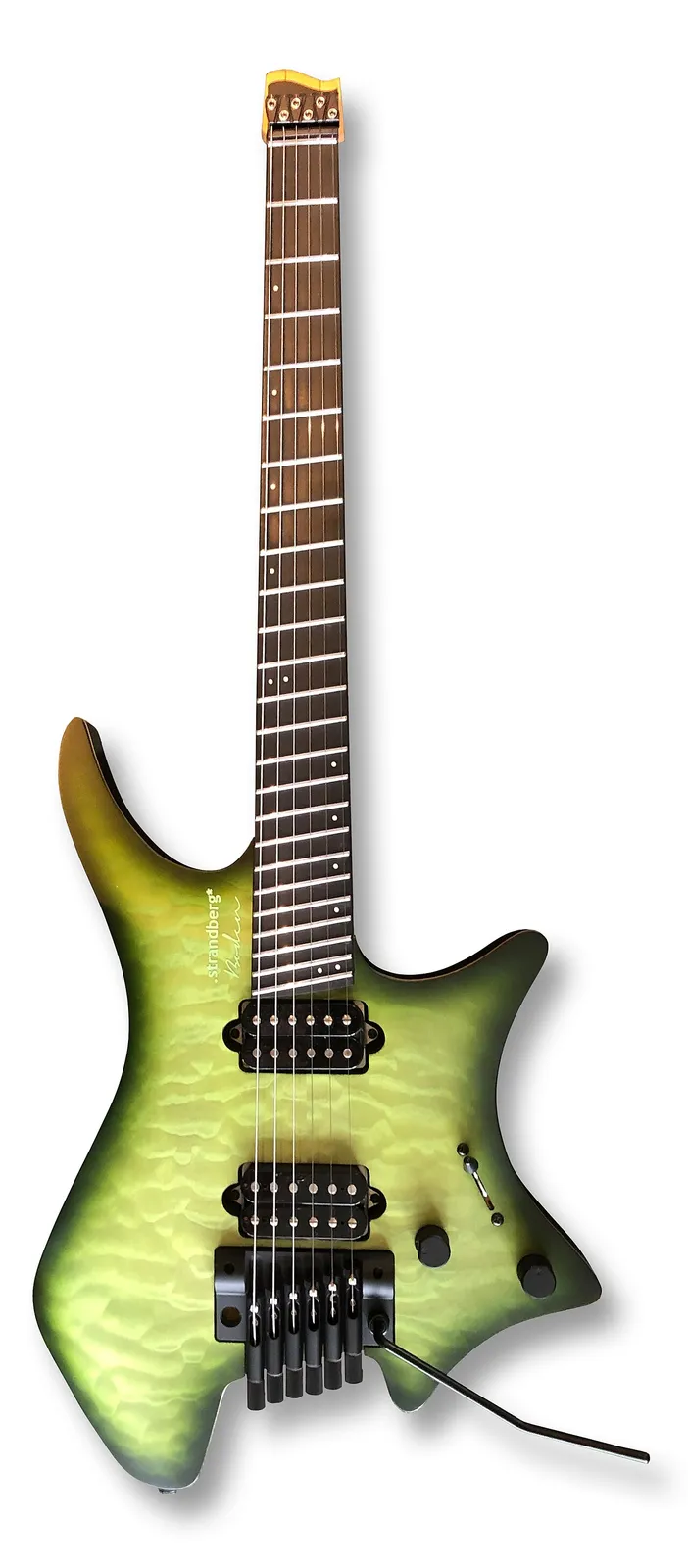
Photo: Auge=mit / Wikimedia Commons / CC BY-SA 4.0 Strandberg
Boden
2014
It started with a sore shoulder. A Swedish engineer built a guitar that would stop fighting him.