Gibson
EDS-1275
Jimmy Page had no way to play “Stairway to Heaven” live. So he ordered a guitar Gibson had stopped selling.
Early 1971. Led Zeppelin have a new song built out of acoustic guitar, stacked electric twelve-strings, and a solo, and a tour that starts on 5 March. Jimmy Page has two hands and one guitar strap. Something has to give.
- Introduced
- 1958
- Type
- Solidbody electric doubleneck
- Class
- Production
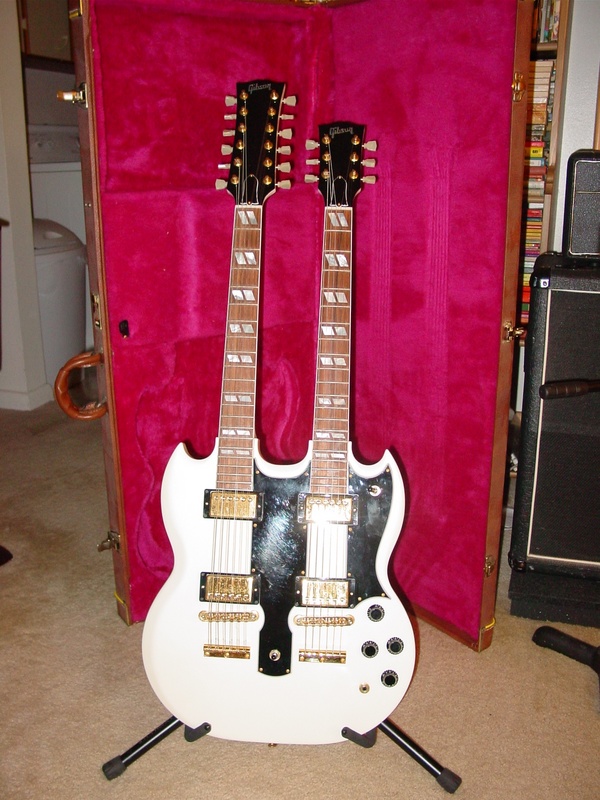
The short version
1957
The first double necks
Built in the spring and shown at the July trade show, next to a guitar-and-mandolin version.
1958
In the catalog
A hollow, carved-spruce Double 12, custom order only. About $475.
1962
Solid
The hollow body gives way to a solid one shaped like the new SG. Or 1963, depending who you ask.
1968
Off the price list
Gibson drops it. Special orders still trickle out.
1971
Page’s arrives
A cherry custom order, in time for the tour that starts 5 March. Gibson itself dates the guitar 1969.
1972
Howe’s white one
Steve Howe buys a white 1964 in London, for playing “And You And I” live.
1977
Back in the catalog
The EDS-1275 returns. Shipping records say the first one went out in late 1974.
Side A
A1
Two hands, one song
Most guitars earn their keep over a whole night. The doubleneck doesn’t. It’s heavy, it looks a little ridiculous, and for most of a set it’s the wrong tool. People buy it anyway, because there’s one song that can’t be played on anything else.
For Jimmy Page, that song was “Stairway to Heaven.” On the record he’d stacked parts on top of each other: acoustic guitar, electric twelve-strings, and then the solo. It sounded great. It also couldn’t be played by one man standing on a stage. He hadn’t worked out how he’d do it live. In his words:
That’s where the Double-Neck came in.
The problem was that Gibson had dropped the doubleneck from its price list in 1968. So Page custom-ordered one, in cherry, and had it for the tour that started on 5 March 1971. (Gibson’s own write-up of his guitar says 1969. Take your pick.)
A2
A hollow thing with no f-holes
The first ones weren’t what you’d picture. Gibson built its first double necks in the spring of 1957 and showed them at the July trade show. The Double 12, with a six-string neck and a twelve-string neck, went into the 1958 catalog, custom order only, at $475. (Or $495, depending who you ask.)
And it was hollow. A carved spruce top, maple back and sides, no center block, and no f-holes at all. The outline had two pointed cutaways, which looks like an SG to us now, but it came three years before the SG did. Four humbuckers. You could get it in sunburst, white, or black.
There was a sibling too, the Double Mandolin, with a regular six-string neck and a short six-string neck tuned an octave higher. There was also a guitar-and-bass version, which is the one Elvis plays in Spinout. Neither is this guitar, and people mix them up all the time.
It’s the wrong guitar for most of the set. Then the one song comes, and nothing else will do.
A3
Then it turned into an SG
Around the end of 1962 (or 1963, depending who you ask) Gibson stopped building the hollow version and made it solid, shaped like the new SG. The two necks now shared a volume, a tone, and a pickup switch, with one more switch to pick the neck. That’s the guitar most people mean when they say EDS-1275.
It never sold much. Counts for the early years are all over the place: 17 shipped in 1958, maybe 50 hollow ones through 1962, and somewhere around 110 in total by 1967, depending on whose ledger you trust. After 1968 it was off the list.
Then it came back. Shipping records have one going out in late 1974, then 334 the next year. The official comeback is usually dated 1977. From 1974 through 1979, Gibson shipped 1,145.
Flip the record · By the numbers
$475
The 1958 list price for the Double 12. Some remember it as $495.
17
Double 12s shipped in 1958, the busiest year of the hollow era.
1,145
Shipped from 1974 to 1979. Roughly ten times the 110 that one count gives for 1958–67.
7th
The fret where Don Felder put his capo on the 12-string neck for “Hotel California.”
Side B
B1
Page’s rig
On stage, Page used the doubleneck for more than “Stairway.” “Celebration Day,” “Tangerine,” “The Song Remains the Same,” “The Rain Song,” and “Sick Again” all got the two-neck treatment. The trick is simple enough to explain and hard to do: the twelve-string neck for the chime, the six-string for the solo, and a switch to jump between them mid-song.
It’s the live guitar. The studio “Stairway” was layered guitars, not the doubleneck.
B2
Everybody’s one song
Other players had a song like that too. Don Felder of the Eagles played a white 1977 EDS-1275 for “Hotel California” on stage, with a capo at the seventh fret of the twelve-string for the intro and verses, then down to the six-string for the choruses and those solos. Steve Howe bought a white 1964 in London in 1972 to play “And You And I” with Yes. Alex Lifeson of Rush played “Xanadu” on one. John McLaughlin used one in the early Mahavishnu Orchestra, and Slash had a black one on stage with Velvet Revolver in 2007.
It’s rarely a guitar for the whole night. But picture Jimmy Page on stage, and there’s a good chance you’re picturing two necks: the guitar he ordered because of a single song.
Put this on
You’ve read about it. Now hear it. Here’s what this guitar sounds like, and what to listen for.
Stairway to Heaven (The Song Remains the Same)
The live version, which is the point. The studio recording is layered guitars. On stage, Page gets the twelve-string parts and the solo out of one instrument by moving between necks.
Watch it on YouTube (opens in a new tab)Hotel California (live)
Don Felder’s white 1977 EDS-1275. The capo sits at the 7th fret of the 12-string for the intro and verses. He drops to the 6-string for the choruses and the solos.
Watch it on YouTube (opens in a new tab)
The cast
The people, and the specific guitars, that made the legend.
1971
Jimmy Page
Cherry 6/12, custom order
Live “Stairway to Heaven,” plus “Celebration Day,” “Tangerine,” “The Song Remains the Same,” “The Rain Song,” and “Sick Again.”
1977
Don Felder
White 1977 EDS-1275
The live “Hotel California” guitar. It went on display at the Met’s Play It Loud show.
1972
Steve Howe
White 1964 EDS-1275
Bought in London for “And You And I” on stage. He later owned a 1960 hollow Double 12 as well. Two different guitars.
1970s
Alex Lifeson
Cherry, then white
Played “Xanadu” live on it. The white one replaced the cherry after it was damaged.
early 1970s
John McLaughlin
EDS-1275
Early Mahavishnu Orchestra. His custom Rex Bogue double neck is a different guitar.
Liner notes
Specs, construction, rarity, value, and every source we used.
Gibson’s SG-shaped 6/12 doubleneck — EDS-1275 — Page’s live Stairway guitar, not a single-neck SG and not a Rickenbacker 12.
- Body
- Double-cut EDS-1275 / SG-style. One-piece mahogany. Nitro VOS. Not a 1958–62 hollow Double 12.
- Neck
- Two set mahogany necks, long tenon, hide glue; profiles 3D-scanned from Page’s guitar. 17° headstocks.
- Fingerboard
- Bound Indian rosewood; 20 authentic medium jumbo; aged cellulose nitrate parallelograms; 12 in radius
- Scale
- 24.75 in / 628.65 mm
- Pickups
- Four Jimmy Page EDS-1275 Custombuckers, Alnico 5, double-black bobbins. 6-string uncovered; 12-string True Historic chrome covers.
- Hardware
- True Historic ABR-1; chrome 6/12 EDS-1275 stopbars; Kluson double-line, double-ring keystone; chrome
- Electronics
- 2 volume, 2 tone; CTS pots; ceramic discs. 3-way Switchcraft pickup + 3-way Switchcraft neck select.
- Finish
- Nitrocellulose VOS, ’69 Cherry
- Nut
- Corian, 42.86 mm / 1.69 in
Open the full research fileConstruction details, the complete player record, production numbers, dated value estimates, and sources
Current gibson.com SKU is the Jimmy Page VOS (EDS1275JPVOCH1), $9,999, 25 Aug 2026. Generic Custom Shop DSEDCHNH (Alnico III Custombuckers, Slim C; dealer street often $7,999) is a different guitar when listed. Murphy Lab Collector’s Edition is another. None of these is a 1958–62 hollow Double 12, an EMS-1235, or a single-neck SG.
Construction
Three objects share the name. Do not collapse them.
1. Current Custom Shop. Standing 2026 catalog guitar is an SG-shaped solid mahogany 6/12, built in Nashville as a Gibson Custom order. The live gibson.com plate is the Page VOS clone, not a 1958 spruce-top and not a leftover generic DSEDCHNH. Epiphone G-1275 is a different factory. Do not file a Custom Shop as a Kalamazoo original.
2. Vintage 1958–62/63 hollow Double 12, plus EMS-1235. Duchossoir (quoted by Fretted Americana): first double necks built spring 1957; Double 12 and Double Mandolin shown at July 1957 NAMM; first described in the November 1957 Gazette; 1958 catalog. Custom-order only. Carved/arched spruce top, laminated maple back and sides, no f-holes, fully hollow, no center block, German-carve edges, flat back (True Vintage Guitar). Florentine double-cut — the silhouette predates the 1961 SG-body Les Paul; it is still not an SG. Four PAFs on the Double 12. 1958 list: Double 12 $475 (Duchossoir) / CME oral $495. Finishes in the 1958 pitch: sunburst, solid white, solid black (Duchossoir; Guitar World).
EMS-1235 is the Double Mandolin: standard 6-string plus a short-scale 6 tuned an octave up, not a 12-string. EBSF-1250 / EBS-1250 is guitar-plus-bass (Elvis Spinout). Those two SKUs are not this plate.
3. 1962+ SG-style solid. Duchossoir: original thinlines phased out at the end of 1962 and superseded by solid bodies patterned on the SG; the two earliest solids shipped at the end of 1962. Guitar World / Vintage Guitar: SG-style mahogany EDS-1275 in 1962. Wikipedia lead dates the solid body 1963. Gibson Custom copy: hollow 1958–1962, then reintroduced as EDS-1275 with a solid mahogany body that “closely resembled” the SG, three-piece maple necks. True Vintage’s “solid maple body from 1962” is a dealer shorthand — Fretted Americana’s 1975 example is solid mahogany with mahogany/maple/mahogany necks; current Custom Shop is one-piece mahogany. Attribute; do not pick a wood winner for every 1960s solid. guitarhq files EDS-1275 under solidbody 1958–1962; that grouping is not the hollow years.
1275 designation. Guitar World: 1959. Duchossoir: Double 12 later known as EDS-1275. Keep both. Mid-1960s catalogs: custom-order “your own choice of double neck equipment” (Duchossoir) — 6/12 is the catalog Double Twelve, not every stretched-SG that left Kalamazoo.
Controls differ by chapter. True Vintage on the spruce-tops: each neck has its own master volume and tone plus a pickup selector, plus a central three-way that selects 6, 12, or both. Duchossoir on SG-styled: the two necks share volume, tone, and pickup selector, plus a neck selector. Do not copy one harness onto the other.
Catalog gap, then 1970s. Duchossoir: shipments stop being recorded after 1967 even though the guitar stayed special-order into 1970. Vintage Guitar: offered until 1968, reintroduced 1977. Meiners (via Fretted Americana): reintroduced late 1974. Keep the fight. 1970s examples are Nashville-era SG-style solids with T-Tops, not 1958 hollows.
Players
This plate is the 6/12 EDS-1275. Elvis’s Spinout guitar is an EBS-1250. Tommy Shaw’s Styx live guitar is a custom two-12 — not this SKU. A Rickenbacker 360/12 is a semi-acoustic 12, not a doubleneck. Page’s Number One / Number Two Bursts live on gibson-les-paul-standard. A single-neck SG is gibson-sg.
Jimmy Page — custom-order cherry 6/12, received early 1971. Guitar Player (quoting Jimmy Page: The Anthology): he had not planned how to play “Stairway to Heaven” live after stacking acoustic and two electric-12 tracks; “That’s where the Double-Neck came in.” Gibson had dropped the model from the price list in 1968; Page custom-ordered one and had it for the tour starting 5 March 1971. Gibson’s current Custom Shop copy captions the same instrument 1969. Keep both. Live Stairway, not the studio master. Ground Guitar / Gibson: also live on “Celebration Day,” “Tangerine,” “The Song Remains the Same,” “The Rain Song,” “Sick Again.” Wikipedia lead adds studio “Carouselambra” on In Through the Out Door — attribute; this pass did not independently confirm the session guitar. Later Seymour Duncan on the 6-string bridge is a post-Zeppelin change (Ground Guitar). Artist-owned. Not a production comp.
Don Felder — white 1977 EDS-1275, Hotel California live. Metropolitan Museum Play It Loud object: 12-string neck with a capo at the 7th for intro and verses; 6-string for choruses and solos. Live guitar. Do not price ordinary whites as Felder’s.
Steve Howe. Reverb / Tony Bacon: white 1964 EDS-1275 bought in London 1972 for live “And You And I.” Separate object: a 1960 hollow Double 12 sold by Gruhn and owned by Howe from 1974 (es-335.com / Matt’s Guitar Shop). Two guitars, two chapters. Do not hang Close to the Edge studio on the doubleneck by default.
Alex Lifeson. Reverb: cherry EDS-1275 in the mid-1970s, then a white after the cherry was damaged; used live on “Xanadu.” 1970s solid, not a 1958 hollow.
John McLaughlin. Played an EDS-1275 in early Mahavishnu years (Reverb; Wikipedia lead). He also used a custom Rex Bogue Double Rainbow. Do not collapse those.
Also known to play. Stephen Stills — hollow Double 12 (Wikipedia lead; Guitar World gallery caption). Slash — black EDS-1275 onstage (Velvet Revolver, 2007). Eddie Van Halen — Wikipedia lead: collection guitar and “Secrets” (Diver Down, 1982); treat as weaker than Page/Felder.
Rarity
Current Custom Shop: orderable. Not rare. Page VOS, generic DSEDCHNH, Felder Hotel California, Lifeson limited, and 2007 Page signatures are separate SKUs.
Hollow 1958–62 Double 12s are the scarce objects. Contested counts — keep as ranges. Guitar World / True Vintage: 110 Double 12 / EDS-1275 shipped 1958–1967. Guitar World / CME: 17 in 1958 (highest year). CME / True Vintage: 15 in 1959. CME: 38 in this shape 1958–1960. True Vintage: fully hollow 1958–1962, “less than 52,” with some 1962 likely already solid. Duchossoir via Fretted Americana: 50 double-twelves 1958–1962 vs 27 1962–1966; six recorded in 1962, including both body styles. True Vintage: 4 shipped in 1966. Do not flatten 17 / 15 / 38 / 50 / 52 / 110 into one census. Shipped, not surviving.
1960s SG-style solids are thin catalog, not Flying-V scarce. Meiners (Fretted Americana): 1,145 shipped 1974–1979 — 1974: 1 / 1975: 334 / 1976: 14 / 1977: 42 / 1978: 288 / 1979: 466. That 1970s bump is why Vintage Guitar can say “reintroduced 1977” while Meiners starts 1974. Factory year-by-year for every 1960s solid is unpublished beyond the ranges above.
Value
Informal estimate, 25 August 2026. Not an appraisal.
Asks ≠ solds. Public 2024–26 sold histograms for 1958–68 originals were not extracted. Thin hammers; this is listings, dealer asks, and a used-modern guide. Do not price a current Custom Shop, a 1970s T-Top, or a Page/Felder/Howe guitar as a 1958–62 hollow. Celebrity lots are a separate market.
New street. Jimmy Page VOS: $9,999 (gibson.com). Generic Custom Shop DSEDCHNH: $7,999 (Guitar Center / Sweetwater leftover copy). Do not collapse those SKUs. 2007 Page limited and Murphy Lab Collector’s Editions are not the 2026 VOS.
Used modern Custom Shop. Reverb Price Guide snippet (Custom Shop EDS-1275 2004–2018): estimated $3,753–$6,379, based on 115 orders. Live asks observed this pass ~$6,300–$8,400. Guide vs ask; not 1960s.
1970s player solids. Gibson Certified Vintage 1977 Alpine White serial 72597170: $12,999 ask. Not a sold median.
1960s SG-style. Olivia’s Vintage 1968 sunburst: $43,900 ASK (modified pickup). True Vintage 1966 listed without a public dollar this pass. Christie’s 1967 (later white, Rik Emmett provenance) — no hammer isolated this pass. Label ASK. Do not invent a sold median.
1958–62 hollow. No public 2024–26 sold ladder extracted. CME’s $495 is 1958 list, not 2026 money.
See also
- gibson-sg — the single-neck pointed double-cut; Fool, Harrison’s Revolver guitar, and Angus live there
- rickenbacker-360-12 — the deluxe electric 12 that made jangle; not a doubleneck
- gibson-sg-custom — white three-pickup tuxedo SG; Tharpe and Hendrix live there, not here
Sources
- Gibson Custom Jimmy Page EDS-1275 Doubleneck VOS, ’69 Cherry
- Guitar Center: Gibson Custom EDS-1275 Double Neck Cherry
- Sweetwater: Gibson Custom EDS-1275 Doubleneck Cherry (DSEDCHNH)
- Gibson Gazette / Custom copy, archived: EDS-1275 Double Neck
- Guitar World: Rod Brakes, How the EDS-1275 changed rock guitar (12 Sep 2023)
- Vintage Guitar: Gibson EDS-1275 and EMS-1235
- True Vintage Guitar: 1959 EDS-1275 doubleneck
- True Vintage Guitar: 1966 EDS-1275 (listing)
- Fretted Americana: 1975 EDS-1275 (Duchossoir / Meiners quotes)
- Chicago Music Exchange: 1958 EDS-1275 transcript
- guitarhq: Gibson model index (EDS-1275 listed 1958–1962 solidbody)
- Guitar Player: Gibson Custom Jimmy Page EDS-1275 VOS (23 Nov 2024)
- Ground Guitar: Jimmy Page’s 1971 EDS-1275
- Reverb News: The star-studded legacy of Gibson double-neck guitars
- Metropolitan Museum / Commons: Don Felder 1977 EDS-1275, Play It Loud
- es-335.com: 1960 hollow EDS-1275 ex Steve Howe
- Reverb Price Guide: Custom Shop EDS-1275 2004–2018
- Olivia’s Vintage: 1968 EDS-1275 sunburst (asking)
- Gibson Certified Vintage: 1977 EDS-1275 Alpine White
- Christie’s: 1967 EDS-1275 doubleneck (Emmett; no hammer this pass)
- Wikipedia: Gibson EDS-1275 (lead only)
%27s_Gibson_EDS-1275_Double_neck_(1977)_-_Play_It_Loud._MET_(2019-05-13_19.33.18_by_Eden,_Janine_and_Jim).jpg)
Keep digging
Guitars this one gets compared to, confused with, or descended from.
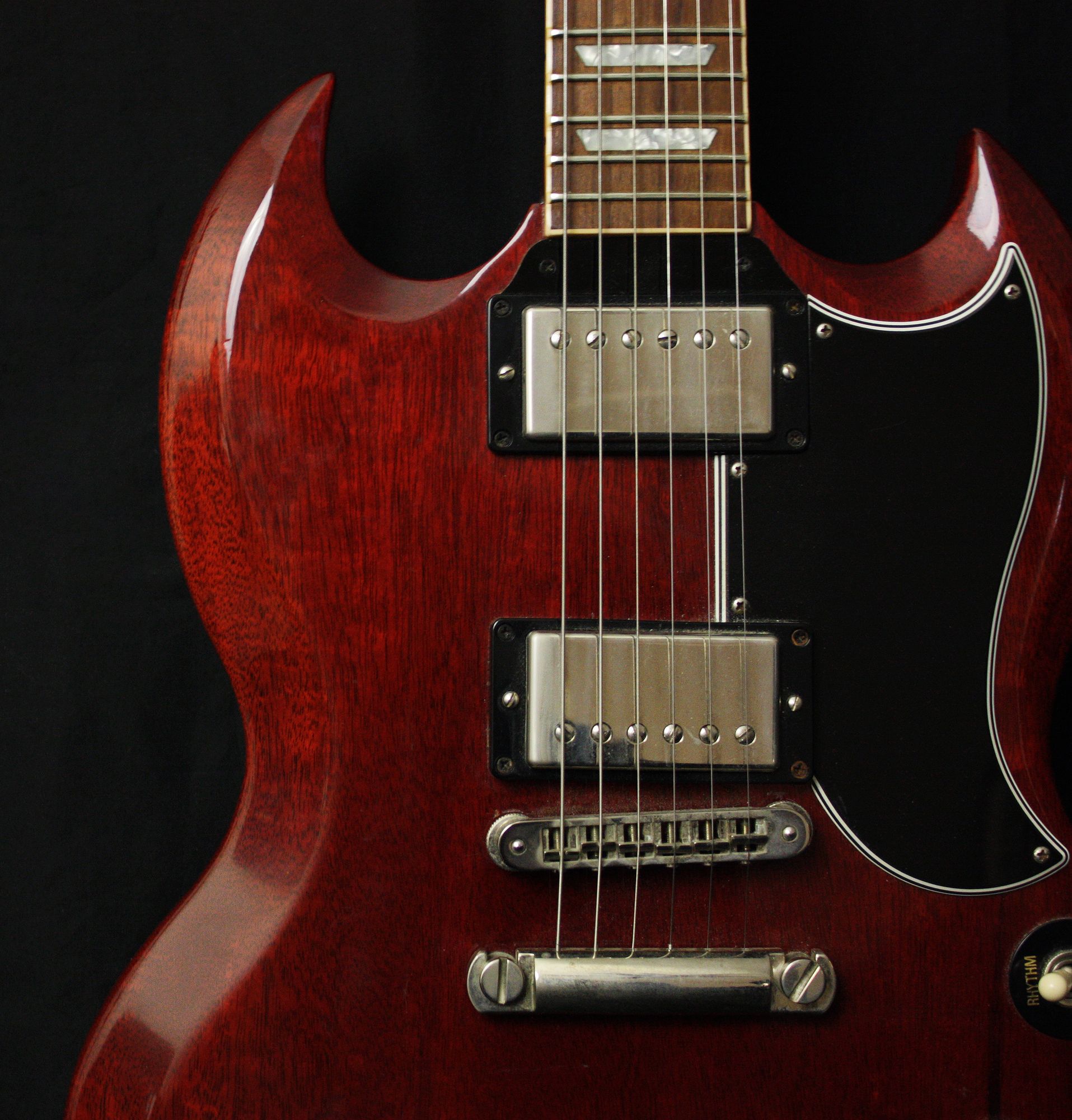
Gibson SG Standard ’61 Reissue, photographed 18 March 2010. Photo by John Tuggle. Licensed under CC BY 2.0. Via Wikimedia Commons. Gibson
SG
1961
Gibson has never stopped making SGs. Angus Young has lost count of his. He still only means one.
- Send a picture
Rickenbacker
360/12
1963
George Harrison was too sick to see it. Roger McGuinn saw it in a movie theater. Tom Petty bought one because McGuinn had one.
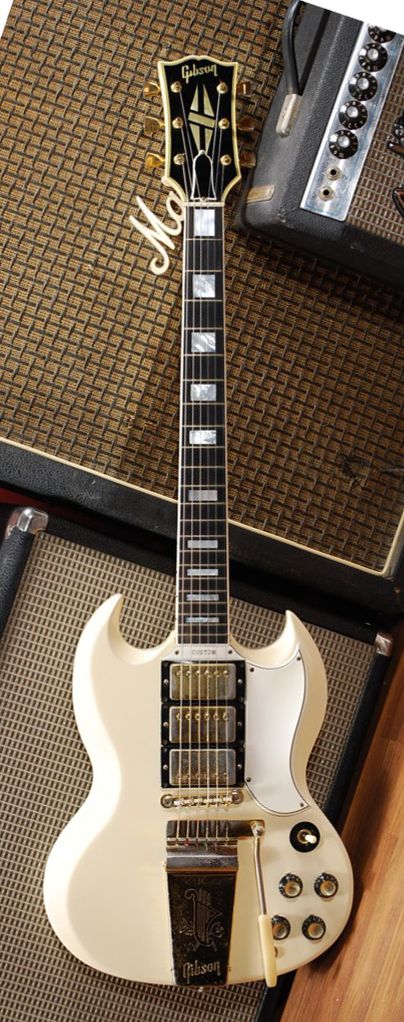
1963 Gibson SG Custom with Lyre Vibrola. Photo by Sellenman; derivative by Clusternote. Licensed under CC BY-SA 3.0. Via Wikimedia Commons. Gibson
SG Custom
1961
White paint, gold hardware, three pickups. Nobody carries this guitar onstage hoping to blend in.