Gibson
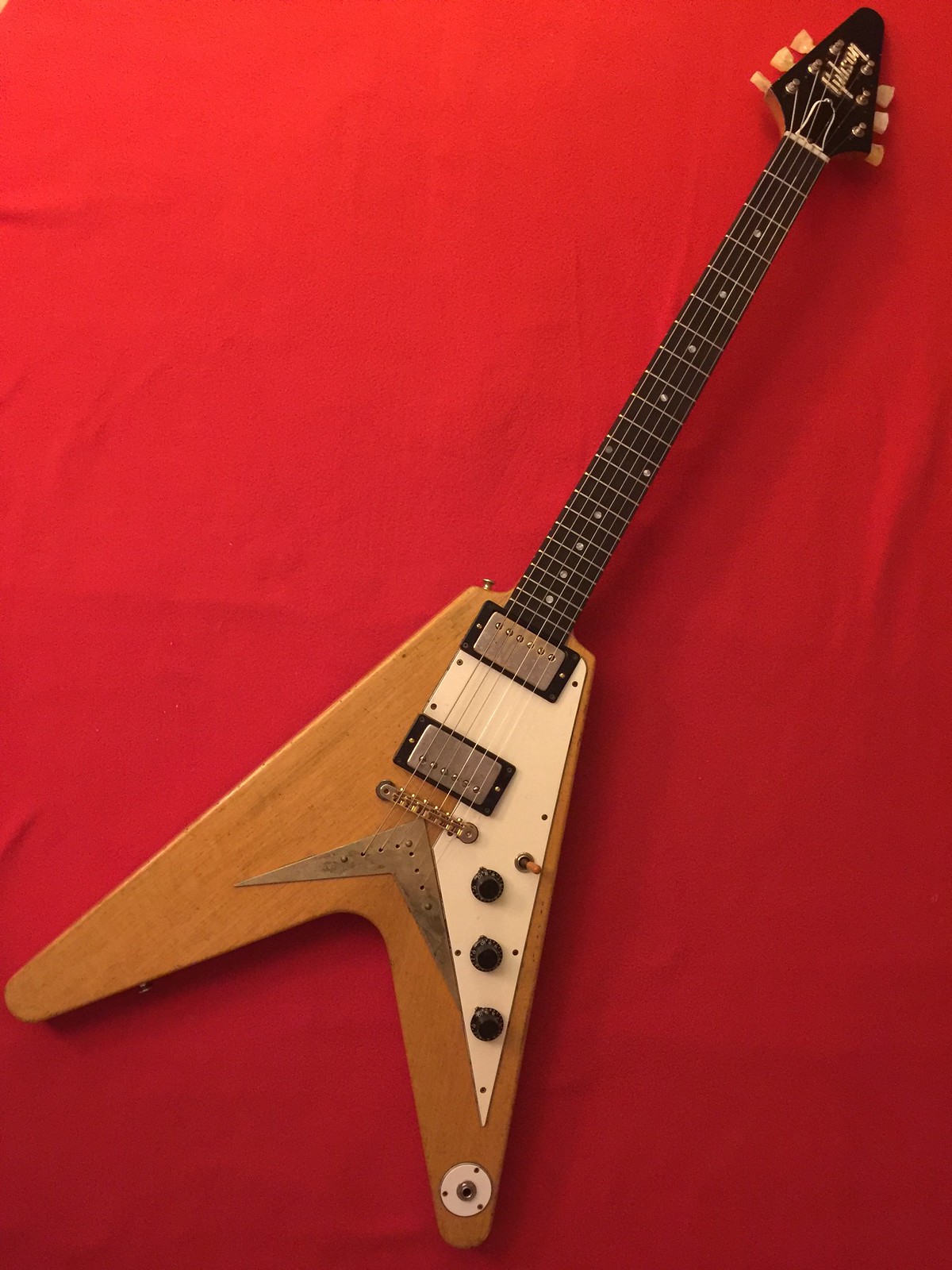
Flying V (1958–59 korina)
Gibson drew the future in 1958, and almost nobody bought it. Ninety-eight guitars later, it was finished. Then the future caught up.
Kalamazoo, Michigan. The fins on American cars are getting taller every year, and Gibson president Ted McCarty wants guitars that look like the space age. The Flying V is the most outrageous of them, and for about two years it's also a flop.
- Introduced
- 1958–59
- Type
- Solidbody electric
- Class
- Closed run
The short version
1957
Too heavy
The first prototypes are mahogany. They’re too heavy, so Gibson switches wood.
1958
Into the catalog
A “modernistic” guitar in blonde korina, gold hardware, and two new humbuckers.
1959
The last seventeen
Gibson ships 17 more and quietly stops.
1962
Leftovers
Unfinished bodies and necks sitting in the racks get finished and sold off.
1965
Found in the back
Dave Davies of the Kinks buys a dusty original out of a shop’s storage.
1966
Try again
Gibson brings the V back in mahogany. That’s the version Hendrix plays.
1969
Hyde Park
Keith Richards plays a late-’50s V in front of a huge crowd in London.
1984
“Amos”
An original 1958 V turns up in This Is Spinal Tap as Nigel Tufnel’s guitar.
Side A
A1
The future, from Kalamazoo
Being early feels exactly like being wrong. You find that out the hard way, and usually alone. The Flying V found out in 1958, and it spent years in the back of the shop before anybody caught up to it.
In the late 1950s Gibson had a problem, and his name was Leo Fender. Fender guitars looked new. Gibson guitars looked like very nice furniture. So Ted McCarty, who ran Gibson, sketched out three guitars that looked like nothing anyone had seen: the Flying V, the Explorer, and the Moderne. Gibson’s catalog called them “modernistic.” The Moderne never shipped at all.
The first Vs were mahogany, and they were too heavy. So Gibson switched to korina, their name for an African wood called limba. It’s pale and blonde, and it gave the guitar that mid-century look without much finishing work. Add gold hardware, two brand-new humbucking pickups, and strings that went straight through the body, and you had a guitar from 1958 that looked like it came from 1985.
It listed at $247.50, about what you’d pay for a Les Paul. Put the two in a shop window side by side. One looks like your dad’s car. The other looks like it could leave the ground.
A2
Ninety-eight
It didn’t sell. Not even close.
Gibson shipped 81 of them in 1958. In 1959 they shipped 17. Then they quietly stopped. That’s 98 guitars, the number most historians use. There were bodies and necks left over in the racks, and in the early ’60s the factory finished some and sold them with nickel hardware instead of gold. Nobody agrees on how many. Then the V was out of the catalog for years.
In 1959 Gibson shipped seventeen of them. Today, if one comes up for sale, it's front-page news.
Players in 1958 wanted a guitar that looked like a guitar. You can sit down and play a Les Paul. Try that with a V and it slides right off your leg. Gibson put a little rubber strip on the treble wing to help. It didn’t help much.
A3
The ones in the back room
The guitars that did sell went to some odd places. A young guitarist named Lonnie Mack ordered one through Hughes Music in Norwood, Ohio, and the shop owner, Glen Hughes, drove all the way to Kalamazoo to collect it. Mack called it “Number 7,” because the serial number supposedly said it was the seventh one made. (That’s folklore. Serials don’t work that way.) Hughes built a steel crossbar so a Bigsby vibrato could sit across the V, and Mack played it constantly. His 1963 instrumental “Wham!” is one reason people call a vibrato arm a “whammy bar.”
In June 1965, Dave Davies of the Kinks needed a replacement for his Guild Starfire. A shop owner went into the back and came out with a dusty original Flying V nobody had wanted. Davies bought it and took it onto Shindig, on American TV.
Flip the record · By the numbers
81
Flying Vs Gibson shipped in 1958.
17
Shipped in 1959. After that, the arrow was out of the catalog for years.
98
Total shipped in 1958–59, the number most historians cite.
$247.50
What one listed for in 1958. About Les Paul money.
Side B
B1
Upside down in Memphis
Albert King played a korina V left-handed and flipped over, so the low strings were on the bottom. He never restrung it. He just learned to play it that way, bending notes by pulling down, and the sound he got out of it changed blues guitar.
Here’s where it gets confusing, and I’ll be straight with you. “Lucy” was the name King gave more than one guitar. His classic Stax records, including Born Under a Bad Sign, weren’t cut on the korina. By the account of the man who later owned it, the korina had left King’s hands for a while by then, and he was playing a 1966 mahogany V.
The same thing goes for Hendrix. His famous Flying Vs are the mahogany ones Gibson started making again in 1966, including the custom left-handed one he played at the Isle of Wight in 1970. None of them is a 1958 korina, whatever the internet says.
B2
Amos, and other famous arrows
Once the V turned into a legend, the originals started showing up everywhere. Keith Richards played a late-’50s V at Hyde Park on 5 July 1969. Rick Nielsen of Cheap Trick bought a 1958 that had once been in Andy Warhol’s possession. Eddie Van Halen used a ’50s V in the studio for parts of 1984, including “Hot for Teacher.”
My favorite is “Amos.” It shipped on 29 May 1958 to Arthur’s Music in Indianapolis, a shop run by a man named Amos Arthur. It passed through a couple of owners and turned up in This Is Spinal Tap as one of Nigel Tufnel’s guitars. Joe Bonamassa has it now, and took it out on his Three Kings tour as a tribute to Albert King.
B3
The flop that won
Early looks like failure right up until the day it doesn’t. Gibson built 98 of these, watched them sit, and stopped. The guitar didn’t change after that. The world did. Rock got louder, players got stranger, and a shape that looked ridiculous in 1958 started to look like the only honest thing to hold on a stage.
Every metal band you’ve ever seen with a pointy guitar owes something to those 98 guitars nobody wanted. Most of those later players used the mahogany Vs from 1966 on, or newer copies. The shape went around the world. The originals barely went anywhere.
If you’ve ever made something people didn’t get yet, this is your guitar. Gibson will sell you a new Flying V tomorrow, and it’s a great guitar. It just isn’t one of the 98 that waited.
Put this on
You’ve read about it. Now hear it. Here’s what this guitar sounds like, and what to listen for.
Wham!
Mack’s instrumental hit from the Wham of That Memphis Man era, with Number 7 on the album cover. Listen to that vibrato arm wobble. It’s one reason people call it a “whammy bar.”
Find it on YouTube (opens in a new tab)Till the End of the Day
Dave Davies, a few months after he bought the dusty V out of a shop’s back room.
Find it on YouTube (opens in a new tab)Hot for Teacher
Eddie Van Halen used a ’50s korina V in the studio for parts of 1984, including this one.
Find it on YouTube (opens in a new tab)
The cast
The people, and the specific guitars, that made the legend.
1963
Lonnie Mack
“Number 7”
Bought through a shop in Norwood, Ohio, whose owner drove to Kalamazoo to pick it up. On the cover of The Wham of That Memphis Man.
1965
Dave Davies
Serial 8-4643
He needed a replacement for his Guild, and a shop owner pulled this out of storage. He took it onto Shindig.
c. 1962
Albert King
A korina V, played upside down
Left-handed, strings not reversed. Not the guitar on Born Under a Bad Sign. That was a 1966 mahogany V.
c. 1982
Rick Nielsen
1958 Flying V
Once in Andy Warhol’s possession. Nielsen bought it and gigged it hard.
1958
Joe Bonamassa
“Amos”
Shipped 29 May 1958 to Arthur’s Music in Indianapolis. Later, Nigel Tufnel’s guitar in Spinal Tap.
1984
Eddie Van Halen
A ’50s korina V
In the studio for parts of 1984, including “Hot for Teacher.”
Liner notes
Specs, construction, rarity, value, and every source we used.
A korina arrow Gibson barely sold: 81 shipped in 1958, 17 in 1959. Hendrix’s Vs are a different guitar.
- Body
- Two-piece solid korina (West African limba), V-shaped, ~1.5" depth; black rubber anti-slip strip under the treble wing
- Neck
- Set one-piece korina; pointed V headstock; raised plastic “Gibson” lettering (not pearl)
- Fingerboard
- 22-fret Brazilian rosewood, pearl/pearloid dots
- Scale
- 24.75" (629 mm) class
- Pickups
- Two PAF humbuckers in black plastic mounting rings
- Hardware
- ABR-1 Tune-o-matic; string-through V-shaped / “Cadillac” / chevron tailpiece plate; gold-plated; Kluson tuners with plastic tulip buttons
- Electronics
- Two volume + master tone, three-way toggle, all on the pickguard; front-mounted jack in a large circular plastic surround
- Finish
- Natural limed korina
- Nut
- ~1.6875" (Blue Book)
Open the full research fileConstruction details, the complete player record, production numbers, dated value estimates, and sources
Original 1958–59 gold-hardware spec. This is not a current SKU. 1966–70 mahogany revival Vs, Historic/Custom Shop korina recreations, and the current Gibson USA Flying V (~$2,499 street, August 2026) are different instruments.
Construction
Gibson Flying V, catalogued 1958 as a “modernistic” / “design of the future” solidbody. Part of Ted McCarty’s late-1950s Modernistic trio with the Explorer/Futura and the unreleased Moderne. Factory run 1958–1959. Leftover unfinished korina bodies/necks were completed later (commonly 1962–1963; some custom-order korina reported into the early 1960s). Regular production then stopped until a redesigned mahogany revival in 1966–67.
Korina is Gibson’s trade name for West African limba (Terminalia superba; also afara). Tony Bacon: chosen in part for a blonde, mid-century look without the extra finishing work mahogany would need. Gibson already used pale korina on the Skylark lap steel (1957). 1957 mahogany prototypes are reported as abandoned because they were too heavy (Fjestad & Meiners). Commercial 1958–59 Vs are korina. Mahogany belongs to those prototypes and to all regular production from 1966 onward.
The spec table is the original gold-hardware recipe. What trips people: the tailpiece is string-through, not a stopbar and not a Maestro. PAF patent granted 28 July 1959; originals carry PAF stickers, not later patent-number decals. Factory finish is natural limed korina (1958 catalogue; Blue Book) — not black, cherry, walnut, or sunburst. Lonnie Mack later painted Number 7 red (drying toward pink); aftermarket. Pickguard black on early examples, white on later ones; Bonamassa’s “Amos” is a known mismatch (black guard, white jack plate). Original case typically brown oblong / trapezoidal. 1962–63 leftovers: nickel hardware, patent-number pickups, black case. 1958 examples commonly carry an inked 8-xxxx on the back of the headstock (Davies 8-4643). FONs with a T prefix for 1958 are a different numbering system. Original list $247.50 (same as the Les Paul Model that year). Catalog around March 1958; Bacon: previewed in Gibson Gazette November 1957.
The 1966–70 V is a different guitar: mahogany, thinner body, softened shoulders, large pickguard with pickups in the guard, Maestro/Vibrola, chrome, patent-number humbuckers. About 175 mahogany Vs late 1966–1970 (guitarhq.com: 2 / 111 / 15 in 1966 / 1967 / 1969). Then Medallion, 1970s mahogany, 1983 korina Heritage, Historic recreations. Current USA Flying V ~$2,499 street is modern production, not a substitute. Hendrix’s famous Vs are 1967 / 1968 / 1969 Custom mahogany, not 1958 korina. The Moderne was patented 1957 alongside V and Explorer; no original 1950s Moderne has been verified.
Players
Original-era players were scarce. The cultural life of the shape and the cultural life of the 1958–59 korina object are two different histories. Later famous V users must not be collapsed onto the 1958 korina.
Lonnie Mack — "Number 7." Original 1958 korina. Guitar.com (3 Jan 2023): ordered through Hughes Music, Norwood, Ohio; shop owner Glen Hughes drove to Kalamazoo to collect it. Serial lore: "the serial number would indicate that Lonnie's V was the seventh one off the assembly line" — serial-as-production-order folklore, not a factory 1–98 ranking. Hughes fabricated a stainless-steel crossbeam so a Bigsby could sit across the open V — not factory. Later pickup changes, red/pink refinish, heavy wear. Constant companion; The Wham of That Memphis Man (1963) cover; "Wham!" is the song often linked to the colloquial "whammy bar." Whereabouts after Mack's death (21 April 2016) not publicly confirmed.
Albert King — original korina V exists; "Lucy" covers more than one guitar. Vintage Guitar (June 2009): Steven Seagal, then custodian, said the serial is 1959 but "some of the parts are from the early '60s"; he believed Gibson gave King the guitar around 1962. King played it left-handed, strings unreversed. Do not collapse Stax-period recordings onto this guitar — Seagal told VG that Born Under a Bad Sign was cut on the 1966 mahogany V after the korina left King's hands for a time. Dan Erlewine's 1972 left-handed black-walnut "Lucy" is a custom one-off measured from the '59, not a factory V. A 2011 Christie's Gere lot was catalogued "ascribed as the ex-Albert King"; MusicRadar reported the same guitar as formerly Albert Lee. King-ascription unverified.
Dave Davies (The Kinks). Original 1958 korina, serial 8-4643. Bought June 1965 as a Guild Starfire replacement (Gill: shop owner pulled a dusty original from storage). Shindig; "Till the End of the Day" (Nov 1965); Kinks covers. Davies sometimes called it a prototype; Heritage catalogued it as 1958. Refinished; heel-crack and logo repairs. Heritage Auctions 19 July 2019 is a provenance event. Last on-stage use often given as 1970.
Keith Richards. A late-'50s V at Hyde Park, 5 July 1969. Rumor that it was Albert King's V is unconfirmed. Later theft stories from Nellcôte during Exile on Main St. circulate; not verified here. A 2022 Hyde Park appearance used a Custom Shop 1958 Korina reissue, not the 1969 guitar.
Slash — 1959 korina Flying V on Use Your Illusion. Gibson Gazette: a 1959 korina Flying V bought just before recording "Knockin' on Heaven's Door" during the Use Your Illusion sessions. Collection guitar, not a 1958-stage identity. Separate from his two 1958 Explorers at the same sessions (see Explorer page).
Rick Nielsen (Cheap Trick). Gibson Gazette / Gibson TV The Collection: a 1958 (famous Andy Warhol photograph) and a 1959 painted Cardinal Red; both original Flying Vs, heavily gigged. MusicRadar: the '58 had been in Warhol's possession; Nielsen bought it c. 1982. Original korina objects, not 1970s mahogany Vs.
Joe Bonamassa — "Amos." Original 1958 korina, shipped 29 May 1958 to Amos Arthur's Arthur's Music, Indianapolis. Later Pete Mitchell; mid-1970s to Norm Harris; then Bonamassa. In This Is Spinal Tap (1984) as Nigel Tufnel's "Amos." Used by Bonamassa on his Three Kings tour as an Albert King homage. No public sale located here.
Eddie Van Halen. Gill: used his '50s V to record several songs on 1984, including "Hot for Teacher." VHND (4 Feb 2014) traces a mint 1958 from St. Louis dealer Dan Martin into EVH's hands and names the same sessions ("Drop Dead Legs," "Girl Gone Bad," "Top of the World" in that account). Studio, not a stage-signature V in the Schenker sense.
Billy F Gibbons. VG 2009: "Mine is a '58." Wikipedia says he played an early korina V on Fandango! — album-use secondary unless a serial/ledger is published.
Not original-korina players. Hendrix's famous Vs are late-60s mahogany, not 1958 korina. Gill is explicit: Hendrix adopted the second (1966–) mahogany version. He owned '67 and '68 examples and a 1969 custom left-handed V (gold hardware, pearl logo, Trini Lopez–style split-diamond inlays), used at the 1970 Isle of Wight Festival. Gibson's 2020 recreations copy that '69 Custom. Schenker brothers, K.K. Downing, Hetfield, Hammett, Mustaine, Paul Stanley: overwhelmingly 1970s-and-later mahogany Vs. Marc Bolan: rare Walnut from the 1967–71 mahogany run. 2022 Keith Richards Custom Shop 1958 Korina Flying V is a modern recreation, not the Hyde Park 1969 guitar.
Rarity
Do not pick a single production number. Lead with the shipment ledger.
81 shipped 1958 + 17 shipped 1959 = 98 is the ledger total most historians use (guitarhq.com; Bacon; Vintage Guitar; Gibson Custom Shop / Premier Guitar 2021; Blue Book; Gruhn & Carter). The “~100” shorthand belongs to this guitar, not the Explorer.
Up to ~120 produced; 98 sold 1958–59 is Duchossoir. explorerbass.com hypothesizes three batches of 40; Jack French recalled leftover V and Explorer bodies in the “40” racks in 1960.
Leftover completions 1962–63 are a separate small batch (nickel hardware, patent-number pickups; scattered custom orders ~1960–64). No agreed leftover count. Duchossoir/Wikipedia: “about twenty of each” sold from remaining stock 1960–63. GuitarHQ prints dashes for Flying V in 1960–63; leftover completions are not given as separate annual shipment counts.
Working range: 81 + 17 = 98 shipped is the figure to cite. A produced ceiling around 120 (Duchossoir / batches-of-40) may stay attributed. Leftover 1962–63 is extra-or-delayed, count unknown. “Fewer than 100” is true only for 1958–59 shipments, not for every korina V that left Kalamazoo.
Value
Informal estimate, 25 August 2026. Not an appraisal.
Original korina Flying Vs almost never appear at public auction. The few published results are often refinished, repaired, or celebrity-associated. Guide ≠ auction.
Public comps: 19 July 2019, Heritage (sale 7213, lot 85040): Davies 8-4643, $162,500 inc. fees — refinished, repaired heel crack and logo; artist-associated, not a clean-original comp. Earlier sale of the same guitar, 1995: $33,150. 5 September 2023, Gardiner Houlgate (“Virginia V”): heavily restored (refinish, neck re-profile, headstock wing repair, later bridge, Bigsby holes filled); £82,160 inc. fees (~$100k+ at then FX). Compromised original, not a mint benchmark. 11 October 2011, Christie's (Gere): 1958 V, King vs Lee ascription conflict, $74,500. Modified public lots in the 2019–23 window sit roughly $100k–$165k, with artist association at the top of that pair. No 2024–26 public sold for a clean original was located.
Guides (not comps): VG April 2011 clean $200k–$250k — stale. Blue Book (older): $250k–$350k clean. Vintage Guitar, “40 Most Valuable Guitars of 2026”: ranked No. 4, $500,000–$750,000. VG notes late-1960s mahogany Vs sell for about 1/10 of original korina.
VG 2026’s $500k–$750k is a magazine guide for a serious-collector original, not a sold ladder. Public auction evidence is thinner and lower: refinished/restored lots $100k–$165k (2019–23). Clean original, original case, no celebrity: VG 2011 $200k–$250k is the last widely published magazine band for that state; it is 15 years old. Do not treat the 2026 guide as an auction median. Leftover 1962–63 nickel-hardware examples generally sit below 1958–59 gold (Blue Book). Modern USA Flying V ($2,499) and Custom Shop Historic reissues (~$9,999 at 2021 launch) are new instruments, not substitutes.
See also
- gibson-explorer-1958-korina — the scarcer Modernistic sibling
- gibson-les-paul-standard — same 1958 price list, opposite commercial fate
- gibson-sg — the double-cut that actually sold
Sources
- Tony Bacon, history of the Flying V
- Reverb, Gibson’s failed modernist experiment
- Reverb, Flying Vs and Explorers timeline
- guitarhq.com shipping table
- Blue Book, Gibson Flying V series
- Vintage Guitar, 40 Most Valuable Guitars of 2026
- Vintage Guitar, Albert King’s Flying Vs
- Vintage Guitar, Virginia V
- Gardiner Houlgate result
- Heritage Auctions, Davies V
- Guitar World, Davies V to auction
- Christie's Gere V
- MusicRadar, Gere collection
- Guitar.com, Lonnie Mack Flying V
- Premier Guitar, 2021 Collector’s Edition
- Vintage Guitar, reissue ’58 Flying V
- 1967-flyingv.weebly.com
- Vintage Guitar, Gibson’s 1966–70 Flying V
- explorerbass.com history — batch-of-40 hypothesis; leftover racks
- Gibson Gazette, six famous Flying V guitarists
- Chris Gill, Guitar Player, Flying V history
- VHND, EVH 1958 Flying V
- MusicRadar, Rick Nielsen korina collection
- Acoustic Music, notable guitar sales
- Reverb: The Story of Amos — Bonamassa 1958; This Is Spinal Tap.
- MusicRadar: Dave Davies Flying V to auction
- Guitar.com: Keith Richards Custom Shop V clip — 2022 reissue, not Hyde Park 1969.
Keep digging
Guitars this one gets compared to, confused with, or descended from.
- Send a picture
Gibson
Explorer (1958–59 korina)
1958–59
Gibson shipped twenty-two of them. Everybody knows the shape. Hardly anybody has held the real thing.

2006 Gibson Les Paul Standard (SN 000660573). Photo by wetwebwork. Licensed under CC BY-SA 2.0. Via Wikimedia Commons. Gibson
Les Paul Standard
1952
Gibson made about 1,500 sunburst Les Pauls, decided nobody wanted them, and stopped. Then the British blues boom happened.
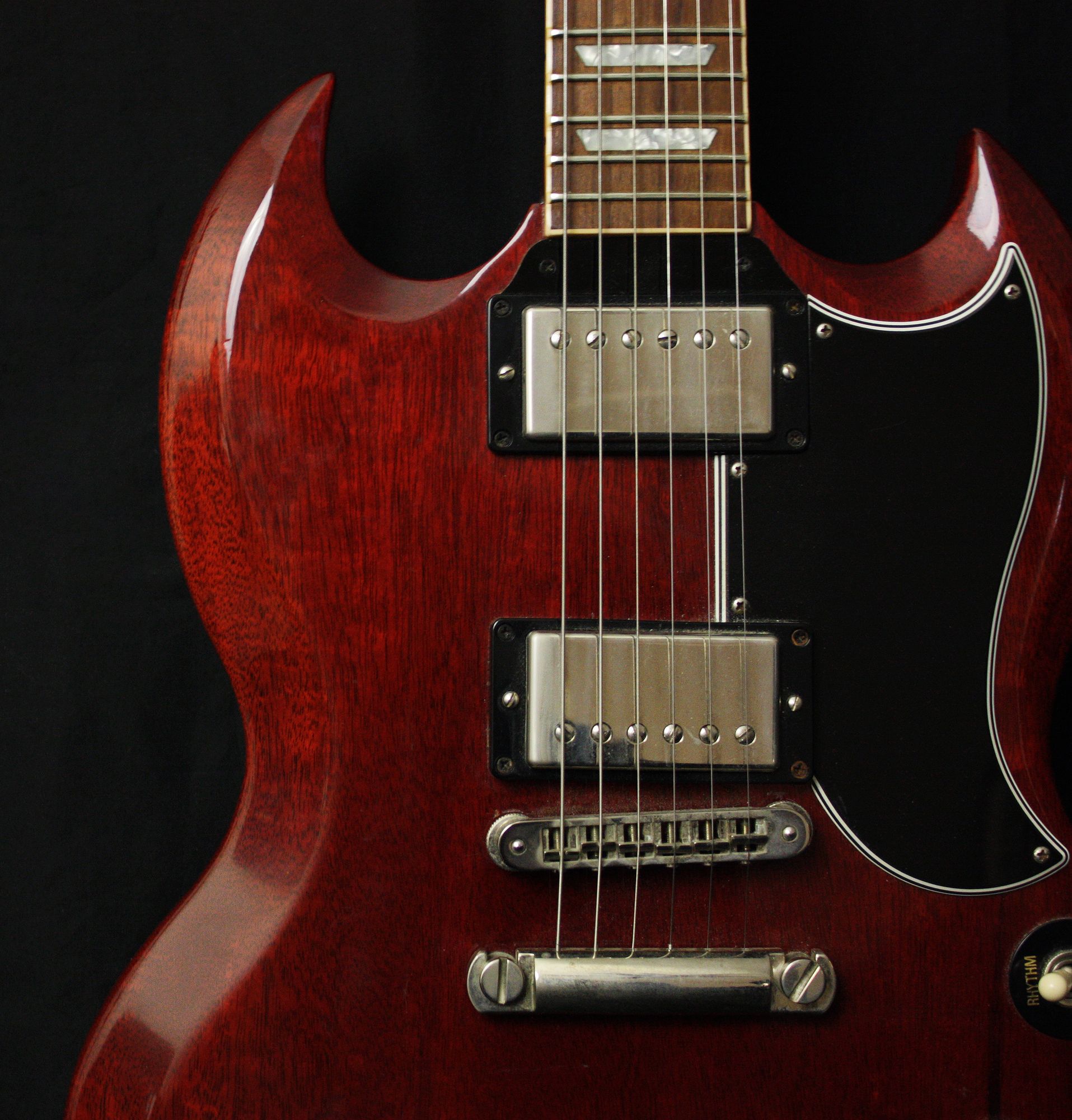
Gibson SG Standard ’61 Reissue, photographed 18 March 2010. Photo by John Tuggle. Licensed under CC BY 2.0. Via Wikimedia Commons. Gibson
SG
1961
Gibson has never stopped making SGs. Angus Young has lost count of his. He still only means one.