Gibson
Firebird
Gibson fixed the Firebird in 1965. Players have been hunting for the unfixed one ever since.
13 April 1968. Eric Clapton buys a four-year-old Gibson Firebird, the original kind, with the neck running straight through the body and all six tuners on the wrong side of the headstock. Gibson had stopped making them that way three years earlier.
- Introduced
- 1963
- Type
- Solidbody electric
- Class
- Production
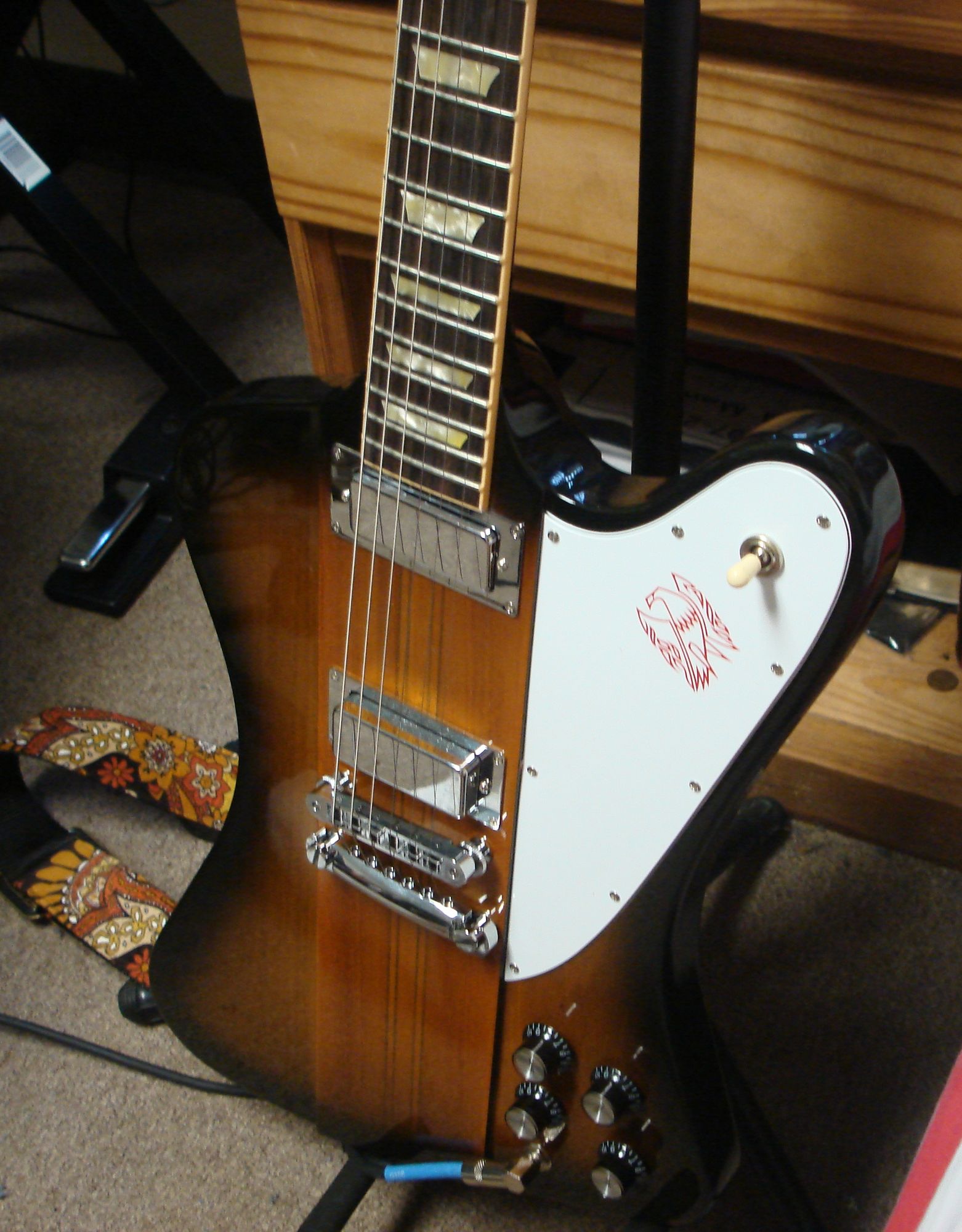
The short version
1963
A car designer’s bird
Ray Dietrich’s Firebird is on the July price list. Guitars follow in the fall, in four trims.
1965
Turned around
In June the “non-reverse” Firebird replaces it, with a glued-in neck and normal tuners.
1968
Clapton’s I
He buys a 1964 reverse Firebird I and plays it at Cream’s Royal Albert Hall farewell.
1969
End of the first run
9,019 Firebirds have shipped since 1963, roughly 4,000 of them the original reverse.
1972
The shape comes back
The Medallion brings back the reverse body for two years. Only 366 ship.
1973
“Amazona”
Phil Manzanera’s red 1964 Firebird VII all over Roxy Music’s Stranded.
1976
At the Fox
Allen Collins plays a 1964 Firebird I on Lynyrd Skynyrd’s One More from the Road.
2025
The Platypus
Gibson USA names a Firebird after the leftovers it once built to use up parts.
Side A
A1
A car designer draws a bird
Every guitar company keeps a list of things it would like to fix about a guitar. Too expensive to build. Balances funny. Breaks too easily. Every so often, what’s on that list is exactly what somebody fell for.
The Firebird started with Ray Dietrich, a man who had spent his career designing car bodies. In 1963 he gave Gibson a rounded, swept-back take on the Explorer, with the treble horn stretched out longer than the bass. The headstock was flipped too, with the tuners along one edge like a banjo’s. People started calling it the “reverse” Firebird, and the name stuck.
It looked fast even hanging on the wall. It was also a lot of work.
A2
Built the hard way
The neck didn’t bolt on, and it didn’t glue in. It ran the whole length of the body, a laminated strip of mahogany with walnut in it, and the body wings were glued on either side. How many layers depends on the year and who’s counting. Either way, it took time and wood.
It came in four trims. The I had one pickup. The III had two. The V had two plus a Tune-o-matic bridge and a vibrato. The VII had three pickups, gold hardware, an ebony board, and pearl blocks. All of them used a small humbucker made just for the Firebird, with no pole screws on top. Not the little humbuckers from a Les Paul Deluxe, either. To my ear they’re brighter and glassier than a full-size Gibson humbucker, and that’s a lot of the Firebird’s personality.
Sunburst was standard. For extra money you could order it in car colors.
A3
Gibson turns it around
By the middle of 1965 the list had caught up with it. Neck-through was expensive, the balance was odd, and they broke. So in June Gibson flipped the design: the longer horn went to the bass side, the neck was glued in like any other Gibson, and the tuners went back to normal. That’s the “non-reverse” Firebird, and Gibson made it through 1969. The cheaper models even switched to P-90 pickups.
You’ll hear a story that Fender’s lawyers had something to do with the change. Nobody has made it stick.
In the switchover, Gibson had leftover reverse bodies and new-style headstocks, and some went out together. Somebody later called those mongrels “platypus” Firebirds. It was never a catalog model. It was the factory using up parts.
The fixed one sold fine. The unfixed one is the one people went looking for.
Flip the record · By the numbers
9,019
Firebirds shipped from 1963 to 1969, both shapes together.
~4,000
Original reverse Firebirds. The non-reverse outnumbered them.
~250
Reverse Firebird VIIs, the top model, with three pickups and gold hardware.
Side B
B1
The people who wanted the old one
Eric Clapton bought his 1964 reverse Firebird I in April 1968, three years after Gibson stopped making them, and played it at Cream’s farewell at the Royal Albert Hall that November. Johnny Winter played a white ’64 reverse V. Phil Manzanera made a red ’64 reverse VII his trademark in Roxy Music, and you can hear it slicing through “Amazona.”
Allen Collins of Lynyrd Skynyrd had four ’64 reverse Firebirds and stuck with them until he got an Explorer from Clapton in 1976. Brian Jones had it both ways: a reverse VII as a gift, then a non-reverse VII as his main stage guitar in 1966 and ’67.
The non-reverse had fans too. Steve Winwood’s was green, and somebody stole it in New York in 1973. But the names people reach for first mostly belong to the version Gibson had decided was a problem.
B2
The platypus gets a name
Between 1963 and 1969 Gibson shipped 9,019 Firebirds, and only about 4,000 of them were the reverse kind. The non-reverse was easier to make, and it outsold the original.
It didn’t matter. When Gibson brought the Firebird back, first as the Medallion in 1972 and then for the Bicentennial in 1976, it brought back the reverse shape. When the Custom Shop recreates a Firebird today, it goes back to 1963.
And in 2025, Gibson USA launched a new Firebird and called it the Platypus. For decades that word meant a leftover built from mismatched parts. Now it’s the name of a new Gibson. Whoever was clearing out those leftover parts in 1965 would probably find that very funny.
Put this on
You’ve read about it. Now hear it. Here’s what this guitar sounds like, and what to listen for.
Amazona
Phil Manzanera’s Cardinal Red 1964 reverse Firebird VII, the guitar he’s known for. Listen for how thin and cutting it gets without ever sounding cheap.
Find it on YouTube (opens in a new tab)Sitting On Top of the World
From Goodbye. Clapton’s 1964 reverse Firebird I, the one he bought after Gibson had already stopped making them.
Find it on YouTube (opens in a new tab)
The cast
The people, and the specific guitars, that made the legend.
Johnny Winter
1964 reverse Firebird V, Polaris White
The white one is his named guitar. He had a sunburst V too, so don’t assume every photo is the same bird.
1973
Phil Manzanera
1964 reverse Firebird VII, Cardinal Red
His trademark, on Stranded and “Amazona.” He played modified non-reverse Firebirds in the mid-’70s as well.
1976
Allen Collins
Four 1964 reverse Firebirds
His choice until 1976, when he got an Explorer from Eric Clapton.
1968
Eric Clapton
1964 reverse Firebird I
Bought 13 April 1968. Cream’s last year. Not the Fool SG and not the Beano Les Paul.
1966–67
Brian Jones
Reverse and non-reverse
A sunburst reverse VII was a gift. His main stage guitar became a non-reverse VII, and he played a III as well.
1973
Steve Winwood
Non-reverse Firebird V, Inverness Green
Stolen in New York in 1973. Gibson’s Custom Shop recreated it in 2008.
Liner notes
Specs, construction, rarity, value, and every source we used.
Reverse (1963–65) and non-reverse (1965–69) share a name, not a silhouette — and neither is an Explorer or the Thunderbird bass.
- Body
- Reverse Firebird; neck-through; layered mahogany; no weight relief. 3-ply W/B/W Firebird hot-stamped pickguard.
- Neck
- 9-ply mahogany/walnut neck-through; Authentic 1963 profile.
- Fingerboard
- Bound Indian rosewood; 22 authentic medium-jumbo; aged cellulose-nitrate trapezoids; 12.0 in radius.
- Scale
- 24.75 in / 628.65 mm
- Pickups
- Firebird Alnico 5 (neck and bridge)
- Hardware
- ABR-1; Maestro Vibrola; Deluxe Banjo Tuners; nickel (Murphy Lab aged)
- Electronics
- 2 volume, 2 tone; CTS pots; hand-wired harness; Switchcraft 3-way
- Finish
- Murphy Lab aged nitrocellulose (Antique Frost Blue, Ember Red, other Custom colors)
- Nut
- Nylon, 42.85 mm / 1.69 in
Open the full research fileConstruction details, the complete player record, production numbers, dated value estimates, and sources
Gibson Custom 1963 Firebird V (e.g. FB5HAAFBNM1) — reverse reissue, not a 1963 original. Reverse originals: neck-through, reverse headstock, banjo tuners. Non-reverse originals: set neck, conventional tuners, long bass horn; not a current USA catalog guitar in Lin’s 25 Aug 2026 pass. Leftover USA DSFR00TBCH1 is no longer available. Wynn’s 2025 USA Platypus is a separate set-neck return.
Construction
Thunderbird II / IV are the basses — not this page.
Ray Dietrich, 1963: rounded “reverse” take on the Explorer — treble horn longer. Not a 1958 Explorer. July 1963 price list; production commonly fall 1963. Trims I, III, V, VII.
Reverse (fall 1963–mid-1965). Neck-through; mahogany wings on laminated mahogany with walnut strips. Ply count contested: Gibson current copy 9-ply mahogany/walnut; Well Strung earliest two mahogany pieces plus two wings, then 7-piece by end of 1963. Catalog 44 1/2 × 14 1/2 × 1 1/2 in. Reverse headstock; Kluson banjo tuners treble side. Holly step; treble-side guard only (no bird 1963; red logo 1964+). Scale 24.75 in.
All reverse trims use Firebird mini-humbuckers (Alnico bar in each coil, no screw poles) — not Epiphone-derived / Les Paul Deluxe minis. I: one mini (neck), not P-90s; wraparound stud; vibrola special-order. III: two minis; short vibrola; bound rosewood dots (guitarhq, Well Strung; VG groups I and III unbound). V: two minis; Tune-o-matic plus Maestro lyre; some early 1963 Vs use III stud + V vibrato. VII: three minis; gold; bound ebony; pearl blocks.
Sunburst standard; Duco custom colors optional. Black as a factory color is disputed. Vintage boards Brazilian rosewood (ebony on VII); current Custom Indian.
Non-reverse (June 1965–1969). Bass horn longer. Set neck. Conventional tuners; guard wraps the pickups. Unbound dots on all four. NAMM / price list June 1965. Well Strung: cost, balance, breakage. VG: neck-through expensive. Wikipedia Fender-lawsuit claim unconfirmed on guitarhq / VG reverse / Well Strung. Non-reverse I two P-90s; III three P-90s; V two minis; VII three minis. Reverse I is one mini. Slide switch (some mid-1966+ 3-way). V-12 added.
1965 leftovers mixing reverse body with non-reverse headstock were later nicknamed “platypus.” Not a third catalog model.
Later reverse shape ≠ 1963–65 original: Medallion 1972–73 (366 shipped); Bicentennial 1976–79. 1981–82 Firebird II is maple / set-neck / active — not this guitar. Custom 1963 Firebird V is the Historic recreation. Leftover USA Firebird is not a 1963 V. Modern vs 1963 pickup internals unverified on Gibson sheets.
Players
Clapton’s Beano guitar is a Les Paul, not a Firebird. His 1964 reverse Firebird I is Cream, 1968. Collins’s later famous guitar is an Explorer (Knebworth, 21 August 1976). Not a 1958 Explorer or Flying V.
Johnny Winter — 1964 reverse V (Polaris White). Premier Guitar / Gibson named instrument. VG also lists a sunburst V; do not collapse.
Phil Manzanera — 1964 reverse VII, Cardinal Red. Stranded / “Amazona.” VG also lists modified non-reverse Firebirds mid-1970s. Red reverse VII is the trademark.
Allen Collins — 1964 reverse Firebirds (four). Choice until an Explorer from Clapton in 1976. A 1964 I on One More from the Road (Fox, 7–9 July 1976). Studio “Free Bird” is Firebird-period, not serialled.
Brian Jones — reverse sunburst VII gift, then non-reverse VII (1966–67 stage main) and a Firebird III (RAH Sept 1966; Got Live). Both shapes.
Eric Clapton — 1964 reverse I, bought 13 April 1968; RAH 25 Nov 1968; “Sitting On Top of the World” on Goodbye. Not the Fool SG or cherry 335.
Steve Winwood — non-reverse V, Inverness Green. Stolen NY 1973; Custom Shop recreation 2008.
Paul McCartney — lefty VII (blue, horseshoe Bigsby), Ram. VG does not name the silhouette.
Gatemouth Brown — non-reverse V. Worn; leather guard; vibrato later removed.
Also. Keith Richards: VG reverse-era list, not a named Stones-album Firebird. Mick Taylor inherited Jones’s. Warren Haynes, Gem Archer, The National: later non-reverse. Leon Wilkeson: Thunderbird bass.
Rarity
Reverse shape is common as a reissue; 1963–65 neck-through originals are not. Factory shipping 1963–69 (Meiners via GuitarHQ / VGB): 9,019 — shipping, not calendar production. ~half of 1965 is reverse, ~half non-reverse, so ~4,000 reverse and ~5,000 non-reverse six-strings, plus 272 NR V-12. Reverse VII ≈ ~250; NR VII after 1965 = 79. VG’s NR V “likely not much more than 500” vs ~670 from the half-year split — keep as a range. Custom-color and current Custom / USA counts unpublished.
Medallion 1972–73: 366. Bicentennial 1976–79: 2,847. USA reverse V 1990–c.2018/19: unknown total. Wynn: USA returned 2025 as the Firebird Platypus (set neck, non-reverse “platypus-bill” headstock) — tribute, not a 1965 leftover census. Custom Shop 1963 V Historics remain current. Artist-owned pieces are separate.
Value
Informal estimate, 25 August 2026. Not an appraisal.
New street. USA Firebird Platypus (2025–): $2,499 list. Thin used solds. Custom 1963 Firebird V Historic asks: $7,500–$8,799 (peak nearly $10,000, Premier Guitar Oct 2024). Asks / street, not solds. Reissues ≠ originals.
Used modern. USA Firebird V (1990s–2010s reverse reissue): commonly ~$1,500–$3,500. Bicentennial ~$3,500–$6,500; thin 2024–26 solds. Medallion: no 2024–26 sold series.
Vintage / collectible. Sold histograms thin; prefer labeled asks. Edgewater July 2026 excellent all-original dealer-comp (not sold): reverse I $15,000–$28,000; III $18,000–$35,000; V $20,000–$40,000; VII $25,000–$50,000. Custom color +40–80% over sunburst. Premier Guitar: original ’60s Vs “sell for as much as $35,000” — sold-direction, not a lot list. Player/modified reverse often $10k–$20k ask. Outlier transitional asks $60k–$75k. Non-reverse excellent all-original (Edgewater, not sold): III $5,000–$10,000; V $6,000–$12,000; VII $7,000–$14,000. Headstock breaks, replaced banjo tuners, and refinishes drop a reverse original a full tier. Celebrity lots are not comps.
See also
- gibson-explorer-1958-korina — related McCarty-era modernist; different year, wood, and story
- gibson-sg — the Gibson solidbody that sold while the bird was a factory problem
- gibson-thunderbird — the bass that shares the bird name, not this six-string
Sources
- Gibson Custom 1963 Firebird V (Murphy Lab Antique Frost Blue)
- Gibson USA Firebird Tobacco Burst (leftover / no longer available)
- Gibson USA Firebird Platypus Tobacco Sunburst
- GuitarHQ: Firebird reverse vs non-reverse
- GuitarHQ: Firebird custom colors
- GuitarHQ: solidbody shipping 1952–69
- Vintage Guitar and Bass: Firebird
- Well Strung: reverse Firebirds
- Well Strung: non-reverse Firebirds
- Vintage Guitar: Gibson Firebirds (reverse)
- Vintage Guitar: Gibson’s Non-Reverse Firebirds (June 2023)
- Vintage Guitar: Gibson’s Non-Reverse ’Birds (October 2011)
- True Vintage Guitar: reverse or non-reverse
- Humbucker Soup: mini-humbucker versus Firebird
- Seymour Duncan forum: Firebird pickup internals (Gibson copy reprint)
- Premier Guitar: Johnny Winter 1964 Firebird V
- Guitar World: Phil Manzanera’s 1964 reverse Firebird VII
- Guitar World: How Phil Manzanera got his Roxy Music Firebird
- Christie’s: Lynyrd Skynyrd / Allen Collins Firebird
- Guitar World: Neville Marten on Clapton’s Cream guitars
- Guitar World: Beano Les Paul identity
- MusicRadar: Epiphone / Gibson Custom 1963 Firebird I and V (2024)
- Reverb News: a timeline of Gibson Firebirds
- Guitar World: Firebird Platypus 2025
- Edgewater: 2026 vintage Gibson value guide
- Premier Guitar: Epiphone 1963 Firebird review (original V / CS reissue prices)
- Carter Vintage: 2025 CS 1963 Firebird V ULA Ember Red (ask)
- Music & Arts: CS Murphy Lab 1963 Firebird V Cardinal Red (ask)
- Wikipedia: Gibson Firebird (lead only)
Keep digging
Guitars this one gets compared to, confused with, or descended from.
- Send a picture
Gibson
Explorer (1958–59 korina)
1958–59
Gibson shipped twenty-two of them. Everybody knows the shape. Hardly anybody has held the real thing.
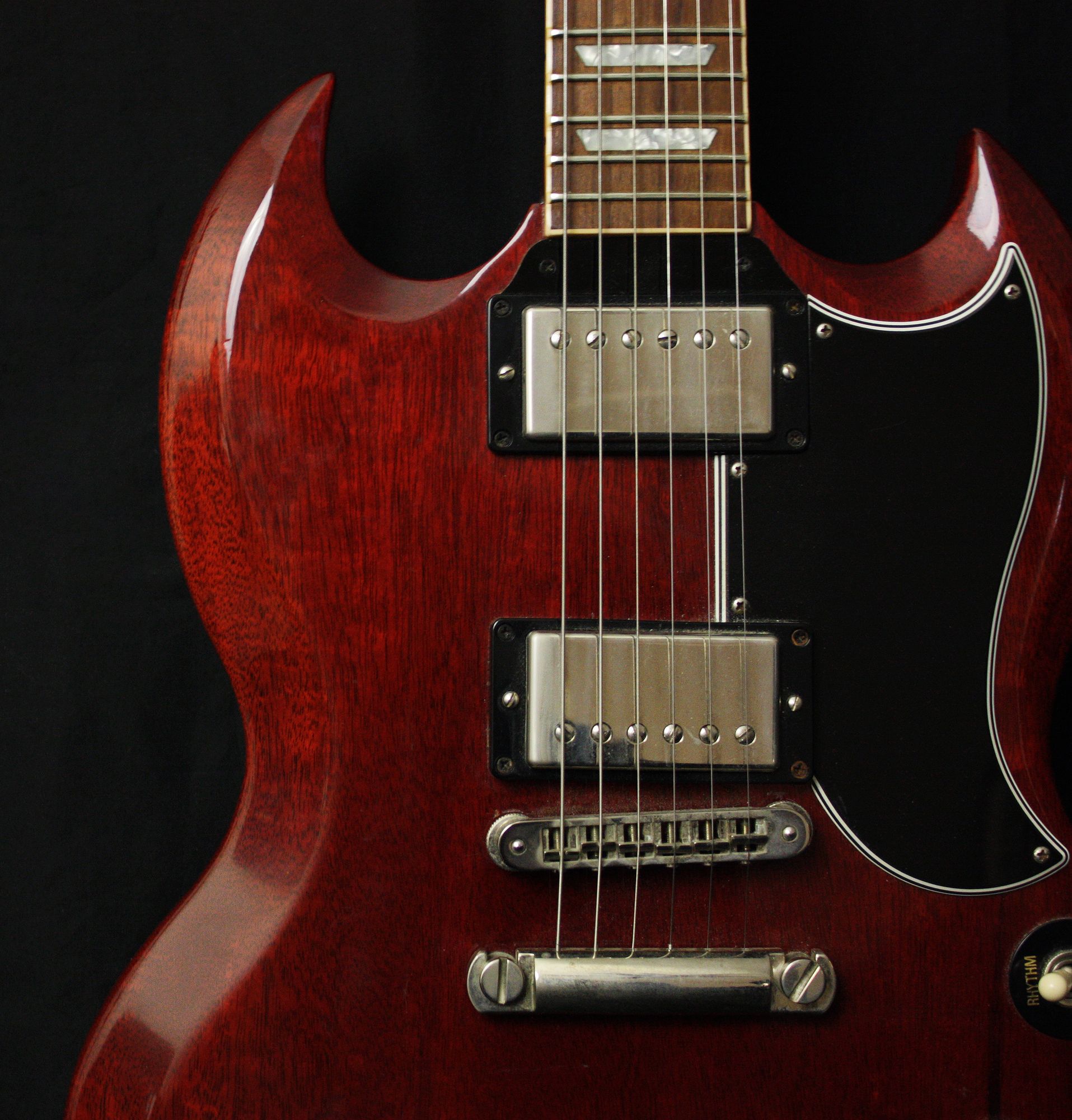
Gibson SG Standard ’61 Reissue, photographed 18 March 2010. Photo by John Tuggle. Licensed under CC BY 2.0. Via Wikimedia Commons. Gibson
SG
1961
Gibson has never stopped making SGs. Angus Young has lost count of his. He still only means one.
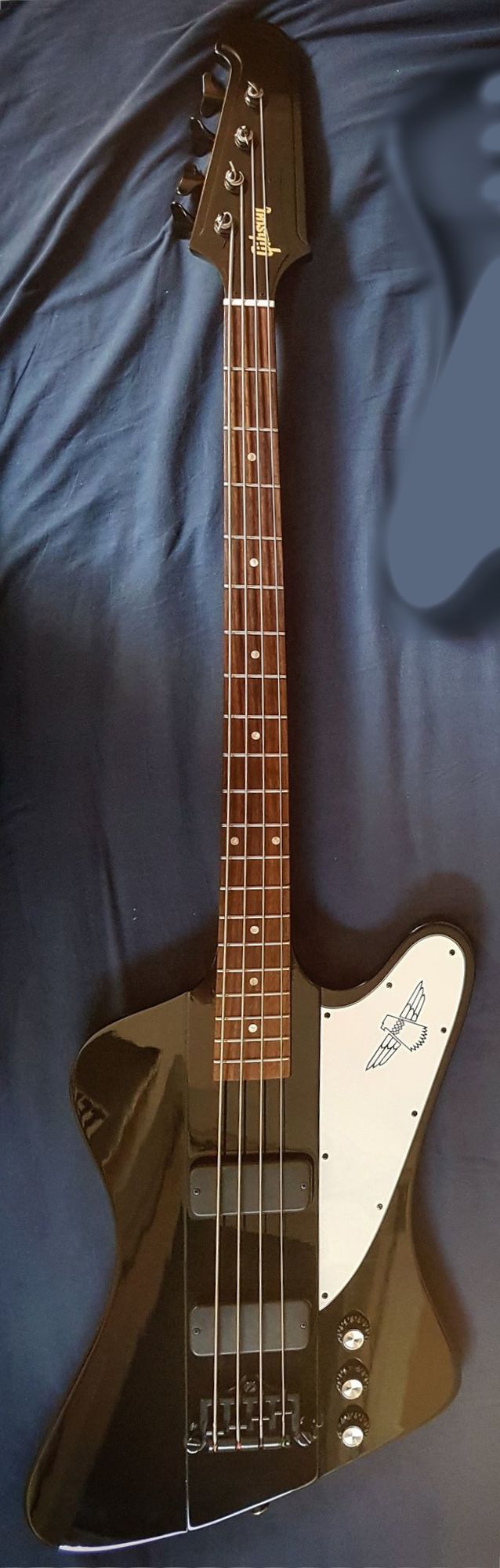
2013 Gibson Thunderbird ebony, clipped from a two-bass photograph. Original photo by MaxVaudous; derivative by Clusternote. Licensed under CC BY-SA 4.0. Via Wikimedia Commons. Gibson
Thunderbird
1963
John Entwistle thought the neck was too thin. So he kept the body and changed the neck.