Gibson
Thunderbird
John Entwistle thought the neck was too thin. So he kept the body and changed the neck.
Forest Hills, New York, July 1971. Keith Moon breaks one of John Entwistle’s Gibson Thunderbird basses, and it ends up smashed. Entwistle doesn’t switch to something sturdier. He keeps playing Thunderbirds for years.
- Introduced
- 1963
- Type
- Solidbody electric bass
- Class
- Production
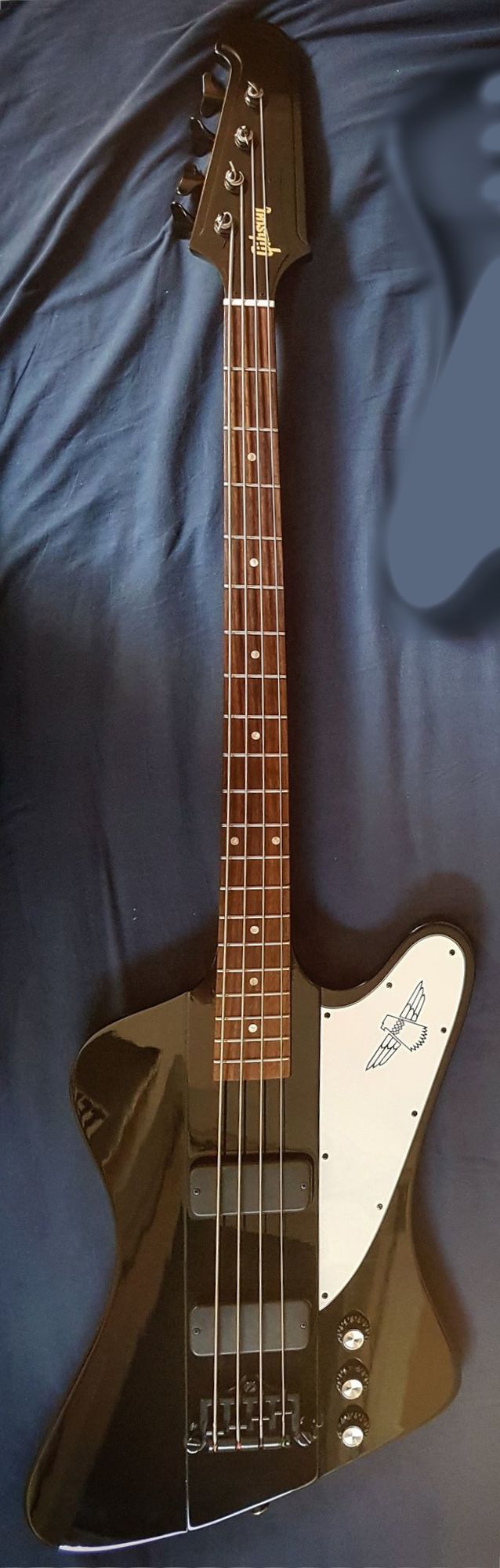
The short version
1963
The bass in the family
Ray Dietrich’s Firebird design gets a bass sibling, in one-pickup and two-pickup versions.
1965
Flipped
The non-reverse Thunderbird arrives, with a glued-in neck and a flat body.
1971
Forest Hills
Keith Moon breaks one of Entwistle’s Thunderbirds, and that one ends up smashed.
1973
Fenderbirds
Around Quadrophenia, Entwistle puts Precision necks on Thunderbird bodies.
1976
Back to reverse
The Bicentennial Thunderbird brings back the reverse body and the neck-through build.
1977
The crash
Lynyrd Skynyrd’s plane goes down. Afterward, Leon Wilkeson’s Thunderbird gets a metal frame on its upper horn.
1992
Reading
Krist Novoselic plays Thunderbird IVs through Nirvana’s summer, Reading included.
Side A
A1
Too thin on top
Nobody loves every part of an instrument. You love the sound, and put up with the weight. You love the neck and wish the knobs were somewhere else. The ones you keep are the ones you’d rather fix than give up.
John Entwistle played Gibson Thunderbirds through the early ’70s, including a 1964 original. He didn’t love the neck. His complaint was simple: “the Thunderbird necks were too thin on top.”
A lot of bass players would have gone back to a Fender at that point. Entwistle did something stranger. Around the Quadrophenia years he took Thunderbird bodies and put Fender Precision necks on them. People called them Fenderbirds. He kept the part he loved and swapped out the part he didn’t.
He had plain ones too, reverse and non-reverse. His 1964 reverse IV was in the Metropolitan Museum of Art’s Play It Loud show in 2019. Not bad for a bass he had complaints about.
A2
A bass built for bass players
Gibson’s basses before 1963 had a short 30½-inch scale and a pickup crammed up against the fingerboard. They had plenty of boom. The Thunderbird was the first Gibson bass with a long scale, about 34 inches depending on whether you believe the catalog or the tape measure. That’s Fender territory. Tighter strings, pickups further from the neck: less boom, more bite.
It came out of Ray Dietrich’s Firebird design, the same swept-back shape with the longer treble horn. The II had one pickup. The IV had two, set further back, closer to where a Jazz Bass puts them. It had Gibson’s first fully adjustable bass bridge, so you could set the intonation string by string. And the neck ran all the way through the body.
It was a lot of bass, with a long headstock that liked to break.
A3
Flipped, and flipped back
In 1965, like the Firebird, it got turned around. The non-reverse Thunderbird had the longer horn on the bass side, a glued-in neck, and a flat slab of a body. Gibson shipped 87 IVs in 1965. Depending on who you ask, some of those were already the new shape, or none of them were. Gibson made the non-reverse through 1969.
Neither version sold much. Gibson shipped 501 Thunderbird IIs in 1964, and neither model had a better year in the ’60s. Original reverse IVs come to somewhere around 300, and the counts don’t quite agree on the last few dozen.
But the shape wouldn’t go away. The Bicentennial Thunderbird in 1976 brought back the reverse body and the neck-through build, and from 1987 on it’s been a regular Gibson. The 2026 model even keeps the raised strip down the middle of the body that makes it look neck-through, though the neck is actually glued in. Gibson says the raised center “evokes” neck-through. That’s Gibson keeping the part people love too.
Gibson built it for bass players. Then bass players rebuilt it for themselves.
Flip the record · By the numbers
34"
Scale, give or take the catalog’s rounding. Gibson’s basses before it were 30½ inches.
$260
The one-pickup Thunderbird II on the July 1963 price list. The two-pickup IV was $335.
~300
Original reverse Thunderbird IVs, give or take. The counts don’t quite agree.
501
Thunderbird IIs shipped in 1964, the best year of the original run.
Side B
B1
Everybody changes something
Look at the famous Thunderbirds and a lot of them aren’t stock. In 1977 Gene Simmons had a Bicentennial-era IV as a backup, with a new pickguard, a DiMarzio in the neck position, and a wireless system. It’s on screen in KISS Meets the Phantom.
In the summer of 1992, Krist Novoselic had two Thunderbird IVs, a sunburst and a black one. He changed the black one’s hardware from black to chrome. In 1994 he gave it to Matt Lukin of Mudhoney. You don’t give away a bass you’ve customized to somebody you don’t like.
B2
The metal horn
Leon Wilkeson played bass in Lynyrd Skynyrd, and he played a Thunderbird. Somewhere along the way he also ended up with a Fenderbird, reportedly from Entwistle himself, after Skynyrd opened for the Who.
On 20 October 1977, the band’s plane went down. Wilkeson survived. Afterward, his Thunderbird got a metal frame fixed to the upper horn so he could hold it the way he wanted, nearly straight up and down.
He could have played anything after that. Something lighter, something easier. He kept the Thunderbird and changed it to fit him. Entwistle swapped a neck. Wilkeson added a piece of metal. Neither one of them was about to put the Thunderbird down.
Put this on
You’ve read about it. Now hear it. Here’s what this guitar sounds like, and what to listen for.
Live at Reading
Krist Novoselic had two Thunderbird IVs that summer, one sunburst and one black.
Watch it on YouTube (opens in a new tab)KISS Meets the Phantom of the Park
Gene Simmons’s 1977 backup bass, a Bicentennial-era Thunderbird IV, is on screen here. It isn’t the Axe, his famous axe-shaped bass. It’s the one he kept in reserve.
Watch it on YouTube (opens in a new tab)
The cast
The people, and the specific guitars, that made the legend.
1971–74
John Entwistle
1964 reverse Thunderbird IV, and others
Played them hard and lost at least one to Keith Moon. Later built “Fenderbirds” because the necks were “too thin on top.”
1977
Leon Wilkeson
A Thunderbird with a metal horn
After the plane crash, a metal frame on the upper horn let him hold it nearly straight up. He also had a Fenderbird, reportedly from Entwistle.
1992
Krist Novoselic
Two Thunderbird IVs
Sunburst and black. He swapped the black one’s hardware to chrome, then gave it to Mudhoney’s Matt Lukin in 1994.
1977
Gene Simmons
Bicentennial-era Thunderbird IV
A backup, with a DiMarzio in the neck position and a wireless rig. Not the Axe.
Liner notes
Specs, construction, rarity, value, and every source we used.
Gibson’s Firebird-shaped bass — Thunderbird, not a Firebird guitar, not a Precision, and not a 4003.
- Body
- Reverse Thunderbird mahogany; raised center section (looks like neck-through; it is set-neck). 3-ply white pickguard with Thunderbird logo.
- Neck
- Glued-in mahogany; SlimTaper; non-reverse Thunderbird headstock (not the 1963 reverse banjo-style head)
- Fingerboard
- Rosewood; 20 medium-jumbo; acrylic dots
- Scale
- 34" / 863.6 mm — long-scale; not Höfner 30", not RIC 33.25"
- Pickups
- Two EB Bass humbuckers (neck and bridge)
- Hardware
- Hipshot Supertone bridge; Hipshot Ultralite Mini-Clover tuners; chrome
- Electronics
- 2 volume, master tone; passive
- Finish
- Gloss nitrocellulose (Ebony, Tobacco Burst Perimeter)
- Nut
- Graph Tech, 1.6" / 40.64 mm
Open the full research fileConstruction details, the complete player record, production numbers, dated value estimates, and sources
Current USA Thunderbird Bass — Gibson.com Ebony BAT4SN00EBCH1, Tobacco Burst Perimeter BAT4SN00TBCH1, $2,499, hardshell case (fetched 25 Aug 2026; No Treble 26 Mar 2026). Reverse body, set mahogany neck, non-reverse headstock. Not a 1963 neck-through original. Not a Firebird guitar. Not a Precision, Jazz Bass, 4003, or Höfner 500/1.
Leftover / labeled, not this table. USA neck-through reverse BAT400EBCH1 (Tobacco Burst / Ebony) — Gibson.com no longer available. USA Non-Reverse Thunderbird BANT00EBCH1 (Ebony) still listed on Gibson.com (~$2,399 on the March 2026 gazette page) — non-reverse silhouette, three-point bridge, Thunderbird (not EB Bass) pickups. Gene Simmons G2 Thunderbird — Gibson.com leftover / no longer available; signature, not this SKU. No current Gibson Custom Historic Thunderbird SKU on Gibson.com this pass. Epiphone Thunderbird ’64 is the Asian 9-ply recreation — adjacent, not this plate.
Construction
Ray Dietrich’s 1963 Firebird family includes this bass. Same year, same modernist brief — not the same instrument. Firebirds are six-strings (I / III / V / VII) on the Firebird plate. Thunderbirds are II (one pickup) and IV (two). Reverse vs non-reverse on this plate works like the Firebird: they share a name, not always a silhouette.
Not a Firebird guitar. Not a Precision. Not a Jazz Bass. Not a 4003. Not a Höfner 500/1. Scale is Gibson’s first 34" bass (previous Gibsons 30.5" EB family). Body is Dietrich offset, not a Fender slab and not a Santa Ana cresting-wave. Neck-through originals share a construction idea with the Rickenbacker 4000/4001 — they are not 4003s.
Reverse (fall 1963–mid-1965). Neck-through; mahogany wings on a 9-ply mahogany/walnut center (Premier Guitar / Gibson copy; RetroFret: 9-piece laminated mahogany center). Raised center carries tuners, pickups, bridge. Reverse body: longer treble horn. Reverse headstock; four in-line Kluson bass tuners (not Firebird banjo tuners). Unbound rosewood dots, 20 frets. Soapbar bass humbuckers (lap-steel molds, Premier Guitar). II: one pickup, volume and tone. IV: two pickups, Jazz-style volume–volume–tone; pickups in Jazz-like positions, not at the fingerboard like earlier Gibson EBs. Tune-o-matic-style adjustable bass bridge plus separate tailpiece — Gibson’s first fully adjustable bass bridge (FlyGuitars). Catalog sunburst; Duco custom colors extra. July 1963 list: II $260, IV $335 (FlyGuitars); VG&B 1964 zone-1: II $290, IV $370. Scale: RetroFret measured 34" / 864 mm, nut 1 1/2"; FlyGuitars catalog 34 1/2" (“actually three eighths”) — keep as a range, do not flatten. Production commonly autumn 1963; RetroFret: basses not shipped in quantity until early 1964. FlyGuitars: reverse run autumn 1963–May 1965.
Non-reverse (price lists June 1965; catalog 1966–69). Longer bass horn. Set neck. Flat slab, no raised center; larger guard. Chrome covers replace nickel. Hardware/pickups otherwise the same family. FlyGuitars: whether any NR shipped in calendar 1965 is unclear; RetroFret: some of the 87 1965 IVs were the new non-reverse. Do not pick one 1965 split. Wikipedia’s Fender-lawsuit story is the same unconfirmed claim the Firebird plate already flags against guitarhq / VG — do not promote it here.
II vs IV is pickup count, not a different body. Later “Thunderbird IV” reissues are two-pickup reverse-shape basses, not a 1963 II.
Later reverse shape ≠ 1963–65 original. Bicentennial Thunderbird IV 1976–79: reverse shape and neck-through return; three-point bridge; red-white-blue bird on the guard (Wikipedia / Axeology). Then a gap. 1987– reverse reissues (VG&B: mainstay from 1987). Leftover USA BAT400EBCH1 was 9-ply neck-through reverse with ceramic Thunderbird humbuckers. 2026 USA (this table) is reverse body with a set neck and a non-reverse headstock — Gibson copy: raised center “evokes” neck-through. It is not a Historic 1963. Non-reverse USA (BANT00EBCH1) is the 1965-on silhouette, not the reverse original. G2 Simmons and Nikki Sixx Blackbird are signatures, not this SKU.
Players
Jamerson, Duck Dunn, and Carol Kaye stay on the Precision. Geddy’s Number One is a Jazz Bass; his Ricky is a 4001. McCartney’s identity bass is the Höfner 500/1; his later 4001S lives on the 4003 plate. They do not belong here.
John Entwistle — 1964 reverse Thunderbird IV (serial 160065) and other Thunderbird IVs, 1971–74. Whotabs: at least two; one broken by Keith Moon at Forest Hills, July 1971, then smashed. 160065 (mahogany, impressed serial): Sotheby’s May 2003, estimate £6,000–£8,000, sold £28,800; later David Swartz; MET Play It Loud through October 2019. Whotabs also lists 1965–69 non-reverse IVs and a possible orange custom-color NR. Entwistle on Quadrophenia-era hybrids: Thunderbird bodies with Fender Precision necks because “the Thunderbird necks were too thin on top.” Those Fenderbirds are hybrids, not this SKU. Artist lot — not a comps tape.
Leon Wilkeson — Thunderbird, including a Guitar World–dated 1963 T-Bird with a post-crash metal horn extension. Guitar World (28 July 2023): metal frame on the upper horn after the 20 October 1977 plane crash so he could hold the bass near-vertical. Also a 1962 Jazz Bass (that plate) and a Fenderbird (Thunderbird body, Precision neck) reportedly from Entwistle after a Quadrophenia support slot; Old Grey Whistle Test, 1975. guitarhq ships 2 Thunderbird IIs in 1963 and no IVs until 1964 — treat “1963” as GW’s attributed year, not a factory census of IVs.
Krist Novoselic — two Thunderbird IVs (Vintage Sunburst and Ebony), summer 1992 including Reading. Live Nirvana / Ernie Bailey: converted the Ebony from black to chrome hardware; gave it to Matt Lukin (Mudhoney) in 1994. Not every Nirvana bass is this guitar (Ripper, RD, Ibanez Eagle, EB-2).
Gene Simmons — Bicentennial-era Thunderbird IV as a 1977 backup, not the Axe. Axeology: latter half of July 1977 (Edmonton / Calgary 31 July 1977); replacement guard, DiMarzio Model One in the neck, Schaffer-Vega wireless; on-screen in KISS Meets the Phantom. Looks 1976/77 (three-point / bicentennial family), not a 1963 reverse original. The Axe and the leftover G2 Thunderbird signature are different objects.
Also, labeled. RetroFret’s user list (Glenn Cornick, “Overend” Watts, Martin Turner, Arthur Kane, Pete Way, George Chambers) is a dealer paragraph, not independently serialled here. Nikki Sixx’s Blackbird is a signature Thunderbird-shape with iron-cross inlays and a kill switch — not this catalog SKU.
Rarity
The Thunderbird as a current USA model is not scarce. 2026 BAT4SN00… is regular catalog. Leftover Non-Reverse and discontinued neck-through USA / G2 are production leftovers, not 1963. Official lifetime totals after 1969 are unpublished.
Scarcity is 1963–69 Kalamazoo shipping, especially reverse II/IV. guitarhq.com (Meiners-style solidbody table, Tbird2 / Tbird4):
| 1963 | 1964 | 1965 | 1966 | 1967 | 1968 | 1969 | |
|---|---|---|---|---|---|---|---|
| Thunderbird II | 2 | 501 | 215 | 361 | — | 67 | 7 |
| Thunderbird IV | — | 235 | 87 | 131 | 120 | 31 | 1 |
FlyGuitars reverse subtotal 718 II + 322 IV (1963–65). NR subtotal 435 II + 283 IV, with a 1969 IV conflict: Meiners/guitarhq 1 vs an anonymous Kalamazoo ledger 6 — keep 1–6. RetroFret: reverse IV “at the maximum around 300.” Custom-color reverse sits above sunburst. Headstock breaks are common (RetroFret: the usual restoration). Artist-owned pieces are a separate market. A 2026 set-neck reverse is not a 1963 neck-through.
Value
Informal estimate, 25 August 2026. Not an appraisal.
Asking prices are not sold prices. 2024–26 Reverb sold histograms were not extracted this pass (price-guide pages challenged). Prefer labeled dealer asks. Entwistle / celebrity lots are not comps. Epiphone is not USA money. A Non-Reverse leftover is not reverse-original money. A 2026 set-neck is not 1963 neck-through money.
New street. Gibson USA Thunderbird Bass $2,499 (Ebony / Tobacco Burst Perimeter, Gibson.com and No Treble, March–August 2026). Leftover Non-Reverse listed $2,399 on Gibson’s March 2026 gazette page. G2 / BAT400 leftover: no current list.
Used modern. USA 1987–2020s reverse reissues: labeled dealer asks around $1,500–$2,300 this pass (e.g. Magdon-style used Tobacco Sunburst $2,300 ask on FlyGuitars’ feed; UK used IV £1,537 ask). No clean 2024–26 Reverb sold band captured. Do not invent one.
Vintage / collectible. Premier Guitar Vintage Vault (5 Mar 2017): 1964 reverse II excellent all-original $7,500 — 2017 dealer-comp, not 2026. 2015 Vintage Price Guide via GuitarPoint: reverse-year T-birds $10,500–$13,100 — dated aggregator. Live asks (not solds): London Vintage Guitars 1964 reverse (twin pickup) £11,999; Fort Lauderdale dealer 1964 reverse IV $27,495; Vintage and Rare / ATB 1964 reverse IV EUR 20,904. GuitarPoint listing with headstock repair priced under that 2015 band. Entwistle 160065 £28,800 hammer (Sotheby’s May 2003) is an artist lot, not a production median. Non-reverse 1966–69 sits below reverse originals in every dated guide cited here; no 2024–26 public NR hammer isolated this pass.
See also
- gibson-firebird — Dietrich’s six-string sibling; reverse vs non-reverse share a name, not always a silhouette; not this bass
- fender-precision-bass — Leo’s 34-inch bolt-on split-coil; the bass this neck-through (then set-neck) bird is not
- fender-jazz-bass — Fender’s second 34-inch four-string; offset slab, two skinny singles; Entwistle’s later hybrids borrow a P-neck, not a Jazz
- rickenbacker-4003 — 33.25" Santa Ana neck-through; related construction idea, different silhouette and year
Sources
- Gibson Thunderbird Bass, Ebony — current USA SKU BAT4SN00EBCH1, $2,499; reverse mahogany body, set SlimTaper neck, non-reverse headstock, 34"/1.6", EB Bass pair, Hipshot Supertone / Ultralite, gloss nitro, hardshell (25 Aug 2026)
- Gibson Thunderbird Bass, Tobacco Burst Perimeter — twin finish; dealer sheets use BAT4SN00TBCH1
- Gibson, upgraded Thunderbird (Mar 2026) — reverse body + set neck + NR headstock; leftover Non-Reverse listed $2,399
- No Treble, 2026 Thunderbird — $2,499; spec table (26 Mar 2026)
- Guitar World, 2026 Thunderbird — 34"; Novoselic / Simmons named as users of the model family
- Gibson leftover neck-through Thunderbird Ebony — BAT400EBCH1, 9-ply neck-through, no longer available
- Gibson Non-Reverse Thunderbird, Ebony — leftover USA BANT00EBCH1
- guitarhq.com solidbody shipping — Tbird2 / Tbird4 1963–69 cells (Meiners)
- FlyGuitars, reverse Thunderbird 1963–65 — July 1963 prices; neck-through; shipping 718 II / 322 IV; autumn 1963–May 1965
- FlyGuitars, non-reverse 1966–69 — set neck; June 1965 lists; 1969 IV 1 vs 6
- Vintage Guitar and Bass, 1964 catalog p.13 — II one pickup / IV two; 1987 relaunch note
- Premier Guitar Vintage Vault, 1964 Thunderbird — Dietrich; 9-ply bass vs two-piece guitar center; 501 II in 1964; 2017 $7,500 (5 Mar 2017)
- RetroFret, 1964 Thunderbird IV — 34"/864 mm, 1 1/2" nut; 235/87 IV; some 1965 NR; reverse IV “~300 max”; Jazz-position pickups
- Whotabs, Entwistle 1971–74 — 160065; Forest Hills 1971; Sotheby’s £28,800; Fenderbird quote
- Guitar World, Wilkeson Thunderbird — ’63 T-Bird metal horn; Fenderbird / OGWT 1975 (28 July 2023)
- Live Nirvana, Novoselic gear — two T-Bird IVs; Lukin 1994
- Axeology, Simmons 1977 Thunderbird — Bicentennial-era backup; not the Axe
- Gibson leftover G2 Thunderbird — signature SKU, no longer available
- Wikipedia, Gibson Thunderbird — lead only (1963 intro; II/IV; NR construction). Lawsuit paragraph unconfirmed here, as on the Firebird plate
- Wikimedia Commons, 2013 Gibson Thunderbird Bass — MaxVaudous / Clusternote, CC BY-SA 4.0; 2013 ebony USA reverse, not a Firebird guitar and not a 1963 original

Keep digging
Guitars this one gets compared to, confused with, or descended from.
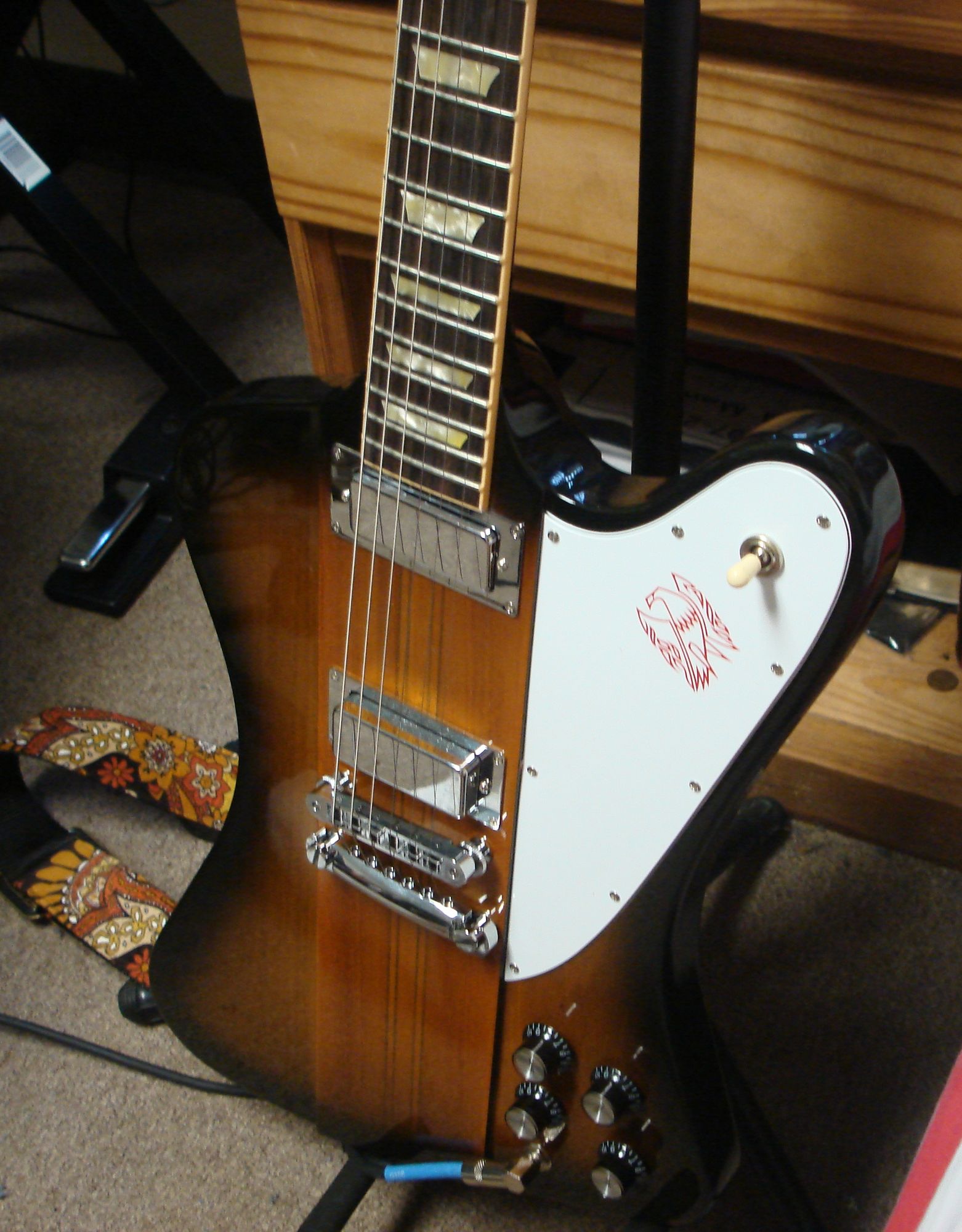
Gibson Firebird V. Photo by Jones629. Public domain (PD-self). Via Wikimedia Commons. Gibson
Firebird
1963
Gibson fixed the Firebird in 1965. Players have been hunting for the unfixed one ever since.

Photo: Infrahertzz / Wikimedia Commons / CC BY-SA 3.0 Fender
Precision Bass
1951
Leo’s bass let the player at the back be heard. You know their lines by heart. You mostly don’t know their names.

Fender Jazz Bass from 1966 in Olympic white with the transition fingerboard (bindings and dot inlays). Photo by Th. Ott. Licensed under CC BY-SA 3.0. Via Wikimedia Commons. Fender
Jazz Bass
1960
Built for jazz players who mostly passed on it. Then bass players started using it to take the solo.