Gibson
Explorer (1958–59 korina)
Gibson shipped twenty-two of them. Everybody knows the shape. Hardly anybody has held the real thing.
Early 1970s. George Gruhn sends Rick Derringer an Explorer on approval, because something about it is odd: the headstock is shaped like a V instead of the usual hockey stick. Derringer opens the case and recognizes it. He’d seen it as a kid, on a visit to the lobby at Gibson in Kalamazoo.
- Introduced
- 1958–59
- Type
- Solidbody electric
- Class
- Closed run
Have a photograph of this guitar? Send a picture
The short version
1958
“Modernistic”
The Explorer, born as the Futura, goes on Gibson’s 1 July price list next to the Flying V, at $247.50.
1959
Three more
Gibson ships three Explorers and stops.
1962
Leftovers
Around 1962–63, spare korina bodies get finished with nickel hardware instead of gold.
1976
Back, in mahogany
Gibson revives the shape in mahogany. That’s the Explorer in most ’70s rock photos.
1983
Albert Hall
Eric Clapton plays his 1958 at the ARMS concert on 21 September. The cameras are rolling.
1999
Clapton lets it go
Clapton’s Explorer goes through Christie’s in New York, in the sale for his Crossroads charity.
2021
Three in one room
Rick Nielsen shows Gibson TV three 1958 Explorers from his own collection.
Side A
A1
The kid in the lobby
Most guitars you forget. You play one in a shop, you like it fine, you hand it back and go get lunch. The original korina Explorer doesn’t work that way. There were so few that almost everyone who ever crossed paths with one seems to remember exactly when, and where, and who they let have it afterward.
Rick Derringer is the best example. In the early ’70s, the Nashville dealer George Gruhn sent him an Explorer on approval, because the headstock wasn’t the usual long hook. It was a V. Derringer knew it on sight. He’d seen it as a kid, standing in the lobby at Gibson in Kalamazoo.
Gibson started it as the Futura, one of the three “Modernistic” designs it drew up in the late ’50s, alongside the Flying V and the Moderne. By the 1 July 1958 price list it was the Explorer, in blonde korina with gold hardware and two of Gibson’s new humbucking pickups, and it cost $247.50. Same as a V. Same as a Les Paul.
A2
Twenty-two, give or take the paperwork
Gibson’s logs show 19 shipped in 1958 and 3 in 1959. That’s 22, and it’s the number almost everyone uses. You’ll see people say “about a hundred.” That’s the Flying V’s number, and even the V only shipped 98.
The honest version is fuzzier. The factory books don’t actually say “Explorer.” They just list korina modernistic guitars, and since nobody has ever verified a Moderne, historians read those lines as Explorers. If a Moderne or two is hiding in there, the count goes down. Some historians go the other way: maybe 38 to 40 built, with 22 sold in 1958–59. Around 1962–63 the factory finished some leftover bodies with nickel hardware, and nobody knows how many. By 2011, about 38 originals were known to exist, leftovers included.
Twenty-two shipped, maybe forty built, and no straight answer. Either way, it’s several times rarer than the V.
Nineteen in 1958. Three in 1959. You could fit every one of them in a small living room.
A3
Not a V with the corners filled in
People lump it in with the V, and they shouldn’t. The body is an offset, angular thing with a long treble horn and a wedge of a bass side. The headstock is that long hockey stick with six tuners down one side and a pearl Gibson logo. The V got raised plastic letters.
The strings don’t go through the body, either. The Explorer has a Tune-o-matic bridge and a stop tailpiece, the same working parts as a 1958 Les Paul, and the jack is on the side. Under all that space-age wood, it’s a Les Paul’s guts in a very strange suit.
The fretboard is still an argument. Most identification guides say rosewood. A couple of respected write-ups, including the auction catalog for Clapton’s, say ebony. When Gibson’s Custom Shop 3D-scanned museum 1958s in 2021, it used Brazilian rosewood. I’d say rosewood and keep my voice down.
And the V headstock? Gibson told Derringer his was the only real one they’d ever seen. Then Rick Nielsen showed one on Gibson TV. So that’s at least two.
Flip the record · By the numbers
19
Explorers Gibson shipped in 1958, by the factory logs.
3
Shipped in 1959. After that, nothing new until the leftovers.
38
Originals known to exist as of 2011, leftover 1962–63 guitars included.
$247.50
List price on 1 July 1958. Same as a Flying V or a Les Paul Model.
Side B
B1
The shape that got away
After the leftovers, the Explorer disappeared for more than a decade. Other companies noticed the empty spot. Hamer built an Explorer-style guitar from 1974, and Eddie Van Halen played an Ibanez Destroyer, an Explorer-shaped copy, on the first Van Halen album. Gibson brought the shape back in mahogany in 1975–76.
That 1976 guitar is the Explorer most people picture. The Edge’s is from that era. James Hetfield’s famous stage guitars are 1976 Gibsons and ESP copies. The Explorer as a heavy metal weapon is real. It just isn’t the life story of those 22 blonde guitars from Kalamazoo.
B2
Three in one collection, two at one session
The originals mostly went quiet, then turned up with people who knew what they had. Clapton bought his around 1983 from a fan in Austin, Texas, and played it at the ARMS concert at the Royal Albert Hall that September. In 1999 it went through Christie’s, in the sale for his Crossroads charity. Gibson’s later “Clapton Cut” Explorer has a trimmed bass side, but the auction description of Clapton’s guitar doesn’t mention a cut. That may be two different stories.
Rick Nielsen has three 1958s. One, he says, “might be the first ever made.” That’s his claim, not a factory ranking. Slash had two at once:
When I went into the studio to record Use Your Illusion, I picked up two ’58 Explorers.
Allen Collins of Lynyrd Skynyrd is the tricky one. His Explorer is usually called a 1958, but the nickel parts and other changes could mean a 1962–63 leftover, or just a lot of work over the years. I’d call it a korina Explorer and leave the year alone.
B3
The one you let go
Slash kept one of his two. It has a Bigsby that Gibson fitted at Kalamazoo in 1975, the paperwork to prove it, and a photo of its first owner, Kirk “Pal” Jennings. The other one he gave to a tech, who later sold it. He calls that “one of my very, very few regrets.”
Derringer sold his too, in the mid-’80s. He never played it much. It was the same guitar he’d seen as a kid in a Kalamazoo lobby, and he still let it go.
Plenty of people have played great music on the copies. But only 22 went out the door in 1958 and 1959, and nearly everybody who has had one remembers the day it arrived. Sometimes they remember the day it left, too.
Put this on
You’ve read about it. Now hear it. Here’s what this guitar sounds like, and what to listen for.
Cocaine (live at the ARMS concert)
Royal Albert Hall, 21 September 1983, filmed. Clapton is playing his 1958 korina Explorer. “Rita Mae,” “Rambling On My Mind,” and “Have You Ever Loved a Woman” were on it that night too.
Watch it on YouTube (opens in a new tab)Live at Knebworth
Allen Collins with his Explorer, 21 August 1976. It’s usually called a 1958, but the hardware hints it could be a 1962–63 leftover, or just heavily changed.
Watch it on YouTube (opens in a new tab)
The cast
The people, and the specific guitars, that made the legend.
early 1970s
Rick Derringer
The V-headstock Explorer
Recognized it from a childhood visit to Gibson’s lobby. He didn’t play it much and sold it in the mid-1980s.
1983
Eric Clapton
1958 korina Explorer
Bought from a fan in Austin, Texas. Played at the ARMS concert, then sold through Christie’s in 1999.
2021
Rick Nielsen
Three 1958s
One, he thinks, “might be the first ever made.” Another has the split V headstock.
1991
Slash
Two ’58 Explorers
He kept one, which Gibson fitted with a Bigsby back in 1975. He gave the other to a tech, and still regrets it.
1976
Allen Collins
Korina Explorer, Maestro vibrato added
His main Lynyrd Skynyrd Explorer from Knebworth on. Called a 1958; it may be a leftover.
1959
Lonnie Mack
An Explorer, alongside his Flying V
Bought from Glenn Hughes, the same Ohio shop owner who got him the V.
Liner notes
Specs, construction, rarity, value, and every source we used.
Scarcer than the korina V, and the guides price it that way: 19 shipped in 1958, 3 in 1959. Almost no public hammers to check the number against.
- Body
- Solid korina (African limba); offset angular / “hourglass” / “X” with elongated treble horn and wedge-shaped bass
- Neck
- Set korina; asymmetric “hockey-stick” / scimitar headstock, six tuners on one side; black-faced peghead with pearl Gibson logo inlay
- Fingerboard
- 22-fret rosewood, pearl dots — Vintage Guitar 2026 and the 1999 Christie's Clapton catalog say ebony. Contested; see Construction
- Scale
- 24.75" class
- Pickups
- Two PAF humbuckers (1958–59)
- Hardware
- ABR-1 Tune-o-matic + stud/stop tailpiece (strings do not go through the body); gold-plated; Kluson Deluxe tuners
- Electronics
- Two volume + one tone, three-way toggle, on a long pickguard (typically white/cream); side-mounted output jack
- Finish
- Natural korina
- Nut
- Width not documented in the sources used here
Open the full research fileConstruction details, the complete player record, production numbers, dated value estimates, and sources
Original 1958–59 gold-hardware spec. This is not a current SKU. 1975–76 mahogany reintroduction, 1983 korina reissues, Historic/Custom Shop recreations, and current Gibson USA Explorers are different instruments. Do not use them as comps.
Construction
Gibson Explorer. Prototype / patent-era name Futura. Listed with the Flying V on Gibson’s 1 July 1958 price list as a “Modernistic” guitar. Sister to the V and the unreleased Moderne. Commercial shipments 1958–1959. Leftover korina bodies completed c. 1962–1963 (nickel hardware). Then dropped until a 1975–76 mahogany reintroduction — not korina. First korina reissue is generally 1983.
Body wood is korina / African limba (Terminalia superba), same naming as the V. The offset angular shape is what later mahogany copies imitate. Those copies are not this guitar.
The spec table is the original gold-hardware recipe. Headstock is the asymmetric “hockey-stick,” six-on-a-side, with a pearl Gibson logo (the V uses raised plastic lettering). A few early/Futura-related examples have a split / V-shaped peghead (Rick Derringer’s documented original is often cited; Blue Book: “a few early specimens were produced with a V-shaped peghead and a raised plastic logo”).
Fretboard is contested. Majority of identification sources say 22-fret rosewood, pearl dots (Blue Book; Reverb Bacon timeline; guitar-explorer blog). Vintage Guitar 2026 and the 1999 Christie's Clapton catalog say ebony. Gibson Custom Shop’s 2021 Collector’s Edition, 3D-scanned from 1958 museum Explorers, used Brazilian rosewood. Report rosewood as the stronger recreation/ID consensus, ebony as a published discrepancy. Do not flatten to one wood.
Main hardware difference from the original V: ABR-1 plus stud/stop tailpiece. Strings do not go through the body. Gold-plated on 1958–59; nickel on 1962–63 leftovers, which typically also have patent-number humbuckers. Side-mounted jack — unlike the V’s front-wing jack. Factory finish: natural korina, not later black/white/cherry. Case: brown 1958–59 vs black 1962–63 (Blue Book). Clapton’s 1999 lot had a black rectangular case with brown plush — consistent with later or leftover-period case, not proof of year by itself. Serial: same 1958 inked 8-xxxx family (Clapton: 8 4541). Original list $247.50 (1 July 1958 price list; same as Flying V and Les Paul Model).
Gibson logs cited as 19 “Korina (Mod. Gtr.)” in 1958 and 3 in 1959 (explorerbass.com). Because no Moderne has been verified, those entries are taken as Explorers — an inference. If any “Mod. Gtr.” were Modernes, Explorer counts would be even lower. Unresolved.
Later Explorers are different guitars. 1975–80 reissue is mahogany — The Edge’s well-known Explorer is that era, not 1958. 1983 is Gibson’s first korina Explorer reissue (Blue Book: estimated <100). Historic/Custom Shop recreations (including 2021 Murphy Lab run of 19) are modern. Current USA Explorers are mahogany in the low thousands. Explorer II / E2 is a different design. Leftover 1962–63: nickel, patent-number pickups, metal-topped knobs, black/yellow cases. VG 2026: leftovers “sell for about half the price.” Blue Book historically treated leftover values as similar to 1958–59. Sources disagree.
Players
Original-era Explorer players are even scarcer than V players. The myth of the Explorer as a metal weapon is real; it is not the biography of the 22-odd 1958–59 korina guitars.
Eric Clapton — serial 8 4541. Original 1958 natural korina Explorer. Bought c. 1983 via Roger Forrester from a fan in Austin, TX (Lee Dickson: Ronnie Prolor). Used at ARMS, Royal Albert Hall, 21 September 1983 (Rita Mae, Rambling On My Mind, Have You Ever Loved a Woman, Cocaine — filmed). Christie's New York, 24 June 1999 (Crossroads) is a provenance event: hammer $120,000; $134,500 with premium. Catalog: 22-fret ebony board (see construction conflict), cream pickguard, stud tailpiece. Clapton also sold a 1996 black Explorer in the same sale ($24,000) — not a 1958. Gibson's 2001 "Explorer Clapton Cut" (shortened bass bout) and "Explorer Split Headstock" are modern recreations; the Christie's essay does not describe 8 4541 as sawn-off. Treat "Clapton Cut" and 8 4541 as possibly two stories until a single-instrument chain is published.
Rick Nielsen (Cheap Trick) — three 1958s. MusicRadar / Gibson TV The Collection (24 Dec 2021): Nielsen showed Mark Agnesi three 1958 korina Explorers. Serial 81008 on the first ("might be the first ever made" — Nielsen's claim, not a factory ranking). One heavily modified/road-worn; one with split V-shaped headstock. MusicRadar's "only 19 '58 Explorers ever made" is the popular 1958-shipment shorthand; it ignores the three 1959 shipments and leftovers. Living holder of multiple original-era Explorers — not a 1976-reissue player in this context.
Slash — two 1958s at the Use Your Illusion sessions. Gibson Gazette, 12 February 2024: "When I went into the studio to record Use Your Illusion, I picked up two '58 Explorers." He gave one to a tech who later sold it ("one of my very, very few regrets"). The one he kept: Bigsby fitted by Gibson at Kalamazoo in 1975 (paperwork), plus photo of original owner Kirk "Pal" Jennings. Heavily gigged original, factory-refitted 1975 — still a 1958 korina body/neck, not a 1976 mahogany reissue. Slash's Use Your Illusion Flying V is a 1959 korina V; these Explorers are a separate pair. Do not swap the stories.
Rick Derringer. Vintage Guitar (Aug/Sept 1998): in the early 1970s Gruhn sent him an Explorer on approval because the headstock was not the usual hockey-stick — it was V-shaped. Derringer recognised it from a childhood visit to the Kalamazoo lobby. Plugged Bigsby holes; Gibson later told him it was the only real V-headstock Explorer they had seen. He did not play it much and sold it in the mid-1980s. Documented original with Futura-style peghead. Replica trap: Gibson Historic korina Explorers with split headstocks (1990s–2000s). Forum lore that "only Derringer's was real" is too strong given Nielsen's documented split-head example on Gibson TV.
Allen Collins (Lynyrd Skynyrd). Widely identified as a 1958 korina Explorer, Maestro vibrola added (not factory on Explorers). Gibson Custom Shop, 2003: signature model "made to the specifications of the 1958 Gibson Explorer once used by" Collins. Purchase story contested (Gruhn's Nashville mid-1976 vs Manny's NYC 1974/May 1976). Hardware on the stage guitar (nickel, replacement Burstbuckers, Badass bridge, Maestro vibrato) may indicate a leftover 1962–63 completion and/or later mods. Often called a 1958; leftover-vs-first-run status is not clean. Main Skynyrd stage/recording Explorer from Knebworth, 21 August 1976, through the plane-crash era. Do not treat as a fully documented gold-hardware 1958.
Lonnie Mack. explorerbass.com: bought an Explorer (as well as Number 7 V) from Glenn Hughes in 1959. Same Cincinnati/Norwood circle. Sourced; not widely photographed in the materials reviewed. Treat as attested but not widely catalogued as a named surviving celebrity Explorer.
Not original-korina players. Metallica / Hetfield / Hammett / Jabs — and The Edge, Dave Grohl, Lzzy Hale — are 1976+ mahogany or copies. Hetfield's Explorer-shaped stage guitars are 1976 Gibson mahogany (e.g. "Rusty") and ESP MX-220 copies (e.g. "Eet Fuk"), not 1958 korina. Matthias Jabs, The Edge: 1976-and-later mahogany or modern Explorers. Eddie Van Halen's Ibanez Destroyer on the first Van Halen album is an Explorer-shaped copy, not a Gibson korina original. Hamer Standard (from 1974) and Jackson Kelly / Dean Z lawsuits explain why Gibson reissued the Explorer in 1976; they are not original instruments. The 1976 Limited Edition mahogany Explorer is the instrument in most 1970s rock photographs labelled "Explorer." 2001 Clapton Cut / Split Headstock and 2003 Allen Collins Custom Shop runs are recreations.
Rarity
Report the range. Do not collapse it. Lead with the shipment ledger.
19 shipped 1958 + 3 shipped 1959 = 22 is the ledger total almost everyone uses (guitarhq.com; Bacon; Vintage Guitar 2026; Gibson Custom Shop / Premier Guitar 2021; Christie's Clapton catalog; Blue Book). This guitar is not “~100.” That shorthand belongs to the Flying V (81 + 17 = 98).
Up to ~38–40 produced; 22 sold 1958–59 is Duchossoir. explorerbass.com / Jack French: one batch of 40 hypothesized from leftover “40” racks. Gibson claimed 38 original Explorers at the 1976 reissue (via Duchossoir) — not independently re-verified against a Gibson primary here. Blue Book’s looser “estimated under 100” line is for the whole korina Explorer family, not the 1958 shipping tally.
Leftover-parts 1962–63 are a separate small batch (nickel hardware, patent-number humbuckers, often black case). Count unknown. Wikipedia (citing VG 2011 apparatus): 38 examples known to exist as of 2011, which includes leftover completions, not only 1958–59 gold-hardware PAFs.
Working range: 19 + 3 = 22 shipped is the figure to cite. Produced ceiling around 38–40 (Duchossoir / Gibson-at-1976) may stay attributed. Leftover 1962–63 is extra, not a reason to round this guitar to ~100. Explorer is several times rarer than the korina V on shipment totals.
Value
Informal estimate, 25 August 2026. Not an appraisal.
Market data is extremely thin — a stronger warning than for the V. The only public original-korina sold located here is one celebrity 1999 lot. That plus guide values do not make a market. Guide ≠ auction. This is not the korina V’s ~$100k–$165k public-lot picture.
Public comps: 24 June 1999, Christie's New York (Clapton / Crossroads), lot 92: 1958 Explorer, serial 8 4541. Hammer $120,000; $134,500 with premium. Artist-associated; 27 years stale. Do not inflate 1999 dollars to 2026. Sweetwater (2023) still cites $134,500 as the public benchmark — that is stale. Oct 2008 compilation listing (Acoustic Music; house not named): “1958 Gibson Explorer (Korina) $150,000” — snapshot only. No 2019–26 original-korina public sold located. No Heritage / Guernsey’s / Gardiner Houlgate original-Explorer hammer in that window. Private treaty dominates.
Guides (not comps): VG April 2011 $250k–$300k (ranked above the V that year). Blue Book commentary: a clean original “will probably bring $350k–$450k” — a guide comment, not a sale. Vintage Guitar, “40 Most Valuable Guitars of 2026”: ranked No. 1, $1,000,000–$1,350,000. Leftover 1963-type examples “about half” (VG 2026).
VG 2026’s $1.0–1.35 million is a magazine guide for top examples, not an auction result. Stale VG 2011 ($250k–$300k) sits below current Blue Book commentary ($350k–$450k); neither is a 2024–26 public sold. Museum-tier; expect private treaty; originality and paperwork dominate. Do not treat the 1999 hammer as a 2026 price, and do not treat the 2026 guide as a sold median. Expect leftover-1963 discounts (VG: half; older Blue Book treated leftovers as similar). Context, not a substitute original-korina comp: The Edge’s 1976 mahogany Explorer sold $611,000 (15 Oct 2006, Music Rising) — artist provenance repricing the shape. Do not use 1976 mahogany Explorer retail ($9k–$11k used), 1983 korina reissues (~$12k listings in 2026), or current USA Explorers as originals’ comps.
See also
- gibson-flying-v-1958-korina — the other original korina Modernistic
- gibson-les-paul-standard — same $247.50 list, not the same guitar
- gibson-sg — later Gibson angular that players could actually find
Sources
- guitarhq.com shipping table
- Vintage Guitar, 40 Most Valuable Guitars of 2026
- Christie's, Clapton 8 4541
- Where’s Eric!, 1999 Christie's auction
- Sweetwater, 1958 korina V / Explorer
- Premier Guitar, Gibson Explorer korina
- Blue Book, Gibson Explorer korina
- explorerbass.com history
- Reverb, Flying Vs and Explorers timeline
- guitar-explorer, 1958 Gibson Explorer
- Premier Guitar, Gibson Moderne
- Gibson Gazette, Slash 1958 Explorer
- MusicRadar, Rick Nielsen three 1958 Explorers
- Vintage Guitar, Rick Derringer
- Acoustic Music, notable guitar sales
- Wikipedia, Gibson Explorer — 19/3/leftover; 38 known as of 2011; VG 2011 $250k–$300k
- MyLesPaul: Allen Collins Explorer — 2003 Custom Shop announcement; korina, Maestro.
- Chris Gill, Guitar Player: History of the Flying V — Modernistic batch planning; V orders vs Explorer.
- Thalia: Iconic Guitars — Gibson Explorer — Gazette quotation; 19/3 shipping; Hamer/Ibanez/1976 revival.
- Ground Guitar: James Hetfield guitars — 1976 "Rusty" vs ESP copies; not 1958 korina.
Keep digging
Guitars this one gets compared to, confused with, or descended from.
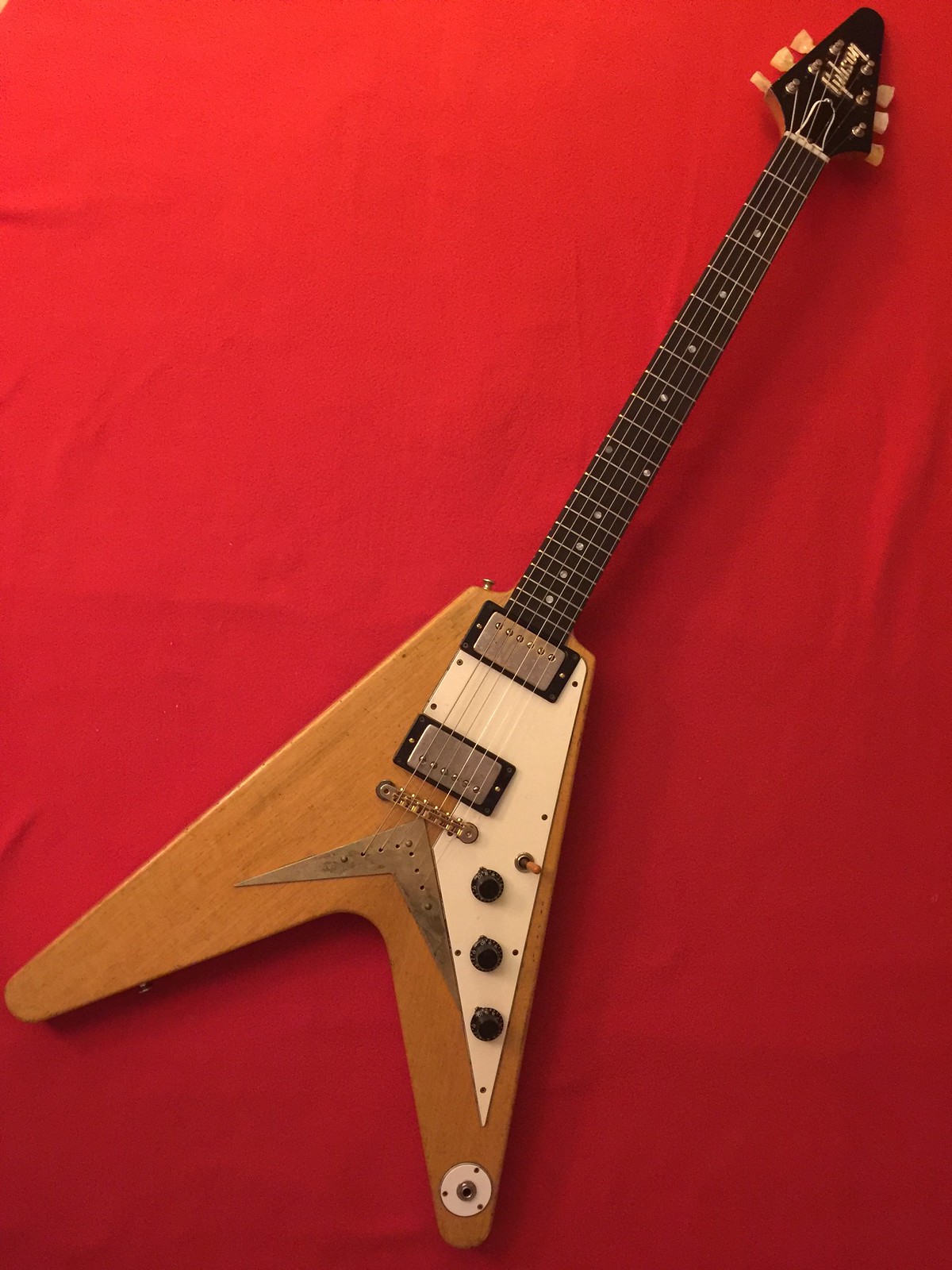
1958 Gibson Flying V korina. Photo by Pete Dyson. Public Domain Mark 1.0. Via Flickr. Gibson
Flying V (1958–59 korina)
1958–59
Gibson drew the future in 1958, and almost nobody bought it. Ninety-eight guitars later, it was finished. Then the future caught up.

2006 Gibson Les Paul Standard (SN 000660573). Photo by wetwebwork. Licensed under CC BY-SA 2.0. Via Wikimedia Commons. Gibson
Les Paul Standard
1952
Gibson made about 1,500 sunburst Les Pauls, decided nobody wanted them, and stopped. Then the British blues boom happened.
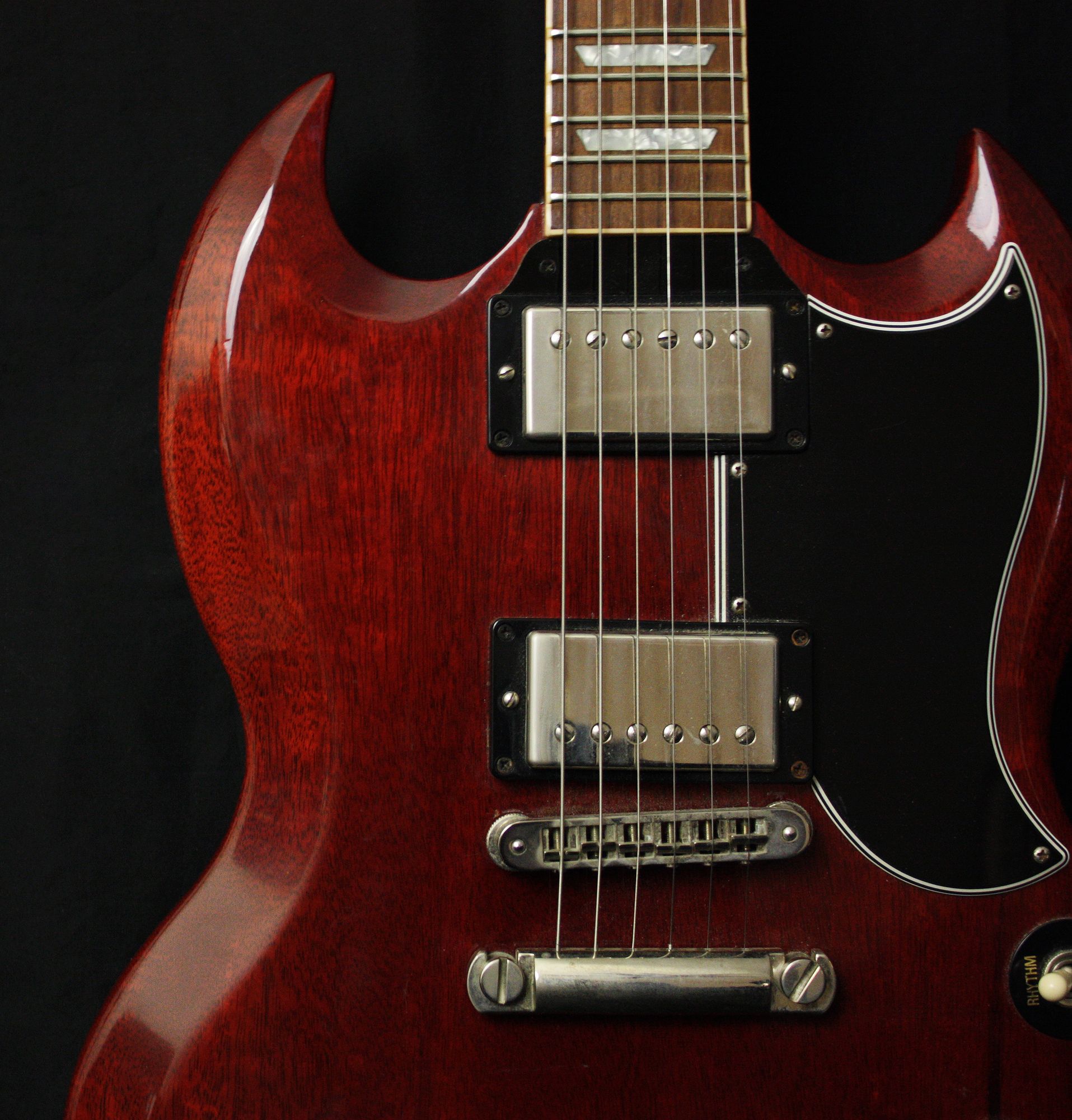
Gibson SG Standard ’61 Reissue, photographed 18 March 2010. Photo by John Tuggle. Licensed under CC BY 2.0. Via Wikimedia Commons. Gibson
SG
1961
Gibson has never stopped making SGs. Angus Young has lost count of his. He still only means one.