Goya
Rangemaster
It has nine buttons where one switch would do, and more than half a century later they still work.
2023. A guitar columnist sits down with a 1967 Goya Rangemaster 109 he bought from a musician in Persephone’s Bees. Italian, hollow, just under six pounds, with a row of buttons across the body like a kitchen radio. He starts pushing them.
- Introduced
- 1966
- Type
- Hollowbody / semi-hollow electric
- Class
- Closed run
Have a photograph of this guitar? Send a picture
The short version
1954
A Swedish guitar, a new name
Levin acoustics start coming into New York as Goyas.
1959
The first Goya electrics
Built by Hagstrom, until the two part ways in 1963.
1965
Rangemaster, the solidbody
The name first appears on an Italian solid with split pickups and a panel of buttons.
1966
The thinlines
Avnet buys Goya. The January catalog shows the hollow 105, 107, and 109.
1968
“The world’s first psychedelic guitar”
The 1092P, cloth under the gloss. The catalog is down to thinlines.
1969
The end of the run, maybe
One account runs the 109 into 1969. Another stops it in 1968.
1976
The name moves on
Martin buys Goya. From here on it means acoustics.
2023
Still working
A 1967 109 turns up in a magazine column with every button doing its job.
Side A
A1
Push a button, any button
- Terry Carleton has a 1967 Goya Rangemaster 109 across his lap. He bought it from Tom Ayres of Persephone’s Bees. It’s hollow, it’s Italian, and it weighs just under six pounds. Where you’d expect a pickup toggle, there’s a row of buttons.
Nine of them. One master volume. Lo, Mid, and High buttons for tone. Six more for the pickups, including one that just shuts the whole thing off.
On his guitar, it works like this. There are two pickups, and each one is split into two halves, one for the treble strings and one for the bass. The buttons pick which halves you hear. Bridge on the low strings with neck on the high strings is the loud one. Other combinations go phasey. Off is a kill switch.
He called the buttons 52 years old, and still working. Everything else about the Rangemaster had moved on a long time ago. Those hadn’t.
A2
A Swedish name on an Italian guitar
The name on the headstock came first. Jerome Hershman, a New York jobber, met the Swedish maker Levin in Gothenburg in 1952, and from 1954 their acoustics came in as Goyas: better than a Kay or a Harmony, short of a Martin or a Gibson. Flattops and classicals. Julie Andrews’ guitar in The Sound of Music is one of the classicals. Not this.
Hagstrom built the first Goya electrics in 1959, and the two companies split in 1963. By 1965 the Rangemaster name was on an Italian solidbody with the same trick: two split pickups, a row of buttons to pick the halves, and a kill.
Then in 1966 Avnet, which already owned Guild, bought Goya and kept the two apart. The same year, the button panel moved onto a hollow body.
A3
Three shapes and a blonde
The January 1966 catalog has three: the 105, a single-cut Venetian; the 107, a single-cut Florentine; and the 109, the double-cut. The 109 is the one people mean. List price $399, which put it nine dollars above a Gibson ES-175D.
They’re mahogany, all but the blonde 109B, which is maple front, back, and sides. The f-holes sit lower than usual, and the top binding runs to eight plies. Fire Engine Red, Jet Black, and Caribbean Blue came along, and stop-tail versions alongside the vibratos.
A double-cut Italian thinline with a radio’s worth of buttons. Not a 335.
It looks like a 335 from across a room. It isn’t. Nobody describes a center block. Carleton’s 109 has a German carve, a three-piece mahogany neck, a Brazilian rosewood board, 20 frets, and a tree of life inlaid in mother-of-pearl. Other examples count 21 or 22 frets. Count before you argue.
Flip the record · By the numbers
9
Buttons. Six for the pickups, one of them off, and three for tone.
$399
List in January 1966. Nine dollars more than a Gibson ES-175D.
$475
The 1968 cloth-covered 1092P, with its case.
Side B
B1
Two workshops, one answer short
Who built it is still two answers. One long-standing account says ZeroSette, the Italian firm behind the solidbody, and calls the thinlines the last ZeroSette Goyas. Others say the Polverini brothers, and one 109B case is stamped Polverini, Made in Italy. Plenty of people used to say Eko. That one’s been dropped. Keep ZeroSette and Polverini.
There was a 12-string too, fully hollow, with a harp tailpiece. It’s a sister, not a 109.
B2
The world’s first psychedelic guitar
By 1968 the catalog was down to the thinlines, plus one very loud idea. The 1092P had cloth under the gloss, in three patterns, for $475 with the case. The catalog called it “the world’s first psychedelic guitar.”
There is a photograph of Jimi Hendrix playing a paisley 1092P, in a Hendrix biography. That’s it: one picture. Not Monterey, not Woodstock, not a record. No song on any Rangemaster has been pinned down, and this story won’t make one up.
B3
The name moves on
The Rangemaster ran from 1966 to 1968, or into 1969, depending who you ask. Nobody published production numbers.
The name kept going without it. A 1967 deal had Levin promising at least 120,000 instruments over ten years; it broke in 1968. Kustom took Goya in 1970, Dude in 1972, and Martin in 1976. The Goyas after that were acoustics, from Sweden, then Finland, then Japan and Korea, until somewhere between 1990 and 1996. One account has the name sold to Goya Foods in 1999. Another says Martin still holds it.
There’s no reissue. The buttons are long gone from any catalog, the name has passed through a string of owners, and on at least one 1967 109, every button still does what it did the day it left Italy.
The cast
The people, and the specific guitars, that made the legend.
Tom Ayres
1967 Rangemaster 109
Of Persephone’s Bees. Owned the guitar in the 2023 column and sold it to the writer.
2023
Terry Carleton
1967 Rangemaster 109
Bought it from Ayres and wrote it up, buttons and all.
Angelina Moysov
1967 Rangemaster 109
Photographed holding the same guitar. No song on it.
Jimi Hendrix
Paisley 1092P
A photograph, in a Hendrix biography. Not Monterey, not Woodstock, not a studio credit.
Liner notes
Specs, construction, rarity, value, and every source we used.
Nine buttons and a pair of split coils on a thin Italian hollow — Goya’s Rangemaster, not the Levin acoustic that made the name.
- Body
- Thinline hollow / semi-hollow. 1966 catalog: 105 single Venetian, 107 single Florentine, 109 double Florentine. Mahogany except blonde 109B, which is maple front, back, and sides. Guitar Gavel: fully bound, eight plies on the front, f-holes bound. One 109B sheet: 16" wide, 1¾" deep. Joel’s 1967 109: 16" mahogany. Mix flagged.
- Neck
- Mahogany where a shop has said. Guitar Player’s 1967 109: three pieces. Joel’s: two pieces, medium C. The 109B sheet: slim C against a maple body. Set versus bolt-on is unpublished.
- Fingerboard
- Rosewood. Guitar Player’s 109: Brazilian, 20 small low frets. The 109B sheet: 22. A 107R card: 21. Do not average.
- Scale
- No figure in the 1966 catalog notes. One 109B measured 24.5". RetroFret’s 1966 solidbody is 24¾" (629 mm) — a different guitar. Do not average. Mix flagged.
- Pickups
- Two split single-coils, four half-coils. Guitar Player numbers them bridge treble, bridge bass, neck treble, neck bass. vintageguitarandbass’s catalog note says each coil covers two strings. Those don’t match. See Construction.
- Hardware
- Vibrato on many; Vintage Guitar also notes stop-tail versions. Van Ghent tuners on one 109B. A Hagstrom vibrato arm is MyRareGuitars’ note on late-1960s Italian Goyas, not a part number for every hollow.
- Electronics
- Master volume; Lo / Mid / High tone buttons; six pickup buttons including an off. Printed maps disagree.
- Finish
- Sunburst, and blonde on the 109B only, in the January 1966 list. Vintage Guitar adds Fire Engine Red, Jet Black, Caribbean Blue with the 1966 expansion. 1092P (1968): cloth under the gloss.
- Nut
- Unpublished on the thinline. RetroFret’s solidbody: 1⅝" (41 mm). Different guitar. Mix flagged.
Open the full research fileConstruction details, the complete player record, production numbers, dated value estimates, and sources
Classic living example = the Italian thinline six-string, 105 / 107 / 109, in the January 1966 catalog. The 109 is the double-cut people mean. No current Rangemaster and no reissue this pass. 109B is blonde maple. 1092P is the 1968 cloth hollow. 116 / 113SB is the 1965–66 solidbody that wore the name first — not this table. The 12-string is another hollow. Panther is the bass. Levin flattops, Hagstrom’s earlier Goya electrics, Japanese Greco, and any Martin-era Goya acoustic are other factories on the brand. Not an Eko. Not an ES-335 (gibson-es-335). Inch tapes on the hollow and millimetres on the solid sit in one argument — mix flagged. Do not average 20 / 21 / 22 frets, or 24.5" against 24¾" (629 mm).
Construction
The job was a thinline New York could hang in 1966. F-holes set lower than usual. Nine buttons instead of a toggle. Goya on the headstock. Not the Swedish acoustic that made the name.
Jerome Hershman was a jobber, at NAMM by 1940, maybe earlier (Vintage Guitar, Michael Wright, July 2018). In 1952 he met Levin in Gothenburg. In 1954 those acoustics came in as Goya — better than a Kay or a Harmony, short of a Martin, a Guild, or a Gibson. Guitar Gavel: a new American name, from the painter. Flattops and classicals. Julie Andrews’ guitar in The Sound of Music is one of the classicals. Not this electric. In 1959 Hagstrom built the first Goya electrics, plastic-covered Deluxe and Standard, with pickup assemblies you could swap. Goya Guitars, Inc. opened that year at 51 West 23rd Street. The split was 1963. Wright: Hershman did not replace them right away.
The name starts on a solidbody. Wright: 1965, Italy, ZeroSette, two split coils, buttons for all, 3+4, 3+1, 2+4, 1+2, and kill, plus Lo, Mid, High, and one volume. The split is a criss-cross — bass strings from one position, treble from the other. VintAxe indexes a 1965 flyer. The scan was not read. ZeroSette, he writes, began in 1945 under the accordion firm he spells Giulett, and was making guitars by 1964. RetroFret’s 1966 solid: 41½" overall, 12¾" (32.4 cm) wide, 1½" (3.8 cm) deep, scale 24¾" (629 mm), nut 1⅝" (41 mm). Mix flagged. Not this table. Opaque solids, one year, 1966. Sunburst solids, at best, 1965–67.
1966 is the hollow. Avnet bought Hershman/Goya, already owned Guild, and became Goya Music Corporation. Guild stayed separate (Wright). Thinlines the same year: the same electronics, a 12-string, stop-tail versions, and Fire Engine Red, Jet Black, Caribbean Blue. The January 1966 catalog, as vintageguitarandbass reads it: semi-acoustic 105, 107, and 109. Venetian single-cut, Florentine single-cut, Florentine double-cut. Blonde only as 109B, and only that one in maple. The rest mahogany. US list $399, $9 more than an ES-175D in that site’s comparison. 1966 money, not 2026 street.
Who built the hollow is still two answers. Wright’s 1968 caption calls the thinlines the last ZeroSette Goyas. Guitar Gavel runs the 109, as ZeroSette, to 1969. Frank Meyers (Premier Guitar, 27 December 2017) has ZeroSette on the cloth 1092P. vintageguitarandbass and Terry Carleton (Guitar Player, 16 March 2023) say the Polverini brothers. MyRareGuitars: Polverini, not Eko, “as previously thought.” One 109B case reads Polverini, Made in Italy (Hendrix Guitars). Blue Book’s Eko line is late-1960s solids and basses, not this hollow and not Wright’s solid. Keep ZeroSette and Polverini.
The buttons are the point. Carleton’s 1967 109 numbers the halves bridge treble (1), bridge bass (2), neck treble (3), neck bass (4). Bridge on the low strings and neck on the high ones is the loud setting; other combinations go phasey; off is a kill. Hendrix Guitars and Guitar Gavel print All, 1+2, 1+4, 2+3, 3+4, Off. The 1965 solid’s pairs are 3+1 and 2+4. vintageguitarandbass’s “two strings only” does not add up to six strings. Don’t collapse the maps. Wright says semi-hollow. Carleton hears a hollowbody: German carve, three-piece mahogany neck, Brazilian board, 20 frets, a tree-of-life in mother-of-pearl, just under six pounds, buttons he called 52 years old and still working. Joel’s 109 is two-piece, medium C, and he calls delamination common — one shop, not a rate. The inch-and-kilogram disagreement, including 2.62 kg on a different cherry guitar, stays in the table. Mix flagged. No source describes a center block. Not a 335.
The 12-string is the other hollow. Twelfth Fret: fully hollow mahogany laminate, braced, double Venetian, harp tailpiece, Van Ghent, serial N3025, dated by them 1967–1969. Not a 109.
By 1968 Wright’s catalog had kept the thinlines only. Meyers, from that book: 1092P, three cloth patterns under the gloss, $475 with case, the catalog’s “world’s first psychedelic guitar.” Window 1966–68 (Wright), or through 1969 (Gavel and the 12-string). No production numbers. Serials 1316, 2451, and 3259 might be in sequence. They don’t count a year.
The name then went back to acoustics. Levin’s Wikipedia page: a 1967 contract for no fewer than 120,000 instruments over ten years, Goya about 70% of a production over 30,000. Broken in 1968. Kustom, Chanute, in 1970; failed 1972; Dude took the leftovers. Whether Levin shipped Dude anything is unknown. Martin bought Levin in 1973 (the company’s ad, Lehigh) and built about 200 LD-18s in Gothenburg. Some LD-28 labels have surfaced (Acoustic Music). Dude sold Goya to Martin in 1976. Wright: Levin again until 1979, a few by Landola in Finland that year, then Japan, some Korea, until 1996. Blue Book: through 1996, and Martin still holds the name. Gavel stops the Asian line at 1990. Acoustic Music: sold to Goya Foods in 1999. guitar-list adds Taiwan, ends Gothenburg production and the last Levin-made Goyas in 1979, operations in 1982, and retires the brand in 1996. Wikipedia’s last Gothenburg guitar is 1981. Keep 1979, 1981, and 1982, and keep 1990, 1996, and the Foods sale. A later Goya is a student acoustic. It is not this hollow. No reissue.
Players
Do not hang a record on this guitar. The Sound of Music classical, the Hagstrom sparkle boxes, a Levin flattop, and a Japanese Greco share a trademark. They are not a 109.
Jimi Hendrix is a photograph. Meyers: a picture of him playing a paisley 1092P, in Harry Shapiro and Caesar Glebbeek, Jimi Hendrix: Electric Gypsy, and ZeroSette as the maker of that guitar. That is the 1968 cloth model. Carleton’s line — a psychedelic-painted version of “this guitar” — is the 109 family, looser than the 1092P. One picture. Not Monterey, not Woodstock, not a studio credit.
Tom Ayres of Persephone’s Bees owned the 1967 109 in Carleton’s column and sold it to him. Angelina Moysov is photographed holding it. One instrument. No song on it.
Also known to play stays empty. A comment under the MyRareGuitars piece calls a blonde 109 Taylor Rice’s guitar. A comment is not a source. Omitted.
Rarity
You cannot buy a new Rangemaster. Follow Wright and the hollow’s catalog life is 1966–68. Follow Gavel, and the 12-string dating, and it runs into 1969. After that the name is an acoustic brand. The buttons are gone.
Goya published no Rangemaster total. Wright: no production numbers. None invented. Three serials that might be sequential are not a census, and they are not all thinlines. That is why a first-year count is unknown.
What is actually thinner: the 1092P, which Meyers treats as exceedingly rare even among ZeroSette oddities. The blonde 109B, because maple was that finish alone. A six-string whose nine buttons still all work. A top that has not opened up, if Joel’s “common” delamination holds. The 12-string, the one-year opaque solid, and the 1965 sunburst slab are other objects. Hendrix’s photographed 1092P, if it is still out there, is one guitar. It is not the model.
Value
Informal estimate, 30 September 2026. Not an appraisal.
Ask versus sold, labeled. No celebrity lot, so no not-a-comp to park — the Hendrix picture has not come up as a sale. No invented medians. $399 (January 1966, blonde or sunburst) and $475 with case (1968, 1092P) are 1960s list prices.
New street. None. No Rangemaster SKU and no reissue this pass. A Martin-era Goya acoustic is a different instrument. Don’t borrow its price.
Used modern. None under this name. There is no later factory run to trade. What changes hands is the 1960s guitar, below.
Vintage / collectible. Reverb’s red-burst Rangemaster guide prints years 1967–1968 and files a solidbody category against a description that says semi-hollow. The dollar widget was not readable this pass. Don’t adopt that year span. Flag: thin sold-comp access.
Named hammer, not a series: Gardiner Houlgate, 10 March 2026, a 1960s Italian semi-hollow, cherry mahogany, rosewood board, electrics working, original hard case, 2.62 kg, condition good. Estimate £400–£600. Sold £420.
Named asks, not hammers. Reverb UK, checked 30 September 2026: 1967 109B natural, Excellent, £2,236.43 plus £250.48 shipping. Jay Rosen’s card: a circa-1966 sunburst semi-hollow at €1,191. Carleton, 16 March 2023: at auction a 109 “is fetching between $1,000 and $1,500,” and he paid “significantly less.” A columnist’s range, not a ledger. Do not average £420 with £2,236, or either of them with $1,000–$1,500. A solidbody 116 is a different guitar and not a comp for this table.
See also
- hagstrom-viking — Hagstrom built Goya’s electrics from 1959 to 1963; the Viking is their own thinline, not this button hollow
- gibson-es-175 — the laminated jazz box a Rangemaster listed $9 above in January 1966
- guild-starfire — Avnet owned Guild in the same years and kept it separate from Goya
Sources
- Vintage Guitar, Michael Wright, “Italian Smorgasbord” (July 2018; web 27 April 2020) — 1952 Levin meeting; 1954 Goya acoustics; Hagstrom electrics 1959–63; 1965 ZeroSette solidbody and its button map; 1966 Avnet purchase, Guild kept separate; thinline debut 1966–68 including a 12-string and stop-tails; Fire Engine Red, Jet Black, Caribbean Blue; opaque solids one year (1966); sunburst solids 1965–67 at best; no production numbers; serials 1316, 2451, 3259; Kustom, Dude, Martin 1976, Levin to 1979, Landola, Japan/Korea to 1996; ZeroSette founded 1945 (VG spelling: Giulett), guitars by 1964
- vintageguitarandbass, 1966 Goya catalog page 4 — 105 / 107 / 109 shapes; 109B blonde maple versus mahogany on the other finishes; Polverini attribution; January 1966 list $399, $9 over an ES-175D; “two strings” coil sentence
- vintageguitarandbass, 1966 catalog page 2 — Rangemaster and Panther introduced together in that book
- Guitar Gavel, “Goya Rangemaster — A Convoluted Lineage” (21 July 2022) — solidbody 1965; 109 from 1966 to 1969, ZeroSette; mahogany; 8-ply top binding; button map; low f-holes; Sound of Music classical is a Goya; Martin bought Levin 1973 and the Goya name 1976; Asian Goyas to 1990 in this account; about 200 LD-18s
- Guitar Player, Terry Carleton, 16 March 2023 — 1967 109; Polverini design; nine buttons; 3-and-3 numbering; German carve; three-piece mahogany; Brazilian board; 20 frets; just under six pounds; auction range $1,000–$1,500 and “significantly less”; Tom Ayres / Persephone’s Bees; Hendrix line, model not pinned to 1092P
- Premier Guitar, Frank Meyers, 27 December 2017 — 1968 catalog 1092P, three cloth options, $475 with case, “world’s first psychedelic guitar”; Hendrix photo of a paisley 1092P in Shapiro and Glebbeek, Electric Gypsy; ZeroSette
- MyRareGuitars, 19 February 2012 — 109 by Polverini, not Eko; 1967 catalog shows the blonde; button map; Hagstrom vibrato on late-1960s Italian Goyas; Panther/Galanti is a different suggestion
- RetroFret, Rangemaster solidbody, 1966, item 7412 — solidbody inches and millimetres: 12¾" (32.4 cm), 1½" (3.8 cm), 24¾" (629 mm), nut 1⅝" (41 mm). Not the thinline
- Wikipedia, Levin — 1967 contract, 120,000 / 70% / over 30,000; broken 1968; Kustom 1970; Dude 1972; Martin buys the name 1976; Levin bought 1973; about 200 LD-18s; last Gothenburg guitar 1981
- Lehigh Preserve, Martin advertisement of the Levin purchase — 1973
- Acoustic Music, Herman Carlson Levin — LD-18 about 200, some LD-28 labels; Goya Foods sale 1999; Gothenburg ends 1981
- Blue Book of Guitar Values, Goya — late-1960s solids and basses filed as Eko (not adopted for the 109); Martin imports through 1996; Blue Book says Martin still holds the name
- guitar-list, Martin-era Goya classicals — Japan, Korea, Taiwan; brand retired 1996 in this account. Not Rangemasters
- guitar-list, Levin — Gothenburg production stopped 1979; operations ceased 1982; last Levin-made Goyas 1979; Martin retired the Goya brand 1996 in this account
- Gardiner Houlgate, 10 March 2026, lot 93 — hammer £420, estimate £400–£600; 2.62 kg; cherry mahogany semi-hollow
- Reverb UK, 1967 109B natural — ask £2,236.43 plus £250.48 shipping, checked 30 September 2026
- Jay Rosen / Vintage & Rare, circa-1966 sunburst — dealer ask €1,191
- Hendrix Guitars, 109B sheet — 24.5" scale, 1¾" × 16", 22 frets, maple body, mahogany neck, Van Ghent, Polverini case. Repeats the vintageguitarandbass catalog note
- Joel’s Vintage Guitars, 1967 109 — 16" mahogany, two-piece neck, medium C, delamination called common
- Distinctive Guitar, 107R — 21 frets; serial 3095; Polverini in the dealer copy
- Twelfth Fret, 12-string, sold listing — fully hollow mahogany laminate, braced, serial N3025, 1967–1969 in their dating
- Reverb price guide, Rangemaster red burst — prints 1967–1968 and a solidbody category; dollar widget not read; years not adopted
- VintAxe, Goya catalog list — a 1965 Rangemaster flyer exists on that index; the scan was not read here
Keep digging
Guitars this one gets compared to, confused with, or descended from.
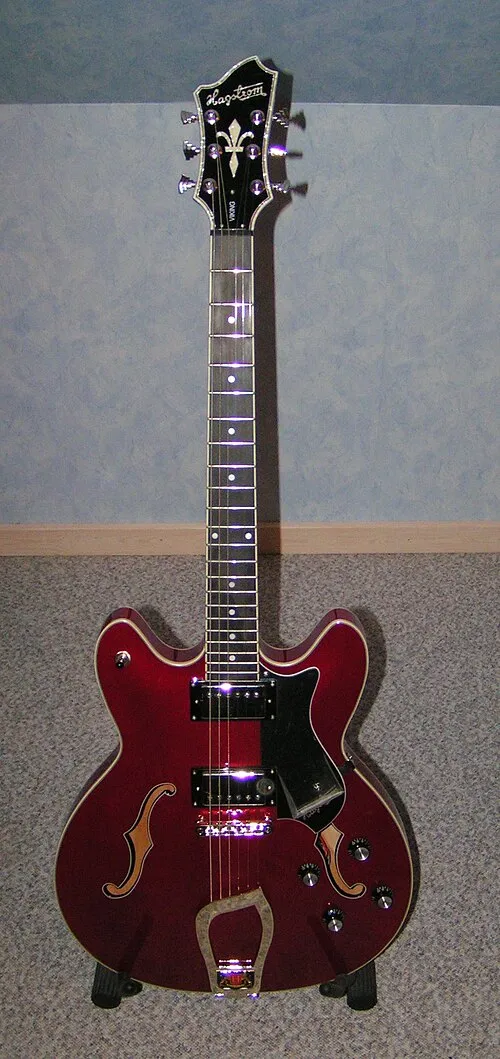
Photo: Søren1234 / Wikimedia Commons / Public domain Hagstrom
Viking
1965
Elvis needed something flashy for the Comeback Special. A session man had a Swedish guitar in his trunk.
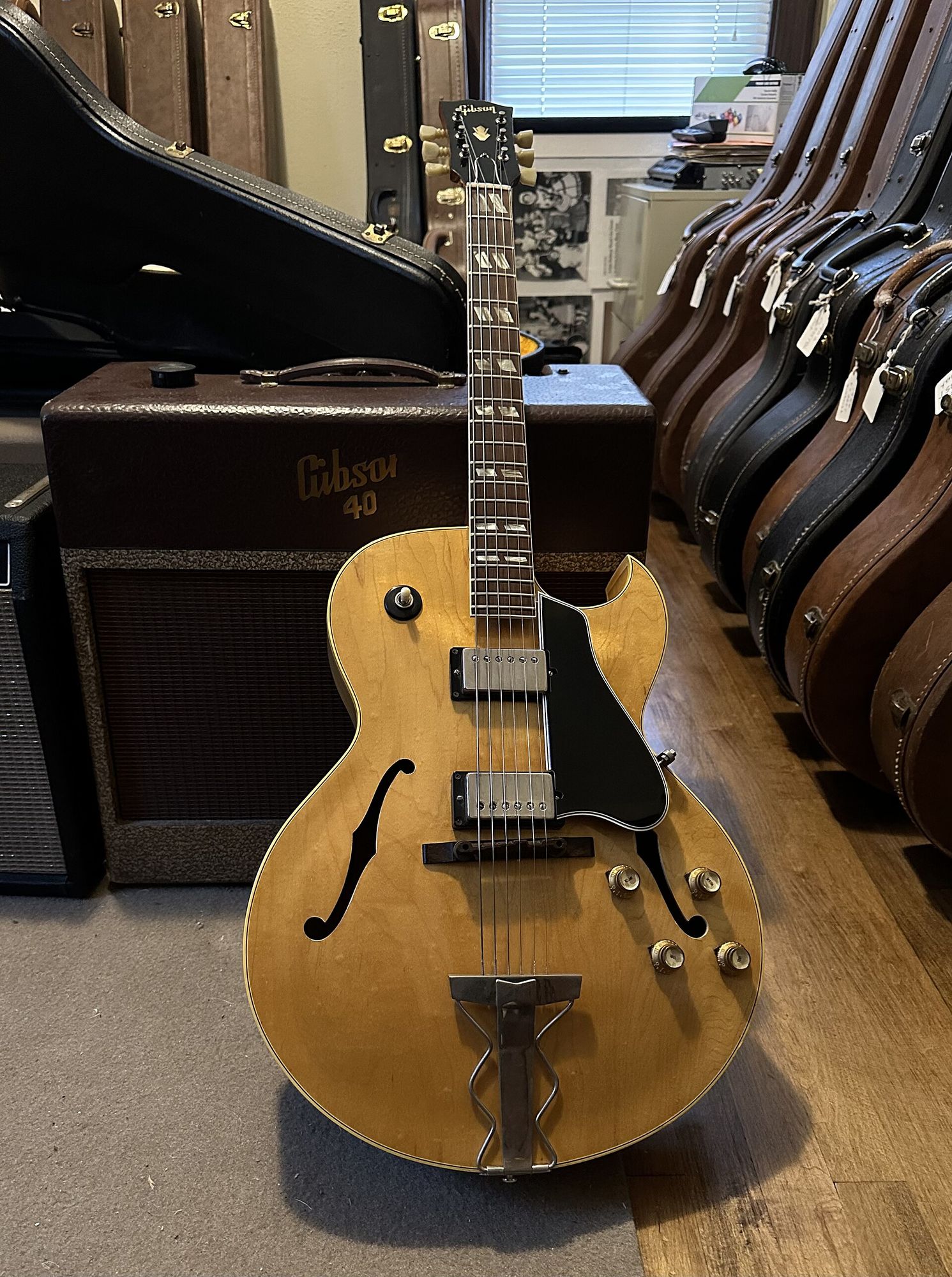
1963 Gibson ES-175DN. Photo by Lightburst. Licensed under CC BY-SA 4.0. Via Wikimedia Commons. Gibson
ES-175
1949
A laminated jazz box that kept changing hands: bought used, given as a gift, borrowed for a hit.
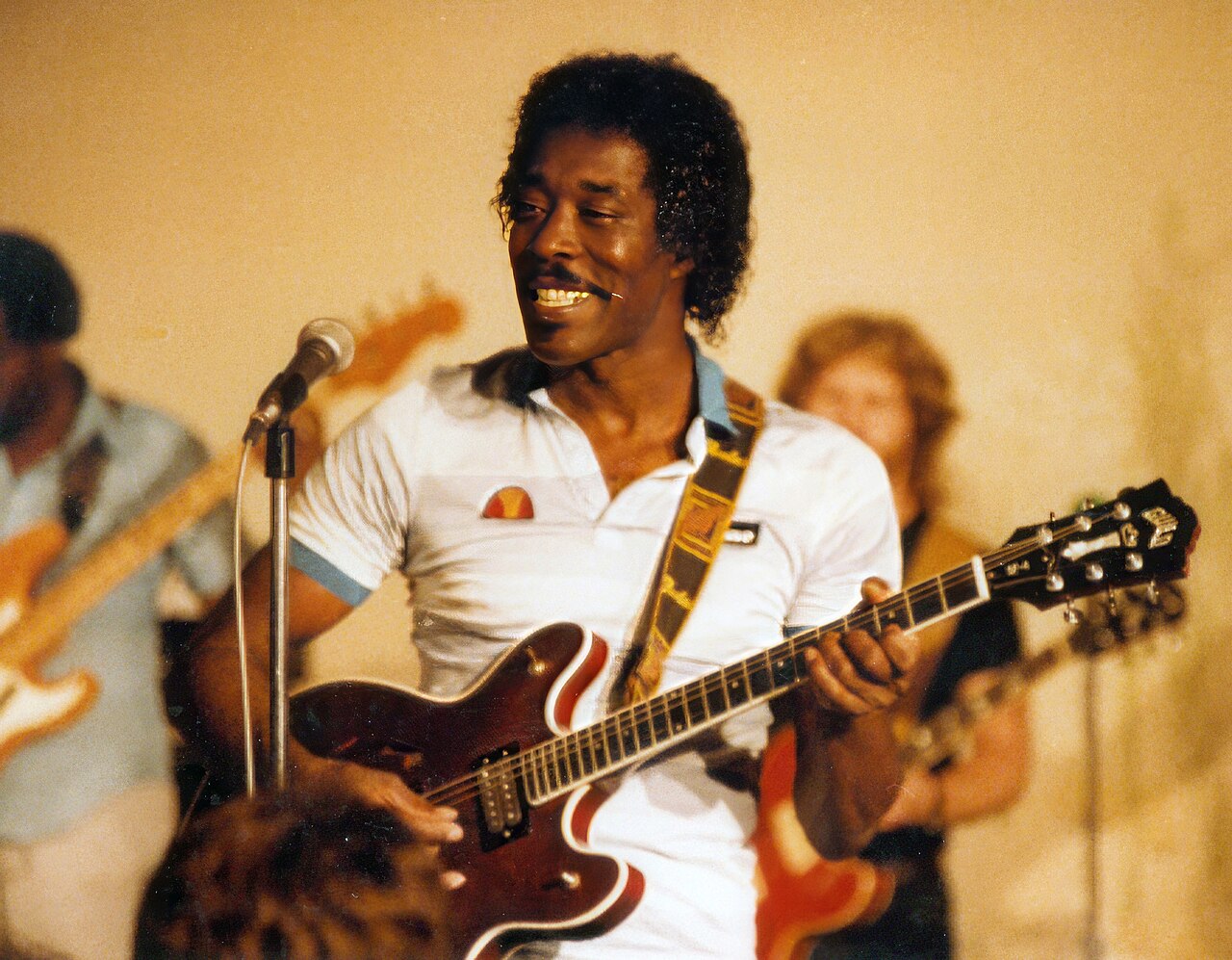
Photo: Bubba73 / Wikimedia Commons / CC BY-SA 3.0 Guild
Starfire
1960
Before they were the Grateful Dead, they were the Warlocks, and Jerry Garcia was playing a Guild Starfire.