Micro-Frets
Spacetone
A Maryland guitar you intonate at the nut, with a bar that dips whole chords in tune. Some even broadcast FM.
1965, a small shop in Wheaton, Maryland. Ralph Jones wants every string in tune at both ends, and a vibrato that can drop a whole chord and bring it back true. He files the patents first. The guitars come later, and the Spacetone later than that.
- Introduced
- 1969
- Type
- Semi-hollow electric
- Class
- Production
Have a photograph of this guitar? Send a picture
The short version
1965
Wheaton
Ralph Jones files a patent on his vibrato in June. The paperwork spells the company “Mirco-Frets.”
1967
Grove Road
A 15,000-square-foot plant opens in Frederick with four models. None of them is the Spacetone.
1968
A radio in the guitar
Jones builds an FM transmitter. The first guitar to get one is the Orbiter.
1969
Style 2
The gasket and grillecloth go. The Spacetone turns up among these guitars. Other dates for it run from 1967 to 1970.
1972
Ralph Jones dies
April 18. The same year’s catalog lists the Spacetone, thin, symmetrical, with Micro-Nut and Calibrato.
1975
The equipment is sold
Fall 1975, the factory closes. One price guide ends the Spacetone around 1973.
2004
A small revival
Somewhere between two dozen and fifty guitars, a Spacetone among them.
2016–17
Back on the headstock
New prototypes include the name. Today it’s a made-to-order guitar with a longer scale.
Side A
A1
Something different for 1965
Ralph Jones had a small shop in Wheaton, Maryland, and a problem he couldn’t leave alone. A guitar is only in tune if each string is the right length at both ends. An adjustable bridge fixes one end. Jones wanted to fix the nut too.
He also wanted a vibrato that could drop a whole chord and bring it back in tune. He filed a patent on that in June 1965, and on the nut a year later. The vibrato patent has the company’s name spelled “Mirco-Frets.” It was that kind of operation.
The company started as Micro Tech. Ground broke late in 1966 on a 15,000-square-foot plant on Grove Road in Frederick, paid for by Marion Huggins, and it opened early in 1967 with four models: the Plainsman, the Covington, the Huntington, and the Orbiter. No Spacetone yet.
A2
A nut with six moving parts
The Micro-Nut is six little segments, one per string, each one adjustable. You set the string height and the length to the twelfth fret right there at the nut, so a chord up the neck and a chord at the first fret both come out true.
The Calibrato was the showpiece. A tensed square spring and six set screws kept the strings moving together through the whole dip. One of the men who revived the brand in 2004 compared it to ailerons on a wing.
Push the bar and a chord goes down “as if you had a pedal steel.”
That’s the sound to listen for. Setting one up was more complicated than a Floyd Rose.
The pickups came from Bill Lawrence’s design. Hazel Jones wound them, with help from Gary Free, on bobbins of plexiglass with wire “finer than a human hair,” under white plexi covers. The catalog called them Hi-Fi. Later a second switch could tap one at about 80 percent of its winding.
A3
The radio in the horn
In 1968 Jones built an FM transmitter with a variable capacitor, so you could play through a radio instead of a cable. Gary Free says the first guitar to get one was the Orbiter. There was no patent on it, so they potted it in epoxy. One historian calls the Orbiter “very possibly the first” consumer wireless guitar.
Some Spacetones have one too. One surviving example still works: an on/off switch on the upper bout, a battery plate, and a tuning screw under a cap on the back. You find a quiet spot on the FM dial and play into it.
The 1972 catalog doesn’t mention it. So it’s a Spacetone with a radio, not a radio Spacetone.
Flip the record · By the numbers
6
Adjustable segments in the Micro-Nut, one per string.
24″
Scale length on the c. 1970 guitars. Short, for a thin double-cut.
~80%
Where the optional Hi-Fi pickup tap sits on the coil, from 1970 or 1971.
2,600–4,000+
Micro-Frets built of every model, depending on the count. Nobody counted Spacetones.
Side B
B1
Nobody agrees when it started
Nobody has turned up a first catalog page for the Spacetone. One price guide says 1967. A dealer put one at 1967 or ’68 by its serial, but the 1967 launch list doesn’t include it. A photo caption calls one a ’70. The first words anyone can quote about it come from 1972: a symmetrical cutaway, two Hi-Fi pickups, the Micro-Nut, the Calibrato, a thin concert size, in Cherry, Sunburst, Black, or Martian Sunburst. This page starts it in 1969, when the grillecloth and gasket were gone and the Spacetone shows up among those guitars. The other dates stay.
It’s two routed maple halves clipped together into a thin, chambered double-cut, with a 24-inch scale. From 1971 the halves were glued, so a later one may be. Who drew it is split too. Gary Free says it was Ralph’s. Another insider says it grew out of an earlier model and belongs to Free and a colleague named Woody. One caption does settle who got the first one: it was made for Hazel Jones.
B2
The one Buddy Merrill gave back
In the late ’60s Buddy Merrill, lead guitar on The Lawrence Welk Show, signed on with Micro-Frets, and they gave him a sunburst Spacetone. It wasn’t to his liking. Within a year or two he had a blond Huntington, the top model.
Deke Dickerson found that Huntington in Merrill’s closet in 2008. He gives the nut its due: it intonates. But an unwound string clicks in the guide and doesn’t always come back. The company, he wrote, “dealt primarily with players who never bent strings.” Merrill told him he liked Micro-Frets, maybe not as much as a Strat. Then: “You can have it, just promise me you’ll practice.”
Where the sunburst Spacetone went, nobody has published.
B3
Parts left over
Ralph Jones died on April 18, 1972. Hazel and Gary Free kept going on parts already cut, and built the solidbody Swinger and the Husky bass out of the pile. In the fall of 1975 the equipment was sold. How many guitars in all depends on who counts: under 3,000, about 2,600, or more than 4,000. Nobody counted Spacetones.
It kept coming back anyway. A 2004 revival built somewhere between two dozen and fifty guitars, a Spacetone among them. New prototypes in late 2016 or 2017 included the name. Today you can order a new Spacetone: alder, a 25.5-inch scale, and no Micro-Nut on the spec sheet. Different guitar.
Same name on the headstock, though, sixty-odd years after a man in Wheaton decided a guitar should be in tune at both ends. Hardly anybody asked for that. It keeps getting built anyway.
The cast
The people, and the specific guitars, that made the legend.
late 1960s
Buddy Merrill
Sunburst Spacetone
Lead guitar on The Lawrence Welk Show. Micro-Frets gave him a Spacetone. It wasn’t to his liking, and within a year or two he had a blond Huntington instead.
1965
Ralph Jones
Inventor
Patented the Micro-Nut and the Calibrato and built the FM transmitter. Died in 1972.
Hazel Jones
The first Spacetone
Wound the pickups with Gary Free, and the first Spacetone was made for her.
Gary Free
Pickup winder, and maybe more
Says the Spacetone was Ralph’s design. Another insider gives it to Free and a colleague named Woody. Both stay.
Mark Farner
A Micro-Frets Signature, not a Spacetone
Grand Funk. The brand’s biggest stage in the ’70s, on a different model.
Liner notes
Specs, construction, rarity, value, and every source we used.
A thin Maryland double-cut you intonate at the nut, with a vibrato built to bend a whole chord in tune — and, on some of them, an FM transmitter instead of a cable.
- Body
- Symmetrical double-cut, thin. Two maple halves, chambers routed inside (RetroFret). Blue Book: maple top/back/sides, white celluloid binding. #1829: 14⅜" (36.5 cm) wide, 1⅝" (4.1 cm) deep. Custom #2471: 14½" (36.8 cm), 1¾" (4.4 cm). Mix flagged. Do not average.
- Neck
- Bolt-on maple. VintageSilvertones: five screws on a logo plate.
- Fingerboard
- Rosewood, dots, 22 frets (Blue Book; both RetroFret examples; VintageSilvertones).
- Scale
- 24" (610 mm) on RetroFret #1829 and #2471. VintageSilvertones: 24". Mix flagged. The 2026 shop page prints 25.5" and no millimetres. Do not average.
- Pickups
- Two Hi-Fi units in white plexiglass covers. Bill Lawrence’s design, wound on plexi bobbins (Vintage Guitar). Not the shop’s “MF designed P90.”
- Hardware
- Patented Micro-Nut; Calibrato tailpiece; Microsonic bridge; chrome. Schallers on RetroFret #1829. Blue Book: 6-on-a-side.
- Electronics
- Volume, tone, selector. From 1970/71 an optional Hi-Fi tap at about 80% of the winding (Vintage Guitar). One indexed example adds an FM on/off. The 1972 catalog blurb does not.
- Finish
- 1972 catalog, via VintageSilvertones: Cherry, Sunburst, Martian Sunburst, Black. Line varnish: Sher-Wood Super Kemvar “M” (Vintage Guitar).
- Nut
- Micro-Nut, six adjustable segments. Width 1⅝" (41 mm) on both RetroFret examples. Mix flagged.
Open the full research fileConstruction details, the complete player record, production numbers, dated value estimates, and sources
Classic living example = a c. 1970 Frederick Spacetone: maple semi-hollow, 24", Micro-Nut, Hi-Fi plexi, Calibrato. Not the solidbody Swinger. Not the Orbiter, the model the wireless story is told on first. Not a Fender, and not a 30" Bass VI. Current made-to-order shop guitar, fetched 28 September 2026: alder, curly maple neck, maple / rosewood / pau ferro, 25.5" scale, 9.5" radius, “MF designed P90,” Gotoh locking tuners, Calibrato optional, binding not offered, curly maple cap on bursts. That page does not list a Micro-Nut, a fret count, a nut width, or a transmitter, and it prints no millimetres.
Construction
The job was intonation. Each string true at the nut as well as the bridge, and a vibrato that could drop a whole chord and come back in tune. Vintage Guitar puts Ralph Jones in a small Wheaton shop, “doing something very different for 1965,” before Frederick cut a production body.
The company started as Micro Tech. Ground broke late 1966 on a 15,000-square-foot plant at Grove Road, financed by Marion Huggins — Wikipedia gives Francis Marion Huggins — and opened early 1967. The first four models were the Plainsman, Covington, Huntington, and Orbiter. The Spacetone is not on that list.
Style 1 is the gasket guitar: two routed slabs, poplar or maple, clips, a “Tempered Masonite Gasket,” grillecloth over the sound hole. Jones patented the method as the Tonesponder. Wide lower bout, symmetrical horns, compared to a potato, and a creak Stang later said he loved. That creak is not this model.
Both patents were filed before those doors opened. Nut 3,429,214, 2 June 1966, granted 25 February 1969: six segments, height and the reach to the twelfth fret. Vibrato 3,411,394, 29 June 1965, granted 19 November 1968 — the assignee line spells “Mirco-Frets.” The Calibrato was not on the earliest Style 1s. Wright, via Meeker’s quote of a 1995 column: a tensed square spring and six set screws, the strings staying together through the travel, a feel like Moseley’s, and a setup more complex than a Floyd. Meadors, to Lorinczi: ailerons, and a chord going down “as if you had a pedal steel.”
1968. DeArmond pickups, briefly, then Bill Lawrence’s design, Hazel winding them with help from Gary Free, on plexi bobbins. Meadors: 52-gauge, “finer than a human hair,” under a 1/8" white cover. One volume, two tones — Style 1.5. The same year Jones built an FM transmitter with a variable capacitor. Free: the first FM guitar was the Orbiter, potted in epoxy because there was no patent. Lorinczi’s hedge is “very possibly the first” consumer wireless, and he puts it in the Orbiter. Do not hand that radio to every Spacetone.
1969 is Style 2: gasket and grillecloth gone, clips still in, one volume and one tone. Vintage Guitar shows a Spacetone among those later Style 2 guitars. From 1970/71 a second switch taps about 80 percent of the coil. Style 3, 1971, glues the halves. The pictured Spacetone is still clipped. A later one may be glued. Don’t make one body out of the run.
Nobody has produced a first catalog page for the name. Blue Book prints 1967–circa 1973. VintageSilvertones believes one guitar is 1967–68, off a serial. The launch list says no. A caption in the Vintage Guitar piece is a ’70 Spacetone; RetroFret dates #1829 and #2471 about 1970. The first text actually quoted is a 1972 blurb: symmetrical cutaway, two Hi-Fi pickups, Micro-Nut, Calibrato, thin concert size, the colors in the table. This plate uses 1969 and keeps the other three years beside it.
The table is the old guitar. What it can’t flatten: #1829 has a stylized f-hole closed with fabric, and RetroFret’s own copy calls the finish both cherry and sunburst. #2471 has an eccentric f-hole and a deeper rim. One VintageSilvertones example still transmits — on/off on the upper bout, a battery plate, a screw under a cap on the back, into a quiet FM station. The 1972 blurb lists neither the hole nor the radio. Don’t average the depths. Don’t turn 25.5" into 610 mm.
Who drew it stays split. Dan (Electricbanjoman) said the Golden Melody became the Spacetone and the Stage II, and that the Spacetone was Woody and Gary Free’s. Free says Orbiters, Comets, and the Spacetone were Ralph’s. A caption calls out “the first Spacetone (made for Hazel Jones).” First recipient. Not a gig.
Dickerson, on the nut of Merrill’s Huntington — same part, other model — is why the cleverness didn’t travel. It intonates. An unwound string clicks in the guide and doesn’t always return. The company, he says, “dealt primarily with players who never bent strings.”
18 April 1972, Jones died. Hazel and Free kept going on parts already cut, and what they built out of that pile was the solidbody Swinger and the Husky bass. Fall 1975 the equipment was sold. Blue Book ends this model circa 1973. Two dates. Keep both.
No Spacetone total exists. Company page: under 3,000, all models. Meadors, serials from the 1100s: probably 2,600. Dan, a 1973 Signature in the 3700s: more than 4,000. That argument is the census.
2004, Meadors and Paul Rose, near Style 3: about 30 (Vintage Guitar, serials from 5001), roughly two dozen (company page), at most 50 (Lorinczi). One of them is a Spacetone in the photo. Not 1970. Stang’s late-2016 prototypes included this name; the company page says 2017. Ultimate Guitar, 30 August 2026, still has him building — they name a Stage II. The shop page fetched 28 September 2026 is the alder 25.5" guitar in the caption. Same word on the headstock. Not this table.
Players
Do not hang Mark Farner’s guitar here. Do not move a Signature, a Huntington, a Calibra, or a converted bass onto this page because the headstock says Micro-Frets. The Spacetone is the symmetrical thin one.
Buddy Merrill is the sourced scene, and it is a rejection. Dickerson, Vintage Guitar, March 2017: Merrill endorsed the brand in the late ’60s after a Fender deal, lead guitar on The Lawrence Welk Show. They gave him a sunburst Spacetone. It wasn’t to his liking. Within a year or two he had a blond Huntington, the top model. Meadors describes that kept guitar as maple, with an ebony board and block inlays — those are the Huntington’s, not this table. In 2008 Dickerson found it in a closet, hurt by a plumbing leak. Merrill said he liked Micro-Frets, maybe not as much as a Strat, and then, “You can have it, just promise me you’ll practice.” The Spacetone is the one he put down. Where it went is unpublished.
Mark Farner played a Signature. Vintage Guitar: onstage with Grand Funk in the ’70s, the endorsement that gave the brand its whiff of a national act. Meadors, to Lorinczi, says they gave him one. The giveaway is not a model number. The magazine’s is.
The other famous hands are other models. Perkins and Buck Trent (Trent with Dolly Parton) put Micro-Frets in front of audiences; Vintage Guitar never says Spacetone. Tommy Cash’s guitar in that piece is a Signature. RetroFret adds the Statler Brothers as line endorsers, still no model. Rutherford’s was rebuilt into a six-string bass; the sidebar about copying it starts from a Signature.
The shop page also names Martin Gore, the Mighty Lemon Drops, and Jerry Garcia. Gore’s Wikipedia page and Guitar World’s October 2024 Gretsch signature are White Falcon, Double Anniversary, and a Gretsch with his name — not this. No interview in hand puts a Spacetone on a Depeche song. Garcia appears on that product page and nowhere else read here. The #2207 listing repeats a Gore story and then admits there is no certificate. Keep the admission.
Also known to play stays short. Perkins, the Statlers, Trent: the brand. Merrill’s sunburst is the Spacetone a magazine names, and he sent it back.
Rarity
You can order a new Spacetone. Alder, 25.5", made to order. It is not a Grove Road guitar. The factory closed in 1975. Stang’s instruments and the 2004 run are other shops on the silhouette.
There is no Spacetone census. The company totals already disagree — under 3,000, probably 2,600, more than 4,000 — so a model count is not hiding in a neck plate.
Thinner than “a Micro-Frets”: a Spacetone that still has the transmitter the 1972 blurb never lists. Stang sold an Orbiter for $1,800 and then could not replace it; he had seen another at a $3,500 ask. That is an Orbiter, the scarce wireless model, not a comp here. Hazel’s first Spacetone is one guitar in a caption. Merrill’s sunburst, if it survives, is the one he didn’t want. Neither is the market.
Value
Informal estimate, 28 September 2026. Not an appraisal.
Ask versus sold, labeled. No Spacetone list price was on the 1972 blurb. The Huntington, another model, listed at $495 in the wide years 1969–71. Meadors’s $227 is a wholesale average across every guitar, his arithmetic for a factory that could not have been profitable. Not a tag on this one.
New street. The maker’s shop, fetched 28 September 2026: $3,499 without the Calibrato, $3,699 with it. Made to order. Custom color “may have an upcharge”; the amount is unpublished. Not a 1970 guitar.
Used modern. No sold band isolated this pass for a 2004 Spacetone or a Stang-era one. The 2004 run is a few dozen guitars of several models. Don’t invent a midpoint for the ones that were this shape.
Vintage / collectible. No price-guide hammer in hand. Flag: thin sold-comp access. Ended asks, not hammers: RetroFret’s 1970 Martian Green #2207 at $3,750; an early-1970s red at The Guitar Spot at $1,899. A black one at Victor Litz is marked sold, dollar not shown. RetroFret’s #1829 is marked sold on their site, no price printed. Do not average $1,899 and $3,750. The paper sold with #2207 is not provenance. The seller says the guitar is not Gore’s. Not a comp.
See also
- gibson-es-335 — 1958 Kalamazoo center-block thinline; this is a clipped Frederick sandwich, not that guitar
- mosrite-ventures — Wright’s Calibrato comparison is Semie Moseley’s vibrato; the Ventures model is not a Spacetone
- silvertone-1448 — another odd American electric of the era; Danelectro masonite, not a Micro-Nut or an FM horn
Sources
- Vintage Guitar, Ward Meeker, “The Micro-Frets Saga” (March 2017) — Wheaton, 1965; Frederick 1967, 15,000 sq ft, Marion Huggins; launch four, no Spacetone; Style 1 gasket / Tonesponder; Micro-Nut; 1968 FM transmitter; Calibrato absent on earliest Style 1; Wright 1995; Moseley comparison; DeArmond then Lawrence plexi, Hazel and Gary Free, 52-gauge, 1/8" cover; Style 1.5; Style 2 in 1969 and a Spacetone as later Style 2; Hi-Fi tap ~80% from 1970/71; Style 3 glued in 1971; Huntington $495; Jones died 18 April 1972; Swinger and Husky from remaining parts; fall 1975 close; Meadors ~2,600 from serials in the 1100s and a $227 wholesale average; Farner on a Signature; Perkins, Trent, Merrill as brand faces; Kemvar “M”; Stang’s late-2016 plan; 2004 run ~30, serials from 5001; first Spacetone made for Hazel; a ’70 Spacetone in the photo; Orbiter asks $1,800 and $3,500
- Deke Dickerson, “Hand-Me-Down Huntington,” same issue — Merrill’s sunburst Spacetone, then the blond Huntington; “promise me you’ll practice”; Micro-Nut and players who didn’t bend
- Micro Frets history — Micro Tech; ground late 1966, open early 1967; the 1967 four; under 3,000; closed 1975; 2004, roughly two dozen; 2017 return. Direct fetch failed this pass; text from the indexed page
- Micro Frets shop, Spacetone — fetched 28 September 2026: $3,499 / $3,699; alder; curly maple neck; maple, rosewood, or pau ferro; MF P90; Gotoh locking; 25.5"; 9.5"; Martian Sunburst, 3-tone, or custom; cap on bursts; no binding; made to order. Gore, Mighty Lemon Drops, and Jerry Garcia are marketing lines, not credits
- U.S. patent 3,411,394 — tremolo-vibrato tuning system; Ralph S. Jones, Hyattstown; filed 29 June 1965; granted 19 November 1968; assignee spelled Mirco-Frets
- U.S. patent 3,429,214 — nut-mount for fingerboards; filed 2 June 1966; granted 25 February 1969
- Blue Book of Guitar Values, Micro-Frets Spacetone — maple thin dual-cut, binding, 22-fret rosewood, Micro-nut, 6-on-a-side, Calibrato, two Hi-Fi pickups; Black / Martian Sunburst / Standard Sunburst; mfg. 1967–circa 1973. Its “Meadors and Rose are selling again” line is the 2004 revival, not 2026
- RetroFret, Spacetone #1829, c. 1970 (sold) — maple sandwich; stylized f-hole; 24" (610 mm); nut 1⅝" (41 mm); 42" × 14⅜" × 1⅝"; cherry in the header, sunburst in the copy; Perkins and the Statlers as line endorsers. Mix flagged
- RetroFret, Spacetone Custom #2471, c. 1970 — 24" (610 mm); nut 1⅝" (41 mm); 42¼" (107.3 cm) × 14½" (36.8 cm) × 1¾" (4.4 cm); eccentric f-hole. Mix flagged
- VintageSilvertones, Micro-Frets Spacetone — indexed 2026; direct page 404 on 28 September 2026. 24", 22 frets, nut 1⅝", 14.5" × 1.75", overall 42"; FM on/off and rear tuning screw; 1972 catalog blurb. The 1967–68 date is the dealer’s serial belief
- Seth Lorinczi, “How Hard Could It Be?” (27 February 2026) — under 3,000; Orbiter as “very possibly” the first consumer FM guitar; Meadors on the Calibrato, and on guitars given to Farner, Perkins, Tommy Cash, and Merrill (the kept one a Huntington); 2004 revival at most 50
- Ultimate Guitar, Stage II (30 August 2026) — Stang still building; the 24" spec in that piece is the Stage II, not this table
- Wikipedia, Micro-Frets — Micro Tech; Francis Marion Huggins; 1967 four; 2017 models include the Spacetone. The artist paragraph mashes models and is not used for credits
- Wikipedia, Martin Gore — Gretsch White Falcon and Double Anniversary
- Guitar World, Gretsch Martin Gore signature (16 October 2024) — the signature story is a Gretsch
- Reverb, 1970 Spacetone #2207 (ended) — ask $3,750; seller disclaims Gore provenance
- Reverb, early-1970s red Spacetone (ended) — ask $1,899
- Reverb, black Spacetone, Victor Litz (sold) — sold; price not shown
- GuitarAttack, Gary Free and Dan — design credit contested; Free: Orbiter was the FM guitar, epoxy, no transmitter patent; Dan: more than 4,000, a 1973 Signature in the 3700s
Keep digging
Guitars this one gets compared to, confused with, or descended from.

Photograph of a vintage 1960 Gibson ES-335TD. Photo by Lightburst. Licensed under CC BY-SA 4.0. Via Wikimedia Commons. Gibson
ES-335
1958
Larry Carlton played three 335s off a shop wall, unplugged, paid $850 for one, and became Mr. 335.
- Send a picture
Mosrite
Ventures
1963
Semie Moseley offered Nokie Edwards the guitar free. He paid $200, and the Ventures dropped their Jazzmasters.
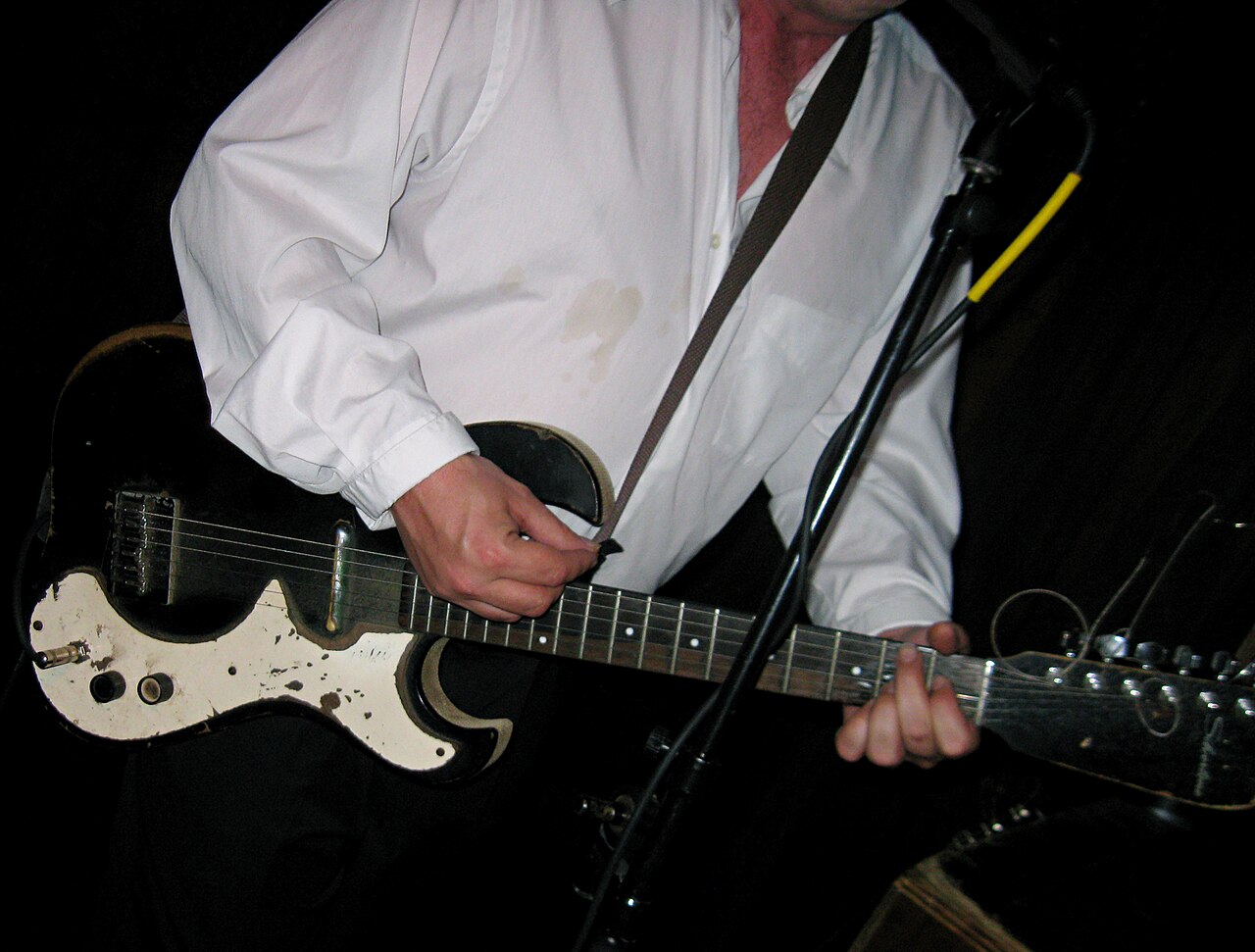
Photo: Rick Hall / Wikimedia Commons / CC BY 2.0 Silvertone
1448
1962
A beginner’s electric from the Sears catalog, with the amp in the case. Beck has played one his whole career.