Gibson
ES-175
A laminated jazz box that kept changing hands: bought used, given as a gift, borrowed for a hit.
1956. Jim Hall buys Howard Roberts’s old Gibson ES-175, second-hand. One pickup, pressed maple, nothing carved, nothing fancy. Hall later puts a humbucker in it and makes it his own. That’s how a lot of 175s got where they were going.
- Introduced
- 1949
- Type
- Hollowbody electric
- Class
- Production
The short version
1949
Kalamazoo
The ES-175 arrives, one P-90 pickup and a pointed cutaway. One history dates it to 15 June.
1953
The D
The two-pickup ES-175D becomes a catalog model. D means double pickup, not double cutaway.
1956
Hall buys Roberts’s
Jim Hall buys Howard Roberts’s single-pickup 175 second-hand.
1957
The first PAF
On 18 February, the first six-string Gibson with a PAF humbucker ships. It’s an ES-175N.
1963
A gift for Joe Pass
Mike Peak gives Joe Pass a sunburst 175. It’s his main guitar until about 1970.
1964
Steve Howe’s
Howe gets the ES-175D that Gibson later copies for his signature model.
2017–19
The end of the line
Regular USA production stops. Sources disagree on which year.
Side A
A1
A jazz box built for work
Some guitars go to one owner and stay there. The ES-175 has spent more than seventy years getting passed around. Sold used, handed down, given as a present, lent out for a session. It keeps ending up in the right hands, often not new.
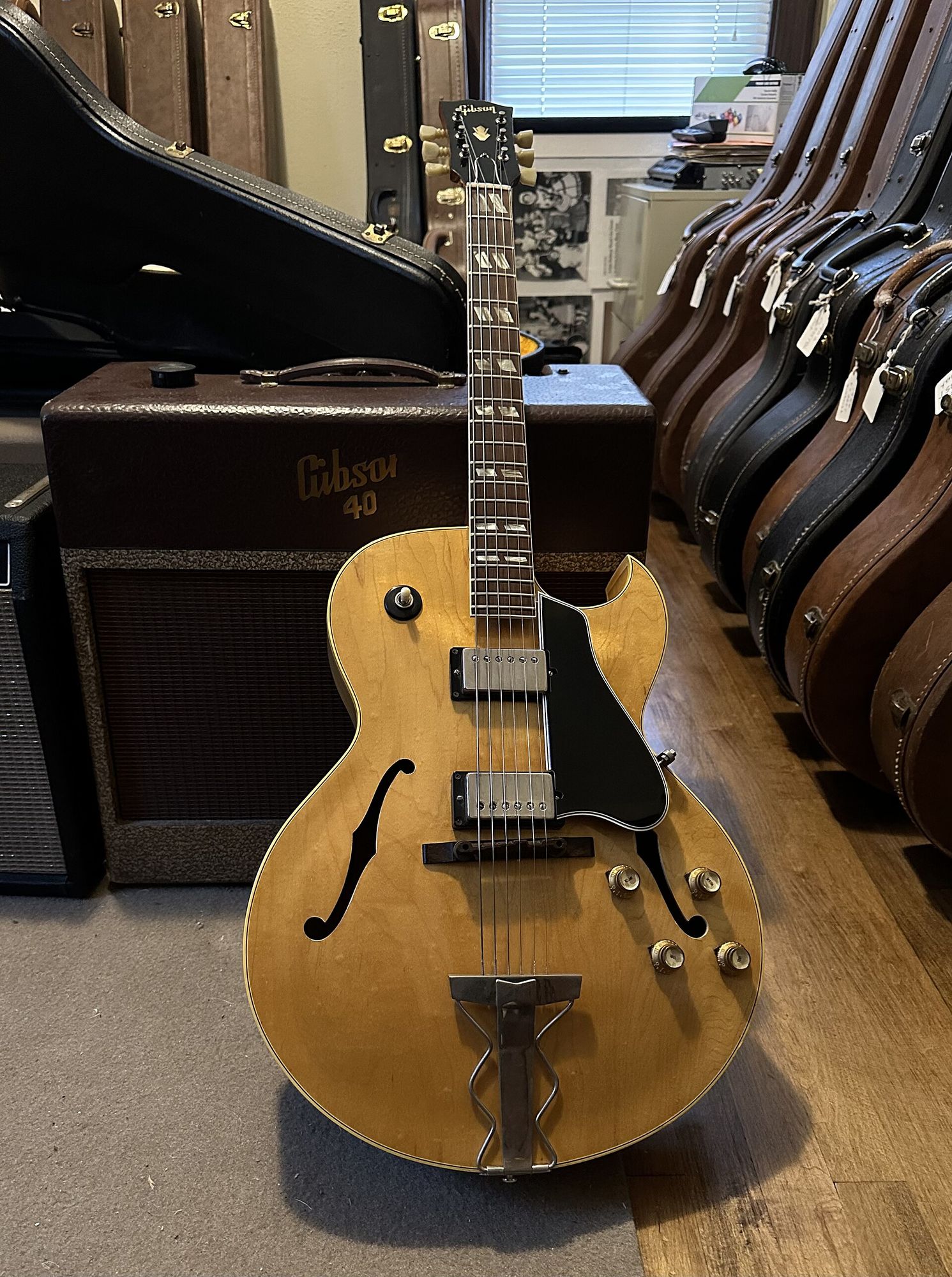
Gibson built the first ones in Kalamazoo in 1949. The fancy Gibson archtops, the L-5 and the Super 400, had tops carved out of solid spruce. The 175 didn’t. Its top and back were laminated maple, pressed into an arch. It was fully hollow, with two f-holes and a single pointed cutaway, and the first ones had one P-90 pickup near the neck.
That sounds like a step down, and on paper it was. In real life it made a workhorse: a jazz guitar a working player could drag around and plug in every night.
A2
The pointed cutaway and the D
The cutaway is called Florentine, and the 175 kept that sharp horn for its whole run. In 1953 the two-pickup version, the ES-175D, became a regular model. The D stands for double pickup. People assume it means double cutaway. It doesn’t.
A few years later it picked up the tailpiece everybody recognizes, the zigzag “T” trapeze. One source says 1958, another says it ran from 1957 to 1970. The one-pickup version hung on until around 1971 or ’72.
The big date is 18 February 1957. That day Gibson shipped its first six-string guitar with a PAF humbucker, the pickup every Les Paul collector dreams about. It was a natural ES-175. Later, plenty of 175s had their PAFs pulled out and put into Les Pauls. That’s the 175’s whole life in one detail: the thing that made it good got borrowed by somebody else.
On a 175 record, I’d tell you to listen for a warm, round, clean tone. The catch is that a fully hollow laminated body can feed back at rock volume, which is why some rock 175 stories happen in the studio, not on stage.
Gibson shipped 142 of them in 1949 and 16,946 by the end of the ’60s. Not rare. Useful.
A3
Second-hand, and a gift
Here’s the pattern. Howard Roberts played a 175 into the late ’50s, including on Mr. Roberts Plays Guitar. In 1956 Jim Hall bought Roberts’s single-pickup 175 second-hand, and later put a humbucker in it.
Herb Ellis played a 1953 single-pickup 175. Gibson later made the ES-165 Herb Ellis and sold it as a re-release of his guitar.
And Joe Pass didn’t even buy his. In 1963 a man named Mike Peak gave him a sunburst ES-175, and it was his main guitar until about 1970.
Flip the record · By the numbers
142
ES-175s Gibson shipped in 1949, the first year.
16,946
Shipped from 1949 to 1969. Not a rare guitar, which was the point.
1957
The year an ES-175N became the first six-string Gibson to ship with a PAF humbucker.
~37,000
Built in its first fifty years, by the count in the book on the model.
Side B
B1
A toothbrush in the tailpiece
Pat Metheny’s blonde 1958 ES-175 had a toothbrush jammed in the tailpiece, and it stayed his main guitar until he retired it from the road in the early ’90s and moved to custom Ibanez guitars.
Steve Howe of Yes got his ES-175D in 1964, and he still talks about it the way you’d talk about a person.
I got my Gibson ES-175 in 1964. I cherished that guitar.
Not every Yes album is the 175, for the record. Fragile was an ES-5 Switchmaster, and Close to the Edge is tied to an ES-345. And Wes Montgomery, who turns up in a few early pictures with a 175, made his name on an L-5 CES.
B2
Borrowed for the Reaper
The 175 even has a rock hit, and of course it was borrowed. Buck Dharma of Blue Öyster Cult played “(Don’t Fear) The Reaper” on a 175 that belonged to the band’s producer, Murray Krugman.
Gibson stopped making the ES-175 in regular production around 2017 or 2019, depending on which source you trust. There isn’t a new one in the catalog now.
That’s fine. Adrian Ingram, who wrote the book on the model, counts about 37,000 built in the first fifty years alone. Somebody will sell you theirs, or lend it to you, or give it to you. That’s how the 175 has always found its players.
Put this on
You’ve read about it. Now hear it. Here’s what this guitar sounds like, and what to listen for.
(Don’t Fear) The Reaper
Buck Dharma played a 175 he borrowed from producer Murray Krugman. A studio guitar for one track, not his stage main.
Find it on YouTube (opens in a new tab)
The cast
The people, and the specific guitars, that made the legend.
1953
Herb Ellis
1953 ES-175, one pickup
Gibson later sold the ES-165 Herb Ellis as a re-release of it.
1956
Jim Hall
Howard Roberts’s old 175
Bought it second-hand with a single P-90 and later put in a humbucker.
1963
Joe Pass
Sunburst ES-175, a gift
Given to him by Mike Peak. His main guitar until about 1970.
1958
Pat Metheny
Blonde 1958 ES-175
With a toothbrush wedged in the tailpiece. His main guitar until he retired it from the road in the early ’90s.
1964
Steve Howe
1964 ES-175D
“I cherished that guitar.” Not every Yes record is the 175, though.
1976
Buck Dharma
A borrowed 175
On “(Don’t Fear) The Reaper,” courtesy of producer Murray Krugman.
Liner notes
Specs, construction, rarity, value, and every source we used.
The laminated workhorse jazz box — fully hollow, Florentine from 1949 — not a carved L-5, not an ES-335, and not an ES-295.
- Body
- Fully hollow laminated maple; Florentine (pointed) cutaway; two f-holes; 16¼" class lower bout; triple-bound top, single-bound back
- Neck
- Set; 14th-fret join (1970 catalog). Classic: mahogany 1949–76; maple 1976–83
- Fingerboard
- Bound rosewood; pearloid double-parallelograms; 20 frets
- Scale
- 24 3/4"
- Pickups
- Two humbuckers. Late production (1990s–2010s): ’57 Classic — not a 1950s PAF
- Hardware
- Chrome; adjustable bridge; trapeze tailpiece
- Electronics
- 2 volume, 2 tone; 3-way toggle
- Finish
- Nitrocellulose; sunburst or natural (N)
- Nut
- No 175 factory figure sourced. Gibson line-wide ~1 11/16" postwar until the mid-1960s narrow-nut years
Open the full research fileConstruction details, the complete player record, production numbers, dated value estimates, and sources
Last typical production: two-humbucker ES-175D. Not listed on gibson.com as of 25 August 2026 — no current USA SKU. Regular production ended c. 2017 (jazzguitar.be; some dealer histories) or 2019 (Wikipedia; Guitar World). D means dual pickup, not double cutaway.
Construction
Kalamazoo, 1949. Laminated maple pressed into an arched top and back, fully hollow, one Florentine (pointed) cutaway, two f-holes, parallel-braced. Not a carved spruce L-5. Not an ES-335 — no center block. guitarhq: postwar ES models go laminated maple except the carved CES flagships and floaters. jazzguitar.be: 15 June 1949; guitarhq: 1949.
Lower bout: guitarhq / Premier Guitar / Blue Book 16 1/4" vs 1970 catalog (VGB) 16 1/2" × 20 1/4" × 3 3/8". Scale 24 3/4" vs L-5 CES 25 1/2". 20 frets in that catalog. Do not state 19 frets as a 175 fact (unconfirmed on guitarhq; confirmed on ES-295).
1949: one neck P-90; parallelogram trapeze. ES-175D from 1953 (some duals 1951–52 without the D). D = double pickup, not double cutaway. February 1957: humbuckers. VGB ledgers: first Gibson six-string PAF — 18 February 1957, ES-175N serial A25000. Zigzag “T” tailpiece: guitarhq 1958; Premier Guitar 1957–1970. Nickel through 1965, then chrome. Single-pickup dropped: guitarhq 1971; Premier Guitar 1972; VGB last list Sept 1970, stray shipping 1972.
ES-175T (1976–79): thinline-rim 175D — not a 335. VGB: mahogany neck 1949–76, maple 1976–83. jazzguitar.be (secondary): volute and Nashville bridge 1976; laminated maple back/sides return c. 1990. 1983 catalog: maple top on mahogany back and rims. ES-175CC: 1978 catalog; VGB says it shipped 1979. Memphis 1959 VOS (2010–2017, jazzguitar.be) is thin/secondary.
Adrian Ingram, The Gibson ES-175, is cited (Wikipedia lead) for about 37,000 in the first fifty years. The ES-165 Herb Ellis and Steve Howe signature are named recreations, not proof every 175 is those guitars. Regular USA production ended c. 2017 or 2019. L-5 CES is the carved 17" flagship. ES-295 is the gold 175-platform relative — not this SKU.
Players
VG’s workhorse jazz box: Ellis, Roberts, Hall, Burrell. Fully hollow laminate can feed back at rock volume (Hunter), so some rock 175 stories are studio, not arena-main.
Wes Montgomery’s public electric identity is the L-5 CES, not this guitar. Jazz Guitar Today (May 2020): a few earliest pictures show an ES-175; career sound is L-5 CES. The ES-295 is Scotty Moore’s first Elvis guitar. Lucille is ES-355-based — do not file B.B. King here.
Herb Ellis — 1953 ES-175, single-pickup. The later ES-165 Herb Ellis was marketed as a re-release of it — not his only guitar. Jim Hall bought Roberts’s single-P-90 175 second-hand in 1956 and later installed a humbucker. Howard Roberts used a 175 into the late 1950s (Mr. Roberts Plays Guitar), then other Gibsons and the oval-hole Howard Roberts models. Known-to-play; do not freeze him on a 175. Joe Pass — sunburst ES-175, gifted 1963 by Mike Peak; main guitar until about 1970. Later Ibanez JP20 / Epiphone Emperor are other-model afterlives.
Pat Metheny — blonde 1958 ES-175 (toothbrush in the tailpiece). Primary until early-1990s road retirement, then custom Ibanez. Early Metheny = 175; later touring = Ibanez. Both true.
Steve Howe’s 1964 ES-175D. Guitar World (20 February 2026): “I got my Gibson ES-175 in 1964. I cherished that guitar.” The Howe signature copies that 1964 D. Not every Yes album is the 175: Fragile used an ES-5 Switchmaster; Close to the Edge is tied to an ES-345.
Buck Dharma — borrowed ES-175 on “(Don’t Fear) The Reaper.” Guitar World (31 January 2024), Dharma: a 175 borrowed from producer Murray Krugman. Studio track. Not his live main.
Kenny Burrell is on VG’s 175 workhorse list and proposed a Florentine L-5 CES in 1958. Both. Martino’s late-1960s main in VG Florentines is a Florentine L-5, not a 175.
Rarity
Not rare as a model. gibson.com’s ES collection this pass is 335 / 345 / 330. Last regular production 2017–2019. Nashville resumed the 335 family, not the 175. The 175 is Florentine for the entire run.
Factory shipping 1949–1969 (GuitarHQ / Meiners — shipping totals, not a census): 16,946. First year 1949: 142. Natural is the scarce finish: no ES-175n in 1959, 5 in 1960; jazzguitar.be says Gibson “officially stopped” natural until ~1963 except those five. PAF-era duals 1957–early 1960s are the demand peak, not the lowest shipping. 1970–2019 shipping unpublished in the public GuitarHQ table.
Kalamazoo 1949–1984; Nashville overlap then post-1984; Memphis c. 2000/01–2019, including 2010–2017 1959 VOS. Those VOS and 1990s–2010s reissues are the good modern 175 — not 1957–60 PAF originals. Mid-1965 narrower nut (Joe’s: 1 11/16" → 1 9/16"): collector discount vs 1950s–early-1960s Kalamazoo.
Value
Informal estimate, 25 August 2026. Not an appraisal.
No current Gibson 175. Ask vs sold. Public 2024–26 solds are thin. Artist-owned pieces (Howe’s ’64, Metheny’s blonde ’58, Ellis’s ’53, Pass’s gifted sunburst) are not comps. Memphis VOS, Howe signatures, and the ES-165 Herb Ellis are not vintage 175s.
Used modern (1990s–2010s 175D), player grade: ~$3,000–$5,500 in 2024–26 dealer/forum chatter. 1959 VOS used: forum private asks ~$4,500–$5,000; dealers often $3,000–$4,000 in that thread; one 2017 liquidation sold $2,700.
Vintage. Edgewater July 2026 excellent all-original dealer-comp (not sold): 1949–53 P-90 single $4,000–$9,000; 1962–69 patent-number $5,000–$10,000; 1957–61 PAF $8,000–$18,000. Carter Vintage ask: 1960 sunburst, PAFs, replacement tuners, $16,000. Joe’s (15 February 2026): 1957–59 PAF, especially blonde, is the peak; natural PAF 175s can sit at or above that $18k cap in dealer retail — thin public solds 2024–26. 175 PAFs were harvested for Les Pauls (Guitar World, 22 June 2026). Headstock repair −40–50% (Joe’s).
See also
- gibson-es-335 — laminated too, but a thinline with a maple center block — not this guitar
- gibson-es-295 — gold 175-platform with floral guard and wraparound trapeze; Scotty’s first Elvis guitar, not this 175
- gibson-les-paul-standard — McCarty-era solidbody; the 175 is fully hollow
Sources
- guitarhq: ES-175 / ES-175D
- guitarhq: postwar electric archtops
- guitarhq: PAF (first six-string PAF)
- guitarhq: hollowbody shipping 1948–69
- Vintage Guitar and Bass: ES-175D
- Premier Guitar: Vintage Vault 1962 ES-175D
- Blue Book: Gibson ES-175
- jazzguitar.be: ES-175 history
- Joe’s Vintage: ES-175 evolution (15 Feb 2026)
- Vintage Guitar: Gibson’s Fabulous Florentines (April 2024)
- Guitar Player: Dave Hunter, 1959 ES-175D (9 Sep 2021)
- Wikipedia: Gibson ES-175 — lead only; Ingram fifty-year figure (~37,000)
- Guitar World: Steve Howe on his first guitar (20 Feb 2026)
- Guitar World: Howe on *Fragile* / *Close to the Edge*
- Guitar Player: Pat Metheny’s 1958 ES-175 (6 Mar 2026)
- Premier Guitar: Pat Metheny rig rundown
- Jazz Guitar Today: The Many L5’s of Wes Montgomery (May 2020)
- Howard Roberts archive: personal guitars
- jazzguitar.be: Famous jazz guitarists and their gear
- Guitar World: Buck Dharma on “The Reaper” 175 (31 Jan 2024)
- Vintage Guitar: John Pisano
- Vintage Guitar: Barney Kessel / Joe Pass JP20 contrast
- Guitar World: history of the ES-175 (22 Jun 2026; production to 2019)
- Gibson ES collection (no 175, 25 Aug 2026)
- Guitar World: Memphis factory vacated 2019
- Guitar.com: Memphis→Nashville ES move
- Wikipedia: Gibson ES Series (175 1949–c.2017)
- Carter Vintage: 1960 ES-175 SB ask $16,000
- Edgewater 2026 vintage Gibson value guide
- jazzguitar.be: ES-175 discontinued thread
- jazzguitar.be: 59 VOS used-value thread
Keep digging
Guitars this one gets compared to, confused with, or descended from.

Photograph of a vintage 1960 Gibson ES-335TD. Photo by Lightburst. Licensed under CC BY-SA 4.0. Via Wikimedia Commons. Gibson
ES-335
1958
Larry Carlton played three 335s off a shop wall, unplugged, paid $850 for one, and became Mr. 335.
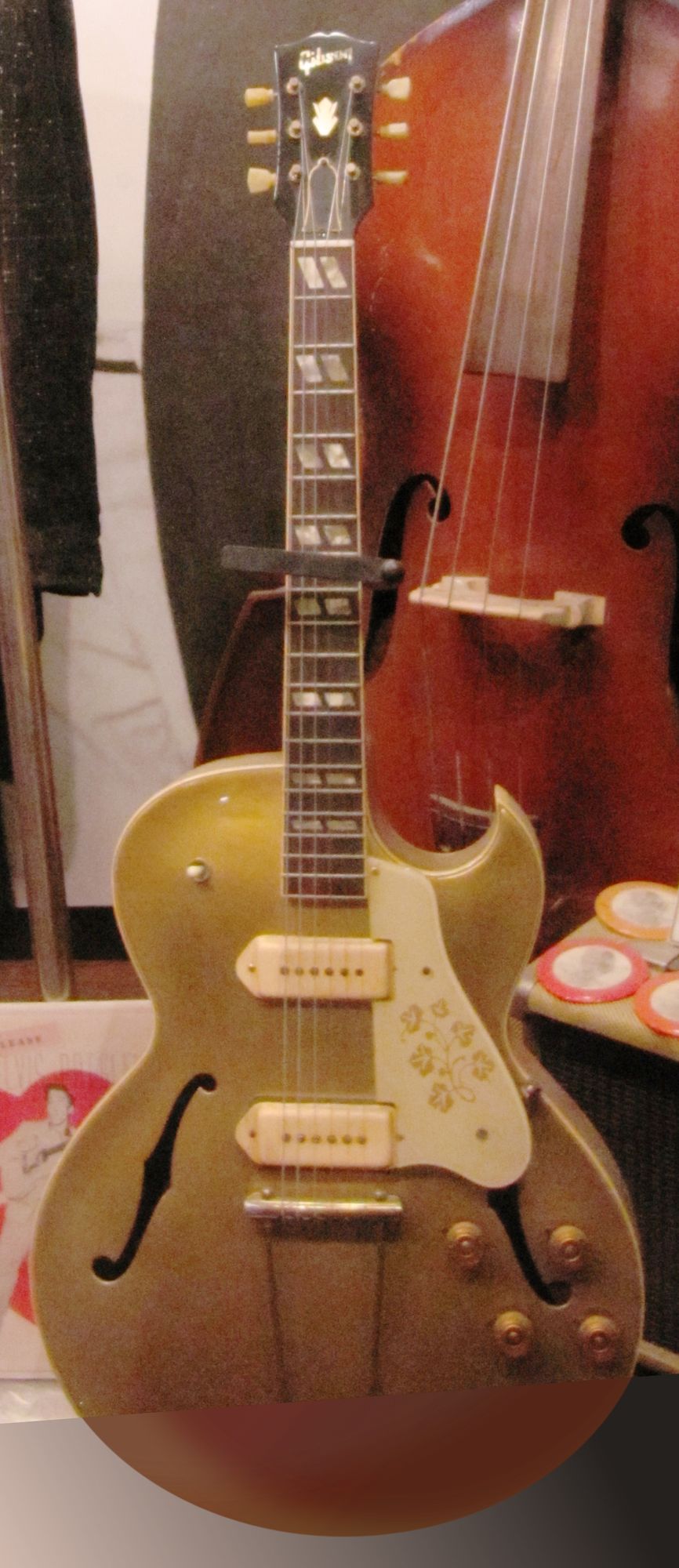
Gibson ES-295, Sun Studio. Clipped from Memphis Sun Studios Elvis instruments.jpg. Photo by Mr. Littlehand; derivative by Clusternote. Licensed under CC BY 2.0. Via Wikimedia Commons. Gibson
ES-295
1952
Scotty Moore traded a Fender for the gold guitar in the window. Four Elvis singles later, he traded it away.

2006 Gibson Les Paul Standard (SN 000660573). Photo by wetwebwork. Licensed under CC BY-SA 2.0. Via Wikimedia Commons. Gibson
Les Paul Standard
1952
Gibson made about 1,500 sunburst Les Pauls, decided nobody wanted them, and stopped. Then the British blues boom happened.