Fender
Telecaster
Telecaster
Leo built it like a tool. The famous ones look like they just clocked off a double shift.
Fullerton, California, autumn 1950. Fender starts building a two-pickup electric Spanish guitar out of a flat slab of ash, with a maple neck bolted onto the end. It’s called the Broadcaster. That name is about to get Fender a letter.
- Introduced
- 1950
- Type
- Solidbody electric
- Class
- Production
The short version
1950
The Broadcaster
Two pickups, a truss rod, and a slab of ash. Production starts in the autumn.
1951
A new name
Gretsch objects, a nameless “Nocaster” fills the gap, and the Telecaster name arrives later that year.
1954
Black to white
The black pickguard turns white in mid-1954. Collectors still split the guitar at that line.
1957
“Suzie Q”
James Burton plays on Dale Hawkins’s record, cut in July.
1959
Dressed up
A rosewood fingerboard, and the bound sunburst Custom Telecaster.
1963
“Act Naturally”
Don Rich on Buck Owens’s Telecaster, and Bakersfield has its sound.
1969
The rooftop
George Harrison plays a 1968 rosewood Telecaster on the Beatles’ rooftop concert, 30 January.
1970
Micawber
Eric Clapton gives Keith Richards a Telecaster for his 27th birthday, in December.
Side A
A1
Built like a shop tool
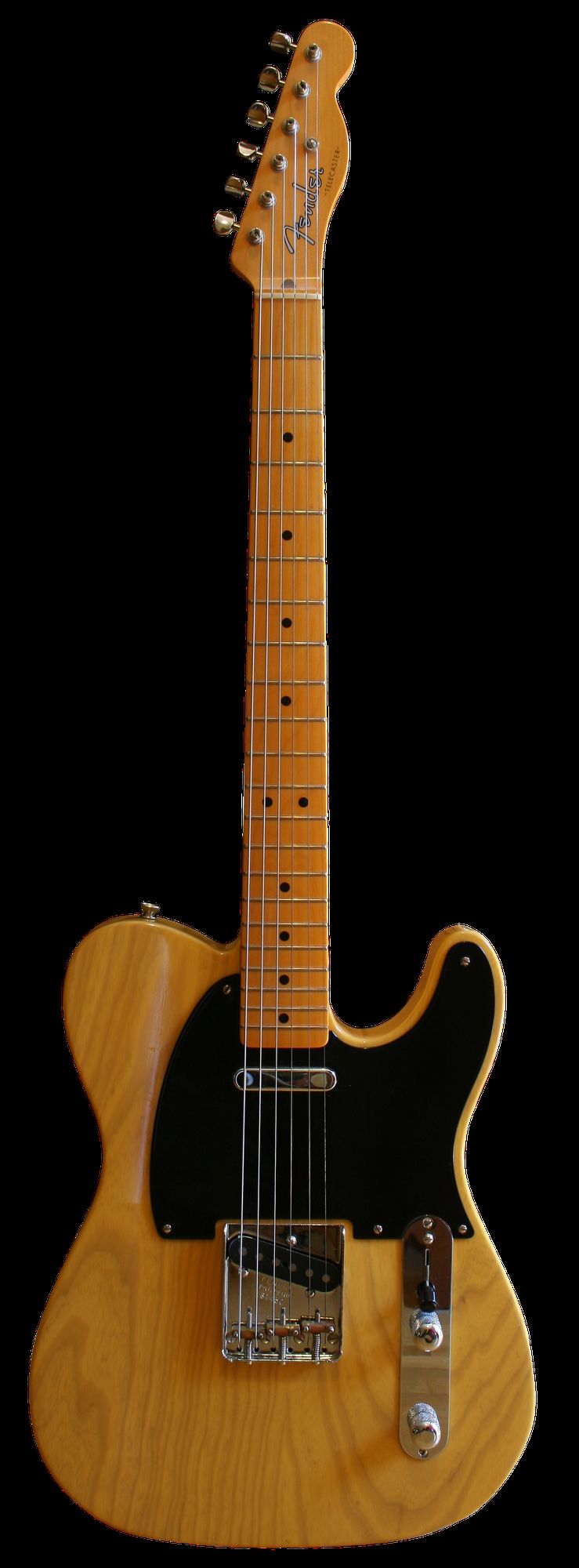
Leo Fender wasn’t making furniture. Put a Telecaster next to anything else from 1950 and you can see it. A flat slab of ash about an inch and three-quarters thick, no carving, no curves on the back. A maple neck bolted onto the end. A bridge pickup sitting in a metal plate that everybody calls the “ashtray.”
It looks like a tool because it is one. And tools get used. They get dropped, repainted, patched with whatever part is lying around, and handed to somebody else. Keep that in mind, because almost every famous Telecaster in this story has been through all of it.
The first ones went out in autumn 1950 as the Broadcaster: two pickups, a three-way switch, three saddles, strings through the body. And a truss rod, which sounds dull until you learn that the guitar before it, the Esquire, often shipped without one, and a lot of those necks had to be replaced.
A2
Three names in about a year
The Broadcaster name didn’t last. Gretsch already had a “Broadkaster,” and they objected. The cease-and-desist letter is dated 20 February 1951. For a stretch, Fender shipped the guitar with no model name on the headstock at all. Collectors call those Nocasters, which is funny and also accurate.
Then it became the Telecaster. Exactly when depends on who you ask: sometime in 1951, maybe summer, maybe as late as September for the new decals.
How many Broadcasters were there? Depends who you ask. The old number is about 200. A newer count says 550 to 600 before the name changed. Fender never published a total, so nobody gets to settle it.
Meanwhile its one-pickup sister, the Esquire, went right on being the Esquire. That’s its own story.
A3
Country got there first
An early Tele bridge pickup is bright and hard, and it cuts straight through a band. Country players knew exactly what to do with that.
Luther Perkins played behind Johnny Cash from 1954 on a Telecaster and an Esquire, and that boom-chicka rhythm came out of those two guitars. In July 1957 James Burton played on Dale Hawkins’s “Suzie Q,” then went to work in Ricky Nelson’s band on American TV, and later for Elvis, often on a paisley Telecaster. Fender made the paisley finish in 1968 as a novelty. Country guys adopted it. Nobody saw that coming.
Out in Bakersfield, Buck Owens and Merle Haggard made the Tele the foundation of a whole sound. On “Act Naturally” in 1963, that’s Don Rich on Owens’s Telecaster. In soul, Steve Cropper’s Telecaster is the one people name for “Green Onions,” “In the Midnight Hour,” and “Soul Man.” And on a 1958 tour of Britain, Muddy Waters played loud electric blues in rooms that had come to hear folk.
Country players heard that bridge pickup and knew exactly what it was for.
Flip the record · By the numbers
~200
Broadcaster-logo guitars, by the old estimate. A newer count says 550–600. Take your pick.
1.75"
Thickness of the classic early ash slab. No belly cut, no forearm cut.
5
Strings on Micawber. Richards took the low E off and tuned the rest to open G.
27
Keith Richards’s birthday when Clapton handed him Micawber, December 1970.
Side B
B1
Paisley, rosewood, and humbuckers
From 1959 on, Fender started dressing the plank up. That year brought a rosewood fingerboard and the bound Custom Telecaster. (Albert Collins’s was a natural-finish 1966, often capoed and tuned to an open minor chord.) In 1968 came the semi-hollow Thinline and those paisley and flower wallpaper finishes, and in 1969 a Telecaster made of rosewood.
Then, in the early ’70s, Seth Lover’s Wide Range humbuckers went into the Thinline, a Custom with a fat humbucker in the neck, and the Deluxe. None of it replaced the blonde slab. It just gave the family more cousins.
B2
None of them are stock
Eric Clapton gave Keith Richards a Telecaster for his 27th birthday in December 1970. Richards named it Micawber, after the Dickens character. Then he took the low E string off, tuned the other five to open G, and put a PAF humbucker in the neck. Later came a lap-steel-style bridge pickup and a six-saddle brass bridge with one saddle pulled out.
What year is it? “Micawber is a ’53,” Richards has said. When it hung in the Met’s Play It Loud show in 2019, the label said 1954. Another story makes it a ’54 Tele wearing a ’52 Esquire neck. I’m not going to pick. Working guitars swap parts.
Bruce Springsteen’s guitar on the cover of Born to Run is a Telecaster body with an Esquire neck. Techs say 1953 or 1954. He bought it at Phil Petillo’s shop in New Jersey, shortly after signing with Columbia in 1972, and it was his road guitar for decades. It came back out for the Super Bowl in 2009.
B3
Painted over, stickered up
Jeff Beck gave Jimmy Page a 1959 Telecaster. It was Page’s go-to when Led Zeppelin formed in 1968, the main guitar on their first album, and the guitar on the “Stairway to Heaven” solo. Page painted it. While he was on tour, a friend painted over his paint job. He saved the neck and put it on a B-bender Tele he used later in the Firm.
George Harrison played a 1968 rosewood Telecaster on the Beatles’ rooftop concert, 30 January 1969. Joe Strummer bought a sunburst 1966 Tele in 1975. After he joined the Clash it got grey primer and black automotive paint and a pile of stickers, the famous one reading “Ignore Alien Orders.” He played it until 2002.
You can walk into any shop and buy a new Telecaster that looks exactly like the catalog. It’s a good guitar. But the ones anybody remembers have a missing string, a borrowed neck, a coat of primer, and a sticker telling you to ignore alien orders.
Put this on
You’ve read about it. Now hear it. Here’s what this guitar sounds like, and what to listen for.
Suzie Q
James Burton on the guitar, cut in July 1957. Listen to that lead line, bright and a little mean. That’s the bridge-pickup sound people buy Telecasters to get.
Find it on YouTube (opens in a new tab)Act Naturally
Don Rich playing Owens’s Telecaster at that session. This is the Bakersfield sound, and the Tele is the foundation of it.
Find it on YouTube (opens in a new tab)Stairway to Heaven (the solo)
Skip ahead to the solo, recorded in 1970. That’s the ’59 “Dragon” Telecaster Jeff Beck gave Jimmy Page. The acoustic parts are a different guitar, and the song as a whole is not a Telecaster record.
Find it on YouTube (opens in a new tab)Get Back (rooftop concert)
George Harrison’s 1968 rosewood Telecaster, on the roof, 30 January 1969. The film is solid. Which overdubs on the album used it is less certain.
Watch it on YouTube (opens in a new tab)
The cast
The people, and the specific guitars, that made the legend.
1954
Luther Perkins
A Telecaster and an Esquire
Behind Johnny Cash from 1954. The boom-chicka came out of these two planks.
1957
James Burton
Telecaster, later a paisley one
“Suzie Q,” then Ricky Nelson’s TV band, then Elvis, often on a 1968 paisley Tele.
1971
Keith Richards
“Micawber”
He says it’s a ’53. A 2019 museum label says ’54. Five strings, open G, a PAF in the neck.
1969
Jimmy Page
The ’59 “Dragon”
A gift from Jeff Beck. Main guitar on the first Led Zeppelin album, and the “Stairway” solo.
1975
Bruce Springsteen
Tele body, Esquire neck
The Born to Run cover guitar. A mutt, bought at Phil Petillo’s shop in New Jersey after he signed with Columbia.
1975
Joe Strummer
1966 Telecaster
Bought sunburst, then painted primer grey and black and covered in stickers. His main guitar until 2002.
Contact sheet
More photographs of this model, including one out in the wild.
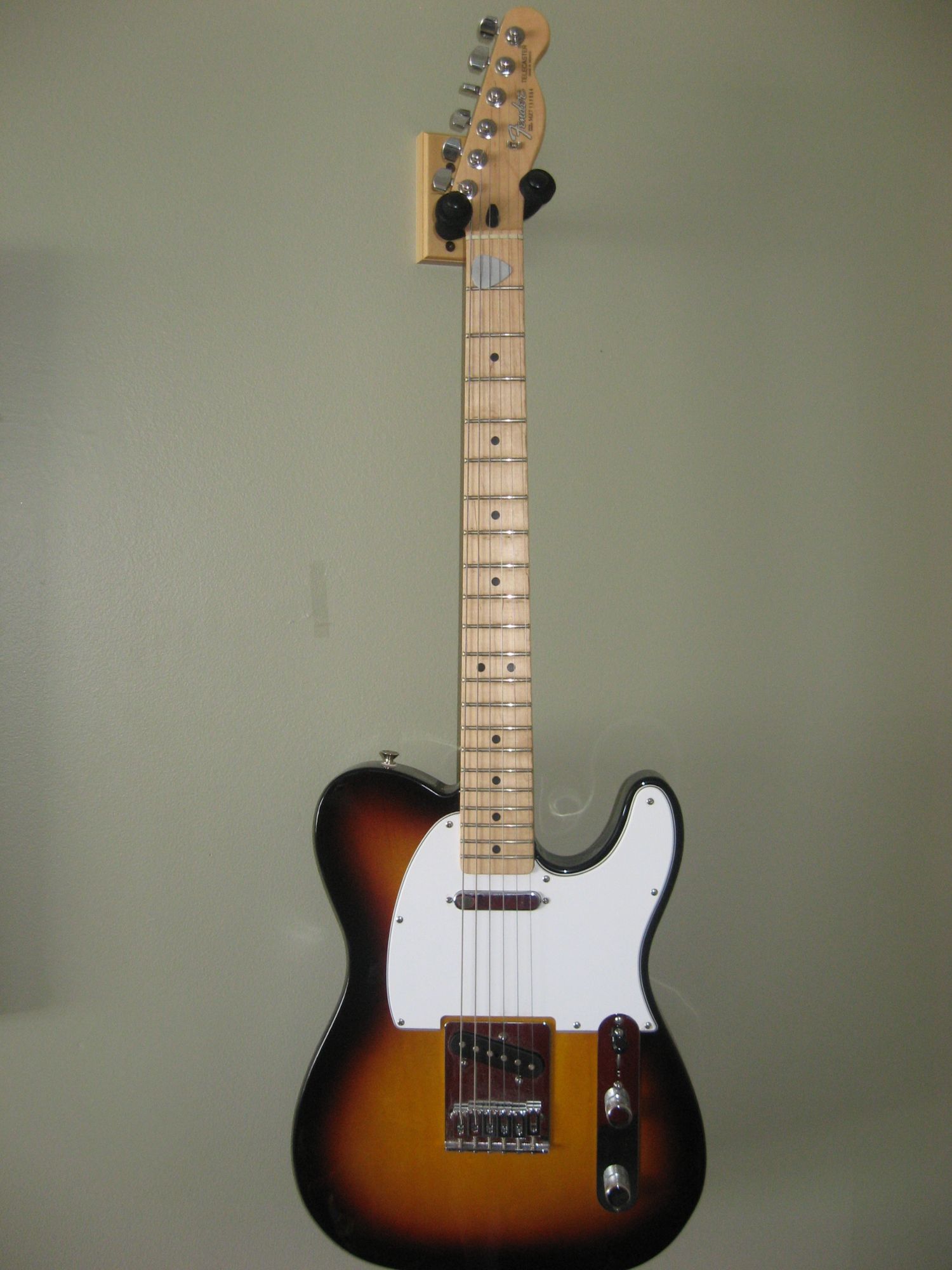
ColorwayHigh quality photo of a Fender Telecaster, sunburst w/maple neck. Photo by Stra2caster. Public domain (PD-self). Via Wikimedia Commons. 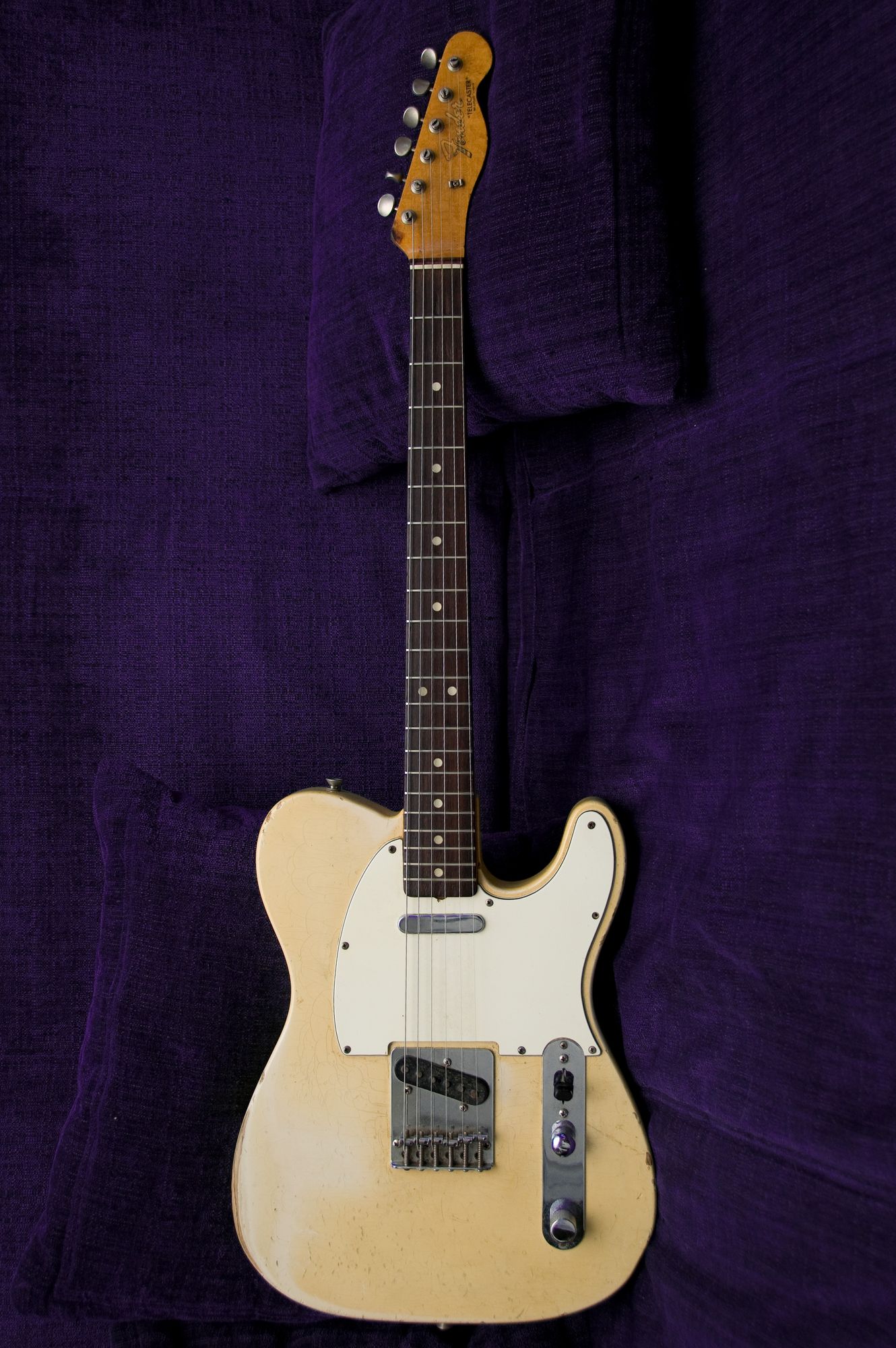
Colorway1966 Fender Telecaster (SN159266). Photo by ArtBrom from Seattle. Licensed under CC BY-SA 2.0. Via Wikimedia Commons. 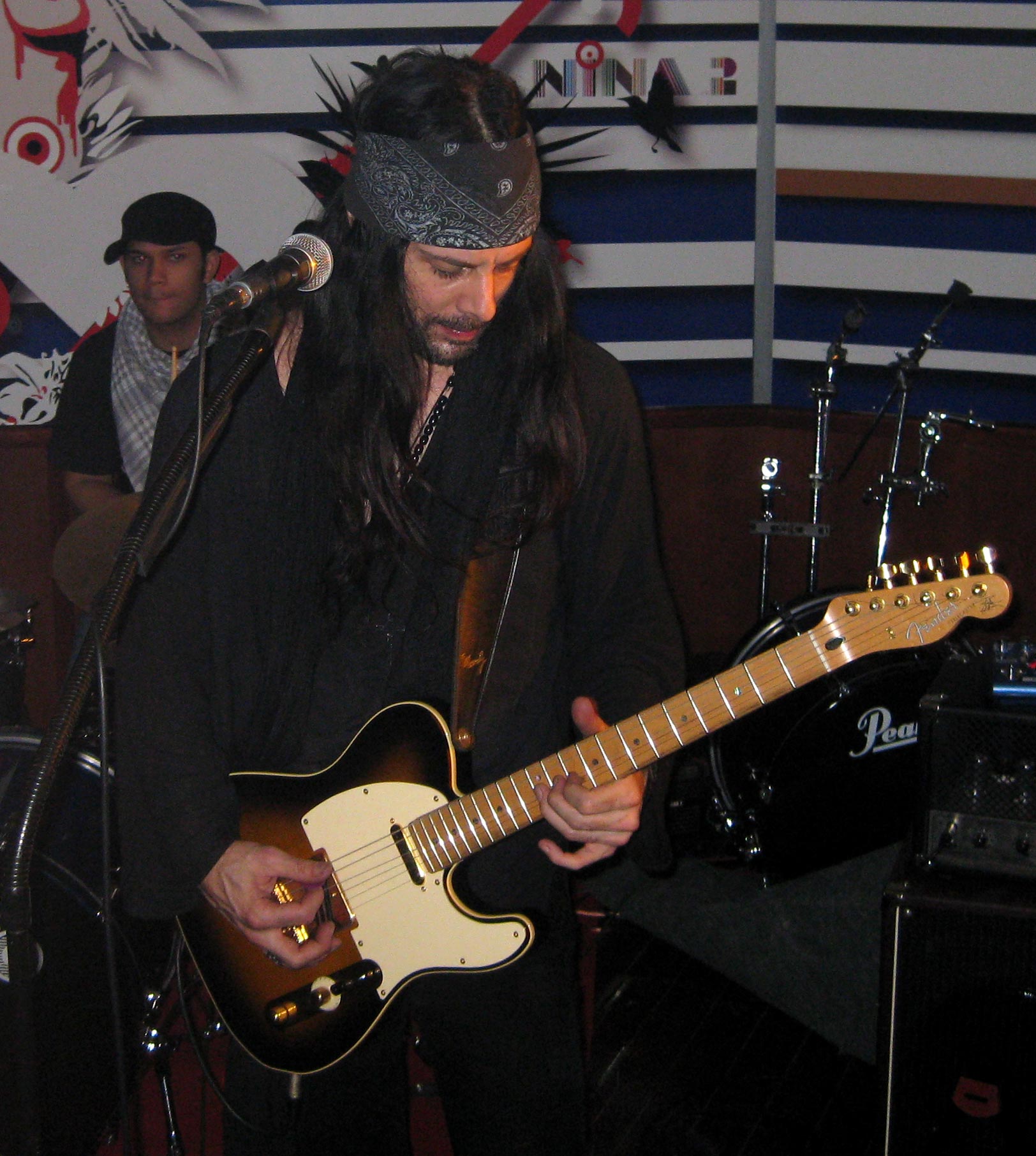
In playRichie Kotzen performing live at ship club Nina 2 in Rijeka (Croatia) on February 17th, 2009. Photo by VedranBaotic. Public domain (PD-self). Via Wikimedia Commons.
Liner notes
Specs, construction, rarity, value, and every source we used.
A slab body, two pickups, and a bridge plate that still does the job Leo assigned it in 1950.
- Body
- Alder or roasted pine (Butterscotch Blonde often roasted pine); single-cutaway slab
- Neck
- Bolt-on maple, Deep “C”
- Fingerboard
- Maple or rosewood, 9.5" radius, 22 narrow-tall frets
- Scale
- 25.5" (648 mm)
- Pickups
- Two V-Mod II Tele single-coils
- Hardware
- Compensated brass “bullet” saddles; top-load or string-through
- Electronics
- Volume, tone, 3-way; push-push tone for series in position 2
- Finish
- Gloss urethane
- Nut
- Bone, 1.685"
Open the full research fileConstruction details, the complete player record, production numbers, dated value estimates, and sources
Current American Professional II. Classic 1950s spec was typically ash, 21 frets, three saddles, nitro blonde, and a black then white pickguard — see Construction. Mexican Player II: alder, Modern “C,” 22 frets, 1.650" nut, Alnico V Tele pickups, gloss polyester.
Construction
The Telecaster is the renamed two-pickup Fender. Production as the Broadcaster starts autumn/October 1950. Fender: “introduced in 1950 and renamed the Telecaster in 1951.” guitarhq.com puts the Telecaster name in summer 1951; True Vintage Guitar has Broadcaster until February 1951. Vintage Guitar magazine: Broadcaster logo October 1950–February 1951. Gretsch objected over the “Broadkaster” trademark; nameless-headstock transitional guitars are the collector nickname Nocaster. Sister single-pickup model: Esquire (June 1950 name; reintroduced 1951 as the one-pickup Tele). True Vintage Guitar dates the Gretsch cease-and-desist 20 February 1951; some compilations put Telecaster decals “around 9/51.”
Classic early spec is a single-cutaway slab, typically 1.75" thick ash. Blonde/butterscotch translucent over ash is the standard look. After mid-1956, non-blonde Teles follow alder-for-opaque/sunburst, ash-for-blonde. Earlier, guitarhq.com’s rule is all-ash. Deluxe and some later variants add Strat-like contours; the original does not.
Neck: bolt-on one-piece maple with truss rod from Broadcaster onward. Early 1950 Esquires often lacked a truss rod; many were replaced. Twenty-one small frets. 7.25" radius typical — a 9" Broadcaster has been documented. Nut 1-5/8" standard. Large rounded “D” early; V in 1956–57. Rosewood slab from 1959; veneer from 1962. Serial on the bridge plate until mid-1954, then the neck plate.
Two single-coils: bridge pickup in a metal “ashtray” plate; smaller neck pickup. Early bridge pickups are a defining part of Tele twang. Three-saddle bridge (brass on the earliest; later steel/threaded), strings through body, Kluson tuners. Volume, tone, 3-way. Early Broadcaster/blend-circuit wiring is a specialist topic — some 1950 examples lack a conventional tone knob. Control plate on the lower bout; side-mounted jack in a cup.
Nitrocellulose blonde standard. Custom Duco from the late 1950s at 5% extra. Black phenolic pickguard 1950–mid-1954; white plastic from mid-1954. That’s the “blackguard” vs “white guard” split collectors actually use.
1959: rosewood and the bound sunburst Custom Telecaster — a name later reused. 1968: Telecaster Thinline (semi-hollow) and Paisley Red / Blue Flower wallpaper finishes. 1969: all-rosewood Telecaster. 1971–73: Seth Lover Wide Range humbuckers — Thinline (1971), Telecaster Custom with neck humbucker (1972), dual-humbucker Telecaster Deluxe (1973, Strat-ish headstock and contours). Wide Range models discontinued around 1979–81. CBS 1965–85; modern FMIC production from 1987.
American Professional II is the table above. Player II is the Mexican high-volume spec.
Players
The Telecaster is the first commercially successful, mass-produced solid-body Spanish electric. The Esquire is a separate one-pickup model (1950–1969), not a nickname and not the 1950 launch name of the two-pickup guitar. Broadcaster = two-pickup 1950 name. Nocaster = collectors' name for early-1951 no-model-name guitars. Telecaster = two-pickup name from 1951. Hybrids exist; they are hybrids.
Luther Perkins (Johnny Cash). Fender: Perkins accompanied Cash from 1954 on a Telecaster and an Esquire. The Cash "boom-chicka" association is with Tele/Esquire. He later used a Jazzmaster; that does not overwrite this one.
Buck Owens / Bakersfield. Fender names Owens — and the Bakersfield scene with Merle Haggard — as establishing Telecaster as the foundation of that country sound. "Act Naturally" (1963), with Don Rich on Owens's Telecaster at that session. Scene association, not one named guitar.
Keith Richards, "Micawber." Gift from Eric Clapton on Richards's 27th birthday (December 1970). Richards, Guitar World: "Micawber is a '53" — contrasted with "a '54 Tele named Malcolm." The Metropolitan Museum of Art's 2019 Play It Loud label identified it as a 1954 Telecaster and stated he first used it to record Exile on Main St. (1971), removed the low E, and tuned the remaining five strings open G (G–D–G–B–D). Named for Dickens's Micawber. Keep both years; do not pick. A later Guitar World "A Life in Guitars" feature also calls it, in one passage, "fundamentally… a '54 Tele with a '52 Esquire neck." Working vintage guitars mix parts. Mods include a PAF in the neck, later a lap-steel-style bridge pickup, and a six-saddle brass bridge with the low-E saddle removed for five-string open G. Principal open-G stage Tele from the early 1970s. Associated with "Brown Sugar," "Honky Tonk Women," "Before They Make Me Run."
Bruce Springsteen, Born to Run cover guitar (1975). Not a stock Esquire. Not a stock Tele. Fender's own "Iconic Mods" page flags it: Telecaster body, Esquire neck — a mutt. Techs indicate 1953 or 1954; bought shortly after the 1972 Columbia signing at Phil Petillo's New Jersey shop. Springsteen, to the Rock and Roll Hall of Fame (quoted by Fender), said he wanted a Telecaster for soul-and-rock reasons (Cropper, Burton, Beck). On the covers of Born to Run, Wrecking Ball, and Human Touch. Road guitar for decades; retired from regular touring in the mid-2000s; Super Bowl XLIII (2009).
Jimmy Page, "Dragon Telecaster." 1959 Telecaster given to Page by Jeff Beck. Fender: go-to guitar when Led Zeppelin formed in 1968; the main guitar on Led Zeppelin (1969); later the guitar for the "Stairway to Heaven" solo (recorded 1970). Acoustic parts of "Stairway" are a different guitar — Page has been explicit about a Harmony acoustic. Do not say Stairway was recorded on a Telecaster. Page told Guitar World in 1998 that a friend painted over his paint job while he was on tour with the '59 Les Paul bought from Joe Walsh; he salvaged the neck for a later B-bender Tele used in the Firm.
George Harrison — 1968 rosewood Telecaster. Get Back / rooftop concert, 30 January 1969. Rolling Stone (11 March 2016): Fender Custom Shop master builder Paul Waller was given access to Harrison's 1968 rosewood Telecaster by the Harrison family in order to replicate the guitar Harrison played in the Let It Be sessions and at the Beatles' rooftop concert, visible on "Get Back." Rooftop and film use is solid. Which overdubs on the released album are that guitar is not established here.
Jeff Beck — 1954 Esquire (Yardbirds). Not a Telecaster. Vintage Guitar: the Yardbirds loaned him Clapton's red Telecaster when he joined; he wanted maple-neck and in 1965, on tour with the Walker Brothers, bought John Walker's maple-neck Esquire. VG lists it on "I'm A Man," "Over Under Sideways Down," "Shapes of Things." Guitar Player (updated 9 March 2026): the same battered blonde 1954 Esquire, fitted with a '55 Telecaster neck, powered "Heart Full of Soul." Photographs look like a Tele; it is a one-pickup Esquire. Fender's later Yardbirds Tribute Esquire admits the distinction. Beck later traded it to Seymour Duncan for the "Tele-Gib."
James Burton. Fender: Dale Hawkins, "Suzie Q" (July 1957); then Ricky Nelson's band on American TV. Later Elvis Presley's guitarist, often on a paisley Telecaster — a 1968 factory novelty that country players unexpectedly adopted. More than one guitar; the paisley is the documented working instrument of that era.
Joe Strummer. Sunburst 1966 Telecaster, bought 1975; after he joined the Clash it was refinished in grey primer and black automotive paint and accumulated stickers, most famously "Ignore Alien Orders." Principal guitar until 2002. Mixdown's London Calling gear rundown also notes a 1950s Esquire in live use c. 1979–81 — canonical Tele, not his only Fender plank.
Albert Collins. 1966 Custom Telecaster. Fender Custom Shop's Albert Collins Signature (issued 1990) is explicitly "the Ice Man's '66 Custom Telecaster." Natural-finish, bound Custom, often capoed and tuned to an open minor chord — the guitar of Ice Pickin' and later Alligator-era records.
Also known to play the model, without a single canonical guitar: Steve Cropper — Green Onions (Booker T. & the M.G.'s, 1962); Otis Redding, "(Sittin' On) The Dock of the Bay" (the hit is 1968; Fender's long essay has a year slip — use the record, not Fender's year); Wilson Pickett, "In the Midnight Hour" (1965); Sam & Dave, "Soul Man" (1967). Muddy Waters — 1958 UK tour, loud electric blues in rooms that expected folk. Roy Buchanan, Danny Gatton. Fender also lists Andy Summers, Chrissie Hynde, and Jonny Greenwood. Greenwood is a Telecaster (and later Starcaster) player in Radiohead — not the Radiohead Jazzmaster story. That one is Thom Yorke.
Rarity
Current production is not rare. Custom Shop and American Vintage II reissues are limited versus Player production; they are not vintage-scarce.
Official Telecaster / Broadcaster / Nocaster shipping totals are unpublished. Serials were shared across models and overlap years; they are dating clues, not shipping counts.
Broadcaster logo (October 1950–February 1951): long-standing expert estimate ~200 (Vintage Guitar 2003 Broadcaster feature; Joe’s). Vintage Guitar’s 2026 “40 most valuable” instead says 550–600 were made before the name changed. Unreconciled — the higher figure may blend Broadcaster + Nocaster or use a different cutoff. Treat official total as unknown; keep both.
Nocaster (1951): collector term for a very short unlabeled window. No official count.
Blackguard (1950–summer 1954): Vintage Guitar 2026 estimate fewer than 10,000, fewer than half surviving original. Still an estimate. Scarce relative to later Teles, less rare than Broadcaster-logo guitars.
Rosewood Teles 1969–72: AxeDB approximately 100. Custom colors, paisley/blue flower, and the rosewood-body Tele are genuine extras. guitarhq.com: “Only about 50 of these original Esquires were shipped” (June–September 1950). Specialist estimate.
Value
Informal estimate, 25 August 2026. Not an appraisal.
Asking prices are not sold prices. Dealer excellent-original retail can sit well above mixed-condition sold medians. Original finish vs refinish, and provenance, can double or halve a result (refinish ≈ half across AxeDB’s 1950–79 Tele sample). Artist-owned examples are a separate market. Reissues and Custom Shop copies do not substitute for 1950s–60s originals.
New street. Mexico Player II about $840. US American Professional II about $1,500–$1,840. American Vintage II about $2,500–$2,700. Custom Shop team-built commonly $3,800–$5,200 ask.
Used modern. Used Mexican Player / Standard typically about $400–$700. Used Pro II generally about $1,000–$1,500 (thin specific capture). Late-CBS 1970–79 AxeDB median about $2,900. Edgewater excellent-original: 1966–75 $4,000–$9,000; 1976–81 $2,000–$4,500.
Vintage / collectible. Distinguish sold medians from dealer ask. AxeDB mixed-condition solds: Broadcaster median ~$51,000 (n=6, thin; range $17,000–$94,000); Nocaster ~$30,000 (n=5); blackguard median ~$29,200 vs whiteguard ~$14,645; pre-CBS 1960–64 ~$9,900 vs early CBS 1965–69 ~$6,750.
Joe’s Vintage Guitars, July 2026, excellent-original dealer: Broadcaster $90,000–$175,000; Nocaster $65,000–$110,000; Tele 1951 $45,000–$75,000; 1952–54 blackguard $40,000–$60,000. Edgewater February 2026 museum-grade Broadcaster $150,000–$250,000+ — higher than Joe’s. VG 2026 Nocaster aside: $85,000–$125,000. Broadcaster dealer-ask is well above AxeDB’s mixed median (~$51k, n=6, thin). Esquire: Joe’s typically about 75% of a same-year Tele; AxeDB finds that discount mainly in blackguard.
Artist-owned Teles sit outside these bands.
See also
Sources
- The one that started it all: a Telecaster history — 1951 Tele, Perkins, Owens/Bakersfield, Richards/Micawber 1953, Springsteen cover ambiguity, CBS/Schultz timeline.
- Telecaster — 1950 introduction / 1951 rename.
- The Telecaster Custom story — 1959 bound Custom vs 1972 Wide Range Custom.
- The Telecaster Deluxe — 1973 Deluxe, Seth Lover, 1981 discontinuation.
- Iconic Mods: Springsteen’s ‘Boss’ Esquire — Tele body / Esquire neck mutt; not a stock Esquire or Tele.
- Chasing the Dragon: Page’s painted Telecaster — 1959 Dragon; Led Zeppelin I; “Stairway” solo.
- American Professional II Telecaster — current spec/price.
- True Vintage Guitar: Broadcaster 1950–1951 — Broadcaster dates, 20 February 1951 Gretsch letter.
- True Vintage Guitar: Telecaster values by year — year-by-year values.
- Joe’s Vintage Guitars Telecaster value guide — July 2026 dealer ranges; ~200 Broadcasters; Esquire ~75%.
- AxeDB: The Vintage Telecaster Market — 3,509 solds; blackguard vs whiteguard medians (March 2026).
- Vintage Guitar: A.J.’s 1950 Fender Broadcaster — ~200 Broadcaster logos October 1950–February 1951.
- Vintage Guitar: 40 Most Valuable Guitars of 2026 — Broadcaster 550–600 claim (unreconciled); blackguard <10,000.
- Vintage Guitar: The Fender Telecaster — originally September 2002; Esquire kept distinct; Nocaster window.
- Vintage Guitar: Jeff Beck — Yardbirds guitar is a 1954 Esquire, not a Tele.
- Guitar World: Keith Richards interview — “Micawber is a ’53”; Malcolm is the ’54.
- Met: Play It Loud (2019) — Micawber labelled 1954.
- Rolling Stone: Harrison’s Let It Be rosewood Tele — 1968 rosewood; rooftop 30 January 1969 (11 March 2016).
- guitarhq.com Fender and 50tele — construction, serials, Esquire/Broadcaster timeline.
- Edgewater Guitars 2026 value guide — February 2026 Tele/Broadcaster/Nocaster ranges.
- Fender American serial dating — shared/overlapping numbers, not model totals.
- Sweetwater Player II Telecaster — Player II spec snapshot.
- Sweetwater American Professional II Telecaster — Am Pro II street snapshot.
- Guitar World: Keith Richards' guitars — a life in guitars
- Arts Journal: Play It Loud label notes — contemporary transcription of Micawber 1954 label.
- Guitar Player: Jeff Beck on Esquires — updated 9 March 2026; 1954 Esquire / '55 Tele neck; "Heart Full of Soul."
- Christie's: Jeff Beck — 10 guitars that shaped a legend — Esquire traded to Seymour Duncan.
Keep digging
Guitars this one gets compared to, confused with, or descended from.

Photo: Lightburst / Wikimedia Commons / CC BY-SA 4.0 Fender
Stratocaster
1954
The guitar most people mean when they say “electric guitar.” Designed by a man who didn’t play one.
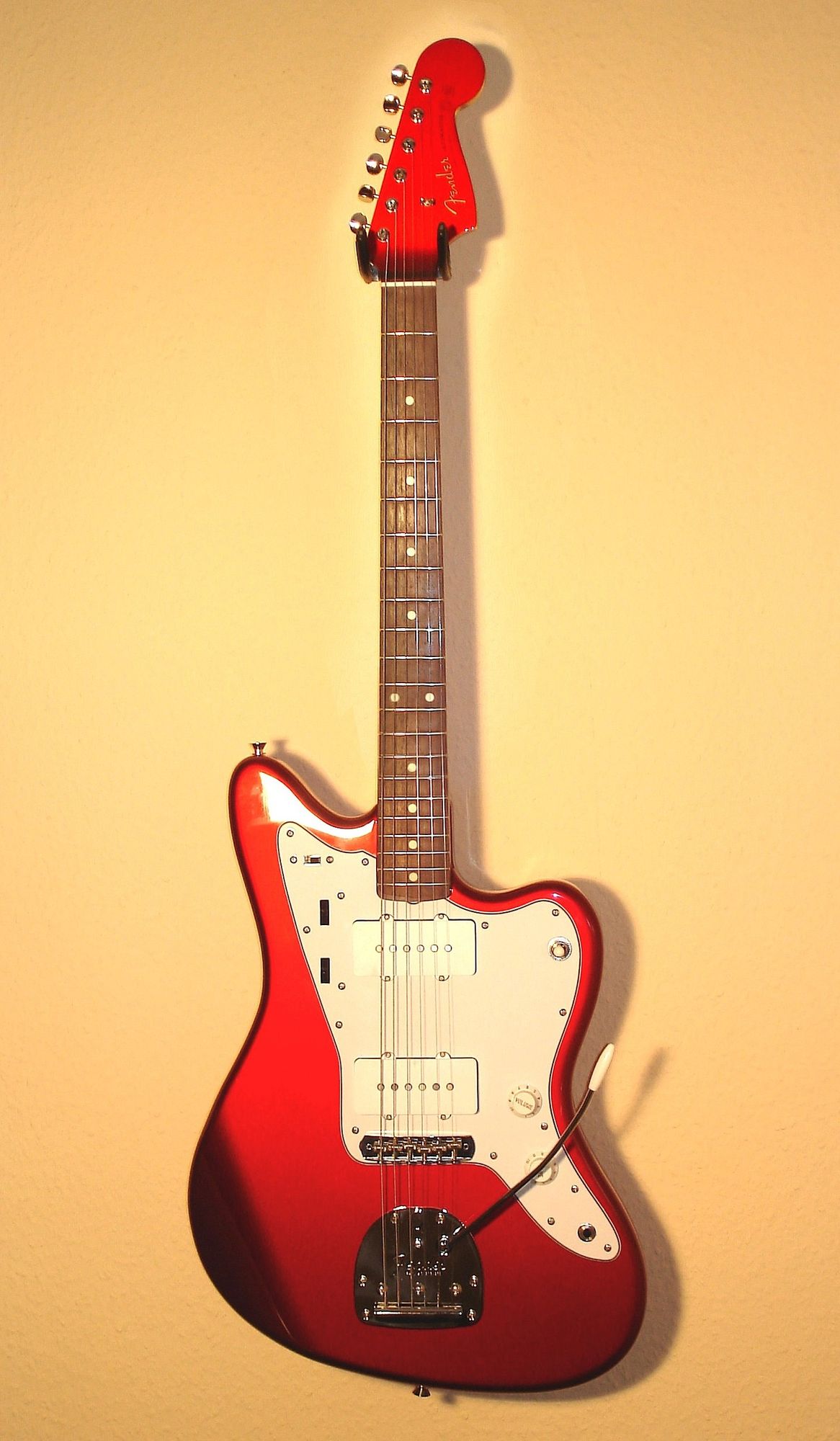
Photo: Dirk-X / Wikimedia Commons / CC BY-SA 4.0 Fender
Jazzmaster
1958
Fender built it for jazz players. Jazz players said no thanks. Surfers, punks, and noise bands said yes.

Photo: Infrahertzz / Wikimedia Commons / CC BY-SA 3.0 Fender
Precision Bass
1951
Leo’s bass let the player at the back be heard. You know their lines by heart. You mostly don’t know their names.