Gretsch
Tennessean
The cheap Chet Atkins Gretsch: one pickup, $295. It’s the guitar on the intro to “House of the Rising Sun.”
Newcastle, early 1962. Hilton Valentine is still playing in a local band called the Wildcats when he buys a Gretsch Tennessean, the budget hollowbody with Chet Atkins’s name on it. He keeps it when he joins the Animals, and it plays the opening of “The House of the Rising Sun.”
- Introduced
- 1958
- Type
- Hollowbody electric
- Class
- Production
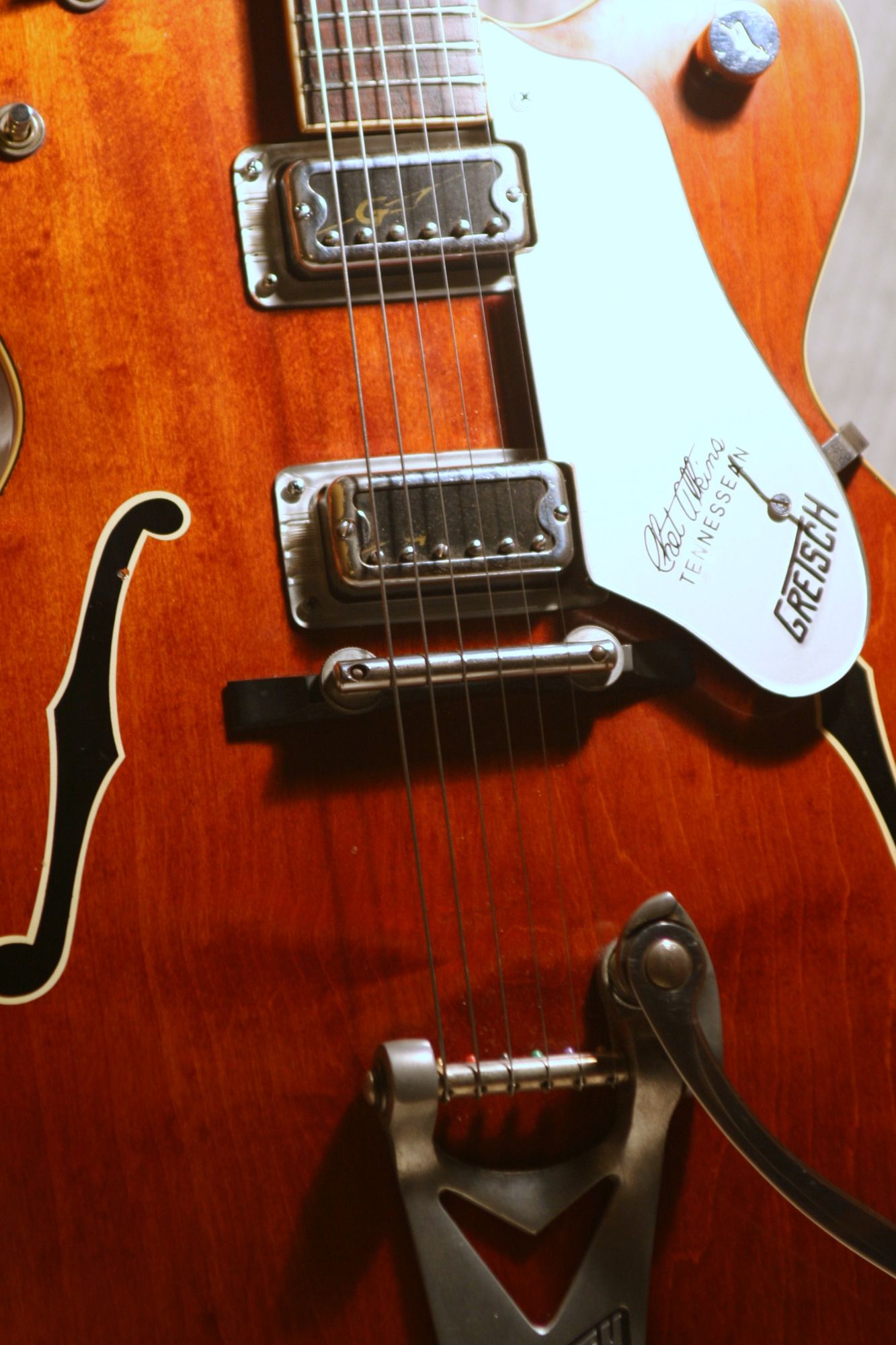
The short version
1958
The economy Chet
One Filter’Tron pickup, cherry red, $295. The only Chet Atkins model with a single pickup.
1961
Thinner, darker, two pickups
Painted-on f-holes, a sealed top, and two HiLo’Tron single-coils.
1962
Newcastle
Hilton Valentine buys his. The list price that year is $350.
1963
George gets one
Late in the year, Harrison adds a Tennessean to his Gretsches.
1980
Discontinued
After Chet leaves, the shape is sold as the Tennessee Rose.
2007
Chet’s name returns
It comes back as the Chet Atkins Tennessee Rose. Today it’s the Tennessean again.
Side A
A1
The one with the fewest extras
Every famous guitar family has a cheap one. The expensive models get the magazine covers. The cheap ones get bought.
In 1958 Gretsch, the Brooklyn company that had put Chet Atkins’s name on its guitars, expanded the Chet line. The Country Gentleman went in at the top. The Tennessean went in at the bottom. It was more or less a 6120 with the extras stripped off: the same 16-inch hollow body, but one pickup instead of two, an unbound headstock, and on the early ones an unbound fingerboard.
Chet’s name ended up on a whole row of Gretsches: the 6120, the chambered 6121, the Gent, this one, and more later. So a photo of Chet holding a Gretsch doesn’t tell you which one it is.
It listed at $295. Most of the early ones were cherry red, though a few left the factory in the 6120’s orange. Most sources call it a 1958 model. One dealer says 1959. I’ll go with the crowd but won’t argue with you.
A2
One pickup, in the wrong place
That single pickup was a Filter’Tron, Gretsch’s humbucker, and it sat at the bridge. That’s the funny part. On his other guitars, Chet preferred the neck pickup, the warm one. The budget Chet got the bright one. It was the only Chet Atkins model with just one pickup.
Then, in 1961, the Tennessean changed almost completely. The body got thinner. The top was sealed, and the f-holes were painted on. The finish went dark, somewhere between cherry and walnut. And the one Filter’Tron became two HiLo’Trons, single-coil pickups that to my ear sound brighter and thinner than the humbucker. By 1962 the body was two inches deep and the list price was $350.
If somebody sells you a 1958 Tennessean with two pickups, somebody changed it.
When the 6120 went double-cut in 1962, the Tennessean didn’t. It stayed a single-cut.
A3
Newcastle, 1962
Hilton Valentine bought his Tennessean in Newcastle in early 1962, while he was still playing in the Wildcats. When he joined the Animals, it came with him, and he used it until Rickenbacker and Vox started handing out free gear.
That was long enough. The opening of “The House of the Rising Sun” is Valentine’s Tennessean, played through a Selmer Selector-Tone amp. Those slow, rolling chords are the first thing a lot of people ever learned on guitar, and they came out of the budget Chet.
Flip the record · By the numbers
$295
List price of the 1958 original, with one pickup.
1
Pickup on the early ones, at the bridge. No other Chet model of 1958 had just one.
16
Inches wide. The 6120’s size, not the bigger Country Gentleman’s.
Side B
B1
George’s other Gretsch
George Harrison had one too, and this is where people get mixed up. His Ed Sullivan guitar in February 1964 was a Country Gentleman. The Tennessean came along in late 1963, a two-pickup model with painted f-holes, the kind being made in 1962 and 1963.
Where did he use it? Dealer histories put it on Help! and the Beatles’ 1965 tours, and a secondhand account adds Shea Stadium. Nobody has checked that against a session sheet, so treat it as a lead, not a fact. Where the guitar is now isn’t on record either.
The same dealer histories put David Crosby of the Byrds and Gerry Marsden of the Pacemakers on Tennesseans in the ’60s. And one of them notes that Tennessean production “went way up” in the Beatle-crazy years from 1964 to 1967. No ledger backs that up, but it’s easy to believe.
B2
Same guitar, new names
The painted f-holes didn’t last forever. By 1970 the Tennessean had real, open ones again, in a dark cherry finish. In 1971 it got a new model number, and in 1980 it was discontinued. Around the same time, Chet left Gretsch, so the shape went on as the Tennessee Rose. When the Chet Atkins names came back to Gretsch, the guitar returned in 2007 as the Chet Atkins Tennessee Rose, and Gretsch’s current Japanese models are called the Tennessean again. Gibson also made a Chet Atkins Tennessean from 1987 to 2005. That’s a different guitar entirely.
The Gent got Ed Sullivan. The Tennessean got a young guitarist in Newcastle, a Selmer amp, and an intro that has been played in every guitar shop in the world ever since.
Put this on
You’ve read about it. Now hear it. Here’s what this guitar sounds like, and what to listen for.
The House of the Rising Sun
That rolling intro is Hilton Valentine’s Tennessean, played into a Selmer Selector-Tone amp.
Find it on YouTube (opens in a new tab)
The cast
The people, and the specific guitars, that made the legend.
1958
Chet Atkins
Namesake
The Tennessean was the economy model in his Gretsch line. Don’t read every Chet photo as one; there are several Chet Gretsches, and later a Gibson Tennessean.
1962
Hilton Valentine
Gretsch Tennessean
Bought in Newcastle while he was with the Wildcats. Played it with the Animals, “House of the Rising Sun” included.
1963
George Harrison
Early-’60s Tennessean
Not his Ed Sullivan guitar. That was a Country Gentleman.
David Crosby & Gerry Marsden
1960s Tennesseans
Named in dealer histories of the model. Not pinned to particular songs.
Liner notes
Specs, construction, rarity, value, and every source we used.
Chet’s hollow 6119 — the Tennessean, not a 6120, and not a Country Gentleman.
- Body
- Laminated maple hollow single-cut, 16" wide, 2.5" deep, Arc-Tone bracing
- Neck
- Set maple “U”
- Fingerboard
- 12" rosewood, 22 medium-jumbo, neo-classic thumbnails, Luminlay side dots
- Scale
- 24.6" (625 mm)
- Pickups
- PRO-FT Filter’Trons
- Hardware
- Adjusto-Matic on pinned rosewood; string-thru Bigsby B6CP; Gotoh locking; nickel
- Electronics
- Two volumes, master volume with treble bleed, no-load master tone
- Finish
- Gloss (Havana Burst on this SKU; Deep Cherry and Walnut also catalogued)
- Nut
- TUSQ XL, 1.6875"
Open the full research fileConstruction details, the complete player record, production numbers, dated value estimates, and sources
Current typical player spec: Professional Collection Tennessean Hollow Body with String-Thru Bigsby (SKU 2401419831). Factory copy calls it the Professional Tennessean; it is the PE-class current 6119, not a year-clone. Parallel current SKU — G6119T-62 Vintage Select Edition ’62 Tennessean — is a HiLo’Tron / simulated-hole clone. It is not this table. Factory spec row “Volume 2. (Middle Pickup)” is a sheet typo; features list neck + bridge volumes.
Construction
Gretsch 6119 Chet Atkins Tennessean: 16"-class single-cut hollow archtop. The cheaper Atkins hollow. Not a 6120. Not a Country Gentleman.
Keep the neighbors straight. 6120 Chet Atkins Hollow Body is also 16"-class, typically orange/Western, two pickups from day one, open f-holes on the classic single-cuts. 6122 Country Gentleman is 17", walnut, gold, often simulated holes, dual Filter’Trons from the first batch. White Falcon 6136 is 17" white/gold. 6121 is the Atkins “solidbody” (chambered Jet-class). Duo Jet 6128 is chambered mahogany. Gibson later sold a Chet Atkins Tennessean (Reverb / Bacon: 1987–2005) — not a Gretsch 6119.
Chet Atkins is on more than one Gretsch. 6120, 6121, 6122, 6119, later Super Chet / Super Axe. A Chet photo is not a model ID.
1958 catalog year. guitarhq: “1958 model 6119 Introduction specs.” Vintage Guitar, Premier Guitar (Dave’s), Jay Scott via Fretted Americana, Reverb’s Atkins roundup, and Gretsch’s 2007 Atkins catalog copy all date the 6119 to 1958, same expansion year as the Country Gentleman’s catalog debut. YAML introduced is 1958. Folkway dealer copy says “introduced for the 1959 model year” — minority; keep it as dealer language, not a rival factory year. Do not back-date the 6119 to the Gent’s autumn-1957 first batch.
Jay Scott (Fretted Americana): 16" maple, 2 3/4" deep, unbound ebony neo-classic board, three-piece maple neck, single Pat. Applied For Filter’Tron at the bridge, black Lucite signpost guard, chrome, Bigsby B-6, $295 list. Vintage Guitar: catalog 16" wide, most measure 15⅝"–15⅞", depth 2 11/16"; a few very early examples in 6120 orange, most early single-cuts Cherry Red; unbound peghead and (early) unbound board; Filter’Tron in the bridge — Atkins preferred the neck pickup on other Chet models. guitarhq intro: 2 5/8" × 16", cherry red, one Filter’Tron, metal bar bridge, Bigsby with no Gretsch logo, chrome. Attribute the depth spread; measure the guitar.
HiLo’Tron vs Filter’Tron is the pickup trap. 1958–60: one Filter’Tron, bridge. guitarhq 1959: Gretsch Bigsby, zero fret, bone nut (replaces metal). Jay Scott: 1960 PAF Filter’Tron begins yielding to patent-number Filter’Tron; V-cutout Gretsch-by-Bigsby. 1961 (guitarhq; Vintage Guitar): thinner 2 1/4" single-cut, painted simulated f-holes, two HiLo’Tron single-coils, dark cherry-walnut, rosewood board, no zero fret that year. 1962: 2" deep, standby switch, Chet + Gretsch on grey guard, zero fret back, slightly redder mahogany stain (guitarhq). RetroFret: $350 new in 1962, the year this Electrotone dual-HiLo replaced the full-depth single-Filter 6119. A 1958–60 6119 with two HiLos, or a 1962 with Filter’Trons, is not stock.
Electrotone / simulated holes vs open. 1958–60: open f-holes on the deeper single-cut. 1961–late 1960s: painted/stenciled holes on a sealed thinner top (guitarhq; Vintage Guitar). RetroFret: earliest Electrotone stencils unbound/inconspicuous; a white border added within about a year. guitarhq 1970: open “f” holes again, dark cherry. Do not hang a 6122 sealed Gent, or a 6120 open-hole orange, on this plate because “Chet” and “hollow.”
16" vs 17". Tennessean and 6120 are 16"-class. Country Gentleman and White Falcon are 17". Factory Professional Tennessean copy: 16"-wide, 2.5"-deep. VS ’62 includes a 16" G6267 thin hollowbody case. Current VS depth 1.85"; vintage 1962 2" (guitarhq; RetroFret). Do not convert.
guitarhq: 6119 stayed single-cut when the 6120 went double-cut in early 1962. 1964: walnut top / mahogany back and sides; nameplate on peghead. 1967: uniform dark stain. 1971: renumbered 7655; no nameplate; adjustable bridge. Discontinued 1980. Baldwin/Booneville 7655s are not 1958 Brooklyn money.
After Atkins left (~1980), Gretsch sold the shape as Tennessee Rose. 2007 Atkins-trust return (MusicRadar; 2007 catalog): the 6119 became Chet Atkins Tennessee Rose, not automatically “Tennessean” on every hangtag. Current Japan Professional pages again say Tennessean. Dealers still print Tennessee Rose on the G6119T-62. Same 6119 family; read the SKU.
Current Japan line is two 6119s, not one spec. Professional Collection string-thru (this table): 16" × 2.5", Arc-Tone, PRO-FT Filter’Trons, urethane/gloss, TUSQ, Gotoh locking, $2,799.99 est. U.S. street (manufacturer). Havana Burst / Deep Cherry / Walnut. Japan (Eddie’s: country of origin Japan). G6119T-62 Vintage Select ’62: single-cut, 1.85", parallel tone bars, TV Jones TV-HT Hilo’Trons, rocking bar, Bigsby B6C, bone nut, silver plexi with “Chet Atkins Tennessean,” $2,899.99 street. Factory VS pickup-configuration row still says Filter’Tron / Filter’Tron — sheet error; the named pickups are Hilo’Trons. Do not back-copy Filter’Trons onto a stock 1962 6119, or HiLos onto this PE-class table.
Players
Chet Atkins — namesake. Economy Atkins hollow. Vintage Guitar: the only Atkins-endorsed model with one pickup in the 1958 recipe. MusicRadar quotes Atkins to Stern (1995) on the Country Gentleman as the record guitar “continually,” the 6120 “once in a while” — that quote is Gent/6120, not a Tennessean session log. Do not treat every late-career Atkins photo as a Gretsch 6119; Gibson Tennesseans exist.
George Harrison — 1963 Electrotone 6119. Not the Sullivan 6122. Official Gretsch (2014): Sullivan is the October 1963 Country Gentleman. RetroFret (dealer, citing the same 1960s beat-group circuit): Harrison acquired a Tennessean “virtually identical” to a 1962–63 dual-HiLo 6119 in late 1963; Help! and the Beatles ’65 world tours. Far Out: Shea Stadium 1965; later Sgt. Pepper sessions claimed there — lead only, not independently track-checked here. Do not price ordinary 6119s off Harrison. Whereabouts of his Tennessean are not sourced here.
Hilton Valentine — 1962 Tennessean, The House of the Rising Sun. Vintage Guitar (Jan 2012): the Animals intro tone from his Gretsch Tennessean into a Selmer Selector-Tone. Valentine’s own equipment page (archived): bought in Newcastle early 1962 while still with the Wildcats; used with the Animals including “House of the Rising Sun” until Rickenbacker/Vox freebies.
RetroFret also names David Crosby (Byrds, similar 1965–66 6119) and Gerry Marsden (Pacemakers, 1963–64 early Electrotone). Dealer lead; not independently song-checked here.
Do not dump 6120 players here. Eddie Cochran, Duane Eddy, Brian Setzer’s Stray Cats guitar, Pete Townshend Who’s Next — those are 6120s. Ed Sullivan Harrison is a Country Gentleman. Malcolm Young is a Jet Firebird. White Falcon stories stay on Falcon. John Lennon late-Beatles electric is the Casino.
Rarity
Modern Japan Professional / Vintage Select 6119s are regular production. Not rare.
Vintage: factory yearly 6119 totals unpublished. Serials are shared across Gretsch models. Do not treat serial ranges as Tennessean counts. 1958–60 single-Filter’Tron, open-hole, deeper single-cuts are the scarcer early object. 1961+ Electrotone dual-HiLo singles (Harrison silhouette) are the commoner vintage 6119 — RetroFret notes production of Tennesseans “went way up” in the Beatle-saturated 1964–67 world; that is dealer language, not a ledger. Baldwin 7655 is a lower collector rung. Binding rot and neck-angle/heel issues are endemic Gretsch (RetroFret flags neck angle on this model). Originality of Filter’Tron vs HiLo’Tron, open vs painted holes, Bigsby, and whether a “Tennessean” hangtag is actually a 6120/6122 drives value more than the name.
Value
Informal estimate, 25 August 2026. Not an appraisal.
Factory yearly totals unpublished. No 2024–26 Heritage/Carter/Dave’s hammer for a clean 1958–60s 6119 was captured. Prefer labeled asks over invented medians. Japan reissues are not Brooklyn 6119s. Harrison’s guitar is not a comp. A Gibson Chet Atkins Tennessean is not a 6119 comparable. Carter’s 1964 walnut listing copy says “double-cutaway”; guitarhq says the 6119 stayed single-cut — do not take that dealer body-shape line as a 6119 fact.
New street. Professional Collection string-thru about $2,800 (manufacturer est. U.S. street $2,799.99). G6119T-62 Vintage Select $2,899.99 (manufacturer; Cream City matching). Eddie’s Guitar Shop listed the Professional Havana Burst $2,499.99 — dealer, not the factory street. Japan Professional, not a 1958 6119.
Used modern. Sold comps are thin; this is listings, not a sold average. No Reverb guide number captured. Carter Vintage 2008 G6119-1959 asking $2,750 (similar-listings rail on a 1966 6119 page). Expect used PE/VS examples to trade below the ~$2,800 / ~$2,900 streets. Do not invent a used median.
Vintage / collectible. Original list $295 (Jay Scott / Fretted Americana, 1958 single-Filter recipe) vs $350 (RetroFret, 1962 dual-HiLo) vs $330 (Gretsch November 1963 price list, PX6119, Georgia Southern scan). Flag all three; they are different years. Asks, not hammers: Carter Vintage 1964 walnut $4,000 (refret, electronics repair, replacement Schallers). Carter 1966 orange $3,500 (replaced bridge, guard off). Carter 1964 natural $2,750 — refin/refret; not a clean-finish comp. Carter similar rail also shows a 1975 7655 $3,500 ask — Baldwin number, not a 1958. Kansas City Vintage Guitars 1959 single-Filter PAF, orange $4,250 (sold-out listing — ask that left the shop). Early Filter’Tron open-hole asks sit in the same thin band as ordinary mid-’60s Electrotone asks in this sample; condition, binding, and whether the pickup era matches the body year swing it hard.
See also
- gretsch-6120 — the 16" Chet hollowbody this cheaper 6119 is not
- gretsch-country-gentleman — 17" Chet sealed Gent; Sullivan Harrison lives there
- gretsch-white-falcon — 17" white/gold, not a cherry/walnut 6119
Sources
Vintage Guitar, 6119 Tennessean — 1958 affordable Atkins hollow; one Filter’Tron; 16" catalog / 15⅝–15⅞" measured; 1961 HiLos + painted holes; 1962 2"
Premier Guitar, 1959 6119 — 1958 expansion with Country Gentleman; stripped 6120; unique red vs 6120 orange
guitarhq, Gretsch 6119 year map — 1958 intro specs; 1961 HiLos/simulated holes; stayed single-cut; 1971 7655; discontinued 1980
Fretted Americana / Jay Scott — $295; 16" × 2 3/4"; 1958 single PAF Filter’Tron
G6119T-62 Vintage Select — $2,899.99; TV-HT Hilo’Trons; 1.85"; 16" case
Professional Collection Tennessean, string-thru — $2,799.99; 16" × 2.5"; PRO-FT Filter’Trons; Arc-Tone
Cream City, G6119T-62 — $2,899.99; dealer still says Tennessee Rose
RetroFret, 1962 PX-6119 — $350 list 1962; Electrotone; Harrison Help! / ’65 tours (dealer); Crosby; Marsden; Valentine
Gretsch, Beatles / Ed Sullivan — Sullivan = 6122, not 6119
Vintage Guitar, Hilton Valentine — Tennessean + Selmer on “House of the Rising Sun”
Hilton Valentine, equipment (archive) — Newcastle early 1962; Animals including Rising Sun
Reverb News / Bacon, guitars of Chet Atkins — 6119 1958–80; Tennessee Rose reissues; Gibson Tennessean 1987–2005
MusicRadar, return of Chet Atkins — 2007: 6119 as Chet Atkins Tennessee Rose
Gretsch 2007 Atkins catalog (scan) — 1958 Tennessean + Country Gentleman in that copy
Gretsch Guitars Price List, 1963 — PX6119 $330
Far Out, Harrison guitars — Tennessean vs Gent; Shea; Sgt. Pepper claim (secondary)
Carter Vintage, 1964 6119 walnut — ask $4,000; listing wrongly says double-cut
Carter Vintage, 1966 6119 orange — ask $3,500
Carter Vintage, 1964 6119 natural — ask $2,750, refin
Kansas City Vintage Guitars, 1959 6119 — ask $4,250, sold out
Wikimedia Commons, 1966 6119 — matanao, CC BY-SA 3.0; Tennessean / 6119, simulated holes, HiLo’Trons

Keep digging
Guitars this one gets compared to, confused with, or descended from.
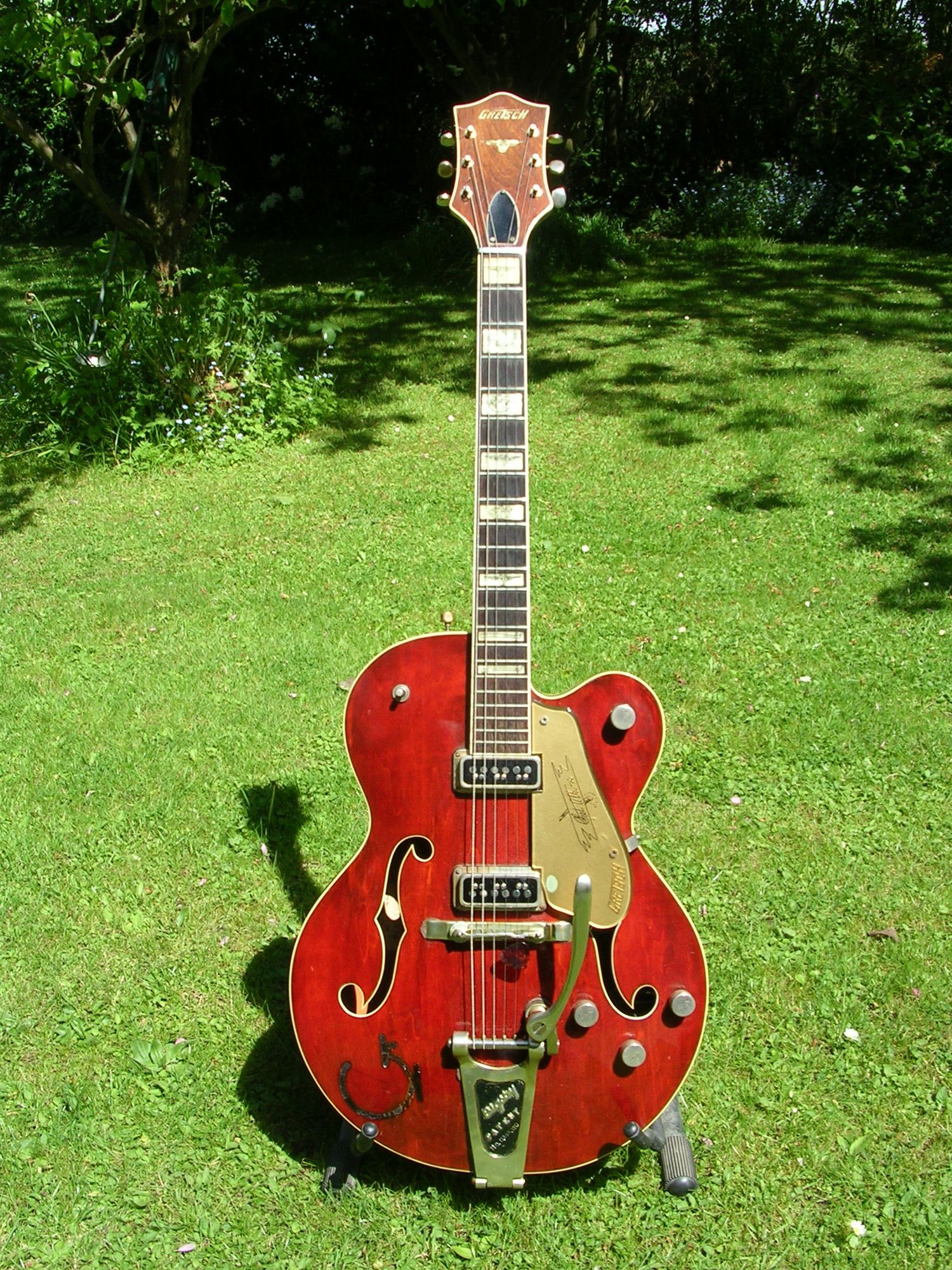
Gretsch 6120 G-Brand 1955. Photo by Francis pullen. Public domain (PD-self). Via Wikimedia Commons. Gretsch
6120
1955
Joe Walsh gave Pete Townshend one. Steve Miller gave Brian Setzer one. Chet Atkins just lent it his name.
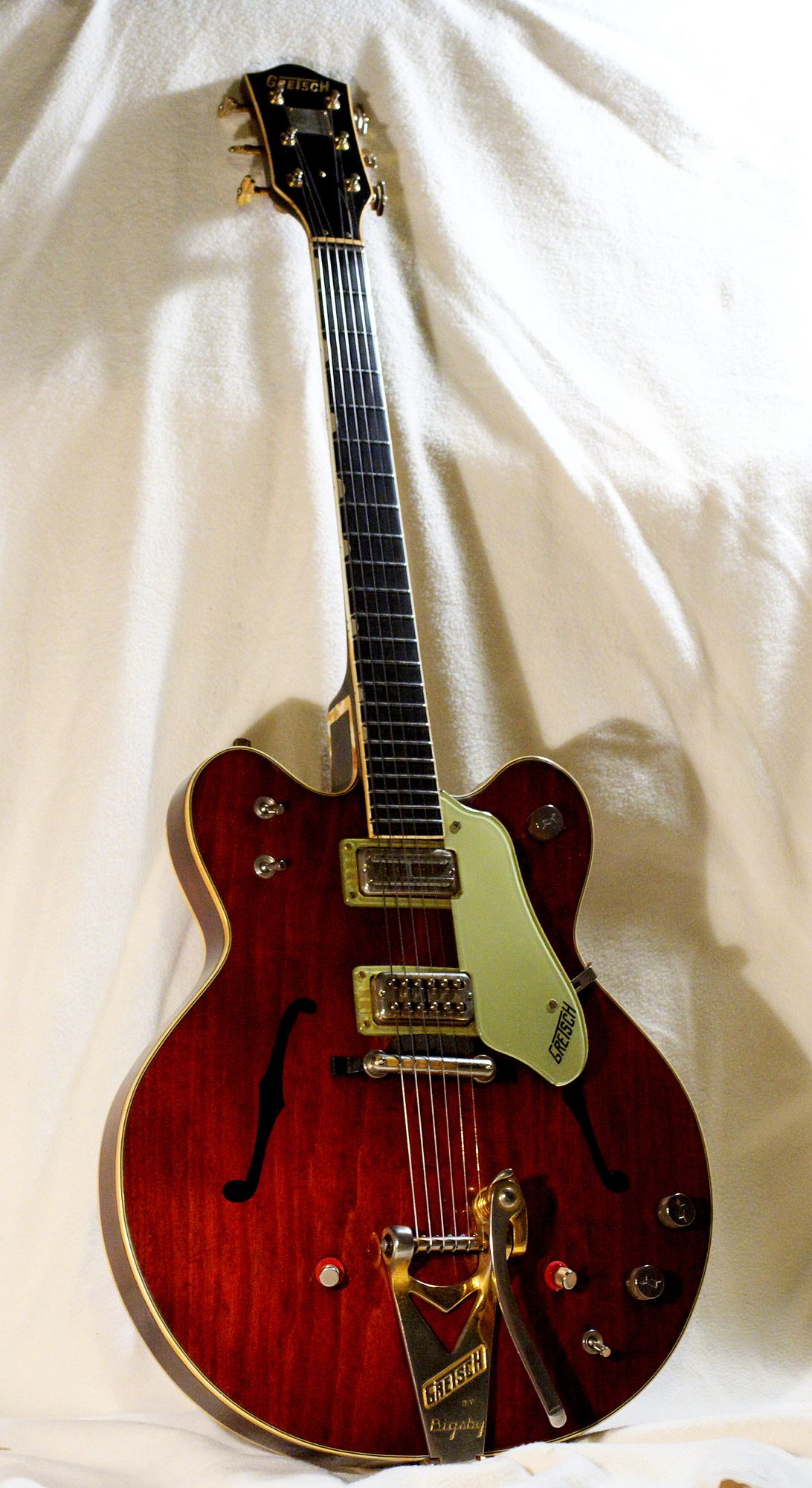
Gretsch Country Gentleman 1964, 6122 Chet Atkins Country Gentleman. Photo by matanao. Public domain (PD-self). Via Wikimedia Commons. Gretsch
Country Gentleman
1957
Chet Atkins asked for a guitar without the cowboy flash. On Ed Sullivan, it didn’t even show its color.
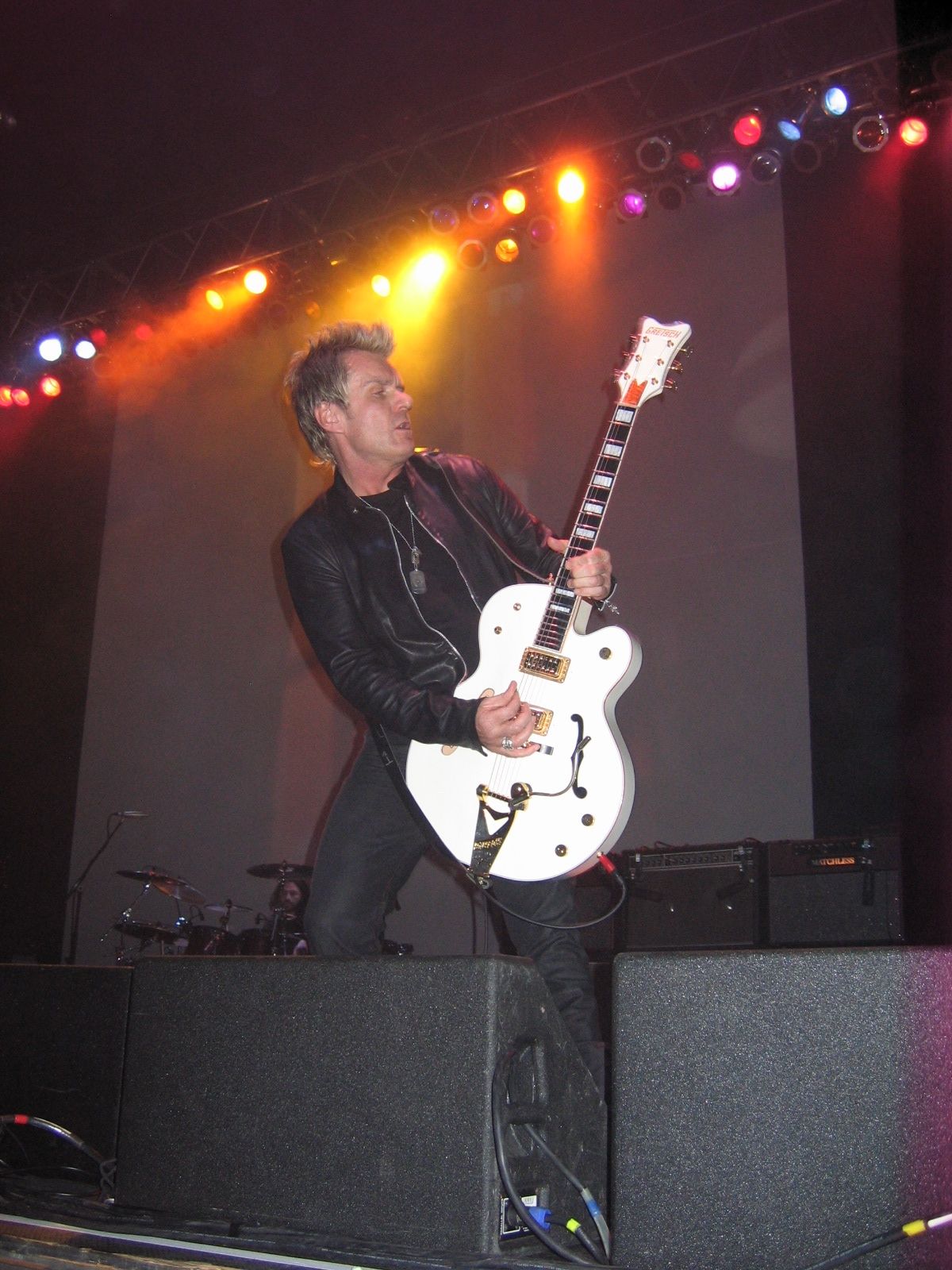
Photo: Veronica Perina / Wikimedia Commons / CC BY 3.0 Gretsch
White Falcon
1955
Gretsch built it to stop people in the aisle of a trade show. It never stopped doing that.