Gretsch
Country Club
Same body as the White Falcon, none of the glitter, and hardly any famous owners.
The Country Club began as Gretsch’s answer to Gibson’s jazz boxes, wore Cadillac Green by the mid-’50s, and never collected the famous names the Falcon and the 6120 did. The players who found it mostly came in through the side door.
- Introduced
- 1954
- Type
- Hollowbody electric
- Class
- Production
Have a photograph of this guitar? Send a picture
The short version
1951
The Electro II cutaways
Gretsch’s first cutaway electrics, 17 inches, gold hardware, two pickups. Some date the first one to 1952.
1954
Country Club
The name covers the line, and the Cadillac Green 6196 arrives. Its first model year may be 1955. Keep both.
1958
Filter’Trons
Filter’Tron pickups and Space Control replace the DeArmonds and the Melita. A stereo version costs $50 more.
1961
The thin years
The rim drops to 1⅞ inches, from 1960 or 1961, and comes back to full depth in 1963 or 1964.
1968
Green goes away
Cadillac Green is dropped from the line.
1971
The Baldwin numbers
The Club is renumbered 7575 and 7576, in 1971 or 1972 depending who you ask.
1981
The original run ends
The Baldwin years close out with the shutdown, and the old Country Club goes with it.
2016
The ’59, from Japan
The G6196T-59 Vintage Select, a Japanese clone of a 1959 Club, with a Bigsby as standard.
Side A
A1
The Falcon he couldn’t afford
Around 1984, Billy Duffy wanted another single-cut White Falcon. He couldn’t find one, and he couldn’t afford one. So he traded his double-cut stereo Falcon for something he could get: a natural Gretsch Country Club.
Then he took it to Roger Giffin in London and had it painted black.
That’s the Country Club in one move. It has the Falcon’s body and neck. The two are virtually identical in size, neck shape, and electronics, and the Falcon’s peghead is bigger. What the Club never had was the glitter, or the famous owners to go with it.
A2
For the progressive jazz guitarist
It started as a jazz guitar. Gibson had the ES-350 Premier and the L-5CES, and in 1951 Gretsch answered with its first cutaway electrics, the Electro II: seventeen inches wide, gold hardware, two pickups. Some date the first one to 1952. By 1954 the name on the line was Country Club, and there was a Cadillac Green one in it, the 6196. Whether green’s first model year was 1954 or 1955 depends who you ask.
The 1955 catalog pitched it “For the progressive jazz guitarist looking for the best there is in tonal resonance and response… Curly maple throughout.”
Early ones carried DeArmond pickups and a Melita bridge, and a tailpiece with a G cut out of it. Some had a spruce top, the catalog notwithstanding, and the body depth on early guitars depends on who measured. If you’re looking at one, don’t trust a year. Measure it.
A3
Clubs have holes
The neighbors get confused with it, so here’s the short version. The White Falcon is the dressy one. The Country Gentleman is Chet Atkins’s 17-inch box, with its f-holes often sealed, and one magazine put the difference plainly: “Clubs have holes and a Gentleman don’t.” The 6120 is a 16-inch Western guitar.
And the Club isn’t a 335. There’s no center block. It’s hollow all the way through, even in the years when the rim got thin.
Clubs have holes and a Gentleman don’t.
In 1958 it got its real voice. Gold Filter’Tron humbuckers replaced the DeArmonds, the Melita gave way to a Space Control bridge, and the board went to ebony. The tone knob left too. In its place: a three-way tone switch next to the pickup selector. For $50 more, Gretsch would sell you Project-O-Sonic stereo.
Flip the record · By the numbers
17"
Body width, same as the White Falcon’s.
$475
A Cadillac Green Club in the 1962 catalog.
$50
The extra charge for Project-O-Sonic stereo in 1958.
1⅞"
Rim depth in the thin years, around 1961.
Side B
B1
Thin, then not
Around 1960 or 1961 the rim got thin, 1⅞ inches. By 1962 a Club could have a padded back, a string mute, and a standby switch, and Cadillac Green listed at $475. Full depth came back in 1963 or 1964. Nobody agrees which.
Through all of it, the Club stayed single-cut. Other Gretsches went double-cut in the ’60s. Stock Clubs didn’t.
Then the Baldwin years. Cadillac Green was dropped in 1968. The model was renumbered 7575 and 7576, in 1971 or 1972, and one account says the scale shrank for a while. The original run ended in 1981.
B2
A 1971 that feeds back less
Tim Armstrong of Rancid picked one of those Baldwin guitars. “My guitar is a 1971 Gretsch Country Club hollowbody,” he said in 2009.
He says its neck is “connected to the body,” unlike a Falcon’s, and that people at Gretsch told him that’s why it feeds back less. That’s his account, of his guitar. It’s a right-handed Club played left-handed, controls on top. He leaves the neck pickup off, so the selector is just on and off, and he runs it into a Mesa/Boogie Triple Rectifier. He won’t pad the top.
In 2010, Gretsch built an Electromatic signature from it, made in Korea. A copy, not the ’71.
B3
Black next to white
Duffy says he doesn’t think he played the Club live while the top was still natural wood. The bridge pickup later became a hotter TV Jones. Roddy Frame rented it for a video in the 1980s.
You can still buy a new one. The current Club is a Japanese clone of a 1959 Club, in Cadillac Green, with Filter’Trons and a Bigsby that Brooklyn never fitted as standard.
But the best way to see one is the video for “Love Removal Machine.” Duffy says the black guitar and the white guitar in it are the Club and his Falcon. One of them is a Falcon. The other is the same body without the glitter, the one he could get, painted black and standing right next to it.
Put this on
You’ve read about it. Now hear it. Here’s what this guitar sounds like, and what to listen for.
Love Removal Machine
Billy Duffy says the black guitar and the white guitar in it are his repainted Country Club and his Falcon. Watch for the black one.
Watch it on YouTube (opens in a new tab)
The cast
The people, and the specific guitars, that made the legend.
1984
Billy Duffy
Natural Country Club, painted black
Couldn’t find or afford another single-cut Falcon, so he traded for a Club, around 1984, and had Roger Giffin paint it black in London. Later a hotter TV Jones in the bridge.
Roddy Frame
Billy Duffy’s black Country Club
Rented it for a video in the 1980s, by Duffy’s account. He doesn’t name the clip.
Tim Armstrong
1971 Country Club
Of Rancid. A right-handed guitar he plays left-handed, controls on top, neck pickup off, into a Mesa/Boogie Triple Rectifier. Gretsch based his Korean Electromatic signature on it.
Liner notes
Specs, construction, rarity, value, and every source we used.
Open f-holes on a 17-inch hollow, and it stayed single-cut — Gretsch’s Country Club, not a White Falcon, not a Country Gentleman, and not an ES-335.
- Body
- Hollow single-cut. Laminated maple top, back, and sides. 1959-style trestle. Factory depth 2.75" (7 cm). Width unpublished on the sheet; the included case is the 17" G6242L. Mix flagged.
- Neck
- Maple, standard “U”; gloss nitrocellulose. Joint unpublished on the factory sheet.
- Fingerboard
- Ebony, 12" (305 mm) radius, 22 medium-jumbo, pearloid neo-classic thumbnails
- Scale
- 25.5" (648 mm). Mix flagged.
- Pickups
- TV Jones Filter'Tron Classic, neck and bridge
- Hardware
- Pinned Space Control; Bigsby B6G with Gretsch logo; Grover Imperial; gold
- Electronics
- Volume per pickup, master volume; 3-way toggle; 3-way master tone switch. No tone knob.
- Finish
- Cadillac Green. Factory sheet: gloss lacquer on the body. Dave’s copy of the same SKU: gloss nitrocellulose. Don’t merge.
- Nut
- Bone, 1.6875" (42.86 mm)
Open the full research fileConstruction details, the complete player record, production numbers, dated value estimates, and sources
Current catalog guitar: G6196T-59 Vintage Select Edition '59 Country Club. A Japan year-clone with a stock Bigsby. Not a 1959 Brooklyn 6196. Sweetwater’s plain G6196T page is discontinued, and its copy mixes a solid spruce top with laminated maple — not this table. Reverb’s trait table prints 21 frets and rosewood on this SKU. Gretsch prints 22 and ebony. Don’t average.
Mixed inch/mm flagged on the factory’s own 2.75" (7 cm) — 2.75" is 69.85 mm, not 70 — and on 25.5" (648 mm) and 12" (305 mm), both rounded. Do not treat 7 cm, 648 mm, or 305 mm as a second measurement.
Construction
The job was the progressive jazz guitarist’s electric. Premier Guitar (Dave Rogers, Tim Mullally, Laun Braithwaite, 16 February 2015, citing Jay Scott, Edward Ball, Tony Bacon, and A. R. Duchossoir): Gretsch’s first cutaway electrics came in 1951, against Gibson’s ES-350 Premier (1947) and L-5CES (1951). Those were the Electro II — 6192 sunburst, 6193 natural. Seventeen inches, gold hardware, two pickups. By 1954 the name Country Club covered the line, and Cadillac Green 6196 was in it. The 1955 catalog, same article: “For the progressive jazz guitarist looking for the best there is in tonal resonance and response… Curly maple throughout.”
The birth year stays split. Blue Book runs Electro II Cutaway / Country Club 6192/6193/6196/7575/7576/7577 as 1951–1981. The Gretsch Pages, quoted by Hillman and by Fretted Americana, also start the 17" boxes in 1951. GGJaguar says the 6192 debuted in 1952 as the Electro II and took the Country Club name in 1954. Guitar Player (Dave Hunter, 24 March 2021) says “introduced in 1951” under the Country Club name. That collapses the rename. This plate starts at the catalog name, 1954. The cutaway is older. guitarhq’s index lists a non-cutaway Electro II (6187, 6188) apart from 6192/6193/6196. Different guitar.
Green is not one year. Premier Guitar: 6196 added by 1954. Hillman’s compilation: the 1955 model year is the first Cadillac Green. The Gretsch Pages, via Fretted Americana: introduced in 1954, and on the 1955 catalog cover. Keep both.
Keep the neighbors off this card. White Falcon 6136 is the other 17" / 25.5" hollow. Vintage Guitar’s Penguin piece: a Falcon has the Club’s body and neck dimensions except a larger peghead, and is “virtually identical” in size, neck shape, and electronics. Still not this finish, and not this model. 6122 Country Gentleman: Vintage Guitar’s line is “Clubs have holes and a Gentleman don’t.” 6120 is the 16" Western hollow on the short scale. Duo Jet 6128 is chambered mahogany. The Synchromatic is the archtop this electric came out of — Gretsch Pages: from the 6030/6031, themselves from the pre-war cat’s-eye 300 — and it is not a pickup guitar. Not an ES-335. No center block. Full hollow, even when the rim got thin. Not a Penguin.
Early spec, and it does not agree with itself. Hillman, before 1954: maple with a spruce top, 17" × 2⅔", rosewood blocks, 25.5", Grover Imperials, clear knobs, bound tortoiseshell guard, two DeArmond Dynasonics, Melita, G-cutout (earliest may still wear a Synchromatic tail). The Gretsch Pages: spruce rarely after ’55, an occasional Club still spruce in 1958–59, and a mid-’50s body printed as 17" × 3½". The 1955 catalog says curly maple throughout. Vintage Guitar, on a 1962 Gent custom, says a thin laminated spruce top by then was down to the Sal Salvador and the occasional 6192. Gretsch-Talk (a forum post citing Ball’s manual, not the book) puts early depth at 3.5", then 3.25", then 2.75" around 1954. One dealer’s 1954 text says 3⅜". Don’t pick a top, and don’t pick a depth. Measure it.
A Bigsby was never the catalog default. Hillman and the Gretsch Pages: extra-cost, some years. Guitar Player, on the 1962: optional. Premier Guitar’s pictured 1962 wears a non-original one where the G was. The current Vintage Select ships a B6G as standard. Do not put it on a 1959.
1958 is this model’s electronic year. Don’t borrow the 6120’s mid-1957 overlap. Premier Guitar: gold Filter’Trons, Space Control, and ebony with neo-classic inlays standard since 1958, in place of DeArmonds and the Melita. Reverb’s 1958–59 note: humptops become thumbprints in that revision. Guitar Player: the tone knob leaves with the Filter’Trons, replaced by a three-way tone switch beside the selector. Volumes per pickup, plus a master, stay. No Filter’Trons on a 1954 Club.
Stereo is a sibling wiring, not the mono table. Vintage Guitar (Preston Gratiot): Project-O-Sonic in 1958 — 6101 sunburst, 6102 natural, 6103 Cadillac Green — $50 over the mono. The same magazine’s Everly piece says an early-’58 brochure leads with a 6192 Country Club Project-O-Sonic. Two number systems. Blue Book ends 6101/6102/6103 in 1963. Hillman drops stereo in 1967; guitar-list runs a 6101 to 1967. Keep 1963 and 1967. Don’t export either onto a Falcon. A Georgia Southern card for a circa-1959 PX6192 describes two Project-O-Sonic pickups, so a 6192 label can be the stereo. That card also prints scale 66 cm (26 inches) against the catalog 25.5", and ribs 6.5–6.8 cm against a described 2⅞" (7.3 cm). Mix flagged. One artifact.
Then the rim got thin, and the return date is not settled. Hillman: 1⅞" in 1961, back to 2¾" at mid-1964. Reverb’s 1960–62 page: 1⅞" for 1960–62, back to 2⅞" in 1963. Guitar Player: the 1962 is the thinline, and full depth returns in 1964, with no fraction. Premier Guitar’s 1962, serial 47040, has the padded back (an access hole sold as cushioning), the mute, and the standby switch, and the 1962 catalog lists Cadillac Green at $475. RetroFret, on a mid-to-late 1963 thin custom, serial 59344: shallow Clubs were short-lived, back to full depth within a year or so, and this one was “one of a batch of 100 thin-body Country Clubs.” A shop’s batch note. Not a year total. Don’t average 2¾" and 2⅞".
It stayed single-cut. Guitar Player: it never took the ’60s double-cut. RetroFret: stock Clubs kept the single cut through the decade. That 1963 guitar is the exception — a double-cut Cadillac Green wearing a 6192 label. A custom, not a catalog DC. Gratiot’s no-hole 6196 is another one-off, a Bakersfield order dated late 1958 or early ’59 by Filter’Trons and no zero fret. Hillman: zero fret begins 1959, standard 1960. A 16" cat’s-eye sold as a “6192” (Fretted Americana) is a special. It does not revise the 17".
Baldwin is the last Brooklyn chapter. Hillman: Cadillac Green dropped 1968; 7575 sunburst and 7576 natural in 1972 at 24.5"; 7577 antique maple in 1974, scale back to 25.5", blocks for thumbnails; shutdown 1981. Reverb’s 1971–73 page renumbers 6192 → 7575/7576 in 1971, blocks in 1974. Keep 1971 and 1972. A Georgia Southern 1977 7576 prints scale 63.5 cm (25 in), lower bout 43.3 cm beside a described 17", nut 4.2 cm, 22 frets, 9 lb 4 oz. The Music Zoo’s 1974 7575 prints 25.5", 42 mm nut, 22 frets, 9 lb 3 oz. Mix flagged. Don’t average 24.5", 25", and 25.5". Gratiot also ends the original run in 1981.
The guitar you can order is none of that. G6196T-59, on Gretsch this pass: laminated maple, trestle, the depth and scale in the table, ebony, 22 frets, TV Jones Filter’Tron Classics, pinned Space Control, stock Bigsby, gold. Reverb: Made in Japan, 2016–present. Estimated U.S. street $3,799.99. One new example at Dave’s weighs 8.0 lb. One guitar. Earlier reissues are other recipes: guitar-list’s G6196-1955, 1995–1999, carved spruce and Dynasonics; GGJaguar’s ’57-style 6192, only 2004–07, thin spruce laminate, Dynasonics, Melita, 21 frets; Blue Book’s G619X, 2001–09, 17" × 2.75", 25.5", Dynasonics. Blue Book’s “2001–present” on a Bigsby G619XT is the book’s span, not a second 2026 SKU. Hillman also prints a 6122-58 under a Club heading. That number is a Country Gentleman. Classic against current: a 1954 Club is the renamed Electro II — DeArmonds, Melita, a G-tail, often spruce — and the 2026 catalog guitar is a Japan ’59 clone with a Bigsby Brooklyn did not fit as standard.
Players
Hunter (2021), on a 1962 6196: the Club never gathered many famous players, and it never sat with the 6120 or the Falcon. That is his judgment. Two later documented guitars still belong here. Do not import the others. Stills, Young, and Duffy’s Falcon are Falcons. Cochran’s and Setzer’s 6120s are 6120s. Harrison’s Gent and his 1957 Duo Jet are other Gretsches. Chet’s name is on the Gentleman and the 6120, not on this model.
Billy Duffy — a Club painted black, about 1984. His site: he wanted another single-cut Falcon, couldn’t find or afford one, and traded the double-cut stereo Falcon for a natural Country Club. Roger Giffin painted it black in London. Duffy: the black guitar and the white guitar in “Love Removal Machine” are that Club and the Sanctuary Falcon. He doesn’t think he played it live while the front was still wood. Bridge pickup later a hotter TV Jones. Roddy Frame rented it for a video in the 1980s. Duffy doesn’t name the clip. Not the Falcon on the other plate.
Tim Armstrong (Rancid) — a 1971 Country Club. Guitar World (Brad Angle, 7 October 2009): “My guitar is a 1971 Gretsch Country Club hollowbody.” He says the Baldwin neck is “connected to the body,” unlike a Falcon’s overhang, and that people at Gretsch told him that’s why it feeds back less. His account. Not in the year map fetched here, and not a spec for every 1971. Neck pickup left off, so the selector is an on/off, into a Mesa/Boogie Triple Rectifier. He will not pad the top. Gretsch’s interview: three-ply maple; right-handed, played left-handed, controls on top. MusicRadar (2010): the G5191 Electromatic is based on that Club. Audiofanzine: Korea. A copy. Not the 1971, and not the Japan Vintage Select. No Rancid title is pinned to the original here.
The 1950s names are thinner than the ads. The same dealer paragraph (Hendrix Guitars, archtop.com, a Dutch shop) cites Jay Scott for Al Caiola, Mundell Lowe, and Mary Osborne, and for a claim the Club outsold the L-5CES. The book is not in hand. The outsold line is not repeated as fact. A Reverb listing describes a 1958 Gretsch ad of Caiola with a Country Club (“They Call You First”). Another, years-old listing claims his 6192 on the Bonanza theme and the theme from The Magnificent Seven. Seller’s letters. Not a session log opened here. Vintage Guitar’s Mundell Lowe profile pictures a Gibson Byrdland. Osborne is not pinned to a Club in anything fetched beyond that dealer paragraph.
Also claimed, not a comp: Carter Vintage files a refinished, heavily altered 1966 6192 as Nathaniel Rateliff’s. Tune Your Sound files a 1972 6192, serial 4 2187, as Bernie Leadon’s, with no Eagles title.
Rarity
You can buy a new one. The Japan G6196T-59 is regular Professional Collection production. Not rare, and not a 1959 Brooklyn guitar. The Korea Armstrong Electromatic is a third factory.
Gretsch published no Country Club totals. Vintage Guitar, in the Penguin piece, says exact early-Gretsch production totals are not available. Serials run across the company, not by model (Reverb News, Peter Schu, 11 March 2015). They date a guitar. They don’t count a year. A Dutch shop’s “fewer than 350” is unsourced. Omitted. RetroFret’s 100 is one 1963 thin-body batch, as that shop describes it. Not a ledger.
What is actually thin: a script-logo Electro II cutaway from before the rename; a clean 1954–57 DeArmond single-cut; an early green 6196 still on Dynasonics; a 6101/6102/6103 that still splits. The 1958–60 Filter’Tron single-cut, before the thin years, is the finished full-depth Club. Baldwin 7575/7576/7577 through 1981 is the later object, easier to find and easier to misread as a ’50s Club. Duffy’s black repaint and Armstrong’s ’71 are one guitar each. Not a price for an ordinary one.
Value
Informal estimate, 12 October 2026. Not an appraisal.
Ask is not sold. Japan is not Brooklyn. A Falcon hammer is not a Club comparable. Celebrity guitars are not comps. No invented medians. Period money: $475 for Cadillac Green in the 1962 catalog (Premier Guitar). RetroFret, on the 1963 custom: PX-6192 at $475, case another $58. Project-O-Sonic was $50 extra in 1958 (Vintage Guitar). Premier Guitar’s $3,500 for an excellent 1962 is that February 2015 article. Gratiot’s “about $1,500 more” for a stereo 6103 than a mono is the same piece, circa 2017. Neither is a 2026 hammer.
New street. G6196T-59, Cadillac Green: $3,799.99 estimated U.S. street (Gretsch; Musician’s Friend; Dave’s, as MAP). Japan, hardshell included. No second current Club SKU was on the factory page this pass.
Used modern. Reverb Price Guide, G6196T-59, 2016–present Cadillac Green, Good to Mint, 27 orders: $1,544–$2,495. Named solds on that history, not a series to average: 17 August 2025 Excellent $1,500; 21 March 2025 Excellent $2,200; 20 October 2025 Excellent $2,199; 8 July 2025 Mint $2,350; 2 February 2025 Mint $2,799; 21 June 2025 and 1 December 2025 Mint $3,229.99 each. The guide band sits under the mint hammers. Sweetwater Gear Exchange, an advisor, not a hammer: suggested used $2,470–$2,926, new shown at $3,799.99. Asks this pass: one used Vintage Select cut to $2,500; Parkway Music, very good, $2,999.95.
Vintage / collectible. 2024–26 hammers are thin, and the widget doesn’t say what was original. Reverb’s 1958–59 history: 5 March 2024 Very Good $4,000; 25 September 2024 Good $1,850; 19 September 2025 Good $2,500. Older rows on the same list: December 2020 Excellent $6,000; April 2021 Excellent $6,500; February 2022 Very Good $3,900; November 2022 Very Good $4,200. Flag: thin sold-comp access. Asks, not hammers: a 1955 6196, claimed all-original, $6,995; a 1957 sunburst 6192 seen off a $6,996 tag at $5,250 and $4,950; a 1958 6192 ask around $7,510–$7,985; a 1954 ask about $9,868. Thin-body 1963 green asks at $5,495 and $5,999. Don’t average any of that with the $2,500 Good sold.
What moves it: script logo or the Country Club name; DeArmond, Filter’Tron, or a rewind; full depth or the thin rim; mono or a live Project-O-Sonic; spruce or maple, as the top is; Brooklyn, a Baldwin 7575/7576, Japan, or the Korea signature; a stock G-tail or a Bigsby that was never stock. Armstrong’s ’71 and Duffy’s black Club are one each. Not a comp.
See also
- gretsch-white-falcon — the other 17" / 25.5" hollow; white and gold, not this Club
- gretsch-country-gentleman — 17" Chet hollow, holes often sealed; “a Gentleman don’t”
- gretsch-synchromatic — the archtop this electric came out of; not a pickup guitar
Sources
- Premier Guitar, “Vintage Vault: 1962 Gretsch 6196 Country Club,” 16 February 2015 — Electro II 1951; Country Club name and 6196 by 1954; 1955 catalog line; 1962 features; catalog $475; the $3,500 is that article’s 2015 estimate
- Guitar Player, Dave Hunter, 24 March 2021 — 17" and 25.5"; DeArmond to Filter’Tron in 1958; 1962 thinline; full depth again in 1964; stayed single-cut; few famous players
- G6196T-59 Vintage Select — current spec; 2.75" (7 cm); 25.5" (648 mm); ebony; 22 frets; bone 1.6875"; TV Jones; Bigsby B6G; est. U.S. street $3,799.99. Mix flagged
- Dave’s, G6196T-59 — MAP $3,799.99; listing copy says nitrocellulose; one guitar at 8.0 lb
- Musician’s Friend, G6196T-59 — $3,799.99
- Reverb price guide, G6196T-59 — Japan; 2016–present; $1,544–$2,495 on 27 orders; named 2025 solds. Trait table’s 21 frets / rosewood disagree with Gretsch
- Reverb, Country Club 1958–1959 — 1958 revision; sold history including 2024–25
- Reverb, Country Club 1960–1962 — that page: 1⅞" for 1960–62, 2⅞" in 1963
- Reverb, Country Club 1971–1973 — renumber to 7575/7576 in 1971 on that page; blocks in 1974
- Hillman, Gretsch Country Club — compilation: pre-1954 spec; 1955 green; thin 1961; mid-1964 return to 2¾"; 7575/7576 in 1972 at 24.5"; 7577 and 25.5" in 1974; shutdown 1981. A 6122-58 under the Club heading is a Gentleman
- Blue Book, Electro / Country Club — family 1951–1981; 6101/6102/6103 1958–1963; G619X 2001–09; G619XT “2001–present” is the book’s span
- Vintage Guitar, Preston Gratiot, “Envious Omissions” — “Clubs have holes and a Gentleman don’t”; no-hole 6196, late 1958 or early 1959; Project-O-Sonic 6101/6102/6103 in 1958, +$50; run ends 1981
- Vintage Guitar, Everly Brothers’ 6122s — early-’58 brochure leads with a 6192 Project-O-Sonic
- Vintage Guitar, Gretsch 6134 White Penguin — Falcon shares the Club’s body and neck except the peghead; early Gretsch totals unpublished
- guitarhq, Gretsch model index — 6192/6193/6196 apart from non-cutaway Electro II 6187/6188
- RetroFret, 1963 custom, item 12477 — stock single-cut through the 1960s; this one a DC custom; batch of 100 thin-body Clubs; PX-6192 $475, case $58
- Georgia Southern, PX6192, circa 1959 — described 2⅞"; scale printed 66 cm (26 in); ribs 6.5–6.8 cm; Project-O-Sonic. Mix flagged
- Georgia Southern, 7576, circa 1977 — described 17"; scale 63.5 cm (25 in); lower bout 43.3 cm; nut 4.2 cm; 9 lb 4 oz. Mix flagged
- The Music Zoo, 1974 7575 — one guitar: 25.5", 42 mm nut, 22 frets, 9 lb 3 oz
- GGJaguar, 2007 6192 — Electro II in 1952, renamed 1954; ’57-style reissue only 2004–07
- Fretted Americana, 1956 6193, quoting The Gretsch Pages — 1951; spruce rarely after ’55; 17" × 3½"; Bigsby never stock; 6196 in 1954
- Billy Duffy, “Gretsch Country Club” — ~1984; Giffin black paint; “Love Removal Machine”
- Guitar World, Brad Angle, 7 October 2009 — 1971 Country Club; the neck claim as he reports it
- Gretsch, Tim Armstrong interview — three-ply maple; right-handed guitar played left-handed
- MusicRadar, G5191BK, 22 July 2010 — signature based on the ’70s Club; £1039 / $1,649.99 is 2010, not 2026 street
- Audiofanzine, G5191BK, 14 June 2010 — Korea; a replica, not the ’71
- Reverb News, Peter Schu, 11 March 2015 — serials run across the company
- Vintage Guitar, Mundell Lowe — the guitar in that profile is a Gibson Byrdland
- Sweetwater Gear Exchange, G6196T-59GE — advisor $2,470–$2,926; new shown at $3,799.99
- Sweetwater, G6196T discontinued — plain G6196T gone; copy mixes spruce and laminated maple
- Carter Vintage, 1966 6192 — refin, heavily altered; shop claim of Nathaniel Rateliff
- Tune Your Sound, 1972 6192 — collection-site claim of Bernie Leadon; serial printed 4 2187
- Reverb listing, 1955 6196 — ask $6,995
- Gretsch-Talk, early depth — forum, citing Ball: 3.5", then 3.25", then ~2.75" around 1954. Not the book
Keep digging
Guitars this one gets compared to, confused with, or descended from.
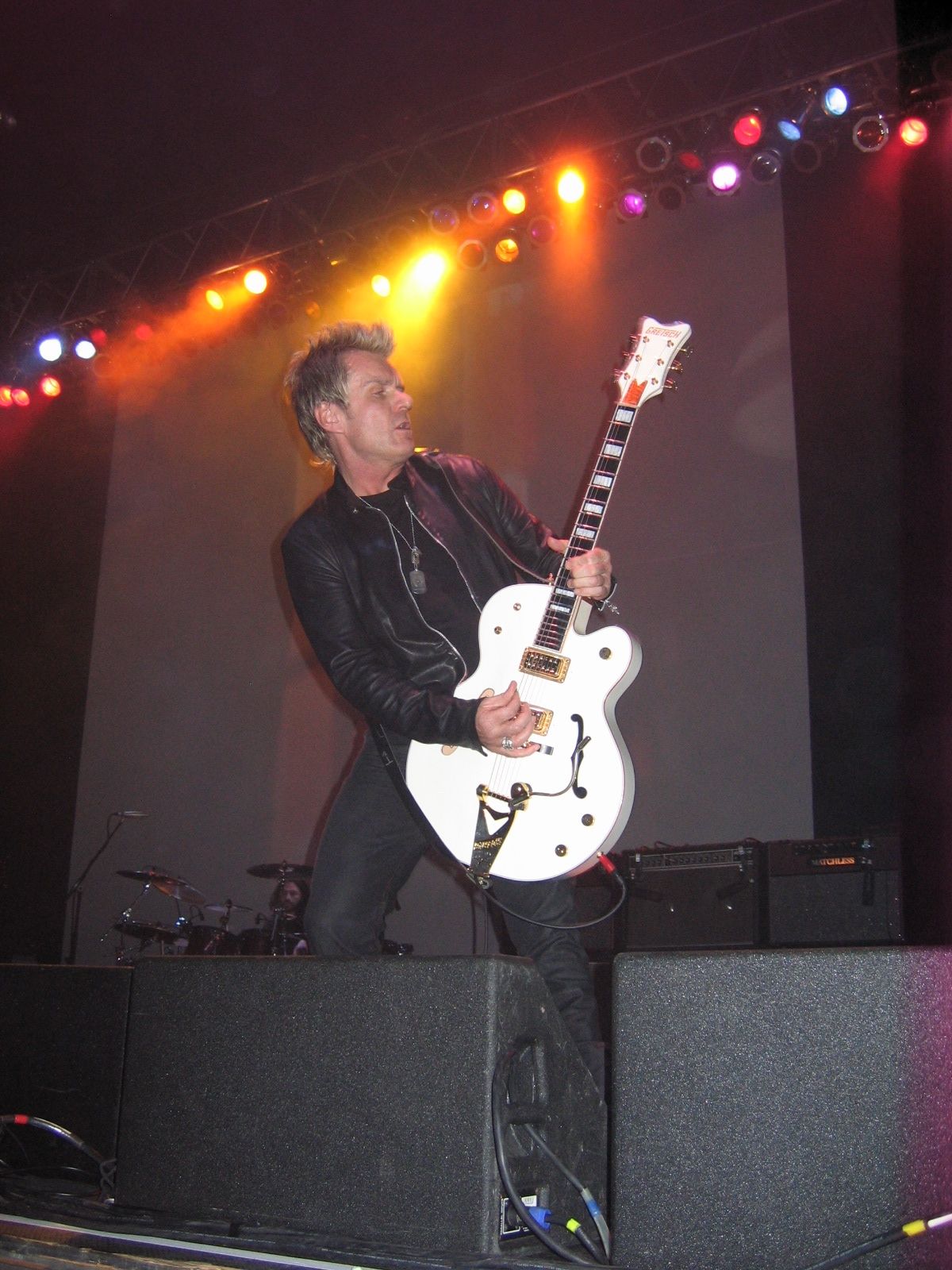
Photo: Veronica Perina / Wikimedia Commons / CC BY 3.0 Gretsch
White Falcon
1955
Gretsch built it to stop people in the aisle of a trade show. It never stopped doing that.
Gretsch Country Gentleman 1964, 6122 Chet Atkins Country Gentleman. Photo by matanao. Public domain (PD-self). Via Wikimedia Commons. Gretsch
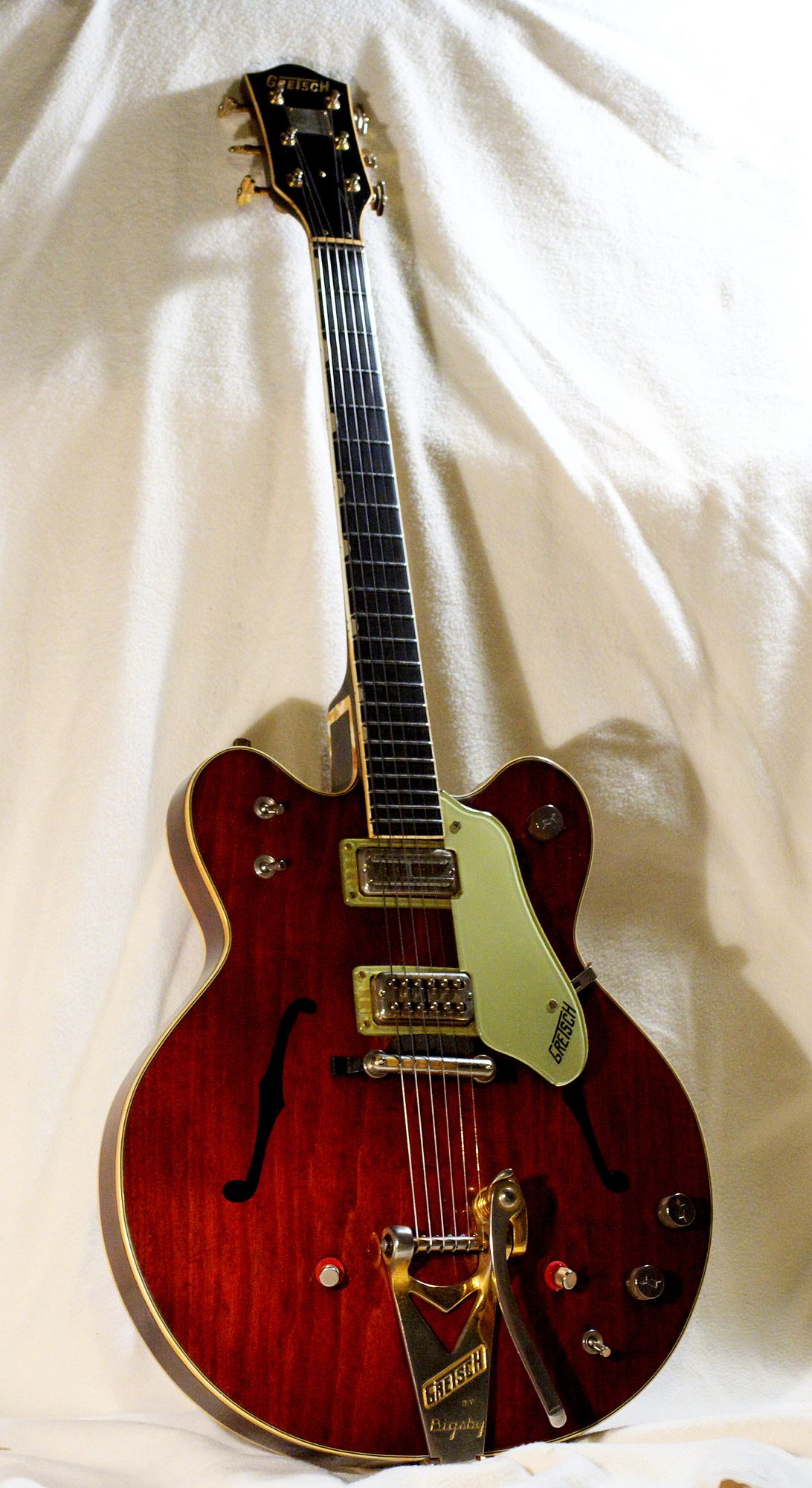
Country Gentleman
1957
Chet Atkins asked for a guitar without the cowboy flash. On Ed Sullivan, it didn’t even show its color.
- Send a picture
Gretsch
Synchromatic
1939
Gretsch’s answer to Gibson had cat’s eyes, a harp, and a neck with no rod in it. The files burned.