Gretsch
Duo Jet
George Harrison bought his used in Liverpool as a teenager. In 1987 he put it on an album cover.
Liverpool, 1961, or maybe 1960, depending on who’s telling it. A teenage George Harrison buys a secondhand black Gretsch Duo Jet, built in Brooklyn in 1957. He’ll play it with the Beatles. He’ll never sell it.
- Introduced
- 1953
- Type
- Chambered solidbody electric
- Class
- Production
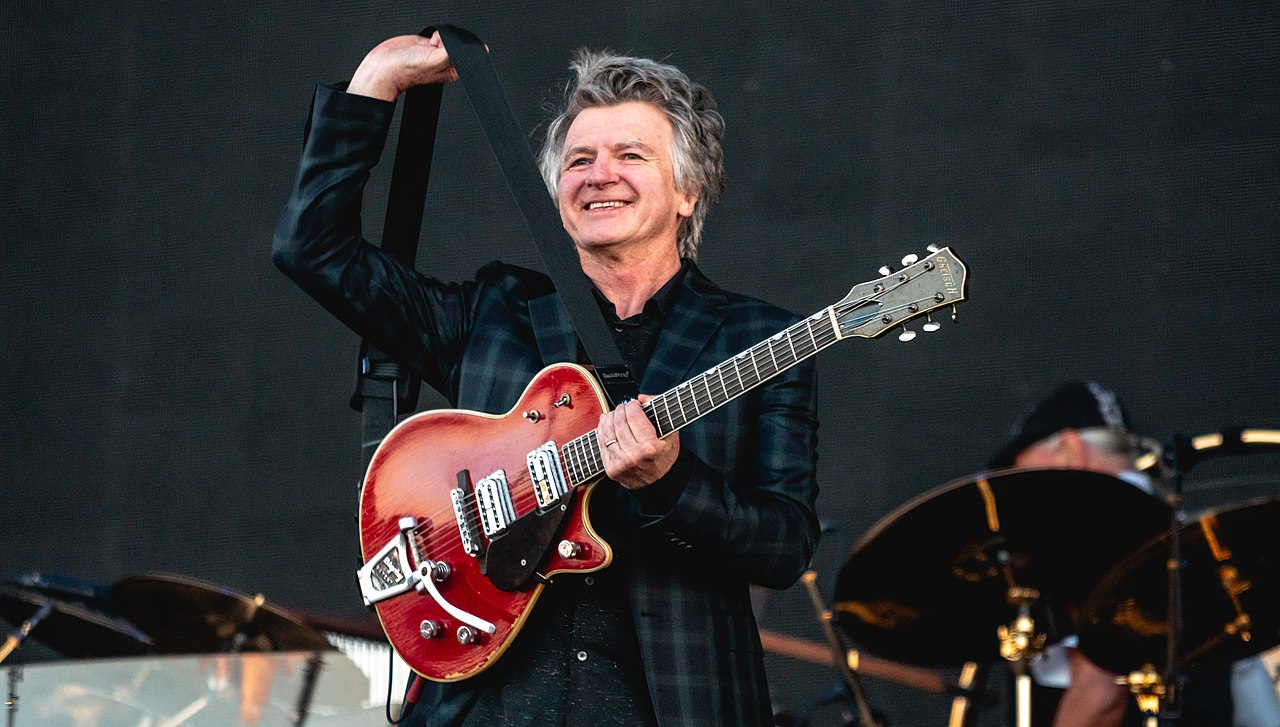
The short version
1953
In the shops
The Duo Jet reaches stores in the fall. The first batch is 150 guitars.
1956
“Be-Bop-A-Lula”
Cliff Gallup’s 1954 Duo Jet on Gene Vincent’s records.
1959
Filter’Trons
Humbuckers arrive on the Jet, in 1959 by Gretsch’s count, or a year earlier by others.
1961
Harrison’s Jet
George Harrison buys a used 1957 Duo Jet in Liverpool. Some accounts say 1960.
1987
Cloud Nine
The same guitar is on the cover of Harrison’s album.
1993
Crazy Legs
Jeff Beck finds a ’50s Duo Jet in pieces in Memphis and makes a Gene Vincent record with it.
Side A
A1
A used black Gretsch
Most people outgrow their first good guitar. You get a record deal, or a better job, or just older, and the thing you saved up for at seventeen goes in a closet or out the door.
George Harrison bought a used black Gretsch Duo Jet in Liverpool around 1961. It was a 1957, made in Brooklyn. Within a couple of years he could have had almost any guitar in the world, and eventually he had a lot of them. He never sold the Jet.
It was his guitar in the early Beatles days, the Please Please Me era, with a Bigsby vibrato somebody had added along the way. Even its birth year took some work. Gretsch reused a run of serial numbers around then, so his Jet is dated by its parts, not its number.
A2
Solid body, sort of
Gretsch’s catalog called it the Electromatic Solid Body Guitar. That was generous. Inside, the mahogany body is chambered, with an arched top over it, which makes it lighter and airier than a real slab like a Les Paul. “Duo” just meant two pickups.
The first 150 reached stores in the fall of 1953, with a script logo, plain knobs, and no inlay at the first fret. Those are the ones collectors hunt. Through 1957 they had DeArmond single-coil pickups, the same kind that went on a lot of ’50s Gretsches, and they came with a Melita bridge and a tailpiece with a G cut out of it. A lot of early Jets got a Bigsby vibrato added afterward.
It had siblings, which is where people get confused. The Silver Jet was the same guitar in sparkle. The Jet Fire Bird was red, and that’s the one Malcolm Young played. The Duo Jet was the black one.
Gretsch called it a solid body. Open one up and you’ll find rooms inside.
A3
Cliff Gallup’s ’54
In 1956, Gene Vincent and His Blue Caps put out “Be-Bop-A-Lula,” and the guitar player was Cliff Gallup. He played a stock Duo Jet with a Bigsby. For years people guessed it was a ’55 or a ’56. A receipt settled it: a ’54.
Put on “Race With the Devil” and listen to what he does with it, those quick, stinging runs up and down the neck. A lot of teenagers in England heard those records.
Flip the record · By the numbers
150
Duo Jets in the first batch, fall 1953. Script logo, plain knobs.
2
Pickups. That’s the “Duo.”
1987
The year Harrison’s ’57 Jet made the cover of Cloud Nine, a quarter-century after he bought it.
Side B
B1
New pickups, new horns, new owners
Then it kept changing. Filter’Tron humbuckers arrived around the end of the ’50s: 1959, by Gretsch’s own count, or 1958 by others. A 1957 Jet should still have the DeArmonds, so if you see Filter’Trons in one, somebody’s been routing. In late 1961 or 1962 it grew a second cutaway.
Baldwin bought Gretsch in 1967. Production left Brooklyn in 1970, and the original Duo Jet ended around 1971. You can buy new ones now, made in Japan, including a copy of Harrison’s.
Other people passed through. Hank Garland played one. David Gilmour owned a ’50s Jet. Pete Townshend used one at UK gigs early in the Quadrophenia days, though his famous Gretsch is a 6120.
B2
Still reaching for it
In 1993 Jeff Beck made Crazy Legs, an album of Gene Vincent songs, and he wanted Gallup’s sound. He found a ’50s Duo Jet in Memphis, in pieces, and used it for the record. People date that guitar to ’55 or ’56, and they don’t agree. After the album he found a ’56 closer to what Gallup had. Beck could have played anything. He played the guitar from the records he heard as a kid.
Harrison did the same thing six years earlier. In 1987 he put out Cloud Nine, and there on the cover was the black Jet from Liverpool. The Harrison family has it now.
He had Strats and Les Pauls and Rickenbackers by then, and a sitar. On the cover, he held the one he bought used as a teenager.
Put this on
You’ve read about it. Now hear it. Here’s what this guitar sounds like, and what to listen for.
Be-Bop-A-Lula
Cliff Gallup on a stock 1954 Duo Jet with a Bigsby. Listen to how much sting he gets out of two DeArmond single-coils.
Find it on YouTube (opens in a new tab)Race With the Devil
Gallup again, same Jet, going faster than most people could follow.
Find it on YouTube (opens in a new tab)Crazy Legs
Beck’s tribute to Gene Vincent’s band, played on a ’50s Jet that turned up in pieces in Memphis. Gallup’s kind of guitar, almost forty years on.
Find it on YouTube (opens in a new tab)
The cast
The people, and the specific guitars, that made the legend.
1956
Cliff Gallup
1954 Duo Jet
Stock, with a Bigsby. A receipt makes it a ’54, not the ’55 or ’56 people used to guess.
1961
George Harrison
1957 Duo Jet
Bought used in Liverpool. The Bigsby was added later. The Harrison family still has it.
1993
Jeff Beck
’50s Duo Jets
A swivel-arm Jet from Memphis, dated ’55 or ’56, for Crazy Legs. Then a ’56 with a factory Bigsby.
1950s
Hank Garland
Duo Jet
The Nashville session ace is on the list of Jet players.
1963
Malcolm Young
A Jet Fire Bird, not a Duo Jet
His famous Gretsch is a 1963 Jet Fire Bird. Same family, different guitar.
Liner notes
Specs, construction, rarity, value, and every source we used.
Chambered mahogany “solid body,” two pickups, gloss black: not a 6120, not a Les Paul slab, not Silver Jet / Fire Bird / Round-Up / Penguin, and not Harrison’s 1957 as if that serial priced ordinary 6128s.
- Body
- Chambered mahogany, arched laminated maple top, 1.85" (official tables omit width)
- Neck
- Set mahogany “U”
- Fingerboard
- 12" rosewood, 22 medium-jumbo, neo-classic thumbnails
- Scale
- 24.6" (625 mm)
- Pickups
- High Sensitive Filter’Trons
- Hardware
- Anchored Adjusto-Matic; string-thru Bigsby B7CP; Gotoh locking; nickel
- Electronics
- Two volumes, master volume with treble bleed, no-load master tone
- Finish
- Gloss (typical black)
- Nut
- TUSQ XL, 1.6875"
Open the full research fileConstruction details, the complete player record, production numbers, dated value estimates, and sources
Current typical player spec: G6128T Players Edition Jet FT with Bigsby. Vintage Select ’53 / ’57 / ’59 are year-clones. They are not this table. PE DS is the DynaSonic Players Edition path. There is no unlabeled “the G6128T.”
Construction
Gretsch Duo Jet, vintage 6128: chambered mahogany, arched bound top. Catalog Electromatic Solid Body Guitar. “Duo” is two pickups. Not a slab Les Paul. Not a 6120 hollow maple archtop.
Keep the neighbors straight. 6129 Silver Jet is sparkle. 6131 Jet Fire Bird is red — Malcolm Young’s official guitar. 6130 Round-Up is western/knotty-pine. 6134 White Penguin is the white/gold fancy sibling. Same size class. Different numbers.
1953 origin. Vintage Guitar: stores fall 1953. First batch 150, SN 11900–12049: script logo, no first-fret inlay, plain knobs. guitarhq titles the first spec block “1954 DuoJet Introduction specs” — catalog/feature-year language, not a rival first-retail year. 1954 first Jet batch: another 150, SN 12950–13099, T-roof, first-fret block. Silver Jet 6129 appears in this batch. Subsequent batches mix 6128/6129.
Body width: VG 13 1/2" × 2"; guitarhq 13 1/4". Range it. Official pages omit width. Early black top: VG Nitron; guitarhq maple top; current factory arched laminated maple over chambered mahogany. Attribute; don’t pick eternal. Scale: guitarhq vintage 24 3/4"; current PE and Vintage Select 24.6" (625 mm). Do not convert.
1953–57: DeArmond Dynasonics + Melita + G-cutout tailpiece. Not a Gibson wrapover. Bigsby on early 6128s is often aftermarket. 1957: humptops replace blocks.
Filter’Trons on Jets are not the 6120 date. guitarhq 1958. Official G6128T-59: “1959 marked the first year that Filter’Tron pickups appeared on the Jet.” Joe’s: standard 1958. Gretsch-Talk: earliest Filter Jets wear PAF covers → 1959. A 1957 6128 should still be DeArmonds; Filter’Trons in a ’57 body usually mean routing.
1958-family: bar / Space Control + Bigsby. Neo-Classic thumbnails mid-1958. Zero fret: guitarhq 6129 list 1959 vs general table 1962 and later vs Gretsch-Talk ~1960. Attribute all three.
Double-cut: guitarhq 1961; Joe’s late 1961 into 1962. 1961 DC: Burns replaces Bigsby (guitarhq).
Brooklyn 1953–1970. Baldwin 1967; Booneville 1970; fires 1973. Original Duo Jet run ~1971 (Joe’s). Baldwin 6128s are not 1950s Brooklyn money. Serials sequential across models; ~1,000-label reuse around 1957/1965 is a trap. Harrison’s Jet sits in that band and is dated 1957 by features, not the serial.
Current Japan Professional / Vintage Select / Electromatic / G6128T-GH are not vintage Brooklyn. PE FT (the table): 1.85" modern chambering. Vintage Select: 2" year-clones (TV Jones, B3-class Bigsby). VS ’53 ships with factory Bigsby; 1953 catalog default was Melita + G-tail. PE DS 3-way wording “Middle” on a two-pickup guitar is a template error — hardware is neck + bridge DynaSonics.
Players
Cliff Gallup — 1954 Duo Jet (stock, Bigsby). Vintage Guitar / Gretsch: a ’54 via receipt, not the guessed ’55 or ’56. Gene Vincent: “Race With The Devil,” “Be-Bop-A-Lula,” “Crazy Legs.”
George Harrison — 1957 6128, SN 21179. Bought Liverpool 1961 (Babiuk / Gretsch 2012). Fred Gretsch 2013 says 1960; prefer 1961. Aftermarket Bigsby. Please Please Me–era Beatle guitar. Cloud Nine (1987) cover. Never sold; Harrison family. A market factor. Not a price for ordinary 6128s. Not a 6120.
Jeff Beck — Crazy Legs (1993). Guitar World (Gill): 1956, swivel-arm, Memphis, in pieces. Christie's lot notes: 1955. After the album, a closer 1956 with fixed-arm factory Bigsby. Attribute both years.
Also known to play: Hank Garland; David Gilmour owned a 1950s 6128, not sourced here as a Pink Floyd master take. Pete Townshend on early Quadrophenia-era UK gigs — his documented Gretsch identity remains the 1959 6120.
Not this guitar: Malcolm Young is a 1963 Jet Firebird. Brian Setzer is a 6120.
Rarity
Modern Japan Professional / Electromatic Jets are regular production. Not rare.
Vintage: 1953 first-batch script (150, SN 11900–12049) is scarce. 1954–57 DeArmond single-cut is the classic 1950s object. 1958–61 Filter’Tron single-cut is the finished-design single-cut. Double-cut from late 1961/62 is the affordable vintage Jet. Factory yearly 6128 totals after the opening 150+150 batches: unpublished. Do not treat serial ranges as shipping totals.
Value
Informal estimate, 25 August 2026. Not an appraisal.
2024–26 public solds for original 6128s are thin. Joe’s Vintage Guitars (July 2026) is asking / price-guide, not hammers. Ask ≠ sold. Do not price a 6128 off a 6120. Harrison’s 1957 is a market factor, never sold, not a price for ordinary 6128s. Artist lots sit outside these ranges.
New street. Electromatic G5230T $600–$700 (Sweetwater $599.99; Gretsch est. $699.99). Vintage Select G6128T-53 / ’59 $2,999.99. G6128T-57 Cadillac Green Dave’s $3,299.99. G6128T-GH $3,999.99. Japan, not Brooklyn.
Used modern. Sold comps are thin; this is listings. Used GH ~$2,450–$3,000 asking (Equipboard). Tribute, not 1957. TFOA 1969 €6,499 ask — late Brooklyn/transition, modified. Do not invent a Baldwin USD band from that tag. guitarprice.net 50–70% below Brooklyn is aggregator, not solds.
Vintage / collectible. Joe’s dealer-guide: DeArmond single-cut 1953–57 player ~$4–7k, excellent ~$8–14k; Filter’Tron single-cut 1958–61 player ~$4–7k, excellent ~$7–13k; double-cut early–mid 60s player ~$3–5k, excellent ~$5–9k. Named 2026 asks: Carter 1957 original DeArmonds $8,000; Chicago Music Exchange 1957 replaced pickups $4,395; MotoMusic 1956 £9,999. 1953 first-batch script: Joe’s five-figure premium for a clean one. TR Crandall SN 11998 sold, price not published. Do not invent a median. guitar-list 1953 Script ask €9,285; 1954 Script €20,160 outlier ask. guitarvalueguide 1953 excellent $18–36k sits above live 2026 dealer asks — third-party guide, not 2026 retail. Christie's SN 13939 hammer not extracted — do not invent one.
Filters: Brooklyn vs Baldwin vs Japan; single-cut vs double-cut; DeArmond vs Filter’Tron vs replaced; original black vs refin; 1957-vs-1965 serial trap.
See also
- gretsch-6120 — the 16" Chet hollowbody this guitar is not
- gretsch-white-falcon — Cadillac hollow, not a Jet
- gibson-les-paul-standard — the slab silhouette people confuse it with
Keep digging
Guitars this one gets compared to, confused with, or descended from.
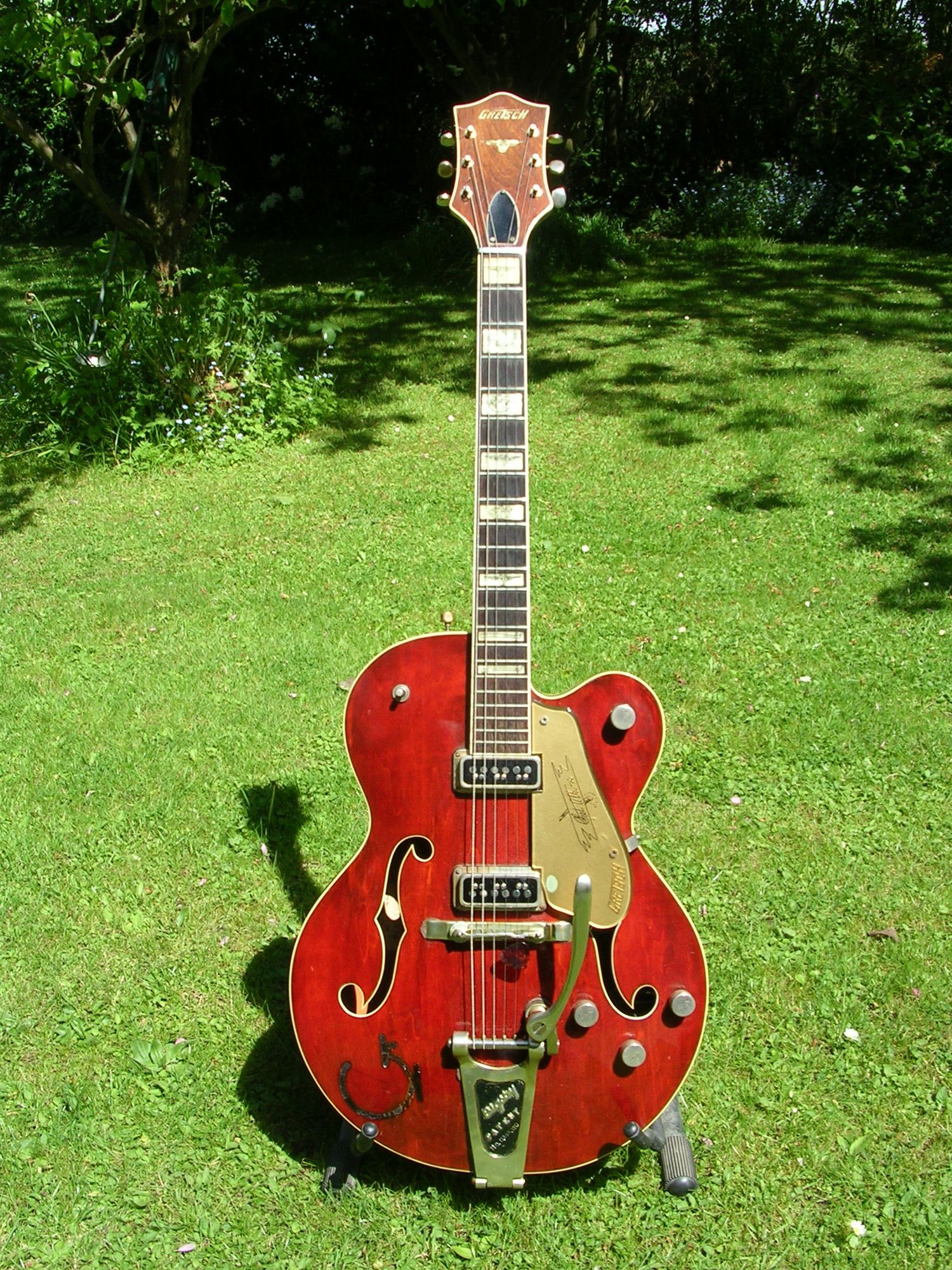
Gretsch 6120 G-Brand 1955. Photo by Francis pullen. Public domain (PD-self). Via Wikimedia Commons. Gretsch
6120
1955
Joe Walsh gave Pete Townshend one. Steve Miller gave Brian Setzer one. Chet Atkins just lent it his name.
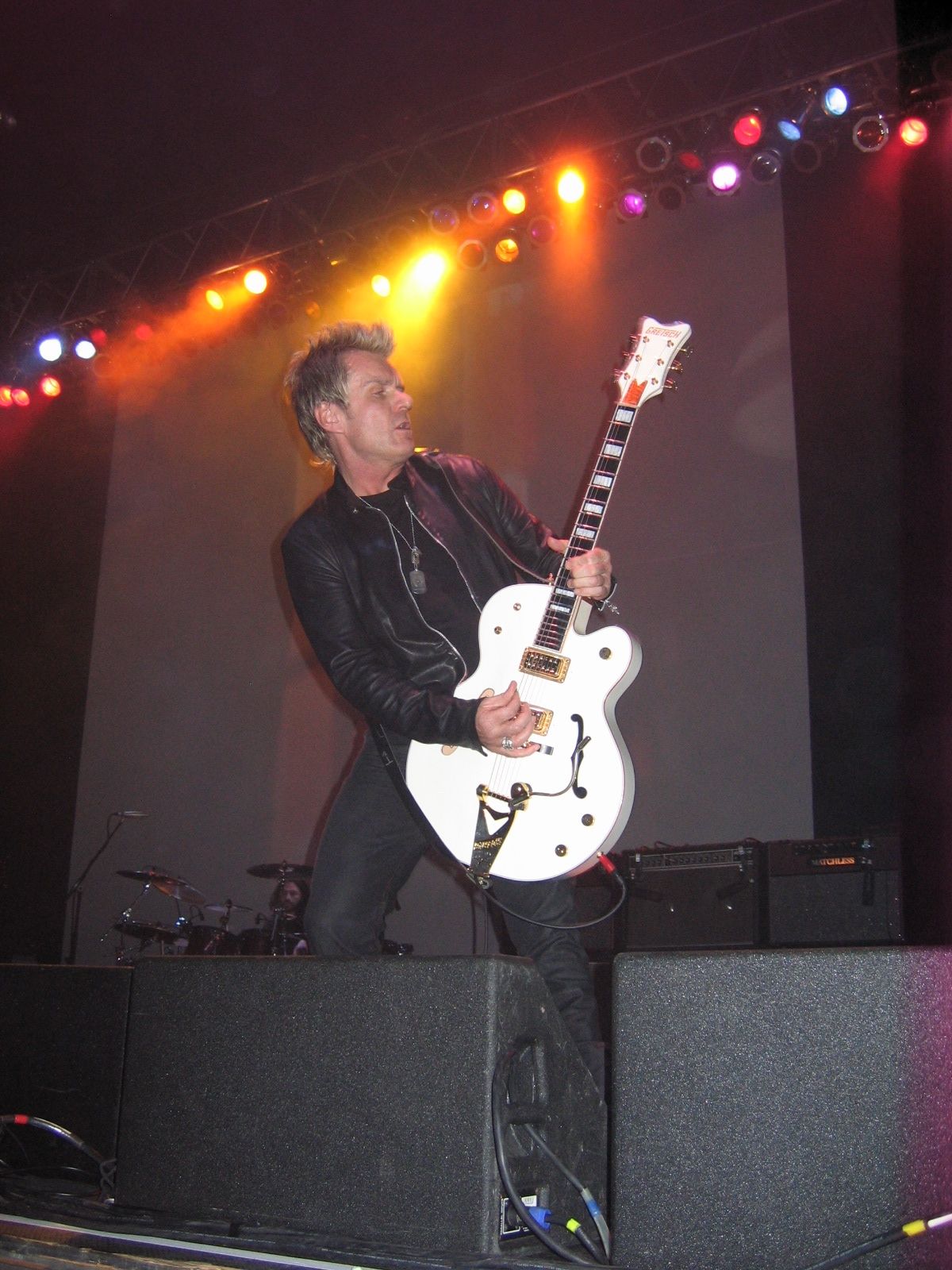
Photo: Veronica Perina / Wikimedia Commons / CC BY 3.0 Gretsch
White Falcon
1955
Gretsch built it to stop people in the aisle of a trade show. It never stopped doing that.

2006 Gibson Les Paul Standard (SN 000660573). Photo by wetwebwork. Licensed under CC BY-SA 2.0. Via Wikimedia Commons. Gibson
Les Paul Standard
1952
Gibson made about 1,500 sunburst Les Pauls, decided nobody wanted them, and stopped. Then the British blues boom happened.