Gibson
L-00
Gibson’s plainest flat-top of the Depression. Famous names keep getting pinned on it. It never needed them.
1932. The country is broke, and Gibson’s catalog has a small flat-top at the bottom of the ladder: black finish, a painted logo, a white pickguard, twenty-five dollars. It’s the plainest guitar in the L-series. That was the idea.
- Introduced
- 1931
- Type
- Flat-top steel-string acoustic
- Class
- Production
The short version
1929–31
Introduced
One history says 1931, with the first batch that year. Another says somewhere between 1929 and 1931.
1932
In the catalog
Black, 12 frets clear of the body, top-only binding, $25.
1933
A new look
Fourteen frets clear, a sunburst top, scalloped braces, a firestripe pickguard. $27.50.
1937
In the shipping books
The back is bound now, the list is $30, and the shipping books count more than 1,300 going out the door.
1941
Natural, if you want it
A natural top joins the sunburst, $42 against $36.75.
1942
The LG-2 arrives
Gibson’s new LG series shows up in August and starts doing the L-00’s job.
1945
Gone
A few wartime banner L-00s along the way, then the model is discontinued.
Side A
A1
The bottom of the ladder
Gibson’s small flat-tops in the early ’30s came in a ladder. In ascending order of fanciness: L-00, L-0, L-1, L-2. The L-2 got the pearl logo. The L-00 got a black finish, a logo painted on the headstock, and a price tag of $25 when it first showed up in the catalog in 1932.
When exactly it started is a small fight. One careful history puts the first batch in 1931. Another account says it was “actually introduced between 1929 and 1931 (but first catalog appearance in 1932).” Either way, it arrived in the worst years of the Depression, and it was priced for them.
Everybody who picks one up wants to know which famous person played one. I’d rather tell you who could afford one.
A2
Small, black, and cheap
The first L-00s were black, with the neck meeting the body at the 12th fret, white binding on the top only, and “the Gibson” or just “Gibson” painted on the peghead. The lower bout is 14¾ inches across. That’s a guitar you can hold on a kitchen chair without your arm going numb.
Gibson’s 1934 catalog promised “perfect balance,” and I think that’s the right way to hear it. A small box like this doesn’t boom. Listen for the low strings and the high strings coming out even, with nothing swamping anything else.
They were built light, too. Light enough that heavy strings will pull an old L-00 apart. If you have one, go easy.
A3
Growing up in a hurry
The L-00 didn’t sit still. By 1933 the neck met the body at the 14th fret, like most flat-tops today. A sunburst joined the black, the braces were scalloped, the pickguard went to firestripe tortoise, and the logo lost its “the.” The price went up to $27.50.
Through the mid-’30s the sunburst kept getting bigger, from small to medium to large. By 1937 the backs were bound and the list price was $30. In 1941 you could order a natural top: $42 natural, $36.75 sunburst.
The L-2 got the pearl logo. The L-00 got a painted one and a $25 price tag.
Flip the record · By the numbers
$25
List price when it first showed up in the catalog, in 1932.
14.75"
Width of the lower bout. A J-45 is around 16 inches. A J-200 is around 17.
1,138
Sunburst L-00s Gibson shipped in 1937, plus 234 in black. Pre-war counts are rough.
$27.50
The 1933 price, after it grew a 14-fret neck and a sunburst.
Side B
B1
The famous people who weren’t holding one
Small old Gibsons attract famous names the way porch lights attract moths.
The best-known one first. The studio portrait of Robert Johnson, the one you’ve seen, shows a Gibson L-1, one rung up the ladder. Gibson’s own Robert Johnson model is an L-1. One Gibson product page even called him an early L-00 player. That’s a mix-up.
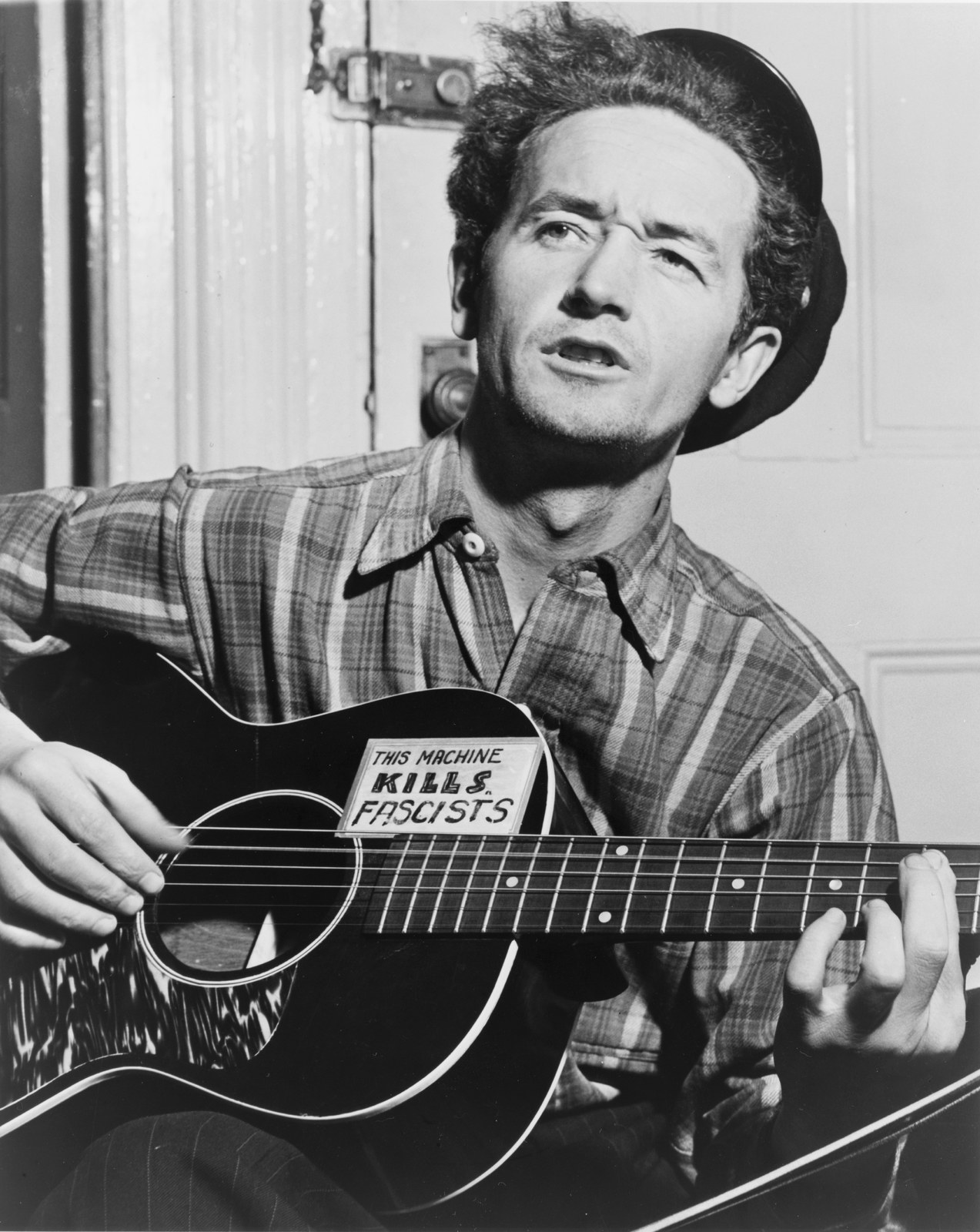
Woody Guthrie’s “This Machine Kills Fascists” guitar is a three-way argument: one source says a Southern Jumbo, another says an L-0, and some dealers say a late-’30s black L-00. Nobody has settled it, so we won’t either. And Elvis Costello’s small 1936 Gibson is an L-C, the pearloid “Century” model, named for the Century of Progress fair in Chicago. Same body family. Different guitar.
B2
How it bowed out
In August 1942 Gibson brought out the LG series. The LG-2 was a small sunburst flat-top about 14⅛ inches wide, and it took over the L-00’s job. They overlapped for a while, and the LG-2 isn’t just the L-00 with a new name. But after 1942 you rarely see an L-00. A few went out in 1943 or 1944 (the sources split on the year) wearing the wartime banner, “Only a Gibson Is Good Enough,” on the old narrow headstock. By 1945 the model was gone.
Gibson makes the L-00 again now, in Bozeman, Montana, with a pickup inside and a spec sheet a 1932 buyer wouldn’t recognize. There’s also a Custom Shop copy of a 1933, aged to look like it has been through something.
B3
Thousands of people nobody photographed
Here’s what the old shipping books say, with the warning that pre-war numbers are “probably not very accurate.” In 1937 alone, Gibson shipped 1,138 sunburst L-00s and 234 black ones. In 1941, 697 more. Those are only the years somebody wrote down. The L-00 was cheap, there were lots of them, and plenty got played until they broke.
Every one of those went to somebody. Somebody who had $27.50 or $30 in the worst decade of the century and spent it on a small black or sunburst Gibson. Nobody took their portrait in a studio. They didn’t paint slogans on the top.
The L-00 never needed Robert Johnson. It had thousands of people nobody photographed.
The cast
The people, and the specific guitars, that made the legend.
1930s
Robert Johnson
A Gibson L-1, not an L-00
The famous studio portrait shows an L-1. Gibson’s Robert Johnson reissue is an L-1 too.
Woody Guthrie
Depends who you ask
“This Machine Kills Fascists” gets pinned on a Southern Jumbo, an L-0, and a black L-00, depending on the source. We won’t pick.
1936
Elvis Costello
1936 Gibson L-C
Same small body family, different model. The pearloid L-C Century was named for Chicago’s Century of Progress.
1932 or 1936
Derek Trucks
Depression-era L-00s
Photographed with old L-00s, and nobody agrees on the year. We’ll leave it there.
1991–2016
Sheryl Crow
L-00 Blues King
A later Bozeman model with the L-00 name on it, not a 1930s Kalamazoo guitar.
Liner notes
Specs, construction, rarity, value, and every source we used.
Gibson’s small-body flat-top — L-00 — not a round-shoulder dreadnought J-45 and not a Super Jumbo J-200.
- Body
- L-00 small body; Sitka spruce top, mahogany back and sides; single-ply top, single-ply back
- Neck
- Mahogany, SlimTaper; compound dovetail neck-to-body joint
- Fingerboard
- Rosewood, 12" (304.8 mm) radius, mother-of-pearl dots, 19 frets
- Scale
- 628.65 mm / 24.75"
- Pickups
- L.R. Baggs VTC under-saddle piezo (current Original; vintage L-00s have none)
- Hardware
- Rectangle closed-slot bridge; bone saddle; TUSQ pins; nickel Golden Age tuners; L-00 pickguard
- Electronics
- Soundhole-mounted volume and tone
- Finish
- Gloss nitrocellulose lacquer; Vintage Sunburst or Ebony
- Nut
- Bone, 43.81 mm / 1.72"
Open the full research fileConstruction details, the complete player record, production numbers, dated value estimates, and sources
Current Original (Gibson.com Vintage Sunburst OCSBL0VS / Ebony OCSBL0EB, 25 Aug 2026). Standard (LSL0VSN19) is a different SKU — Mini Grover Rotomatics, TUSQ saddle, "Black" nut. Custom Shop 1933 / Murphy Lab is a Historic recreation, not this table. Do not copy Sitka or the VTC onto a 1930s Kalamazoo guitar.
Construction
Small body. guitarhq.com: 14.75" (also 14 3/4") lower bout. Not a round-shoulder J-45 (~16"). Not a Super Jumbo J-200 (17"). Not an LG-2 (14 1/8"–14 1/4"). Current production is Bozeman, Montana. The Depression run was Kalamazoo.
This plate is the L-00 Original. Gibson.com quotes the 1934 catalog on "perfect balance" and a white script logo, antiqued binding, Golden Age tuners. Sitka over mahogany, "Traditional hand scalloped X-bracing," gloss nitro, factory L.R. Baggs VTC. Hide glue is not on that spec sheet. Standard (LSL0VSN19) is the same street money with Mini Grovers and TUSQ saddle — different hardware, still not a 1930s guitar. Custom 1933 L-00 Reissue (Murphy Lab Light Aged, CSSBL0EBLA): thermally aged red spruce top, red-spruce braces with hide glue, V-profile neck, 1.77" bone nut, antique white guard on Ebony, no factory piezo on the sourced spec sheets. A reissue. Not FON 21.
First year is a catalog fight. guitarhq.com L-00 page: introduced 1931, first batch FON 21, first catalog 1932, $25 list. guitarhq.com flattop overview: "actually introduced between 1929 and 1931 (but first catalog appearance in 1932)." Keep both. Don't pick. Early recipe: spruce top, black finish, 12 frets clear, mahogany back and sides, white bound top only, white pickguard (no guard was an option), rectangle rosewood bridge, unbound ebonized board, "V" neck, 3-on-a-plate tuners, 24 3/4" scale, painted "the Gibson" or "Gibson" logo.
It was the plainest L-series flattop. guitarhq.com: in ascending fanciness L-00, L-0, L-1, L-2. L-1 is the Robert Johnson photograph. L-0 is a sibling, not this SKU. L-2 is the fancy one (pearl logo; some rosewood). Don't collapse them because they share a letter.
1933: 14 frets clear, small-to-medium sprayed sunburst, scalloped X, firestripe (or "mocking") tortoise guard, "Gibson" logo without "the," $27.50. guitarhq.com FON 298 is marked as the start of 14-fret L models (1932). 12-fret examples continue in the 1932 table. Do not use dealer dating that holds 14-fret until 1937–38.
1935–37: sunburst grows (small → medium → large). Back binding: unbound at intro; mixed mid-decade; guitarhq.com 1937: "all have back bound now," list $30. A few 3/4-scale L-00s. 1941: natural optional; $36.75 sunburst / $42 natural. Hawaiian HG-00 (1937–42) is heavier-braced, 12-fret, straight saddle — not this guitar.
LG-2 is a different catalog name. guitarhq.com: LG-1, LG-2, LG-3 introduced August 1942. LG-2 is the wartime small-body that shipped in volume: ~14 1/8" wide, X-braced spruce sunburst, banner logo. Guitar World: the 14¼" LG series "fleshed out" a limited wartime range that still included the L-00, J-45, and Southern Jumbo. guitarhq.com: the L-00 is rarely seen after 1942 because the LG series largely replaced it; discontinued 1945. They overlapped. Do not hang an LG-2 on this plate. Do not treat LG-2 as a renamed L-00.
Banner vs pre-war. The collected L-00 is the 1930s Depression guitar. Wartime banner ("Only a Gibson Is Good Enough") is the exception on this model. guitarhq.com overview: a few L-00s with the banner, 1943. guitarhq.com L-00 page: a few with the banner on the narrow 1930s peghead, 1944. FON list: 1943 batches under white logo; 1944 banner, small peghead (2799, 2815). Keep the year split. The common small banner guitar is the LG-2, not this one. J-45 / Southern Jumbo banners live on those plates.
Spruce species on 1930s tickets is not on guitarhq.com — do not copy Sitka onto a Depression L-00. Dealer sheets sometimes say Adirondack; leave it unlabeled unless the guitar is measured. Pre-war L-00s were lightly built; guitarhq.com warns heavy strings will pull them apart.
Players
Named instruments only. This model does not have a museum-held hero serial in the public record the way a Burst does. Unsourced "blues box" celebrity dumps are not repeated here.
Robert Johnson's photograph is an L-1, not an L-00. The Hook Brothers studio portrait is the Gibson L-1 flattop (1926–37). Gibson's Robert Johnson signature reissues the L-1. A Gibson Custom Select L-00 page that names Johnson as an L-00 early adopter is marketing mix-up. Keep him off this plate.
Woody Guthrie's "This Machine Kills Fascists" stencil is not locked to this model. The J-45 plate, citing Guitar Center, puts the slogan on a Southern Jumbo "and a few other of his favorite guitars." Wikipedia's L-series lead says Guthrie used an L-0. Dealer copy (True Vintage; Edgewater) calls a late-1930s black L-00 with firestripe the slogan guitar. Three names. Don't pick. Don't migrate the stencil here as if it were an L-00 census object.
Elvis Costello's 1936 small Gibson is an L-C (L-Century), not an L-00. Christie's (Gilmour's 2008 Costello Century, no. 91 of 300): Gibson named the pearloid L-C for Chicago's Century of Progress; Costello popularized that variant; the 2008 signature copies his 1936 L-C. Musician's Friend listing copy still says "Body Style: L-00 Small Body" — body family, not the catalog name.
Keep off this page: Dylan's debut cover (J-50); Holly's leather jumbo (J-45); Page's Led Zeppelin I acoustic (J-200); Arlo Guthrie's 3/4 LG-2; Patty Griffin LG-2; Chris Stapleton mid-1950s LG-2 / song credit LG-0; Julian Lage 1932 L-0; Jeff Buckley L-1. Sheryl Crow's L-00 Blues King is a later Bozeman SKU (Reverb: 1991–2016; some years bubinga, shallower body) — not a 1930s L-00.
Secondary gear pages (Ground Guitar; Guitar Lobby) photograph Derek Trucks with Depression-era L-00s and disagree on year (1932 black vs 1936). No serial this pass. Do not upgrade that to a named instrument.
Rarity
Current Original / Standard: regular Bozeman catalog. Unit counts unpublished. Used Originals are common.
Vintage Kalamazoo L-00 (1931/32–1945) is the common Depression small Gibson, not J-45-common and not Advanced Jumbo-scarce. guitarhq.com collectibility: B. L-00s were inexpensive and numerous; they also break.
Factory shipping from guitarhq.com (Meiners-era table). Columns: pre-1937 / 1937 / 1938 / 1939 / 1940 / 1941 / war years / published total. guitarhq.com: pre-WW2 numbers "are probably not very accurate." FON lists are not production counts. 1938–39 FON recording gap on the L-00 page.
- L-00 black: pre-1937 ?; 1937: 234; later years blank; total 234.
- L-00 sunburst: pre-1937 ?; 1937: 1,138; 1938: 591; 1939: 384; 1940: 284; 1941: 697; war ?; total 3,094.
- L-00 blond: 1941: 28; war ?; total 28.
War-year cells are unknown. Banner L-00s are the scarce slice of an already-ending model. LG-2 banner shipping is a different, larger small-body run — do not add it here.
Value
Informal estimate, 25 August 2026. Not an appraisal.
Ask vs sold. Public hammers are thin. Reissues are not 1931. Artist-owned lots are a separate market.
New street. L-00 Original Vintage Sunburst / Ebony $2,999 (gibson.com, 25 Aug 2026). L-00 Standard Vintage Sunburst $2,999 — same money, different SKU. Custom 1933 Murphy Lab Light Aged Ebony $5,499 (gibson.com). Dealer street on the Historic can sit under list (Peach Guitars discounted GBP asks are not USD solds).
Used modern (Bozeman Original). Thin labeled solds this pass. Dealer asks: Tone Wolf 2025 Vintage Sunburst, Excellent, $2,399; Parkway Music Original, Excellent, $2,199.95. Informal used Original neighborhood about $2,200–$2,500 — listings, not a histogram.
Vintage / collectible. Reverb Price Guide for L-00 1932–1945, Good to Mint: estimated used $3,727–$9,787 (159 orders). That guide page is a 2024 snapshot (Independence Day chrome on the scrape), not a 25 Aug 2026 live tape. Dated solds on the same page (spring 2024): Very Good $4,000 / $6,250 / $5,100; Good $4,500 / $2,000 / $7,500; Excellent $7,000. Condition and originality move a full tier — the $2,000 Good is not a clean original median.
Edgewater July 2026 dealer-comp, excellent all-original: pre-war L-00 $4,000–$9,000; pre-war LG-2 $3,500–$7,000 — guide, not sold, and a reminder they are different models. Live asks sit at the top of that band and above: Rudy's 1937 black FON 527C $9,395 (reset, reglued bridge); Guitar Broker 1933 FON 633 $9,995; Premier Guitars Sydney 1934 player A$11,595 ask (needs work). Banner L-00s: scarce enough that no clean 2024–26 public sold series was isolated this pass — do not invent a premium median. 12-fret 1931–32 and original-finish black are the usual extras; refinish and heavy repair sit at the floor.
See also
- gibson-j-45 — round-shoulder mahogany dreadnought; the wartime banner volume lives there, not on this small body
- gibson-j-50 — natural-top J-45 companion; Dylan's debut cover is that guitar, not an L-00
- gibson-j-200 — Super Jumbo; the S is Super, not this 14.75" Depression flat-top
Sources
- https://www.gibson.com/products/gibson-l-00-original-vintage-sunburst
- https://www.gibson.com/products/gibson-l-00-original-ebony
- https://www.gibson.com/products/gibson-l-00-standard-vintage-sunburst
- https://www.gibson.com/products/gibson-custom-1933-l-00-ebony-light-aged
- https://www.guitarhq.com/loo.html
- https://www.guitarhq.com/gibson6.html
- https://www.guitarhq.com/shippin2.html
- https://www.guitarworld.com/features/gibson-lg-series
- https://reverb.com/p/gibson-l-00-1932-1945
- https://reverb.com/p/gibson-l-00-blues-king-1991-2016
- https://edgewaterguitars.com/blog/what-s-my-vintage-gibson-worth-complete-2026-value-guide-by-model
- https://rudysmusic.com/products/u-gibson-1937-l-00-black-527c-w-nohsc
- https://www.guitarbroker.com/product/1933-gibson-l-00/
- https://truevintageguitar.com/blogs/previous-inventory/1937-gibson-l-00-black
- https://willcuttguitars.com/products/gibson-1933-l-00-light-aged-ebony-010-cssbl0ebla-21754010
- https://www.peachguitars.com/gibson-murphy-lab-1933-l-00-ebony-light-aged.htm
- https://tonewolf.com/products/gibson-l-00-original-2025-vintage-sunburst
- https://parkwaymusic.com/products/gibson-l-oo-w-case-used
- https://www.christies.com/en/lot/lot-6198173
- https://en.wikipedia.org/wiki/Robert_Johnson_(guitars)
- https://en.wikipedia.org/wiki/Gibson_L_Series
- https://www.groundguitar.com/derek-trucks-guitars-and-gear/derek-trucks-1936-gibson-l-00/
- https://commons.wikimedia.org/wiki/Category:Gibson_L-00
Keep digging
Guitars this one gets compared to, confused with, or descended from.
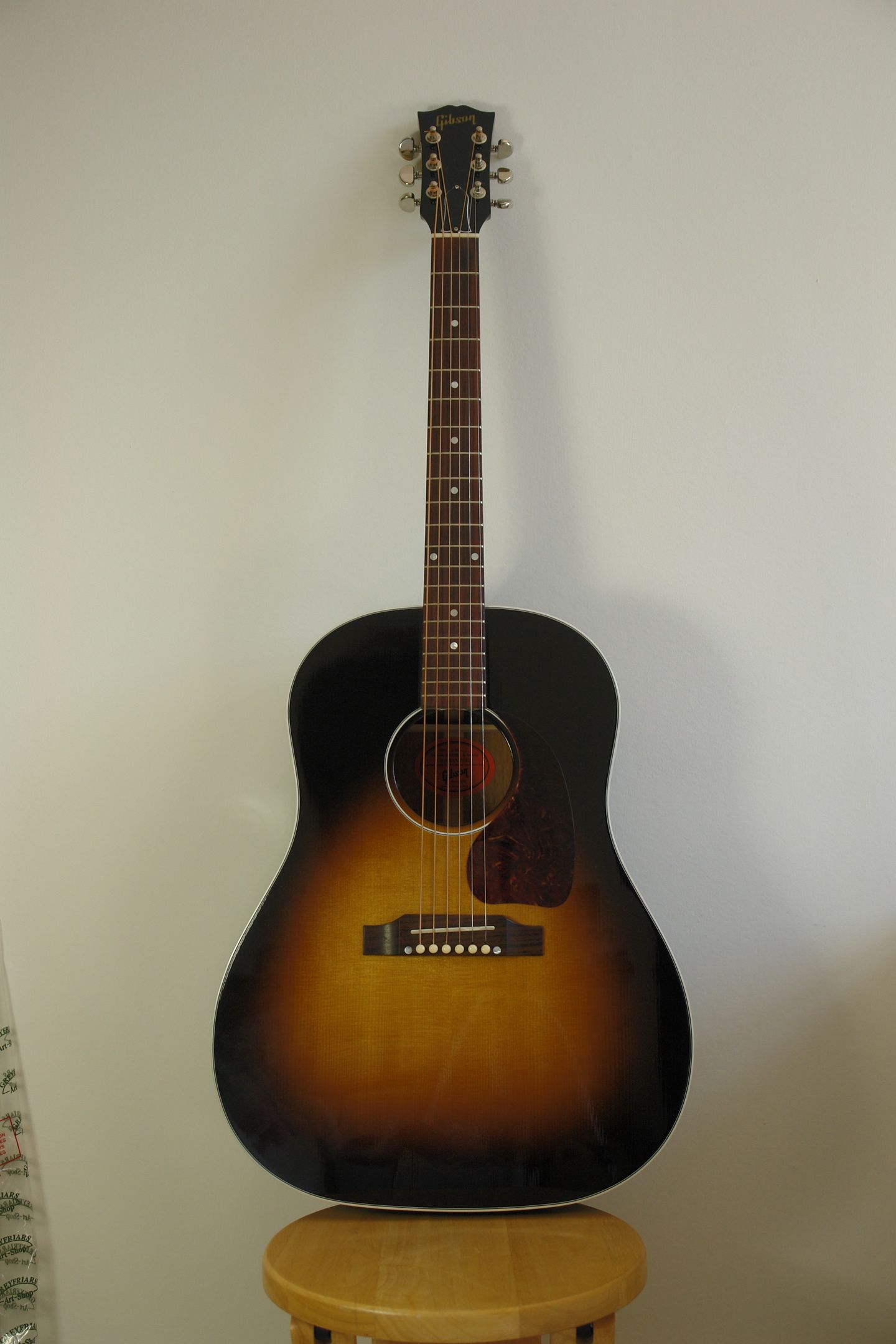
Gibson J-45. Photo by Jim Hutcheson. Licensed under CC BY 2.0. Via Wikimedia Commons. Gibson
J-45
1942
Born in 1942 out of whatever wood a wartime factory could find. Gibson calls it its best-selling acoustic ever.
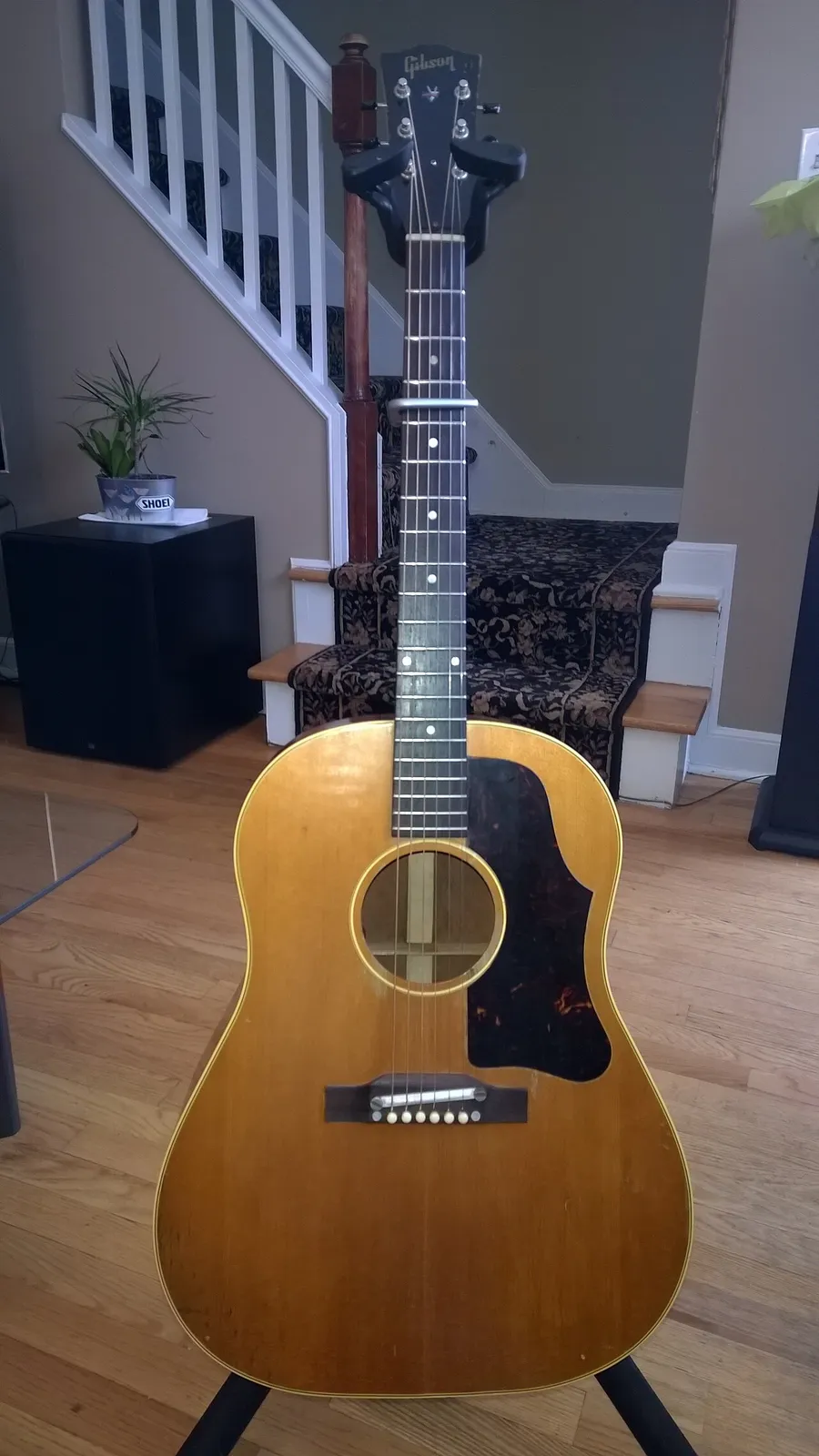
Photo: sbaimo from United States / Wikimedia Commons / CC BY 2.0 Gibson
J-50
1942
The J-45 with nothing to hide: a bare natural top, five dollars more, and Bob Dylan’s first album cover.
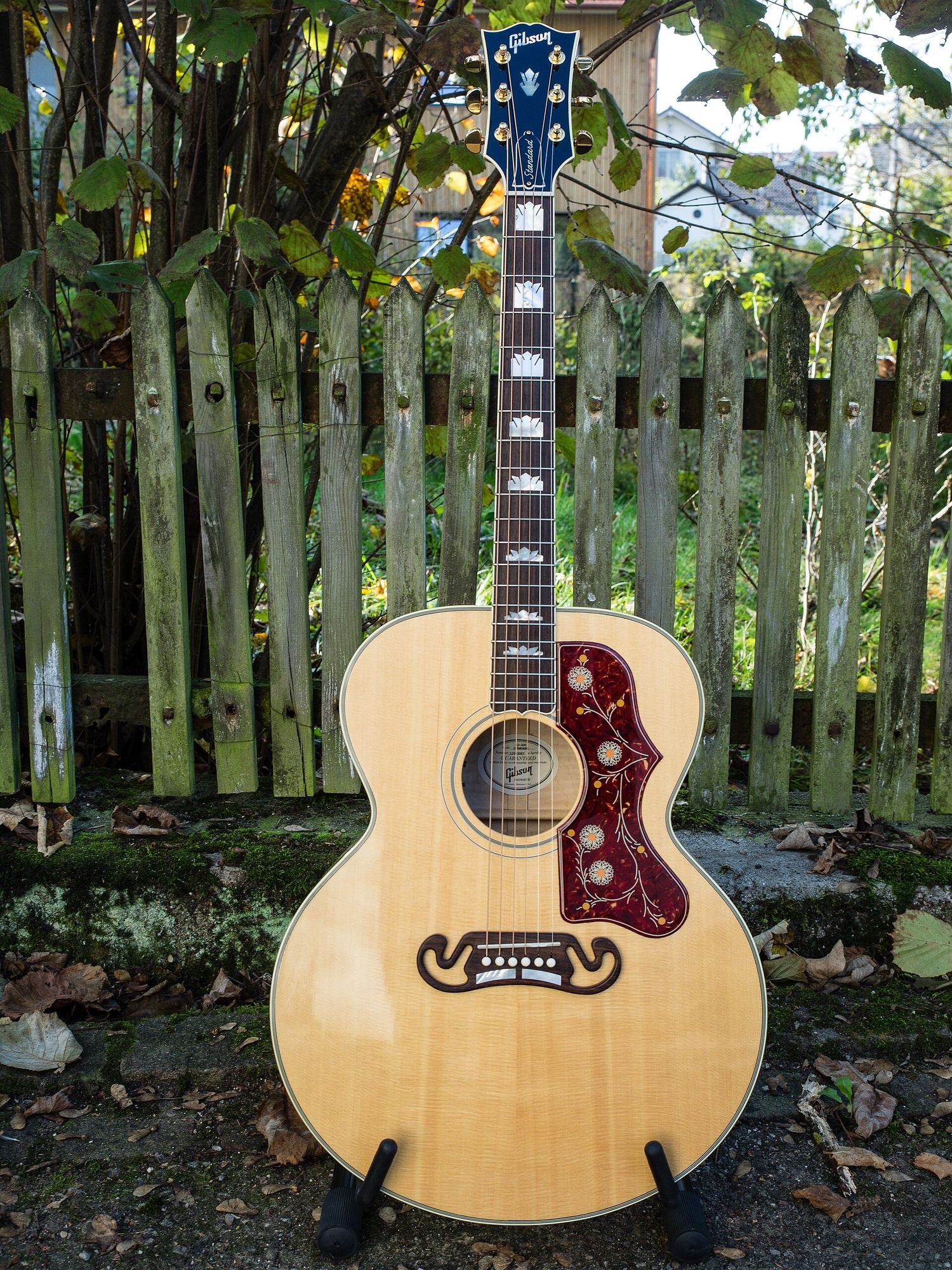
Gibson SJ-200 Standard Acoustic Guitar, Super Jumbo, Antique Natural Finish. Photo by Gibb Stutz. Licensed under CC BY 3.0. Via Wikimedia Commons. Gibson
J-200
1937
Gibson built the first one for a singing cowboy. It has been making people look like stars ever since.