Martin
000-18
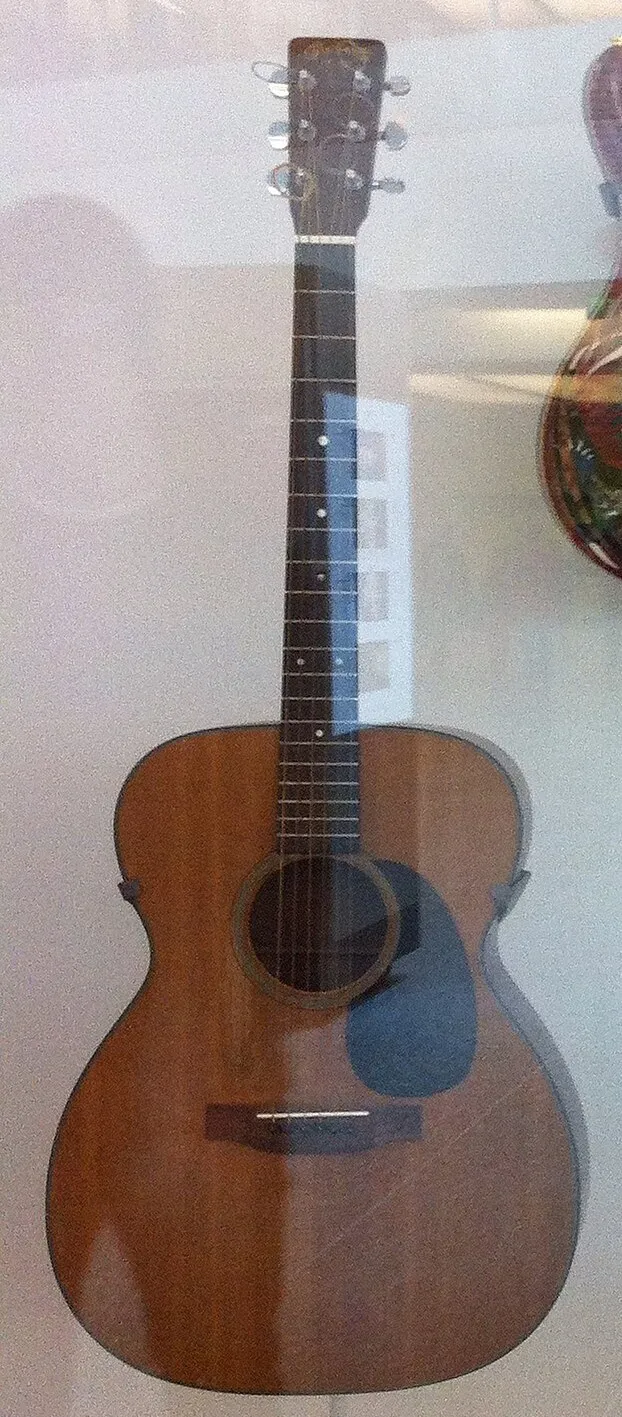
Julian Lage’s 1939 000-18 had been in pieces. It showed up when his own left hand needed putting back together.
A player with an injured left hand borrows a guitar from a shop. The guitar is a 1939 Martin 000-18, and it has been in pieces and put back together by a restorer. It’s supposed to be a loan. It doesn’t stay one.
- Introduced
- 1934
- Type
- Acoustic
- Class
- Production
The short version
1902
The 000 size
Martin’s 000 auditorium size appears, with a twelve-fret neck.
1917
Mahogany
Style 18 switches from rosewood to mahogany back and sides.
1930
The long-scale cousin
The OM-18 arrives with a 25.4-inch scale. The 000-18 sits out 1932 and 1933.
1934
Back, mostly long
The 14-fret 000-18 replaces the OM-18. Most of that year’s guitars still have OM necks.
1939
Lage’s guitar
The year Martin narrows the nut on 14-fret 000s, and the year of Julian Lage’s 000-18.
2025
The current one
Standard refresh with scalloped Sitka braces and a 24.9-inch scale.
Side A
A1
A loaner, a bad hand
Julian Lage hurt his left hand. For a guitarist that’s the hand that makes the notes, and there’s no working around it.
Around then, Retrofret lent him a guitar: a 1939 Martin 000-18. It wasn’t a pristine closet find. The way the story gets told, the guitar had been in pieces, and a restorer named T.J. Thompson had put it back together.
Lage played it. Chris Eldridge nudged him not to give it back. He bought it.
A2
The middle size
The 000 is Martin’s 15-inch auditorium body. It sits between the little 0 and the 15⅝-inch dreadnought, and it’s shallower than the dreadnought too. What you get is balance: enough bass to fill a room, not so much that it smears the notes when you play fast or fingerpick.
The 18 is the trim and the wood. Style 18 went to mahogany in 1917, and mahogany is dry and direct, more midrange than rosewood, less of the ringing overtone halo. On a 000 that means every note is clearly its own note. That’s a jazz player’s kind of acoustic.
It helps to know what it isn’t. It isn’t a D-18 in a smaller box, and it isn’t a 000-28, which is the same body in rosewood with herringbone trim. Same size, different voice. The 18 is the plain one, black binding and a simple multi-stripe rosette, and that’s the point of it.
This is a working guitar, and people treated it like one. Before Elvis Presley walked into O.K. Houck in Memphis and came out with the 1942 D-18 he played at Sun, he traded in a 000-18. Nobody documented that 000-18 any further. It was a guitar you traded up from.
Flip the record · By the numbers
15″
Width of the 000 body. A dreadnought is 15⅝ and a lot deeper.
325
000-18s built in 1934, going by the factory records.
275
How many of those 325 still had the long OM-style neck.
24.9″
Scale of today’s 000-18. The D-18 is 25.4.
Side B
B1
The year it couldn’t decide
The size goes back to 1902, with a twelve-fret neck. The 14-fret version is where it gets fussy.
From 1930 to 1933, Martin built an OM-18 on the same body with a longer 25.4-inch scale. While the OM ran, the 000-18 sat out 1932 and 1933. In 1934 the 000-18 came back to replace it, and for a while the factory simply kept using OM necks. Of the 325 000-18s built in 1934, 275 had the long-scale neck. So a 1934 000-18 isn’t automatically the short-scale guitar you’d assume.
Even the short scale is a small argument. Martin says 24.9 inches for today’s 000-18, and some old spec sheets say 24.5. I’d measure before I’d bet.
Shorter scale means lower string tension. The strings feel a little slinkier, bends come easier, and the fretting hand works a little less. By 1939 the 000-18 was a short-scale guitar. Late in 1944 the factory stopped scalloping the braces, the thinning that lets a top move more freely, so a pre-war 000-18 is a different animal from a postwar one.
Today’s Standard puts the scalloped braces back. It’s a regular catalog guitar, not a rare one. The old ones are where the stories are.
B2
Back together
Lage kept the loaner. His Collings signature model has a neck scanned from this Martin.
The Lage Collings isn’t a Martin. It’s the shape of one old Martin neck, copied so other people’s hands can feel it.
His record World’s Fair was reportedly tracked on it. Listen and you’ll hear a lot of air around the notes, which is a mahogany 000 doing what it does best.
That guitar had been in pieces. Thompson spent the hours to make it whole. Then it went out on loan to a man whose hand wasn’t working right, and it never went back to the shop.
Put this on
You’ve read about it. Now hear it. Here’s what this guitar sounds like, and what to listen for.
World’s Fair
Lage reportedly tracked this record on his 1939 000-18, the one that had been in pieces. That’s secondhand, so hold it loosely, and listen for how much room a mahogany 000 leaves around every note.
Find it on YouTube (opens in a new tab)
The cast
The people, and the specific guitars, that made the legend.
1939
Julian Lage
1939 000-18
Loaned to him by Retrofret after a left-hand injury, then bought. Collings scanned its neck for his signature model.
T.J. Thompson
Restorer
Put Lage’s 1939 000-18 back together.
Chris Eldridge
The nudge
The friend who talked Lage into buying the loaner.
Elvis Presley
A 000-18, traded away
Traded a 000-18 at O.K. Houck in Memphis for the 1942 D-18 he used at Sun. That 000-18 isn’t documented any further.
Liner notes
Specs, construction, rarity, value, and every source we used.
Auditorium Style 18 — short-scale 000 mahogany, not a D-18 in a smaller box, and not a 000-28.
- Body
- 000-14 Fret auditorium; spruce top with aging toner; mahogany back and sides; black binding; Style 18 back strip; Old Style 18 multi-stripe rosette
- Neck
- Select Hardwood (Martin spec — not explicitly mahogany), GE Modified Low Oval with High-Performance Taper; satin, dark mahogany color; dovetail joint
- Fingerboard
- Ebony, Old Style 18 abalone dots, unbound, 20 frets, 14th-fret joint
- Scale
- 24.9"
- Pickups
- None
- Hardware
- Ebony GE Modern Belly bridge, drop-in saddle, 2 5/32" spacing; ebony pins (no dots); compensated bone saddle (16" radius); nickel open-gear tuners with butterbean knobs; faux-tortoise pickguard
- Electronics
- None
- Finish
- Gloss top and back/sides; satin neck; aging toner on top
- Nut
- Bone, 1 3/4"; 12th-fret width 2 1/8"
Open the full research fileConstruction details, the complete player record, production numbers, dated value estimates, and sources
SKU 10Y2500018. 2025 Standard Series refresh. GE-scalloped Sitka top braces. Hide glue not listed. Scale 24.9" — not the D-18’s 25.4". Martin.com list $2,999.99 (fetched 25 Aug 2026). Not a 000-28 (rosewood/herringbone). Not an OM-18.
Construction
C. F. Martin & Co., Nazareth. Auditorium 000, not a dreadnought. guitarhq.com body-size table: 14-fret 000 is 15" × 4 1/8" × 19 3/8"; D is 15 5/8" × 4 7/8" × 20". Style 18 woods and trim on a 000 body. Not a D-18 in a smaller box.
Name years, not one invention date. guitarhq’s model table spells this size OOO-18 (letter O) for 1923–present, with 1911–1922 also listed — that is guitarhq’s 000-18 row, not a different Martin. 12-fret 000 size 1902. 14-fret 000 as catalog default 1934. This plate’s YAML introduced: 1934 is the 14-fret Standard identity, matching the 000-28 sibling — not a claim that no 12-fret 000-18 existed.
OM-18 is the long-scale trap. guitarhq: OM-18 1930–1933, 14-fret, 25.4"; 000-18 not available 1932–33 while OM-18 ran; 1934 000-18 reintroduced replacing OM-18. Early 1934 14-fret 000-18s can still be OM-spec long scale. The Guitarphile (serial 56808): of 325 000-18s in 1934, 275 had long-scale necks (bar frets, ebony reinforcement); short-scale arrives with T-frets / T-bar. guitarhq names serial 57553 long-scale vs 57918 short-scale. A 1934 000-18 is not automatically 24.9".
Scale print conflict. Current Standard: 24.9" (Martin.com). guitarhq 1934 spec line: 24.5" reduced from OM 25.4". Same fight as 000-28. Do not flatten. 12-fret 000 length/scale stays a specialist measurement.
Style 18 since 1917 is mahogany back and sides (guitarhq; rosewood earlier). 1939 nut-width cut 1 3/4" → 1 11/16" around serial 72740; current Standard is back to 1 3/4". Forward vs rear-shifted bracing 1939; heavy vs scalloped late 1944. Those are dated Style 18 changes, not a different model name.
Not this guitar. D-18 is Style 18 on a D body. 000-28 is Style 28 (rosewood, herringbone) on the same 000 size. OM-28 is long-scale 000/OM. 00-18 is smaller. Gut/classical 00-18G / 00-18C are not steel 000-18.
Players
Julian Lage — 1939 000-18. Premier Guitar (Cline/Lage): Retrofret loan after a left-hand injury; restored by T.J. Thompson; bought after Chris Eldridge’s nudge. Collings OM1 JL neck is a scan of this guitar (julianlage.com), not a Martin SKU. Guitar World (April 2024, via secondary report): World’s Fair tracked on it; the guitar had been in pieces. Artist-owned — not a comps tape. Keep off the 000-28 plate.
Elvis / Scotty Moore. The Houck-Memphis trade is a 1942 D-18 story: Moore archive says Presley traded a 000-18 for D-18 serial 80221. That 000-18 is not documented further here. Do not move the Sun D-18 onto this plate.
Martin factory copy (“trusted by generations”) is not a player census.
Rarity
Current Standard 000-18 is regular catalog, not scarce. Official lifetime totals are unpublished.
Scarcity is pre-war 14-fret, especially 1934 long-scale survivors, and clean 12-fret 000-18s. Hutton’s 325 for 1934 is an archival year count, not a factory lifetime. They are not D-45-scarce (closed 91) and not D-18-pre-war money as a class — mahogany 000s sit under rosewood 000-28s of the same year when both are original. Brazilian-era boards/bridges follow Style 18 chronology (guitarhq), not a 000-28 herringbone census.
Value
Informal estimate, 25 August 2026. Not an appraisal.
Ask vs sold. Lage’s 1939 and named celebrity lots are not comps. A current GE-scalloped Standard is not a 1934 long-scale.
New street. Martin.com $2,999.99 (25 Aug 2026). Same list neighborhood as the 2025 D-18 Standard.
Used modern. No clean 2024–26 Reverb sold band captured this pass. Expect used Standards under list; do not invent a midpoint.
Vintage / collectible. Public hammers were not isolated this pass. Dealer asks for 1930s 000-18s exist on the specialist market; do not paste D-18 or 000-28 ask ladders onto this size. A restored/refin example is not a collector original.
See also
- martin-d-18 — Style 18 on a dreadnought; Elvis’s Sun guitar lives there
- martin-000-28 — Style 28 rosewood/herringbone on the same 000 size
- martin-om-28 — 25.4" long-scale 14-fret 000/OM; not the short-scale Standard 000-18
Sources
- https://www.martinguitar.com/10Y2500018.html
- https://guitarhq.com/style18.html
- https://theguitarphile.com/1934-martin-000-18-guitar-serial-number-56808/
- https://theguitarphile.com/1934-martin-000-18-guitar-serial-number-57921/
- https://www.premierguitar.com/artists/nels-cline-and-julian-lage-gnarly-humanist-and-the-twenty-something-terror
- http://www.julianlage.com/collings-guitars
- https://www.scottymoore.net/42D18.html
- https://www.sweetwater.com/store/detail/0001814S--martin-000-18-standard-series-acoustic-guitar-natural-aging-toner
Keep digging
Guitars this one gets compared to, confused with, or descended from.
Photo: doryfour / Wikimedia Commons / CC BY-SA 2.0 Martin
D-18
1931
Elvis traded his D-18 up for a leather-covered D-28. The plain one had already been there for the Sun records.
- Send a picture
Martin
000-28
1934
Eric Clapton met the 000-28 in pictures of Big Bill Broonzy. Now people meet it in pictures of Clapton.
- Send a picture
Martin
OM-28
1929
In 1929 one player asked Martin for a longer neck. The answer was a new guitar, and it lasted about four years.