Guild
Thunderbird S-200
Mark Dronge went away for two weeks. When he got back, his guitar had a kickstand.
Guild's Thunderbird S-200 is a lopsided offset six-string with a Jaguar's worth of switches and a chrome bar that folds out of its back so it can stand up on its own. It isn't Gibson's Thunderbird bass, and it isn't the Polara that shared its catalog page.
- Introduced
- 1963
- Type
- Solidbody electric
- Class
- Production
Have a photograph of this guitar? Send a picture
The short version
1963
Three solids at once
Guild's catalog adds the Jet-Star S-50, the Polara S-100, and the Thunderbird S-200, with the Thunderbird on top at $359.50.
1964
The long horn
Less than a year after the batwing in the catalog, the lopsided outline arrives, and a 1964 already has the folding stand.
1965
The pickups change, probably
By one account the Anti-Hum humbuckers give way to single-coils around early 1965. Not every source agrees on the order.
1966
Guild is sold
Alfred Dronge sells Guild to Avnet and stays on as president while production moves, gradually, from Hoboken to Westerly.
1966
Two solos
Jorma Kaukonen plays the "White Rabbit" and "Somebody to Love" solos on his Thunderbird through a Standel amp.
1968
Muddy's endorsement
Muddy Waters signs with Guild and is given a Thunderbird from about 1966, stand and all.
1968–70
Gone
The catalogs offer it through 1968. Another account has the kickstand models dropped in 1970.
2016
Back, without the stand
Guild's Korean-made Newark St. reissue copies the lopsided 1964–68 guitar, for $799 street, and leaves the stand off.
Side A
A1
Two weeks away
Mark Dronge, by his own telling, designed a solid-body guitar for his father's company and then went away for two weeks before it was finished.
When he came back, it was in production. His father, Alfred, had put two things on it. One was a fluted headstock first drawn for a Merle Travis model that never happened. The other was a chrome bar, hinged in the back of the body, that folded out so the guitar could stand up by itself between songs.
Mark told that story in 2016, more than fifty years on.
The stand is the part collectors come for. It's the first thing anybody points at when one of these comes into a shop.
A2
Three solids and a funhouse mirror
Guild spent the 1950s on flat-tops and jazz boxes. In 1963 its catalog grew three solid-bodies at once: the Jet-Star S-50 at $149.50, the Polara S-100 at $279.50, and the Thunderbird S-200 at the top, $359.50.
The guitar on that 1963 page is a batwing, the same silhouette as its two siblings. Less than a year later the Thunderbird had grown the long, lopsided horn that people mean when they say S-200. One reviewer called the outline an offset and a non-reverse Firebird in a funhouse mirror. That's about right.
It is not a Gibson. Gibson's Thunderbird came out the same year, from Kalamazoo, with four strings.
The stand isn't in the 1963 blurb, but a 1964 sunburst already has it, marked "patent pending" and thrown in at no extra cost: a bar about a foot long, two small feet, and a magnet to park it flat. Whether the Polara got one too depends on who you ask. The later catalog says yes. One of the people who has written the most about the S-200 says no.
A3
A switch for every argument
Somebody at Guild had looked hard at a Fender Jaguar. The Thunderbird has a lead circuit and a separate rhythm circuit for the neck pickup alone, on/off switches for each pickup, and a bass-cut switch that thins the sound right down. In the lead position a slider throws the two pickups out of phase, for that hollow, nasal honk. One historian thinks it may be the earliest phase switch on a production guitar. "May" is his word, and it stays.
The pickups depend on the year, and on whose year. The early ones are generally said to be Guild Anti-Hum humbuckers, with single-coils taking over around early 1965. Another reference has it the other way around, and the 1968 catalog still says Anti-Hum. The guitar in front of you will tell you more than the paperwork.
Same with the wood. One dealer says cherry ones are mahogany and sunburst ones are alder. Even the scale depends on whose tape it is: 24¾ inches in the catalogs, 24½ on a 1964 somebody actually measured.
Flip the record · By the numbers
$359.50
The 1963 list price, top of Guild's three new solids. The Jet-Star was $149.50.
About 1 ft
The chrome bar that folds out of the back, with two small feet and a magnet to hold it shut.
150 or fewer
One historian's likely ceiling for the whole 1960s run. Guild never published a total.
0
Kickstands on the 2016 reissue.
Side B
B1
Because the Spoonful had one
Zal Yanovsky bought a sunburst 1964 new at Manny's on 48th Street and almost immediately had Gibson pickups put in it. Through the Lovin' Spoonful's 1965–66 run he was nearly always seen with it.
Across the country, Jorma Kaukonen was playing a Thunderbird in Jefferson Airplane, and he bought a Standel amp because the Spoonful had one. In late 1966, around Surrealistic Pillow, he was changing rigs. In his own words, he was
"transitioning from the Guild Thunderbird guitar and the Standel amp to the Gibson and two Fender Twin Reverbs."
Most of the album is the Gibson, an ES-345 Stereo, through the Twins. Two solos aren't. By his account, the leads on "White Rabbit" and "Somebody to Love" are the Thunderbird and the Standel.
B2
Muddy on the cover, not on the record
In 1966 Alfred Dronge sold Guild to Avnet. He stayed on as president, and production moved gradually from Hoboken to Westerly, Rhode Island.
In 1968 Muddy Waters signed an endorsement and was given a Thunderbird made around 1966, stand and all. He took it on the road in the late sixties, including Newport on 18 July 1969. He's holding it on the cover of Electric Mud. He isn't playing on that record, though. The guitars on the May 1968 session are Phil Upchurch, Roland Faulkner, and Pete Cosey. The cover and the session are two different claims.
The catalogs carry the S-200 through 1968. Another account has the kickstand models dropped in 1970, when Guild redrew its electrics. The Polara came back shaped more like an SG. The Thunderbird, as one historian put it, "simply disappeared."
Nobody knows how many there were. Guild's surviving records start partway through the run, and some documents were lost. One careful guess puts the ceiling at 150 or fewer.
B3
The one thing they left off
Then Dan Auerbach started playing an old one where people could see it. People asked what it was, and several writers credit him with what happened next.
In 2016 Guild built the Thunderbird again, in Korea: all mahogany, a Hagstrom vibrato, a pair of Little Buckers, and $799 on the street with a gig bag. It copies the lopsided 1964–68 guitar, right down to the bound board and the pearloid blocks.
It doesn't have the stand. One owner of the reissue says the stand never really worked, and old headstocks turn up broken in the sale ads.
Muddy's is in a museum in Seattle now, with the chrome bar still folded into its back.
Put this on
You’ve read about it. Now hear it. Here’s what this guitar sounds like, and what to listen for.
White Rabbit
Kaukonen says the solo is the Thunderbird through a Standel. Most of the rest of Surrealistic Pillow is an ES-345 and two Twins.
Find it on YouTube (opens in a new tab)Somebody to Love
The other solo Kaukonen puts on the Thunderbird and the Standel, cut while he was switching rigs.
Find it on YouTube (opens in a new tab)
The cast
The people, and the specific guitars, that made the legend.
1965
Zal Yanovsky
Sunburst 1964 S-200, bought new at Manny's
Nearly always seen with it through the Lovin' Spoonful's 1965–66 heyday. Gibson pickups went in almost right away.
1966
Jorma Kaukonen
Thunderbird, through a Standel amp
The "White Rabbit" and "Somebody to Love" solos, by his own account. Then the ES-345 took over.
1968
Muddy Waters
S-200 from about 1966, stand and all
Given it with a 1968 endorsement and took it on tour, Newport 1969 included. It's at the Museum of Pop Culture now.
Dan Auerbach
A vintage S-200
Played one where people could see it, and several writers credit him with getting the guitar built again.
Liner notes
Specs, construction, rarity, value, and every source we used.
A chrome bar that folds out of the back — Guild’s Thunderbird S-200, not the Polara beside it and not Gibson’s bass.
- Body
- Offset solid. 1963 catalog: batwing, 13 1/4" wide, 17 3/4" long, 1 9/16" deep. 1968 catalog (same page as 1965/66): asymmetric, 13 1/4" wide, 19 1/4" long, 1 9/16" deep. RetroFret’s 1964 sunburst: alder, lower bout 13" (33 cm), depth 1 1/2" (3.8 cm). Same shop: cherry is mahogany. Fretted Americana’s 1965 cherry: solid mahogany, 8.20 lb. Gruhn: mahogany or alder. MoPOP’s c. 1966 (Muddy’s), overall 39 9/16 × 12 3/4 × 1 15/16 in. (100.489 × 32.385 × 4.921 cm) — one guitar. Mix flagged. Do not average.
- Neck
- Set mahogany, bound. 1963 catalog: lightning-action. RetroFret: mahogany on the 1964. Not the Newark St. vintage C.
- Fingerboard
- Bound rosewood, pearloid blocks, 22 frets. Catalog: 8 position blocks.
- Scale
- 1963 and 1968 catalogs, and Fretted Americana’s 1965: 24 3/4". RetroFret measured the 1964: 24 1/2" (622 mm). Mix flagged. Do not average. Do not invent millimetres for 24 3/4".
- Pickups
- Two. Early: Guild Anti-Hum humbuckers (1963 blurb; RetroFret’s 1964; Gruhn’s early examples). Later: “Frequency Tested” single-coils — DeArmond, on Wright’s ’66. RetroFret puts the change around early 1965. The 1968 blurb still says Anti-Hum. VG&B’s overview says single-coil first. Do not pick one.
- Hardware
- Hagstrom vibrato — RetroFret calls it a Tremar — and an Adjusto-Matic bridge. Wright: knife-edge; he does not know if Guild licensed it or bought it. Asymmetric guitars: chrome bar in the back, magnet, two small feet. Wright: about a foot long. Not in the 1963 blurb.
- Electronics
- Passive. 1963 blurb: two volumes, two tones, a toggle. By RetroFret’s 1964 and the 1968 blurb: a lead circuit and a rhythm circuit, pickup on/off switches, and a bass-cut. Wright: in the lead position, a slider throws both pickups out of phase. He calls that possibly the earliest production phase switch. “Possibly” stays.
- Finish
- 1963 standard: sunburst, cherry, emerald green. 1968 standard: cherry or sunburst. Custom white, emerald green, ebony grain, +$20 (June 1968). RetroFret’s 1964: sunburst lacquer. One guitar’s finish word, not every year.
- Nut
- RetroFret’s 1964: 1 5/8" (41 mm). Fretted Americana’s 1965: “over 1 11/16".” GAD’s vintage example: 1 5/8". Mix flagged. Do not average. Do not invent millimetres for 1 11/16".
Open the full research fileConstruction details, the complete player record, production numbers, dated value estimates, and sources
Classic living example = 1960s Guild Thunderbird S-200, the asymmetric offset with the Hagstrom vibrato and the stand in the back. RetroFret’s 1964 and 1965 are Hoboken. The 1963 catalog guitar is the batwing on the same page as the Polara. The 2016 Newark St. S-200 T-Bird is a Korean mahogany reissue without the stand — not this table. The 2017 T-Bird ST is a stopbar. The late-1990s DeArmond Jet Star is another factory’s try at the outline. Not the S-100 Polara. Not a Jet-Star S-50. Not Gibson’s Thunderbird bass. No Gibson SKUs. Mixed inch/mm flagged. Do not average 24 3/4" with 24 1/2" (622 mm), 13 1/4" with 13" (33 cm) or 12 3/4", or 1 9/16" with 1 1/2" (3.8 cm) or 1 15/16". Do not invent millimetres for 24 3/4", 13 1/4", 17 3/4", 19 1/4", or 1 9/16".
Construction
The job was a solid that did not look like anyone else’s, with enough switches to answer a Jaguar, and somewhere to set it down between songs. Guild had spent the 1950s on flat-tops and jazz boxes. In 1963 the catalog grew three solids at once: Jet-Star S-50, Polara S-100, Thunderbird S-200. The Thunderbird was the top of that page. List, that year: S-200 $359.50, Polara $279.50, Jet-Star $149.50.
Not a Gibson Thunderbird. Same year, other company, four strings, Kalamazoo (gibson-thunderbird). This is a six-string. Not a Firebird. Premier Guitar’s Charles Saufley, on the reissue, said the outline looks like an offset and a non-reverse Firebird in a funhouse mirror. A resemblance is not the instrument.
The 1963 page is a batwing, the same silhouette as the Polara and the Jet-Star. Vintage Guitar and Bass: the longer, lopsided horn arrived less than a year later. Guild’s 2016 copy, on the Ronquillo demo and in MusicRadar’s 20 May news, dates that asymmetrical guitar 1964–1968. MusicRadar’s Ed Mitchell (21 November 2016) still says it was “first hatched” in 1963. Keep the catalog year and the shape year. YAML introduced is 1963, not a claim that every S-200 is a batwing.
The 1963 blurb is the batwing row in the table: Anti-Hums “on the humbucking principle,” a toggle, no stand. VG&B’s note on the same page says the art shows single-coils, and that Anti-Hums show up, sometimes, by 1964. The blurb and the editorial do not agree.
The stand is what collectors come for, and it is not in that first blurb. RetroFret’s 1964 sunburst, serial 29735, already has it: a metal bar hinged out of the back, “patent pending,” “at no extra cost,” two feet, a magnet to park the bar. George Gruhn (Vintage Guitar, January 2016): the same hardware on the S-100 and the S-200, not on the S-50. Tony Bacon, quoted by Fretted Americana: the Polara had it too, and the Thunderbird was one of only two guitars with a metal stand in the back. The 1968 blurb — VG&B says that page matches 1965/66 and 1966 — gives the stand to both Thunderbird and Polara. The Polara on that page is still 17 3/4" long. The Thunderbird has grown to 19 1/4". Michael Wright (Vintage Guitar, November 2006) says the Polara and the Jet-Star did not have the stand. Keep Gruhn, Bacon, the 1968 blurb, and Wright. This plate is the S-200. That argument is why the Polara is not nested here.
Who added the bar is its own story. DrumBob, on Let’s Talk Guild (6 October 2016), reporting an interview that day for Collectible Guitar: Mark Dronge said he designed the S-200, left for two weeks before it was finished, and came back to find his father had added the Merle Travis headstock and the stand and put the guitar into production. The magazine issue was not re-checked. RetroFret, on the 1964, calls the fluted head “originally designed for a stillborn Merle Travis model,” with a pearloid bird under the Guild logo. Wright: the open-book head gave way, near 1964, to the center-humped shape; catalog art stayed Florentine through ’68; most Thunderbirds that turn up wear the later head. Gruhn: early pearloid bird, later a gold bird decal or a Chesterfield inlay. Do not make one headstock the whole run.
By RetroFret’s 1964 the switching is already the Jaguar idea: lead knobs, a neck-only rhythm circuit, and a “strangle” switch with a white dot. June 1968 list: S-200 $375, Polara $280, Jet-Star $159.50 ($185 with vibrato). Custom color +$20. Wright thinks the phase slider may be the earliest production one. “May” is his word.
Wood and coils move, and the catalogs do not chase them. RetroFret: cherry is mahogany, sunburst is alder, the neck is always mahogany, and the 1964 is still on Guild humbuckers; around early 1965 it went to “Mickey Mouse” single-coils. Gruhn agrees with that order. Wright: Anti-Hums first, then DeArmond singles; his ’66, serial SC 120, wears the singles. VG&B’s model page says single-coil first. The 1968 blurb still says Anti-Hum. Scale, nut, and the 8.20 lb cherry stay in the table. Do not average.
Hoboken is where RetroFret places the 1964 and the 1965. Gruhn: Alfred Dronge sold Guild to Avnet in 1966 and stayed president until ’69, while production moved gradually to Westerly. A late S-200 is not automatically either town.
Wright and the catalogs: offered 1963–68. Gruhn: the kickstand S-100 and S-200 discontinued in 1970, when the electrics were redrawn; the S-100 came back shaped toward an SG, and the S-200 “simply disappeared.” Keep 1968 and 1970. A one-pickup Jet-Star bass on this outline, Wright says at least 1965–67, is a bass. Off this plate. Kim Thayil’s Guild is an S-100 Polara. Guild’s shop still sells one in his name. It is not an S-200.
2016. Córdoba-era Guild, Korea. MusicRadar (20 May) and Guild’s Ronquillo demo: a replica of the 1964–68 asymmetrical guitar, all mahogany, vintage C, bound rosewood, pearloid blocks, LB-1 Little Buckers, Hagstrom Vintage Tremar, open gears — Grover Sta-Tite on MusicRadar and GGJaguar — Antique Burst or black, gig bag. Street $799 (MusicRadar; Premier Guitar, 21 October 2016). Cianci: list $1,400, same street. MusicRadar’s November review also prints £745 and €795. Pounds and euros stay. GGJaguar’s 2017: polyurethane, bone nut 1 11/16", 24 3/4", lower bout 12 3/4", depth 1 1/2", 7.1 lb, 22 frets, no kickstand. He says the stand never worked and vintage headstocks broke. Saufley: LB-1s 5.06k bridge and 7.02k neck, Alnico 5, a wide C. MusicRadar’s review: 12" radius, medium-jumbo. GAD (February 2018): World Musical Instrument, Korea, KWM serials, retail $1,180, street about $850. The 2017 T-Bird ST, which GAD puts at that NAMM, is the stopbar. Reverb’s category runs it 2017–2021. Not this vibrato reissue, and not a 1964.
Premier Guitar also names the late-1990s DeArmond Jet Star: Fender-owned Guild’s subsidiary, another pass at this outline, and the market shrugged. MusicRadar’s review calls the Korean Newark St. the first real recreation. Not this table.
Guild’s shop guitar index this pass lists Polaras, a Surfliner, a Traveler, and Starfires. No S-200. Sweetwater’s black T-Bird page is still up and marked no longer available.
Players
Do not hang a Gibson Thunderbird, a Firebird, a Polara, or a Jet-Star here. Do not hang the Guild Thunderbird amplifier. A Starfire II, where a gear piece gives Muddy one, is a hollow. The circa-1967 Airplane photograph that shows an ES-345 is that Gibson. Sweetwater’s discontinued T-Bird page puts Buddy Guy next to Dan Auerbach. No interview in this pass puts Guy on an S-200. Leave him off.
Zal Yanovsky — a sunburst ’64, bought new at Manny’s. Wright spells it Yanofsky. RetroFret, Gruhn, and Premier Guitar use Yanovsky. RetroFret: through the Lovin’ Spoonful’s 1965–66 heyday he was nearly always seen with a sunburst ’64 from Manny’s on 48th Street, almost immediately refit with Gibson pickups, “probably PAF.” He kept it for his time in the band. RetroFret calls it the “Lovin’ Spoonful Guitar.” No song title is pinned here. A stock-pickup 1964 is not his.
Jorma Kaukonen — Thunderbird on two Surrealistic Pillow solos, then an ES-345. Been So Long, quoted by Guitar Player (Christopher Scapelliti, 4 February 2026): around Pillow he was “transitioning from the Guild Thunderbird guitar and the Standel amp to the Gibson and two Fender Twin Reverbs.” The solos on “White Rabbit” and “Somebody to Love” were the Thunderbird and the Standel, minus the extra horns he had bolted on. “The other tracks were done with the Twins and the ES-345 Stereo.” He told Neely Tucker he got the Standel because the Spoonful had one, and that this guitar plus that amp is those two solos. Recorded, in that article, December 1966; the single out in February 1967. Premier Guitar in 2016 still said “allegedly.” The book names the takes. Do not move the rest of Pillow onto this guitar, and do not move After Bathing at Baxter’s. He told Jas Obrecht the psychedelic Airplane album, in his opinion, is Baxter’s.
Muddy Waters — a c. 1966 S-200, given in 1968, now at MoPOP. Not the Electric Mud session. Museum of Pop Culture, object 1999.251.1: in 1968 he signed an endorsement and was given this circa-1966 Thunderbird, stand and all. He played it on tour in the late 1960s, including Newport on 18 July 1969, and he is pictured holding it on Electric Mud (1968). That is the museum’s sentence. AllMusic (Bruce Eder), on the album recorded in May 1968: he isn’t playing. The guitars are Phil Upchurch, Roland Faulkner, and Pete Cosey. Wright wrote that Muddy “played a Thunderbird on” Electric Mud. The cover and the session are not the same claim. Keep the picture, the tour, Newport, and Eder. RetroFret: an endorsement and “a later model,” which fits a c. 1966 guitar in 1968 better than a 1964. One instrument, in a museum. Not a comps tape.
Dan Auerbach — a vintage S-200, and the reason several writers give for the reissue. No Black Keys title is pinned here. Cianci: the vintage guitar made people ask what it was, and the Korean reissue followed. RetroFret: his use was enough that Guild built it again. MusicRadar’s review puts him on a ’64. That is the guitar, not a track list.
Also known to play stays short. Wright, and Bacon via Fretted Americana: Lowell “Banana” Levinger of the Youngbloods. Gruhn and RetroFret: Jeff McDonald of Redd Kross (RetroFret: Red Kross). RetroFret: Peter Holsapple of the dB’s. Reverb News (11 August 2016): Fred Cole of the Pierced Arrows. No titles on any of them.
Rarity
You cannot buy a new Thunderbird S-200 from Guild. Newark St. stock is the ordinary used guitar, and it has no stand. A 1960s S-200 is the scarce one. A Polara wears another serial prefix. A DeArmond Jet Star is another decade. A T-Bird ST is a stopbar.
Guild did not publish a Thunderbird total, and the dating chart will not invent one. The archived Guild chart (mrgearhead: “the most accurate information Guild has available,” and a note that documents were lost) prints first and last S200 numbers, not a count: 1965 SC101; 1966 SC102 to SC153; 1967 SC154 to SC166; 1968 SC167 to SC191; 1969 N/A. First and last are not a census. RetroFret, after the mid-1965 change to model-specific numbers: impossible to say how many came before that, then “52 were sold in 1966, another 13 in 1966, and the final 25 shipped in 1968.” The sentence says 1966 twice. Those spans are the chart’s 1966, 1967, and 1968 if you subtract, which is why the second 1966 reads like a slip. Do not treat the subtraction as a factory total. Wright: “records indicate about 90”; his ’66 is SC 120, inside the 1966 span; he guesses 30 or so in ’63–’64 and a likely ceiling of 150 or fewer once ’68 is in. Keep the chart, RetroFret’s sentence, and Wright’s ceiling. Pre-1965 stays unknown. None invented.
What is actually thinner: a 1963 batwing; an early humbucker guitar with the pearloid bird still in the head; a stand that never dropped the neck on the floor; Yanovsky’s refit ’64; Muddy’s, which is not for sale. A Korean T-Bird is none of those.
Value
Informal estimate, 26 October 2026. Not an appraisal.
Ask is not sold. No factory total, and no celebrity hammer. Muddy’s guitar is in a museum. Yanovsky’s refit is not a comps tape. A Polara is not an S-200. A Gibson Thunderbird is a bass. A DeArmond Jet Star is not 1960s Guild money. A T-Bird ST is not the vibrato reissue. Euros stay euros. Do not average the dollar guide with the euro guide. The 1963 list $359.50 and the June 1968 list $375 (custom +$20) are catalog prices, not 2026.
New street. None. Guild’s shop has no S-200 this pass. Sweetwater’s page is a leftover reference, not a cart. Historical launch money, not 2026: MusicRadar, 20 May 2016, and Premier Guitar, 21 October 2016, street $799, gig bag in Guild’s copy. Cianci: list $1,400, street $799. MusicRadar’s 21 November 2016 review prints the same $799 beside £745 and €795. GAD, February 2018: retail $1,180, street about $850.
Used modern. The Newark St. vibrato reissue is the ordinary used guitar. Reverb’s price guide on the Newark St. Collection S-200 T-Bird: $443–$785, 419 orders, Good to Mint, the card’s “All Models” line. Named solds on that history, not a series: 4 December 2025, Excellent, $550; 19 October 2025, Very Good, $875; 14 October 2025, Very Good, $500; 19 August 2025, Excellent, $676; 4 August 2025, Excellent, $719.10; 17 April 2025, Excellent, $799; 1 April 2025, Very Good, $610. A euro view of a guide on the same model name showed €621–€1,129 from 20 orders. Different sample. Not a conversion. One shop tag that later read sold out, not a hammer: Music Go Round, Littleton, sunburst, $749.99 (page edit 26 July 2026).
Vintage / collectible. No Reverb price-guide dollar band rendered for a 1960s S-200 this pass. Flag: thin sold-comp access. Named asks, not hammers. Gary’s Classic, a 1965 sunburst with two single-coils, the kickstand, and an original hardshell: $5,595 (page 11 May 2026). Emerald City’s 1964, stock Guild humbuckers: the shop page showed $7,060 and sold out; a Reverb listing that reads as the same guitar ended at $5,495, listed about seven months before this pass. Not a hammer. Older, and not dollars: Tip Top’s 1965, ask €4,999, listed three years ago. A refinished 1964 with the neck pickup changed ended near $2,199.99, listed eleven years ago. That is not original-finish money. Do not average it with Gary’s or Emerald City. Original finish, the coils the year is supposed to have, and a headstock the stand did not break: that is what these asks are for.
See also
- gibson-thunderbird — Gibson’s 1963 bass, reverse then non-reverse; the other Thunderbird, four strings, not this Guild
- fender-jaguar — the lead/rhythm switching this borrows; no folding stand, and not an offset Guild
- guild-bluesbird — the later Guild solid announced beside the Newark St. T-Bird in 2016; a single-cut, not this shape
Sources
- Vintage Guitar and Bass, 1963 Guild catalog, page 8 — S-50, S-100, and S-200 new for 1963; batwing; S-200 blurb with Anti-Hums, toggle, no stand; 13 1/4" × 17 3/4" × 1 9/16"; 24 3/4"; $359.50 / $279.50 / $149.50; sunburst, cherry, emerald green. Editorial on the same page says the art shows single-coils
- Vintage Guitar and Bass, 1968 catalog, page 7 — page identical to 1965/66 and 1966; S-200 13 1/4" × 19 1/4" × 1 9/16", Anti-Hum blurb, solo/rhythm, stand “at no extra cost”; Polara blurb also includes the stand and stays 17 3/4" long; June 1968 prices $375 / $280 / $159.50 ($185 with vibrato); custom +$20
- Vintage Guitar and Bass, Guild S-200 Thunderbird — 1963 batwing, asymmetric less than a year later, production through 1968; “single coil at first, but more often Guild humbuckers”; players paragraph follows Wright and adds Auerbach
- Vintage Guitar, Michael Wright, Guild S-200 Thunderbird (November 2006) — 1963 with Polara and Jet-Star; Anti-Hums then DeArmond singles; phase switch “may” be the earliest; foot-long stand; Florentine head vs later head; ’63–’68 cherry or sunburst; Muddy on Electric Mud; Yanofsky spelling; Banana Levinger; Kaukonen on Surrealistic Pillow; about 90, SC 120, “30 or so” in ’63–’64, “150 or fewer”; Polara and Jet-Star without the stand, in this account; Jet-Star bass 1965–67
- Vintage Guitar, George Gruhn, S-100/S-200 kickstand models (January 2016) — 1963 introduction; stand on S-100 and S-200, not S-50; mahogany or alder; early humbuckers and pearloid bird, later single-coils; kickstand versions discontinued 1970; Avnet 1966, gradual move to Westerly; Muddy, Yanovsky, Jeff McDonald, Auerbach “seen in the hands”
- Vintage Guitar, Bob Cianci, Guild’s S-200 T-Bird — Korean reissue; list $1,400, street $799; mahogany; black and Antique Burst; LB-1s; Mode 1 / Mode 2; Muddy and Yanovsky; Auerbach’s vintage S-200
- RetroFret, 1964 S-200, serial 29735 — Hoboken; alder sunburst, mahogany neck; stand, patent pending; Tremar and Adjusto-Matic; humbuckers, single-coils around early 1965; cherry/mahogany vs sunburst/alder; 39 1/2" (100.3 cm), 13" (33 cm), 1 1/2" (3.8 cm); scale 24 1/2" (622 mm); nut 1 5/8" (41 mm); Yanovsky’s ’64 from Manny’s with Gibson pickups; Muddy endorsement, “a later model”; Holsapple; McDonald; Auerbach and the reissue; “52… in 1966, another 13 in 1966… 25… in 1968”
- Fretted Americana, 1965 cherry S-200 — 8.20 lb; nut “over 1 11/16"”; scale 24 3/4"; solid mahogany; stand; bound rosewood, 22 frets, blocks. Quotes Bacon, Electric Guitars: The Illustrated Encyclopedia, p. 182: 1963–68; phase switching; one of two guitars with a metal stand; Polara also had the stand; players including Muddy, Yanofsky, Kaukonen, and Banana
- Guild dating chart, archived at mrgearhead (1 July 2003) — S200 first/last: 1965 SC101; 1966 SC102–SC153; 1967 SC154–SC166; 1968 SC167–SC191; 1969 N/A. Not a count. Documents lost, on the same page. General 1964 band 28944–38636, which contains RetroFret’s 29735
- Let’s Talk Guild, DrumBob, “Interviewed Mark Dronge Today” (6 October 2016) — Mark Dronge, via that interview: he designed the S-200; two weeks away; his father added the Merle Travis headstock and the stand and sent it to production. Magazine issue not re-checked
- Museum of Pop Culture, Guild Thunderbird S-200 formerly owned by Muddy Waters, 1999.251.1 — c. 1966; 1968 endorsement; Newport 18 July 1969; pictured on Electric Mud; overall 39 9/16 × 12 3/4 × 1 15/16 in. (100.489 × 32.385 × 4.921 cm)
- AllMusic, Bruce Eder, *Electric Mud* — May 1968 session; Waters isn’t playing; Upchurch, Faulkner, Cosey
- Guitar Player, Christopher Scapelliti, Jorma Kaukonen (4 February 2026) — Been So Long: Thunderbird and Standel on the “White Rabbit” and “Somebody to Love” solos; other Pillow tracks on ES-345 and Twins; Standel because the Spoonful had one
- Premier Guitar, Charles Saufley, Guild S-200 T-Bird review (21 October 2016) — Korean reissue; street $799; no stand; LB-1s 5.06k / 7.02k; wide C; “allegedly” on Pillow in 2016; late-1990s DeArmond Jet Star
- MusicRadar, Michael Astley-Brown (20 May 2016) — reissue of the 1964–68 asymmetrical guitar; $799 with gig bag; Antique Burst or black; LB-1s; Hagstrom Vintage Tremar; vintage C; bound rosewood; Grover Sta-Tite
- MusicRadar, Ed Mitchell, S-200 T-Bird review (21 November 2016) — “first hatched” 1963; Auerbach on a ’64; Korean; no stand; 24.75"; 12" radius; 22 medium-jumbo; £745 / €795 / $799
- Guild Guitars, R.J. Ronquillo demo (20 July 2016) — Guild’s description: replica of 1964–1968; all mahogany; vintage C; bound rosewood; pearloid blocks; Antique Burst or black; gig bag
- Reverb News, Guild S-200 Thunderbird reissue (11 August 2016) — Muddy, Yanovsky, Fred Cole, Auerbach; LB-1s; “under $800”
- GGJaguar, 2017 S-200 T-Bird — reissue based on the Yanovsky-era guitar; kickstand omitted; mahogany; 24 3/4"; nut 1 11/16"; lower bout 12 3/4"; depth 1 1/2"; 7.1 lb; Grover Sta-Tite; LB-1s; Hagstrom Tremar
- GAD’s Ramblings, Newark Street S200 T-Bird (28 February 2018) — Korea, WMI, KWM serials; retail $1,180, street about $850; T-Bird ST announced at 2017 NAMM
- GAD’s Ramblings, the vintage S-200 (20 May 2014) — kickstand, magnet, two feet; 1 5/8" neck on that example; headstock breaks in sale ads
- Guild shop, guitars — Polara, Polara Deluxe, Kim Thayil signature, Surfliner, Traveler, Starfire; no S-200 this pass. Thayil signature copy: his S-100 Polara, not this model
- Sweetwater, S-200 T-Bird black — no longer available; page left up. Names Buddy Guy and Auerbach; Guy is not pinned to an S-200 here
- Reverb price guide, Newark St. Collection S-200 T-Bird — $443–$785, 419 orders, Good to Mint; named 2025 solds $550, $875, $500, $676, $719.10, $799, $610. A euro view of a guide on the same name: €621–€1,129, 20 orders
- Gary’s Classic Guitars, 1965 S-200 — sunburst, two single-coils, kickstand, ask $5,595 (page 11 May 2026)
- Emerald City Guitars, 1964 S-200 — stock humbuckers, kickstand; page showed $7,060 and sold out
- Reverb, Emerald City 1964 listing — ended ask $5,495; listed about seven months before this pass. Not a hammer
- Music Go Round, Littleton, Newark St. S-200 — sunburst tag $749.99; page later showed sold out (edit 26 July 2026). Not a hammer
- Reverb, T-Bird ST category — stopbar sibling, category years 2017–2021, Korea. Not the vibrato reissue
Keep digging
Guitars this one gets compared to, confused with, or descended from.
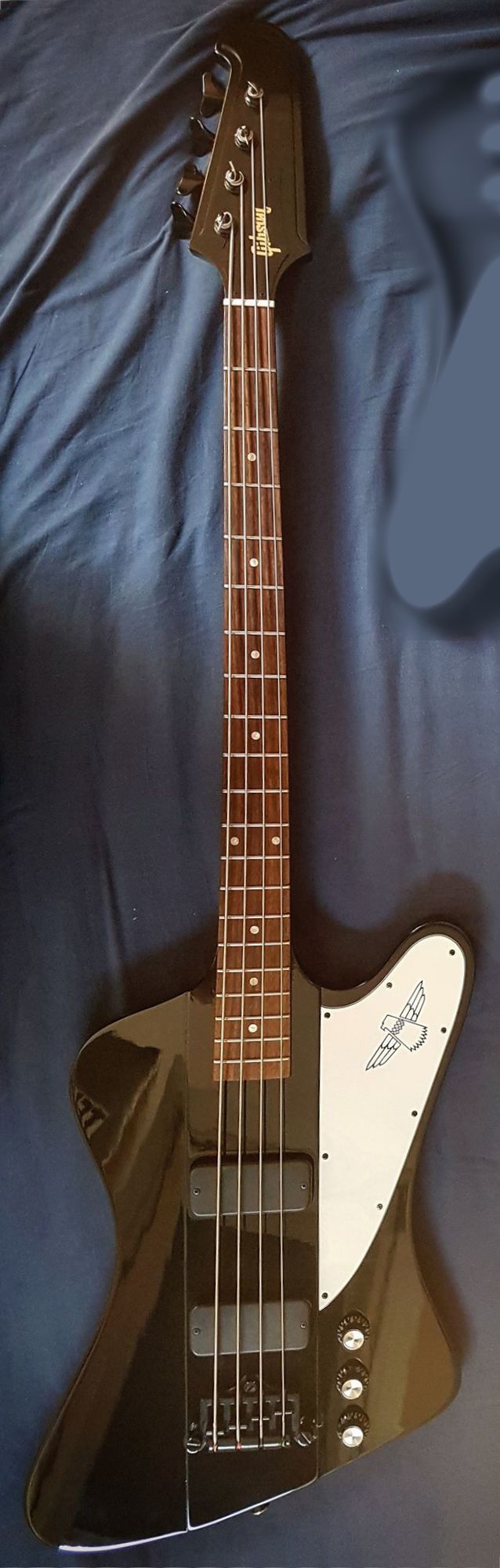
2013 Gibson Thunderbird ebony, clipped from a two-bass photograph. Original photo by MaxVaudous; derivative by Clusternote. Licensed under CC BY-SA 4.0. Via Wikimedia Commons. Gibson
Thunderbird
1963
John Entwistle thought the neck was too thin. So he kept the body and changed the neck.
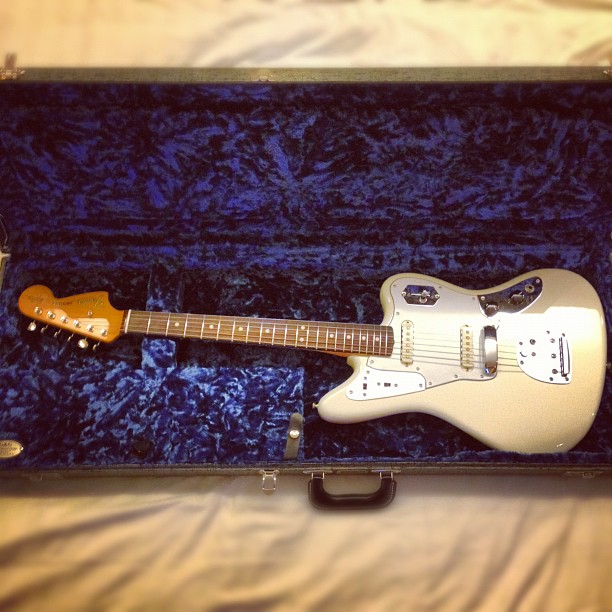
Fender Jaguar Johnny Marr signature. Photo by ToGa Wanderings. Licensed under CC BY 2.0. Via Wikimedia Commons. Fender
Jaguar
1962
It was the top of Fender’s catalog in 1962. By the late ’70s it was a pawn-shop guitar, and somebody’s only one.
- Send a picture
Guild
Bluesbird
1970
Guild took the name off the price list in 1974. The players kept calling it a Bluesbird anyway.