Harmony
Sovereign
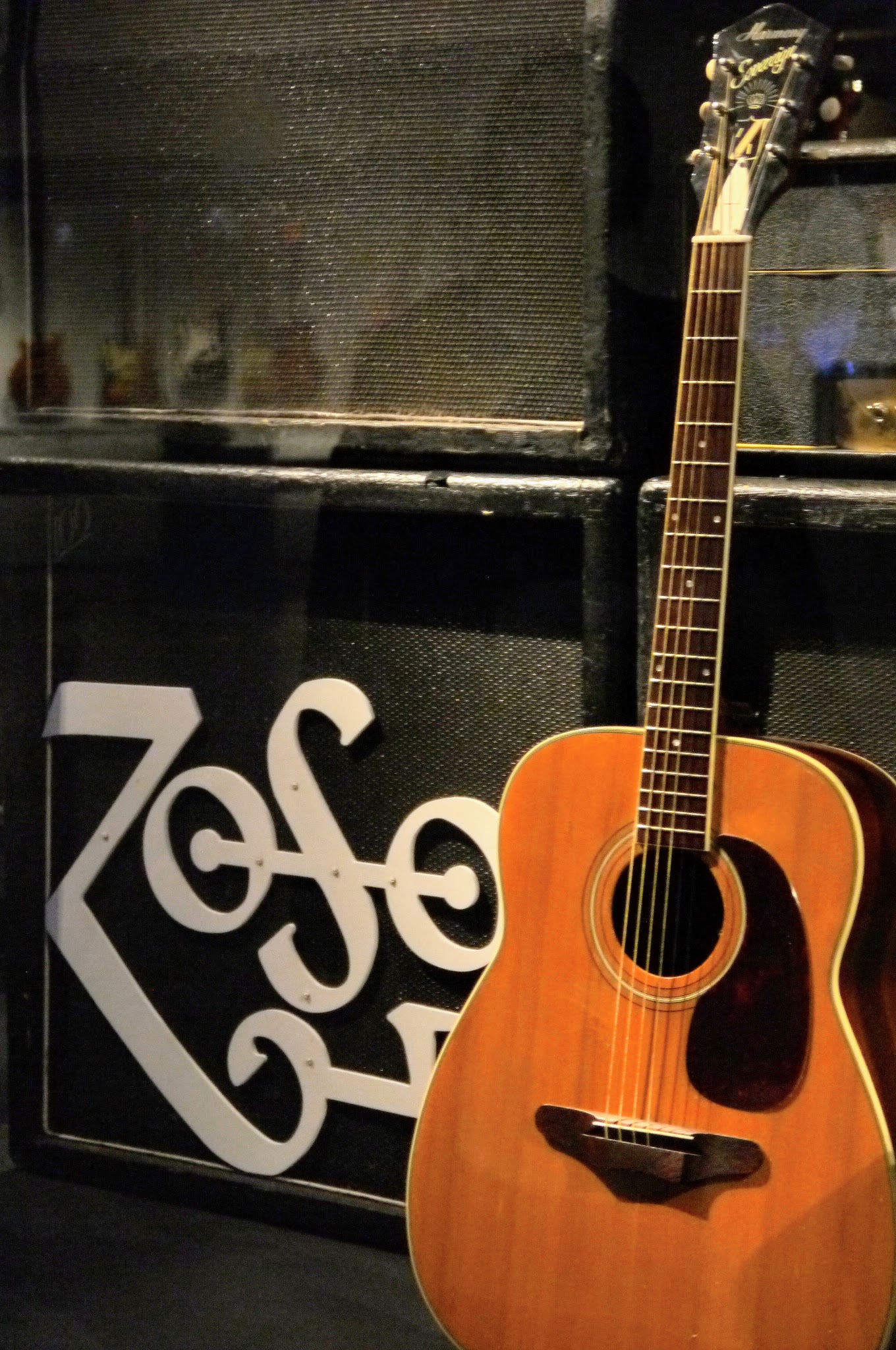
An $85 jumbo out of a Chicago catalog, and the guitar Jimmy Page wrote four Led Zeppelin albums on.
Harmony’s Sovereign jumbo was an ordinary catalog flat-top: spruce, mahogany, a neck they called slim. Martins were hard to get in England, and Jimmy Page was happy with his. In 2019 it was in a glass case at the Met, still in use.
- Introduced
- 1958
- Type
- Acoustic flat-top
- Class
- Production
The short version
1938–39
The name
Harmony buys the Sovereign name, first used by Oscar Schmidt in Jersey City.
1958
The H1260
The Sovereign jumbo is in Harmony’s price list at $69.50.
c. 1962
Page’s guitar
The Met dates Jimmy Page’s Sovereign to about now. When he bought it is his guess.
1966
Harmony’s Big 3
An ad puts the 1260 beside two electrics. The catalog asks $85.00, case extra.
1968
Townshend moves on
Pete Townshend buys a Gibson J-200 at Manny’s and stops using his Harmony.
1970
Led Zeppelin III
Page records most of the album, and all of its acoustic tracks, on the Sovereign.
1975
Harmony closes
Chicago’s Harmony goes out of business. The jumbo by then has a new number.
2019
Play It Loud
Page’s Sovereign goes on show at the Metropolitan Museum of Art.
Side A
A1
Behind glass at the Met
In 2019, the Metropolitan Museum of Art put a Harmony in a glass case.
It was Play It Loud, a show of rock instruments, and this one came from the collection of Jimmy Page. A Sovereign H1260 jumbo, natural top, a tortoiseshell guard shaped like a teardrop, Harmony in gold script. The label called it one of Page’s main songwriting instruments. He’d composed on it for the first four Led Zeppelin albums, recorded most of Led Zeppelin III on it, and played the acoustic parts of “Stairway to Heaven” on it.
Then the last line: it remains in use today.
A museum-grade guitar, in other words, that came out of a catalog.
A2
Eighty-five dollars, case extra
Harmony was Chicago’s big factory, founded in 1892, owned by Sears for a stretch, independent again after 1940. The Sovereign name was older and wasn’t theirs to begin with: Oscar Schmidt had used it in Jersey City, and Harmony bought it in 1938 or 1939.
The H1260 jumbo shows up in 1958 at $69.50. In the 1966 catalog it was $85.00, and the case was another $16. The book’s own sentence sells it plainly: “selected mahogany back and sides, resonant spruce top, white edge bindings,” and a reinforced mahogany “Slim-Line” neck. A deep, wide box, made to sell to folk and country players.
It sold under other names too. Airline, Silvertone, Regal, even a Fender badge: same Chicago jumbo, someone else’s logo. Harmony built guitars for Fender in those years, not the other way around.
A3
Ladder braces
What the catalog doesn’t mention is the bracing.
The H1260 is the ladder-braced one, the older, plainer way: struts straight across the top instead of the X a Martin uses. Some of the later jumbos went to X. A lot of the old ones have been reset or converted since. Those still play, but they aren’t the top that left Chicago.
Watch the names, too. The H55 is the smaller Sovereign with a pickup at the end of the board. The H1270 is the twelve-string. Neither is this guitar.
Flip the record · By the numbers
$69.50
The Sovereign jumbo’s list price in 1958.
$85.00
The 1966 catalog price. The case was $16 more.
4
Led Zeppelin albums Page composed on it, by the Met’s label.
Side B
B1
Martins were hard to get
So why would Jimmy Page write on a Harmony?
Because Martins weren’t easy to get in England, and he was happy with what he had. Where he bought it is his own guess: Selmer’s, around the Yardbirds, “or a bit before.” The Met says about 1962. Those don’t quite meet. Keep both.
He told Guitar World he’d arranged “Babe, I’m Gonna Leave You,” “Ramble On,” “Friends,” and “Stairway to Heaven” on it. Arranged, not recorded: the first album’s acoustics were a borrowed Gibson J-200 that wasn’t his. “Ramble On” and “What Is and What Should Never Be” were written on the Sovereign. On the third album, he recorded every acoustic track with it.
“I used the Harmony all the way through, really.”
When the Martin finally showed up depends which year you ask him. In one interview it was after the fourth album. In another, Houses of the Holy. Both are his.
B2
Townshend and Barrett
Page wasn’t the only one.
Pete Townshend had a natural H1260 in the studio and on demos in the ’60s. There are photos of it around 1967, Top of the Pops included. In 1968 he bought a new Gibson J-200 at Manny’s in New York and stopped using the Harmony. Nobody knows where it went. His staple twelve-string Harmony, the one he said was as close as he could get to Lead Belly’s Stella, is the H1270. Different guitar.
Syd Barrett had a 1963 Sovereign. A Hard Rock Cafe placard called it his first guitar, used with the Tea Set and on The Piper at the Gates of Dawn. It wasn’t his first guitar. By 1963 he already had a Hofner acoustic and a Futurama. The correction is better anyway: his first good one.
B3
It didn’t fight back
Harmony of Chicago closed in 1975. The jumbo carried on to the end under a new number, and when the brand came back in 2018, under new owners, there was no Sovereign in the line.
So the one people know is a 1960s catalog box with a museum label. The Met calls it one of Page’s main songwriting instruments. Page had a simpler review:
“It didn’t fight back, and it didn’t go out of tune.”
That’s most of what a songwriter needs. The rest of what he needed came out of him, and you can hear it on side two of Led Zeppelin III.
Put this on
You’ve read about it. Now hear it. Here’s what this guitar sounds like, and what to listen for.
Friends
Page arranged it on the Sovereign and recorded the third album’s acoustic tracks on it. This is one of them.
Find it on YouTube (opens in a new tab)Led Zeppelin III
The record the Met says Page cut mostly on this guitar. Page says every acoustic track on it is the Harmony, so start with side two, the acoustic side.
Find it on YouTube (opens in a new tab)Stairway to Heaven
The acoustic parts on the record are the Sovereign. Not the live version; that’s the Gibson doubleneck.
Find it on YouTube (opens in a new tab)
The cast
The people, and the specific guitars, that made the legend.
1970
Jimmy Page
Sovereign H1260, ca. 1962
Wrote and arranged on it through the early Led Zeppelin albums and recorded Led Zeppelin III’s acoustic tracks on it. Still his.
1967
Pete Townshend
A natural H1260 jumbo
Used in the studio and on demos in the ’60s, until a 1968 J-200 replaced it. His staple Harmony twelve is a different guitar.
1963
Syd Barrett
A 1963 Sovereign
Not his first guitar, despite the museum placard. His first good one.
Liner notes
Specs, construction, rarity, value, and every source we used.
Spruce over mahogany, ladder braces, and a wide jumbo — the Harmony Sovereign Jimmy Page used to record *Led Zeppelin III*, not the pickup H55.
- Body
- Jumbo flat-top. Spruce top, mahogany back and sides; Harmony Database: all solid woods. 1966 catalog: 16 × 4 5/16 × 40¾". Database measure: 16¼" (411 mm) wide, 40⅝" (1032 mm) long, 4⅜" (110 mm) deep. Met, on Page’s guitar: 41" (104.1 cm) × 16¼" (41.3 cm) × 4⅜" (11.1 cm). Mix flagged. Do not average.
- Neck
- Mahogany, set (Met). 1966 catalog: Torque-Lok reinforced “Slim-Line.” Database measure at the 12th: 2¼" (56 mm).
- Fingerboard
- Rosewood, dot inlays, white binding (Met). 1966 catalog: “ovalled” rosewood. Reverb’s H1260 widget prints 19 frets. The catalog does not.
- Scale
- 25¼" (642 mm) Harmony Database. Met, on Page’s guitar: 25". Mix flagged. Do not average.
- Pickups
- None
- Hardware
- Rosewood bridge; metal machines with plastic buttons (Met). 1966 case is extra: C-550.
- Electronics
- None
- Finish
- Natural. Page’s guitar: six-ply white and black binding, tear-shaped tortoiseshell guard (Met).
- Nut
- 1¾" (44.8 mm) Harmony Database. Mix flagged.
Open the full research fileConstruction details, the complete player record, production numbers, dated value estimates, and sources
Classic living example = 1958–71 H1260 Sovereign Jumbo (Chicago). No current Sovereign SKU this pass: harmony.co (fetched 22 October 2026) leads with Jupiter, Rebel, Silhouette, Comet, Juno, H62 / H72, and a Foundation Series (Stella parlor, Dreadnought, Orchestra, Grand Auditorium, Classical) — not this name. H55 is the smaller Sovereign with a neck pickup. H1203 is the Western Special in the 1963 and 1965 catalogs. H1270 is the 12-string. H6560 is the 1972–75 jumbo number. H6560A is a later Korean guitar. No Gibson SKUs. Mixed inch/mm flagged. Do not average 16" / 16¼", 4 5/16" / 4⅜", 40⅝" / 40¾" / 41", or 25" / 25¼". One database example weighs 4 lb 11.2 oz. Page’s guitar is 5–6 lb (Met). Do not average those either.
Construction
The job was a jumbo a catalog could sell for folk and country. Deep body. Spruce on mahogany. A neck they called slim. Chicago, not Nazareth, and not the little parlor with the same last name.
Wilhelm Schultz founded Harmony in 1892. Sears bought it in 1916; Joe Kraus took it independent after 1940 (Vintage Guitar, Peter Stuart Kohman, June 2014, via Wikipedia). The word Sovereign is older than this box. Vintage Guitar (Michael Wright, July 2007): Oscar Schmidt’s Stella and Sovereign names in the late 1890s, registered 1909. Wright: Carver sold those names to Harmony in 1938; Wikipedia and Neil Harpe say 1939. Keep both. First Harmony Stella and Sovereign models in the 1939 catalog were a new round shape (Wright). That is Jersey City’s name on a Chicago guitar. It is not this jumbo. See stella-12-string.
This plate starts in 1958. Harmony Database, verified production 1958–1971, “other years possible, not verified.” The same page’s price line opens at 1958: $69.50. Then $69.50 in 1959, $72.50 in 1962, $85.00 in 1967, $95.00 in 1969, and $122.50 in 1972. The 1966 catalog, quoted on that page and on Whotabs: No. 1260, size 16 × 4 5/16 × 40¾ in., $85.00, case C-550 an extra $16.00. Historical list, not 2026 street. The database does not show a prototype year before the 1958 price. It also does not swear the run stopped the day the verified years do. The 1972 figure sits on the H1260 price list while the jumbo’s next number, H6560, is filed as 1972–1975. Keep the split. Don’t pick one and bury the other.
What you get, in the 1966 book’s own sentence, is “selected mahogany back and sides, resonant spruce top, white edge bindings,” and a Torque-Lok mahogany “Slim-Line” neck with an “ovalled” rosewood board. Harmony Database measures one at 16¼" (411 mm) wide, 4⅜" (110 mm) deep, scale 25¼" (642 mm), nut 1¾" (44.8 mm), and calls the woods solid. The Met’s label on Page’s ca. 1962 guitar, serial 9631111260, measures a different object: 41" (104.1 cm) long, 16¼" (41.3 cm) wide, 4⅜" (11.1 cm) deep, scale 25", six-ply binding, set neck, dot inlays, gold script Harmony, a white Sovereign logo, crown and coat-of-arms decals, a rosewood bridge, a tear-shaped tortoiseshell guard. Do not average a catalog line, a shop measure, and a museum guitar.
The braces are the part the catalog does not name. Harmony Database’s H1260 page never prints “ladder.” The H6560 page, the seventies jumbo, says some late tops are X-braced, and the comments there call the 1260 series the ladder-braced one. Moonlight Luthiers, who reset these guitars, date an H1260 or an H1203 by the bridge plate: long birch or spruce before about 1965, short spruce after, red glue before that year and an early PVA after. Their split is approximate. It is not a serial decoder. An X-brace conversion is a later repair. It is not the guitar that left Chicago.
Not an H55. Harmony Database: H55, “Sovereign with neck pickup,” 1958–71, pickup at the end of the board, soundhole moved down from the pure acoustics, a P13-style unit on four screws, later a DeArmond on two. The 1962 catalog calls it a dual-purpose Sovereign, auditorium size, acoustic or through an amp. Blue Book files it dreadnought-style, 15.125" wide, 3.75" thick, 24.25" scale, then H655 for 1972–75. Keep auditorium and dreadnought-style. Either way it is the smaller guitar with a pickup. The Rocket plate’s “not a Sovereign” means this H55, not the H1260. Wrong body. Wrong job.
Not an H1203. The 1963 and 1965 Harmony catalogs (vintageguitarandbass.com) list a Western Special 1203 beside Sovereign 1260. Harmony Database files H1203 under the Sovereign name and measures one near 15⅛" wide. Smaller flat-top. Not this table.
Not an H1270. Twelve strings, 1963–1971, a 12-fret neck so the guitar is not longer than the six, pickguard from 1964, harp tailpiece from 1968 (Harmony Database). The 1969 catalog says not to tune a 12-string up to six-string pitch. Pete Townshend’s staple Harmony is that twelve. Off this six.
H1264 “Jet Set,” 1970–1972, is black, birch, a short run. H1265 / H1266 are the sunburst Deluxe jumbos with the big guards. Not the natural H1260.
Mail-order badges are the same Chicago jumbo with someone else’s name. Harmony Database, 2007: Airline 7032, Alden 9955, Fender F-1060, Holiday AL9243, Opus X, Regal R235, Silvertone S633, Sears S1221, Vega FTJ. François Demont, on that page: Harmony built guitars for Fender in this period, not the other way around. A Fender badge on one of these is still Chicago. It is not a Fullerton acoustic.
Harmony of Chicago closed in 1975. The H6560 is the jumbo that carries the name to the end: some laminated bodies, some late X-bracing, “Sovereign” on the headstock in 1972 and “Harmony” in 1974 (Harmony Database). Identification is difficult on purpose. H6560A is Korean and, in the database’s words, a completely different guitar. BandLab relaunched the brand in 2018 (Reverb News, Carly Smith, 14 December 2017; MusicRadar, 31 January 2018). What harmony.co sells now is other shapes. Classic vs current: 1958–71 H1260 — solid spruce and mahogany, ladder-braced jumbo, no pickup — against no new Sovereign you can order.
A 1966 ad put the 1260 in “Harmony’s Big 3” with the H19 Silhouette and the H76 (Vintage Guitar and Bass). The acoustic they were willing to print next to two electrics. That is the guitar.
Players
Do not hang an H55, an H1270, a borrowed J-200, a Vox 12-string, or the live doubleneck on this plate. Do not hang an Eko Ranger on Page.
Jimmy Page. The guitar this plate can name. Met, Play It Loud (2019), collection of Jimmy Page: Sovereign H1260, serial 9631111260, ca. 1962, “one of Page’s main songwriting instruments.” The label: he used it to compose on the first four Led Zeppelin albums, to record the majority of Led Zeppelin III (1970), and to record the acoustic parts of “Stairway to Heaven.” It “remains in use today.” Provenance on that label: Jimmy Page, circa 1962. The serial does not date the guitar. Harmony’s own FAQ says the number resets by batch and does not mean a year. The Met’s “ca. 1962” is the museum’s date. Keep it as a label, not a decoded stamp.
Page, to Brad Tolinski, Guitar World, November 2010: “Babe, I’m Gonna Leave You,” “Ramble On,” “Friends,” and “Stairway to Heaven” were arranged on that guitar. Martins were not easy to get in England. He was happy with the Harmony. “I didn’t get my Martin until after the fourth album was released. I used the Harmony all the way through, really.” Where he bought it: he guessed Selmer’s, around the Yardbirds, “or a bit before.” That guess and the Met’s circa 1962 do not match. Keep both.
Same interviewer, Guitar World, 11 June 2014: the Harmony is what he used “to write all the acoustic songs and many of the electric songs on the first three albums,” “to record all the acoustic tracks on the third album,” and on “Stairway to Heaven.” He “pretty much used it until I started playing a Martin on Houses of the Holy.” Electric songs he names as written on it: “Ramble On” and “What Is and What Should Never Be.” “It didn’t fight back, and it didn’t go out of tune.” The 2010 “after the fourth album” and the 2014 “Houses of the Holy” are both his. He does not name which Martin.
The first album’s recorded acoustics are a different guitar. Page to Steve Rosen, Guitar Player, July 1977: “Babe I’m Gonna Leave You” and “Black Mountain Side” were a Gibson J-200, which wasn’t his. In 2014 he talks about Mickey Most’s J-200 as that model. The J-200 plate keeps a second lender, Big Jim Sullivan. Do not collapse them (gibson-j-200). Arranged on the Harmony is not the same sentence as recorded on the J-200.
“Thank You,” Morgan Studios, 1969, is a Vox 12-string (Wikipedia). Not this six. The live “Stairway” is the Gibson EDS-1275. Page to Guitar Player in 1977, on the film and soundtrack: leave the 12-string neck open and the strings ring in sympathy. That is the doubleneck, not the Sovereign. Dealer copy that hangs the whole song, or an Eko Ranger 6, on this jumbo is the wrong guitar (eko-ranger-6).
Pete Townshend. Whotabs: an H1260 jumbo, natural, dot inlays, “used in the studio and demo recording ’60s.” Photographs there are ca. 1967, including Top of the Pops. In 1968 he bought a new Gibson J-200 at Manny’s in New York and stopped using the Harmony. Whereabouts unknown. Whotabs does not name a Who track for the six. “Pinball Wizard” is on that 1968 J-200 (Whotabs), not here. His Harmony 12-string is the H1270: Whotabs puts it on “Sunrise” and on “Sparks” / “Underture” from Tommy, and quotes a 2010 Acoustic interview — “Later I bought a Harmony 12-string that became my staple,” as close as he could get to Lead Belly’s Stella. That is the twelve.
Syd Barrett. Hard Rock Cafe Orlando, placard photographed in 2007 (Wikimedia Commons): a 1963 Harmony Sovereign, “Syd Barrett’s first guitar,” used with the Tea Set and then with Pink Floyd “to record Piper at the Gates of Dawn.” Ground Guitar, after writing to the cafe: the label should read “Syd’s first quality guitar.” By 1963 he already had an acoustic Hofner and the Futurama he played with Geoff Mott and the Mottoes. Keep the placard and the correction. Track-by-track credits on Piper are the placard’s album claim. Nothing finer is published here.
Also known to play stays empty on purpose. Dealer listings add Dylan, Ryan Adams, and a 1971 Keith Richards. None of those is a named guitar in a named interview this pass. None invented.
Rarity
You cannot buy a new Sovereign from Harmony. The Chicago run ended with the company. Foundation Series dreadnoughts and parlors are other shapes. A Korean H6560A is another factory. They are not a 1958 H1260.
Harmony did not publish H1260 unit totals. None invented. The FAQ: a date stamp (F or S plus a two-digit year) dates a guitar; the long number does not, because the shop reset it by batch. Ed, a former Harmony worker, told the database F and S were first and second half, not Fall and Spring. The stamp dates one guitar. It doesn’t count a year. That is why a first-year census is unknown, not the chapter.
What is actually thinner: an H1260 still on its ladder braces and its original neck angle. Moonlight’s work, and half the listings, are resets and X-brace conversions. Those play. They are not the top that left the factory. Early examples before the mid-1960s plate change are the scarcer end of an ordinary catalog guitar. Page’s Sovereign is one object. It is not a vintage H1260.
Value
Informal estimate, 22 October 2026. Not an appraisal.
Ask vs sold labeled. Celebrity lots are not-comps. No invented medians or factory counts. Period $69.50 (1958 and 1959), $72.50 (1962), $85.00 plus a $16 case (1966 catalog), $85.00 (1967), $95.00 (1969), and $122.50 (1972, on the H1260 price list) are catalog money, not 2026 street.
New street. None under Sovereign this pass. Harmony’s Foundation Series is a different cart — parlor, dreadnought, orchestra, grand auditorium, classical — and not this jumbo. No Foundation dollar pulled into this estimate.
Used modern. Korean H6560A guitars exist. No clean Reverb Price Guide band isolated on them this pass. Don’t invent a midpoint.
Vintage / collectible. Reverb Price Guide on H1260 Sovereign 1958–1971 Natural, Good to Mint, 301 orders: $407–$1,055. Named hammers on that rail, as the widget printed them this pass: 8 December 2025 Good $820; 29 November 2025 Good $500; 25 November 2025 Very Good $1,050; 22 November 2025 Good $500; 18 November 2025 Good $950; 17 November 2025 Very Good $594.15; 14 November 2025 Excellent $700. Labeled widget, not a sold median computed here. The visible hammer list stops in December 2025. Named ask, not a 2026 hammer: a 1960s H1260 on Reverb, 20 October 2026, $712.99 after a drop from $899.99. Do not average that ask with the band. Gardiner Houlgate, 3 December 2024, an H6560 (the later number), hammer £280. Different model. Not a comp. Page’s guitar was exhibited. It has not been sold. Not a comp.
See also
- eko-ranger-6 — dealer copy hangs Page’s acoustic on a Ranger 6; the Met guitar is this H1260
- harmony-rocket — Chicago electric; the “not a Sovereign” note there is the pickup H55, not this jumbo
- stella-12-string — Oscar Schmidt’s Sovereign name, Jersey City; Harmony bought the word, not this body
Sources
- Harmony Database, H1260 (archived 31 Dec 2007, with prices) — verified 1958–1971, other years possible; $69.50 / $69.50 / $72.50 / $85 / $95 / $122.50; 1966 catalog text, 16 × 4 5/16 × 40¾, $85, case $16; Airline 7032 and the other badges; Harmony built for Fender
- Harmony Database, H1260 — spruce, mahogany, solid; 16¼" (411 mm) / 40⅝" (1032 mm) / 4⅜" (110 mm); scale 25¼" (642 mm); nut 1¾" (44.8 mm); neck at 12th 2¼" (56 mm)
- Harmony Database, H6560 — 1972–1975; some late X-bracing; some laminate; headstock wording; H6560A Korean and different; 1260 series called ladder-braced in the comments
- Harmony Database, H55 — 1958–71; neck pickup; auditorium vs the pure acoustics; 1962 “dual purpose” catalog text; later H655
- Harmony Database, H1270 — 12-string Sovereign, 1963–1971; 12-fret neck; pickguard 1964; harp tailpiece 1968; 1969 downtune caution
- Harmony Database, FAQ — date stamp vs batch serial; Ed on F / S as half-years
- Blue Book, Harmony acoustic-electric — H55 dreadnought-style; 40 × 15.125 × 3.75 in; 24.25" scale; H655 1972–75
- Vintage Guitar and Bass, Harmony model index — 1963 and 1965 catalogs: Western Special 1203 beside Sovereign 1260 and 1270; H55 listed separate
- Vintage Guitar and Bass, 1966 “Big 3” ad — H19, H76, and the 1260
- Moonlight Luthiers, dating Sovereigns — bridge-plate length and glue, about 1965; H1260 and H1203
- Wikimedia Commons, Page’s H1260 at the Met — Play It Loud label; serial 9631111260; ca. 1962; 25" scale; 41 × 16¼ × 4⅜ in; 5–6 lb; LZ III and “Stairway” acoustic parts
- Guitar World, Brad Tolinski, 23 December 2010 — arranged “Babe,” “Ramble On,” “Friends,” “Stairway”; Martin after the fourth album; Selmer’s guess
- Guitar World, Brad Tolinski, 11 June 2014 — wrote on it; recorded the third album’s acoustic tracks and “Stairway”; Martin by Houses of the Holy; “Ramble On,” “What Is and What Should Never Be”; first-album acoustics on a J-200
- Steve Rosen, Guitar Player, July 1977 (transcript) — “Babe I’m Gonna Leave You” and “Black Mountain Side” on a J-200 that wasn’t his
- Guitar Player, 9 January 2024 — 1977 interview: doubleneck sympathetic 12-string on the “Stairway” film, not the album
- Wikipedia, Thank You (Led Zeppelin song) — Morgan Studios, 1969; Vox 12-string
- Whotabs, Townshend H1260 — studio and demos, ’60s; ca. 1967 photos; 1968 J-200 from Manny’s; whereabouts unknown
- Whotabs, Townshend H1270 — 12-string; “Sunrise,” “Sparks” / “Underture”; 2010 Acoustic quote
- Whotabs, Townshend J-200 — “Pinball Wizard” on the 1968 Gibson, not the Harmony
- Wikimedia Commons, Barrett Harmony at Hard Rock — 2007 placard: 1963 Sovereign, Tea Set, Piper
- Ground Guitar, Barrett’s H1260 — Hard Rock correction: “first quality guitar,” not his first guitar
- Vintage Guitar, Michael Wright, Stella Concert (July 2007) — Sovereign name late 1890s / 1909; Harmony 1938; 1939 catalog, new round shape
- Wikipedia, Harmony Company — founded 1892; Sears 1916; Kraus after 1940 (Kohman); closed 1975; BandLab 2018
- Reverb News, Carly Smith, 14 December 2017 — BandLab reboot
- MusicRadar, 31 January 2018 — NAMM 2018
- harmony.co, our guitars — fetched 22 October 2026; Foundation Series acoustics; no Sovereign
- Reverb Price Guide, H1260 Sovereign — $407–$1,055, 301 orders; hammers Nov–Dec 2025 $820 / $500 / $1,050 / $500 / $950 / $594.15 / $700; ask $712.99 on 20 October 2026
- Gardiner Houlgate, 3 December 2024, lot 693 — H6560, hammer £280; not an H1260

