Harmony
Rocket
Chris Stein started on one at twelve. Decades later, Jack White was swapping one in for his Airline.
1962. Chris Stein is twelve years old, and his first guitar is a Harmony Rocket, “blonde to black burst,” as he still remembered it almost fifty years later. It’s a hollow electric from a Chicago factory that made guitars for beginners, named for the space race, with gold-foil pickups made in Toledo, Ohio.
- Introduced
- 1959
- Type
- Hollowbody electric
- Class
- Production
Have a photograph of this guitar? Send a picture
The short version
1959
Liftoff
Harmony’s first Rockets. A thin, hollow single-cut in sunburst, for beginners on up.
1960
Rocket III
Three pickups, six knobs in a row, and a white chicken-head switch.
1962
A first guitar
Chris Stein, age twelve, gets a Rocket. Later he helps start Blondie.
1963
Red
The sunburst gives way to cherry and red burst.
1965
$117.50
The two-pickup Rocket lists at $117.50 in Harmony’s catalog.
1966
New covers
The pickups get “mustache” covers and adjustable poles. Some date the change a year or two earlier.
1968
Double-cut
The single-cut Rocket is gone. The catalog version gets two cutaways.
1975
Closed
Harmony of Chicago shuts down.
Side A
A1
A beginner’s guitar with a space-race name
In 1962, Chris Stein got his first guitar. He was twelve. Nearly fifty years later he left a comment on a Harmony collectors’ site, and he still knew exactly what it looked like:
this is Chris from Blondie… my first guitar was a Harmony Rocket, blonde to black burst… i got it in 1962 when i was 12.
That’s what the Rocket was for. Harmony, in Chicago, was a volume factory, and the Rocket was its thin electric for players just getting started, or a little past that. It arrived in 1959, when everything American wanted to sound like it was headed for orbit.
There were a few stages. The Rocket I had one pickup. The Rocket II had two. In 1960 the Rocket III showed up with three pickups, six knobs lined up along the bottom edge, and a white chicken-head selector like something off a ham radio. Later came a two-pickup version with a vibrato, and Harmony called that one the Rocket VII. It went I, II, III, VII. Don’t ask me.
It was the kind of guitar you start on, and then, if things go well, move past.
A2
Hollow, bolt-on, and honest about it
The Rocket is a fully hollow single-cutaway, two inches deep, with two f-holes and laminated maple. There’s no block down the middle like a Gibson 335. The maple neck bolts on. The fingerboard is dyed maple, or, as one writer described it, “unidentifiable brown wood.” The bridge is a floating piece of wood. The tuners are three to a strip.
None of this is fancy, and all of it matters to the sound. A thin hollow box with a bolt-on neck is quick and bright and a little papery, and it will feed back if you let it. Early necks said “steel-reinforced” on the headstock. An adjustable truss rod came in the mid-’60s; the dates don’t agree on exactly when.
A3
The gold in the gold foil
The pickups are why people still want these. They’re DeArmond Golden-Tone gold foils, made in Toledo, Ohio. The early ones have a chrome cover with a stylized S, a gold insert, and no visible poles. Around the middle of the decade they switched to a “mustache” cover with adjustable poles and red foil underneath, and a little less output.
A gold foil doesn’t sound like a Fender single-coil or a Gibson humbucker. To my ear it’s clearer and thinner than the second and rougher around the edges than the first, and when you push an amp with it, it breaks up in a way that sounds like an old record. That sound is the whole reason a beginner’s guitar from 1959 is still in conversation.
Flip the record · By the numbers
$117.50
The two-pickup Rocket in the 1965 catalog. The one-pickup model was $84.50.
2"
Body depth. Fully hollow, f-holes, nothing down the middle.
6
Knobs in a row along the bottom of the three-pickup Rocket III.
12
Chris Stein’s age when he got his, in 1962.
Side B
B1
Red, then double, then gone
In 1963 the sunburst gave way to cherry and red burst. The 1965 catalog lists the one-pickup Rocket at $84.50, the two-pickup at $117.50, the vibrato model at $134.50, and the three-pickup at $144.50. In 1968 the single cutaway went away, and the Rocket became a double-cut. The three-pickup one lost its row of six knobs for a master volume and a tone for each pickup, which is more sensible and a lot less fun.
Harmony also built the same guitars with other names on them: Airline, Silvertone, Barclay, even Heathkit. If you’ve got one, look inside. Harmony stamped a date in the body, and you can often read it through the f-hole.
Harmony of Chicago closed in 1975. That wasn’t quite the end: somebody imported “reissue” Harmonys in the early 2000s, and there was a Korean-built reissue of the two-pickup Rocket in the 2010s. The new Harmony, relaunched in 2018, builds its American guitars in Kalamazoo, and it doesn’t make a Rocket.
B2
The grown-ups come back
The Rocket was built for kids starting out. The players who went looking for it later were anything but. Jack White occasionally swapped his Airline for a Rocket in the White Stripes. Dan Auerbach used Rockets and their Harmony relatives with the Black Keys, though his famous one is a different model. And there’s a photo of a two-pickup Rocket in the studio of Portishead’s Adrian Utley.
Those are people who can play anything they want. They picked the guitar a twelve-year-old started on in 1962. Chris Stein remembered the color of his for almost fifty years. Some guitars you outgrow. Some you just come back to.
The cast
The people, and the specific guitars, that made the legend.
1962
Chris Stein
His first guitar, a Rocket
“my first guitar was a Harmony Rocket, blonde to black burst.” He was twelve. Later of Blondie.
Jack White
A Rocket, now and then
Occasionally swapped his Airline for a Rocket in the White Stripes. Which songs, I can’t tell you.
Dan Auerbach
Rockets and their relatives
Used Rockets and their brethren with the Black Keys. His best-known Harmony is an H78, which is a different guitar.
Adrian Utley
Two-pickup Rocket
Portishead. A dual gold-foil Rocket has been pictured in his studio.
Liner notes
Specs, construction, rarity, value, and every source we used.
A 2-inch hollow, a bolt-on maple neck, and DeArmond gold foil — Harmony’s Rocket, not a Stratotone, not an H75, and not a Sovereign.
- Body
- Fully hollow single-cut; laminated maple (Guitar Player). Bluebook: hardwood. Two f-holes, celluloid binding. Harmony Database: 15¾" (399 mm) wide, 39½" (1003 mm) long, 2" (50 mm) deep. Vintage Guitar and Bass / Bluebook: 15¾" × 40½", 2" thick. Mix flagged.
- Neck
- Bolt-on maple. Steel-reinforced early; adjustable truss circa 1964 (Vintage Guitar and Bass, first in the 1965 catalog) or from 1966 (Harmony Database). Mix flagged.
- Fingerboard
- Ebonized maple, 20 frets, dots (Bluebook / Harmony Database). Guitar Player: “unidentifiable brown wood,” not rosewood. Mix flagged.
- Scale
- 24¼" (615 mm) Harmony Database; Bluebook 24.25". Chicago Music Exchange measured 24" on a 1965. Mix flagged.
- Pickups
- Two Rowe-DeArmond Golden-Tone gold-foil single-coils (H54 table). Toledo. S-cover to about 1964–65 (Guitar Player); “double mustache” with adjustable poles from 1966 (Harmony Database). Mix flagged.
- Hardware
- Floating wooden-saddle bridge; Harmony trapeze (H53 / H54 / H59); Type W vibrato on H56 only; 3+3 open-back Waverly strip tuners (Bluebook)
- Electronics
- Volume and tone per pickup; 3-way on a diamond plate (H54 / H56). H53: volume, tone. H59: six knobs, chicken-head selector.
- Finish
- Sunburst, then cherry / red burst from 1963
- Nut
- 1¾" (44.4 mm) Harmony Database. Chicago Music Exchange: 1-11/16". Mix flagged.
Open the full research fileConstruction details, the complete player record, production numbers, dated value estimates, and sources
Classic living example = 1959–67 H54 Rocket II (Chicago). No current Rocket SKU this pass: harmony.co (fetched 17 September 2026) ships Jupiter, Rebel, Silhouette, Comet, Juno, and H62 / H72 reissues — not this name. H53 is the one-pickup Rocket I. H56 is the two-pickup Rocket VII with Type W vibrato. H59 is the three-pickup Rocket III. Slash-one double-cuts (H53/1, H54/1, H56/1, H59/1) are the 1968 redesign. H75–H78 are the deluxe three-pickup line, not Rockets. H55 Sovereign is an acoustic with a neck pickup. Stratotone is the other family. No Gibson SKU. Mixed inch/mm flagged. Do not average 39½" / 40½", 24" / 24¼", or 1-11/16" / 1¾".
Construction
The job was a thinline electric a catalog could sell next to a Les Paul. Fully hollow. Two inches. F-holes. A bolt-on neck. DeArmond gold foil from Toledo. Not a 335’s maple stick, and not Harmony’s own Stratotone slab.
Chicago. Wilhelm Schultz founded Harmony in 1892. Sears bought it in 1916; Joe Kraus took it independent after 1940 (Vintage Guitar, Peter Stuart Kohman, June 2014, via Wikipedia). Vintage Guitar and Bass: earliest Rockets 1959, sunburst, entry to intermediate, Chicago like the rest of the 1960s–70s line. Harmony Database the same years for H53 and H54. Guitar Player (Dave Hunter): single-cutaway Rocket 1959–1967, then a double-cut. Reverb’s H54 years 1959–1967. This plate starts in 1959.
The name is the space race, not a Fender. H53 Rocket I, one Golden-Tone, trapeze. H54 Rocket II, two coils, trapeze — the guitar this table is. H59 Rocket III from 1960 (Harmony Database), three coils, six knobs along the lower bout, a white chicken-head selector (Guitar Player). H56 Rocket VII, two coils plus Harmony’s Type W vibrato: Harmony Database 1965–1967; Bluebook 1966–68. Keep both. The H56 number had already been a Roy Smeck archtop. That is a different guitar.
What you get is a completely hollow single-cut with a bolt-on maple neck. Vintage Guitar and Bass: body 15¾" × 40½", 2" thick. Harmony Database measures the H54 at 15¾" (399 mm) wide, 39½" (1003 mm) long, 2" (50 mm) deep, scale 24¼" (615 mm). Do not average them. Guitar Player: laminated maple; the board is not rosewood. A floating two-piece wooden bridge. Budget three-on-a-plate tuners. Raised white Harmony guard. Indox Golden-Tone pickups designed with DeArmond, made in Toledo.
The coils are why players still want the thing. Guitar Player: Rowe-DeArmond S-cover gold foil from arrival until around 1964–65 — stylized S in the chrome, gold insert, no poles. Then the “mustache” cover, adjustable poles, red-foil underneath, a little less output. Harmony Database dates the mustache change, and the truss rod, to 1966. Vintage Guitar and Bass puts the adjustable rod circa 1964, first mentioned in the 1965 catalog. Keep 1964, 1965, and 1966. Early headstocks say steel-reinforced neck. Later ones get a cover and a rod.
Finish follows the same cut. Harmony Database and Vintage Guitar and Bass: sunburst, then cherry / red burst from 1963. The 1965 catalog (Vintage Guitar and Bass, page 6) is already the red-shaded book: H53 $84.50, H54 $117.50, H56 $134.50, H59 $144.50. Historical list, not 2026 street.
Not a Stratotone (harmony-stratotone). Different family, different construction. The H44 is a copper-bronze neck-through slab. The 1958 H45–H49 line is a no-f-hole “tone-chamber” hollow. This is a 2-inch f-hole thinline with a bolt-on. Shared factory. Shared DeArmond. Not the same guitar.
Not an H75. Harmony Database files H75 as a separate three-pickup hollow, 1960–1972, not a Rocket number. H76 is that guitar with a Bigsby. H77 / H78 are the redburst pair. Dan Auerbach’s famous Harmony is an H78. It is not this table.
Not a Sovereign. H55 is the Sovereign flattop with a neck pickup. Acoustic. Wrong family.
1968. Vintage Guitar and Bass: the catalog went double-cut, slash-one codes — H53/1, H54/1, H56/1, H59/1. H59/1 drops the six-pot row for a master volume and individual tones. Harmony Database: H53/1 1968–1971, H54/1 1968–1972, H56/1 1968–1971, H59/1 1968–1969. Bluebook: original series discontinued 1968, slash-one 1969–1972, then H654 / H656 1973–75. Harmony Database dates those last two to 1972. Keep the split. Barclay, Airline, Silvertone, and Heathkit badges exist. Same Chicago line, other names.
Harmony of Chicago closed in 1975. Westheimer imported “reissue” Harmonys in the early 2000s; Reverb files a Korean H54 Reissue in the 2010s. BandLab relaunched the brand in 2018 (Reverb News, Carly Smith, 14 December 2017; MusicRadar, 31 January 2018). Living USA models are built at 225 Parsons Street, Kalamazoo. The Standard Series Comet is the current semi-hollow, inspired by the H72, not this Rocket. Classic vs current: 1959–67 H54 — 2-inch hollow, two gold foils, trapeze — against no new Rocket you can order from Harmony in 2026.
Players
Do not hang a Stratotone or an H78 on this plate. Do not recruit Jack White’s Airline Res-O-Glas as if it were this guitar.
Chris Stein. The first guitar this plate can name in the player’s own words. Harmony Database, 15 August 2010: “this is Chris from Blondie… my first guitar was a Harmony Rocket, blonde to black burst… i got it in 1962 when i was 12.” Album-to-guitar credits are unpublished here.
Jack White. Guitar Player (Dave Hunter): he “occasionally swapped his Airline for a Rocket during his time with the White Stripes.” The Airline is a different plate (airline-res-o-glas). Which White Stripes sides sat on a Rocket is unpublished here.
Dan Auerbach. Guitar Player: “Dan Auerbach’s use of Rockets and their brethren with the Black Keys.” Brethren is the word. Premier Guitar’s Rig Rundown (Chris Kies, 11 September 2014) is the H78 — three gold foils, Bigsby, the two-piece guitar — not an H54. Do not flatten it onto this table.
Adrian Utley. Guitar Player pictures a dual gold-foil H54 in the Portishead guitarist’s studio. A named object in a named magazine. Session log unpublished here.
Also known to play stays short. Reverb product copy repeats Auerbach and Wayne Coyne as “notable Harmony players.” That is a widget, not a pinned Rocket. None invented.
Rarity
You cannot buy a new Rocket from Harmony. The Chicago run ended with the company. Living Jupiter / Comet / H62 / H72 SKUs are other factories on other silhouettes. They are not a 1959 H54.
Harmony did not publish Rocket unit totals. None invented. Date stamps (F / S plus a two-digit year, often readable through an f-hole) and pickup stamps date a guitar. They don’t count a year. That is why a first-year census is unknown, not the chapter.
What is actually thinner: complete Type W H56 examples (Sweetwater’s 1967 listing: the only Rocket with that vibrato, scarcer than the H54 hardtail); early S-cover, steel-reinforced single-cuts; un-refinned first-year sunbursts before the 1963 red. Slash-one double-cuts and the late H654 / H656 are later objects. Stein’s 1962 Rocket is a unique object. It is not a vintage Rocket.
Value
Informal estimate, 17 September 2026. Not an appraisal.
Ask vs sold labeled. Celebrity lots are not-comps. No invented medians or factory counts. Period $84.50 / $117.50 / $134.50 / $144.50 (H53 / H54 / H56 / H59, early 1965 catalog via Vintage Guitar and Bass) is 1960s money, not 2026 street.
New street. None under Rocket this pass. Harmony’s living Comet is $1,799.00 factory (harmony.co, with case) — a different cart, H72-inspired, not this table. H72 Reissue $699.00; H62 Reissue $849.00.
Used modern. 2010s Korean H54 reissues exist (Reverb: built in Korea). No clean Reverb Price Guide dollar widget isolated this pass. Named used ask, not a 2026 hammer: Musician’s Friend H54 Reissue Red Burst $499.99. Don’t invent a midpoint.
Vintage / collectible. Reverb Price Guide on H54 Rocket, Good to Mint, 184 orders: $482–$926. Named hammers on that rail: 31 August 2025 Very Good $603.95; 15 July 2025 Very Good $750; 14 July 2025 Excellent $895.72; 30 May 2025 Good $450; 23 May 2025 Excellent $695; 21 April 2025 Good $750; 10 April 2025 Good $520. Labeled widget, not a sold median computed here. Named ask, not a 2026 hammer: 1963 H54 Red Sunburst $799; tobacco H54 $1,250. Do not average those asks with the Reverb band. H53 / H56 / H59 Price Guide widgets were thin this pass; don’t invent them. Stein’s first guitar is one object. Not a comp.
See also
- harmony-stratotone — Chicago sibling; H44 slab / hollow Stratotone, not this 2-inch Rocket
- kay-thin-twin — Chicago thinline contemporary; no f-holes, two blades, not gold-foil
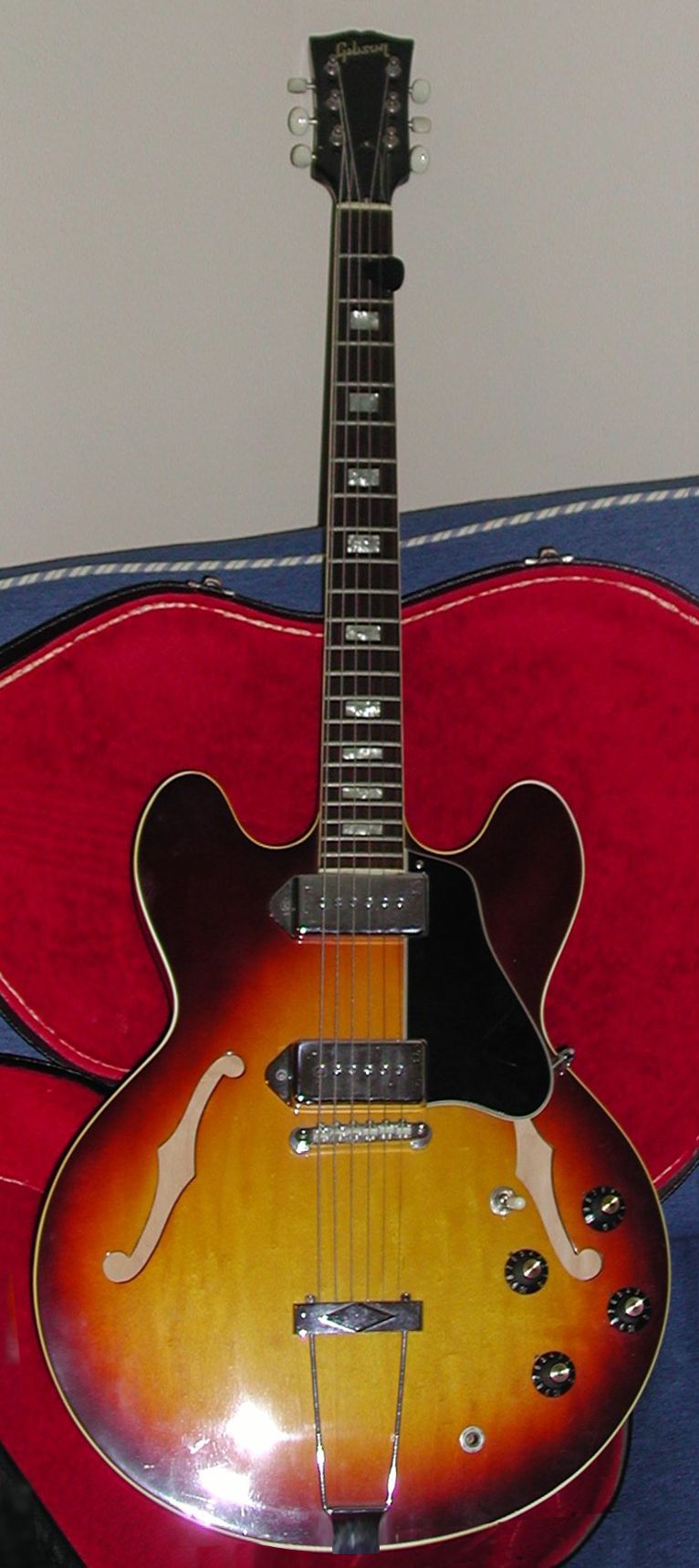
- gibson-es-330 — 1959 fully hollow thinline this catalog Rocket is not
Sources
- Vintage Guitar and Bass, Harmony Rocket — earliest 1959; sunburst then cherry 1963; H53 / H54 / H56 / H59 pickup and tailpiece table; 15¾" × 40½", 2" thick; bolt-on maple; Toledo Golden-Tone; truss circa 1964 / 1965 catalog; slash-one 1968–1972
- Vintage Guitar and Bass, 1965 Harmony catalog p. 6 — H53 $84.50; H54 $117.50; H56 $134.50; H59 $144.50; Type W on H56
- Guitar Player, Dave Hunter — 1959–67 single-cut then double-cut; H53 / H54 / H59 / H56; S-cover to ~1964–65 then mustache; laminated maple; bolt-on; Auerbach Rockets and brethren; White swapped Airline for a Rocket; Utley H54 photo
- Harmony Database, Thin Line family — H53 / H54 1959–1967; H59 1960–1967; H56 1965–1967; slash-one years; H654 / H656 1972; mustache and truss from 1966; H75 not a Rocket
- Harmony Database, H54 — 15¾" (399 mm) / 39½" (1003 mm) / 2" (50 mm); scale 24¼" (615 mm); nut 1¾" (44.4 mm)
- Harmony Database, H53 — 1959–1967; Chris Stein 15 August 2010 comment, first guitar 1962
- Harmony Database, H75 — deluxe three-pickup 1960–1972; not a Rocket
- Bluebook, Harmony Electric: Rocket Series — hardwood; 40.5" / 15.75" / 2" / 24.25"; Waverly; original disc. 1968; slash-one 1969–1972; H654 / H656 1973–75; H56 1966–68
- Reverb Price Guide, H54 Rocket — years 1959–1967; $482–$926, 184 orders; hammers Aug 2025–Apr 2025 $603.95 / $750 / $895.72 / $450 / $695 / $750 / $520
- Reverb, Harmony Rocket H54 Reissue Redburst — 2010s Korean reissue; original H54 1959
- Chicago Music Exchange, Harmony Rocket Sunburst 1965 — maple hollow; bolt-on maple; dyed maple board; 24" scale; 1-11/16" nut; 1965 stamps
- Wikipedia, Harmony Company — founded 1892; Sears 1916; Kraus independent 1940 (Kohman, VG June 2014); closed 1975; BandLab 2018; H53 Rocket listed among models
- Reverb News, Carly Smith, 14 December 2017 — BandLab Harmony reboot
- MusicRadar, 31 January 2018 — NAMM 2018 resurrection
- Premier Guitar, Chris Kies, 11 September 2014 — Auerbach H78, not a Rocket
- harmony.co — living cart this pass: Jupiter, Rebel, Silhouette, Comet, Juno, H62 / H72; no Rocket
- Harmony, Standard Series Comet — Comet $1,799 with case; not a Rocket
- Harmony, H72 Reissue Cherry — $699; not a Rocket
- Harmony, H62 Reissue Sunburst — $849; not a Rocket
- Sweetwater Gear Exchange, 1967 H56 — Type W only on H56; single-cut phased out after 1967
- Musician’s Friend, used H54 Reissue — used ask $499.99; Korean reissue, not Chicago
Keep digging
Guitars this one gets compared to, confused with, or descended from.

Photo: Weekly Dig / Wikimedia Commons / CC BY 2.0 Harmony
Stratotone
1952
In 1954 a Strat cost about $250. Harmony’s Stratotone cost $64.50, and it had the name first.
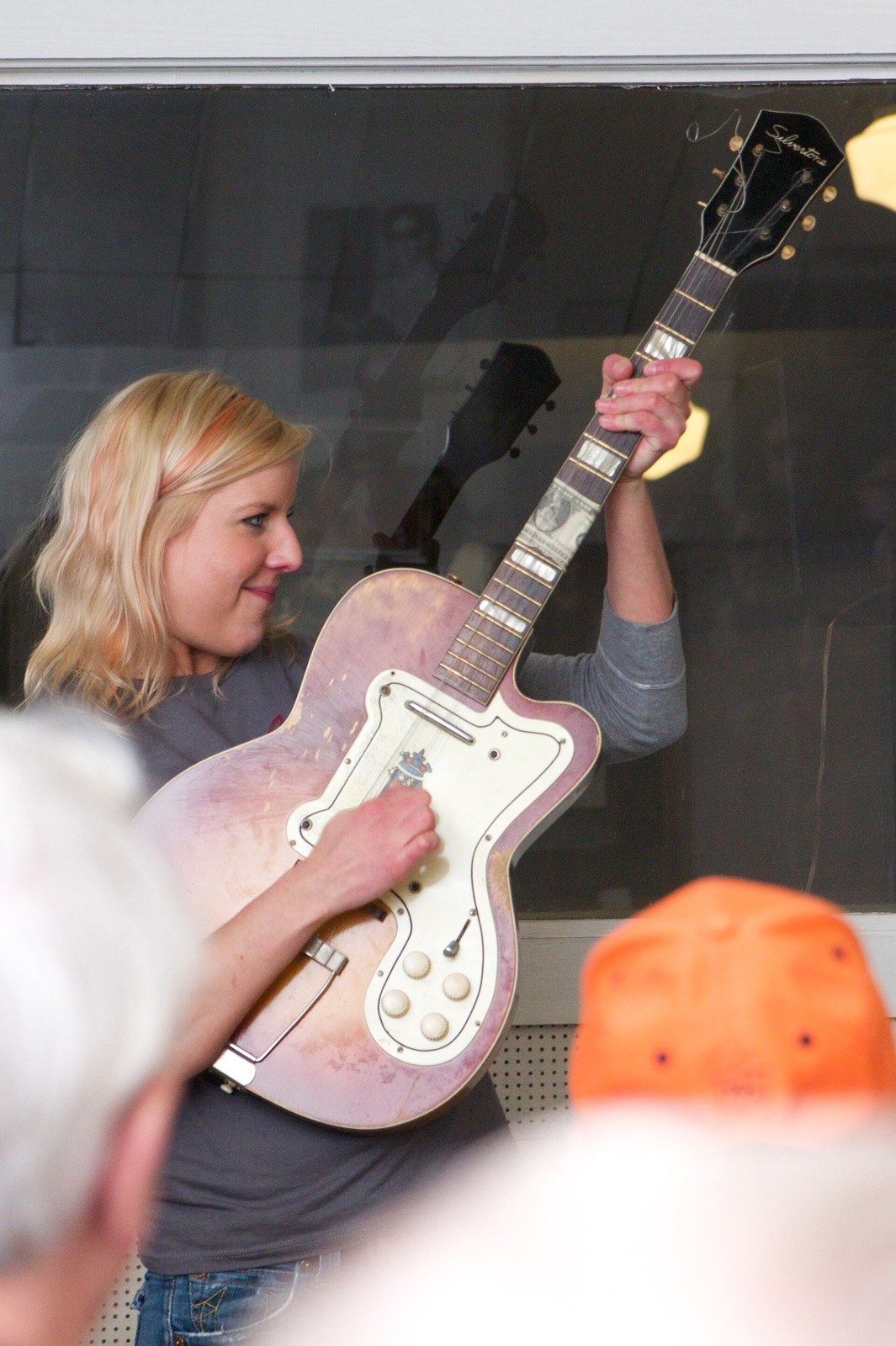
Photo: H. Michael Miley / Wikimedia Commons / CC BY-SA 2.0 Kay
Thin Twin
1952
Kay gave it a catalog number. Chicago blues gave it a name: the Jimmy Reed.
Gibson ES-330TD (front). Photo by Es330td; derivative by Clusternote. Licensed under CC BY-SA 3.0. Via Wikimedia Commons. Gibson
ES-330
1959
From across the room it looks like a 335. Inside, it’s all air, and the people who play one like it that way.