Harmony
Stratotone
In 1954 a Strat cost about $250. Harmony’s Stratotone cost $64.50, and it had the name first.
Chicago, the early 1950s. Fender and Gibson have just put solidbody electric guitars in the shops, at prices that take a month’s wages. Harmony, America’s volume guitar house, puts one in its catalog that costs about a week’s.
- Introduced
- 1952
- Type
- Solidbody electric
- Class
- Production

The short version
1892
Harmony opens
Wilhelm Schultz starts the company in Chicago.
1952
The H44
The Stratotone appears in the catalog. Depending who you ask, it was 1953 or 1954.
1954
$64.50
The Stratotone lists at $64.50. Fender’s brand-new Stratocaster costs about $250.
1956
Two pickups
The H88 Doublet, the same little slab with a second pickup, lists at $134.50.
1958
Hollowed out
The Stratotone name moves to a hollow “tone-chamber” line called Mars, Mercury, and Jupiter.
1963
Come On
The Rolling Stones’ first single. Brian Jones is playing a Stratotone.
1975
Closed
Harmony of Chicago shuts down.
Side A
A1
A week’s pay, not a month’s
In 1954 a Fender Stratocaster cost about $250. A Telecaster was $190. A Gibson Les Paul Standard was $235, and even the stripped-down Les Paul Junior was $110. Those were grown-up prices.
Harmony’s Stratotone was $64.50. The case was eight dollars more. (Another account has it at $72.50. Either way.) That’s the whole story, really. It was the difference between a guitar you stare at in a catalog and a guitar that actually shows up at your house.
Harmony could do that because Harmony was the volume house of American guitars. Wilhelm Schultz had started it in Chicago in 1892, and by the ’50s it was turning out ukuleles, archtops, and guitars with other people’s names on them, like the Silvertones that Sears sold. The Stratotone, the H44, was that factory’s first solidbody. It showed up in the catalog in 1952, or 1953, or 1954, depending who’s counting.
A2
It had the name first
Everybody assumes the Stratotone is a knockoff of the Stratocaster. It isn’t. The name is stratosphere plus tone, a space-age name with an atomic-looking note on the headstock, and the H44 was already in Harmony’s book when Fender’s Stratocaster shipped in 1954. Same decade, same first five letters, and Harmony got there first.
It doesn’t look like a Strat either. It’s a tiny single-cutaway slab, about three feet long, closer in outline to a very small Les Paul, though nobody at Harmony expected you to confuse the two.
A3
One stick of wood
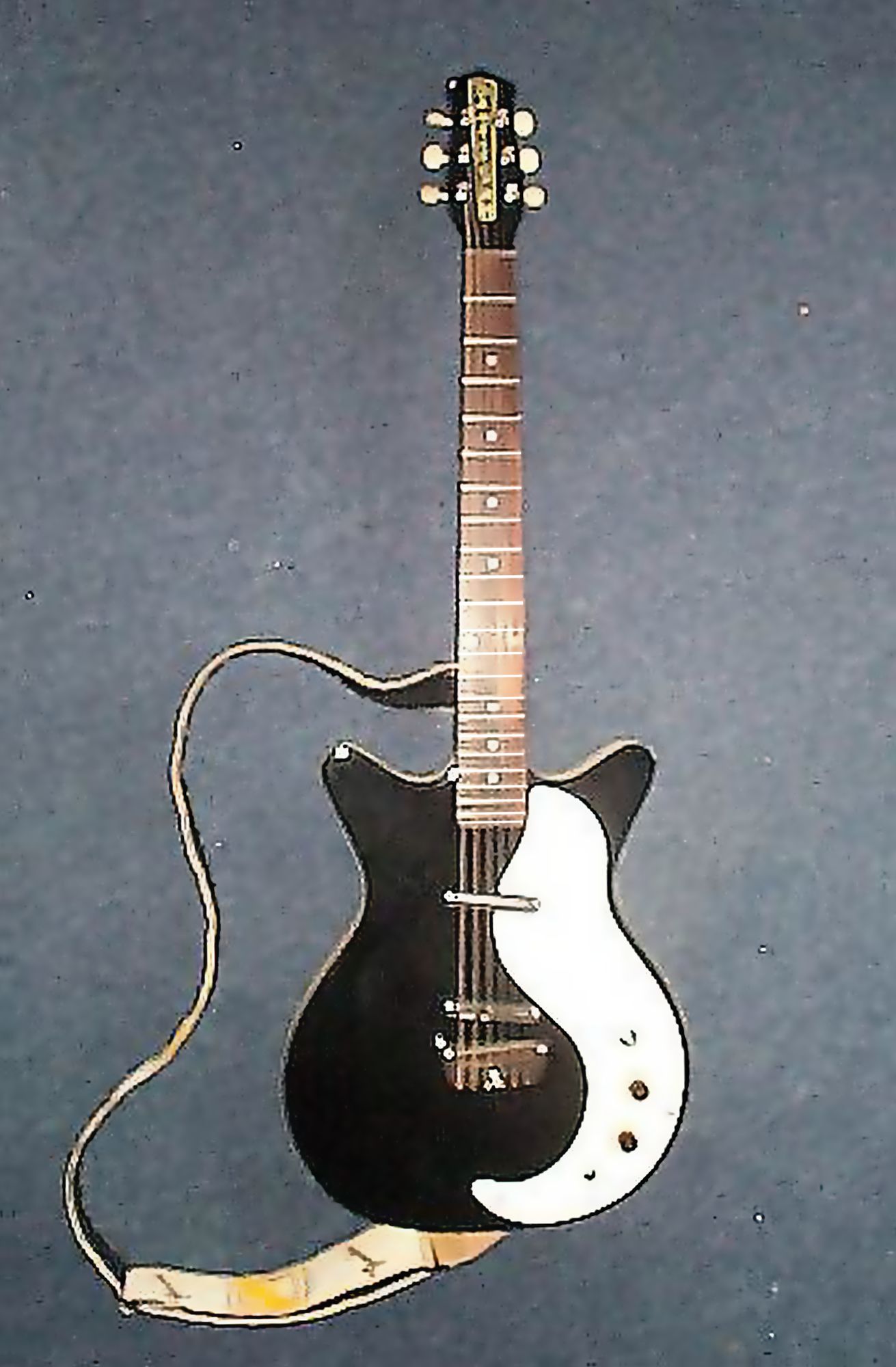
Here’s how you build a guitar for $64.50. One long piece of wood runs from the headstock to the tail, with two glued-on “ears” to fill out the body. No fitted neck joint. No truss rod. One DeArmond “Hershey bar” pickup up by the neck, a volume, a tone, and a little switch that cuts the tone control out of the circuit altogether, for when you want every bit of treble that pickup has. The bridge is held down by string pressure. The finish is a copper-bronze lacquer that wears through to primer on the neck.
One stick of wood, one pickup, no truss rod, and a price a kid could actually save up for.
Harmony sold it as an “easy-to-handle” Spanish electric: light and thin. The neck is fat and round, the jack plate is plastic, and on most old ones that jack plate has cracked. None of that mattered to a kid in 1954. It plugged in. That was the point.
Flip the record · By the numbers
$64.50
List price in 1954, with the case $8 extra. Another account has it at $72.50.
$250
About what a Fender Stratocaster cost that same year.
1
Pickup, a DeArmond “Hershey bar” up by the neck.
1975
The year Harmony of Chicago closed. The Stratotone name had mostly gone by the mid-’60s.
Side B
B1
Then they hollowed it out
Harmony kept tinkering. Mid-decade came the H88 Doublet, the same little slab with two pickups, $134.50 in 1956. Then in 1958 the name went hollow. The catalog put it this way: “Excitingly New! Ultra-Thin! Stratotone Electrics are now made with a carefully designed hollow ‘tone-chamber’ wood body, in place of solid wood.” No f-holes. The models got planet names. The Mars came with one pickup or two, and the two-pickup one listed at $97.50. The Mercury had a single Golden-Tone soapbar pickup. The Jupiter, at the top, cost $42 more than the Mars and came in blonde. Sears sold the Jupiter too, with a Silvertone badge on it, because that was how Harmony worked.
Those are the Stratotones a lot of people actually know. Spencer Davis played a Jupiter with the Spencer Davis Group, and Steve Winwood did for a while too. Dan Auerbach of the Black Keys keeps a ’60s hollow one in his rig, tuned to open G for “Run Right Back.”
B2
Buick green, and the first Stones single
Ritchie Valens was photographed with a copper H44. Charlie Subecz, who later owned Harmony, told a better story: that Valens sanded his down and painted it Buick green in high-school woodshop. That’s Subecz’s telling, and it’s a good one. Either way, the green is a refinish.
And then there’s Brian Jones. In the early ’60s he played a two-pickup hollow Stratotone, the guitar he used to teach Keith Richards. It was on the Rolling Stones’ earliest demos, their club gigs, and their first single, a cover of Chuck Berry’s “Come On.”
Harmony of Chicago closed in 1975, and you can’t buy a new Stratotone today. But the first Rolling Stones record went out on a guitar from the cheap end of a Chicago catalog. A lot of bands start exactly there.
Put this on
You’ve read about it. Now hear it. Here’s what this guitar sounds like, and what to listen for.
Come On
Their debut single, a Chuck Berry cover. Brian Jones is on a two-pickup hollow Stratotone, the guitar he used to teach Keith Richards.
Find it on YouTube (opens in a new tab)
The cast
The people, and the specific guitars, that made the legend.
1950s
Ritchie Valens
Copper H44
Photographed with one. Harmony’s later owner said Valens sanded his and painted it Buick green in high-school woodshop.
1963
Brian Jones
Early-’60s hollow Stratotone
Two pickups. The guitar he used to teach Keith Richards, on the Stones’ first demos, club gigs, and debut single.
mid-1960s
Spencer Davis
Stratotone Jupiter
The top of the hollow line, prominently featured with the Spencer Davis Group. Steve Winwood played one for a time too.
2014
Dan Auerbach
’60s hollow Stratotone
A longtime member of the arsenal, kept in open G for “Run Right Back.” Not his famous H78, which is a different Harmony.
Marc Ribot
H44
A dealer sold an H44 that used to be his.
Liner notes
Specs, construction, rarity, value, and every source we used.
A copper-bronze slab, a Hershey-bar DeArmond, and a neck through the body — Harmony’s Stratotone, not a Fender Stratocaster.
- Body
- Single-cut; neck-through hardwood with glued wings. True Vintage Guitar: poplar. RetroFret: hardwood. Mix flagged.
- Neck
- Through-body, no truss rod. Fat round profile.
- Fingerboard
- Rosewood, 20 frets, dots. Heel at the 14th.
- Scale
- 25¼" on Premier Guitar / True Vintage Guitar / Harmony Database (642 mm). RetroFret prints 25" (635 mm). Mix flagged.
- Pickups
- One DeArmond “Hershey bar” single-coil, neck
- Hardware
- Compensating bridge held by string pressure; trapeze tailpiece; open-back Waverly strip tuners on RetroFret’s 1954
- Electronics
- Volume, tone, tone-bypass / rhythm-lead switch
- Finish
- Copper-bronze / “lustrous, copper-bronze coating.” Black and gold exist. Valens’ green is a refinish.
- Nut
- 1¾" (44 mm) RetroFret. Mix flagged.
Open the full research fileConstruction details, the complete player record, production numbers, dated value estimates, and sources
Classic living example = 1952–57 H44 Stratotone (Chicago). No current Stratotone SKU this pass: harmony.co (fetched 3 September 2026) ships Jupiter, Rebel, Silhouette, Comet, Juno, and H62 / H72 reissues — not this name. H88 Doublet is the two-pickup solid sibling. H42 Newport is the Harmometal-trim solid. H45–H49 Mars / Mercury / Jupiter are the 1958 hollow “tone chamber” line. Current Jupiter is a Kalamazoo mahogany single-cut with gold-foil humbuckers — not this table. No Gibson SKU. Mixed inch/mm flagged on RetroFret’s measured H44 (overall 36 7/16" (92.5 cm), lower bout 10¾" (27.3 cm), depth 1¾" (4.4 cm), scale 25" (635 mm), nut 1¾" (44 mm)). Premier Guitar: three feet long, 10 5/8" wide, 25¼" scale. Harmony Database: 10 7/8" (275 mm) wide, 25¼" (642 mm) scale. Do not average them.
Construction
The job was a Spanish electric a kid could actually buy. Fender and Gibson had put solidbodies in the shops. Harmony put one in the catalog that cost a working week, not a month. Chicago. Wilhelm Schultz founded the company in 1892. Sears bought it in 1916 (Vintage Guitar, Peter Stuart Kohman, June 2014, via Wikipedia). Joe Kraus ran it, left in 1940, then bought enough stock to take it independent. The shop was already America’s volume house: ukuleles, archtops, Silvertones for Sears, Stellas after Oscar Schmidt. The Stratotone is that factory’s first solid.
True Vintage Guitar: the H44 debuted in the 1952 catalog, two years after the Broadcaster, the same year as Gibson’s Les Paul. RetroFret’s Marc Ribot example: launched 1953 as a response to the Les Paul. Premier Guitar (Wizard of Odd): Harmony “broke away from its typical big-bodied, hollow, archtop designs” and introduced the solidbody H44 in 1954. Keep 1952, 1953, and 1954. Reverb’s H44 years are 1952–1957. Harmony Database the same. This plate starts in 1952.
The name is not a Strat. Vintage Guitar and Bass: stratosphere plus tone, space-age prefix, atomic note on the headstock. The H44 was already in the book when Fender’s Stratocaster shipped in 1954. Harmony did not copy the name. Nobody at Harmony expected you to confuse one with a Les Paul either, even if you squint (Vintage Guitar, Michael Wright). Tiny single-cut. Neck through the body: one stick from headstock to tail, two glued “ears” for the outline, no fitted joint. No truss rod. One DeArmond Hershey-bar coil. Volume, tone, a switch that dumps the tone circuit. Cupcake knobs. A compensating bridge the strings hold down. A trapeze. Plastic jack plate that RetroFret says nearly always cracks. Copper-bronze lacquer that wears to primer on the neck. That is the guitar.
Premier Guitar: billed as an “easy-to-handle” Spanish electric, lightweight, thin. $64.50 in 1954, case eight dollars extra. A Stratocaster then about $250, a Tele $190, a Les Paul Standard $235, a Junior $110. True Vintage Guitar prints $72.50. Keep both. Historical list, not 2026 street.
Mid-decade, Harmony split the solid. Premier Guitar: dual-pickup H88 Doublet, then H42 Newport with Harmometal trim. RetroFret’s 1956 H88: $134.50 that year, gold sparkle over black on an Alden’s-badge example, two coils, concentric pots. Same small slab, two pickups. Not this table’s one-coil copper.
Then they hollowed the name. RetroFret: a new hollow Stratotone line in 1958, “outstanding value in their price class.” Vintage Guitar and Bass quotes the catalog: “Excitingly New! Ultra-Thin! Stratotone Electrics are now made with a carefully designed hollow ‘tone-chamber’ wood body, in place of solid wood.” No f-holes. H45 Mars, one coil, sunburst. H46 Mars, two coils, sunburst, $97.50 and a $10 case in the catalog RetroFret quotes; Jupiter $42 more. H47 / H48 Mercury, one Golden-Tone soapbar, cherry or blonde. H49 Jupiter, two Golden-Tones, blonde, top of the line. Vintage Guitar and Bass: H45–H49 1958–1965 (H47 to 1962). Harmony Database the same range, with later stamps possible. Silvertone 1423 is a Sears-badge Jupiter. Roy Smeck H7208 is a Smeck-badge Jupiter, not this slug.
Not a Fender Stratocaster (fender-stratocaster). Different factory, different year, different construction, shared prefix by accident of the 1950s. Not a Les Paul. Not the current Jupiter. BandLab relaunched Harmony in 2018 (Reverb News, Carly Smith, 14 December 2017; MusicRadar, 31 January 2018). Living USA models are built at 225 Parsons Street, Kalamazoo. The Standard Series Jupiter is mahogany, 22 frets, gold-foil humbuckers, $1,499 with a MONO case on harmony.co this pass. Same planet name. Different guitar. Westheimer’s early-2000s imports and the late-2000s Korean H44 reissues are later objects. Harmony of Chicago closed in 1975.
Classic vs current: 1952–57 H44 — copper-bronze slab, one Hershey bar, neck through — against no new Stratotone you can order from Harmony in 2026.
Players
Do not hang a Fender Stratocaster on this plate. Do not recruit Dan Auerbach’s H78 as if it were this guitar. Do not flatten every 1960s hollow Stratotone onto the H44 table.
Ritchie Valens. The H44 this plate can name on paper. Premier Guitar: he strapped one up. The Twelfth Fret: the copper H44 appears in photographs of Valens, who also played an ES-125. Charlie Subecz, then Harmony’s owner, to Gearwire: Valens owned a bronze H44, sanded it, painted it Buick green in high-school woodshop. That is Subecz’s claim. Album-to-guitar credits are unpublished here.
Brian Jones. Guitar World (Jonathan Horsley, 10 December 2025): early-’60s Harmony Stratotone, dual Hershey bars, the guitar he used to teach Keith Richards, on the Stones’ earliest demos, club gigs, and the debut single, a cover of Chuck Berry’s “Come On.” RetroFret’s 1959 H46: Jones used a nearly identical Mars for the early Stones gigs and recordings. Guitar World ties the physics-lab graphic to the H46 Mars name. Heritage Auctions hammer $150,000. Celebrity lot. Not a street tape.
Dan Auerbach. Premier Guitar Rig Rundown (Chris Kies, 11 September 2014): a ’60s Harmony Stratotone, longtime member of the arsenal; once acquired, the bridge P-90 rewound by Lindy Fralin; kept in open G for “Run Right Back.” UberProAudio names that guitar an H47. It is a hollow Stratotone, not an H44, and not the H78.
Spencer Davis. Vintage Guitar (Peter Stuart Kohman, “Forty Quid of Klunk”): Davis brandished a Stratotone Jupiter; Steve Winwood did for a time. RetroFret: the Jupiter “prominently featured in the mid-1960s by Spencer Davis of the Spencer Davis Group.”
Also known to play stays short. Guitar World names Mike Campbell, James Bay, and Junior Watson on Stratotones. RetroFret sold an H44 previously owned by Marc Ribot. Album-to-guitar credits beyond those named interviews are unpublished here. None invented.
Rarity
You cannot buy a new Stratotone from Harmony. The Chicago run ended with the company. Living Jupiter / Rebel / Silhouette SKUs are other factories on other silhouettes. They are not a 1950s H44.
Harmony did not publish Stratotone unit totals. None invented. Date stamps (F / S plus a two-digit year) and pot codes date a guitar. They don’t count a year. That is why a first-year census is unknown, not the chapter.
What is actually thinner: early H44s; complete H88 Doublets (RetroFret: far rarer twin of the H44); un-refinned copper-bronze; hollow first-year 1958–59 Mars examples RetroFret calls nicer than later ones. Jones’s guitar and Valens’ photographed H44 are unique objects. They are not a vintage Stratotone.
Value
Informal estimate, 3 September 2026. Not an appraisal.
Ask vs sold labeled. Celebrity lots are not-comps. No invented medians or factory counts. Period $64.50 (Premier Guitar, 1954) and True Vintage Guitar’s $72.50 are 1950s money, not 2026 street. H88 $134.50 in 1956 (RetroFret) and H46 $97.50 (catalog via RetroFret) are the same.
New street. None under Stratotone this pass. Harmony’s living Jupiter is $1,499.00 factory (harmony.co, Space Black, case included) — a different cart.
Used modern. Late-2000s Korean H44 reissues and Westheimer-era imports exist. No clean Reverb Price Guide band isolated this pass. Don’t invent a midpoint.
Vintage / collectible. Reverb Price Guide on H44 Stratotone 1952–1957 Copper, Good to Mint, 112 orders: $813–$1,594. Named hammers on that rail: 14 November 2025 Very Good $1,140; 22 October 2025 Very Good $700; 21 October 2025 Good $1,150; 22 August 2025 Excellent $2,399.99; 18 August 2025 Excellent $600; 3 July 2025 Very Good $1,225; 21 June 2025 Good $850. Labeled widget, not a sold median computed here. Named ask, not a 2026 hammer: RetroFret 1954 H44 $2,500. Do not average those asks with the Reverb band. Jones’s $150,000 Heritage lot is one object. Not a comp.
See also
- fender-stratocaster — the 1954 Fullerton guitar that shares a prefix; not this Chicago slab
- danelectro-59 — another 1950s budget solidbody; lipstick masonite, not a Hershey-bar H44
- heritage-h-150 — current Harmony USA is built at Heritage on Parsons Street; not this Chicago H44
Sources
- True Vintage Guitar, 1953 H44 — catalog debut 1952; $72.50; poplar neck-through; 25¼"; 1¾" nut; DeArmond; copper-bronze; pot 134302 (2nd week 1953); Valens, Perkins
- Premier Guitar, Wizard of Odd, 1954 H44 — introduced 1954; 10 5/8" wide; 25¼" scale; three feet long; $64.50 + $8 case; Strat ~$250 / Tele $190 / Les Paul Standard $235 / Junior $110; Valens; H88 Doublet; H42 Newport Harmometal
- RetroFret, 1954 H44 — early 1950s; 36 7/16" (92.5 cm) / 10¾" (27.3 cm) / 1¾" (4.4 cm); scale 25" (635 mm); nut 1¾" (44 mm); pots 304-405 (5th week 1954); Waverly; ask $2,500
- RetroFret, 1956 H44 — hardwood; copper; pots 20th week 1956
- RetroFret, c. 1957 H44, Marc Ribot — launched 1953; DeArmond; tone-bypass; 36 3/8" / 10½" / 1¾"; scale 25" (635 mm); nut 1¾" (44 mm)
- RetroFret, 1956 H88 Doublet — two-pickup sibling; $134.50 in 1956; gold sparkle over black
- RetroFret, 1959 H46 Mars — hollow line 1958; catalog $97.50 / case $10; Jupiter $42 more; Jones early Stones
- RetroFret, 1961 Jupiter — top of the 1958 semi-solid line; Spencer Davis
- Vintage Guitar and Bass, Stratotone — H44 solid, H42 Newport solid; H45–H49 hollow 1958–65; name predates Stratocaster; Jones H46 1962; catalog “tone-chamber” copy
- Harmony Database, H44 — 1952–1957; neck-through; 10 7/8" (275 mm); 25¼" (642 mm); 1¾" nut
- Harmony Database, H46 — 1958–1965; two pickups
- Wikipedia, Harmony Company — founded 1892; Sears 1916; Kraus independent 1940 (Kohman, VG June 2014); closed 1975; BandLab 2018; DeArmond pickups
- Vintage Guitar, Peter Stuart Kohman, Forty Quid of Klunk — Spencer Davis Stratotone Jupiter; Winwood for a time
- Vintage Guitar, Michael Wright, Stratospheric Variations — Stratotone in the Les Paul image, not a copy
- The Twelfth Fret, 1955 H44 — Valens photographs; ES-125 also; neck-through, likely poplar
- Guitar World, Jonathan Horsley, 10 December 2025 — Jones Stratotone $150,000; Come On; taught Richards; H46 Mars; Campbell, Auerbach, James Bay, Junior Watson
- Premier Guitar, Chris Kies, 11 September 2014 — Auerbach ’60s Stratotone; Fralin P-90; “Run Right Back” open G
- UberProAudio, Dan Auerbach rig — H47, Lindy Fralin P-90s
- Reverb News, Carly Smith, 14 December 2017 — BandLab Harmony reboot
- MusicRadar, 31 January 2018 — NAMM 2018 resurrection
- Harmony, Standard Series Jupiter Space Black — $1,499; mahogany; 25"; gold-foil humbuckers; not a Stratotone
- harmony.co — living cart this pass: Jupiter, Rebel, Silhouette, Comet, Juno, H62 / H72; no Stratotone
- Reverb Price Guide, H44 Stratotone Copper 1952–1957 — $813–$1,594, 112 orders; hammers Nov 2025–Jun 2025 $1,140 / $700 / $1,150 / $2,399.99 / $600 / $1,225 / $850
Keep digging
Guitars this one gets compared to, confused with, or descended from.

Photo: Lightburst / Wikimedia Commons / CC BY-SA 4.0 Fender
Stratocaster
1954
The guitar most people mean when they say “electric guitar.” Designed by a man who didn’t play one.
Danelectro 59-DC. Photo by Sander van Malssen. Licensed under CC BY-SA 2.0. Via Wikimedia Commons. Danelectro
59
1958
Jimmy Page’s has been shown at the Met. The same two lipsticks and coke-bottle head are hanging on a shop wall near you.
- Send a picture
Heritage
H-150
1988
Gibson left Kalamazoo. A few of the people who built its guitars stayed in the building and kept going.