Höfner
Club 40
John Lennon and George Harrison both saw a Club 40, and in John’s words, both “thought it was the end.”
Britain, the mid-’50s. Import controls keep new American electrics off the shop counters, and Selmer in London is selling a small German hollowbody from Höfner under a name that sounds like a night out. By 1959, two Quarrymen are playing one each.
- Introduced
- 1955
- Type
- Hollowbody / thinline electric
- Class
- Production
Have a photograph of this guitar? Send a picture
The short version
1955
Club 40 and Club 50
By September, Selmer’s London ads call the pair “Les Paul style.” Some date the guitar a year earlier.
1958
Flick action
The oval control plate gives way to a rectangular console.
1959
Hessy’s
On 28 August, Aunt Mimi puts £17 down on John Lennon’s first electric.
1959
George’s swap
Harrison trades up from his President to a Club 40, his first electric.
1960
Hamburg
Lennon is still on his at the Top Ten club, before a Rickenbacker takes over.
1962
Gone from the shops
Selmer stops selling the 40, the 50, and the 60.
1965
A prize
Harrison is asked to give his Club 40 away in a competition for the 1966 German tour.
1966
The Star Club draw
Frank Dostal wins George Harrison’s first electric guitar in Hamburg.
Side A
A1
Two out of four
The Casbah, Liverpool, 1959. The Quarrymen are on. Ken Brown has a Höfner Senator. Paul McCartney has a Zenith. John Lennon and George Harrison each have the same guitar: a small, single-cutaway Höfner Club 40.
They weren’t holding the guitar they’d have picked from an American catalog. You mostly couldn’t get those in Britain. They were holding the one they could get, and it didn’t feel like second best. Lennon put it this way:
Both George and I saw a Hofner Club 40 and we both thought it was the end.
A2
A Les Paul from across the room
Walter Höfner added it to the range in 1955. From a few feet away, it could pass for the solid guitar Gibson had put out in 1952. Up close, it’s another animal. The lower bout is 13 inches across. The top was arched, carved spruce at first, over a flat flame-maple back. And it’s fully hollow, with no soundholes at all. Knock on it and it’s a box.
That was the Höfner way of doing things. Walter had spent his life building hollow instruments, and solid bodies were “just a step too far” for those shops. So you got the silhouette of a Les Paul with the construction of an archtop, one pickup at the neck, a volume, a tone, a floating ebony bridge, and a trapeze tailpiece. In Germany it was the 125. With a second pickup at the bridge it was the 126.
A3
Why it’s called Club
Britain gave it the name. Import controls kept new American electrics off UK counters, and Selmer in London already imported Höfner. Selmer’s Ben Davies didn’t like model numbers. By September 1955 the one-pickup and two-pickup guitars were in Selmer’s ads as the Club 40 and the Club 50, “Les Paul style.” Some sources push the debut back to 1954. The ads are 1955.
The name was older than the guitar, too. Selmer had already put “Club 40” on an archtop that Dick Knight built in London after the war. Same words, different instrument.
The Höfner changed as it went along. The carved spruce top became a pressed laminate in the late ’50s, though the dates don’t agree. The oval control plate became a rectangular “flick action” console in 1958. The back picked up a dome, and the neck finally got a truss rod, around 1960. In 1961 a blonde one listed at £29 in Britain, at a time when a weekly wage was about £15.
Flip the record · By the numbers
13″
Across the lower bout. A small guitar, and fully hollow.
0
Soundholes. No f-holes, even though there’s nothing but air inside.
£17
What Aunt Mimi put down on John’s at Hessy’s, 28 August 1959.
£29
UK list for a blonde one in 1961, when a weekly wage was about £15.
Side B
B1
George’s swap
Harrison’s guitar before this one was a President, “a cello-style, f-hole, single-cutaway” that he had stuck a pickup on.
I soon got fed up with it and did a straight swap for a Club 40. I thought it was the most fantastic guitar ever.
It was his first electric, and the third guitar he owned. Ray Ennis of the Swinging Blue Jeans has his own footnote: “The Club 40 that George got was originally mine,” traded on a Tuesday at the Cavern.
Lennon got his the grown-up way. On 28 August 1959, at Hessy’s, his Aunt Mimi put £17 down on it, on hire purchase. That’s how two of the four guitars on the Casbah stage came to match.
B2
Put down, not thrown away
Neither of them stayed on it long. By November 1959 Harrison had a Futurama, the nearest thing to a Strat. Lennon took his Club 40 to Hamburg and played it at the Top Ten in 1960. By the end of that year he had a Rickenbacker 325. The Club 40 went to Paul on loan for a while, then it was sold. Nobody knows where it is.
Harrison kept his. In 1965 he was asked to give it as the prize in a competition promoting the Beatles’ 1966 German tour. The draw was at the Star Club in Hamburg, and Frank Dostal of the Faces won it. The four signatures on it aren’t the band’s. Road manager Neil Aspinall signed them. After Frank died, his widow, Mary Dostal of the Liverbirds, sent it to auction in 2018.
Selmer stopped selling the Club 40 in 1962. Höfner doesn’t make one now. The two-pickup Club 50 is still in the catalog. Plenty of British players started out on a Club of some kind, but the lists rarely say which one.
It was never the best guitar in the world. It was a 13-inch hollow box that looked like a Les Paul from across the room and cost about two weeks’ wages. To a kid who had been sticking a pickup on a cello-style guitar, it was the most fantastic guitar ever. He said so.
The cast
The people, and the specific guitars, that made the legend.
1959
George Harrison
Club 40, his first electric
Swapped his President for it and “thought it was the most fantastic guitar ever.” Kept it after he moved on to a Futurama.
1959
John Lennon
The Club 40 from Hessy’s
Bought on hire purchase on 28 August 1959 and played in Hamburg in 1960, until the Rickenbacker. Where it ended up is unknown.
1960
Paul McCartney
John’s Club 40, on loan
Borrowed it briefly before it was sold. His Höfner bass is a different instrument.
1959
Ray Ennis
The Club 40 before George had it
Of the Swinging Blue Jeans. “The Club 40 that George got was originally mine,” traded on a Tuesday at the Cavern.
1966
Frank Dostal
Harrison’s Club 40, won
Of the Faces. Won George’s guitar in the prize draw at Hamburg’s Star Club.
Liner notes
Specs, construction, rarity, value, and every source we used.
Fully hollow, no soundholes, one neck pickup — Höfner’s Club 40, a 13-inch German electric that only looks like a Les Paul.
- Body
- Fully hollow single-cut; no f-holes; no centerblock. Early top is solid carved spruce, later a pressed laminate. Flat maple back, domed from about 1960. Lower bout 13" (33 cm). Depth disagrees. Mix flagged.
- Neck
- Set, three-piece maple/beech/maple. Join at the 14th fret on Harrison’s guitar. No truss rod until 1960 (Ramsay McKinnon).
- Fingerboard
- Unbound rosewood, dots. 22 frets and a zero fret on serial 244 (Julien’s) and on a measured 1960, serial 1452. Ramsay does not count frets.
- Scale
- 24¼" (616 mm) on RetroFret’s 1955–57, on the MET label for serial 244, and on serial 1452. Ramsay’s 1958 sheet prints 635 mm and no inches. Mix flagged. Do not average.
- Pickups
- One neck single-coil. Early Fuma or black bar; metal-cover “toaster” by about 1960. The Club 50 is the guitar with two.
- Hardware
- Adjustable ebony floating bridge; nickel trapeze, many with a “KH” medallion. Not a stopbar.
- Electronics
- Early oval panel, volume and tone (serial 244). Rectangular “flick action” console from 1958.
- Finish
- Blonde is what UK buyers took. Brunette and sunburst exist. Binding B/W on blonde, W/B on brunette (Ramsay).
- Nut
- Three-ply black/white/black on Ramsay’s 1958 sheet — material, not a width. Widths disagree: RetroFret 1 9/16" (40 mm); Folkway 1⅝"; serial 1452 just under 1⅝". Mix flagged.
Open the full research fileConstruction details, the complete player record, production numbers, dated value estimates, and sources
Classic living example = late-1950s Club 40 / German 125 (Bubenreuth). No Club 40 on Höfner’s shop this pass (24 September 2026). HCG50 Club 50 is the two-pickup sibling still listed. Not a solidbody, not the 500/1, not the 500/2 Club bass, not the Chinese Club Solid, not the earlier London Straten that used the name. Mixed inch/mm flagged. Do not average 24¼" with 635 mm, or 1¾" / 44 mm with 50 mm with ~2" / 5.1 cm with 2⅛".
Construction
The job was a small electric a player could get. Walter Höfner put it in the range in 1955: 13" lower bout, fully hollow, arched top, flat flame-maple back, no soundholes. One pickup was the German 125. Two was the 126. Steve Russell (vintagehofner): at a glance it could pass for the solid guitar Gibson had put out in 1952. It is not that guitar. Walter had spent his life building on the hollow-instrument plan. Solid bodies, Russell writes, were “just a step too far” for those shops. The top started as carved spruce. The body did not.
Britain is why the name is Club and not 125. Import controls kept new American electrics off UK counters (Tony Bacon, Reverb News, 23 June 2020). Selmer London already imported Höfner. Ben Davies disliked model numbers. By September 1955 the pair were in Selmer ads as the Club 40 and the Club 50, called “Les Paul style” (Russell, chapter 6). Höfner’s own European catalogues say “Club-Style” only in 1958. A photo caption on Russell’s chapter reads 1954/55. RetroFret says introduced 1954–5 and debuted 1955. A 2012 MusicRadar review of a later solid says 1957. This plate starts in 1955. Keep the caption.
The name was older than this guitar. Selmer had already put “Club 40” on a Straten archtop Dick Knight built in London after the war (vintagehofner fact file). Lew Davies’s Compensator tailpiece came off that bench. Same words on a headstock are not the same instrument.
Then it changed where you can see it. Russell: carved spruce became a pressed spruce laminate in 1957 (he also writes “around 1958/59”). Ramsay’s 1958 sheet says laminated maple. RetroFret, Folkway, the MET label, and serial 1452 say spruce. Keep both. Flat backs until about 1959; Russell dates the dome to the start of 1960. The oval plate — volume and tone — is what is on 244. In 1958 it became the rectangular console Selmer called “the new flick action change.” Pickups run Fuma, then black bars for most guitars up to 1960, then toasters. Truss rod from 1960 (Ramsay). The scale and the depth will not agree: the table has them. A 24¼" neck is not 635 mm. Weights on named guitars, not one average: MET 4–5 lb on 244, Fretted Americana 4.00 lb on 1452, Gardiner Houlgate 1.80 kg on its circa-1958.
Not the 50, the 60, or the 70. The 50 is this body plus a bridge pickup. The 60, early 1958, is the deluxe: ebony board, flower inlays, bound five-piece neck. German 127/128 are that deluxe from 1960. The 70 appeared on Selmer’s stand in autumn 1967 — blade pickups, four knobs, a toggle. Russell: about 60 sold, gone by 1969. That count is his, and it is the 70.
Selmer’s 40, 50, and 60 were already dead in the shops in 1962, off the autumn 1963 catalogue. Höfner’s price list kept them through 1970 as something you could still order. Very few survive from after 1962.
No new Club 40 on Höfner’s shop this pass. What is listed is the Club 50, HCG50-SB-0: fully hollow, no centerblock, two staple pickups, neck joins at the 14th, 22 frets. Höfner prints the scale as 25¼" / 64.3 cm — that pair does not convert, and it is not this table. A 2007 “John Lennon” Club 40 was a limited hollow copy; product pages say 120 pieces for the 120th anniversary, with a graphite neck. Not a 1959. The Chinese Contemporary Club Solid (MusicRadar) is mahogany, solid, about 4 kg, and “lacks the internal airspace.” Höfner’s case page says a Club case also fits “solid body” archtops. The Club 50 spec says centerblock none. Believe the instrument. The period solid is the Colorama, from about 1956 (Bacon).
Players
George Harrison — serial 244, his first electric. MET: ca. 1958, acquired 1959. Julien’s lot text has him on the swap. The President was “a cello-style, f-hole, single-cutaway” he had stuck a pickup on. “I soon got fed up with it and did a straight swap for a Club 40. I thought it was the most fantastic guitar ever.” Ray Ennis of the Swinging Blue Jeans, same text: “The Club 40 that George got was originally mine,” traded on a Tuesday at the Cavern. Andy Babiuk, in Guitar World (3 May 2018): first electric, and the third guitar Harrison owned.
He played it with the Quarrymen at the Casbah. Lennon, early 1960s, via Julien’s: “both George and I saw a Hofner Club 40 and we both thought it was the end.” Beatles Bible: by November 1959 Harrison had a Futurama, the nearest thing to a Strat. He still had 244. Guitar World: in 1965 he was asked to give it as a prize for a competition promoting the 1966 German tour. MusicRadar: the draw was at Hamburg’s Star Club; Frank Dostal of the Faces won it; his widow Mary Dostal, of the Liverbirds, sent it to Julien’s. The four signatures are road manager Neil Aspinall’s. Julien’s, 19 May 2018, lot 550: estimate $200,000–$300,000, sold price $430,000, plus a 27% buyer’s premium and an online fee. One object. Not a comp. Goldmine’s $1.27 million (Julien’s, November 2024) is his Futurama. Different guitar.
John Lennon — Hessy’s, 28 August 1959. Not 244. Julien’s: Aunt Mimi put £17 down on his first electric. Beatles Bible: hire-purchase that day, and the 1959 Casbah lineup was two Club 40s, Ken Brown on a Senator for his six weeks in the Quarrymen, Paul on a Zenith. The Senator is not this page. Hamburg photographs on the first trip still show Lennon on the Club 40, including the Top Ten in 1960 (Beatles Bible). Wikipedia’s instrument table has him on a 1958 Rickenbacker 325 by October–November 1960. That guitar lives on rickenbacker-325.
Wikipedia: the Club 40 was briefly loaned to Paul, then sold. The same table puts a Club 40 in McCartney’s column for October–December 1960, beside a Rosetti Solid 7. Where Lennon’s guitar went, and for what, these sources do not say. Paul’s 500/1 is a bass. Stuart Sutcliffe’s Höfner is a 500/5-class bass. Neither belongs here.
Russell also names David Gilmour, Ritchie Blackmore, Justin Hayward, Joe Brown, and John McNally as players who started on Clubs. He does not say 40 rather than 50 or 60. Ads that pin all of them on this model are flattening the line.
Rarity
You cannot buy a new Club 40. It was a regular model, then the catalogue dropped it. A current HCG50 is the two-pickup sibling. The 2007 Lennon copy is a different decade; “120” is product-page copy, not a ledger. A Club Solid is solid, and Chinese.
Höfner published no Club 40 total. None invented. The Selmer serial chart dates UK headstocks: 255–420 (1958), 421–820 (1959), 821–1534 (1960). Those bands date a guitar. They are not a census, and subtracting them would fake one. Standard non-Selmer models had no serial until 1976, so a blank-headstock 125 can be the same instrument. The owners’ register, closed 20 September 2019, is a sample — it includes serial 134, about 1956, before the chart starts.
Thinner in the real world: carved-spruce tops, oval plates, a Fuma or black-bar pickup that has not been changed, a back that is still flat. Russell’s “about 60” is the Club 70. Harrison’s 244 is one guitar. Lennon’s Hessy’s Club 40 is unlocated. Neither is a market for the rest.
Value
Informal estimate, 24 September 2026. Not an appraisal.
Ask is not sold. Celebrity lots are not comps. No invented medians. Ramsay’s 1961 UK list is period money: blonde £29, brunette £28, against a wage he puts at about £15 a week. Not 2026 street.
New street. None. Höfner’s shop lists the Club 50, not a 40, and no new-40 price was on a cart this pass. Musician’s Friend’s Lennon reissue shows $3,150 and “unavailable” — an old page, not a guitar you can order. Do not borrow a Club 50 price.
Used modern. The 2007–08 reissues are their own market: hollow, one pickup, graphite neck. Named sold listings, not a series. Reverb, 2008 #119, page marked sold at $3,988.88. An earlier Reverb listing, marked sold at $2,199, was listed seven years ago. Do not average them into a 1959.
Vintage / collectible. A plain Club 40 is player money until the headstock says Harrison. Gardiner Houlgate, The Guitar Sale, 3–4 December 2024, lot 709, circa 1958, frets worn: estimate £500–£800, hammer £500. Hender Amps, a 1962, page marked sold at €1,399 (2023). Two sales. Not a band. Asks, not hammers: a 1962 on eBay at £875 or best offer; a 1961 on Reverb UK at £2,417.82. Music Locker’s 1958 at £1,295 is a 2021 shop sold, not a 2026 result. Do not average the £500 hammer with the £2,400 ask.
244 at $430,000 (19 May 2018) is the celebrity lot. The premium sits on top of that figure. The Futurama at $1.27 million is not this guitar.
See also
- hofner-500-1 — the hollow 30" violin bass; McCartney’s bass, not this six-string
- gibson-les-paul-standard — the 1952 solid this 13" hollow was drawn against, and is not
- rickenbacker-325 — the Capri Lennon bought in Hamburg when he put the Club 40 down
Sources
- Steve Russell, vintagehofner, Chapter 5: Club-style guitars — 1955 introduction of the 125/126; fully hollow, no soundholes; carved spruce then laminate; flat back, domed 1960; Selmer names; “Club-Style” in 1958; 1954/55 caption; Fuma then black bar; dropped 1962 / autumn 1963 catalogue; price list to 1970; Club 60 and 70; “about 60” is the 70; solid bodies “a step too far”
- Steve Russell, Chapter 6: Selmer London — September 1955 ad; “Les Paul style”; the name on an earlier Straten
- vintagehofner, Straten Club 40 fact file — the first Selmer “Club 40” is a London Straten, not a Höfner; Lew Davies Compensator
- Ramsay McKinnon, Club 40 & 50 — 1958: 635 mm, 440 × 330 × 50 mm, laminated maple top, three-ply nut, truss rod from 1960, ebony bridge, trapeze
- Ramsay McKinnon, 1961 UK prices — blonde £29, brunette £28; £15/week note
- Tony Bacon, Reverb News, 23 June 2020 — 1955; one pickup vs two; hollow, no f-holes; 1958 “flick action”; import controls; Colorama about 1956
- RetroFret, 125 / Club 40, 1955–57 — introduced 1954–5; 38" × 13" × 1¾" (4.4 cm); 24¼" (616 mm); nut 1 9/16" (40 mm)
- RetroFret, Club 40, 1960 — debuted 1955; toaster; flick-action from 1958
- MET label, via Wikimedia Commons — serial 244, ca. 1958; 24¼"; 38" × 13" × ~2" (5.1 cm); 4–5 lb; acquired 1959
- Julien’s Auctions, lot 550 — Harrison, Ennis, and Lennon quotes; Hessy’s, 28 August 1959, £17 down; estimate $200,000–$300,000; sold $430,000; premium 27% + online fee
- Julien’s, 19 May 2018 — “Sold for $430,000”
- Guitar World, 3 May 2018 — Babiuk: first electric, third guitar; 1965 donation for the 1966 tour prize; Aspinall signatures
- MusicRadar, 4 May 2018 — Star Club, 1966; Frank Dostal; Mary Dostal; serial 244
- The Beatles Bible, 2 July 2009 — Hessy’s, 28 August 1959; Casbah lineup; Futurama by November 1959; Top Ten, Hamburg, 1960
- Wikipedia, Beatles instruments — Ricky by October–November 1960; Club 40 in McCartney’s column October–December 1960
- Wikipedia, Höfner — about a year, then a Ricky; loaned to Paul, then sold. “Still manufactured” is not a Club 40 on the shop
- Höfner, Selmer serial numbers — 255–420 (1958), 421–820 (1959), 821–1534 (1960); non-Selmer models unnumbered until 1976
- vintagehofner owners’ register — closed 20 September 2019; serial 134, c. 1956
- Höfner Club 50, HCG50-SB-0 — fully hollow, no centerblock, two staples, 25¼" / 64.3 cm, 42 mm nut. Not the 40
- Höfner Club case — “solid body” in the case copy; the Club 50 spec says hollow
- MusicRadar, Club Solid review — Chinese solid, ~4 kg; the review’s 1957 date disagrees with Russell
- Folkway, 1955 Club 40 — 24¼" scale, 1⅝" nut
- Fretted Americana / GBase, serial 1452 — 13" × 2⅛", 24¼", nut just under 1⅝", 22 frets, 4.00 lb
- Gardiner Houlgate, lot 709 — circa 1958; 1.80 kg; estimate £500–£800; hammer £500; 4 December 2024 on this page, 3 December 2024 on the four-day-sale listing
- Hender Amps, 1962 — marked sold, €1,399 (2023 page)
- Musician’s Friend, Lennon reissue — unavailable; $3,150 on the page
- Reverb, 2008 reissue #119 — marked sold, $3,988.88
- Reverb, 120th-anniversary listing — “120” in the copy; marked sold, $2,199, listed seven years ago
- Reverb UK, 1961 — ask £2,417.82
- eBay, 1962 — ask £875 or best offer
- Goldmine, November 2024 — $1.27 million is the Futurama, not the Club 40
_-_Play_It_Loud._MET_(2019-05-13_18.37.53_by_Eden,_Janine_and_Jim).jpg)
Keep digging
Guitars this one gets compared to, confused with, or descended from.
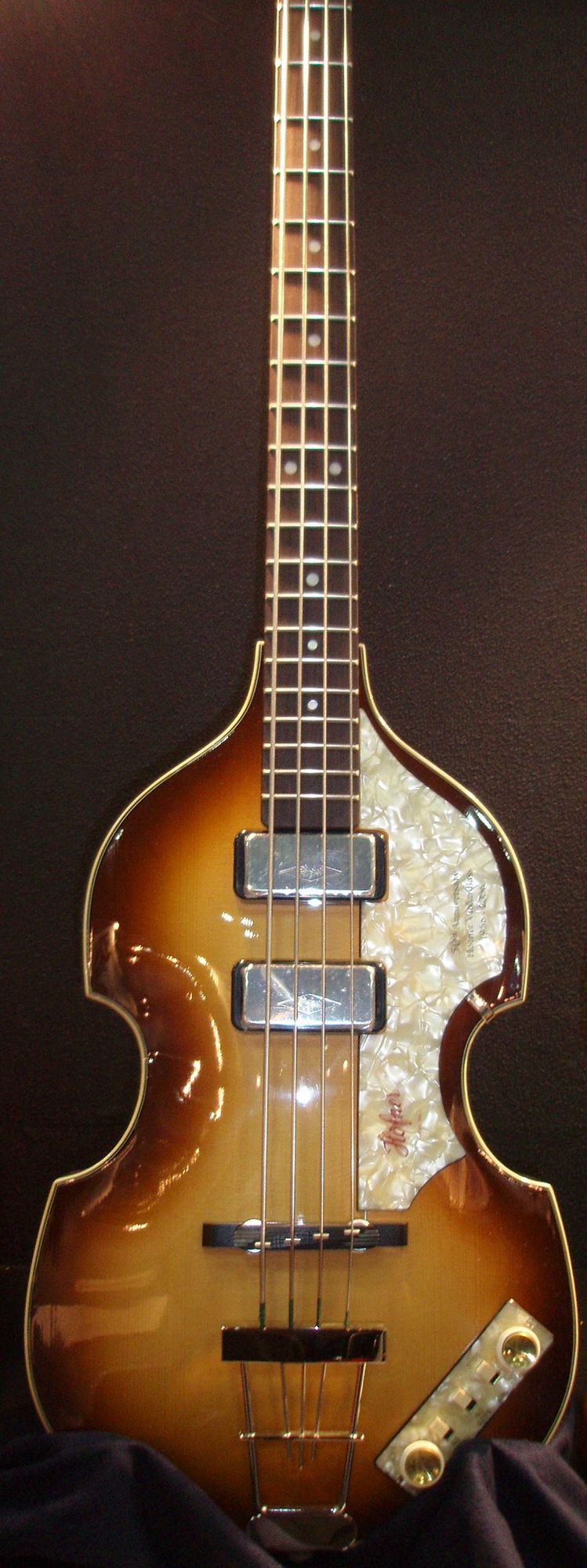
Höfner 500/1 Anniversary RH, equal to a ’61 Cavern Bass layout. Photo by CasinoKat. Licensed under CC BY-SA 3.0. Via Wikimedia Commons. Höfner
500/1
1956
McCartney bought the bass he could afford in Hamburg. It was stolen in 1972, and it came home in 2024.

2006 Gibson Les Paul Standard (SN 000660573). Photo by wetwebwork. Licensed under CC BY-SA 2.0. Via Wikimedia Commons. Gibson
Les Paul Standard
1952
Gibson made about 1,500 sunburst Les Pauls, decided nobody wanted them, and stopped. Then the British blues boom happened.
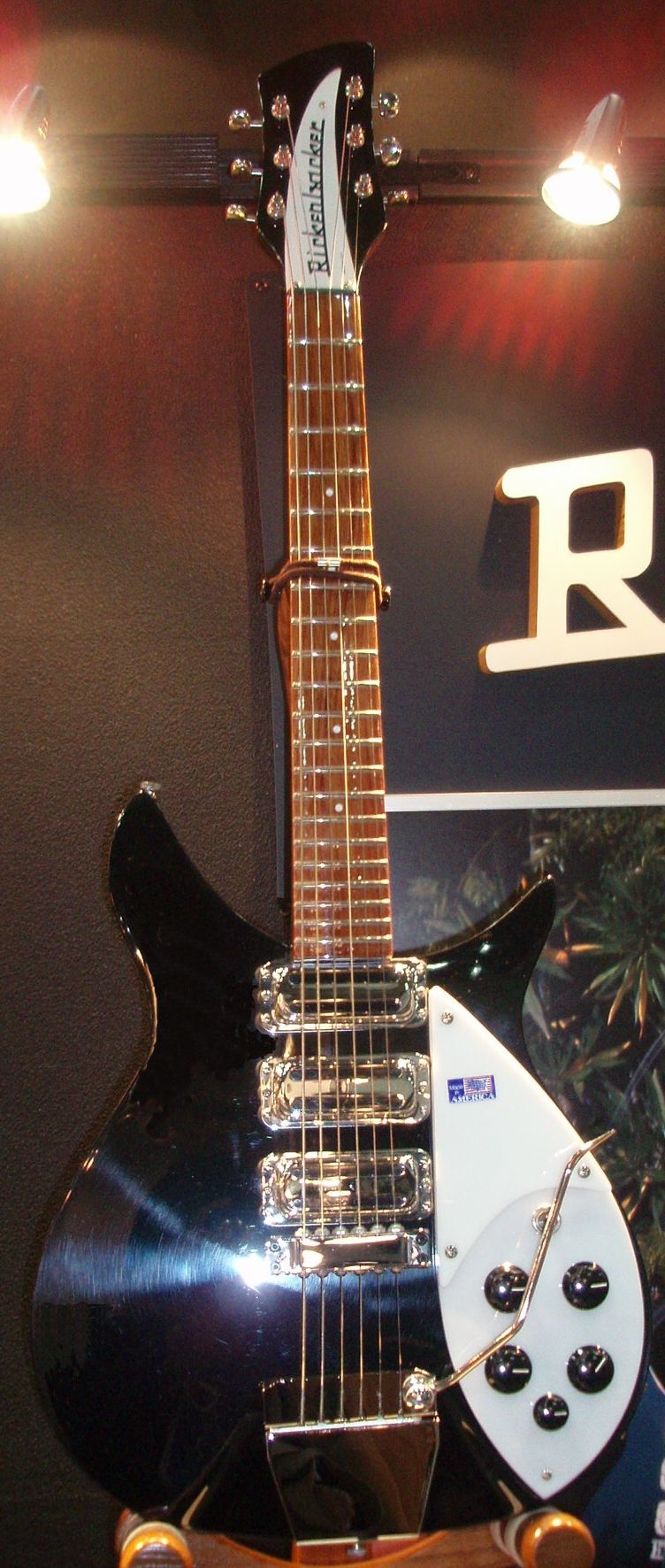
Rickenbacker 325C64. Photo by CasinoKat. Licensed under CC BY-SA 3.0. Via Wikimedia Commons. Rickenbacker
325
1958
Lennon bought it natural in Hamburg and had it painted black. The reissues copy the ends of that story, not the middle.