Magnatone
Mark V
Paul Bigsby designed it, with his own vibrato on the tail. Everybody went home with the amp instead.
Inglewood, California, 1957. Magnatone is an amp-and-steel-guitar shop, and this year it has two new ways to make a note waver. One is a guitar with a Bigsby vibrato on the back. The other is an amplifier that bends the pitch electronically. Guess which one people remember.
- Introduced
- 1957
- Type
- Semi-hollow electric
- Class
- Production
Have a photograph of this guitar? Send a picture
The short version
1937
Dickerson Brothers
The company starts out making steel guitars and small amps.
1947
Magnatone
New owners, a new name, and a move to Inglewood. Some accounts say 1946.
1955
Enter Bigsby
Paul Bigsby is hired to design Magnatone’s solid guitars.
1956
The Mark III
Magnatone’s first Spanish electric, “designed exclusively for Magnatone.”
1957
Mark IV and Mark V
The upscale double-cuts arrive. The same year, the amps get true pitch-bending vibrato.
1958
$249.50
The catalog still calls it new. Bigsby is already gone, and the guitar soon follows.
2013
Magnatone returns
The name comes back, building amps in St. Louis. No Mark V.
Side A
A1
Two kinds of wobble
Here’s a question that confuses everybody. What’s the difference between vibrato and tremolo?
Properly, vibrato is when the pitch moves, and tremolo is when the volume pulses. Fender got them backwards: a “tremolo” arm on the guitar that bends the pitch, and a “vibrato” channel on the amp that just pulses the volume. Magnatone used the words the right way round, and meant it.
In 1957 the shop in Inglewood had both kinds of real vibrato. It had the Mark V guitar, with a Bigsby arm that moves the pitch by changing the string length. And it had a new line of amps that moved the pitch inside the circuit. The amps went on to be famous. The guitar is this one.
A2
A steel shop hires Bigsby
Magnatone started out in 1937 as Dickerson Brothers, making lap steels and small amps. By the late ’40s it had new owners, the Magnatone name, and a home in Inglewood. By the mid-’50s Fender and Gibson had solid electrics on the counter, and Magnatone wanted one too.
So around 1955 it hired Paul Bigsby, the man whose vibrato tailpiece was already turning up on other people’s guitars. His first Magnatone Spanish guitar was the Mark III in 1956, “designed exclusively for Magnatone by one of the top designers in the field.” Then came the fancy ones, the Mark IV and Mark V, meant to go up against the Les Paul.
When exactly depends on whose paper you read. A catalog and some early guitars point to 1956, the best-known history says 1957, and a 1958 catalog still calls them “two exciting new models.” Take your pick.
A3
Built around the neck
The Mark IV and the Mark V are the same guitar, with one difference. The IV has a plain tailpiece. The V has a Bigsby.
It’s a pointed double-cut, chambered inside, with sound cavities routed out of the wings. The catalog says it was “built around the neck,” one piece of Honduras mahogany running the length of the guitar. Others who’ve looked closely at real ones say glued-in or set neck instead, so that one’s still open. The early ones have a carved lip around the top, which went away later. Two Alnico pickups, a volume, a tone, a three-way switch.
The outline looks a lot like a guitar Bigsby had made for Billy Byrd. It’s a Bigsby design through and through, including the bridge. In 1958 it listed at $249.50, and the catalog made sure you knew what you were getting: “Fitted with the World Famous Bigsby Vibrato Unit.”
Flip the record · By the numbers
$249.50
List price in the 1958 catalog, “Fitted with the World Famous Bigsby Vibrato Unit.”
2
Ways the same shop made pitch waver in 1957. A Bigsby arm on the guitar, a circuit in the amp.
14¼″
Body width in the early catalog. Two and a half inches thick, hollowed out inside.
1
Piece of Honduras mahogany for the neck, running the length of the guitar, per the catalog.
Side B
B1
The amp that stole the show
Now the other half of 1957. Magnatone’s new 200-series amps had pitch-bending vibrato, not just a volume pulse. The catalog bragged about “Magnatone’s Big ‘V’ Electronic True Vibrato.” It’s a lush, seasick swirl.
Buddy Holly bought a Custom 280 at Manny’s in 1958. Lonnie Mack’s “Wham” is that amp swirling. Those are amps, not this guitar. Mack’s wobble on “Memphis” comes more from the Bigsby on his Flying V, which is its own kind of joke: the Bigsby sound, just not on a Magnatone.
The Mark V went to a few lounge-jazz players and didn’t catch on. Bob Gibbons, from the Tennessee Ernie Ford Show, endorsed it, and so did Gene Davis. I can’t point you to a record with one on it, and I won’t guess.
B2
Gone by the next year
Magnatone’s management sold shares to new investors in January 1957, and a new factory went up in Torrance in 1958. Bigsby was already gone. The Mark V didn’t last much past that. When Magnatone made guitars again around 1959, a different designer, Paul Barth, drew them.
Nobody knows how many Mark Vs were made. “Very small quantities” is the best anybody’s offered.
Magnatone came back in 2013, and it makes amps. There’s no new Mark V. The guitar that Paul Bigsby drew, with his own vibrato bolted to the back, is still sitting in the shadow of the amp. Plug one into the other, if you ever find both, and the pitch can wobble two ways at once, both of them from the same shop, the same year.
The cast
The people, and the specific guitars, that made the legend.
1955
Paul Bigsby
Designer
Designed Magnatone’s Spanish guitars from about 1955 to 1957. The Mark V is the one with his vibrato on it.
1950s
Bob Gibbons
Mark V endorser
Guitarist on the Tennessee Ernie Ford Show, and one of the guitar’s period endorsers.
1950s
Gene Davis
Mark V endorser
The other name on the period endorsements.
1959
Paul Barth
The later Marks
Designed the Mark VII through IX after Bigsby left. Different guitars.
1958
Buddy Holly
Not this one
Holly’s Magnatone was a Custom 280 amp, bought at Manny’s in 1958. Not the guitar.
Lonnie Mack
Not this one
The swirl on “Wham” is the Magnatone amp. His guitar was a Flying V with a Bigsby.
Liner notes
Specs, construction, rarity, value, and every source we used.
A through-neck double-cut, two Alnico coils, and a Bigsby on the tail — Magnatone’s Mark V, not the Mark IV trapeze and not the amp that actually pitch-shifts.
- Body
- Double-cut; hollowed-out / chambered. 1956 catalog (guitar-list): 14¼" wide, 2½" thick, 19" body, 41" overall; mahogany or basswood. VintageSilvertones measured a Lyric-badge example at 14" wide, 2" thick (2½" at the neck), 40" overall, 7 lb. Mix flagged.
- Neck
- Catalog: one-piece Honduras mahogany, headstock to endpin — “built around the neck.” Vintage Guitar: neck-through. VintageSilvertones: glued-on. Tune Your Sound: set, like the Mark III. Mix flagged.
- Fingerboard
- Rosewood. Catalog: seven inlaid markers. Typical: dots. Early Reverb example: split-rectangles. Blocks with a center stripe exist and are the thinner look. VintageSilvertones: 20 frets. Mix flagged.
- Scale
- 25" on VintageSilvertones’s measured example. Catalog unpublished. Eastwood Marksman 5 tribute: 24¾". Mix flagged.
- Pickups
- Two single-coils. Catalog / Eastwood: Alnico VI. Japanese Guitar Magazine: Alnico IV. Mix flagged. Height plus per-string adjustment; chromed covers.
- Hardware
- Bigsby vibrato (that is the Mark V). Bigsby-designed bridge. Kluson Deluxe on the VintageSilvertones example. Mark IV is the same guitar with a set / trapeze tail.
- Electronics
- Volume, tone, 3-way. Early examples: Tele-style Daka-Ware lever. Catalog: one volume and one tone working either or both pickups.
- Finish
- Catalog: natural mahogany back and sides, sunburst top. VintageSilvertones: sunburst front and back. 1958 catalog: seven-coat lacquer.
- Nut
- 1½" metal (VintageSilvertones; “presumably aluminum”). Eastwood tribute: 1⅝". Mix flagged.
Open the full research fileConstruction details, the complete player record, production numbers, dated value estimates, and sources
Classic living example = period Magnatone Mark V (Inglewood / California, Paul Bigsby design). No current Magnatone Mark V SKU this pass: magnatoneusa.com (fetched 11 September 2026) is amps. Mark IV is the hardtail sibling. Mark III is the earlier Spanish. Mark VII–IX are Paul Barth’s later solids. Lyric is a factory badge of this guitar. Eastwood Marksman 5 is a 2013 tribute — set neck, 22 frets, 24¾" — not this table. Mosrite Mark V is a Bakersfield guitar. No Gibson SKU. Factory and dealer inches only; millimetres unpublished this pass. Mix flagged on catalog vs VintageSilvertones vs Eastwood. Do not average them.
Construction
The job was a Spanish electric from an amp-and-steel shop. Fender and Gibson already had solids on the counter. Magnatone hired Paul Bigsby to put one in the book with his name on the pattern — and, the same year, put true pitch-shifting vibrato in the amp.
Wright: Dickerson Brothers, 1937, steels and small amps. In 1947 they became Magna Electronics, branded Magnatone, and moved to Inglewood. MusicRadar and Wikipedia put Art Duhamell’s purchase around 1946, Magna Electronics / Magnatone the new names. Keep 1946 and 1947. Wikipedia, citing Andy Babiuk’s The Story of Paul Bigsby: Bigsby designed Magnatone solids 1955–1957. MusicRadar: commissioned by 1955, production fading with Bigsby’s input by late 1957. Keep both.
Vintage Guitar (Michael Wright, Magnatone X-5 Zephyr, October 2022): first Spanish was the Mark III in ’56, “designed exclusively for Magnatone by one of the top designers in the field.” That designer was Bigsby. The upscale double-cut Mark IV and Mark V “introduced in ’57” with neck-through construction and sound cavities, meant to compete with Les Pauls, taken up by a few lounge-jazz players, and gone the following year. guitar-list prints Mark V specs from a 1956 catalog and dates manufacture 1956 to 1958. Japanese Guitar Magazine (23 March 2021): around 1956. A Reverb listing treats serial 51813, split-rectangle inlays and a Daka-Ware lever, as a 1956 earliest run. VintageSilvertones quotes a 1958 catalog still calling Mark IV and Mark V “two exciting new models.” Keep 1956, 1957, and 1958. This plate starts in 1957.
The guitar is a pointed double-cut with a hollowed body. Catalog: 14¼" wide, 2½" thick, built around a one-piece Honduras mahogany neck instead of bolted on, dual Alnico VI coils, Bigsby vibrato. Tune Your Sound: one thick block, rear-routed chambers in the lower-bout wings, solid up the middle and in the upper wings. Japanese Guitar Magazine: the outline and guard sit close to Bigsby’s Billy Byrd guitar. German carve on early examples, dropped later (Tune Your Sound; Japanese magazine, carve through 1956–57). Neck-through in the catalog and in Wright; glued-on on VintageSilvertones; set on Tune Your Sound. Keep both. Do not average them.
Not the Mark IV. Same guitar, set tail or trapeze, no Bigsby. Eastwood (Mike Robinson): dual Alnico VI on both; Mark IV is the trapeze. Not the Mark III. Earlier Spanish, 1956. Not Barth’s Marks. Wright: Artist Mark VII, VIII, IX, and X Artist Deluxe Stereo around ’59, Rickenbacker-ish, gone 1960. rickenbacker101 (Andy White): Paul Barth after Bigsby left; Mark VII–IX 1959. Keep both. Different factory chapter. Not a Mosrite Mark V. That is a shorter German-carve sibling on the Ventures plate (mosrite-ventures). Bakersfield, not Inglewood. Not a Fender Jazzmaster (fender-jazzmaster). Fender’s 1958 offset is a floating bridge and a separate vibrato tail. This is Bigsby’s chambered Magnatone with his own tailpiece. Shared decade, shared word “vibrato.” Different object.
The company’s real invention is not this guitar. It is the amp. Fender called a volume pulse “vibrato” and a pitch-shifting tail “tremolo.” Magnatone did the opposite and meant it. John Teagle (Vintage Guitar): the 200 series — 213, 260, 280 — with pitch-bending vibrato, 1957. The same year Wright puts this guitar in the book. A 1957 catalog, via Dave Hunter on Buddy Holly’s Custom 280, boasts “Magnatone’s Big ‘V’ Electronic True Vibrato.” Don L. Bonham’s varistor circuit; U.S. patent 2,988,706, issued 13 June 1961 (Wikipedia). Magnatone USA still dates “true pitch-shifting vibrato” to 1957 and still uses tubes plus silicon-carbide varistors. The Bigsby on this tailpiece is mechanical true vibrato: the arm changes string length, the pitch moves. The amp’s F.M. vibrato is electronic true vibrato: the pitch moves in the circuit. Two different pitch-shifters from one shop. Do not mash them. Do not hang the Custom 280 on this slug.
January 1957: Wright has management selling shares to F. Roy Chilton. Tune Your Sound names Duhammel and Hellman selling to Chilton, Buckles, and Walsh. August 1958: Chilton commissioned a Torrance factory (Wright). Bigsby had already gone. 1958 catalog list for the Mark V: $249.50, “Fitted with the World Famous Bigsby Vibrato Unit” (VintageSilvertones). Historical list, not 2026 street.
Classic vs current: period Mark V — through-neck (or set, depending who is measuring), sound cavities, two coils, Bigsby — against no new Mark V you can order from Magnatone. The living company, revived 2013 by Ted Kornblum (NAMM; Magnatone USA), builds amps in St. Louis. Twilighter, Varsity, Slash collection. Not this guitar. Eastwood’s Marksman 5, announced September 2013 (Premier Guitar; Vintage Guitar, Ward Meeker), is a chambered mahogany tribute with a set neck, 22 frets, 24¾" scale, 1⅝" nut, EW Alnico SCP90s, roller bridge, Bigsby. Retail then $999. eastwoodguitars.com did not serve a live Marksman 5 product page this pass. That is a replica cart, not a 1957 Inglewood guitar.
Players
Do not hang Buddy Holly, Lonnie Mack, Bo Diddley, Neil Young, Jeff Beck, Billy Gibbons, or Slash on this guitar. Those names are Magnatone amps. Holly’s object is a 1958 Custom 280, bought at Manny’s in September 1958, Dymo-labeled, used on home demos including “Peggy Sue Got Married” (Hunter, Vintage Guitar, September 2011). Mack’s “Wham” is the amp’s swirl; “Memphis” is more the Bigsby on his Flying V (Hunter). They stay off this table.
Bob Gibbons. Tune Your Sound and guitar-list: endorsement from Gibbons of the Tennessee Ernie Ford Show. Vintage Guitar (Rich Kienzle) names session great Bobby Gibbons on Ford’s mid-1950s TV band. Same circle. Album-to-guitar credits for a named Mark V serial are unpublished here.
Gene Davis. Tune Your Sound: the other period endorsement. No session log isolated this pass.
Wright: a few lounge-jazz guitarists, not much traction. Catalog appearances are not pinned serials.
Also known to play stays short. None invented.
Rarity
You cannot buy a new Mark V from Magnatone. The original run ended with the catalog. Living Magnatone is an amp line. Eastwood’s Marksman 5 is another factory on this silhouette. Lyric-badge examples are this guitar under another plate.
Magnatone did not publish Mark V unit totals. None invented. Serial plates date a guitar. They don’t count a year. Wright: introduced ’57, lasted into the following year. guitar-list: 1956–1958. Eastwood: “very small quantities.” That is why a census is unknown, not the chapter.
What is actually thinner: German-carve first-run bodies; Daka-Ware levers and split-rectangle inlays (the Reverb 51813 type); complete originals with the Bigsby un-replaced. Block-inlay boards with a center stripe are the scarcer look against ordinary dots. A custom Bigsby-built Spanish is a different object and a different market.
Value
Informal estimate, 11 September 2026. Not an appraisal.
Ask vs sold labeled. Celebrity lots are not-comps. No invented medians or factory counts. Period $249.50 (1958 Magnatone catalog, VintageSilvertones) is 1950s money, not 2026 street.
New street. None under Mark V this pass. magnatoneusa.com is amps. Historical tribute list, not a 2026 Magnatone cart: Eastwood Marksman 5 $999 retail (Vintage Guitar, February 2014 review; guitarsite at launch). My Rare Guitars open-box Marksman V listed $849 (fetched 11 September 2026). Those are Eastwood prices. Not this table.
Used modern. Marksman 5 tributes trade used. No clean Reverb Price Guide band isolated this pass. Don’t invent a midpoint.
Vintage / collectible. No Reverb Price Guide widget isolated on Mark V this pass. Flag: thin sold-comp access. Named asks, not hammers: VintageSilvertones Lyric-badge circa 1957 $7,449 (fetched 11 September 2026); Kummer’s Vintage ~1957 sunburst $5,495 (down from $6,495); guitar-list’s live Reverb rails $3,750 and $3,999. Named older ended listings, not a series: LA Guitar Shop 1956 serial 51813 $3,999 (listed ten years ago); a 1957 “Bigsby Guitar” $3,795. Eastwood, March 2014: vintage Mark IV to Mark V “$4,500–$8,000” — a 2014 band, not a 2026 sold median. Guitarsite’s launch copy put originals “around $7,500+.” Do not average those asks. Holly’s Custom 280 is an amp. Not a comp.
See also
- fender-jazzmaster — Fender’s 1958 floating vibrato cousin; not Magnatone’s amp true vibrato
- harmony-stratotone — 1950s budget solid contemporary; Chicago slab, not this California chamber
- mosrite-ventures — Bakersfield vibrato guitar; Mosrite’s Mark V is a different object
Sources
- Vintage Guitar, Michael Wright, Magnatone X-5 Zephyr (October 2022) — Dickerson Brothers 1937; Magna Electronics 1947 / Inglewood; Mark III ’56; Mark IV and Mark V introduced ’57, neck-through, sound cavities; Les Paul competition; lounge-jazz uptake; gone the following year; January ’57 sale to Chilton; August ’58 Torrance; Artist Marks ’59, gone 1960; photographed ’57 Mark V
- Vintage Guitar, Dave Hunter, Buddy Holly’s ’58 Magnatone 280 (September 2011) — true vibrato; Custom 280 September 1958 Manny’s; “Peggy Sue Got Married” demos; 1957 catalog “Electronic True Vibrato”; $395 amp list; Mack “Wham” vs “Memphis” Bigsby; Bo Diddley
- Vintage Guitar, John Teagle, Magnatone Amps — 200 series 213 / 260 / 280 pitch-bending vibrato in ’57
- Vintage Guitar, Ward Meeker, Eastwood Intros Marksman 5 (17 September 2013) — tribute replica of the 1957 Mark V; chambered mahogany; 24¾"; 22-fret set neck; 1⅝" nut; EW Alnico SCP90s
- Vintage Guitar, Zac Childs, Eastwood Marksman 5 — $999 retail; Bigsby and roller bridge
- guitar-list, Magnatone Mark V — manufacture 1956–1958; 1956 catalog dimensions, through-neck Honduras mahogany, Alnico VI, Bigsby; height plus per-string pickup adjustment; Bob Gibbons
- VintageSilvertones, MAGNATONE Mark V circa 1957 — Lyric badge identical; measured 40" / 14" / 2"–2½" / 25" scale / 1½" nut / 20 frets / 7 lb; Kluson Deluxe; 1958 catalog $249.50 and seven-coat lacquer; ask $7,449
- Tune Your Sound, Magnatone MARK V “The BIGSBY Guitar,” 1957 — Mark IV set tail vs Mark V Bigsby; mahogany or basswood; set-neck claim; German carve dropped; Bob Gibbons / Gene Davis; 1956–57 span; chambers in lower wings
- Eastwood, Mike Robinson, The Originals — Magnatone Mark V (26 March 2014) — true-vibrato amps; Mark V Bigsby vs Mark IV trapeze; through-neck semi-hollow; Alnico VI; 2014 vintage $4,500–$8,000; Marksman 5 October 2013
- Premier Guitar, Eastwood Unveils the Marksman 5 (17 September 2013) — ultra-rare 1957 Mark V; 24¾"; 22 frets; 1⅝"; SCP90s; Robinson quote
- MusicRadar / Guitarist, Magnatone amps: a history, and the rebirth (19 August 2014) — Dickerson; Duhamell 1946; Bigsby Marks by 1955, fading late 1957; Mack / Holly / Bo Diddley on amps; Barth relaunch; 2013 revival
- Magnatone USA, About — true pitch-shifting vibrato 1957; Dickerson 1937; closed 1969; Kornblum revival; 2013 NAMM; St. Louis amps
- Wikipedia, Magnatone — F.M. Vibrato vs Fender tremolo; Bonham patent 2,988,706 (13 June 1961); Bigsby 1955–1957 (Babiuk); Lonnie Mack / Robert Ward / Neil Young 280 as amp users; 2013 revival
- Guitar Magazine (JP), Magnatone Mark V (23 March 2021) — Bigsby around 1955; Mark V around 1956; through-neck semi-hollow; Billy Byrd kinship; Alnico IV; Daka-Ware early switch; German carve 1956–57
- rickenbacker101, Andy White, The Barth/Magnatone Guitars — Bigsby Marks 1955–1958; true stereo vibrato on the amps; Barth Mark VII–IX 1959
- Reverb, 1956 Magnatone Mark V serial 51813 — ended ask $3,999; split-rectangle inlays; Daka-Ware; 1956 catalog Bigsby credit; only Bigsby-designed Magnatone with a Bigsby
- Reverb, Magnatone MARK V 1957 “The BIGSBY Guitar” — ended ask $3,795; Mark IV/V in the 1957 catalog into mid/late 1957; Gibbons / Davis
- guitar-list, Mark V for sale — live Reverb asks $3,750 / $3,999
- Kummer's Vintage, 1957 Magnatone Mark V — ask $5,495 (from $6,495)
- guitarsite, Eastwood Marksman 5 — launch $999; originals “around $7,500+”
- My Rare Guitars, Open Box Eastwood Marksman V — open-box $849; tribute copy, not this table
- Vintage Guitar, Rich Kienzle, Tennessee Ernie Ford — Bobby Gibbons on Ford’s mid-1950s TV sessions
Keep digging
Guitars this one gets compared to, confused with, or descended from.
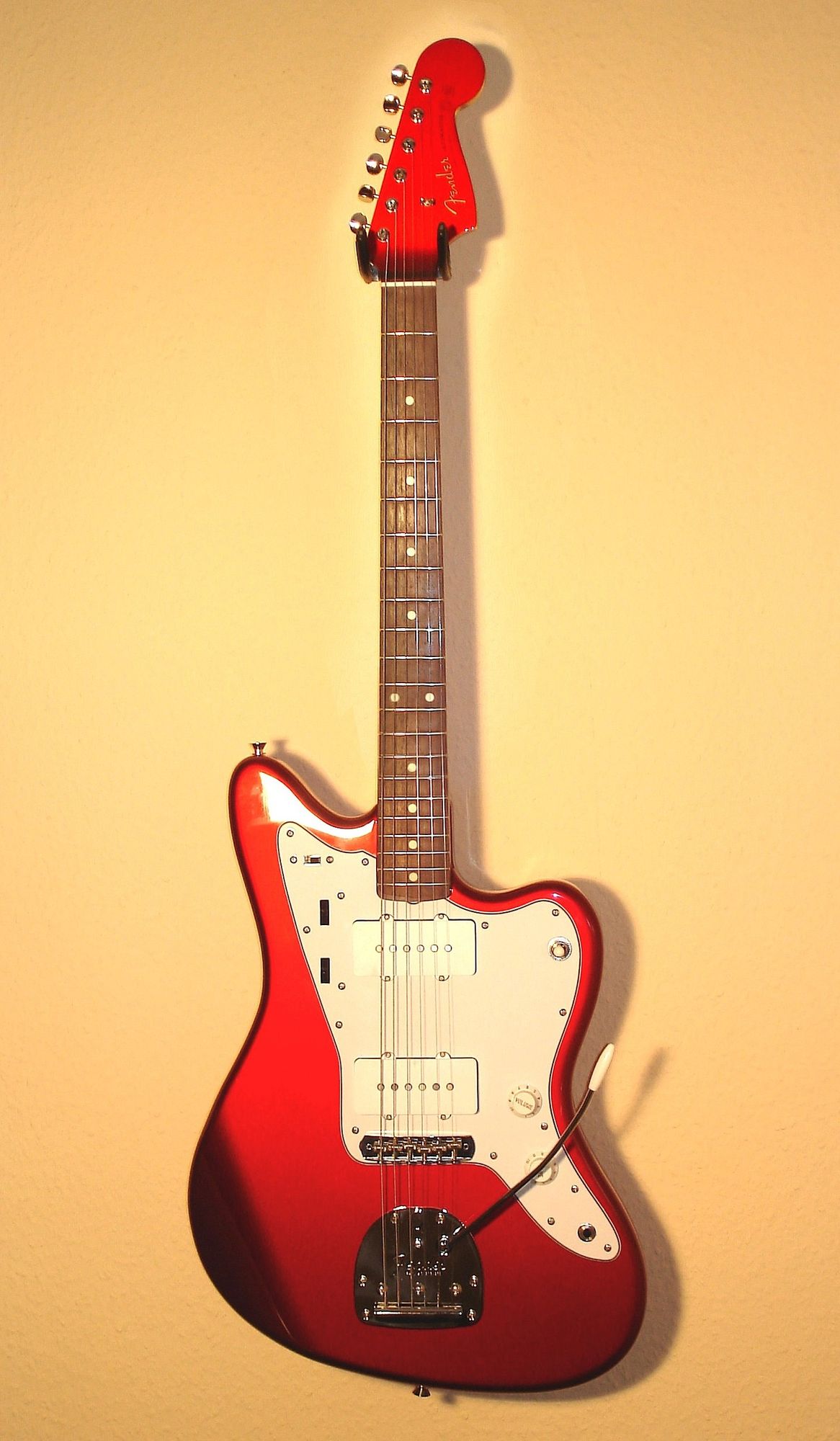
Photo: Dirk-X / Wikimedia Commons / CC BY-SA 4.0 Fender
Jazzmaster
1958
Fender built it for jazz players. Jazz players said no thanks. Surfers, punks, and noise bands said yes.

Photo: Weekly Dig / Wikimedia Commons / CC BY 2.0 Harmony
Stratotone
1952
In 1954 a Strat cost about $250. Harmony’s Stratotone cost $64.50, and it had the name first.
- Send a picture
Mosrite
Ventures
1963
Semie Moseley offered Nokie Edwards the guitar free. He paid $200, and the Ventures dropped their Jazzmasters.