Kay
Thin Twin
Kay gave it a catalog number. Chicago blues gave it a name: the Jimmy Reed.
Chicago, 1952. Kay is the volume house, turning out guitars for its own catalog and for Sears, Spiegel, and Montgomery Ward. This year there’s a new one on the counter: thin, single-cut, no f-holes, and two skinny pickups hiding under the guard. The factory calls it the K-161.
- Introduced
- 1952
- Type
- Hollowbody / thinline electric
- Class
- Production
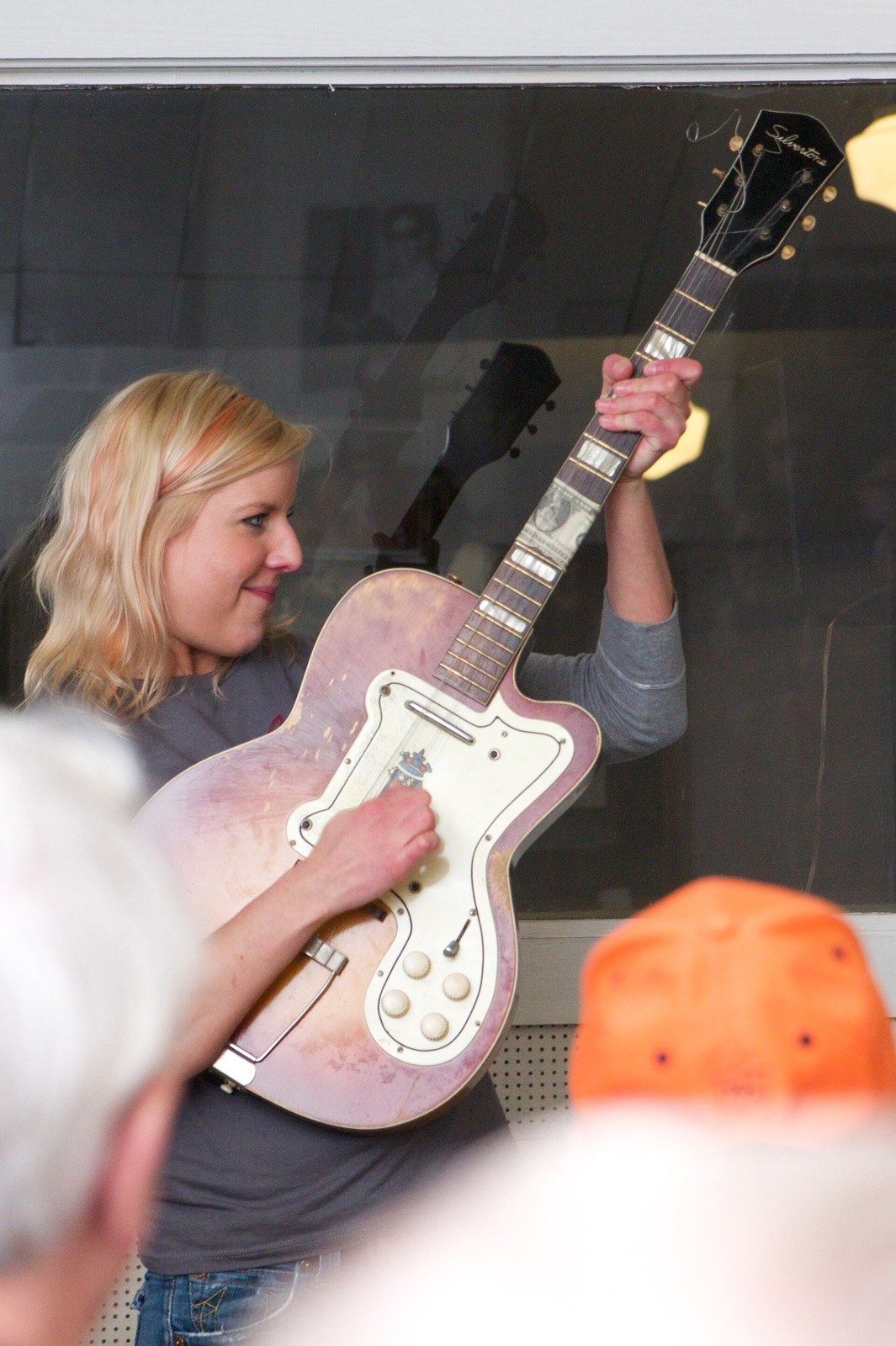
The short version
1952
The K-161
Kay’s thin single-cut arrives, “not long after Gibson’s Les Paul.” Some catalog counts start it in 1953.
1954
Sears gets one
The same guitar shows up in the Sears book as the Silvertone 1381.
1957
$175
The Kay catalog lists it in blonde curly maple, with a “full professional” scale.
1958
Gibson catches up
The ES-335 arrives from Kalamazoo. Different guitar, same idea of a thin electric.
1959
New number
Kay recatalogs the line and the Thin Twin becomes the K5910.
2009
Grammy night
T-Bone Burnett plays one behind Robert Plant and Alison Krauss at the Grammy Awards.
Side A
A1
A number in a catalog
Kay didn’t make guitars for heroes. Kay made guitars for catalogs. The company went back to a mandolin shop in 1890, and by the 1950s it was the Chicago factory that filled the pages of Sears, Spiegel, and Montgomery Ward.
So the Thin Twin spent its life as a string of numbers. At Kay it was the K-161. In the Sears book it was the Silvertone 1381, and later the 1369. Spiegel sold it as an Old Kraftsman. In 1959 Kay renumbered it K5910. Same guitar, different badge, different number, depending on which catalog you were holding.
Nobody walks into a shop today and asks for a K5910.
A2
Thin, for 1952
It turns up in 1952, or 1953, depending on whose count you trust. Gibson’s Les Paul had just come out, and here was Kay’s answer: a single-cut hollow body with no f-holes at all.
New super thin auditorium size is only 2 3/4″ deep.
That’s the 1957 catalog talking. Two and three-quarter inches is still a fair bit of guitar, and the “thin” in the name really belongs to the pickups. There are two of them, thin blades with big bobbins hiding under the pickguard so only a sliver shows. To my ear they’re bright and wiry, the kind of sound that cuts through a loud room.
You’ll hear the Thin Twin called the first semi-hollow electric, six years ahead of Gibson’s ES-335. Maybe. Nobody has put a factory drawing on the table, and the descriptions of what’s inside don’t agree. The 335 is a different animal anyway: double-cut, f-holes, a block of maple down the middle, Kalamazoo. This is a Chicago single-cut with two blades and no holes.
A3
The Jimmy Reed
Here’s how a catalog guitar gets a name. Jimmy Reed is pictured with one on an album cover, and the association with his loping shuffles did the rest. It stuck so hard that people don’t call it a K-161. They call it the Jimmy Reed.
Without Reed, this guitar might well have faded, the way most catalog guitars do. I can’t tell you which of his records it’s on, and I won’t guess. The name is the fact.
Flip the record · By the numbers
2¾″
Body depth. “Super thin,” said the catalog, for 1957.
2
Thin blade pickups. That’s the “twin” in the name.
$175
List price in the 1957 Kay catalog. The case was $21.60 extra.
6
Years between the Thin Twin and Gibson’s ES-335.
Side B
B1
Two guitars, no bass
Howlin’ Wolf had one too. His 1952 K-161 is in the Rock & Roll Hall of Fame now, and the Hall’s line on it is short:
He used this guitar at the beginning of his career.
Enough people connect him to it that the guitar sometimes goes by his name too, though Reed’s is the one that stuck.
His band is where the Thin Twin’s sound makes the most sense. Wolf’s guitarist Hubert Sumlin turns up alongside him in publicity shots with the Thin Twin, and he explained why the Kays mattered in that band: “For four years, Wolf didn’t have a piano or even a bass — just two guitars and drums, so Jody Williams and I coordinated our parts closely and decided that we would both play Kays.”
Two Kays, doing the whole band’s job.
One thing to keep straight. Wolf’s bassist, Andrew “Blueblood” McMahon, made Kay’s matching K-162 bass famous as the “Howlin’ Wolf” bass. That’s a bass. This is the six-string.
B2
What they call it now
The Thin Twin ran through the late ’50s, and in some form into the ’60s, depending who you ask. Kay itself was gone by 1968. In 2009 a reissue came out, listing at $1,075, and that same year T-Bone Burnett played a Thin Twin at the Grammys, behind Robert Plant and Alison Krauss. A catalog design from 1952, on network TV.
The catalogs gave it four numbers and a couple of different badges. None of them stuck. Ask anyone who knows old blues guitars what that thin blonde single-cut with no f-holes is, and they won’t read you a catalog number. They’ll say it’s a Jimmy Reed.
The cast
The people, and the specific guitars, that made the legend.
1950s
Jimmy Reed
The Jimmy Reed model
The man the guitar is named for, by the people who play it. Pictured with one on an album cover.
1952
Howlin’ Wolf
1952 Kay K-161
Used it at the start of his career. That guitar is now in the Rock & Roll Hall of Fame.
1950s
Hubert Sumlin
A Kay
Wolf’s guitarist. Turns up in publicity shots with Wolf and a Thin Twin, and says he and Jody Williams both played Kays.
1950s
Jody Williams
A Kay
Wolf’s other guitarist in the years with no piano and no bass. He and Sumlin matched Kays on purpose.
2009
T-Bone Burnett
Thin Twin
Played one backing Robert Plant and Alison Krauss at the Grammys.
1950s
Andrew “Blueblood” McMahon
Not this one
Wolf’s bassist played the matching K-162 bass. That’s the “Howlin’ Wolf” bass, not this guitar.
Liner notes
Specs, construction, rarity, value, and every source we used.
Two blade pickups on a 2¾-inch hollow with no f-holes — Kay’s Thin Twin, not an ES-335, and not the matching K-162 bass.
- Body
- Single-cut hollow; no f-holes; 2¾" (70 mm) deep. 1957 catalog: blonde curly maple top and back, dark mahogany sides. VintageSilvertones measured 15" wide, 41" overall. Mix flagged.
- Neck
- Set maple. Catalog: “Speed Demon.” VintageSilvertones: glued-on.
- Fingerboard
- Bound rosewood, block markers. VintageSilvertones measured 19 frets on a c. 1955. 2009 reissue: 20. Mix flagged.
- Scale
- 25¾" in the 1957 catalog. VintageSilvertones measured 25⅞". Reissue (Premier Guitar / Vintage Guitar): 26". Musician’s Friend reissue table: 24.75". Mix flagged.
- Pickups
- Two thin blade single-coils; large bobbins under the guard
- Hardware
- Trapeze tailpiece; thumbwheel / compensating bridge; 3+3 open-back tuners (Kluson Deluxe on VintageSilvertones’s 1955)
- Electronics
- Volume and tone per pickup; 3-way. Catalog: selector switch. VintageSilvertones: slider. Mix flagged.
- Finish
- Blonde curly maple typical. Sunburst and house-brand Silvertone exist.
- Nut
- 1.71" VintageSilvertones. Reissue: 1-11/16" bone (Premier Guitar). Mix flagged.
Open the full research fileConstruction details, the complete player record, production numbers, dated value estimates, and sources
Classic living example = 1950s Kay K-161 Thin Twin (Chicago). No current typical Thin Twin SKU this pass: Musician’s Friend and Amazon reissue pages are unavailable (fetched 3 September 2026). K-162 Electronic Bass is the matching bass, not this table. Silvertone 1381 / 1369 and Old Kraftsman are house-brand badges of this guitar. K5910 is the late-1950s recatalog number. No Gibson SKU. Mixed inch/mm flagged on Wikipedia’s 2¾" (70 mm) depth; scale and nut millimetres unpublished on the measured sources. Do not average 25¾" / 25⅞" / 26" / 24.75".
Construction
The job was a thinline electric Chicago could put on a counter next to a Les Paul. Hollow. No f-holes. Two blades under a firestripe guard. Gibson’s ES-335 was six years away.
Kay was already the volume house. Andrew Groeschel’s mandolin shop, 1890. Stromberg-Voisinet, 1921. Henry “Kay” Kuhrmeyer’s company, 1931 (Wikipedia). House brands for Sears, Spiegel, Montgomery Ward. The Thin Twin is that factory’s thinline, not a student slab and not a carved jazz box.
Wikipedia dates the K-161 to 1952, “not long after Gibson’s Les Paul,” single-cut, firestripe tortoiseshell guard, a pair of thin blade pickups. Premier Guitar’s 2009 reissue copy the same year. Reverb’s product page: years of production 1952–1959. VintageSilvertones: Thin Twin in the Kay catalogs 1953–1960. Keep 1952, 1953, and 1960. This plate starts in 1952.
The name is the pickups. Wikipedia: the body is larger than “thin” implies — 2¾" (70 mm) deep. The 1957 catalog, via VintageSilvertones: “New super thin auditorium size is only 2 3/4″ deep.” Twin thin blades, not a 335’s inch-and-a-half laminate. A large bobbin sits under the guard; Vintage Guitar (Pete Prown, December 2016, on the reissue) has only a sliver of coil showing, the rest mounted to bracing and guard with screws and grommets.
What you get is a single-cut hollow with a flat top and no f-holes. Wikipedia: free-floating arched back, two braces along the top; “believed to be the first semi-hollow electrics (i.e., thinline-hollowbody electric with solid center-block), predating the Gibson ES-335 by six years” — Wikipedia’s claim, citation-needed on that page, not a factory drawing in-hand. Prown on the reissue: internal parallel braces to cut feedback. Keep both. Not an ES-335 (gibson-es-335). Different year, different factory, different outline. The 335 is a double-cut laminate with f-holes and a maple stick through the middle, 1958, Kalamazoo. This is Chicago, single-cut, no f-holes, two blades. Ancestor in the thinline-electric job. Not that guitar. No Gibson SKU.
Not the K-162. Same year, matching “Electronic” bass — Wikipedia: first commercially available thinline-hollowbody electric bass, second production electric bass after the Precision. Howlin’ Wolf’s bassist Andrew “Blueblood” McMahon made it the “Howlin’ Wolf” bass. That is a bass. This table is six strings.
1957 catalog (VintageSilvertones): blonde curly maple top and back, dark mahogany sides, $175.00; 161C Keratol case $21.60. “Full professional 25 3/4″ scale.” Speed Demon neck. Twin adjustable pickups, 3-way. Historical list, not 2026 street.
VintageSilvertones dates the running changes: tortoise-shell guard 1953–57, black 1958–1960; earliest headstocks engraved Kay crest, then a raised logo. Silvertone 1381 in the Sears Spring/Summer 1954 book through early 1958; Spring/Summer 1957 becomes 1369 (Wikipedia). Old Kraftsman is Spiegel’s badge. Same guitar, other names.
Late 1950s Kay recataloged the line. Wikipedia: 1959 catalog, Thin Twin becomes K5910, Electronic Bass K5965; minor cosmetics until 1966, when Kay went budget-only. Facebook Kay-group dating (not a factory table): K5910 Thin Twin II catalogued only in ’59. Keep the range. Kuhrmeyer retired 1955; Sidney Katz took over; Elk Grove Village 1964; Seeburg 1965; Valco 1967; dissolved 1968 (Wikipedia).
2008–2009. Kay Guitar Company of California reissued twelve vintage models, Fritz Brothers (Wikipedia; Premier Guitar, 5 August 2009). Reissue copy: 26" rosewood, 12" radius, 20 frets, checkerboard binding, Kel-von-a-tor head, list $1,075 / MAP $799. Vintage Guitar, December 2016: list $1,175, China, about eight pounds, 26" scale. Musician’s Friend’s reissue table prints 24.75" — mix flagged, not averaged. Fritz Brothers’ Street Series listed the Thin Twin at $899. Those are reissue carts, not a 1952 Chicago guitar. Musician’s Friend and Amazon are unavailable this pass. Classic vs current: 1952 K-161 — 2¾" hollow, no f-holes, two blades — against no new Thin Twin you can order from a living Kay page in 2026.
Players
Do not hang a Gibson ES-335 on this plate. Do not recruit the K-162 bass as if it were this guitar. Do not flatten every Kay house-brand onto Jimmy Reed.
Jimmy Reed. The guitar this plate is named for. Vintage Guitar: irrevocably associated with the Chicago bluesman. Guitarist (Jamie Dickson, October 2023): were it not for that association with Reed’s loping shuffles, the K-161 might have faded. Equipboard and dealer copy: pictured on an album cover with one. guitarhq files the K-161 as the Jimmy Reed or Howlin’ Wolf model. Album-to-guitar credits for named Vee-Jay sides are unpublished here. The nickname is the fact.
Howlin’ Wolf. Rock & Roll Hall of Fame (10 June 2025 post): 1952 Kay K-161; “He used this guitar at the beginning of his career.” Recordmecca: owned and stage-played Kay, exhibited at the Rock Hall, the Delta Blues Museum, Chicago’s Museum of Science and Industry, and EMP; from the estate of Memphis promoter Andrew “Sunbeam” Mitchell; Club Ebony. Silvertone World: Wolf and Hubert Sumlin in 1950s–60s publicity shots holding the Thin Twin. Wikipedia’s Howlin’ Wolf page: he played a K-161 in his earlier years; that guitar “currently residing in the Rock & Roll Hall of Fame in Cleveland.” Named object. Not a session log for “Smokestack Lightning.”
Hubert Sumlin. Guitar World (March 1992): “I also had a Kay guitar. For four years, Wolf didn’t have a piano or even a bass — just two guitars and drums, so Jody Williams and I coordinated our parts closely and decided that we would both play Kays.” That is Sumlin on Kay, not a pinned K-161 serial. Silvertone World puts him in the Thin Twin publicity shots. Keep both.
T-Bone Burnett. Premier Guitar’s 2009 reissue copy, Musician’s Friend, and the Fritz Brothers page: Burnett played a Thin Twin backing Robert Plant and Alison Krauss at the 2009 Grammy Awards. Equipboard: photo with Plant and Krauss. Manufacturer copy plus a picture. Which songs on that stage are unpublished here.
Also known to play stays short. guitarhq and dealer pages repeat Reed / Wolf. None invented.
Rarity
You cannot buy a new Thin Twin from Kay of Chicago. The original run ended with the catalog. Living Kay-branded imports and the 2009 China reissues are other factories on this silhouette. They are not a 1952 K-161.
Kay did not publish Thin Twin unit totals. None invented. Date stamps and pot codes date a guitar. They don’t count a year. That is why a first-year census is unknown, not the chapter.
What is actually thinner: earliest engraved-crest headstocks; tortoise-guard 1953–57 examples VintageSilvertones treats as the first run; complete originals with the blades un-rewound. Reed’s photographed guitar and Wolf’s Rock Hall K-161 are unique objects. They are not a vintage Thin Twin.
Value
Informal estimate, 3 September 2026. Not an appraisal.
Ask vs sold labeled. Celebrity lots are not-comps. No invented medians or factory counts. Period $175.00 (1957 Kay catalog, VintageSilvertones) is 1950s money, not 2026 street.
New street. None under Thin Twin this pass. Musician’s Friend and Amazon reissue pages unavailable (fetched 3 September 2026). Historical reissue lists, not a 2026 cart: Premier Guitar 2009 $1,075 list / MAP $799; Vintage Guitar 2016 $1,175; Fritz Brothers Street Series $899. Roger Fritz USA custom (Kay Vintage Reissue, LLC, Reverb, listing ended): MSRP $2,995 — a shop guitar, not this table.
Used modern. China K161V reissues trade used. Named ask, not a 2026 hammer: a Very Good cherry-sunburst reissue $1,093.99. No clean Reverb Price Guide band isolated this pass. Don’t invent a midpoint.
Vintage / collectible. Reverb Price Guide exists on Thin Twin Jimmy Reed Blonde (years 1952–1959); the dollar widget was bot-blocked this pass. Flag: thin sold-comp access. Named ask, not a hammer: Strum Guitars 1955 natural $1,795. Named older sold listings, not a series: Silvertone 1381 $1,300 (listed nine years ago); 1952 K-161 $1,500 (same era of listing). Do not average those asks. Wolf’s Rock Hall guitar is one object. Not a comp.
See also
- gibson-es-335 — the 1958 Kalamazoo thinline this Chicago hollow is not
- harmony-stratotone — Chicago 1952 contemporary; solid H44, not this hollow
- silvertone-1448 — another Sears electric; Danelectro masonite, not Kay’s Thin Twin 1381
Sources
- Wikipedia, Kay Musical Instrument Company — K-161 debut 1952; firestripe guard; blade pickups; K-162 Electronic Bass 1952; Wikipedia “first semi-hollow / center-block, six years before ES-335” (citation-needed); K5910 / K5965 1959 catalog; until 1966; Silvertone and Old Kraftsman badges; Groeschel 1890 / Stromberg-Voisinet 1921 / Kay 1931; Katz 1955; Elk Grove 1964; Seeburg 1965; Valco 1967; dissolved 1968; Fritz reissues 2008–2009
- Wikipedia, Howlin' Wolf — K-161 in earlier years; Rock & Roll Hall of Fame, Cleveland
- Vintage Guitar, Pete Prown, Kay’s K161 Thin Twin (December 2016) — Jimmy Reed association; reissue ~8 lb; 26" scale; 12" radius; 20-fret bound rosewood, pearloid blocks; parallel braces; blade pickups under the guard; China; list $1,175
- Premier Guitar, Kay Now Shipping K161 Thin Twin Reissue, 5 August 2009 — originally 1952; Jimmy Reed / Howlin' Wolf nickname; 26" scale; 12" radius; 20 frets; 1-11/16" bone nut; list $1,075 / MAP $799; Plant/Krauss 2009 Grammy copy
- VintageSilvertones, Kay Thin Twin K161 c. 1955 — catalogs 1953–1960; tortoise 1953–57 / black 1958–1960; engraved crest then raised logo; 1957 catalog $175 / case $21.60 / 25¾" scale / 2¾" depth; measured 41" / 15" / 2.75" / 25⅞" / 1.71" nut / 19 frets
- Reverb Price Guide, Thin Twin Jimmy Reed Blonde — years of production 1952–1959; dollar widget bot-blocked this pass
- Guitar World, Hubert Sumlin interview, March 1992 — Kay guitar; four years with Jody Williams, both on Kays; Wolf without piano or bass
- Silvertone World, Howlin' Wolf & Hubert Sumlin — publicity shots with the Thin Twin
- Recordmecca, Howlin’ Wolf owned & stage-played Kay — Rock Hall / Delta Blues Museum / MSI / EMP; Sunbeam Mitchell estate; Club Ebony
- Rock & Roll Hall of Fame, 10 June 2025 — 1952 Kay K-161; beginning of career
- guitarhq, other makers / Kay — K-161 ThinTwin (Jimmy Reed or Howlin' Wolf model)
- Guitarist, Jamie Dickson, October 2023 — manufactured 1952–1959; Reed association
- Musician’s Friend, Kay Vintage Reissue Thin Twin — unavailable this pass; reissue table 24.75" / 1.69 in (43 mm); Plant/Krauss 2009 copy
- Fritz Brothers, Vintage Reissue Kay Guitars — Thin Twin and Electronic Pro Bass first reissues; Street Series Thin Twin list $899
- Kay Vintage Reissue, LLC, Roger Fritz USA K161VF (Reverb) — MSRP $2,995; listing ended; custom, not the Chicago table
- Strum Guitars, 1955 Thin Twin (Reverb) — ask $1,795; nut 1.67"; 19 frets on the product spec
Keep digging
Guitars this one gets compared to, confused with, or descended from.

Photograph of a vintage 1960 Gibson ES-335TD. Photo by Lightburst. Licensed under CC BY-SA 4.0. Via Wikimedia Commons. Gibson
ES-335
1958
Larry Carlton played three 335s off a shop wall, unplugged, paid $850 for one, and became Mr. 335.

Photo: Weekly Dig / Wikimedia Commons / CC BY 2.0 Harmony
Stratotone
1952
In 1954 a Strat cost about $250. Harmony’s Stratotone cost $64.50, and it had the name first.
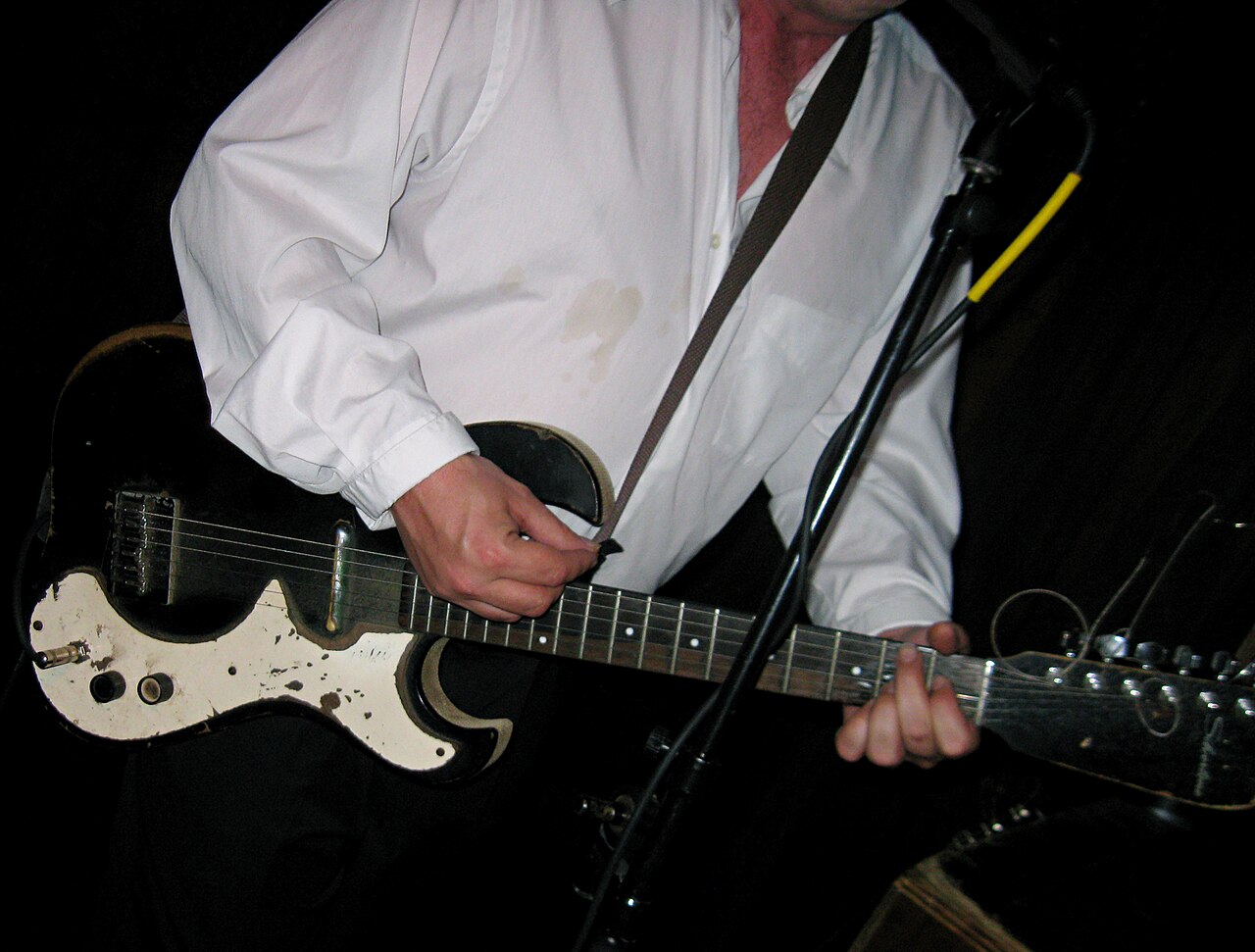
Photo: Rick Hall / Wikimedia Commons / CC BY 2.0 Silvertone
1448
1962
A beginner’s electric from the Sears catalog, with the amp in the case. Beck has played one his whole career.