Höfner
500/1
McCartney bought the bass he could afford in Hamburg. It was stolen in 1972, and it came home in 2024.
Hamburg, 1961. Paul McCartney needs a bass. The Fenders seem to cost about £100, and he can afford about £30. At the Steinway shop, a sales assistant named Günter Höper takes an order for something Höfner doesn’t even list: a left-handed violin bass.
- Introduced
- 1956
- Type
- Hollowbody electric bass
- Class
- Production
The short version
1955
A violin that plugs in
Walter Höfner designs an electric bass shaped like a violin.
1956
Frankfurt
Höfner shows the 500/1 at the Frankfurt Musikmesse. It has been in production ever since.
1961
Hamburg
McCartney orders a left-handed 500/1 at the Steinway shop. It becomes “the ’61.”
1963
The ’63
His second Höfner makes its first appearance on Ready Steady Go, 4 October.
1966
Candlestick Park
The ’63 plays the last show of the Beatles’ touring years, 29 August.
1969
The roof
The ’63, with a BASSMAN sticker on it, on the rooftop, 30 January.
1972
Stolen
The ’61 disappears from a van in Notting Hill on 10 October.
2024
Home
The ’61 comes back in February. On 19 December it plays “Get Back” at the O2.
Side A
A1
Thirty quid in Hamburg
Nobody buys a bass thinking it’ll be the one. You buy the one you can afford.
In 1961 Paul McCartney was in Hamburg, and he needed a bass. The Fenders seemed to cost about £100. He could manage about £30. He told the story himself, years later:
I got my violin bass at the Steinway shop… this bass that was quite cheap.
The Steinway shop was Steinway Musikhaus, and the sales assistant was Günter Höper. There was one problem. McCartney is left-handed, and Höfner didn’t list a left-handed 500/1. You can’t just flip one of these over, either; a right-handed violin bass turned upside down would need a new top. So it was ordered left-handed. That bass became “the ’61.”
A2
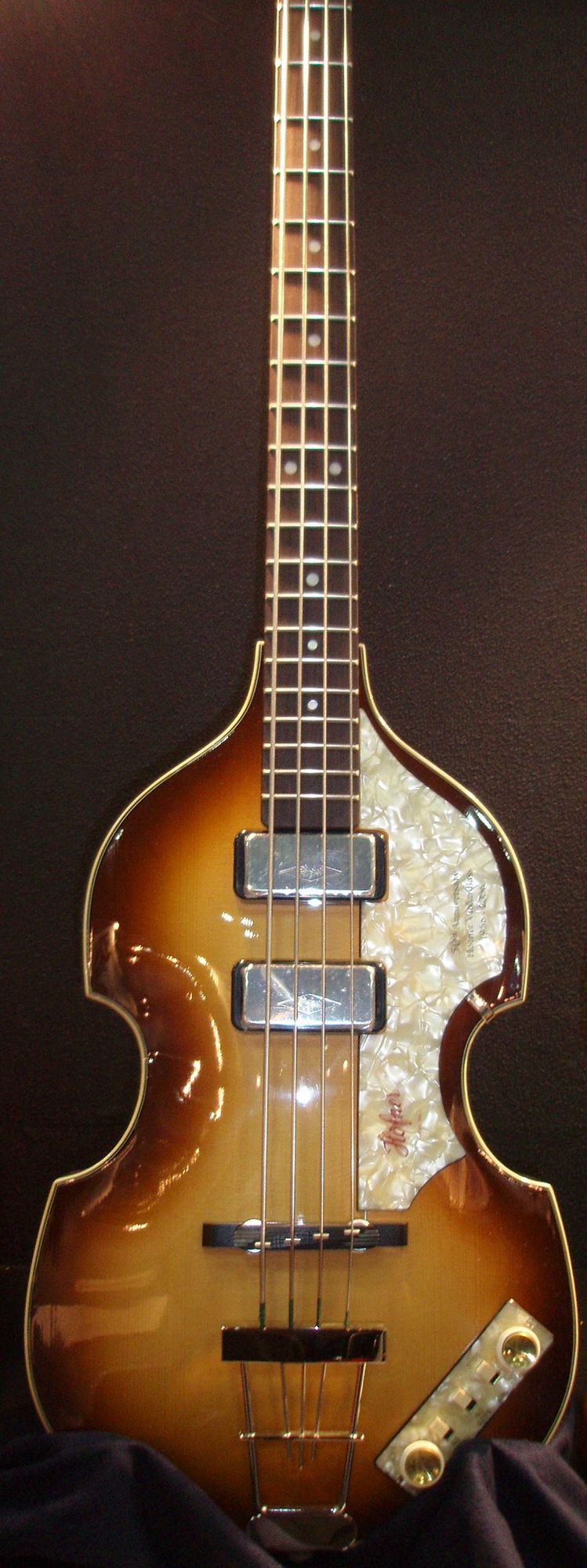
A violin with no f-holes
Walter Höfner designed the thing in 1955, and the company showed it at the Frankfurt Musikmesse in 1956. It has been in production ever since. It’s built like a small archtop, completely hollow, with no soundholes at all.
The scale is 30 inches. A Fender bass is 34. That means the frets are closer together, the strings are looser, and the whole thing is light. It doesn’t boom like a Precision. It thumps, round and warm and a little woody, and it gets out of the way fast.
On McCartney’s ’61, the two pickups sat close together up toward the neck, which pushes the sound further toward that warm thump.
The model kept changing around him. In early 1962 Höfner dropped those close-set pickups and moved the treble one to the bridge. By 1963 there were new “staple” pickups. McCartney’s ’61 was built before all that. His next one would have all of it.
A3
The ’61 and the ’63
People mix these two up all the time, so here’s the short version.
The ’61 is on the first two Beatles albums and the singles through “She Loves You.” In the summer of 1963 McCartney ordered a replacement. The ’63 first turned up on Ready Steady Go on 4 October 1963. It was the second left-handed one Höfner built him: an arched back, strip tuners, a two-piece neck, staple pickups, and the treble pickup down at the bridge.
The ’63 became his number one. It did the live shows and TV through Candlestick Park on 29 August 1966, and in the studio it played on almost everything until a Rickenbacker 4001 came in, in 1965. Sometime between the DC Stadium show on 15 August 1966 and Philadelphia the next day, its pickguard came off.
On the rooftop, on 30 January 1969, that’s the ’63, with a BASSMAN sticker on it. Not the ’61.
Flip the record · By the numbers
£30
About what McCartney could afford in 1961. The Fenders seemed to cost about £100.
30"
Scale length. A Fender bass is 34". Short, hollow, and light.
1972
The year the ’61 was stolen. It came home in 2024.
1956
First shown at the Frankfurt Musikmesse. Höfner has made it ever since.
Side B
B1
The backup that went missing
The ’61 became the spare. In the spring of 1964 it got an overhaul: a respray, a new combined pickup housing, new knobs. It was in the “Revolution” promo film in 1968. It was at Twickenham for the Get Back filming in January 1969. When the sessions moved to Apple, it didn’t turn up, at least not on camera.
On 10 October 1972 it was stolen from a van in Notting Hill. For more than fifty years, that was the end of the story.
B2
Back from the attic
In February 2024 it turned up in an attic on England’s south coast. Höfner authenticated it. McCartney’s own site put out the news in one plain sentence:
Paul’s 1961 Höfner 500/1 bass guitar, which was stolen in 1972, has been returned.
On 19 December 2024, at the O2 Arena in London, he played it on “Get Back.” Its first time on a stage in fifty years.
And the ’63? When Elvis Costello was working with McCartney in the late ’80s, on Flowers in the Dirt, he asked him to take it out again. It’s still the bass he plays onstage: the real one, not a copy.
Höfner still builds the 500/1 in Germany, including a “Cavern” version laid out like the ’61. It’s a lovely bass, and it’s a new one. The McCartney family of Höfners has grown too: there’s a Union Jack one from the 2012 Jubilee and a 1967 he picked up after a private show in 2016.
He bought the ’61 because it was the one he could afford. Sixty-odd years later, it’s the one nobody could replace.
Put this on
You’ve read about it. Now hear it. Here’s what this guitar sounds like, and what to listen for.
She Loves You
The ’61, the Hamburg bass. It’s on the first two albums and the singles up to and including this one.
Find it on YouTube (opens in a new tab)The rooftop concert
The ’63, not the ’61. Look for the BASSMAN sticker on it. The ’61 had been at the Twickenham filming earlier that month and wasn’t seen after the move to Apple.
Watch it on YouTube (opens in a new tab)Get Back (live at the O2)
The ’61, stolen in 1972, back on a stage for the first time in fifty years.
Watch it on YouTube (opens in a new tab)
The cast
The people, and the specific guitars, that made the legend.
1961
Paul McCartney
The ’61 and the ’63
Two left-handed 500/1s. The ’61 made the early records and was stolen in 1972. The ’63 took over in late 1963, played Candlestick Park and the roof, and it’s still his main live bass.
1955
Walter Höfner
Designer
Designed the violin-shaped electric bass that Höfner first showed in 1956.
1961
Günter Höper
Sales assistant, Steinway Musikhaus
Took McCartney’s order in Hamburg for a left-handed bass Höfner hadn’t cataloged.
1988
Elvis Costello
The man who asked
Asked McCartney to take the Höfner out again during their work on Flowers in the Dirt.
1960
Stuart Sutcliffe
A different Höfner
The Beatles’ first bassist played a Höfner too, but a Club/President-shape 500/5, not a violin bass.
Liner notes
Specs, construction, rarity, value, and every source we used.
The violin bass McCartney made famous — Höfner 500/1, hollow short-scale, not a Precision and not a Rickenbacker 4003.
- Body
- Fully hollow violin shape; spruce top; flamed maple back and sides; no soundholes; no centerblock; black/white/black top and back binding
- Neck
- Set maple (Thomann: 3-piece); joint at 16th fret; white neck binding (Höfner’s distinction for this SKU vs the other German violin basses)
- Fingerboard
- Rosewood, pearl dots, 22 frets
- Scale
- 30" / 762 mm — short; not 34"
- Pickups
- Two Höfner staple nickel humbuckers (neck + bridge — post-1962 layout)
- Hardware
- Ebony Höfner bridge; trapeze nickel tailpiece; strip nickel machines; pearloid pickguard (Thomann: supplied not mounted)
- Electronics
- Passive Höfner pearl panel, gold-top knobs
- Finish
- Sunburst; Made in Germany; case included
- Nut
- 42 mm
Open the full research fileConstruction details, the complete player record, production numbers, dated value estimates, and sources
SKU H500/1-64-0, from Höfner’s Violin Bass shop and Thomann (fetched 25 Aug 2026). Fully hollow. Not a 34-inch Fender. Not a Rickenbacker 4003. H500/1-61-0 Violin Bass ‘Cavern’ is a current named Höfner SKU (close-spaced Diamond nickel pickups, rugby-ball tuners, unbound board, 2.31 kg) — labeled on this plate, not a second encyclopedia page. HCT Contemporary has a spruce centerblock — not this table. Ignition is the Asian budget line. 500/2 Club is a different body.
Construction
Karl Höfner GmbH. Walter Höfner designed an electrically amplified violin-shaped bass in 1955; the company first showed the 500/1 at the Frankfurt Musikmesse in 1956 and has kept it in production since (hofner.com Violin Bass category). Hollow, no soundholes, short 30" scale. Built like a small archtop, not a bolt-on Fender and not a Santa Ana neck-through.
Not a Precision. Not a Jazz Bass. Not a 4003. Scale is 30", not Fender’s 34" and not RIC’s 33.25". Body is hollow violin, not a contoured alder slab and not a solid maple 4003. McCartney later owned a left-handed 4001S (1965) — that bass lives on the 4003 plate as a 4001/4001S story, not here.
Pickup layout is not one frozen “Cavern vs everything else” cartoon. vintagehofner.co.uk: the 1956 catalogue and surviving first instruments show pickups widely spaced (neck and bridge). Close-spaced “Cavern” pickups toward the neck appear soon after (c.1956/57 examples). Wikipedia compresses the pre-1962 years as stacked-at-the-heel; that misses the 1956 catalogue. Early 1962: Type 3 “Cavern” pickups discontinued; Type 510B “Diamond Logo”; treble pickup moved to the bridge. 1963: Type 511 “Staple” on documented examples (vintagehofner). McCartney’s ’63 bass (Wass): arched back, strip tuners, two-piece neck, new headstock logo, staple humbuckers, bridge pickup at the bridge.
Other dated changes, not a SKU dump: vertical logo replacing inlaid ebony fascia c.1957–58; truss rod by 1960; 22 frets from 1960 on vintagehofner’s 1960 notes (beatlebassdealer: 22 from 1960 — keep as specialist dating, not a factory census). Pearloid guard/console and individual tuners around 1961. Raised plastic logo phased in 1964. Wider console from mid-1965. Type 512 blade pickups 1967. Spanish-licensed Keller bodies: vintagehofner five hundred 500/1s 1963–73 — that count is theirs, not a Höfner census.
Current German line is year-dated recreations of this one model, not a different bass. Live shop (25 Aug 2026): H500/1-61-0 ‘Cavern’ and lefty; H500/1-62 ‘Mersey’; H500/1-63 Artist; H500/1-64-0 / ’64 Relic; Rooftop ’69; Vintage relics. Cavern/Hamburg originals and the living Cavern SKU stay on this plate. Do not invent a second slug. Ignition / Ignition Cavern (Asia) and HCT (centerblock) are labeled adjacent. Club 500/2 (1964) is not a 500/1.
Players
Paul McCartney — 1961 500/1 (“the ’61” / Cavern bass) and 1963 500/1 (“the ’63,” his #1). Identity instrument for this plate. Not a Precision. Not the 4001S.
1961, Hamburg. Wass (Guitar World, 13 July 2022 / updated 16 Feb 2024): Steinway Musikhaus, Collonaden 29; sales assistant Günter Höper; ordered left-handed — Höfner had not catalogued a lefty 500/1; Wass: no evidence of a speculative lefty already in stock, and a righty flipped would need a new top. McCartney, Guitarist September 1993 (via Wass): “I got my violin bass at the Steinway shop… this bass that was quite cheap.” Same interview via Wikipedia: Fenders seemed about £100; he could afford about £30. Close-spaced pickups. Wass: first two Beatles albums and singles through She Loves You. Replacement ordered summer 1963; ’63 first seen Ready Steady Go, 4 October 1963.
1963 bass. Wass: second factory lefty; arched back, strip tuners, two-piece neck, staples, bridge pickup moved. Live/TV through Candlestick Park, 29 August 1966. Studio: almost all records until the Rickenbacker 4001 in 1965. Pickguard off between DC Stadium 15 August 1966 and JFK Stadium Philadelphia the next day (Wikipedia, citing period photos). Rooftop, 30 January 1969: the ’63 with a BASSMAN sticker (Wass). Costello asked him to take it out again on Flowers in the Dirt (1988); Wass: it is still the live #1, not a copy.
The ’61 after 1963. Backup. Spring 1964 Sound City overhaul (Wass): respray, combined pickup housing, radio knobs. Revolution promo 1968; Get Back/Let It Be filming at Twickenham, then not seen at Apple. Stolen from a van, 10 October 1972, Notting Hill (Lost Bass Project via Guitar World, 16 Feb 2024). Recovered February 2024 from a south-coast attic; authenticated by Höfner; McCartney’s site: “Paul’s 1961 Höfner 500/1 bass guitar, which was stolen in 1972, has been returned.” First stage use in fifty years: O2 Arena, London, 19 December 2024, Get Back (MusicRadar, 20 Dec 2024). Artist-owned — not a comps tape.
Wass’s other McCartney Höfners (Jubilee 2012 Union Jack on a stock v62 Mersey; a 1967 bought after a 2016 private show) are the same model family, not separate encyclopedia objects.
Not this guitar. Stuart Sutcliffe’s Höfner was a 500/5-class Club/President-shape bass, not a 500/1. Tina Weymouth’s MET instrument is a 500/2 Club. Jamerson / Dunn / Kaye stay on the Precision. Geddy’s Number One is a Jazz Bass; his Ricky is a 4001. Lemmy is not a violin bass.
Rarity
The 500/1 as a current model is not scarce. German year-dated SKUs, HCT, and Ignition are regular catalog. Official lifetime totals are unpublished. Serials date instruments; they are not a census. vintagehofner’s closed owner register is a sample, not a factory run.
Scarcity is early German originals, especially 1956–61 close-pickup “Cavern” examples, first-year wide-pickup 1956s, and left-handed 1960s pieces. Blonde 500/1s: vintagehofner “about 10” from “authoritative information” — attributed, not a factory total. Spanish Keller 500/1s (500, 1963–73, vintagehofner) are a licensed subset, not Höfner Germany. McCartney’s two lefties are a separate market. A current H500/1-61-0 Cavern is a German reissue, not a 1961 Hamburg original.
Value
Informal estimate, 25 August 2026. Not an appraisal.
Asking prices are not sold prices. 2024–26 Reverb sold histograms were not extracted this pass. Prefer labeled dealer asks. McCartney instruments are not comps. Ignition is not German money. HCT is not fully hollow 500/1 money. A Cavern reissue is not a 1961.
New street. Thomann US (live 25 Aug 2026): German H500/1-64-0 about $3,222; ’64 Relic $3,399; ’62 Mersey $2,899; Rooftop ’69 $3,199; Artist about $2,111. Ignition SE / Ignition Cavern SE $389 — adjacent. Sweetwater Ignition (discontinued page) last $349.99. Equipboard German ‘61 Cavern new $3,536.12 / used $2,792.34 (12 June 2026 scrape) — marketplace, not a sold median.
Used modern. German 1990s–2020s recreations sit under new street when they sell; no clean 2024–26 Reverb sold band captured. Do not invent one.
Vintage / collectible. Bass Direct 1964 500/1 £3,299 ask (jack replaced, neck-pickup repair). Vintage Rare & Retro 1964 £2,650 (sold-out listing; neck reset; jack and added heel strap button). Equipboard 1963–66 “1965 Violin” used average $2,150 (12 June 2026) — marketplace average, not a hammer. guitarprice.net 2026 compilation: 1960s 500/1 $3,000–$8,000+ — aggregator, not a sold table. Left-handed 1960s asks sit above right-handed; no 2024–26 public lefty hammer isolated here.
See also
- fender-precision-bass — Leo’s 34-inch bolt-on; the bass this hollow 30" violin is not
- fender-jazz-bass — Fender’s second 34-inch four-string; offset slab, two skinny singles
- rickenbacker-4003 — 33.25" Santa Ana neck-through; McCartney’s later 4001S is that family, not this Höfner
Sources
- Höfner, The Violin Bass — 1956 Frankfurt Musikmesse; continuous production; 30" short scale; German reissues vs Ignition
- Höfner H500/1-61-0 ‘Cavern’ — current named Cavern SKU: spruce/flamed maple, no centerblock, 30"/42 mm, 22 frets, close Diamond nickels, rugby-ball tuners, 2.31 kg
- Höfner H500/1-63-AR Artist — German Artist: two-piece maple neck, 30"/42 mm, 2.39 kg
- Höfner H500/1-64-RLC ‘64 Relic’ — 30"/42 mm, 2.24 kg, aged sunburst
- Thomann, H500/1-64-0 — current ‘64 spec + $3,222 (25 Aug 2026); compare Artist $2,111, Mersey $2,899, Ignition $389
- Long & McQuade, 500/1 64 — white celluloid neck binding as the German-64 distinction; fully hollow; 30"/42 mm
- vintagehofner.co.uk, 500/1 gallery — 1956 wide pickups vs later Cavern close-spacing; 1962 diamond + bridge pickup; 1963 staples; Keller 500 (1963–73); blonde “about 10”
- Nick Wass, Guitar World — Steinway / Höper / lefty order; ’61 vs ’63; RSG 4 Oct 1963; 4001 1965; rooftop ’63; Flowers in the Dirt; Jubilee / ’67
- Guitar World, Lost Bass found — stolen 10 Oct 1972; recovered Feb 2024; McCartney site quote
- MusicRadar, O2 19 Dec 2024 — ’61 onstage Get Back
- Wikipedia, Höfner 500/1 — lead only (1955 design / 1956 show; McCartney quotes; 4001S 1965). Pre-1962 pickup paragraph is compressed against vintagehofner’s 1956 catalogue
- MET, 500/1 Violin Bass — c.1962 example: 30", hollow, staple humbuckers, pearl panel (two volumes, pickup on/off, rhythm/solo)
- Sweetwater, Ignition Violin Bass — discontinued page; last $349.99
- Bass Direct, 1964 500/1 — £3,299 ask
- Vintage Rare & Retro, 1964 500/1 — £2,650 sold-out ask
- Equipboard, 1965 500/1 — used average $2,150 (12 June 2026)
- Equipboard, 500/1 ‘61 Cavern — new $3,536.12 / used $2,792.34 (12 June 2026)
- guitarprice.net Höfner — 2026 compilation; 1960s $3–8k+; not solds; Club/Weymouth bleed in the FAQ — ignore that list
- Wikimedia Commons, Anniversary Cavern RH — CasinoKat, CC BY-SA 3.0; Cavern-layout reissue, not a 1961 original
RH.jpg)
Keep digging
Guitars this one gets compared to, confused with, or descended from.

Photo: Infrahertzz / Wikimedia Commons / CC BY-SA 3.0 Fender
Precision Bass
1951
Leo’s bass let the player at the back be heard. You know their lines by heart. You mostly don’t know their names.

Fender Jazz Bass from 1966 in Olympic white with the transition fingerboard (bindings and dot inlays). Photo by Th. Ott. Licensed under CC BY-SA 3.0. Via Wikimedia Commons. Fender
Jazz Bass
1960
Built for jazz players who mostly passed on it. Then bass players started using it to take the solo.
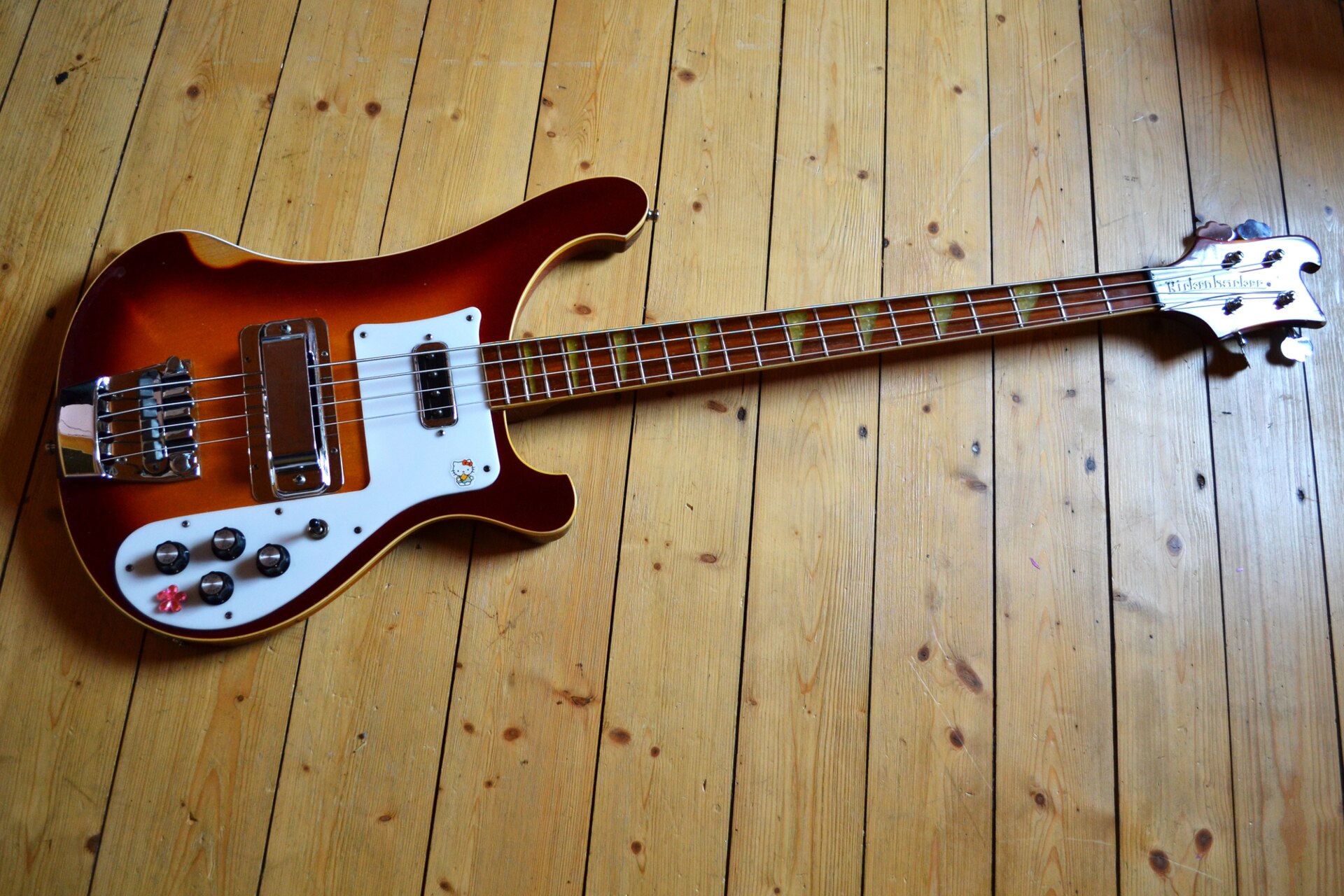
Rickenbacker 4003 (33 1/4" scale). Photo by DeLerkim. Licensed under CC BY-SA 2.0. Via Wikimedia Commons. Rickenbacker
4003
1980
Rickenbacker’s first answer to players’ new strings was to void the warranty. The 4003 was the better answer.