Gibson
Les Paul
Standard
Gibson made about 1,500 sunburst Les Pauls, decided nobody wanted them, and stopped. Then the British blues boom happened.
Kalamazoo, early 1950s. A radio repairman out in California is selling solidbody electrics as fast as he can build them, and the grand old archtop company in Michigan can’t let that stand. Gibson needs a solidbody. It needs a name. It gets both, and it takes the world about fifteen years to notice.
- Introduced
- 1952
- Type
- Solidbody electric
- Class
- Production

The short version
1952
The Goldtop
The Les Paul Model arrives, finished in gold, with two P-90 pickups.
1957
Humbuckers
The goldtop gets PAF humbuckers and a Tune-O-Matic bridge. The recipe is done.
1958
Sunburst
Gibson swaps the gold for cherry sunburst over a maple top. This is “the Burst.”
1961
Gone
The single-cut is dropped. The new, thinner double-cut is sold as the Les Paul.
1964
Ed Sullivan
Keith Richards plays a ’59 Burst with a Bigsby on the Stones’ Sullivan debut.
1966
The Beano album
Clapton plays a Burst on Blues Breakers. That summer it’s stolen. It has never turned up.
1968
Back by demand
Gibson brings the single-cut back. Players had been hunting the old ones for years.
1969
Number One
Jimmy Page buys a Burst from Joe Walsh and plays it with Led Zeppelin for the rest of the band’s life.
Side A
A1
Gibson blinks
Companies like to think they decide which guitars become classics. They don’t. Players do, usually years later, usually with a guitar the company already gave up on. Take the Les Paul.
In the early 1950s, Gibson was the serious guitar company. Big carved archtops, beautiful acoustics, made in Kalamazoo by people who’d been doing it forever. Then Leo Fender started selling a plank of ash with a neck screwed onto it, and people bought it.
Ted McCarty, who ran Gibson, said it straight: they built a solidbody because Fender already had one, and Gibson didn’t want to leave that field open. McCarty’s people worked on it for about a year. Then he went to the biggest guitar star in America, Les Paul, who was at the top of the charts with his wife, Mary Ford, and offered him his name on the headstock.
Plenty of people assume Les Paul designed it. McCarty was clear about that:
He never saw it before I took it down there.
Les asked for a different tailpiece. That was about it. The homemade “Log” Les built in the early ’40s is a great story too, but it isn’t this guitar.
A2
Gold, then sunburst
The first one, in 1952, was the Les Paul Model, finished in gold, with two P-90 single-coils. In 1957 Gibson gave it the new humbucking pickups, stamped “Patent Applied For,” which is why everybody calls them PAFs, and a Tune-O-Matic bridge. Now it had the sound.
It still wasn’t selling. Gibson shipped 2,245 goldtops in 1953. By 1957 it was down to 598. So in 1958 they tried something else: cherry sunburst over a carved maple top, the maple grain showing through. On some guitars the grain was plain. On some it was flamed like tiger stripes. Gibson didn’t pick the flashy ones on purpose. You got what you got.
The red dye they used faded in sunlight. Over the years a lot of those cherry sunbursts turned lemon, honey, or tobacco. Lift the pickguard on an original and the red is often still hiding underneath. No two Bursts look alike now, and that’s a big part of why people lose their minds over them.
Gibson built about 1,500 of the most desired electric guitars ever made, and then decided the design was a dud.
A3
Gibson gives up
The sunburst Standard didn’t save it. Late in 1960 Gibson dropped the single-cut body. The new thin, double-cut guitar kept the Les Paul name until about the end of 1963. After that, it was just the SG. The Les Paul, the heavy carved single-cut, was done.
That’s the whole run. Three years, only one of them a full year, and about 1,400 to 1,700 guitars depending on who’s counting. Gibson never published a list.
Flip the record · By the numbers
2,245
Goldtops Gibson shipped in 1953. By 1957, it was down to 598.
~1,500
Sunburst Standards from 1958–60. Estimates run from about 1,400 to 1,700.
3
Years of Burst production. Only 1959 was a full year.
$265
The 1958 list price. The case was $47.50 extra.
Side B
B1
The Beano album
What brought it back wasn’t Gibson. It was a bunch of British kids who’d been listening to American blues.
Keith Richards had a ’59 Burst with a Bigsby on the Stones’ Ed Sullivan debut in October 1964. Then in 1966 Eric Clapton recorded Blues Breakers with John Mayall on a sunburst Les Paul cranked through a Marshall, and every guitar player in England heard it. The album cover shows Clapton reading a Beano comic, so the guitar became the Beano Burst. That summer it was stolen from a church hall in north-west London during Cream rehearsals. It’s never been found.
Billy Gibbons saw that album cover and went looking for his own. In 1968 he found “Pearly Gates,” paid for by selling a 1936 Packard, and he says it’s on every ZZ Top studio record since.
B2
Everybody wants one
By the late ’60s, a used Burst was the guitar. Mike Bloomfield traded his ’54 Goldtop for a ’59 and debuted it at Monterey Pop in 1967, and a lot of people give him credit for starting the whole vintage-guitar craze. Peter Green played a 1959 with a weird, hollow, out-of-phase sound in the middle position. Some say the factory put a pickup in backwards; some say somebody flipped a magnet later. It went to Gary Moore, and eventually to Kirk Hammett.
In 1969 Jimmy Page bought a Burst from Joe Walsh. That’s “Number One.” According to the Metropolitan Museum of Art, it was at every Led Zeppelin performance and on every recording from 1969 to the 2007 reunion. In September 1970 Duane Allman, after a show in Daytona, traded his 1957 Goldtop for a 1959 Burst and moved his old pickups into the new guitar.
Gibson had noticed. In 1968 they brought the single-cut Les Paul back, at first as a goldtop with P-90s, like the ’50s version. It wasn’t a Burst reissue, but it was a start.
B3
Not a Burst
Walk into a shop today and you can buy a new Les Paul Standard made in Nashville. Solid mahogany, carved maple top, two humbuckers, and a choice of ’50s or ’60s neck. It’s a great guitar. Gibson’s Custom Shop will sell you a laser-scanned copy of a ’59 with aged plastic and a color-matched finish, which is closer.
But neither one is a Burst. A Burst is one of those 1,500 or so guitars from 1958 to 1960 that Gibson didn’t think anyone wanted. Most of the famous ones have names. A couple are still missing.
Gibson made the Les Paul. It took a handful of kids in London and Chicago, playing secondhand guitars through loud amps, to make it matter. Nobody at the factory voted for the Burst. The players did, one record at a time, and the company followed them.
Put this on
You’ve read about it. Now hear it. Here’s what this guitar sounds like, and what to listen for.
Hideaway
From the “Beano” album, the Burst cranked through a loud amp. This is the sound that sent a generation looking for old sunburst Les Pauls. The guitar was stolen that summer and never found.
Find it on YouTube (opens in a new tab)The Supernatural
Peter Green on “Greeny,” from A Hard Road. This is the guitar with the strange out-of-phase middle sound that nobody can fully explain. Listen to how vocal and restrained Green plays it.
Find it on YouTube (opens in a new tab)La Grange
Billy Gibbons says “Pearly Gates,” the ’59 he bought by selling a 1936 Packard, is on every ZZ Top studio album.
Find it on YouTube (opens in a new tab)Led Zeppelin II
The record Jimmy Page made after buying “Number One” from Joe Walsh. The whole album, not one song.
Find it on YouTube (opens in a new tab)
The cast
The people, and the specific guitars, that made the legend.
1966
Eric Clapton
The “Beano” Burst
On Blues Breakers with Eric Clapton. Stolen from a church hall that summer during Cream rehearsals. Never found.
1967
Mike Bloomfield
1959 Standard
Traded his ’54 Goldtop for it and debuted it at Monterey Pop. Vanished in the mid-’70s.
1966
Peter Green
“Greeny”
A 1959 with a strange out-of-phase sound nobody can fully explain. Later owned by Gary Moore, then Kirk Hammett.
1968
Billy Gibbons
“Pearly Gates”
Named after a 1936 Packard whose sale paid for it. On every ZZ Top studio album, he says.
1969
Jimmy Page
“Number One”
Bought from Joe Walsh. The Met says Page played it at every Zeppelin show and on every record from 1969 to the 2007 reunion.
1970
Duane Allman
1959 Cherry Sunburst
Traded his ’57 Goldtop for it after a show in Daytona, and moved the old pickups into it.
Liner notes
Specs, construction, rarity, value, and every source we used.
The current USA Standard is a non-weight-relieved mahogany/maple single-cut with Burstbuckers — a working guitar that sits next to the Burst market, not in it.
- Body
- Single-cut; non-weight-relieved mahogany with carved maple cap (figured on Heritage Cherry Sunburst 50s). Single-ply binding on top and fretboard. No weight relief.
- Neck
- Set mahogany; 50s Vintage profile.
- Fingerboard
- Bound Indian rosewood; 22 medium jumbo frets; acrylic trapezoids; 12.0 in (304.8 mm) radius. End-of-board 57.4 mm / 2.26 in.
- Scale
- 24.75 in / 628.65 mm
- Pickups
- Burstbucker 1 (neck) / Burstbucker 2 (bridge); Alnico 2; nickel covers
- Hardware
- ABR-1 Tune-O-Matic; aluminum Stop Bar; nickel. Vintage Deluxe tuners with Keystone buttons. Cream pickguard. Gold Top Hat knobs with dial pointers.
- Electronics
- 2 volume, 2 tone; 3-way toggle; 1/4 in jack. Hand-wired audio-taper pots and Orange Drop capacitors.
- Finish
- Gloss nitrocellulose lacquer (Heritage Cherry Sunburst, Goldtop, Tobacco Burst, etc.). Faded 50s is satin nitro.
- Nut
- Graph Tech, 43.05 mm / 1.69 in
Open the full research fileConstruction details, the complete player record, production numbers, dated value estimates, and sources
Current USA Original Collection Standard 50s. The 60s keeps the same body and wiring; it swaps SlimTaper, Grover Rotomatic kidneys, and a 60s Burstbucker pair (Alnico 5). Neither is a 1958–60 Burst, and neither is a Custom Shop Historic reissue.
Construction
The Standard did not start as a sunburst humbucker guitar. 1952: Les Paul Model, gold, two P-90s, trapeze, developed with Les Paul in Kalamazoo. 1954 adds the Custom (“Black Beauty”) and the Junior. 1955: Special. The layout most people mean by “Standard” lands in 1957, when the goldtop gets PAF humbuckers and a Tune-O-Matic.
Sunburst Standards from 1958–60 are the Burst. Vintage only. See the sidebar. Do not shop a current USA Standard, or a Historic reissue, as if it were one.
Late 1960 / 1961 Gibson dropped the single-cut. The double-cut “SG” body shipped as a Les Paul until about the end of 1963. That guitar is not a current SKU.
The single-cut came back in 1968 as a Goldtop “Standard” with P-90s and Tune-O-Matic — ’55–’57 style — plus a two-humbucker Custom. Reverb News dates the launch to June 1968 NAMM / July 1968 to dealers. It was not a 1959 Burst reissue. 1969: Deluxe with mini-humbuckers; some Norlin-era models use pancake mahogany/maple/mahogany. Studio arrives 1983.
Current typical Standard is the USA Original Collection 50s or 60s, Nashville. Solid mahogany, carved maple cap, no CNC weight relief. Original 1950s bodies were the same sandwich without CNC chambers. Forum arguments about 9-hole vs chambered vs solid are not factory spec for this SKU. “Vintage wood is lighter” shows up as anecdote (Vintage Guitar quoting Vic DaPra) without published weight stats.
50s: “50s Vintage” neck, Burstbucker 1/2 (Alnico 2), Vintage Deluxe Keystones, gold Top Hats with dial pointers. 60s: SlimTaper, 60s Burstbuckers (Alnico 5), Grover Rotomatic kidneys. AA figured maple is specified on the 60s Bourbon Burst. Burstbuckers are a factory claim, not a vintage PAF clone claim. Current USA nitro is modern gloss (or satin Faded), not period-correct aniline sunburst chemistry.
Modern Collection variants add Ultra Modern weight relief, coil splits, and a contoured heel. Those are not this page’s spec. Gibson Custom Historics (1959 Les Paul Standard Reissue VOS, Murphy Lab aged) are a separate line: laser-scanned body/neck, chemically recreated plastics, color-matched sunburst. A new VOS lists $6,699. That is a recreation. It is not a Burst.
Players
Ted McCarty, Vintage Guitar April 1999: Gibson designed a solidbody because Leo Fender was already selling one, and Gibson did not want to leave that field open. McCarty worked about a year on a prototype, then proposed Les Paul — then at the top of the charts with Mary Ford — as the name. He was explicit about design credit: "He never saw it before I took it down there." Les requested a different tailpiece. Les Paul's homemade "Log" (early 1940s) is not the 1952 Gibson Les Paul Model. Design credit is contested in public memory; McCarty's on-the-record account is the stronger company-side source. Early public image was Les and Mary's pop/jazz/country television, not later rock mythology.
The 1952 guitar was a gold-finished Les Paul Model. The named instruments that turned the Standard into a collector object are 1958–60 Bursts: Greeny, Pearly Gates, Page's Number One, Clapton's Beano guitar, Bloomfield's '59, Allman's '59 after trading Goldtop 7-3312. They are not current catalog. Details sit in the sidebar. Named Bursts are famous examples, not separate encyclopedia pages.
Clapton's Beano guitar is a Les Paul, not an SG. Cream's later "woman tone" period is largely the Fool SG — a different guitar, a different page. Allman's "Beano Burst" is a mix-up. Allman's slide fame is mostly the 1957 Goldtop. The Beast is Bernie Marsden's Burst, not Page Number One.
Gibson Gazette uses Slash as a Standard association. The documented Slash guitar in Walter Carter's "First 'Burst" piece is sample 8 3096, a Burst, first plate in Yasuhiko Iwanade's The Beauty of the 'Burst. Adam Jones's Silverburst is a Les Paul Custom, not a Standard. Do not treat marketing "Slash without a Les Paul" copy as a documented instrument claim.
Rarity
Current USA Original Collection 50s/60s: regular production. Not rare. Figured-top vs plain-top and Faded finishes are catalog variants, not limited Historic runs.
Vintage pre-Burst goldtops, Customs, Juniors, and Specials collect on their own scale. Goldtop shipments reportedly fell from 2,245 (1953) to 598 (1957) (Vintage Guitar “First ’Burst,” Walter Carter, citing shipping records).
1958–60 Burst counts are an estimate, not a census (GuitarHQ 1,712 with 1958 mixing goldtop; Meiners/Joe’s ~1,465 sunburst; public range ~1,400–1,700). See the sidebar. Historic R8/R9/R0 reissues have shipped for decades. They are not Bursts.
Value
Informal estimate, 25 August 2026. Not an appraisal.
New street. USA Standard 50s/60s typically about $2,799. Gibson.com (25 Aug 2026): figured-top Standard 50s Heritage Cherry Sunburst $2,799; figured-top Standard 60s Bourbon Burst $2,799; plain-top 60s / exclusive colors $2,599; Standard 50s Faded $2,299. Current Custom new about $5,499. Historic Collection VOS dealer/retail ask commonly ~$6,000–$8,000 (Gibson Custom 1959 Les Paul Standard Reissue VOS lists $6,699). Murphy Lab typically ~$7,000–$12,000+ depending on aging grade (Ultra Light Aged Factory Burst lists $7,199). Those reissues are not vintage Bursts.
Used modern (2019–present 50s/60s). AxeDB (updated 19 Aug 2026, sold-data aggregator): Standard 50s typically $1,800–$2,075; Standard 60s $1,825–$2,125; high liquidity (~46 sales/month cited). guitarprice.net 2026 guide (secondary; cites Reverb): used Les Paul Standard $2,000–$4,000 overall; current-production Standard excellent $2,200–$2,800, good $1,800–$2,200. Reverb marketplace listing floors (not sold averages): Standard 50s (2019–present) “from $1,500.” Direct Reverb Price Guide pages were bot-blocked in the research pass. Rounded informal band: about $1,800–$2,700 for ordinary used 50s/60s Standards in good–excellent condition; AAA/exclusive tops can sit higher. Data is liquid for this SKU.
Vintage / collectible. Original 1958–60 Burst: see sidebar. 1957 goldtop Standard (first-year PAFs): True Vintage Guitar $40,000–$125,000 — below Burst, still top-tier original. 1968–69 single-cut return: TVG ~$10,000–$30,000 for true 1968 examples. Norlin 1970s Deluxe/Custom commonly $2,500–$8,000 player-vintage; a 2025 Reverb Price Index notes Norlin-era Standards up 41% vs 2019 — index movement, not a dollar range. Used Custom Shop R9s show up dealer-listed in the mid four to low five figures (Carter Vintage similar listings $5,650–$9,500 — asking, not sold; 1990s–2000s Historic used often **$4,000–$8,000**). Celebrity Burst lots (Knopfler and the rest) are a separate market, not production comps for a USA Standard.
See also
- gibson-sg — the double-cut that replaced this body in 1961
- gibson-es-335 — the other 1958 Gibson that never left the catalog
- fender-stratocaster — the other working-guitar pole of the same era
Sources
- Gibson Les Paul Standard 50s figured top
- Gibson Les Paul Standard 60s figured top
- Gibson Gazette: Les Paul models
- Gibson Custom 1959 Les Paul Standard Reissue VOS
- Vintage Guitar: 1958–60 Les Paul Standard
- Vintage Guitar: First ’Burst (Carter)
- Reverb News: Les Paul’s first comeback (1968)
- Reverb buying guide: Gibson Les Pauls
- AxeDB: Standard 50s
- AxeDB: Standard 60s
- guitarprice.net Gibson guide
- Well Strung: Burst by year (Meiners shipments)
- Reverb: How many Bursts (Bacon prorate)
- Guitar World: Knopfler auction
- Dore & Rees: Morgan Burst
- MusicRadar: Morgan Burst date
- Westport 2020 $216,000
- Julien’s 1959 Standard
- Heritage 2012 lefty Burst
- Guitar World: Hammett / Greeny
- Music Zoo: Greeny serial 9 2208
- Nitorlack: Burst tones / fade
- GuitarHQ solidbody shipping totals
- Joe’s Vintage Guitars: Gibson shipping totals 1948–1979
- True Vintage Guitar: Les Paul value guide
- Heritage Vintage Guitars Hall of Fame realized prices
- Vintage Guitar: Ted McCarty, April 1999
- Metropolitan Museum of Art: Page Number One
- Vintage Guitar: Bloomfield sunburst mystery
- duaneallman.info: 1957 Goldtop 7-3312
- Guitar World: Marsden “The Beast”
- Guitar World: Tony Bacon on Clapton’s Cream guitars
- Vintage Guitar: Legendary 'Burst — Peter Green / Gary Moore — August 2006; Greeny chain and out-of-phase middle.
- Met Number One (archived)
- Guitar.com: Jimmy Page's Led Zeppelin Les Pauls — 15 April 2025; Number One / Two / Black Beauty.
- Guitar World: Kirk Hammett talks Greeny — 29 January 2020.
- Guitar Player: The Keith Burst / Ed Sullivan — 25 October 2023.
- Guitar Player: Billy Gibbons on Pearly Gates
- Guitar World: Gibson unveils Pearly Gates Les Paul
- David Dann: Michael Bloomfield Guitars
- Christie's: Les Paul Model artist's prototype, c. 1952
- Guitar Center: History and evolution of the Gibson Les Paul
Keep digging
Guitars this one gets compared to, confused with, or descended from.
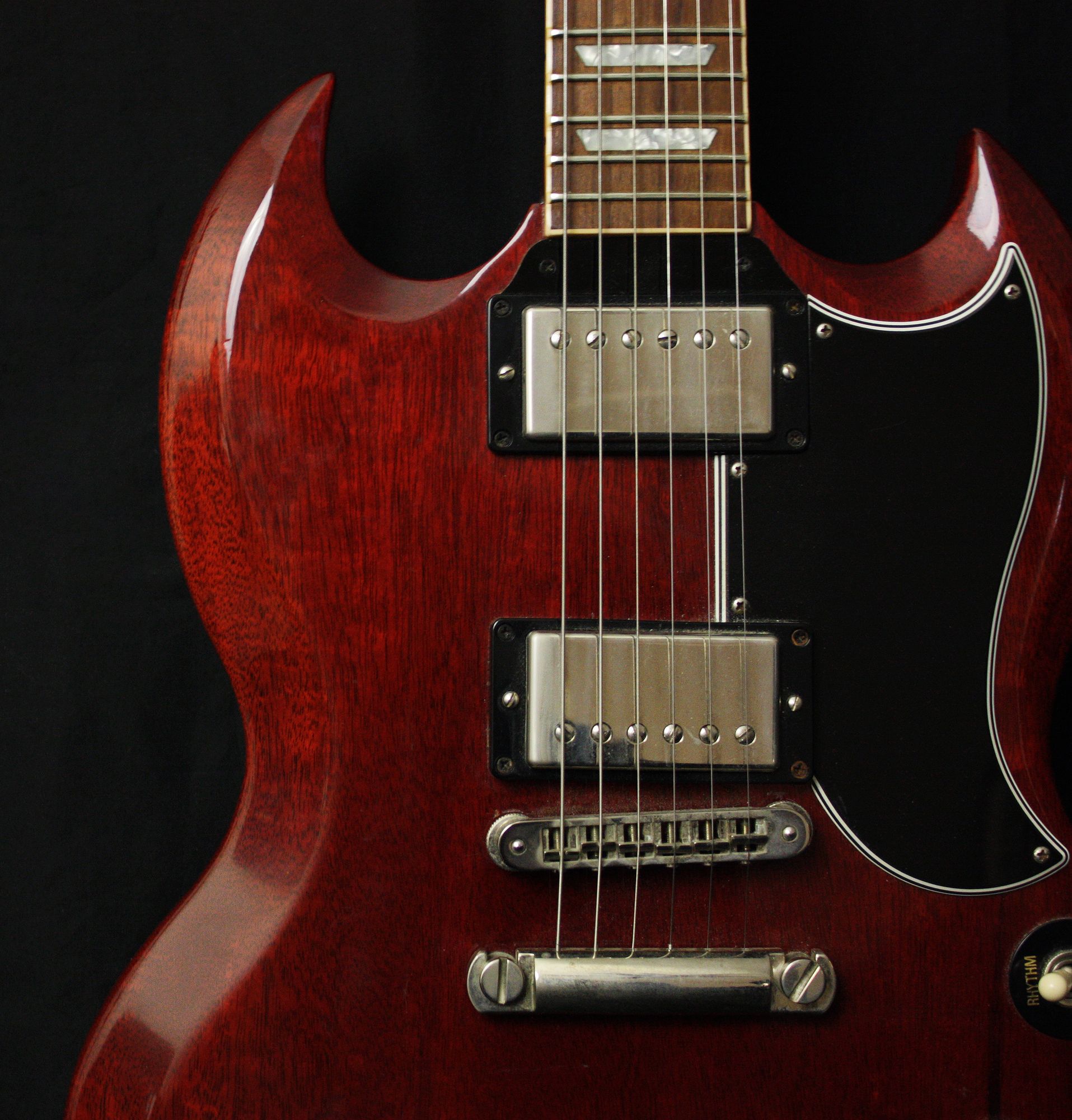
Gibson SG Standard ’61 Reissue, photographed 18 March 2010. Photo by John Tuggle. Licensed under CC BY 2.0. Via Wikimedia Commons. Gibson
SG
1961
Gibson has never stopped making SGs. Angus Young has lost count of his. He still only means one.

Photograph of a vintage 1960 Gibson ES-335TD. Photo by Lightburst. Licensed under CC BY-SA 4.0. Via Wikimedia Commons. Gibson
ES-335
1958
Larry Carlton played three 335s off a shop wall, unplugged, paid $850 for one, and became Mr. 335.

Photo: Lightburst / Wikimedia Commons / CC BY-SA 4.0 Fender
Stratocaster
1954
The guitar most people mean when they say “electric guitar.” Designed by a man who didn’t play one.