H.S. Anderson
Madcat
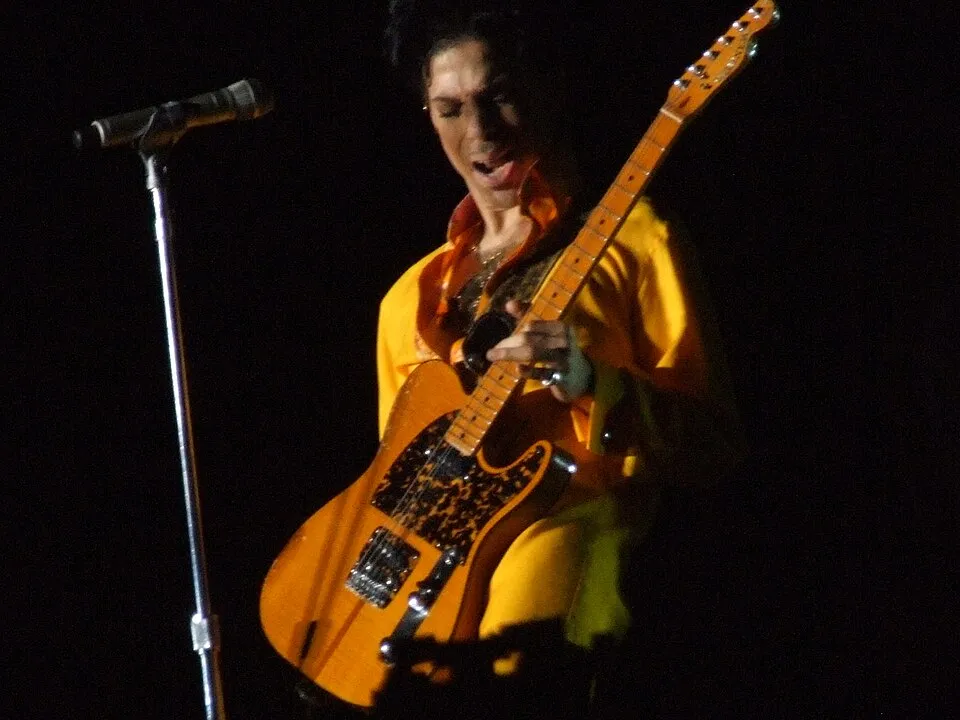
It was built in Japan to be anything but a Telecaster copy. Then Prince made it famous as his Tele.
Japan, 1973, give or take a year. A guitar outline gets sketched over drinks, a designer at a Nagano factory builds the prototype, and a walnut stripe runs down the middle of a shape everybody thinks they already know.
- Introduced
- 1973
- Type
- Solidbody electric
- Class
- Production
The short version
1973
The Mad Cat arrives
The brand launches at Moridaira. Some date the first ones to 1972; early examples carry no serial.
1975
Shiino leaves
The designer goes off to found ESP. The Madcat stays in Nagano, and serial stamps begin.
1980
Prince picks one up
A Hohner-badged Madcat goes out on the Rick James tour, by one account. How he got it is still argued.
2004
The Hall of Fame solo
Prince plays “While My Guitar Gently Weeps” at the Rock & Roll Hall of Fame.
2009
Back in Nagano
Moridaira reissues a small run. It sells out before the guitars are fully on the floor.
2011
The last of the batch
An anniversary run. Dany Meeuwissen buys the last 16, or 15, depending who’s counting.
2012
Vintage Re-Issue
Handmade in Japan under the H.S. Anderson name again.
2022
V3
A slim-C version developed with Takumi Suetsugu.
Side A
A1
Drawn over drinks
Japan, 1973, or 1972, or 1974, depending on which old hand you ask. Takahiko Ishikawa sketches a guitar outline over drinks. Hidesato Shiino, an employee at the Nagano maker Moridaira, takes the drawing and builds the prototype. Atsuro Yamada draws the cat mark.
You know the outline. Single cutaway, slab body. It’s a Telecaster’s.
That was the problem they set themselves: a Tele shape that refused to be a copy. Everything they did after the sketch was about making it something else. Design credit stays split between the two men, and that seems fair. One drew it. One made it real.
A2
Walnut down the middle
Turn one over and you see the first thing that isn’t Fender. A stripe of walnut runs down the center, front and back, with sen ash wings on either side and maple on the faces. You won’t find that centerline on a Tele. Add black binding and a leopard-print pickguard, and nobody at the shop counter will think it came from California.
The early bodies were built up from lots of pieces, as many as seven per wing, because the factory couldn’t get wide enough stock in one go. By 1977 or 1978 they were down to two.
Then the hardware. It sits closer to a hardtail Strat than to a Tele: bent-steel saddles on a Strat-style plate, Strat-shaped single-coils, strings through the body into flush ferrules. So the Tele outline is holding a different guitar.
And the name? H.S. is Hidesato Shiino. Anderson is Hugh Anderson, the New Zealand road racer. It has nothing to do with Tom Anderson’s shop in California.
A3
Someone else’s badge
Shiino didn’t stay. In 1975 he left to found ESP. The Madcat stayed at Moridaira, and that same year the serial stamps started, so a 1973 or 1974 example has none.
In Japan it cost around ¥80,000 new. Somewhere around 500 were made in the ’70s, give or take, and that count includes a small batch that went out with a Hohner logo on the headstock, in the same pearloid lettering. Same Nagano guitar, different badge. Hohner never called it a Mad Cat.
That export batch is where the story turns. One of those Hohner-badged guitars ended up in Minneapolis.
Flip the record · By the numbers
~500
Madcats in the 1970s, give or take, counting the Hohner-badged batch. Nobody published a ledger.
¥80,000
About what one cost new in the 1970s.
15 or 16
The last guitars of the 2011 anniversary run, bought by one man. The counts don’t agree.
~30
Reissues a year, by the maker’s own count.
Side B
B1
Thirty dollars, or a shop in Minneapolis
How Prince got his depends who you ask. The legend says he paid $30 for it at a gas station. Another account says he more likely bought it at Knut Koupee in Minneapolis, in the autumn of 1980, after Dirty Mind. A third puts it in the late ’70s. Keep all of them.
What’s clearer is what he did with it. It went out on the 1980 Rick James tour, by one account. His engineer, Susan Rogers, said he preferred it in the studio over the Cloud, the guitar built for the Purple Rain film, and that it was on most of his studio albums from 1980 on, except Batman. Purple Rain, 1999, and Musicology are the ones people name first.
A Tele shape built to be anything but a copy, and famous as somebody’s Tele.
It didn’t stay stock. The pickups were swapped, first for Fender Vintage Noiseless, then for Kinmans. A third coil went in under the guard and later came out. It carried a wireless pack for the Purple Rain tour, and the necks were replaced along the way.
It also got cloned. Roger Sadowsky built six copies for that tour, and Wendy Melvoin’s tour Madcat is one of the Sadowskys. Those are good guitars. They aren’t Moridaira’s.
B2
The best Telecaster he ever played
In 2004, at the Rock & Roll Hall of Fame, Prince stepped out for the solo in “While My Guitar Gently Weeps” with the Madcat. In 2007, by one account, it was with him at the Super Bowl. The original now sits in the Paisley Park collection.
Back in Nagano, the guitar came home. Moridaira reissued a small run in 2009, and it sold out before the guitars were fully on the floor. Two years later came an anniversary run. Dany Meeuwissen, who had owned a 1979 original, bought the last 16 of them, or 15, depending who’s counting. The Vintage Re-Issue followed in 2012, handmade in Japan.
The MkII moved to Heartbreaker pickups, wound in Belgium off a 1984 set, and added a fourth switch position that puts the coils in series. They still build about 30 a year.
Takumi Suetsugu, a tech who knew Prince’s guitar, called it the best Telecaster he had ever played. In 2022 he helped develop the next Madcat, the slim-necked V3. It still has the walnut stripe, and it still isn’t a Telecaster.
Put this on
You’ve read about it. Now hear it. Here’s what this guitar sounds like, and what to listen for.
Purple Rain
The album most tied to his Hohner-badged Madcat. Nobody has a track sheet for every overdub, so take it as the record, not a session log.
Find it on YouTube (opens in a new tab)While My Guitar Gently Weeps (Rock & Roll Hall of Fame)
The Madcat on a big stage, late in its life. Wait for the solo.
Watch it on YouTube (opens in a new tab)Super Bowl halftime show
One fan archive puts the Madcat on the field that night. Watch for the leopard guard.
Watch it on YouTube (opens in a new tab)
The cast
The people, and the specific guitars, that made the legend.
1980
Prince
Hohner-badged Madcat (HG-490)
On most of his studio albums from 1980 on, except Batman, by engineer Susan Rogers’s account. The original is in the Paisley Park collection.
1973
Hidesato Shiino
The prototype
The “H.S.” in the name. Built the first one at Moridaira, then left in 1975 to found ESP.
2011
Dany Meeuwissen
1979 original, then the 2011 anniversary run
Owned a 1979 original, bought the last of the 2011 batch, and partnered with Moridaira on the Vintage Re-Issue.
2022
Takumi Suetsugu
Prince’s Madcat, then the V3
A tech who called it the best Telecaster he’d ever played, and later helped develop the slim-C V3.
Liner notes
Specs, construction, rarity, value, and every source we used.
Walnut down the middle, a leopard guard, and Strat-style hardware on a Tele outline — H.S. Anderson’s Madcat, not a Fender and not a Tom Anderson.
- Body
- Walnut center strip, sen ash wings, maple top and back; single-cut Tele outline; black binding; leopard pickguard and jack plate
- Neck
- Bolt-on maple, C-shape (slim C on V3); rolled board edge on current Amptec cards
- Fingerboard
- Maple, 21 vintage frets; 240R (9.4") radius; 2.0 × 1.0 mm wire. Mix flagged.
- Scale
- 25.5" (648 mm). Mix flagged.
- Pickups
- Heartbreaker custom single-coils (Alnico II on the 2019 MusicRadar MkII card: bridge 6.85k, neck 5.67k), voiced from 1970s Keiyo / 1984 sets
- Hardware
- Gotoh GTC102 hardtail, string-through ferrules; Callaham or Highwood bent-steel saddles plus spare Gotoh blocks; 10.5 mm spacing; Gotoh SG360, 1:14; two string trees
- Electronics
- Volume, tone, 4-way (series as the extra throw). MkI / 2012 reissue was 3-way.
- Finish
- Polyurethane, color-matched to a 1984 Mad Cat; amber natural typical
- Nut
- 42.8 mm; bone on the 2013 Premier Guitar review guitar. Inches unpublished on the factory spec sheet this pass. Mix flagged.
Open the full research fileConstruction details, the complete player record, production numbers, dated value estimates, and sources
Current typical = Vintage Re-Issue Mad Cat MkII (Moridaira, Nagano; Amptec / hsandersonguitars.com; MusicStreet fetched 30 September 2026). Factory prints mm on nut, radius, fret wire, and spacing; MusicStreet and MusicRadar also print 25.5" / 648 mm and 9.4". Mix flagged. V3 is the later Amptec slim-C (Gladesville; from 2022, with Takumi Suetsugu). Japanese HS-1 MAD CAT LTD (Ikebe SN.25065, Bill Lawrence T-I / T-II) is a parallel Moridaira reissue — not this table. Hohner HG-490, The Prinz, TE Prinz, and Bill Lawrence hook-headstock badges are other names. Not a Fender Telecaster (fender-telecaster). Not Tom Anderson Guitarworks (tom-anderson-classic). Standalone.
Construction
The job was a Tele-shape that refused to be a copy. Walnut down the middle. Sen-ash wings. Maple faces. A leopard guard. Strat-style single-coils and a hardtail, strings through the body. Nagano, not Fullerton.
1973. Premier Guitar dates the Mad Cat to that year, Morris / Moridaira. Amptec’s Dany Meeuwissen, to MusicRadar (Dave Burrluck, 18 October 2019): the H.S. Anderson brand launched in 1973, and employee Shiino Hidesato designed it. music-trade.co.jp: Shiino with Moridaira from 1973; 1973–74 examples have no serial; stamps from 1975. madcat.ch FAQ: 1972–1979. Kaitunes: early badge HS-1, later TE80, serials from 1975 (read right to left). Keep 1972, 1973, and 1974. This plate starts in 1973. Japanese Wikipedia’s Shiino page puts a later Moridaira commission at 1983 — that page’s date, not the birth year.
Not a Fender Telecaster. The outline is the trap. MusicRadar and madcat.ch: hardware and pickups sit closer to a hardtail Strat — bent-steel saddles on a Strat-style plate, Strat-shaped coils, flush ferrules. Not Tom Anderson. H.S. is Hidesato Shiino. Anderson is Hugh Anderson, the New Zealand road racer — Shiino’s book 僕らが作ったギターの名器, via guitar-concierge. Newbury Park is a different shop. Not a Schecter. Schecter’s later Prince work is the Cloud replica. This is Moridaira’s bolt-on.
The body is the point. Amptec: walnut center, sen ash sides, tiger maple top and bottom. guitar-concierge: a centerline front and back you will not find on a Tele. music-trade: early pancakes because they could not get wide one-piece stock; 1977–78 as two-piece solid. Kaitunes: early wings as many as seven pieces per side, then simpler. Keep the range. Atsuro Yamada drew the cat mark. music-trade, citing Shiino: Takahiko Ishikawa sketched the outline over drinks; Shiino built the prototype. Design credit stays split.
Shiino left. music-trade: he founded ESP in 1975. The Madcat stayed at Moridaira. A small OEM batch went out with a Hohner logo in the same pearloid lettering (Amptec; Premier Guitar). Guitarcloud files Prince’s as Hohner HG-490 — Hohner never used the name Mad Cat. Same Nagano guitar. Different badge. Later Bill Lawrence badges pick up a hook headstock around 1983. 1984: Hohner’s Korean The Prinz (Cort) is a different factory. TE Prinz (1990) and Hohner Artist / Artist Elite (2008) are later still. None of those are this table.
2009. Moridaira reissued a small run. Ikebe: sold out before the guitars were fully on the floor. 2011: 45th-anniversary run, still the living Japanese HS-1 line. Meeuwissen bought the last 16 of that batch (factory About); a 2014 Gitarist PDF says 15. Keep both. He had a 1979 original; the new ones were not it. Premier Guitar, 19 October 2012: Vintage Re-Issue, handmade in Japan. Review guitar, Joe Charupakorn, March 2013: Bill Lawrence USA S1 and S3 in place of original Keiyo, bone nut, Gotoh SG360, street $3,100. MkII moved the pickups to Heartbreaker in Belgium, cloned off a 1984 set, and added the 4-way. Factory site this pass: about 30 a year. Premier Guitar 2013: about seven a month. Company-side rates, not a census of 1973.
What you actually get now is a small-batch Nagano bolt-on. Walnut, ash, maple. Leopard guard. Hardtail. 25.5 inches. Not a Fender Custom Shop Tele, not a G&L ASAT, and not Tom Anderson’s T Classic.
Players
Do not hang a Fender Telecaster, a Cloud, a Schecter Cloud replica, or a Music Man Albert Lee on this plate. Albert Lee’s signature is another guitar.
Prince — Hohner-badged Madcat (HG-490). The guitar this plate is known for. Premier Guitar: the H.S. Anderson-designed Hohner T-style on Purple Rain, 1999, and Musicology. Guitarcloud: first used on the 1980 Rick James tour; likely on Dirty Mind; later Controversy, 1999, Purple Rain, Lovesexy, Nude, One Nite Alone..., 2004ever, Earth, Welcome 2 America. Susan Rogers, via Guitarcloud: he preferred the Hohner in the studio over the Cloud; most studio albums from 1980 on except Batman. Acquisition is contested. The legend is $30 from a gas station (Guitarcloud). Goldies Parade: more likely Knut Koupee in Minneapolis, after Dirty Mind in autumn 1980. Keep both. Do not treat the $30 as a factory list. Tech Takumi Suetsugu, via Guitarcloud: the best Telecaster he has ever played — his wording, on a guitar that is not a Tele. Pickups swapped later (Fender Vintage Noiseless, then Kinman); a third coil under the guard, later removed; wireless pack for the Purple Rain tour. Original in the Paisley Park collection. Goldies Parade: While My Guitar Gently Weeps, Rock & Roll Hall of Fame, 2004. madcatsandclouds: Super Bowl 2007. Named object. Not a session log for every overdub on Purple Rain.
The Cloud is Dave Rusan at Knut-Koupee, for the film. Later Schecter-licensed replicas. Leave it off. Roger Sadowsky built six copies for the Purple Rain tour (Guitar.com, citing Sadowsky to Ultimate Guitar, 2020); two “Ejacucasters” with a copper tube in the neck. Goldies Parade: a purple floral Sadowsky from the America video hammered $381,000 in November 2024. Those are Sadowskys. Celebrity lots, not this factory.
Also known to play stays short. Wendy Melvoin’s tour Madcat is a Sadowsky copy, not a Moridaira HS-1. Hohner The Prinz in the closet was not the stage guitar (Guitarcloud). None invented.
Rarity
You can order a new Vintage Re-Issue. Current production is small-batch, not rare as a model. hsandersonguitars.com: about 30 a year. That rate does not count 1970s originals.
Moridaira did not publish 1970s Madcat totals. None invented. Amptec, Premier Guitar, and madcat.ch FAQ print a little over 500 / around 500 for the 1970s, including the Hohner OEM batch. Distributor figures, not a factory ledger. Serials date a guitar. They don’t count a year.
What is actually thinner: un-serialized 1973–74 HS-1s; complete originals with Keiyo coils un-rewound; the Hohner-logo export batch Prince’s guitar belongs to. 2009 and 2011 anniversary runs were limited objects. They are not a census of the Madcat. Prince’s HG-490 at Paisley Park is one guitar.
Value
Informal estimate, 30 September 2026. Not an appraisal.
Ask vs sold labeled. Celebrity lots are not-comps. No invented medians or factory counts. Period ¥80,000 (madcat.ch FAQ; Kaitunes; Guitarcloud, about 80,000 yen new in 1976) is 1970s money, not 2026 street. Premier Guitar 2013 street $3,100 is a 2013 reissue ticket.
New street. Named dealer cards this pass: MusicStreet Vintage Re-Issue Madcat MKII $3,840.00 (serial 24016, preorder). Left-handed MKII $4,052.00. Ikebe HS-1 MAD CAT LTD SN.25065 $2,250.00 (sold out) — Japanese parallel, labeled adjacent. Gladesville Mad Cat V3 A$5,289.00. Do not average those asks into a MAP.
Used modern. No clean Reverb Price Guide band isolated this pass. Flag: thin sold-comp access. Named solds, not a midpoint: Reverb Vintage Re-Issue MKII #20093 $3,027.15 (sold); HS-1 Vintage Reissue v2 $3,967.60 (sold); Madcat V1 2013 $3,286.31 (sold). Omega Auctions, 2 December 2025: unplayed MKII display £2,600 hammer — a framed reissue, not a street tape.
Vintage / collectible. Named asks, not hammers: Mike & Mike’s Guitar Bar 1975 HS-1 $12,499.99 (listing ended); 1978 Very Good $9,553.95 (ended). Do not average those asks. Prince’s Paisley Park HG-490 is one object. The $381,000 floral Sadowsky is a Sadowsky. Not a comp.
See also
- fender-telecaster — the Fullerton slab this Nagano walnut-center bolt-on is not
- tom-anderson-classic — different Anderson; Newbury Park, not Moridaira
- g-l-asat — another Tele-layout that is not a Fender SKU
Sources
- H.S. Anderson Guitars — Vintage Re-Issue, Moridaira; ash / maple / walnut; ~30 per year. Fetched 30 September 2026.
- H.S. Anderson Guitars: About — 1979 original; 45th-anniversary last 16; Meeuwissen / Moridaira partnership; Werchter 10 July 2010.
- Premier Guitar, H.S. Anderson Introduces the Vintage Re-issue Mad Cat, 19 October 2012 — 1973 original; handmade Japan; walnut / ash / maple; 42.8 mm nut; 240R; Bill Lawrence S1 & S3; 3-way; Gotoh GTC102 / SG360.
- Premier Guitar, Joe Charupakorn, H.S. Anderson Mad Cat review, 11 March 2013 — 1973 Morris; ~500 originals; Hohner Japanese vs Cort Korean; 2009 45th; ~seven a month; S1/S3 vs Keiyo; bone nut; 9.4" / 21 frets; street $3,100; Purple Rain / 1999 / Musicology.
- MusicRadar, Dave Burrluck, Vintage Reissue Mad Cat MkII, 18 October 2019 — Meeuwissen: brand 1973, Shiino design, walnut / sen ash / maple, Strat-style hardware, ~500 including Hohner OEM; 648 mm / 240 mm (9.4"); Heartbreaker Alnico II 6.85k / 5.67k; 4-way; MkI 2012, MkII 1984-based.
- Madcat Guitars: History — 1973 launch; ~500; Hohner OEM; Bill Lawrence hook headstock; 1984 Cort The Prinz; 1990 TE Prinz; 2008 Artist / Artist Elite.
- Madcat Guitars: FAQ — ~500; 1972–1979; ~¥80,000; serials read right to left.
- guitar-concierge: Mad Cat / H.S. Anderson — Shiino / Moridaira 1973; three-person build; 2009 and 2011 reissues; Hohner The Prinz naming; Yamada cat mark; Prince on Hohner, not H.S. Anderson-logo, Purple Rain promo.
- guitar-concierge: H.S. Anderson — Hidesato Shiino initials; Hugh Anderson; not Tom Anderson; Shiino book quote; Hohner / Bill Lawrence badges.
- music-trade.co.jp: H.S. Anderson Madcat Original — 1973 start; Ishikawa sketch / Shiino prototype; Yamada logo; 1973–74 no serial; 1975+ cavity signatures; Shiino to ESP 1975; pancake then 2P; measured 42 mm nut / 3.8 kg on that HS-1.
- Kaitunes: H.S. Anderson HS-1 Madcat — HS-1 / TE80; serials from 1975; ~¥80,000; Hohner OEM; Bill Lawrence BT2M ~1983.
- Guitarcloud: Hohner HG-490 “Mad Cat” — Prince from Dirty Mind era; 1980 Rick James tour; Hohner never used “Mad Cat”; HG-490 / HS-1 / Bill Lawrence; ~500; ¥80,000; $30 legend; Suetsugu; Rogers on studio use except Batman; Paisley Park; Sadowsky copies; later Hohner reissues unused live.
- Reverb News: Dreaming in Paisley — H.S. Anderson / Hohner; early ’80s; 25½-inch; walnut strip; maple faces; leopard guard; necks replaced.
- Guitar.com, Justin Beckner, Guitars used on Purple Rain, 13 August 2024 — late-70s acquisition; Purple Rain use; Sadowsky six copies / Ejacucasters.
- Goldies Parade: Prince’s guitars — autumn 1980 / Knut Koupee vs $30 legend; 2004 Hall of Fame; Sadowsky floral $381,000 (Nov 2024); Paisley Park original.
- Madcats & Clouds: H.S. Anderson — gas station vs Knut Koupee; regular use from 1981 in photos; Super Bowl 2007; Hall of Fame 2004.
- MusicStreet: Vintage Re-Issue Madcat MKII — $3,840.00; serial 24016; Highwood saddles; Heartbreaker; 4-way; 42.8 mm / 240R. Fetched 30 September 2026.
- MusicStreet: MKII left-handed — $4,052.00; 25.5" scale. Fetched 30 September 2026.
- Ikebe: HS-1 MAD CAT LTD SN.25065 — $2,250.00 sold out; ash 2P / flame maple / walnut; Bill Lawrence T-I/T-II; Gotoh SG503; 3.4 kg; 2009 / 2011 reissue history. Fetched 30 September 2026.
- Gladesville Guitar Factory: Mad Cat V3 — A$5,289.00; 2022 development; Suetsugu; slim C; Heartbreaker; 4-way.
- Reverb: Vintage Re-Issue Madcat MKII #20093 — sold $3,027.15.
- Reverb: HS-1 Vintage Reissue Model v2 — sold $3,967.60.
- Reverb: Madcat V1 2013 — sold $3,286.31.
- Omega Auctions, 2 December 2025, lot 668 — unplayed MKII display £2,600 hammer.
- Mike & Mike’s Guitar Bar, 1975 HS-1 (Reverb) — ask $12,499.99, listing ended.
- Japanese Wikipedia: 椎野秀聰 — ESP 1975; later Moridaira H.S. Anderson commission 1983 on that page; 2009 Mad Cat revival; died 24 November 2025.
Keep digging
Guitars this one gets compared to, confused with, or descended from.
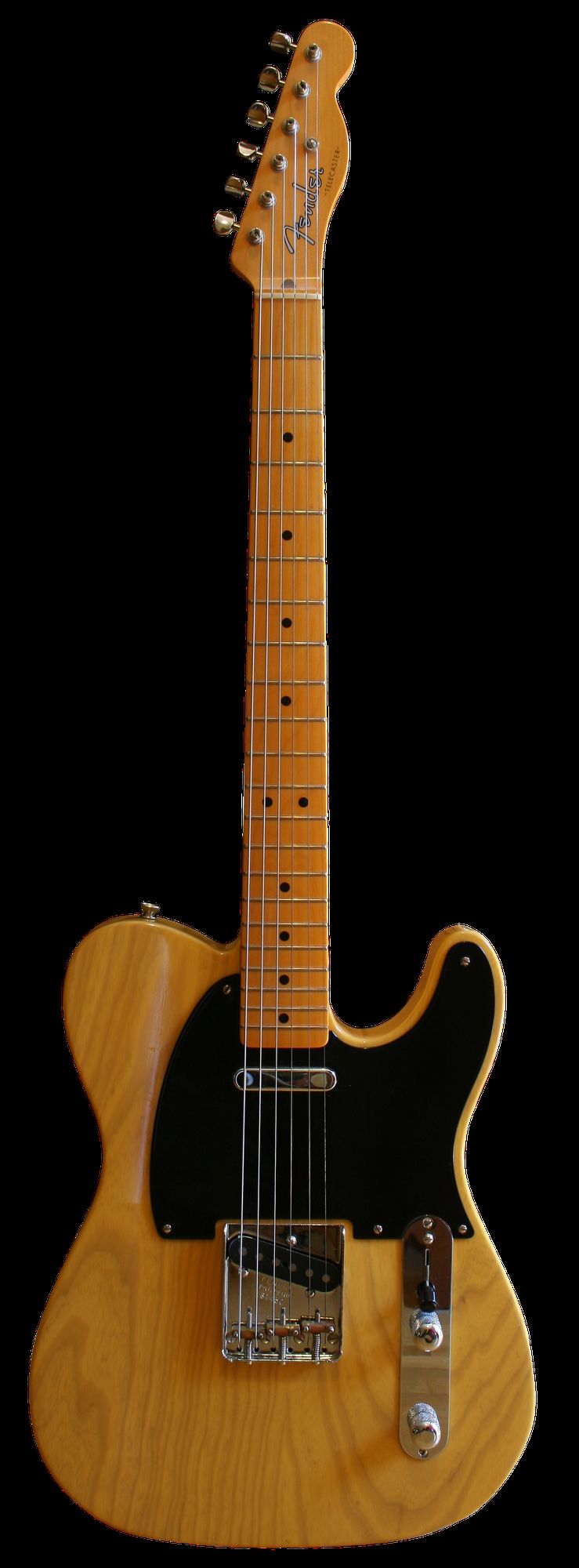
Fender Telecaster American Vintage 1952 with transparent background. Photo by Massimo Barbieri. Licensed under CC BY-SA 3.0. Via Wikimedia Commons. Fender
Telecaster
1950
Leo built it like a tool. The famous ones look like they just clocked off a double shift.
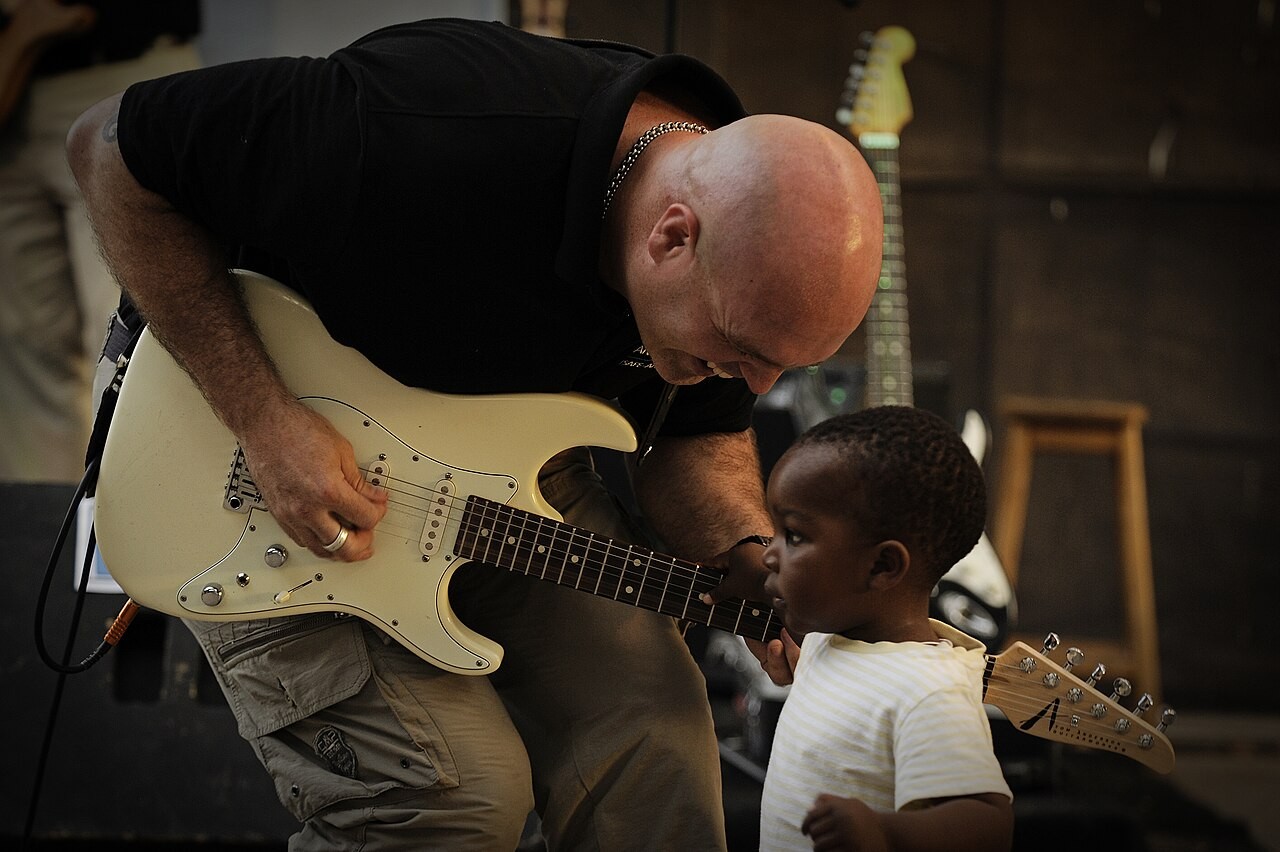
Photo: Staff Sgt. Ryan Crane / U.S. Air Force / Public domain Tom Anderson
Classic
1991
Tom Anderson grew up on vintage guitars and wanted them a little better. Forty years later, he’s still at it.
- Send a picture
G&L
ASAT
1985
Thirty-five years after his first Broadcaster, Leo Fender built another one. Gretsch objected again.