Yamaha
SG-2000
Santana told Yamaha to put a chunk of metal under the strings. They listened, and the notes stopped dying.
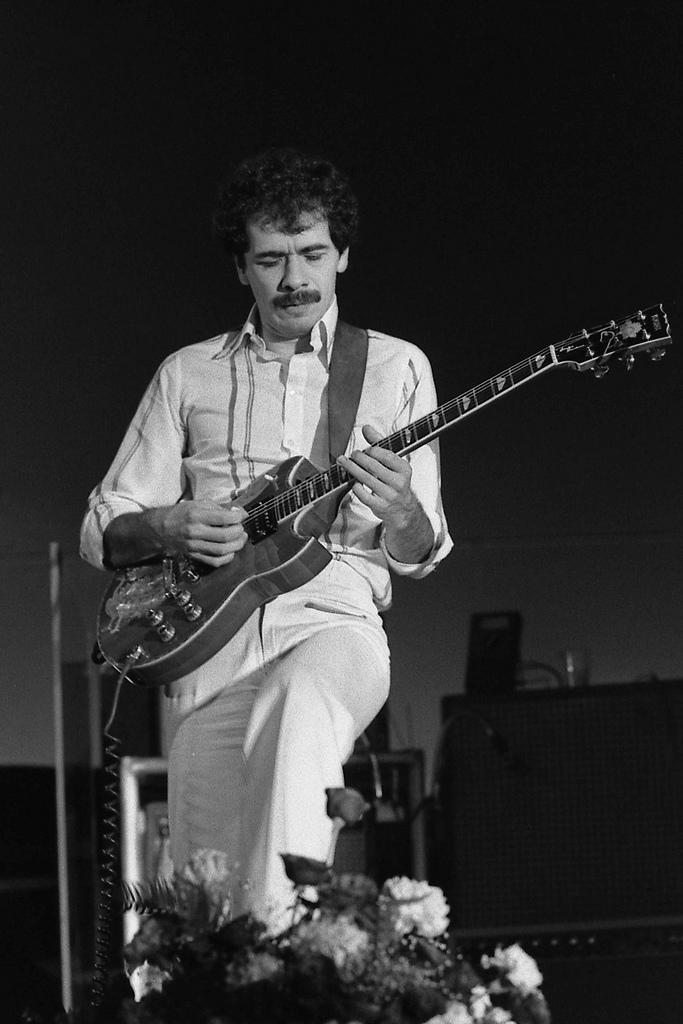
The mid-1970s. Yamaha shows Carlos Santana a handsome new double-cut, the SG-175. He sits down with the people who built it and gives them the bad news: he can’t play it. It’s too light. Then he tells them how to fix it.
- Introduced
- 1976
- Type
- Solidbody electric
- Class
- Production
The short version
1974
The SG-175
Yamaha’s carved, set-neck double-cut. Santana finds it too light.
1976
The SG-2000
Leaves the factory in July, with a through-neck and a brass plate under the bridge.
1977
Moonflower
Santana’s SG-2000 years begin, with “Europa” live on stage.
1980
SBG-2000
Gibson objects to the SG name, so American catalogs rename it. Japan keeps SG-2000.
1983
The Crossing
Stuart Adamson’s SG-2000 is there from the demos for Big Country’s first album.
1988
The end of the run
Regular Japanese production stops, by one count. Other accounts end it earlier or later.
2010
Frusciante switches
John Frusciante puts down his Strats for SG-2000s.
Side A
A1
Too light
Yamaha had been building a thick, carved double-cut since 1974, the SG-175. It was a handsome guitar, mahogany, set neck. They showed it to Carlos Santana, and he didn’t love it. It was too light. He sat down with them and said so:
I sat down with them and said, ‘Look, I can’t play the guitar, man.’ I asked them to put a big chunk of metal right where the tailpiece is. You hit it and it’s like hitting a grand piano — it really resonates.
That’s a funny thing to say to a company that makes grand pianos. But what Santana wanted wasn’t complicated. He wanted the note to keep going after he hit it.
A2
A chunk of metal and a neck that doesn’t stop
In July 1976, what came out of the factory in Hamamatsu was the SG-2000.
The chunk of metal is there, a brass plate under the bridge. And the neck doesn’t stop at the body. It runs all the way through, three pieces of mahogany and maple from the headstock to the end of the guitar, with the body wings glued on either side. Yamaha patented that construction and called it the T-Cross. There’s a carved maple top, gold hardware, a bound ebony board, and a pair of open humbuckers mounted on three points.
The idea behind all that is simple. When you play a note, less of it leaks away into joints and loose parts, so it hangs there. For a player who builds whole solos around one long, singing note, that’s the difference between a guitar and the right guitar.
People mix it up with a Gibson SG. Don’t. Gibson’s is thin mahogany with a glued-in neck. This one is thick, capped with maple, and made in one long piece down the middle. The name got it in trouble anyway: in 1980 Gibson objected, and American catalogs started calling it the SBG-2000. Same guitar.
A3
Europa
From 1977 until he switched to PRS sometime after 1982, Santana played SG-2000s. The live “Europa” on Moonflower. Inner Secrets, Marathon, Zebop! His bandmate Chris Solberg, who joined in 1978, remembered what mattered:
The sustain was really important to Carlos. His criteria at the time was that long note in the song Europa.
His tech, Ed Adair, described three of them, green, black, and blue. “The inlay is pretty spectacular,” he said. Years later, when Paul Reed Smith showed up in Baltimore with a guitar, Santana put it simply: “I’d been playing Yamahas for a long time.”
Flip the record · By the numbers
¥150,000
The original Japanese list price in 1976.
3
Pieces of mahogany and maple running the full length of the guitar, nut to strap button.
24¾
Inches of scale length. Close to a Les Paul, with a completely different build.
24,000
SG-1000s and SG-2000s together, from one unconfirmed source. Yamaha never published a count.
Side B
B1
Scotland, and a big range of sound
Stuart Adamson picked up an SG-2000 in the Skids and carried it into Big Country. When the band was demoing the songs that became The Crossing, his bandmate Bruce Watson remembered it plainly: “Stuart had his SG2000, a Fender Antigua Strat with no trem, and a little MXR pitch transposer.”
Adamson told a magazine in 1983, “I have a Yamaha SG2000 and a Fender Stratocaster, that’s all I use… I think you can get a big range of sound out of the 2000.” Big Country stacked a lot of guitars, though, and he said the Strat took the straight big sound on “In a Big Country,” so don’t pin every part on the Yamaha. Watson’s own Yamaha from those years was an SG-500.
B2
Still ringing
Regular production in Japan ended in 1988, by one account. Yamaha reissued it in limited numbers in 2007, and Yamaha isn’t making one now.
But the note didn’t stop. In late 2010, John Frusciante, who’d spent years as a Stratocaster player in the Red Hot Chili Peppers, switched to SG-2000s. His favorite was “a purple one from 1980.” He’d gone looking for one because of John McGeoch, the post-punk guitarist, though McGeoch’s own Yamaha was actually the set-neck SG-1000.
Santana asked for a guitar that would hold a note a little longer. It held on to players, too. Thirty-four years after it first left Hamamatsu, it caught John Frusciante.
Put this on
You’ve read about it. Now hear it. Here’s what this guitar sounds like, and what to listen for.
Europa (live)
From Moonflower. Santana’s criteria for a guitar back then, a bandmate said, was “that long note in the song Europa.” Wait for it.
Find it on YouTube (opens in a new tab)Well All Right
From Inner Secrets, one of the SG-2000 records.
Find it on YouTube (opens in a new tab)The Crossing
Stuart Adamson’s SG-2000 was there from the demos, and in 1983 he said it and a Strat were all he used. The band layered a lot of guitars, and he said the Strat took the straight big sound on “In a Big Country,” so don’t pin every part on the Yamaha.
Find it on YouTube (opens in a new tab)Enclosure
Made after he switched to SG-2000s, with a purple 1980 as his favorite.
Find it on YouTube (opens in a new tab)
The cast
The people, and the specific guitars, that made the legend.
1977
Carlos Santana
SG-2000s, green, black, and blue
Asked for the metal plate, then played the result from 1977 until he moved to PRS sometime after 1982.
1976
Yojirou Takabayashi
Designer
Designed the SG-2000.
1983
Stuart Adamson
SG-2000
Played it from the Skids years into Big Country, next to a Strat. “That’s all I use.”
2010
John Frusciante
A purple 1980 SG-2000
Bought a Yamaha SG because of John McGeoch.
1977
John McGeoch
An SG-1000, not this one
Bought his Yamaha in Manchester in 1977. It was the set-neck sibling, though he sometimes gets filed under the 2000.
Liner notes
Specs, construction, rarity, value, and every source we used.
Through-neck, T-Cross, and a brass plate under the bridge — Yamaha’s thick double-cut flagship, not a Gibson SG and not a Pacifica.
- Body
- Thick double-cut solid. Carved maple top (Vintage Guitar: early three-piece, center grain set perpendicular to the sides); mahogany sandwich wings; ribcage contour on the back. Mix flagged.
- Neck
- Through-neck, three-piece mahogany / maple / mahogany. T-Cross. Not a set neck.
- Fingerboard
- Bound ebony, 22 jumbo, mother-of-pearl split-wing inlays. Named dealers split on radius: Norman’s 12" (1980); Mike & Mike’s 14" (1982). Mix flagged.
- Scale
- 24.75" / 628 mm. Mix flagged.
- Pickups
- Twin shielded Alnico V humbuckers; open covers that leave both coils and the poles showing; three-point mount
- Hardware
- Gold-plated. Tune-o-matic-style / finetune bridge on a brass sustain plate; harp-and-scroll stop tail; enclosed 15:1 tuners
- Electronics
- Two volume, two tone, 3-way. Coil taps (push/push) from about 1980 (Vintage Guitar: volume pots). Early examples are humbuckers only.
- Finish
- Launch colors (Vintage Guitar): cherry sunburst, brown sunburst, cherry, brown, black. Multi-ply top and headstock binding.
- Nut
- Guitar Player, September 1980: 1 9/16". Named dealers: 1 11/16" bone (Mike & Mike’s); 1.706" (Norman’s); 43 mm (Digimart, 1981). Mix flagged.
Open the full research fileConstruction details, the complete player record, production numbers, dated value estimates, and sources
Classic living example = late-1970s Nippon Gakki SG-2000 (Hamamatsu). No current SG-2000 SKU this pass. SBG-2000 is the 1980 U.S. name, not a different guitar. SG-175 is the 1974 set-neck predecessor. SG-1000 is the set-neck sibling. SG1820 / SBG1820 (2010) is set-neck, no brass plate — another object. Pacifica is the 1990 Strat-layout. Gibson SG is the thin 1961 mahogany. No Gibson SKU. Mix flagged; do not average 1 9/16" with 43 mm.
Construction
The job was sustain. Hamamatsu, 1976. Gibson already had a thin double-cut it later called SG. Yamaha’s own SG name is older still: Innovation Road dates SG-2 and SG-3 to 1966. Different object. Pacifica is 1990, bolt-on Strat-layout. Same badge. Not this guitar.
The thick double-cut starts before the 2000. Vintage Guitar (Michael Wright, June 2003): slab SG-30 / SG-35 late 1973, then carved SG-90 and SG-175 in 1974. The 175 is the handsome set-neck mahogany Yamaha showed Carlos Santana. He told them it was too light.
Guitar Player, June 1978, via Dave Hunter (22 August 2023): “I sat down with them and said, ‘Look, I can’t play the guitar, man.’ I asked them to put a big chunk of metal right where the tailpiece is. You hit it and it’s like hitting a grand piano — it really resonates.”
What left the factory in July 1976 (Wright) is the SG-2000. Designer Yojirou Takabayashi. Yamaha’s Innovation Road plate dates it 1976: Santana’s advice, single-piece construction, a sustain plate under the saddle, an open humbucker on three-point mounts.
Through-neck. Not a set neck, not a bolt-on. Three-piece mahogany / maple / mahogany from nut to butt. Yamaha patented the T-Cross System: mahogany flanks along the maple core (Yamaha Guitars, citing Hal Leonard 2006). Wright: carved three-piece maple top, center grain perpendicular to the sides; mahogany sandwich wings; brass block under the bridge. Hunter: mahogany and maple glued at opposing orientations, plus that three-piece cap. Keep both. The back has a ribcage scoop the 175 did not.
This is not a Gibson SG (gibson-sg). Kalamazoo’s is thin mahogany, no maple cap, set neck — 1961 as a Les Paul body, SG name later. This is thick, capped, through-neck, Hamamatsu. No Gibson SKU. It is not a Les Paul either (gibson-les-paul-standard): same 24.75" neighborhood and a carved maple top, different joint, different horns, brass in the top.
Hardware is gold. Split-wing pearl on bound ebony. Jumbo frets. Five-ply on the top and the double-dip head. Harp-and-scroll stop. Five launch colors (Wright): cherry sunburst, brown sunburst, cherry, brown, black. Original SRP ¥150,000 (Yamaha Guitars / Hal Leonard 2006) — 1976 money, not 2026 street.
1976 also got a short Devadip run: pearl figure on the belly, after Santana’s custom 175. That is a limited object. Not this table.
The set-neck SG-1000 arrived the same year. No T-Cross through-neck. No brass plate. Do not mash them.
1980: Gibson objected to the SG prefix (Wright). U.S. catalogs become SBG-2000. U.K. SG-2000S. Japan keeps SG-2000. Same guitar. Push/push coil taps land around then (Wright: volume pots). The cross-grain maple center in the top gives way to a single piece.
U.S. SBG-2000 through 1984, then SBG-2100. Japan regular production of the SG-2000 stops 1988 (Wright). Reverb’s product page prints years 1976–1982. Keep both. Japanese Wikipedia dates a later 2000 / 1000 / 3000 run’s end to February 2010, when SG1820 ships — Wikipedia is a lead, not a factory ledger. SG1820 is set-neck, Seymour Duncan or EMG. Not this SKU. Yamaha USA’s SBG series page is discontinued this pass.
Winter NAMM 2007: Yamaha USA reissued SBG2000 and SBG1000 from Music Craft, Hamamatsu, “limited supply” (Bryan Savage). Neck-through on the 2000. A reissue. Not 1976.
Players
Do not hang a Gibson SG on this plate. Santana at Woodstock, 16 August 1969, is a red Gibson SG Special — already on gibson-sg. Not a Yamaha. Do not steal John McGeoch: his site pins an SG-1000, bought 1977 from A1 Music in Manchester. Hunter’s 2023 Guitar Player piece files McGeoch on an SG-2000. Keep the mash. The 1000 is the other object.
Carlos Santana. The Yamaha years start with an SG-175 he did not love. Custom Buddha-inlay 175s sit in Japanese magazine photos (ja.wikipedia lead); Wright’s Devadip 2000 is the production echo. Hunter: he used the SG-2000 widely 1977 until PRS sometime after 1982 — live “Europa” and “Let the Children Play / Jugando” on Moonflower; “Well All Right,” “Open Invitation,” “Wham!” on Inner Secrets; then Marathon and Zebop!. MusicRadar (Chris Solberg, who joined for Inner Secrets, 1978): “The sustain was really important to Carlos. His criteria at the time was that long note in the song Europa.” Vintage Guitar (Dan Forte, March 2006), tech Ed Adair: three SG-2000s — green, black, and a blue one; “The inlay is pretty spectacular.” “They haven’t been out on the road in a long time.” Named objects. Not a street 2000. Then PRS. Santana, to Forte: Paul showed up in Baltimore with a guitar; “I’d been playing Yamahas for a long time.”
Stuart Adamson. His own site: the Yamaha SG-2000 arrives in the Skids years and sparks “Hope and Glory,” “Night and Day,” “The Saints Are Coming,” “Of One Skin.” Bruce Watson, same page, on the Townhill demos that became The Crossing (1983): “Stuart had his SG2000, a Fender Antigua Strat with no trem, and a little MXR pitch transposer.” Adamson to One Two (November 1983): “I have a Yamaha SG2000 and a Fender Stratocaster, that’s all I use… I think you can get a big range of sound out of the 2000.” “In a Big Country” itself is layered; he told the magazine the Strat took the straight big sound. Do not flatten every Big Country guitar onto the 2000. Guitar World (2026): Watson’s Yamaha on the early tours and The Crossing is an SG-500. Keep the split.
John Frusciante. Premier Guitar (Tessa Jeffers, 3 March 2014): main guitars are SG-2000s; favorite is “a purple one from 1980”; a few SG-1500s beside them; switched from the Strat in late 2010; Enclosure is the named record. He bought an SG because of McGeoch. McGeoch’s own guitar stays a 1000. Frusciante’s is this one.
Also known to play stays short. Hunter: Al Di Meola, Bill Nelson (Be-Bop Deluxe), Phil Manzanera, Paul Barrere, Boz Scaggs. Yamaha USA’s 2007 reissue note puts Bob Marley on an SG2000; Wright puts Marley on the SG-1000. Keep both. No session tape pinned here.
Rarity
You cannot order a new SG-2000 from Yamaha this pass. The regular Japan run ends 1988 on Wright’s telling. Later Japan continuations and the 2007 Music Craft SBG2000 are other factories on this silhouette. They are not a 1976 guitar.
Yamaha does not publish SG-2000 unit totals. None invented. Wright: “One unconfirmed source says only 24,000 SG-1000s and SG-2000s were produced.” Combined, unconfirmed — not a census. Serial stamps date a guitar. They don’t count a year. History of Yamaha Guitars, via yamahaguitars.nl, prints 1976 SG-2000 sequence 1001–1126; the same page notes early modern SGs wearing leftover SG-175 five-digit stamps. Dating chart, not a factory ledger.
What is actually thinner on the ground: first-year 1976 examples (no coil tap; Wright’s three-piece perpendicular maple cap); the Devadip belly-inlay run; complete originals with the brass plate and the open Alnicos un-rewound. Santana’s green / black / blue set is three objects. Not a vintage 2000.
Value
Informal estimate, 8 September 2026. Not an appraisal.
Ask vs sold labeled. Celebrity lots are not-comps. No invented medians or factory counts. Period ¥150,000 (Yamaha Guitars / Hal Leonard 2006) is 1976 list, not 2026 street.
New street. No current SG-2000 SKU. Yamaha USA’s SBG series (SBG1820 / 1820A / 1802) is discontinued this pass; that line was the 2010 set-neck guitar, not this table. 2007 SBG2000 was a limited Music Craft reissue — historical cart, not a 2026 page.
Used modern. 2007–2008 Japan reissues trade used. No clean Reverb Price Guide band isolated for the reissue this pass. Don’t invent a midpoint.
Vintage / collectible (SG-2000). Reverb Price Guide, Yamaha SG-2000: $1,391–$2,558 based on 93 orders Good to Mint — labeled estimate, not a 2026 sold median computed here. Named U.S. solds on that tape: 31 July 2026 Good $2,500; 31 March Very Good $2,699; 22 February Good $1,200; 19 January Very Good $1,800; 4 November 2025 Good $1,250; 26 September 2025 Good $1,200. Reverb Canada’s widget on the same product: C$1,806–C$3,346, “estimate based on US sales prices.” Premier Guitar (17 March 2009) had typical used $900–$1,200 — 2009 money, not this pass. Santana’s inlaid set is a celebrity object, not a street tape.
See also
- gibson-sg — thin 1961 mahogany this thick through-neck is not
- yamaha-pacifica — 1990 Strat-layout electric; not this flagship
- gibson-les-paul-standard — the carved-top mahogany this was sold against; not a Yamaha
Sources
- Yamaha, Innovation Road: SG-2000 — 1976; Santana advice; through-neck; sustain plate; three-point open humbucker
- Yamaha, Innovation Road: SG-3 — SG-3 / SG-2, April 1966; different object
- Vintage Guitar, Michael Wright, Yamaha SG (June 2003) — July 1976 intro; T-Cross through-neck; three-piece maple top; brass block; 22-fret ebony; Alnico V; SBG-2000 U.S. 1980; coil taps; Japan to 1988; Devadip; SG-1000 set-neck; unconfirmed 24,000 (1000+2000); Marley on SG-1000
- Guitar Player, Dave Hunter, Yamaha SG-2000 (22 August 2023) — 1976 unveiling; T-Cross; 24.75"; Santana 1978 quote; 1977–after 1982 use; Moonflower / Inner Secrets / Marathon / Zebop!; McGeoch mash onto 2000; Di Meola / Nelson / Manzanera / Barrere
- Premier Guitar, Yamaha SG2000 (17 March 2009) — 1976 intro; June 1978 Guitar Player cover; T-Cross / Sustain Plate; 2009 used $900–$1,200
- Yamaha USA, Reintroduces Two Classic Guitars (10 January 2007) — NAMM 2007 SBG2000 / SBG1000; Music Craft Hamamatsu; neck-through on 2000; limited supply; Savage quote; press also files Marley on SG2000
- Yamaha USA, SBG Series — SBG series discontinued; 2010 set-neck 1820 line
- MusicRadar, Why now is the time to claim a Yamaha SG (14 October 2020) — 1976 SG2000; Takabayashi; 24¾"; T-Cross; Solberg on Europa / Inner Secrets
- Vintage Guitar, Dan Forte, Carlos Santana (March 2006) — Adair: three SG2000s (green, black, blue); PRS after Yamahas
- Premier Guitar, John Frusciante: War and Peace (3 March 2014) — 1980 purple SG2000; Enclosure; switch late 2010; McGeoch as the reason
- Stuart Adamson Official, Biography — SG2000 in the Skids; Watson on Townhill / The Crossing demos
- One Two / muzines, Stuart Adamson (November 1983) — “I have a Yamaha SG2000 and a Fender Stratocaster”
- Guitar World, Bruce Watson on Big Country (24 May 2026) — Watson’s Crossing Yamaha is an SG-500
- johnmcgeoch.com, Gear — Magazine-era Yamaha SG1000; A1 Music 1977
- Reverb Price Guide, Yamaha SG-2000 — $1,391–$2,558, 93 orders; years 1976–1982; named 2025–26 solds
- Yamaha Guitars (Facebook), SG2000 (2 March 2016) — Hal Leonard 2006: T-Cross and Sustain Plate patents; original SRP ¥150,000
- yamahaguitars.nl, Dating SGs by serial number — History of Yamaha Guitars serial chart; 1976 SG2000 1001–1126; leftover SG-175 stamps
- Mike & Mike’s Guitar Bar, 1982 SG2000 — 24 3/4"; 1 11/16" bone; 14" radius; T-Cross; Sustain Plate
- Norman’s Rare Guitars, 1980 SG-2000 — 24.75"; 1.706" nut; 12" radius
- Digimart, 1981 SG-2000 — 628 mm scale; 43 mm nut
- ja.wikipedia, ヤマハ・SG — lead only: 1976 SG-2000; 2010 line end; McGeoch / Marley on SG-1000; Santana custom on SG-175 base
Keep digging
Guitars this one gets compared to, confused with, or descended from.
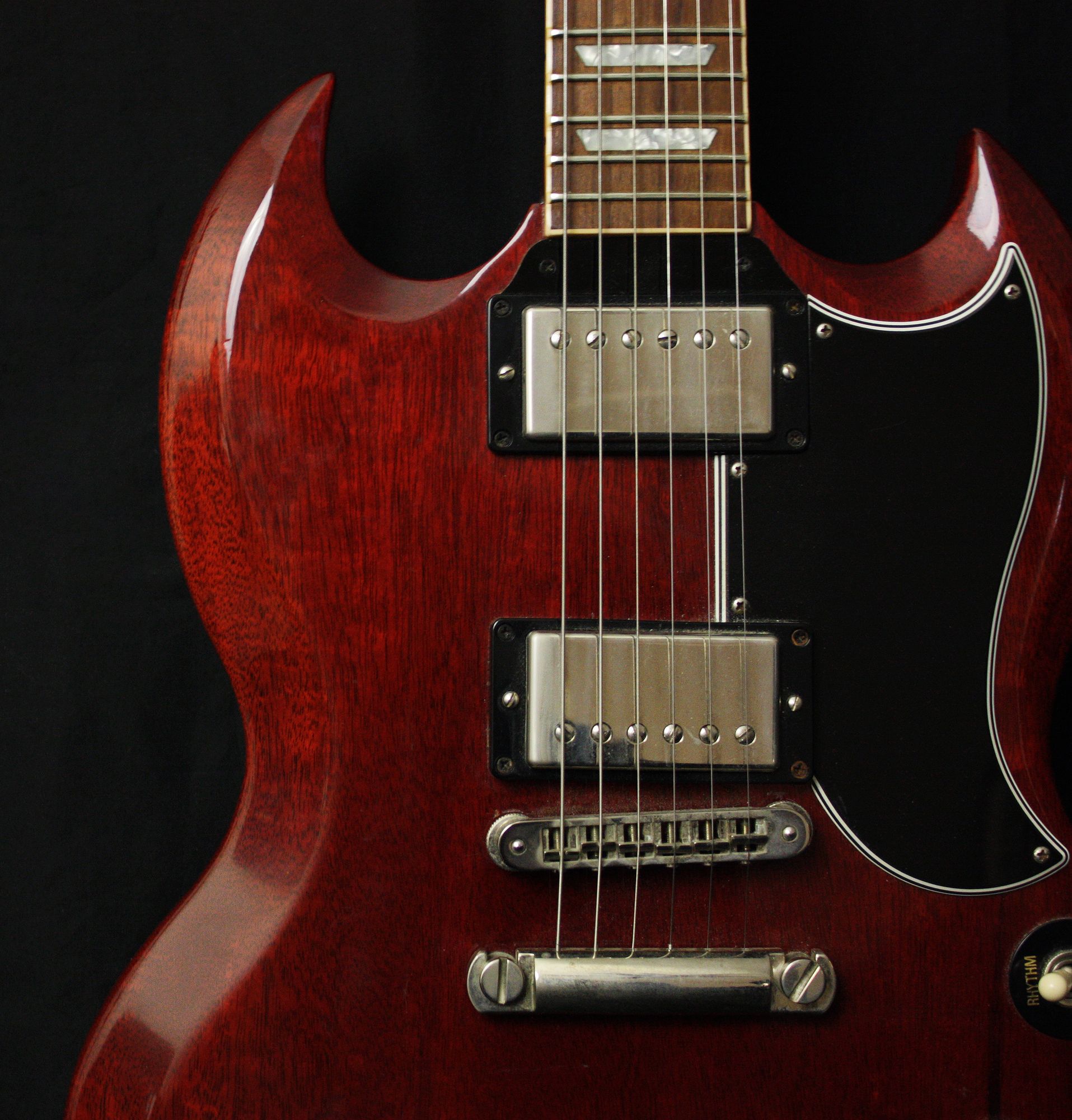
Gibson SG Standard ’61 Reissue, photographed 18 March 2010. Photo by John Tuggle. Licensed under CC BY 2.0. Via Wikimedia Commons. Gibson
SG
1961
Gibson has never stopped making SGs. Angus Young has lost count of his. He still only means one.
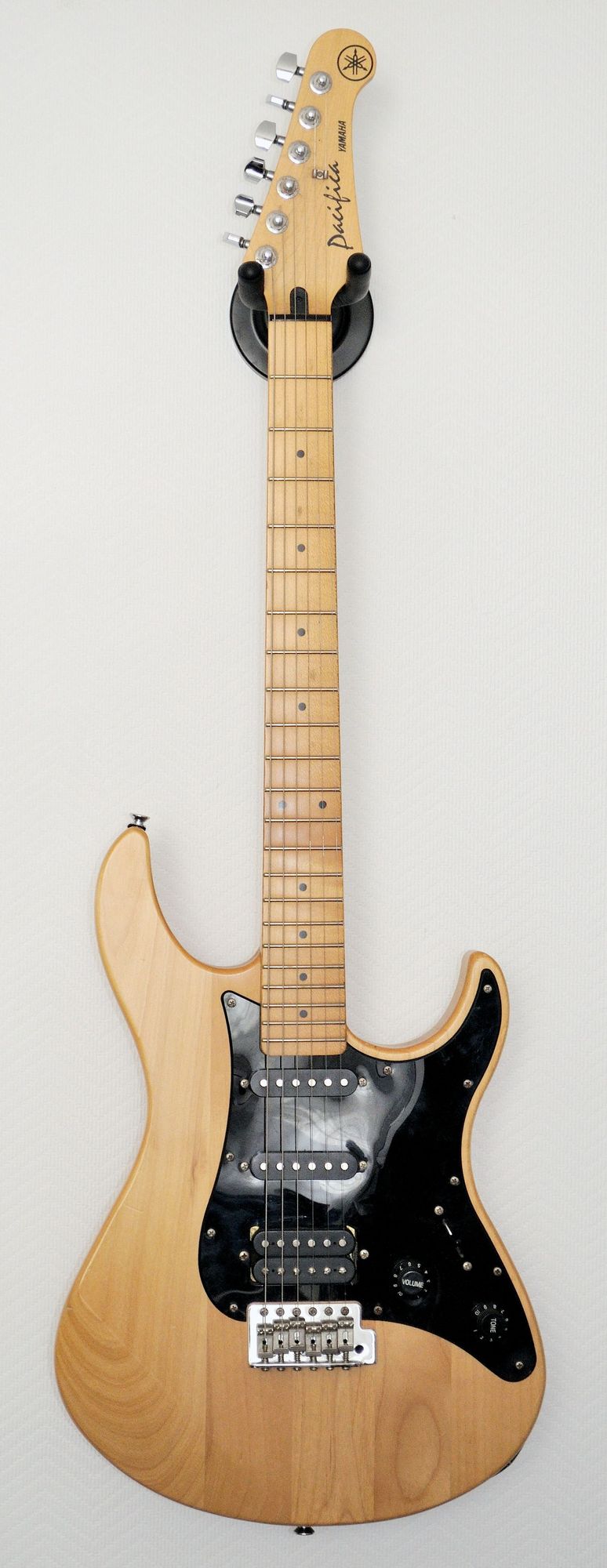
Electric guitar Yamaha Pacifica 112. Photo by BastienM. Licensed under CC BY-SA 3.0. Via Wikimedia Commons. Yamaha
Pacifica
1990
No hit record, no famous owner, no legend. Just the guitar that’s ready when a beginner is.

2006 Gibson Les Paul Standard (SN 000660573). Photo by wetwebwork. Licensed under CC BY-SA 2.0. Via Wikimedia Commons. Gibson
Les Paul Standard
1952
Gibson made about 1,500 sunburst Les Pauls, decided nobody wanted them, and stopped. Then the British blues boom happened.