Danelectro
Longhorn
Garry Tallent worked in the Danelectro plant as a teenager. On Born to Run, he played its Longhorn.
Neptune, New Jersey. Nathan Daniel’s factory builds guitars out of stapled pine, hardboard, and vinyl. In 1958 it puts a showpiece in the catalog: horns cut so deep the body looks like a lyre, a guitar that climbs into mandolin range, and two basses on the same body.
- Introduced
- 1958
- Type
- Solidbody electric
- Class
- Production
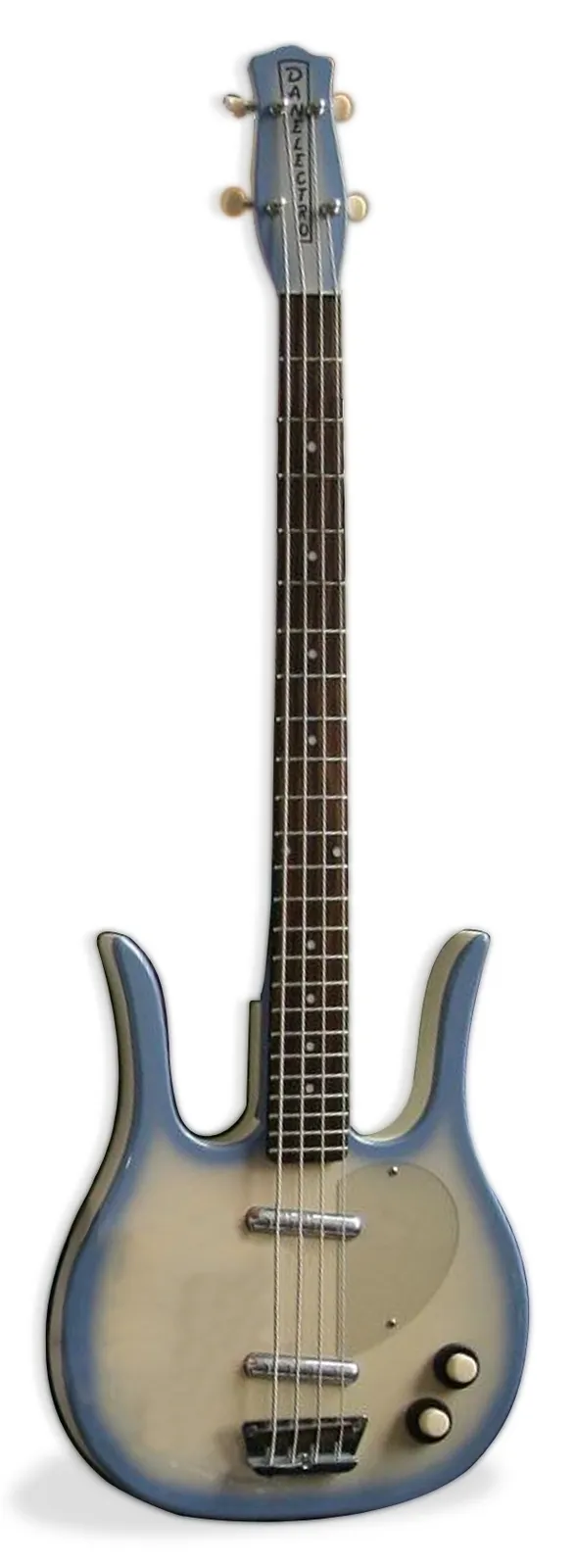
The short version
1956
The masonite method
From the fall, Danelectro bodies are a stapled wood frame with masonite top and back and vinyl sides.
1958
The Longhorn
The Guitarlin, a four-string bass, and a six-string bass, at $150. Some registries say 1959.
1959
The pickup moves
On the basses, the treble pickup moves back from the neck toward the bridge.
1960
Bomber jacket
Link Wray is on an LP cover with a Longhorn, and on TV playing “Trail of the Lonesome Pine.”
1965
“My Generation”
John Entwistle goes through three Longhorn basses on the demos. The master solo is on a Fender.
1966
MCA
MCA buys Danelectro. The Longhorns stay on the price list at $150.
1969
Neptune closes
Or late 1968, when MCA folded the company. The two accounts don’t agree.
1975
Born to Run
Garry Tallent plays a Longhorn bass, with roundwound strings, on the album.
Side A
A1
The plant down the road
Garry Tallent was a teenager when he worked at the Danelectro plant in Neptune, New Jersey. His first bass wasn’t a Longhorn. It was a double-cut guitar body with a six-string bass neck on it. The Longhorn, as he tells it, came later.
Nobody would call the way that plant built guitars precious. From the fall of 1956, a Danelectro body was a frame of poplar or pine, stapled together, with a ⅜" sheet of masonite on the top and back and vinyl covering the unpainted sides. The pickups sat in chrome tubes that look like lipstick cases. The old story says they were cosmetics surplus. Howard Daniel says they weren’t.
It was cheap, and it was clever.
A2
Top of the line for $150
In 1958, Nathan Daniel put a showpiece in the catalog. It used the same body frame as his double-cut shorthorns, but the horns were cut so deep the body looks like a lyre. It listed at $150. That year only one Danelectro cost more: the three-pickup Standard, at $165.
The year isn’t quite settled. The catalog and most histories say 1958, and a first-year six-string bass has pots from the 40th week of 1958. One careful Danelectro registry starts the body in 1959. Both stay.
Cutting away that much wood changed the sound. With less masonite and less air inside, the cavity got smaller, and the guitar got brighter.
There was one shape and three instruments. The Guitarlin had 31 frets, guitar plus mandolin, so far up the neck that a bridge pickup would have landed on the fingerboard. Both pickups sat in toward the neck instead. (One registry dates the Guitarlin to 1963, which makes three dates for one guitar.) The 4423 was a four-string short-scale bass. The 4623 was a six-string bass, E to E. The way Daniel pitched it, you got two extra strings for free.
The first basses borrowed the Guitarlin’s routing, with both pickups up at the neck. In 1959 the treble pickup moved back. Every one came in bronze-to-white sunburst. There was no other color.
A3
Knobs that only switch
Then there’s the wiring, which is why so many of them got rewired. Each pickup had a stacked pot with little wooden flipper pointers: on/off on top, volume underneath. There was no tone control. Big capacitors tuned each pickup before you touched anything. The catalog made it sound like a luxury:
Each feather-touch pointer turns its corresponding pickup on or off.
Most surviving Longhorns have been modified. Graham Nash turned up on a magazine cover with one in the fall of 1965, and its knobs were already missing.
The showpiece didn’t outsell the plain one, either. The Standard shorthorns cost about $50 less, and they sold far more.
Flip the record · By the numbers
$150
List price in the 1958 catalog. Only the three-pickup Standard cost more, at $165.
31
Frets on the Guitarlin. Guitar plus mandolin, on one neck.
3
Models on one body. Guitarlin, four-string bass, six-string bass.
0
Tone knobs on an original. The stacked pots are on/off and volume.
Side B
B1
Strings like a piano
The players found it anyway. Link Wray had already posed with a Longhorn on the cover of Link Wray and the Wraymen in 1960, in a bomber jacket, and played one on television that year. (It isn’t the “Rumble” guitar.) Pete Townshend was on stage with a Guitarlin in 1965. That lasted until he put it through a Marshall.
John Entwistle bought a bronze sunburst 4423 in London. The strings were so thin, he said,
they sounded just like a piano.
Those thin strings were the sound, and they were also the problem. He went through three of them recording “My Generation.” The last string broke before the master. So the solo you know is a Fender Jazz Bass with La Bella tape-wounds. The Danelectro is on the demos.
Jack Bruce bought one in Dan Armstrong’s shop across from Manny’s in New York. It was “useful for some things, but I didn’t use it much,” he said. “I did use it on some tracks.” That was around Disraeli Gears in 1967, with the bass already rewired by Armstrong. Some tracks. Not the album.
B2
Still $150 at the end
MCA bought Danelectro in 1966. The Longhorns dropped out of one color catalog, came back on the one-sheets, and were still $150 near the end. The plant in Neptune closed in 1969. Another account has MCA folding the company in late 1968. Both are on the record.
The shape outlived the factory. Other factories built it under other names, and Dave Edmunds played a Longhorn six-string bass prominently on Information in the early ’80s and put it on the cover. Danelectro sells a Longhorn Bass today, captioned “First made in 1958,” and calls it “this squawky short scale bass,” which is about right. It has tone knobs now.
But the best Longhorn story is the one that stays home. The teenager who had worked in the plant in Neptune grew up, strung a Longhorn with roundwounds, and played it on Born to Run.
Put this on
You’ve read about it. Now hear it. Here’s what this guitar sounds like, and what to listen for.
Born to Run
Garry Tallent says the album is on his Longhorn, strung with roundwounds. Listen for a bright, short-scale bass with some bite to it, not a thud.
Find it on YouTube (opens in a new tab)Information
Edmunds used a Longhorn six-string bass prominently on this record, and he’s holding it on the cover.
Find it on YouTube (opens in a new tab)Trail of the Lonesome Pine (The Jack Spector Show)
A TV spot with close-ups of the guitar, the same year Wray posed with a Longhorn on the Wraymen LP. Not “Rumble.”
Watch it on YouTube (opens in a new tab)
The cast
The people, and the specific guitars, that made the legend.
1975
Garry Tallent
Longhorn bass
Worked at the Neptune plant as a teenager. The Longhorn came after his first bass. Played it on Born to Run.
1960
Link Wray
Longhorn
In a bomber jacket with one on the cover of Link Wray and the Wraymen. Used on records and tours in the late ’50s. Don’t pin “Rumble” on it.
1965
John Entwistle
Bronze sunburst 4423
Bought in London. Went through three on the “My Generation” demos. The released solo is a Fender Jazz Bass.
1965
Pete Townshend
Guitarlin
On stage with one in 1965. That ended when he put it through a Marshall.
1967
Jack Bruce
Four-string, rewired by Dan Armstrong
Used it on some Cream tracks around Disraeli Gears. The EB-3 stayed his main bass.
Dave Edmunds
Longhorn six-string bass
Played it prominently on Information in the early ’80s, and posed with it on the cover.
Liner notes
Specs, construction, rarity, value, and every source we used.
Twin-cutaway masonite horns, two lipsticks — Danelectro’s Longhorn, guitar and bass, not a ’59, and not a Convertible.
- Body
- Twin-cutaway Longhorn. Living bass: masonite/hardboard over plywood (Sweetwater; Chicago Music Exchange). Original: masonite over pine/poplar, vinyl sides (RetroFret; guitarhq)
- Neck
- Bolt-on maple, “C” (living). Original: poplar (guitarhq 1956–69 method; RetroFret)
- Fingerboard
- Pau ferro, 14" radius, 24 frets, dots (zZounds). Original: Brazilian rosewood. Mix flagged
- Scale
- Living bass: 29.75". RetroFret vintage: 29 3/4" (756 mm) on a 1958 4423; 29 1/2" (749 mm) on a 1958 4623 and a 1965 4423. Mix flagged
- Pickups
- Two lipstick-tube single-coils. Living: high-output, high-impedance
- Hardware
- Living: traditional bridge, rosewood or pau ferro saddle, die-cast tuners. Original: metal plate, sliding rosewood saddle, Kluson then “skate-key” tuners, coke-bottle head
- Electronics
- Living: two stacked volume/tone sets. Original: stacked on/off (top) with volume underneath; no separate tone. Mix flagged
- Finish
- Living: copper burst and black typical. Original: bronze-to-white sunburst only (Blue Book; RetroFret; Kohman)
- Nut
- 1.650" aluminum on zZounds / Andy Babiuk living basses. Sims: 1.75". RetroFret vintage: 1 11/16" (43 mm) / 1 5/8" (41 mm) / 1 3/4" (44 mm). Mix flagged
Open the full research fileConstruction details, the complete player record, production numbers, dated value estimates, and sources
Current production typical = living Longhorn Bass (danelectro.com Baritone & Bass tile, “First made in 1958”; Sweetwater, zZounds, fetched 25 September 2026). Factory cart unpublished on the tile; Sweetwater routes the buy. Living Longhorn Guitar (Sweetwater LHGCB, 21 frets) and Longhorn Baritone sit on this silhouette; they are not the Guitarlin. Red Hot Longhorn (2024, f-hole, 3-way) is a later twist, not this table. Classic living example of the original object = 1958–69 4123 Guitarlin / 4423 four-string / 4623 six-string bass (Neptune, N.J.). ’59M NOS+ (danelectro-59) is the two-lipstick shorthorn. Convertible (danelectro-convertible) is a hollow shorthorn with a round hole. Coral Longhorn L2N6 is 1968–69 Kawai laminate. No Gibson SKU. Mixed inch/mm flagged on RetroFret (overall 40" (101.6 cm) / 39 3/4" (101 cm), lower bout 13 1/4" (33.7 cm) / 13 1/8" (33.3 cm), depth 1 5/8" (4.1 cm) / 1 9/16" (4 cm), scale 29 3/4" (756 mm) / 29 1/2" (749 mm)). Do not average the scales or the nuts.
Construction
The job was a showpiece Nathan Daniel could hang next to the shorthorn Standard and still call top of the regular line. Same masonite method. Horns cut so deep the body looks like a lyre. Guitar that reached mandolin. Bass that used the guitar’s body. Vintage Guitar (Peter Stuart Kohman): introduced in the 1958 catalog at $150, four-string and six-string bass matching the Model 4123 Guitarlin. For that year only the three-pickup Standard 3031 listed higher, $165. Historical list, not 2026 street. This plate starts in 1958.
guitarhq files the longhorn body 1959–1969, the 4423/4623 basses the same span, and the Guitarlin 4123 1963–1969. Blue Book, RetroFret, Premier Guitar, MusicRadar, and danelectro.com all print 1958. RetroFret’s first-year 4623 has pots from the 40th week of 1958. Keep 1958, 1959, and guitarhq’s 1963 Guitarlin. Do not pick a winner.
What you get is Danelectro method with more of the middle cut away. guitarhq: from fall 1956, poplar or pine frame, stapled, ⅜" masonite top and back, vinyl on the unpainted sides, lipstick tubes in chrome cosmetics housings. Kohman: same body frame as the double-cut shorthorn, Masonite and air removed, smaller cavity, brighter. RetroFret: body identical on all three Longhorns; the basses take a longer 29 1/2" neck. Coke-bottle head. Bronze-to-white sunburst only. Two lipsticks. Jack on the rim.
Three models, one cut. 4123 Guitarlin: 31 frets, “guitar + mandolin,” both pickups in toward the neck because a bridge pickup would sit on the board. 4423: four-string short-scale bass. 4623: six-string bass, E-to-E; RetroFret has Daniel calling it two extra strings for free. First-year basses share the Guitarlin’s routing — both pickups at the neck. RetroFret: treble pickup moved back in 1959. That is the running change.
The wiring is why players rewired them. Kohman: stacked pots, on/off on top, volume underneath, wooden “flipper” pointers, no tone control; large caps pre-tune each pickup. Catalog: “Each feather-touch pointer turns its corresponding pickup on or off.” RetroFret: most surviving examples have been modified. Living stacked volume/tone is not that circuit.
Not the ’59 (danelectro-59). Two-lipstick shorthorn 3021 — seal guard, shorter horns. Not a Convertible (danelectro-convertible). Fully hollow shorthorn, round hole, one lipstick or none. Not a U2. U1 / U2 are 1956–58 single-cuts (guitarhq). Not the 1956 UB-2, Daniel’s earlier six-string bass on a U body (Howard Daniel, Vintage Guitar). Not the Coral Longhorn. Kohman Part 2: 1968 Coral L2N6 on Kawai arched laminate. Different factory. This plate stays standalone.
MCA bought Danelectro in 1966 (guitarhq; Kohman, Part 1). Kohman: Longhorns $150 on the Dane Line back page; missing from the ’67/’68 color book, restored on one-sheets; still $150 near the end; still in the 1969–’70 catalog with the Convertible and the Baby Sitar. guitarhq: Neptune closed 1969. Kohman: MCA folded the company in late 1968. Keep both.
Kohman: Meazzi Dynelectron in Milan while the original was still in the book; Hondo II in the late 1970s; Jerry Jones later. Evets revived the badge. A 1998–99 Guitarlin reissue exists (31 frets, 25" on a named Reverb listing). Guitar Interactive (3 November 2015) and MusicRadar / Guitarist (Ed Mitchell, January/February 2016): ’58 Longhorn guitar and bass, guitar 635 mm (25"), 21 frets. Those are Koreans, not a Neptune 4123.
The living bass is the object Danelectro still captions 1958. danelectro.com: “this squawky short scale bass.” Sweetwater, zZounds, Chicago Music Exchange: hardboard/plywood, maple “C,” pau ferro, 24 frets, 29.75", two high-output lipsticks, stacked volume/tone. Living Longhorn Guitar: 21-fret copper-burst six-string at Sweetwater, not 31 frets. Living Baritone: Sweetwater 29.72", not the 4623. Red Hot Longhorn (Premier Guitar, 12 March 2024): f-hole, master volume and tone, 3-way, street $599 — a 2024 cousin, not this table. Classic vs current: 1958 4123/4423/4623 — masonite, vinyl, bronze-white sunburst, flipper stacks, 31-fret guitar or short-scale bass — against a living Longhorn Bass that ships 24 frets, stacked volume/tone, copper burst or black.
Players
Do not recruit Jimmy Page. The Met guitar is a 1961 3021, on danelectro-59. Do not hang “Rumble” on this plate. Do not flatten Townshend’s SG, Entwistle’s Jazz Bass master, or Bruce’s EB-3 onto this silhouette. Do not treat Tom Petty’s Wilburys videos as the album bass.
Link Wray. Vintage Guitar (Kohman): pictured in bomber jacket and Longhorn on the cover of the 1960 LP Link Wray and the Wraymen; “Trail of the Lonesome Pine” on The Jack Spector Show the same year, guitar close-ups. Premier Guitar (Dave Rogers, 16 August 2013): used on recordings and tours in the late ’50s. Named pictures. Not “Rumble.”
Pete Townshend. Kohman: pictured with a Guitarlin in 1965–’66; a ’66 Premier drums ad shows the Who with matching Longhorns. MusicRadar (Mitchell, 2016): on stage in 1965; ended when he put it through a Marshall. He used the shorthorn Standard around the same time, then Coral Hornet in 1967–’68 (Kohman). Guitarlin, not an SG.
John Entwistle. His own account, via Whotabs: 4423, bronze sunburst, two lipsticks; bought in London; strings so thin “they sounded just like a piano”; went through three recording “My Generation”; last string broke before the master, so the released solo is a Fender Jazz with La Bella tape-wounds. RetroFret repeats the demo-vs-master split. Named guitar, named trap.
Jack Bruce. Vintage Guitar: bought a Danelectro in Dan Armstrong’s shop opposite Manny’s; “useful for some things, but I didn’t use it much. I did use it on some tracks”; piano-like, twangy; EB-3 remained the Cream bass. RetroFret: the 4-string around Disraeli Gears in New York, 1967, already rewired by Armstrong. Some tracks. Not the whole album.
Garry Tallent. His own account (Musicians Hall of Fame interview): worked at the Neptune plant as a teenager; first bass was a double-cut guitar body with a six-string bass neck; the Longhorn “came later.” Born to Run (1975) is on the Longhorn, roundwounds. Premier Guitar (Victor Broden, September 2024) has him on one often in that era. Named guitar, named album. Not every E Street cut.
Dave Edmunds. RetroFret: used a Longhorn six-string prominently on Information in the early 1980s, and posed with it on the cover. Named album. Six-string, not the 4423.
Also known to play stays short. Kohman: Graham Nash of the Hollies on the cover of Beat Instrumental, fall 1965, knobs already missing; Steve Marriott of the Small Faces posed with a Guitarlin in ’66. Tom Petty holds a Longhorn in Traveling Wilburys videos (“End of the Line”); Jeff Lynne played bass on the records. Video, not the album. None invented.
Rarity
You can buy a new Longhorn. The living bass and the 21-fret guitar are regular production, backordered at Sweetwater this pass, not scarce. Original Neptune 4123 / 4423 / 4623 examples are finite. RetroFret: Longhorns were heavily outsold by the Standard shorthorns at about $50 less. Danelectro did not publish Longhorn totals. None invented. Premier Guitar’s Guitarlin note — “only about 200 were made between 1958 and 1968” — is that article’s figure, not a factory census. Neck-pocket serials date a guitar (guitarhq: week / unknown digit / year). They don’t count a year. That is why a first-year census is unknown, not the chapter.
What is actually thinner: 1958 basses with both pickups still at the neck; original flipper stacks; Guitarlins that still have 31 frets. Wray’s Wraymen guitar, Entwistle’s London 4423s, Edmunds’s Information 4623 are unique objects. They are not a vintage Longhorn. Coral L2N6, Jerry Jones, Hondo, and Dynelectron are other factories on this outline.
Value
Informal estimate, 25 September 2026. Not an appraisal.
Ask vs sold labeled. Celebrity lots are not-comps. No invented medians or factory counts. Period $150 (1958 catalog, Kohman; RetroFret) is 1950s money, not 2026 street. Case $25 more (Premier Guitar, 2013).
New street. Living typical. Sweetwater Longhorn Bass Black $629, estimated February 2027; Copper Burst $629 (fetched 25 September 2026). zZounds $629. Dealer asks at $569 (Motor City Guitar; Sims Music) and $569.99 (Andy Babiuk’s Fab Gear). Living Longhorn Guitar Copper Burst $639 (Sweetwater; estimated November 2026). Factory MAP unpublished on the danelectro.com tile. Red Hot Longhorn street $599 (Premier Guitar, March 2024) is that SKU, not this table.
Used modern. 1998–99 Guitarlin reissues, 2015-era ’58 Longhorns, and later Korean/Indonesian Longhorn Basses trade used. Reverb Price Guide on Longhorn Bass Copper Burst: $321–$490, 160 orders, 2010s, Good to Mint. Named used ask, not a hammer: 2022 Copperburst $499 (Tone Wolf). Don’t invent a midpoint across guitar and bass.
Vintage / collectible. Flag: thin sold-comp access. Reverb Price Guide widgets on Guitarlin 4123 did not print a clean Good-to-Mint band this pass. Named asks, not hammers: 1962 4423 Excellent $4,250; another 1962 $3,495; 1959 Copper Burst $4,499.99; 1959 4623 $3,400 (Sylvan Music); RetroFret 1958 4623 listed $3,950 (ended). Fretboard Journal, 9 April 2014: 1959 Guitarlin at Olivia’s $2,495. Premier Guitar, 2013: Guitarlin “current value” $2,000 — that article’s figure, not 2026 street. Do not average those asks. Entwistle’s London 4423s and Wray’s Wraymen guitar are not comps.
See also
- danelectro-59 — the two-lipstick shorthorn 3021; same lipstick idea, not this lyre-cut Longhorn
- danelectro-convertible — the fully hollow shorthorn with a round hole; same plant, not this silhouette
- fender-bass-vi — Fender’s 1961 six-string bass; not Danelectro’s 4623 Longhorn
Sources
- Danelectro, Baritone & Bass — living Longhorn Bass tile; “First made in 1958”; Sweetwater buy link
- Danelectro, Longhorn & 66BT Baritone — living Longhorn Baritone; not the Guitarlin
- Danelectro, Red Hot Longhorn — 2024 f-hole cousin; not this table
- Sweetwater, Longhorn Bass Black — plywood; 29.75"; 24 frets; two lipsticks; stacked volume/tone; $629; estimated February 2027
- Sweetwater, Longhorn Bass Copper Burst — same living spec; $629
- Sweetwater, Longhorn Guitar Copper Burst — living 21-fret guitar; plywood; two lipsticks; stacked volume/tone; $639; estimated November 2026
- Sweetwater, Longhorn Baritone Copper Burst — 29.72"; $629; not the 4623
- zZounds, Longhorn Bass — 29.75"; 24 frets; 14" radius; 1.650" aluminum nut; pau ferro; dual-action truss; $629 Black / Copperburst
- Chicago Music Exchange, Longhorn Bass Copper Burst — masonite top, plywood; maple C; pau ferro; 1.65"; 29.75"; $629
- Andy Babiuk’s Fab Gear, Longhorn Bass Copper Burst — hardboard/plywood; 1.650"; $569.99
- guitarhq, Danelectro / Silvertone / Coral — Daniel 1947; masonite/poplar from fall 1956; shorthorn 1958 13.25"; longhorn body 1959–1969; Longhorn Bass 4423/4623 1959–1969; Guitarlin 4123 1963–1969; pointer knobs; MCA 1966; plant 1969
- Vintage Guitar, Peter Stuart Kohman, Top O’ The Line, For Only $150! — 1958 catalog $150; Guitarlin 4123; matching 4- and 6-string basses; lyre doodle; masonite/pine, smaller cavity; flipper on/off wiring; Wray 1960 Wraymen / Jack Spector Show; Nash 1965; Townshend 1965–66; Marriott 1966; MCA 1967 sale; one-sheets; still $150; late-1968 close; Dynelectron / Hondo / Jerry Jones
- Vintage Guitar, Peter Stuart Kohman, The Last Days of Danelectro, Part 1 — MCA 1966; Longhorns $150 on the Dane Line back page; missing from ’67/’68 color book, restored on one-sheets; still in the 1969–’70 catalog
- Vintage Guitar, Peter Stuart Kohman, The Last Days of Danelectro, Part 2 — 4623 still $150 in ’67/’68; Coral Longhorn L2N6 as a recasting of the 1958 design; Kawai laminate
- Vintage Guitar, Howard Daniel, Dano Redux — Guitarlin 31-fret, 1958; first six-string electric bass 1956 (UB-2, not this table); lipstick tubes not surplus
- Vintage Guitar, Jack Bruce — Danelectro from Dan Armstrong’s shop; some Cream tracks; piano-like / twangy; EB-3 remained the main bass
- Vintage Guitar, Ward Meeker, Red Hot Longhorn Bass — short scale since 1958; 29.75"; 24 frets; 1.65" aluminum nut; $599; f-hole cousin
- Premier Guitar, Vintage Vault: 1958 Danelectro Guitarlin (16 August 2013) — 31 frets; masonite; ~200 made 1958–1968 (article figure); Link Wray late-’50s use; $150 plus $25 case; 2013 value $2,000
- Premier Guitar, Danelectro Introduces Red Hot Longhorn Bass (12 March 2024) — first introduced 1958; 29.75"; street $599
- Premier Guitar, Victor Broden, Red Hot Longhorn (September 2024) — Garry Tallent, Born to Run era; Jack Bruce and John Entwistle mid-’60s turns
- MusicRadar, Ed Mitchell, Danelectro ’58 Longhorn Guitar (18 January 2016) — 1958 trio 4423 / 4623 / 4123; Wray pictured late ’50s; Townshend 1965, through a Marshall; 21-fret reissue; 14" / 355 mm radius
- Guitar Interactive, Danelectro Reissue Longhorn Guitar and Bass (3 November 2015) — 2015 guitar and bass reissues; dual lipsticks; stacked volume/tone on the guitar
- RetroFret, 1958 Longhorn 4423 — first-year both pickups at the neck; Guitarlin routing; 40" / 13 1/4" / 1 5/8"; scale 29 3/4" (756 mm); nut 1 11/16" (43 mm)
- RetroFret, 1958 Longhorn 4623 — introduced 1958 with Guitarlin and 4-string; $150 list; treble pickup moved 1959; 29 1/2" bass necks; flipper wiring; pots, 40th week 1958; 39 3/4" / 13 1/8" / 1 9/16"; scale 29 1/2" (749 mm); nut 1 5/8" (41 mm); tic-tac; Edmunds Information
- RetroFret, 1965 Longhorn 4423 — 39 3/4" / 13 1/8" / 1 5/8"; scale 29 1/2" (749 mm); nut 1 3/4" (44 mm); Petty posed with a Longhorn in the 1980s
- RetroFret, 1966 Longhorn 4423 — Entwistle “My Generation” demos vs Jazz Bass master; Bruce Disraeli Gears rewired by Armstrong
- Blue Book, Longhorn Guitarlin #4123 — lyre Masonite; vinyl; two pickups; wooden pointer concentrics; coke-bottle head; bronze and white sunburst only; introduced 1958 through 1969; 4423 / 4623 same span
- Reverb News, A Brief (Revised) History of Danelectro (30 January 2017) — Howard Daniel on lipstick tubes not surplus / not Max Factor
- Reverb Price Guide, Longhorn Bass Copper Burst — used 2010s Good-to-Mint $321–$490 (160 orders)
- Reverb, Danelectro Guitaralin 4123 1960s — years of production 1958–1966; 31-fret neck; Price Guide widget unpublished this pass
- Reverb, late-1990s Guitarlin reissue — 31 frets, 25" scale on a named 1998/99 Korean listing
- Whotabs, John Entwistle gear 1960–1966 — 4423; “My Generation” demos; three basses for the strings; master on Jazz Bass
- Musicians Hall of Fame interview, Garry Tallent — worked at the Neptune plant; first bass a double-cut with a six-string bass neck; Longhorn later; Born to Run on the Longhorn with roundwounds
- Fretboard Journal, Catch of the Day: 1959 Danelectro Guitarlin (9 April 2014) — 31 frets; stapled poplar; Olivia’s ask $2,495
- Wikimedia Commons, List of Danelectro models — Guitarlin 4123 1958–1969; Longhorn 4423 / 4623 1958–1969; Coral Long Horn L2N6 1968–1969
- Motor City Guitar, Longhorn Bass Copperburst — $569; 29.75"; 24 frets; two stacked volume/tone sets
- Sims Music, Longhorn Bass Copper Burst — $569; Korea; masonite/plywood; 1.75" nut on that table (mix flagged vs 1.650")
- Tone Wolf, 2022 Longhorn Bass Copperburst — used $499; Indonesia; 1.650"; 29.75"
- Sylvan Music, 1959 4623 — named ask $3,400; 29 3/4"; 1 5/8" nut
- Reverb, used Danelectro 4-string basses — named asks, not hammers: 1962 4423 $4,250; 1962 $3,495; 1959 $4,499.99
Keep digging
Guitars this one gets compared to, confused with, or descended from.
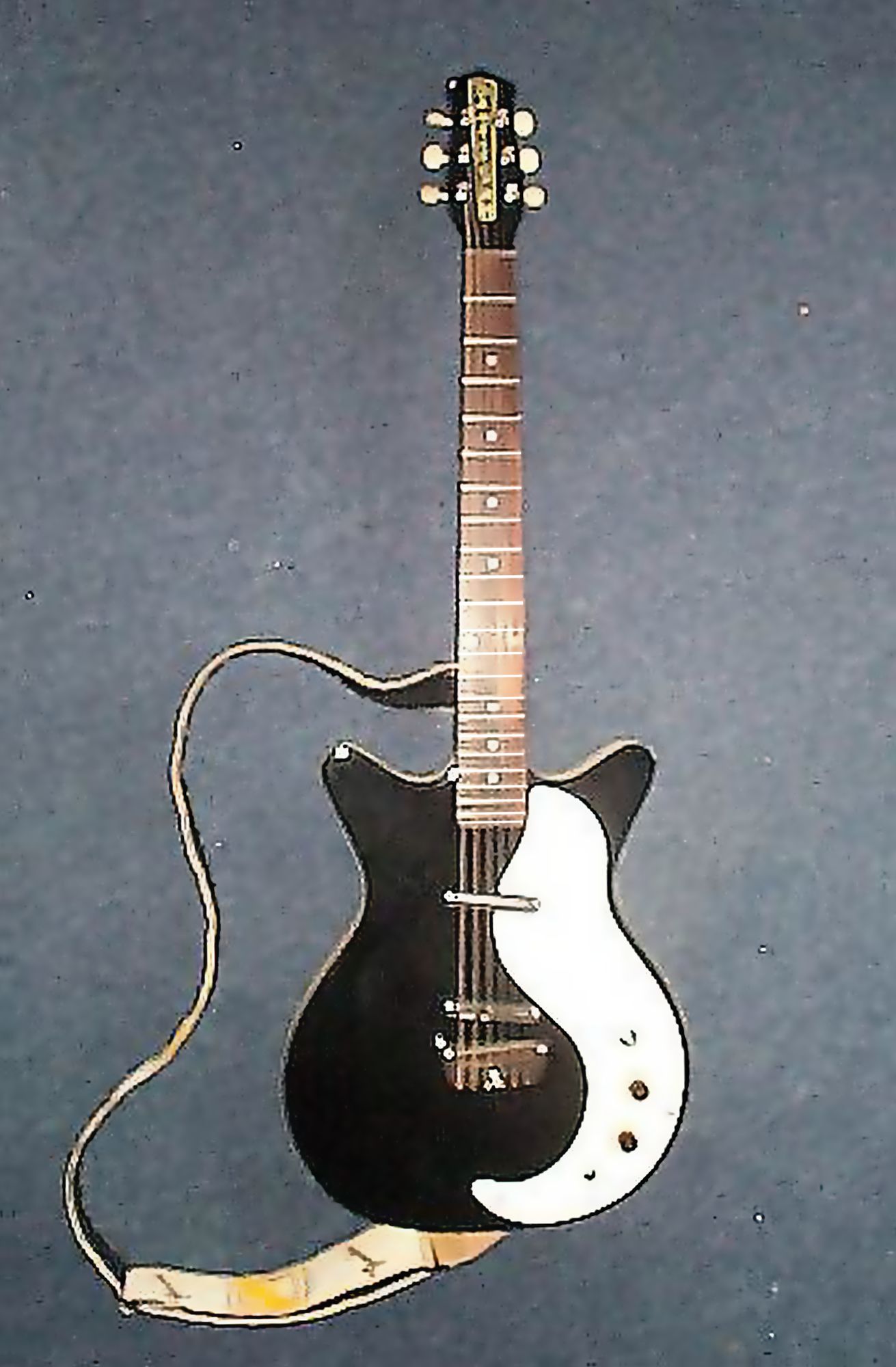
Danelectro 59-DC. Photo by Sander van Malssen. Licensed under CC BY-SA 2.0. Via Wikimedia Commons. Danelectro
59
1958
Jimmy Page’s has been shown at the Met. The same two lipsticks and coke-bottle head are hanging on a shop wall near you.
- Send a picture
Danelectro
Convertible
1959
Danelectro sold it with a pickup or without. The cheap one came with plugs in the knob holes, for later.
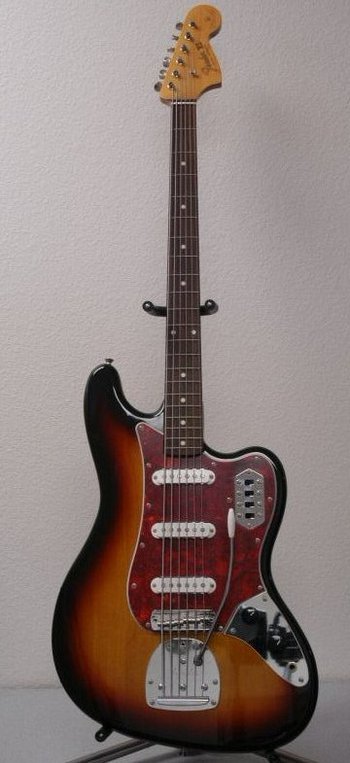
Photo: Blackyde / Wikimedia Commons / CC BY-SA 3.0 Fender
Bass VI
1961
Six strings, an octave down. It’s what a guitar player picks up when somebody hands them the bass part.